
18 to 22 Years
You are entering a new phase in adult life. When adults supported by WRC exit the school system with a certificate of completion or diploma, they can access employment or, in some cases, day programs.

Services for 18 to 22 Years
Services are based on need and must be requested through the Individual Program Plan (IPP) process. Please contact your service coordinator to discuss access to services.
Generic Resources, Private Resources, and/or Natural Supports must be explored prior to WRC funding. Examples include health insurance and other state/county services.
-
Case Management
A (SC) will be assigned to develop an Individual Program Plan (IPP) and assist with arranging appropriate services.
-
Social Recreation Services
WRC offers social recreation services to assist individuals with social interactions and peer relations in a community setting.
-
Personal Assistance Services
Personal Assistance Services are used to assist a person with a disability in completing typical tasks that are necessary for daily living.
-
Behavior Intervention Services
Services are provided by specialists who offer training and instruction to assist families, individuals, and caregivers in developing positive strategies and techniques to manage behaviors. For those families with private insurance and Managed Care, funding of behavior services will be based on current state/federal laws and regulations. See your service coordinator for further funding details.
-
Respite Services
Parents and caregivers can receive intermittent or regularly scheduled non-medical care and supervision to provide relief to family members. Behavior Intervention
-
Co-Pay Assistance
WRC may be able to assist with behavior intervention insurance co-payments, co-insurance, and deductibles (Welfare & Institutions Code 4659.1).
-
Social Skills
These time-limited classes help to improve interpersonal skills, social interactions, and communication. Parent/caregiver participation is required.
-
Westside Family Resource and Empowerment Center (WFREC)
Our parent-run center offers support groups, trainings, community resources, and referrals to . Call 310-258-4063 or visit www.wfrec.org.
-
Conferences
WRC may be able to provide funding for conference registration fees. Ask your Service Coordinator for more information.
-
Education Support Services (ESS)
A referral to an education advocacy can be made for families who need assistance with the Individualized Education Program (IEP) and /or accessing appropriate services through the school districts.
-
Paid Internship Program (PIP)
PIPs helps individuals build job skills and experience through paid internships. The goal is to gain skills for future employment or transition into a paid position at the same job.
-
Tailored & Individualized Services
Tailored services offer individuals opportunities to choose and customize day services to explore post-secondary education, employment, or volunteer activities. Individualized services offer options for those with extensive support needs.
-
Coordinated Family Support (CFS) Services
Coordinated Family Support is available for adults ages 18 and over who choose to live in their family home. CFS assists with developing skills in the home, coordinating services, and helping individuals access their community.
-
Incontinence Supplies
Insurance firstReferrals can be made to assist individuals with securing supplies available through Medi-Cal, private insurance, or through WRC’s vendored providers when no other generic source is available.
-
Family Home Agencies (FHAs)
FHAs provide an option to live with a mentor/family, who will support them in building their independence and achieving their life goals.
-
Medical Equipment
Insurance firstFamilies can access medically necessary equipment through referrals to Medi-Cal, private insurance, or other generic sources such as (CCS).
-
Parenting Skills and Support
For individuals receiving WRC services who are parents, Specialized Parenting Skills agencies offer trained staff to provide support and on-going training for new parents or parentsto-be with information on pregnancy, delivery, and care for a baby.
-
Written Translations and Interpretation
WRC offers written translation services for all documents when the family’s preferred language is not English. Interpretation services for IPP or service planning /review meetings are also available.
-
Transportation
WRC offers various transportation services and supports: mobility training to help individuals use public transportation safely, funding for monthly bus passes or specialized/vendored transportation companies, and help accessing public transit agencies.
-
Adult Post-School Transition
WRC offers adult services for those who have exited the school system, such as Independent Living Services and Supported Living Services, Day Services, Residential Services, and Employment.
-
Driving Lessons/Driver’s Education
Driver’s training may be an option for individuals receiving WRC supports who pass a written driving test and have access to an insured vehicle. The individual or their family will be responsible for the first 15 hours of classes. WRC may assist with funding additional hours.
-
Self-Advocacy Groups
The Consumer Advisory Committee (CAC) hosts self-advocacy groups located in WRC’s service area. Visit westsiderc.org for dates and locations. their families, and communities of choice by facilitating access to , culturally responsive services and resources.
-
Coordinated Career Pathways (CCP) Services
A service designed for individuals exiting work activity programs, subminimum wage settings, or within two years of exiting secondary education to achieve or advance in Competitive Integrated Employment (CIE). Two new services are available through CCP, a Career Pathway Navigator (CPN) and a Customized Employment Specialist (CES). Services are time-limited to 18 months but can be extended to a maximum of 24 months.
-
Crisis Prevention and Support
WRC has a crisis response team to support individuals who are experiencing serious emotional or behavioral concerns.
The Brochure for This Age
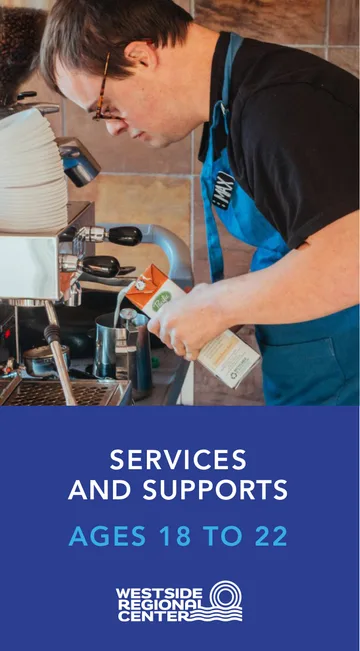
WRC prints the Services and Supports brochure for this age in each of these languages.
Printer-friendly copies
Next Step
New to WRC?
Apply for Age 3 and OlderAlready with WRC?
Call your service coordinator to ask about a service. If you do not know who that is, call (310) 258-4000.
Support Groups Coming Up
Informed Education Partners (IEP) Support Group
Different Thinkers Different Learners
Siempre Amigas Support Group
With Westside Family Resource and Empowerment Center
Level Up: African American/Black Families Support Group
Ethiopian Support Group for Parents of Children who Have Special Needs
Informed Education Partners (IEP) Support Group
Different Thinkers Different Learners
Level Up: African American/Black Families Support Group
Siempre Amigas Support Group
With Westside Family Resource and Empowerment Center
Siempre Amigas Support Group
With Westside Family Resource and Empowerment Center
Siempre Amigas Support Group
With Westside Family Resource and Empowerment Center
Siempre Amigas Support Group
With Westside Family Resource and Empowerment Center
Siempre Amigas Support Group
With Westside Family Resource and Empowerment Center
Siempre Amigas Support Group
With Westside Family Resource and Empowerment Center
Siempre Amigas Support Group
With Westside Family Resource and Empowerment Center
Siempre Amigas Support Group
With Westside Family Resource and Empowerment Center
WRC posts new support groups, trainings and meetings on its calendar each month. Call (310) 258-4000 to ask about the next one.
Intake Process and Eligibility
If you have a developmental concern about yourself or a family member, the Department will be your first contact at Westside Regional Center. CLICK HERE to learn more about our eligibility process.
Online Training Course
Family Welcome Experience
We are thrilled to announce the launch of the brand-new online training course, the Family Welcome Experience, available for Westside Regional Center (WRC). This course contains 5 modules, which you can watch at your own pace. Our goal is to ensure equitable access to information about services that may be available to you and your family, either at WRC or in your local community, and how to obtain those services.
Topics covered in this course include:
- Regional Center services and supports
- Resources available at WRC
- Resources available in your community
- Westside Family Resource and Empowerment Center
- Financial assistance programs
- Housing and rental assistance programs
Each video contains helpful resources that you can download onto your computer or smartphone.
Individuals interested in enrolling in this online course can complete the following form: www.surveymonkey.com/r/FWE-REGISTER
Download the flyer: English PDF, Spanish PDF
Resources for Adults and their Families
Understanding the Diagnosis: A Guide for Families
Developmental disabilities are a group of conditions due to an impairment in physical, learning, language, or behavior areas. These conditions begin during the developmental period, may impact day-to-day functioning, and usually last throughout a person’s lifetime.
Receiving a diagnosis of a developmental disability comes with a lot of information, paperwork, appointments, changes, and feelings. You may have many questions regarding developmental disabilities. As you look for answers, you will encounter information about the various conditions, their causes, and possible treatments. All of this information may make it challenging to organize options and begin to choose a treatment plan that best fits your family.
It is natural to want to identify the single root cause of the diagnosis. Many families may battle with feelings of guilt and/or shame. Please understand that these diagnoses are complex and there may not be a single factor that has been identified as the cause. Know that families and caregivers can be strong advocates and have high expectations of a person/family member with the disability.
Westside Regional Center anticipates supporting you and your family as you proceed from the initial diagnosis to ongoing support services. You are not alone in this process. For additional information about diagnosis, you may contact your service coordinator, WRC’s Staff Psychologist, Kaely Shilakes, Psy.D at 310-258-4157, or click on the following documents below:
| Title | English | Spanish | Farsi |
|---|---|---|---|
| Understanding Autism: A Guide For Families | English PDF | Spanish PDF | Farsi Word |
| Understanding Cerebral Palsy: A Guide For Families | English PDF | Spanish PDF | Farsi Word |
| Understanding Down Syndrome: A Guide For Families | English PDF | Spanish PDF | Farsi Word |
| Understanding Epilepsy: A Guide For Families | English PDF | Spanish PDF | Farsi Word |
| Understanding Intellectual Disability: A Guide For Families | English PDF | Spanish PDF | Farsi Word |
Westside Family Resource & Empowerment Center
The Westside Family Resource and Empowerment Center () is housed within the same building and works in collaboration with the Westside Regional Center, local school districts, and community-based organizations that provide supports and services to children and their families. The WFREC is staffed by experienced parents and family members who are qualified to provide emotional, technical, and informational support to families who have an infant, child, or young adult with a disability, chronic illness, or other health care need.
They offer a variety of support groups where parents have the opportunity to meet and learn from other parents. These groups are designed to provide information, resources, community, and hope. When families share common concerns and experiences, the support can be uniquely meaningful. They also sponsor training and workshops to help families learn how to understand and navigate the often-times complex systems of care in California. Watch their welcome video to learn more.
For more information, please call (310) 258-4063 or visit www.wfrec.org.
WFREC Brochure
Self-Advocacy Groups
Self-advocacy groups strive to empower individuals to become active and influential members of their communities, as well as agents of change concerning their rights and wishes. At self-advocacy meetings, personal rights are discussed and individuals have an opportunity to share their experiences and concerns. Group members learn from each other and gain confidence to stand up for themselves. There are several active self-advocacy groups in the WRC area. Meetings offer a great opportunity for members to make new friends and maintain lasting friendships. Attendance at self-advocacy meetings is encouraged for all individuals served by WRC. Click here for more information.
PMLCA Healthy Lifestyle Change Program
The Healthy Lifestyle Change program is a service for Peer Mentor Lifestyle Coach Agency. The Healthy Lifestyle Change Program is a peer mentoring venture which was established to identify and support adults with disabilities who are at risk for or who have a diagnosis of Type II diabetes as well as supporting people who wish to develop a more healthful lifestyle. The groups meet at the Westside Regional Center located in Culver City. Peer Mentors, fitness and nutrition facilitators support people to incorporate exercise and good nutrition education into their daily routines.
| Name of Group | Activities | Day/ Meeting Time | Contact Information |
|---|---|---|---|
| Healthy Lifestyle Change | Fitness & yoga | Every Tuesday and Thursday of the week 2:00-4:00pm | (424) 702-6023 |
| Healthy Cooking & Eating Class | Nutrition and cooking demonstration | Every Wednesday of the week 3:30-5:00pm | (424) 702-6023 |
Networking and Life Skills Group
- Who comes to this fun group? Anyone who wants to be social and have fun.
- May I bring a friend? Of course. Bring a friend and you will also make friends at the group.
- Is there food? YES. We have tasty refreshments.
- How much does it cost to go? It’s FREE. That’s right, FREE.
- What if I’m looking for a roommate? Attend a “Networking” meeting and one of the peer mentors can assist you.
| Name of Group | Activities | Day/ Meeting Time | Contact Information |
|---|---|---|---|
| Networking and Life Skills Group | Fun Activities, Yummy Snacks, Get Social – Hang out with your Friends and Meet new ones. Participate in Interactive Presentations | 2nd Thursday & 3rd Wednesday of each month 4:30-6:30pm | (424) 703-0728 |
Education Support Services (ESS)
If your child is found for services under the Lanterman Act and you need educational support assistance, please contact the Education Support Services (ESS) unit. The ESS staff provide assistance to clients of Westside Regional Center who are school-age (3 to 22) and pursuing a Free and Appropriate Public Education (FAPE) in their community. ESS staff can review IEP documents and assessment reports, attend IEP meetings, and/or observe the student in the school setting. You may contact the ESS staff directly or request a referral through your service coordinator.
Download the flyer: English PDF, Spanish PDF
- Name
- Barbara Marbach
- Ron Lopez
- Feben Fantu
- Phone
- 310-258-4024
- 310-258-4002
- 310-258-4183
Informed Education Partners (IEP) Support Group – Online
Both the ESS staff and WFREC staff facilitate a monthly bilingual (English, Spanish) support group called the “Informed Education Partners” on the first Thursday of the month from 6:30 PM to 8:30 PM. Call the WFREC at (310) 258-4063 for more information.
Register for a group: English session or Spanish session
Transitioning From High School to Community Life
This section is intended for High School students in the Special Education program, their families, and the professionals that support them. The objective is to prepare students for life after high school: college, employment, living independently, changes in healthcare, and more.
YouTube Series
Series Guide
Booklet
Trainings, Events, and Conferences: At Westside
Westside Regional Center (WRC) sponsors training, conferences, workshops, and events for parents, individuals we serve, service providers, and other professionals within our community. Visit our calendar of events for more information.
Trainings and Conferences: In the Community
WRC encourages individuals with disabilities and family members to be empowered and informed through participation in trainings and conferences offered within the special needs community.
WRC may fund for tuition or conference registration fees up to a maximum of $300 for trainings and/or conferences per year. For adults receiving WRC services, funding may include lodging and/or transportation costs when authorized. Funding for parents or caregivers does not cover the cost of lodging or transportation. Check with your service coordinator or the WFREC to inquire about training and conference opportunities.
Shows what this word means
IFSP (Individual Family Service Plan)
An IFSP is the plan for a baby or toddler in Early Start. It lists your family's goals and the services for your child.
WRC’s definition
Individual Family Service Plan. A written statement completed yearly which lists goals and specific objectives in areas important to the consumer. Each objective contains a target date that the objective is to be met and one or more plans designed to reach the objective.
IPP (Individual Program Plan)
An IPP is a written plan you make with WRC. It lists your goals and the services that help you reach them.
WRC’s definition
Individual Program Plan/Individual Support Plan. A written statement of goals and specific objectives in areas important to the client. Each objective contains one or more plans to achieve it and a target date for completion.
Service coordinator
Your service coordinator is your main contact at WRC. They help plan and arrange the services in your plan.
WRC’s definition
A service coordinator (SC) will be assigned to develop an Individual Program Plan (IPP) and assist with arranging appropriate services.
Medi-Cal
Medi-Cal is California's free or low-cost health insurance program.
WRC’s definition
California’s version of the federal Medicaid Program that pays medical expenses for public assistance recipients and other low-income persons.
Generic resources
Generic resources are help that is open to everyone, like health insurance, Medi-Cal or school services. WRC checks these first.
WRC’s definition
Services offered or available to the general public, as distinguished from specialized services for specific groups of people. For example, training provided by the Department of Rehabilitation is a generic service available to any California resident in need of rehabilitation. In the absence of a generic service, Westside may purchase that service for its clients.
Vendor (service provider)
A vendor is a person or agency WRC has approved and pays to give services.
WRC’s definition
Any community agency or professional that provides services purchased by the regional center for its clients. Also known as a Service Provider.
CCS (California Children's Services)
CCS is a state program for children with certain physical health conditions.
WRC’s definition
California Children’s Services. Provides specialized medical and rehabilitation services for children with physical disabilities with certain conditions. The program is financed by federal, state, and county taxes, and supplemented by family repayments when indicated
Person-centered planning
Person-centered planning starts with what the person wants for their own life.
WRC’s definition
An approach to planning for the future based on the client and family’s wishes and on the client’s abilities and preferences.
Intake
Intake covers the first steps after you call WRC: WRC gathers information and checks whether you can get services.
WRC’s definition
If you have a developmental concern about your child or a family member, the Intake Department will be your first contact at Westside Regional Center.
WFREC (Family Resource and Empowerment Center)
WFREC is a parent-run center with support groups and trainings for families.
WRC’s definition
Our parent-run center offers support groups, trainings, community resources, and referrals to generic resources.
Eligibility
Eligibility is whether a person can get WRC services. WRC decides it after an assessment.
WRC’s definition
The process to determine whether, and to what degree, an individual has developmental deficits. An assessment identifies the individual’s strengths, abilities, needs, and developmental level.