
Municipal Code
Chapter VIII, Health and Welfare
As Adopted and Amended
The text on this page is the City’s chapter as posted. An ordinance passed since may not be set into it yet.
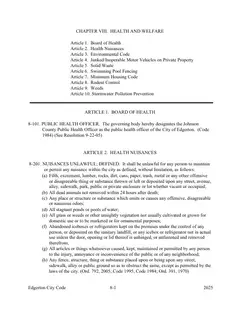
Article 1. Board of Health
Public Health Officer
The governing body hereby designates the Johnson County Public Health Officer as the public health officer of the City of Edgerton.
Article 2. Health Nuisances
Nuisances Unlawful; Defined
It shall be unlawful for any person to maintain or permit any nuisance within the city as defined, without limitation, as follows:
(a)Filth, excrement, lumber, rocks, dirt, cans, paper, trash, metal or any other offensive or disagreeable thing or substance thrown or left or deposited upon any street, avenue, alley, sidewalk, park, public or private enclosure or lot whether vacant or occupied;
(b)All dead animals not removed within 24 hours after death;
(c)Any place or structure or substance which emits or causes any offensive, disagreeable or nauseous odors;
(d)All stagnant ponds or pools of water;
(e)All grass or weeds or other unsightly vegetation not usually cultivated or grown for domestic use or to be marketed or for ornamental purposes;
(f)Abandoned iceboxes or refrigerators kept on the premises under the control of any person, or deposited on the sanitary landfill, or any icebox or refrigerator not in actual use unless the door, opening or lid thereof is unhinged, or unfastened and removed therefrom;
(g)All articles or things whatsoever caused, kept, maintained or permitted by any person to the injury, annoyance or inconvenience of the public or of any neighborhood;
(h)Any fence, structure, thing or substance placed upon or being upon any street, sidewalk, alley or public ground so as to obstruct the same, except as permitted by the laws of the city.
Public Officer
The Governing Body shall designate a public officer to be charged with the administration and enforcement of this Article.
Complaints; Inquiry and Inspection
The public officer shall make inquiry and inspection of premises upon receiving a complaint or complaints in writing signed by two or more persons stating that a nuisance exists and describing the same and where located or is informed that a nuisance may exist by the Public Health Officer, or police or fire personnel. The public officer may make such inquiry and inspection when he or she observes conditions which appear to constitute a nuisance. Upon making any inquiry and inspection the public officer shall make a written report of findings.
Right of Entry
The public officer has the right of access and entry upon private property at any reasonable time for the purpose of making inquiry and inspection to determine if a nuisance exists.
Order of Violation
(a)The governing body or its designee, as hereinafter named, shall serve upon the owner, any agent of the owner of the property or any other person, corporation, partnership or association found by the public officer to be in violation of Section 8-201 an order stating the violation. The order shall be served on the owner or agent of such property by certified mail, return receipt requested, or by personal service. If the property is unoccupied and the owner is a nonresident, then by mailing the order by certified mail, return receipt requested, to the last known address of the owner.
(b)If the owner or the agent of the owner of the property has failed to accept delivery or otherwise failed to effectuate receipt of a notice or order sent pursuant to this section during the preceding twenty-four month period, the governing body of the city may provide notice of the issuance of any further orders to abate or remove a nuisance from such property or provide notice of the order by such methods including, but not limited to, door hangers, conspicuously posting notice of such order on the property, personal notification, telephone communication or first class mail. If the property is unoccupied and the owner is a nonresident, notice provided by this section shall be given by telephone communication or first class mail.
(c)The City Code Enforcement Officer is hereby designated by the governing for the purposes of issuing the order required herein. Such order shall be issued by the City Code Enforcement Officer upon the filing of a written statement of a violation of this Article. The order shall be issued in the name of the governing body; shall be served as required in this Article; and shall, contain all notices and other information as required by this Article and K.S.A. 12-16173, and amendments thereto.
Same; Contents
The order shall state the condition(s) which is (are) in violation of Section 8-201. The notice shall also inform the person, corporation, partnership or association that
(a)He, she or they shall have 10 days from the date of serving the order to abate the condition(s) in violation of Section 8-201; or
(b)He, she or they have 10 days from the date of serving the notice to request a hearing before the governing body of the matter as provided by Section 8-209;
(c)Failure to abate the condition(s) or to request a hearing within the time allowed may result in prosecution as provided by Section 8-207 and/or abatement of the condition(s) by the city as provided by Section 8-208.
Failure to Comply; Penalty
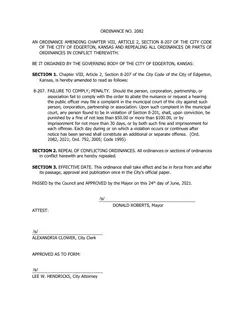
Should the person, corporation, partnership, or association fail to comply with the order to abate the nuisance or request a hearing the public officer may file a complaint in the municipal court of the city against such person, corporation, partnership or association. Upon such complaint in the municipal court, any person found to be in violation of Section 8-201, shall, upon conviction, be punished by a fine of not less than $50.00 or more than $100.00, or by imprisonment for not more than 30 days, or by both such fine and imprisonment for each offense. Each day during or on which a violation occurs or continues after notice has been served shall constitute an additional or separate offense.
Abatement
In addition to, or as an alternative to prosecution as provided in Section 8-207, the public officer may seek to remedy violations of this Article in the following manner. If a person to whom an order has been served pursuant to Section 8-205 has neither alleviated the conditions causing the alleged violation nor requested a hearing before the governing body within the time periods specified in Section 8-206, the public officer may present a resolution to the governing body for adoption authorizing the public officer or other agents of the city to abate the conditions causing the violation at the end of 10 days after passage of the resolution. The resolution shall further provide that the costs incurred by the city shall be charged against the lot or parcel of ground on which the nuisance was located as provided in Section 8-210. A copy of the resolution shall be served upon the person in violation in one of the following ways:
(a)Personal service upon the person in violation;
(b)Certified mail, return receipt requested; or
(c)In the event the whereabouts of such person are unknown and the same cannot be ascertained in the exercise of reasonable diligence, an affidavit to that effect shall be made by the public officer and filed with the city clerk, and the serving of the resolution shall be made by publishing the same once each week for two consecutive weeks in the official city newspaper and by posting a copy of the resolution on the premises where such condition exists.
(d)If the owner or the agent of the owner of the property has failed to accept delivery or otherwise failed to effectuate receipt of a notice or order sent pursuant to this section during the preceding twenty-four month period, the governing body of the city may provide notice of the issuance of any further orders to abate or remove a nuisance from such property or provide notice of the order by such methods including, but not limited to, door hangers, conspicuously posting notice of such order on the property, personal notification, telephone communication or first class mail. If the property is unoccupied and the owner is a nonresident, notice provided by this section shall be given by telephone communication or first class mail.
Hearing
If a hearing is requested within the 10 day period as provided in Section 8-206, such request shall be made in writing to the governing body. Failure to make a timely request for a hearing shall constitute a waiver of the person's right to contest the findings of the public officer before the governing body. The hearing shall be held by the governing body as soon as possible after the filing of the request therefore, and the person shall be advised by the city of the time and place of the hearing at least five days in advance thereof. At any such hearing, the person may be represented by counsel, and the person and the city may introduce such witnesses and evidence as is deemed necessary and proper by the governing body. The hearing need not be conducted according to the formal rules of evidence. Upon conclusion of the hearing, the governing body shall record its determination of the matter by means of adopting a resolution and serving the resolution upon the person in the manner provided in Section 8-208.
Costs Assessed
If the city abates or removes the nuisance pursuant to section 8208, the city shall give notice to the owner or his or her agent by certified mail, return receipt requested, of the total cost of the abatement or removal incurred by the city. The notice shall also state that the payment is due within 30 days following receipt of the notice. The city also may recover the cost of providing notice, including any postage, required by this section. The notice shall also state that if the cost of the removal or abatement is not paid within the 30-day period, the cost of the abatement or removal shall be collected in the manner provided by K.S.A. 12-1,115, and amendments thereto, or shall be assessed as special assessments and charged against the lot or parcel of land on which the nuisance was located and the city clerk, at the time of certifying other city taxes, shall certify the unpaid portion of the costs and the county clerk shall extend the same on the tax rolls of the county against such lot or parcel of land and it shall be collected by the county treasurer and paid to the city as other city taxes are collected and paid. The city may pursue collection both by levying a special assessment and in the manner provided by K.S.A. 12-1,115, and amendments thereto, but only until the full cost and applicable interest has been paid in full.
Article 3. Environmental Code
Title
This Article shall be known as the "Environmental Code."
Legislative Finding of Fact
The governing body has found that there exist within the city unsightly and hazardous conditions due to: dilapidation, deterioration or disrepair of walls, siding, fences or structure exteriors; accumulations increasing the hazards of accidents or other calamities; structural defects; uncleanliness; unsightly stored or parked material, equipment, supplies, machinery, vehicles or parts thereof, and abandonment of tanks, or other storage units. Such conditions are inimical to the general welfare of the community in that they have a blighting influence on the adjoining properties, the neighborhood and the city, or are injurious to the health and safety of the residents of the city, or constitute a threat to the environment, and the health and safety of citizens, because of contamination to air, water, vegetation, and/or soil. The governing body desires to promote the public health, safety and welfare by the repair, removal, abatement, and regulation of such conditions in the manner hereafter provided.
Purpose
The purpose of this Article is to protect, preserve, upgrade, and regulate the environmental quality of industrial, commercial and residential neighborhoods in this city, by outlawing conditions which are injurious to the health, safety, welfare or aesthetic characteristics of the neighborhoods and to provide for the administration and enforcement thereof.
Rules of Construction
For the purpose of this Article, the following rules of construction shall apply:
(a)Any part thereof - Whenever the words premises, structure, building or yard are used they shall be construed as though they were followed by the words "or any part thereof."
(b)Gender - Words of gender shall be construed to mean neuter, feminine or masculine, as may be applicable.
(c)Number - Words of number shall be construed to mean singular or plural, as may be applicable.
(d)Tense - Words of tense shall be construed to mean present or future, as may be applicable.
(e)Shall - The word shall is mandatory and not permissive.
Definitions
The words and phrases listed below when used in this Article shall have the following meanings:
(a)Abandoned Motor Vehicle - any motor vehicle which is not currently registered or tagged pursuant to K.S.A. 8-126 to 8-149 inclusive, as amended; or illegally parked; or incapable of moving under its own power; or in a junked or wrecked condition.
(b)Abandoned Tank or Other Storage Unit – any abandoned tank or other storage unit that has been used for storage of any product that the public officer -- charged with the administration and enforcement of this article -- deems to constitute a threat to the environment, or the health and safety of citizens, because of risk of contamination to air, water, vegetation, and/or soil, or because of risk of explosion or fire. A tank or other storage unit shall be deemed abandoned after it is permanently taken out of service as a storage vessel for any reason, or which has not been used for active storage for a period of more than one year.
(c)Accessory Structure - a secondary structure detached from the principal structure but on the same premises, including, but not limited to, garages, sheds, barns, or outbuildings.
(d)Commercial or Industrial - used or intended to be used primarily for other than residential purposes.
(e)Dilapidation, Deterioration or Disrepair - shall mean any condition characterized by, but not limited to: holes, breaks, rot, decay, crumbling, cracking, peeling or flaking paint, rusting, missing boards, broken doors, broken glass, deterioration of siding, visible damage from fire, wind, lack of maintenance, or other evidence of physical damage, neglect, lack of maintenance, excessive use or weathering.
(f)Exterior - those parts of a structure which are exposed to the weather or subject to contact with the elements; including, but not limited to: sidings, facings, veneers, masonry, roofs, foundations, porches, screens, shutters, windows, doors or signs.
(g)Garbage - without limitation any accumulation of animal, fruit or vegetable waste matter that results from the handling, preparation, cooking, serving, delivering, storage, or use of foodstuffs.
(h)Person - any individual, individuals, corporation, partnership, unincorporated association, other business organization, committee, board, trustee, receiver, agent or other representative who has charge, care, control or responsibility for maintenance of any premises, regardless of status as owner, renter, tenant or lessee, whether or not in possession.
(i)Premises - any lot, plot or parcel of land including the structures thereon. Premises shall also mean any lot, plot or parcel of land without any structures thereon.
(j)Refuse - garbage and trash.
(k)Residential - used or intended to be used primarily for human habitation.
(l)Structure - anything constructed or erected which requires location on the ground or is attached to something having a location on the ground including any appurtenances belonging thereto.
(m)Trash - combustible waste consisting of, but not limited to: papers, cartons, boxes, barrels, wood, excelsior, furniture, bedding, rags, leaves, yard trimmings, or tree branches and non-combustible waste consisting of, but not limited to: metal, tin, cans, glass, crockery, plastics, mineral matter, ashes, clinkers, or street rubbish and sweepings.
(n)Weathered - deterioration caused by exposure to the elements.
(o)Yard - the area of the premises not occupied by any structure.
Public Officer
The governing body shall designate a public officer to be charged with the administration and enforcement of this Article.
Enforcement Standards
No person shall be found in violation of this ordinance unless the public officer, after a reasonable inquiry and inspection of the premises, believes that conditions exist of a quality and appearance not commensurate with the character of the neighborhood. Such belief must be supported by evidence of a level of maintenance significantly below that of the rest of the neighborhood. Such evidence shall include conditions declared unlawful under Section 8-308 but shall not include conditions which are not readily visible from any public place or from any surrounding private property.
Unlawful Acts
It shall be unlawful for any person to allow to exist on any residential, commercial or industrial premises, conditions which are injurious to the health, safety or general welfare of the residents of the community or conditions which are detrimental to adjoining property, the environment, the neighborhood or the city. For the purpose of fair and efficient enforcement and administration, such unlawful conditions shall be classified as follows:
(a)Exterior conditions (yard) shall include, but not be limited to, the scattering over or the parking, leaving, depositing, abandoning, or accumulation on or in the yard of any of the following:
(1)lumber, wire, metal, tires, concrete, masonry products, plastic products, supplies, equipment, machinery, auto parts, junk or refuse; or
(2)abandoned motor vehicles; or
(3)furniture, stoves, refrigerators, televisions, sinks, bicycles, lawn mowers, or other such items of personal property; or
(4)nauseous substances, carcasses of dead animals or places where animals are kept in an offensive manner; or
(5)abandoned tank or other storage unit.
(b)Exterior conditions (structure) shall include, but not be limited to, deteriorated, dilapidated, or unsightly: (1) exteriors of any structure;
(2)exteriors of any accessory structure; or
(3)fences, walls, or retaining walls.
Order of Violation
(a)The governing body or its designee, as hereinafter named, shall serve upon the owner, any agent of the owner of the property or any other person, corporation, partnership or association found by the public officer to be in violation of Section 8-308 an order stating the violation. The order shall be served on the owner or agent of such property by certified mail, return receipt requested, or by personal service. If the property is unoccupied and the owner is a nonresident, then by mailing the order by certified mail, return receipt requested, to the last known address of the owner.
(b)SAME; CONTENTS. The order shall state the condition(s) which is (are) in violation of Section 8-308. The notice shall also inform the person, corporation, partnership or association that:
i.He, she or they shall have 10 days from the date of serving the order to abate the condition(s) in violation of Section 8-308; or
ii.He, she or they, have 10 days from the date of serving the notice to request a hearing before the governing body of the matter as provided by Section 8-312;
iii.Failure to abate the condition(s) or to request a hearing within the time allowed may result in prosecution as provided by Section 8-310 and/or abatement of the condition(s) by the city as provided by Section 8-311.
(c)If the owner or the agent of the owner of the property has failed to accept delivery or otherwise failed to effectuate receipt of a notice or order sent pursuant to this section during the preceding twenty-four month period, the governing body of the city may provide notice of the issuance of any further orders to abate or remove a nuisance from such property or provide notice of the order by such methods including, but not limited to, door hangers, conspicuously posting notice of such order on the property, personal notification, telephone communication or first class mail. If the property is unoccupied and the owner is a nonresident, notice provided by this section shall be given by telephone communication or first-class mail.
(d)The City Code Enforcement Officer is hereby designated by the governing body for the purposes of issuing the order required herein. Such order shall be issued by the City Code Enforcement Officer upon the filing of a written statement of a violation of this Article. The order shall be issued in the name of the governing body; shall be served as required in this Article; and, shall contain all notices and other information as required by this Article; and, shall contain all notices and other information as required by the Article and K.S.A. 1617e, and amendments thereto.
Penalty
The public officer may file a complaint in the municipal court against any person found to be in violation of Section 8-308, provided however, that such person shall first have been sent a notice as provided in Section 8-309 and that the person has neither alleviated the conditions causing the alleged violation nor requested a hearing before the governing body within the time periods specified in Section 8-309. Upon such complaint in the municipal court, any person found to be in violation of Section 8-308 shall upon conviction be punished by a fine of not less than $50 nor more than $100, or by imprisonment, for not more than 30 days, or by both such fine and imprisonment, for each offense. For the purposes of this ordinance, a separate offense shall be deemed committed on each day during or on which such violation is permitted to exist.
Abatement
In addition to, or as an alternative to prosecution as provided in Section 8-310, the public officer may seek to remedy violations of this Article in the following manner. If a person to whom an order has been served pursuant to Section 8-309 has neither alleviated the conditions causing the alleged violation nor requested a hearing before the governing body within the time periods specified in Section 8-309, the public officer may present a resolution to the governing body for adoption authorizing the public officer or other agents of the city to abate the conditions causing the violation at the end of 10 days after passage of the resolution. The resolution shall further provide that the costs incurred by the city shall be charged against the lot or parcel of ground on which the nuisance was located as provided in Section 8-314. A copy of the resolution shall be served upon the person in violation in one of the following ways:
(a)Personal service upon the person in violation;
(b)Certified mail, return receipt requested; or
(c)In the event the whereabouts of such person are unknown and the same cannot be ascertained in the exercise of reasonable diligence, an affidavit to that effect shall be made by the public officer and filed with the city clerk, and the serving of the resolution shall be made by publishing the same once each week for two consecutive weeks in the official city newspaper and by posting a copy of the resolution on the premises where such condition exists.
(d)If the owner or the agent of the owner of the property has failed to accept delivery or otherwise failed to effectuate receipt of a notice or order sent pursuant to this section during the preceding twenty-four month period, the governing body of the city may provide notice of the issuance of any further orders to abate or remove a nuisance from such property or provide notice of the order by such methods including, but not limited to, door hangers, conspicuously posting notice of such order on the property, personal notification, telephone communication or first class mail. If the property is unoccupied and the owner is a nonresident, notice provided by this section shall be given by telephone communication or first class mail.
Hearing Before Governing Body
If a hearing is requested within the 10 day period as provided in Section 8-309 such request shall be made in writing to the governing body. Failure to make a timely request for a hearing shall constitute a waiver of the person's right to contest the findings of the public officer before the governing body. The hearing shall be held by the governing body as soon as possible after the filing of the request therefor, and the person shall be advised by the city of the time and place of the hearing at least five days in advance thereof. At any such hearing, the person may be represented by counsel, and the person and the city may introduce such witnesses and evidence as is deemed necessary and proper by the governing body. The hearing need not be conducted according to the formal rules of evidence. Upon conclusion of the hearing, the governing body shall record its determination of the matter by means of adopting a resolution and serving the resolution upon the person in the manner provided in Section 8-311.
Appeals
Any person affected by any determination of the governing body under Sections 8-311 or 8-312 may appeal such determination in the manner provided by K.S.A. 60-2101.
Costs Assessed
If the city abates or removes the nuisance pursuant to section 8311, the city shall give notice to the owner or his or her agent by certified mail, return receipt requested, of the total cost of the abatement or removal incurred by the city. The notice shall also state that the payment is due within 30 days following receipt of the notice. The city also may recover the cost of providing notice, including any postage, required by this section. The notice shall also state that if the cost of the removal or abatement is not paid within the 30-day period, the cost of the abatement or removal shall be collected in the manner provided by K.S.A. 12-1,115, and amendments thereto, or shall be assessed as special assessments and charged against the lot or parcel of land on which the nuisance was located and the city clerk, at the time of certifying other city taxes, shall certify the unpaid portion of the costs and the county clerk shall extend the same on the tax rolls of the county against such lot or parcel of land and it shall be collected by the county treasurer and paid to the city as other city taxes are collected and paid. The city may pursue collection both by levying a special assessment and in the manner provided by K.S.A. 12-1,115, and amendments thereto, but only until the full cost and applicable interest has been paid in full.
Construction
Nothing in this Article shall be construed to abrogate or impair the powers of the courts or of any department of the city to enforce any provisions of its laws nor to prevent or punish violations thereof. The powers conferred by this ordinance shall be in addition to and supplemental to the powers conferred by the Kansas Constitution, by any other law or by ordinance.
Article 4. Junked/Inoperable Motor Vehicles on Private Property
Findings of Governing Body
The governing body finds that junked, wrecked, dismantled, inoperative or abandoned vehicles, recreational vehicles, trailers, truck campers, jet skis and boats affect the health, safety and general welfare of citizens of the city because they:
(a)Serve as a breeding ground for flies, mosquitoes, rats and other insects and rodents;
(b)Are a danger to persons, particularly children, because of broken glass, sharp metal protrusions, insecure mounting on blocks, jacks or other supports;
(c)Are a ready source of fire and explosion;
(d)Encourage pilfering and theft;
(e)Constitute a blighting influence upon the area in which they are located;
(f)Constitute a fire hazard because they frequently block access for fire equipment to adjacent buildings and structures.
Definitions
As used in this Article, unless the context clearly indicates otherwise:
(a)Inoperable - means a condition of being junked, wrecked, wholly or partially dismantled, discarded, abandoned or unable to perform the function or purpose for which it was originally constructed.
(b)Vehicle - means, without limitation, any automobile, truck, tractor or motorcycle which as originally built contained an engine, regardless of whether it contains an engine at any other time.
(c)Recreational Vehicle – means a vehicular-type unit built on or for use on a chassis and designed primarily as living quarters for recreational, camping, vacation or travel use, and which has its own motive power or is mounted on or drawn by another vehicle.
(d)Trailer – means every vehicle without motive power or an engine designed to be towed behind a motor vehicle.
(e)Truck Camper – means any structure designed, used or maintained primarily to be loaded on or affixed to a motor vehicle to provide a mobile dwelling, sleeping place, office or commercial space.
(f)The term Motor Vehicle as used in this Article shall include vehicles, recreational vehicles, trailers, truck campers, jet skis and boats.
Nuisances Unlawful; Defined; Exceptions
It shall be unlawful for any person to maintain or permit any motor vehicle nuisance within the city.
(a)A motor vehicle nuisance is any motor vehicle which is not currently registered or tagged pursuant to K.S.A. 8-126 to 8-149 inclusive, as amended; or parked in violation of city ordinance; or incapable of moving under its own power; or in a junked, wrecked or inoperable condition. Any one of the following conditions shall raise the presumption that a vehicle is junked, wrecked or inoperable;
(1)Absence of a current registration plate upon the vehicle;
(2)Placement of the vehicle or parts thereof upon jacks, blocks, or other supports;
(3)Absence of one or more parts of the vehicle necessary for the lawful operation of the vehicle upon street or highway.
(4)The provisions of this article shall not apply to any motor vehicle which is enclosed in a garage or other building.
Public Officer
The governing body shall designate a public officer to be charged with the administration and enforcement of this article.
Complaints; Inquiry and Inspection
The public officer may make inquiry and inspection of premises when he or she observes conditions which appear to constitute a nuisance or is informed that a nuisance may exist by the board of health, or police or fire personnel. The public officer may additionally make such inquiry and inspection upon receipt of a complaint stating that a nuisance exists.
Right of Entry
The public officer has the right of access and entry upon private property at any reasonable time for the purpose of making inquiry and inspection to determine if a nuisance exists.
Order of Violation
(a)The governing body or its designee, shall serve upon the owner, any agent of the owner of the property or any other person, corporation, partnership or association found by the public officer to be in violation of Section 8-403 an order stating the violation. The order shall be served on the owner or agent of such property by certified mail, return receipt requested, or by personal service. If the property is unoccupied and the owner is a nonresident, then by mailing the order by certified mail, return receipt requested, to the last known address of the owner.
(b)If the owner or the agent of the owner of the property has failed to accept delivery or otherwise failed to effectuate receipt of a notice or order sent pursuant to this section during the preceding twenty-four month period, the governing body of the city may provide notice of the issuance of any further orders to abate or remove a nuisance from such property or provide notice of the order by such methods including, but not limited to, door hangers, conspicuously posting notice of such order on the property, personal notification, telephone communication or first class mail. If the property is unoccupied and the owner is a nonresident, notice provided by this section shall be given by telephone communication or first-class mail.
(c)The City Code Enforcement Officer is hereby designated by the governing body for the purposes of issuing the order required herein. Such order shall be issued by the City Code Enforcement Officer upon the filing of a written statement of a violation of this Article. The order shall be issued in the name of the governing body; shall be served as required in this Article; and, shall contain all notices and other information as required by this Article and K.S.A. 12-1617e, and amendments thereto.
Same; Contents
The order shall state the condition(s) which is (are) in violation of Section 8-403. The notice shall also inform the person, corporation, partnership or association that:
(a)He, she or they shall have 10 days from the date of service of the notice to abate the condition(s) in violation of Section 8-403; or
(b)He, she or they have 10 days from the date of service of the notice to request a hearing before the governing body or the city attorney as its designated representative of the matter as provided by Section 8-412;
(c)Failure to abate the condition(s) or to request a hearing within the time allowed may result in prosecution as provided by Section 8-407 and/or abatement of the condition(s) by the city as provided by Section 8-410.
Failure to Comply; Penalty
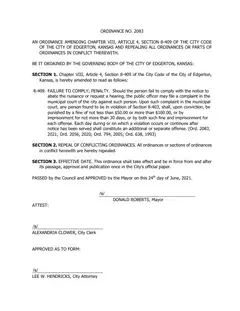
Should the person fail to comply with the notice to abate the nuisance or request a hearing, the public officer may file a complaint in the municipal court of the city against such person. Upon such complaint in the municipal court, any person found to be in violation of Section 8-403, shall, upon conviction, be punished by a fine of not less than $50.00 or more than $100.00, or by imprisonment for not more than 30 days, or by both such fine and imprisonment for each offense. Each day during or on which a violation occurs or continues after notice has been served shall constitute an additional or separate offense.
Abatement
In addition to, or as an alternative to prosecution as provided in Section 8-409, the public officer may seek to remedy violations of this Article in the following manner: If a person to whom a notice has been sent pursuant to Section 8-407 has neither alleviated the condition(s) causing the alleged violation or requested a hearing before the governing body or the city attorney as its designated representative within the time period specified in Section 8-408, the public officer may present a resolution to the governing body for adoption authorizing the public officer or other agents of the city to abate the conditions causing the violation at the end of ten (10) days after passage of the resolution. The resolution shall further provide that the costs incurred by the city shall be charged against the lot or parcel of ground on which the nuisance was located as provided in Section 8-413. A copy of the resolution shall be served upon the person in violation in one of the following ways:
(a)Personal service upon the person in violation;
(b)Service by certified mail, return receipt requested; or
(c)In the event the whereabouts of such person are unknown and the same cannot be ascertained in the exercise of reasonable diligence, an affidavit to that effect shall be made by the public officer and filed with the City Clerk, and the serving of the resolution shall be made by publishing the same once each week for two consecutive weeks in the official city newspaper and by posting a copy of the resolution on the premises where such condition exists.
(d)If the owner or the agent of the owner of the property has failed to accept delivery or otherwise failed to effectuate receipt of a notice or order sent pursuant to this Section during the preceding twenty-four month period, the governing body of the city may provide notice of the issuance of any further orders to abate or remove a nuisance from such property or provide notice of the order by such methods including, but not limited to, door hangers, conspicuously posting notice of such order on the property, personal notification, telephone communication or first class mail. If the property is unoccupied and the owner is a nonresident, notice provided by this section shall be given by telephone communication or first-class mail.
Disposition of Motor Vehicle; Recovery of Motor Vehicle
Disposition of any motor vehicle removed and abated from private property pursuant to this ordinance shall be as provided by K.S.A. Supp. 8-1102, as amended.
(b)Any person attempting to recover a motor vehicle impounded as provided in this article, shall show proof of valid registration and ownership of the motor vehicle before the motor vehicle shall be released. In addition, the person desiring the release of the motor vehicle shall pay all reasonable costs associated with the impoundment of the motor vehicle, including transportation and storage fees, prior to the release of the motor vehicle.
Hearing
If a hearing is requested within the ten (10) day period as provided in Section 8-408, such request shall be made in writing to the City Clerk. Failure to make a timely request for a hearing shall constitute a waiver of the person's right to contest the findings of the public officer. The hearing shall be held by the governing body or the city attorney as its designated representative as soon as possible after the filing of the request therefore, and the person shall be advised by the city of the time and place of the hearing at least five days in advance thereof. At any such hearing, the person may be represented by counsel, and the person and the city may introduce such witnesses and evidence as is deemed necessary and proper by the governing body or the city attorney as its designated representative. The hearing need not be conducted according to the formal rules of evidence. Upon conclusion of the hearing, the findings of the governing body or the city attorney as its designated representative shall be prepared in resolution form, adopted by the governing body, and the resolution shall be served upon the person in the matter provided in Section 8-410.
Costs Assessed
If the city abates or removes the nuisance pursuant to Section 8-410, the city shall give notice to the owner or his or her agent by certified mail, return receipt requested, of the total cost of the abatement or removal incurred by the city. The notice shall also state that the payment is due within 30 days following receipt of the notice. The city also may recover the cost of providing notice, including any postage, required by this section. The notice shall also state that if the cost of the removal or abatement is not paid within the 30-day period, the cost of the abatement or removal shall be collected in the manner provided by K.S.A. 12-1,115, and amendments thereto, or shall be assessed as special assessments and charged against the lot or parcel of land on which the nuisance was located and the City Clerk, at the time of certifying other city taxes, shall certify the unpaid portion of the costs and the county clerk shall extend the same on the tax rolls of the county against such lot or parcel of land and it shall be collected by the county treasurer and paid to the city as other city taxes are collected and paid. The city may pursue collection both by levying a special assessment and in the manner provided by K.S.A. 12-1,115, and amendments thereto, but only until the full cost and applicable interest has been paid in full.
Restoration Permit
Upon written application and approval by the city council, an applicant may receive a permit to park or store an inoperable motor vehicle actively used for vehicle restoration. The permit shall be valid for a period of three (3) months and shall be issued when an applicant demonstrates sufficient proof that the inoperable vehicle is actively being used for vehicle restoration. It shall be up to the city council discretion whether the current restoration permit may be extended for an additional three (3) month period. A written application shall be submitted to the City Clerk with a restoration permit fee as established by the City of Edgerton Fee Resolution. At no time may any vehicle parts be stored outside, and the vehicle shall not be allowed to become a public health nuisance or eyesore. If the vehicle is not fully operable upon expiration of the permit, the vehicle shall be removed by the City.
Article 5. Solid Waste
Definitions
Unless the context clearly indicates otherwise, the meaning of words and terms as used in this ordinance shall be as follows:
(a)Bulk Container. Any container used for garbage or refuse disposal with a capacity larger than ninety-five (95) gallons.
(b)Dwelling Unit. Any enclosure, building, trailer or portion thereof occupied by one or more persons for and as living quarters;
(c)Garbage. Waste resulting from the handling, processing, storage, packaging, preparation, sale, cooking and serving of meat, produce and other foods and shall include unclean containers;
(d)Multi-Family Unit. Any structure containing two or more individual dwelling units;
(e)Recyclables. Any waste materials that are capable of being recycled and Johnson County, Kansas has mandated cities within Johnson County to provide for curb-side collection of the same;
(f)Refuse. All garbage and/or rubbish or trash;
(g)Rubbish or Trash. All non-putrescible materials such as paper, tin cans, bottles, glass, crockery, rags, ashes, lawn and tree trimmings, stumps, boxes, wood, street sweepings and mineral refuse. Rubbish or trash shall not include earth and waste from building operations or wastes from industrial processes or manufacturing operations;
(h)Solid Waste. All non-liquid garbage, rubbish or trash.
Required
All dwelling units within the city limits shall have solid waste trash service provided by the city or by a contractor retained by the city for such service except the following dwelling units shall be exempt from such requirement: (a) multi-family units that are served by a bulk container on the date that this Article 5 takes effect but such exemption shall only apply for as long as a bulk container is so used; or (b) a dwelling unit whose occupant owns a properly licensed business within the city which utilizes a bulk container and city staff has approved an exemption for the dwelling unit.
Collection
All solid waste accumulated at a dwelling unit within the city shall be collected, conveyed and disposed of by the city or a contractor specifically retained and authorized by the city to collect and dispose of such solid waste.
Contracts
The city shall have the right to enter into a contract with any responsible person or business for collection and disposal of solid waste from dwelling units within the city.
Duty of Owner, Occupant
The owner or occupant of every dwelling unit required to use the city’s trash service shall store solid waste in a container provided by the city’s contractor. No owner or occupant of dwelling units shall permit to accumulate quantities of refuse or other waste materials within or close to any structure within the city unless the same is stored in approved containers and in such a manner as not to create a health or fire hazard.
Containers
The city’s contractor shall provide to each dwelling unit within the city required to use the city’s trash service as set forth in section 8-502containers for ordinarily accumulated solid waste at such dwelling unit during the intervals between collections made by the city’s contractor. Each numbered containers will be assigned to that dwelling unit and remain at that dwelling unit unless removed by the city or its contractor. Additional containers may be obtained from the city’s contractor at an additional cost to the dwelling unit. All garbage shall be drained of all liquids before being placed in containers. The containers shall be placed along the appropriate street or alley for the collection at the time appointed for collection, and such containers shall be placed away from any obstacles, such as vehicles, mailboxes, etc., that interfere with the pickup of the containers. Except for tree trimmings, yard waste, or bulky items such as furniture or appliances, it shall be unlawful for any garbage, refuse., or recyclables to be placed out for collection that is not contained within a container issued by the city’s contactor except that additional garbage and refuse may be placed for pickup in a plastic bag, not to exceed 35-gallons in a capacity or 45 pounds in weight, with a sticker purchased through the city or directly from the city’s contactor. Up to 10 extra bags of garbage and refuse need not be stickered for the scheduled trash day immediately following Memorial Day and Christmas. Additional recyclables may be placed for pickup throughout the year in a cardboard box or plastic waste container that is clearly marked “Recycling.” Plastic bags, when used, shall be securely closed. All garbage shall be drained of all liquids before being placed in bags or containers.
Same; Location
No person, firm or corporation shall place or store any solid waste, grass clippings, tree limbs or solid waste containers at any place in front of the building setback line or existing building line in a residentially zoned area, except between the hours of 7:00 pm on the day before collection and 7:00 pm on the day of collection. All solid waste containers shall be placed at or near the street curb for collection, but shall not be placed in any street right-of-way.
Bulk Containers
On premises where excessive amounts of refuse accumulates or where cans or bags are impractical, bulk containers for the storage of refuse may be used. Containers shall have a capacity greater than ninety-five (95) gallons and shall be equipped with appurtenances for attaching mechanical lifting devices which are compatible with the collection equipment being used. Containers shall be constructed of durable rust and corrosion resistant material which is easy to clean. All containers shall be equipped with tight fitting lids or doors to prevent entrance of insects or rodents. Doors and lids shall be constructed and maintained so they can be easily opened. Containers shall be watertight, leak proof and weather proof construction.
Screening Requirement
All residential land uses containing multiple dwellings and all commercial and industrial land uses shall furnish enclosure and screening methods as provided in this section. Trash receptacles shall be screened from public view on at least three sides with a solid fence enclosure constructed of cedar, redwood, masonry, or other compatible building material and shall be made accessible for collecting trash. The fence required by this section shall be at least six feet in height and at least one foot higher than the height of the receptacle to be screened.
Enter Private Premises
Solid waste collectors, employed by the city or operating under contract with the city, are hereby authorized to enter in and upon private property for the purpose of collecting solid waste therefrom as required by this Article.
Ownership of Solid Waste
Ownership of solid waste when placed for pickup or in containers by the occupants or owners of the dwelling units upon which refuse accumulates, shall be vested in the city and thereafter shall be subject to the exclusive control of the city, its employees or contractors. No person shall meddle with refuse containers or in any way pilfer or scatter contents therof in any alley or street within the city.
Wrapping Garbage
All garbage shall be drained of all excess liquid, and wrapped in paper or other disposable container before being placed in solid waste containers.
Heavy, Bulky Waste
Heavy accumulations such as brush, tree limbs, broken concrete, sand or gravel, automobile frames, dead trees, and other bulky, heavy materials shall be disposed of at the expense of the owner or person controlling same. Yard waste will be collected on a once per week basis. All yard waste must be set out in either biodegradable paper or cornstarch based bags, in containers marked as Compost or Yard Waste, or in bundles tied with biodegradable twine or string that do not exceed four feet in length and 18 inches in diameter. The combined total for bags, containers, or bundles shall not exceed eight n number, and no bag, container, or bundle shall exceed 65 pounds. For the months of March, April, August, September, October, and November, the combined limit of bags, containers and bundles shall be enlarged to 12 per pickup. Each resident is allowed one individual bulky item (e.g. furniture or appliances0 per week to be picked up at no additional charge, but such pickup must be scheduled with the city’s contractor three business days in advance of the pickup. Charges will apply to any additional bulky item pickups.
Hazardous Materials
No person shall deposit in a solid waste container or otherwise offer for collection any hazardous garbage, refuse, or waste. Hazardous material shall include: (a) Explosive materials;
(b)Rags or other waste soaked in volatile and flammable materials;
(c)Chemicals;
(d)Poisons;
(e)Radio-active materials;
(f)Highly combustible materials;
(g)Soiled dressings, clothing, bedding and/or other wastes, contaminated by infection or contagious disease;
(h)Any other materials which may present a special hazard to collection or disposal personnel, equipment, or to the public.
Prohibited Practices; Remedies
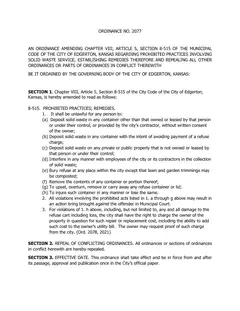
1.It shall be unlawful for any person to:
(a)Deposit solid waste in any container other than that owned or leased by that person or under their control, or provided by the city’s contractor, without written consent of the owner;
(b)Deposit solid waste in any container with the intent of avoiding payment of a refuse charge;
(c)Deposit solid waste on any private or public property that is not owned or leased by that person or under their control;
(d)Interfere in any manner with employees of the city or its contractors in the collection of solid waste;
(e)Bury refuse at any place within the city except that lawn and garden trimmings may be composted;
(f)Remove the contents of any container or portion thereof;
(g)To upset, overturn, remove or carry away any refuse container or lid;
(h)To injure such container in any manner or lose the same.
2.All violations involving the prohibited acts listed in 1. a through g above may result in an action bring brought against the offender in Municipal Court.
3.For violations of 1. h above, including, but not limited to, any and all damage to the refuse cart including loss, the city shall have the right to charge the owner of the property in question for such repair or replacement cost, including the ability to add such cost to the owner’s utility bill. The owner may request proof of such charge from the city.
Open Burning Unlawful
It shall be unlawful for any person, firm, corporation, or other entity, including their agents or employees, to burn, permit or cause to be burned any garbage or refuse or any other heavy smoke producing or combustible materials out of doors at any location within the city limits.
Same; Exceptions
It shall be lawful to burn in an incinerator or other lawful burning receptacle, tree limbs of less than four feet in length and ten inches in circumference, grass clippings and leaves. All burning herein permitted shall occur no earlier than thirty minutes after sunrise and no more than thirty minutes before sunset. All fires permitted hereunder shall, at all times, be in the presence of an adult who shall undertake to supervise the same. All materials permitted to be burned herein shall not contain any material not otherwise permitted to be burned including, but not limited to, heavy smoke producing material or animal carcasses.
Objectionable Waste
Manure from cow lots, stables, poultry yards, pigeon lofts and other animal or fowl pens, and waste oils from garages or filling stations shall be removed and disposed of at the expense of the person controlling the same and in a manner consistent with this ordinance.
Private Collectors
It shall be unlawful for any private collector company, except a contractor under contract with the city, to collect or transport any solid waste from a dwelling unit (unless exempted by Section 8-502) within the city.
Rules and Regulations
The collection and transportation of trash and waste materials shall be at all times under the general supervision of the mayor or his or her duly authorized agent, who shall have the authority by and with the consent of the governing body to make additional rules and regulations not inconsistent with the terms and provisions of this ordinance requiring that the collection and transportation of trash and waste materials shall be conducted in such manner as not to endanger the public health, or to become an annoyance to the inhabitants of the city, and providing for a proper fee to be charged to the customer.
Charges
The City of Edgerton shall establish by the annual Fee Resolution a charge for the cost and maintenance of the collection and disposition of solid waste within the City. All owners or occupants of dwelling units within the City (unless exempted by Section 8-502) shall be required to pay for such solid waste service.
Billing
Solid waste charges shall be billed monthly and shall be included on water or utility bills. No payment shall be accepted on utility bills except for the full amount billed for all services. Delinquent solid waste bills shall carry the due dates, grace periods and penalties as water bills.
Same; Delinquent Account
In the event the owner or occupant of any dwelling unit required to pay for city refuse service shall fail to pay the solid waste bills within sixty (60) days following the date upon which it becomes due, the city clerk shall annually certify such unpaid bills to the county clerk as a lien upon the property, or may pursue such other collection efforts as permitted by law. The lien shall be collected subject to the same regulations and penalties as other property taxes are collected.
Penalty
Any person, firm or corporation violating any of the provisions of this article, shall upon conviction thereof, be fined not more than $100 and each single and separate violation of this article shall be deemed a separate offense thus allowing a consequent new and separate fine of not more than $100 for each separate offense.
Article 6. Swimming Pool Fencing
Definitions
(a)Fence: A structure or barrier, constructed of wooden or metal parts, rails, boards, wire mesh, etc., and used to define and enclose a specific area for the purpose of protection, privacy or confinement.
(b)Wall: A masonry, wooden or synthetic structure used as an enclosure or boundary marker.
Enclosure of Pools, Jacuzzis and Hot Tubs
(a)All swimming pools, Jacuzzis and hot tubs shall be enclosed by a fence or wall.
(b)Fences or walls around all pools, jacuzzis or hot tubs shall not be less than four (4) feet, nor more than six (6) feet, in height and shall have a self-latching gate.
Article 7. Minimum Housing Code
Title
This article shall be known as the “Minimum Standard for Housing and Premises Code,” and will be referred to herein as “this code.”
General
Buildings used in whole or in part as a home or residence of a single family or person and every building used in whole or in part as a home or residence of two or more persons or families living in separate apartments and all premises, either residential or non-residential, shall conform to the requirements of this code.
Declaration of Policy
The governing body declares the purpose of this code is to protect, preserve, and promote the physical and mental health of the people, including the general appearance of privately and publicly-owned structures or dwellings, and all other premises for the purpose of sanitation and public health:
(a)Establishes minimum standards for basic equipment and facilities for light, ventilation and heating, for safety from fire, for the use and location and amount of space for human occupancy, and for safe and sanitary maintenance;
(b)Establishes standards concerning unsightly and blighted buildings and premises, both residential and non-residential structures.
(c)Determines the responsibilities of owners, operators and occupants.
(d)Provides for the administration and enforcement thereof.
Definitions
The following definitions shall apply to the enforcement of this code:
(a)Basement shall mean a portion of a building located partly underground but having less than half its clear floor-to-ceiling height below the average grade of the adjoining ground.
(b)Cellar shall mean a portion of a building located partly or wholly underground and having half or more than half of its clear floor-to-ceiling height below the average grade of the adjoining ground.
(c)Dwelling shall mean any building which is wholly or partly used or intended to be used for living or sleeping by human occupants; provided, that temporary housing hereinafter defined shall not be regarded as a dwelling.
(d)Dwelling Unit shall mean any room or group of rooms located within a dwelling and forming a single habitable unit with facilities which are used, or intended to be used for living, sleeping, cooking and eating.
(e)Habitable Dwelling shall mean any structure or part thereof that shall be used as a home or place of abode by one or more persons.
(f)Habitable Room shall mean a room designed to be used for living, sleeping, eating or cooking purposes, excluding bathrooms, toilet rooms, closets, hall and storage places, or other similar places, not used by persons for extended periods.
(g)Infestation shall mean the presence, within or around a dwelling, of insects, rodents, or other pests.
(h)Multiple Dwelling shall mean any dwelling containing more than two dwelling units.
(i)Occupant shall mean any person, living, sleeping, cooking, or eating in, or having actual possession of, a dwelling unit or rooming unit.
(j)Operator shall mean any person who has charge, care, owns, or has control of a premise or of a building or structure or part thereof, in which dwelling units or rooming units are let.
(k)Owner shall mean any person, firm, or corporation, who jointly or severally along with others, shall be in actual possession of, or have charge, care and control of any structure or dwelling unit or premises within the city as owner, employee, or agent of the owner, or as trustee or guardian of the estate or person of the title holder, and such person shall be deemed and taken to be the owner or owner of such property within the true intent and meaning of this code and shall be bound to comply with the provisions of this article to the same extent as the record owner and notice to any such person shall be deemed and taken to be a good and sufficient notice as if such person or persons were actually the record owner or owner of such property.
(l)Person shall mean and include any individual, firm, corporation, association or partnership.
(m)Plumbing shall mean and include all of the following supplied facilities and equipment: gas or fuel burning equipment, water pipes, garbage disposal units, waste pipes, water closets, sinks, installed dishwashers, lavatories, bathtubs, shower baths, installed clothes-washing machines, catch basins, drains, vents and any other similar supplied fixtures, together with all connections to water, sewer, gas or fuel lines.
(n)Premise shall mean any lot or land area, either residential or non-residential, not covered by a structure and which is subject to a city tax in part or in whole.
(o)Public Officer shall mean the Code Enforcement Officer or his/her designee (s).
(p)Rooming House shall mean any dwelling, or that part of a dwelling containing one or more rooming units in which space is let by the owner or operator to three or more persons who are not husband and wife, son or daughter, mother or father, or sister or brother of the owner or operator.
(q)Rooming Unit shall mean any room or group of rooms forming a single habitable unit used or intended to be used for living and sleeping, but not for cooking or eating purposes.
(r)Refuse. For the purpose of this article refuse shall include garbage, and trash.
(1)Garbage shall mean any accumulation of animal, fruit or vegetable waste matter that attends the preparation of, use of, cooking of, delivering of, or storage of meats, fish, fowl, fruit or vegetable.
(2)Trash (Combustible). For the purpose of this article combustible trash shall mean waste consisting of papers, cartons, boxes, barrels, wood and excelsior, tree branches, yard trimmings, wood furniture, bedding and leaves, or any other combustible materials.
(3)Trash (Non-Combustible) For the purpose of this article non-combustible trash shall mean waste consisting of metals, tin cans, glass, crockery, other mineral refuse and ashes and street rubbish and sweepings, dirt, sand, concrete scrap, or any other non-combustible material.
(s)Structure shall mean anything constructed or erected on the ground or attached to something having a location on the ground.
(t)Supplied shall mean paid for, furnished, or provided by or under the control of, the owner or operator.
(u)Temporary Housing shall mean any tent, trailer, recreational vehicle or other temporary or mobile structure used for human shelter which is designed to be transportable and which is not attached to the ground, house or building or another structure, or to any utilities system on the same premises for more than 30 consecutive days, except when located in a mobile home court duly licensed under laws of the city.
(v)Words – Meanings. Whenever the words “dwelling,” “dwelling unit,” “rooming house,” “rooming unit,” “premises,” are used in this ordinance, they shall be construed as though they were followed by the words “or any part thereof.”
Duty of Occupant or Owner or Occupied or Unoccupied Building and Its Premises or Vacant Premises
(a)It shall be the duty of the owner of every occupied or unoccupied dwelling, building and premises or vacant premise, including all yards, lawns and courts to keep such property clean and free from any accumulation of filth, rubbish, garbage, or any similar matter as covered by sections 8-708 and 8-709).
(b)It shall be the duty of each occupant of a dwelling unit to keep in clean condition the portion of the property which he or she occupies and of which he or she has exclusive control, to comply with the rules and regulations, to place all garbage and refuse in proper containers. Where care of the premise is not the responsibility of the occupant then the owner is responsible for violations of this code applicable to the premises.
(c)If receptacles are not provided by the owner, then the occupant shall provide receptacles as may be necessary to contain all garbage and trash.
(d)Every occupant of a dwelling containing a single dwelling unit shall be responsible for the extermination of any insects, rodents or other pests therein or on the premises; and every occupant of a dwelling unit in a dwelling containing more than one dwelling unit shall be responsible for such extermination whenever his or her dwelling unit is the unit primarily infested.
(e)Notwithstanding, the foregoing provisions of this section, whenever infestation is caused by failure of the owner to maintain a dwelling in a vermin proof or reasonable insect-proof condition, extermination shall be the responsibility of the owner and operator.
(f)Whenever infestation exists in two or more of the dwelling units in any dwelling, or in the shared or public parts of any dwelling containing two or more dwelling units, extermination thereof shall be the responsibility of the owner.
Regulations for the Use and Occupancy of Dwellings
No person shall occupy as owner-occupant or let to another for occupancy any dwelling or dwelling unit for the purpose of living, sleeping, cooking, or eating therein, which does not comply with the following requirements. The following requirements are hereby declared essential to the health and safety of the occupants of such dwelling or dwelling unit:
(a)Attached Garages or Non-dwelling Areas. All non-dwelling structures and garages which are covered by a common or connecting roof, must have a ceiling with a fire resistance rating of not less than one hour as defined in the building code.
(b)Basement or Cellar. The basement or cellar of any dwelling shall be reasonably dry and ventilated and shall be kept free from rubbish accumulation.
(c)Basement Dwelling Units. The use of basements or cellars for dwelling units is prohibited unless they comply with Section 8-706(r) of this Article governing ventilation, provided however, if occupied at the time of the passage of this code and if it complies with all other provisions of this code, the public officer may approve less than the required windows, if in his or her opinion, the window area is not detrimental to the occupants.
(d)Bathing Facilities. Every dwelling unit shall contain within a room which affords privacy to a person in the room, a bathtub or shower in good working condition and properly connected to an approved water and sewer system.
(e)Boarding and Rooming Houses. No room shall be used for sleeping purposes unless the ceiling height is at least seven feet and there are at least 400 cubic feet of air space for each occupant over six years of age. For sleeping rooms with sloping ceilings, the ceiling height shall be at least seven feet over at least 50 percent of the floor area.
(1)Bathing facilities shall be provided in the form of a tub or shower for each eight occupants. Separate facilities shall be provided for sex and plainly marked.
(2)A flush toilet shall be provided for each six occupants and shall be separated with the separate access from bathing facilities if more than four occupants are served by each. Separate facilities shall be provided for each sex and shall be plainly marked.
(f)Drainage. All courts, yards or other areas on the premises of any dwelling shall be so graded and drained that there is no pooling of the water thereon. Properly constructed wading and swimming pools and fishponds are excepted from this section.
(g)Entrances.
(1)There shall be for each dwelling unit a normally used separate access either to a hallway, stair way, or street, which is safe and in good repair. Each entrance area must have a landing area that meets building code standards.
(2)A secondary exit to the ground shall be available in the case of fire through windows, porch roofs, ladders or any combination that is free of hazard or egress.
(h)Floor Area. Every dwelling unit shall contain at least 150 square feet of floor space for the first occupant thereof and at least 100 additional square feet of floor space for every additional occupant thereof. The floor space shall be calculated on the basis of total habitable room area, inside measurements. No floor space shall be included in determining habitable room area over which the ceiling is less than seven feet above the floor for the purpose of this subsection.
(i)Garbage and Trash Receptacles. Every dwelling and every dwelling unit shall be provided with such receptacles, not exceeding 32 gallon capacity, as may be necessary to contain all garbage and trash and such receptacles shall at all times be maintained in good repair.
(j)Heating. Every dwelling and every dwelling unit shall be so constructed, insulated, and maintained and be provided by owner or occupant with heating units so that it is capable of reaching an air temperature of 70 degrees Fahrenheit under ordinary winter conditions. The chimney of the dwelling or dwelling unit shall be maintained in good order, and the owner of the approved heating equipment shall maintain it in good order and repair.
(k)Kitchen Sink. In every dwelling unit containing two or more rooms, there shall be at least one kitchen sink with public water under pressure and connected to the public sewer, or if that sewer system is not available, to a sewage disposal system approved by the city health department.
(l)Lavatory Facilities. Every dwelling unit shall contain within its walls a lavatory basin in good working condition and properly connected to an approved water and sewer system and located in the same room as the required flush water closet or as near to the room as practicable.
(m)Lighting. Every habitable room shall have a ceiling electric outlet and a duplex outlet in wall or floor, or at least two wall or floor outlets.
(n)Lighting of Toilets and Bathrooms. Every toilet and every bathroom in every dwelling shall have at least one electric light in either the ceiling or on the wall.
(o)Plumbing. All plumbing, water closets and other plumbing fixtures in every dwelling or dwelling unit shall be maintained in good work order.
(p)Privies. All pit privies, privy vaults, “dry hopper” sewer-connected privies and frost-proof closets are hereby declared to be a public nuisance.
(q)Toilet Facilities. There shall be at least one flush toilet in good working condition for each dwelling unit located within the dwelling and in a room which affords privacy.
(r)Ventilation. Every habitable room in a dwelling or dwelling unit shall contain a window or windows openable directly to the outside air and the total area of such window or windows shall be not less than five percent of the floor area of such room. An approved system of mechanical ventilation or air conditioning may be used in lieu of openable windows. Such system shall be capable of providing not less than four air changes per hour, except that in toilet compartments such system shall provide a complete air change every five minutes and be automatically put in operation when the toilet compartment light is in the “on” position.
(s)Water Heating Facilities. Every dwelling shall have supplied water heating facilities which are installed in an approved manner and are maintained and operated in a safe and good working condition and are properly connected with the hot water lines to the kitchen sink, lavatory and bathtub or shower.
(t)Windows and Doors. Every window and exterior door shall be reasonably weather-tight, lockable, and rodent-proof and shall be kept in good working condition and good repair.
Maintenance and Repair; Dwellings
Every dwelling and every part thereof shall be maintained in good repair by the owner or agent and be fit for human habitation. The roof shall be maintained so as not to leak and all rainwater shall be drained therefrom so as not to cause dampness in the walls or ceilings. All floors, stairways, doors, decks, door landings, porches, windows, skylights, chimneys, toilets, sinks, walls, and ceilings shall be kept in good repair and usable condition.
Designation to Unfit Dwellings
The designation of dwellings or dwelling units as unfit for human habitation and placarding of such unfit dwellings or dwelling units shall be carried out in compliance with the following requirements:
(a)The Public Officer may determine, or five citizens may petition in writing, that any dwelling unit is unfit for human use or habitation if they find that conditions exist in such structure which are dangerous or injurious to the health, safety or morals of the occupants of such buildings or other residents of the neighborhood, or which will have a blighting influence on properties in the area.
(b)Such Conditions may include the following without limitation:
(1)Defects therein increasing the hazards of fire, accident, or other calamities.
(2)Lack of:
1 Adequate ventilation.
2 Light.
3 Cleanliness.
4 Sanitary facilities.
(3)Dilapidation.
(4)Disrepair.
(5)Structural defects.
(6)Overcrowding.
(7)Inadequate ingress and egress.
(8)Unsightly appearance that constitute a blight to the adjoining property, the neighborhood or the city.
(9)Air Pollution.
(c)Placarding – Order to Vacate. Any dwelling or dwelling unit deemed as unfit for human habitation, and so designated and placarded by the Public Officer shall be vacated within a reasonable time as so ordered.
(d)Order of Violation. Procedures as outlined in section 8-712 are applicable hereto.
(e)Compliance required before reoccupying. No dwelling or dwelling unit which has been condemned and placarded as unfit for human habitation shall again be used for human habitation until written approval is secured from, and such placard is removed by the Public Officer.
(1)The Public Officer shall remove such placard whenever the defect or defects upon which the condemnation and placarding action were based have been eliminated.
(2)It shall be unlawful for anyone to let, lease, occupy or permit the occupancy, whether for a consideration or not, of any dwelling so posted and any violation of this provision shall constitute a public offense within the meaning of this code.
(3)It shall be unlawful for any person to deface or remove the placard from any dwelling or dwelling unit which has been condemned as unfit for human habitation and placarded as such, except the Public Officer as herein provided, and any violation of this provision shall constitute a public offense within the meaning of this code.
Designation of Blighted Premises (Residential and Non-Residential)
The designation of unsightly and blighted premises and elimination thereof shall be carried out in compliance with the following requirements.
(a)The Public Officer may determine, or five citizens may petition in writing, that if the appearance of a premise is not commensurate with the character of the properties in the neighborhood or otherwise constitutes a blight to the adjoining property or the neighborhood or the city for such reasons as, but not limited to:
(1)Dead trees or other unsightly natural growth.
(2)Unsightly stored or parked material, equipment, supplies, machinery, trucks or automobiles or parts thereof; vermin infestation, inadequate drainage.
(3)Violation of any other law or regulations relating to the use of land and the use of occupancy of the buildings and improvements.
(4)Absence of grass, suitable ground cover or other erosion control measure in nonpaved areas for more than fourteen days.
(b)Notice of Violation. Procedures as outlined in section 8-712 are applicable hereto.
Designation of Blighted Buildings and Premises (Non-Residential)
(a)Certain Blighted Conditions covered in sections 8-708 and 8-709 concerning buildings and premises which are on the tax roll of the city are applicable to all non-residential buildings and premises.
(b)Order of Violation. Procedures of notification shall follow those prescribed in section 8-712.
Complaints; Inquiry and Inspection of Buildings and Structures, and Premises
(a)For the Purpose of Determining Compliance with the provisions of this code, the Public Officer or his or her authorized representative is hereby authorized to make inspections to determine the condition, use, and occupancy of dwellings, dwelling units, rooming units, and the premises upon which the same are located. This requirement is applicable to existing dwellings or buildings.
(b)The Public Officer is not limited by the conditions in the above paragraph (a) where new construction or vacant premises are involved and may make such inspections at any appropriate time.
(c)The Owner, Operator, and Occupant of every dwelling, dwelling unit, and rooming unit shall give the public officer, or his or her authorized representative, during reasonable hours, free access to such dwelling, dwelling unit, and rooming unit, and its premises, for the purpose of such inspection, examination and survey after identification by proper credentials.
(d)Every Occupant of a dwelling shall give the owner thereof, or his or her authorized agent or employee, access to any part of such dwelling, or its premises, at all reasonable times, for the purpose of making such repairs or alterations as are necessary to effect compliance with the provisions of this code or with any rule or regulation adopted and promulgated, or any order issued pursuant to the provisions of this code.
Order of Violation
(a)The governing body or its designee, as hereinafter named, shall serve upon the owner, any agent of the owner of the property or any other person, corporation, partnership or association found by the public officer to be in violation of Section 8-708 and/or 8-709 an order stating the violation. The order shall be served on the owner or agent of such property by certified mail, return receipt requested, or by personal service. If the property is unoccupied and the owner is a nonresident, then by mailing the order by certified mail, return receipt requested, to the last known address of the owner.
(d)If the owner or the agent of the owner of the property has failed to accept delivery or otherwise failed to effectuate receipt of a notice or order sent pursuant to this section during the preceding twenty-four month period, the governing body of the city may provide notice of the issuance of any further orders to abate or remove a nuisance from such property or provide notice of the order by such methods including, but not limited to, door hangers, conspicuously posting notice of such order on the property, personal notification, telephone communication or first class mail. If the property is unoccupied and the owner is a nonresident, notice provided by this section shall be given by telephone communication or first class mail.
(e)The Public Officer is hereby designated by the governing for the purposes of issuing the order required herein. Such order shall be issued by the Public Officer upon the filing of a written statement of a violation of this Article. The order shall be issued in the name of the governing body; shall be served as required in this Article; and shall, contain all notices and other information as required by this Article and K.S.A. 12-16173, and amendments thereto.
Same; Contents
The order shall state the condition(s) which is (are) in violation of Section 8-708 and/or 8-709. The notice shall also inform the person, corporation, partnership or association that:
(d)He, she or they shall have 30 days from the date of serving the order to abate the condition(s) in violation of Section 8-708 and/or 8-709; or
(e)He, she or they have 10 days from the date of serving the notice to request a hearing before the governing body of the matter as provided by Section 8-714;
(f)Failure to abate the condition(s) or to request a hearing within the time allowed may result in prosecution as provided by Section 8-715 and/or abatement of the condition(s) by the city as provided by Section 8-716.
Public Officer: Authority
For the purpose of protecting the city against unsightly or blighted premises, also the health, welfare, and safety of the inhabitants of dwellings or dwelling units, the public officer referred heretofore is hereby authorized, with the consent and prior knowledge of the governing body, to enforce provisions of this code and of other laws which regulate or set standards affecting buildings and premises.
Hearing
If a hearing is requested within the 10 day period as provided in Section 8-712, such request shall be made in writing to the governing body. Failure to make a timely request for a hearing shall constitute a waiver of the person's right to contest the findings of the public officer before the governing body. The hearing shall be held by the governing body as soon as possible after the filing of the request therefore, and the person shall be advised by the city of the time and place of the hearing at least five days in advance thereof. At any such hearing, the person may be represented by counsel, and the person and the city may introduce such witnesses and evidence as is deemed necessary and proper by the governing body. The hearing need not be conducted according to the formal rules of evidence. Upon conclusion of the hearing, the governing body shall record its determination of the matter by means of adopting a resolution and serving the resolution upon the person in the manner provided in Section 8-715.
Failure to Comply; Penalty
Should the person, corporation, partnership, or association fail to comply with the order to abate the nuisance or request a hearing the public officer may file a complaint in the municipal court of the city against such person, corporation, partnership or association. Upon such complaint in the municipal court, any person found to be in violation of Section 8-708 and/or 8-709, shall, upon conviction, be punished by a fine of not less than $50.00 or more than $100.00, or by imprisonment for not more than 30 days, or by both such fine and imprisonment for each offense. Each day during or on which a violation occurs or continues after notice has been served shall constitute an additional or separate offense.
Abatement
In addition to, or as an alternative to prosecution as provided in Section 8-715, the public officer may seek to remedy violations of this Article in the following manner. If a person to whom an order has been served pursuant to Section 8-712 has neither alleviated the conditions causing the alleged violation nor requested a hearing before the governing body within the time periods specified in Section 8-713, the public officer may present a resolution to the governing body for adoption authorizing the public officer or other agents of the city to abate the conditions causing the violation at the end of 10 days after passage of the resolution. The resolution shall further provide that the costs incurred by the city shall be charged against the lot or parcel of ground on which the nuisance was located as provided in Section 8-717. A copy of the resolution shall be served upon the person in violation in one of the following ways:
(e)Personal service upon the person in violation;
(f)Certified mail, return receipt requested; or
(g)In the event the whereabouts of such person are unknown and the same cannot be ascertained in the exercise of reasonable diligence, an affidavit to that effect shall be made by the public officer and filed with the city clerk, and the serving of the resolution shall be made by publishing the same once each week for two consecutive weeks in the official city newspaper and by posting a copy of the resolution on the premises where such condition exists.
(h)If the owner or the agent of the owner of the property has failed to accept delivery or otherwise failed to effectuate receipt of a notice or order sent pursuant to this section during the preceding twenty-four month period, the governing body of the city may provide notice of the issuance of any further orders to abate or remove a nuisance from such property or provide notice of the order by such methods including, but not limited to, door hangers, conspicuously posting notice of such order on the property, personal notification, telephone communication or first class mail. If the property is unoccupied and the owner is a nonresident, notice provided by this section shall be given by telephone communication or first class mail.
Costs Assessed
If the city abates or removes the nuisance pursuant to section 8-716, the city shall give notice to the owner or his or her agent by certified mail, return receipt requested, of the total cost of the abatement or removal incurred by the city. The notice shall also state that the payment is due within 30 days following receipt of the notice. The city also may recover the cost of providing notice, including any postage, required by this section. The notice shall also state that if the cost of the removal or abatement is not paid within the 30-day period, the cost of the abatement or removal shall be collected in the manner provided by K.S.A. 12-1,115, and amendments thereto, or shall be assessed as special assessments and charged against the lot or parcel of land on which the nuisance was located and the city clerk, at the time of certifying other city taxes, shall certify the unpaid portion of the costs and the county clerk shall extend the same on the tax rolls of the county against such lot or parcel of land and it shall be collected by the county treasurer and paid to the city as other city taxes are collected and paid. The city may pursue collection both by levying a special assessment and in the manner provided by K.S.A. 12-1,115, and amendments thereto, but only until the full cost and applicable interest has been paid in full.
Conflict of Laws; Effect or Partial Invalidity
(a)Conflicts between the provisions of this code and with a provision of any zoning, building, fire, safety, or health ordinance or code of the city, existing on the effective date of this article, the provision shall prevail which establishes the higher standard.
(b)Conflicts between this article with a provision of any other ordinance or code of the city existing on the effective date of this article which establishes a lower standard, the provisions of this article shall be deemed to prevail and such other laws or codes are hereby declared to be repealed to the extent that they may be found in conflict with this code.
Right of Petition
After exhausting the remedy provided in section 8-715, any person aggrieved by an order issued by the public officer and approved by the governing body after a hearing on the matter, may within 30 days from the date which the order became final petition the district court of the county in which the property is located to restrain the public officer from carrying out the provisions of the order.
Article 8. Rodent Control
Definitions
For the purposes of this article, the following words and phrases shall have the following meanings:
(a)Building. Any structure, whether public or private, that is adapted for occupancy as a residence, the transaction of business, the rendering of professional services, amusement, the display, sale or storage of goods, wares or merchandise or the performance of work or labor, including office buildings, public buildings, stores, theaters, markets, restaurants, workshops and all other houses, sheds and other structures on the premises used for business purposes.
(b)Occupant. The person that has the use of, controls or occupies any business building or any portion thereof, whether owner or tenant. In the case of vacant business buildings or any vacant portion of a business building, the owner, agent or other person having custody of the building shall have the responsibilities of an occupant of a building.
(c)Owner. The owner of any building or structure, whether individual, firm, partnership or corporation.
(d)Rat harborage. Any condition which provides shelter or protection for rats, thus favoring their multiplication and continued existence in, under or outside a structure of any kind.
(e)Rat-stoppage. A form of rat-proofing to prevent the ingress of rats into buildings from the exterior or from one building to another, consisting essentially of the closing of all openings in the exterior walls, ground or first floors, basements, roofs and foundations, that may be reached by rats from the ground by climbing or by burrowing, with material or equipment impervious to rat-gnawing.
Building Maintenance
All buildings and structures located within the present or future boundaries of the city shall be rat-stopped, freed of rats and maintained in a rat-stopped and rat-free condition.
Notice to Rat-Stop; When City to Do Work
Upon receipt of written notice from the governing body, the owner of any building or structure specified therein shall take immediate measure for the rat-stoppage of such building or structure. The work shall be completed in the time specified in the written notice, which shall be within 15 days, or within the time of any written extensions thereof that may have been granted by the governing body.
Failure to Comply
If the owner fails to comply with such written notice or extension, then the governing body is authorized to take such action as may be necessary to completely rat-stop the building or structure at the expense of the owner, and the city clerk shall submit bills for the expense thereof to the owner of the building or structure. If the bills are not paid within 60 days, the city clerk shall certify the amount due to the city treasurer and the charge shall be a lien against the property where the work has been done, and the owner shall be promptly billed therefor. The expense thereof shall include the cost of labor, materials, equipment and any other actual expense necessary for rat-stoppage.
Replace Rat-Stoppage
It shall be unlawful for any occupant, owner, contractor, public utility company, plumber or any other person to remove the ratstoppage from any building or structure for any purpose and fail to restore the same in a satisfactory condition or to make any new openings that are not closed or sealed against the entrance of rats.
Notice to Eradicate Rats
Whenever the governing body notifies in writing the owner of any building or structure theretofore rat-stopped as hereinabove defined, that there is evidence of rat infestation of the building or structure, the owner shall immediately institute appropriate measures for freeing the premises so occupied of all rats. Unless suitable measures for freeing the building or structure of rats are instituted within five days after the receipt of notice, and unless continually maintained in a satisfactory manner, the city is hereby authorized to free the building or structure of rats at the expense of the owner thereof and the city clerk shall submit bills for the expense thereof to the owner of the building or structure and if the same are not paid, the city clerk shall certify the amount due from the owner to the city treasurer, and the owner shall be promptly billed therefor. The expense thereof shall include the cost of labor, materials, equipment and any other actual expense necessary for the eradication measures.
Conditions Conducive to Harborage of Rats
(a)All food and feed kept within the city for feeding animals shall be kept and stored in rat-free and rat-proof containers, compartments, or rooms unless kept in a rat-stopped building.
(b)It shall be unlawful for any person to place, leave, dump or permit to accumulate any garbage or trash in any building or premises so that the same shall afford food and harborage for rats.
(c)It shall be unlawful for any person to accumulate or to permit the accumulation on any premises or on any open lot any lumber, boxes, barrels, bricks, stone or similar materials that may be permitted to remain thereon and which are rat harborages, unless the same shall be placed on open racks that are elevated not less than 12 inches above the ground, evenly piled or stacked.
(d)Whenever conditions inside or under any building or structure provide such extensive harborage for rats that the health department deems it necessary to eliminate such harborage, he or she may require the owner to install suitable cement floors in basements or to replace wooden first or ground floors or require the owner to correct such other interior rate harborage as may be necessary in order to facilitate the eradication of rats in a reasonable time and thereby to reduce the cost of such eradication.
Inspections
The Code enforcement officer is empowered to make such inspections and re-inspections of the interior and exterior of any building or structure as in his or her opinion may be necessary to determine full compliance with this article.
Article 9. Weeds
Weeds to Be Removed
It shall be unlawful for any owners, agent, lessee, tenant or other person occupying or having charge or control of any premises to permit weeds to remain upon said premises or any area between the property lines of said premises and the centerline of any adjacent street or alley, including, but not specifically limited to, sidewalks, streets, alleys, easements, right-of-way and all other areas, public or private. All weeds as hereinafter defined are hereby declared a nuisance and are subject to abatement as hereinafter provided.
Definitions
Weeds as used herein, means any of the following:
(a)Brush and woody vines shall be classified as weeds;
(b)Weeds and grasses which may attain such large growth as to become, when dry, a fire menace to adjacent improved property;
(c)Weeds which bear or may bear seeds of a downy or wingy nature;
(d)Weeds which are located in an area which harbors rats, insects, animals, reptiles or any other creature which either may or does constitute a menace to health, public safety or welfare;
(e)Weeds and grasses on or about property which, because of its height, has a blighting influence on the neighborhood. Any such weeds shall be presumed to be blighting if they exceed eight (8) inches in height.
Public Officer; Notice to Remove
(a)The Governing Body shall designate a public officer to be charged with the administration and enforcement of this article. The public officer or authorized assistant shall give written notice to the owner, occupant or agent of such property by certified mail, return receipt requested, or by personal service to cut or destroy weeds; provided, however, that if the property is unoccupied and the owner is a nonresident, such notice shall be sent be certified, return receipt requested, to the last known address of the owner. Such notice shall only be given once per calendar year.
(b)The notice to be given hereunder shall state:
(1)that the owner, occupant or agent in charge of the property is in violation of the city weed control law;
(2)that the owner, occupant or agent in control of the property is ordered to cut or destroy the weeds within ten (10) days of the receipt of the notice;
(3)that the owner, occupant or agent in control of the property may request a hearing before the governing body or its designated representative within five
(5)days of the receipt of the notice or, if the owner is unknown or a nonresident, and there is no resident agent, ten (10) days after notice has been published by the City Clerk in the official city newspaper;
(4)that if the owner, occupant or agent in control of the property does not cut or destroy the weeds or fails to request a hearing within the allowed time, the City or its authorized agent will cut or destroy the weeds and assess the cost of the cutting or destroying the weeds, including a reasonable administrative fee, against the owner, occupant or agent in charge of the property;
(5)that the owner, occupant or agent in control of the property will be given an opportunity to pay the assessment, and if it is not paid within thirty (30) days of such notice, it will be added to the property tax as a special assessment;
(6)that no further notice will be given during the current calendar year prior to the removal of weeds from the property; and
(7)that the public officer should be contacted if there are questions regarding the order.
(c)If there is a change in the record owner of title to property subsequent to the giving of notice pursuant to this section, the City may not recover any costs or levy an assessment for the costs incurred by the cutting or destruction of weeds on such property unless the new record owner of title to such property is provided notice as required by this Article.
Abatement; Assessment of Costs
(a)If the owner, occupant or agent in charge of the property has neither alleviated the conditions causing the alleged violation nor requested a hearing within the time periods specified in Section 8-903, the public officer, an authorized agent or a party contracted by the City shall abate or remove the conditions causing the violation.
(b)If the City abates or removes the nuisance pursuant to this Section, the City or an authorized agent shall give notice to the owner, occupant or agent in charge of the property by certified mail, return receipt requested of the costs of abatement of the nuisance. The charge for the abatement of the nuisance shall be as established by the City Fee Resolution and shall increase for every subsequent violation within a calendar year. Additionally, the owner of the property shall be charged for any additional reasonable expenses incurred by the City or its agent to abate the condition, including, but not limited to, the costs of repair or replacement of City equipment which is damaged as a result of the abatement of the costs of providing notice, including any postage, required by this Section. The notice shall state that payment of the costs is due and payable within thirty (30) days following mailing of the notice.
Right of Entry
The public officer and the public officer’s authorized assistants, employees, contracting agents or other representatives are hereby expressly authorized to enter upon private property at all reasonable hours for the purpose of cutting, destroying, verifying the extent of and/or removing such weeds in a manner not inconsistent with this Ordinance.
Unlawful Interference
It shall be unlawful for any person to interfere with or to attempt to prevent the public officer or the public officer’s authorized representative from entering upon any such lot or piece of ground or from proceeding with such cutting and destruction. Such interference shall constitute a violation of this Article.
Noxious Weeds
(a)Nothing in this Article shall affect or impair the rights of the City under the provision of Chapter 2, Article 13 of the Kansas Statutes Annotated, relating the control and eradication of certain noxious weeds.
(b)For the purpose of this Article, the term noxious weeds shall mean kudzu (Pueraria lobata), field bindweed (Convolvulus arvensis), Russian knapweed (Centaurea piicris), hoary cress (Lepidium draba), Canada thistle (Cirsium arvense), quackgrass (Agropyron repens), leafy spurge (Euphorbia esula), burragweed (Franseria tomentosa and discolor), pignut (Hoffmannseggia densiflora), musk (nodding) thistle (Carduus nutans L.), and Johnson grass (Sorghum halepense).
Agricultural Property Excluded; Exception
Any property, or part of property, used exclusively for agricultural purposes shall be exempt from the requirements of Section 8-901 provided the owner, agent, lessee, tenant or other person in possession of the property shall not permit weeds to remain upon said premises at any place on the property within twenty (20) feet of the property lines of any adjoining property, public or private, or of any alleys, sidewalks, streets or other public rights-of-way. Property shall be deemed to be used for “agricultural purposes” if it meets the following conditions:
(a)No residential structure is located on the property or, if a residential structure is located thereon, the structure is located on a part of the property that is separated by a fence from all other parts of the property upon which weeds are located; and
(b)The property is an area of at least three acres; and
(c)The property is lawfully used during the year for the purpose of keeping animals or production of a crop.
Article 10. Stormwater Pollution Prevention
Title
The title of City Code Sections 8-1001 through 8-1010, inclusive, shall be known as the Stormwater Pollution Prevention Act (“Act”).
Purpose and Findings
A.The purpose of the Act shall be to prevent the discharge of pollutants from land and activities within the City into municipal separate storm sewer system (MS4) and/or into surface waters.
B.The Governing Body of the City hereby finds that pollutants are discharged into surface waters, both through inappropriate non-stormwater discharges into the MS4 or the surface waters directly, and through the wash off and transport of pollutants found on the land and built surfaces by stormwater during rainfall events.
C.Further, the Governing Body of the city hereby finds that such discharge of pollutants may lead to increased risks of disease and harm to individuals, particularly children, who come into contact with the water; may degrade the quality of such water for human uses such as drinking, irrigation, recreation, and industry; and may damage the natural ecosystems of rivers, streams, lakes and wetlands, leading to a decline of the diversity and abundance of plants and animals.
D.Further, the Governing Body of the City hereby finds that this ordinance will promote public awareness of the hazards involved in the improper discharge of trash, yard waste, lawn chemicals, pet waste, wastewater, oil, petroleum products, cleaning products, paint products, hazardous waste, sediment and other pollutants into the storm drainage system.
E.Further, the Governing Body of the City hereby finds that such discharges are inconsistent with the provisions and goals of the Clean Water Act, the National Pollutant Discharge Elimination System (NPDES), and other federal and state requirements for water quality and environmental preservation.
F.Further, the Governing Body of the City hereby finds that a reasonable establishment of restrictions and regulations on activities within the City is necessary to eliminate or minimize such discharges of pollutants, to protect the health and safety of citizens, to preserve economic and ecological value of existing water resources within the City and within downstream communities, and to comply with the provisions of the City’s responsibilities under the Clean Water Act and the NPDES program
Abbreviations
For the purposes of this Act, the following definitions shall apply:
BMP Best Management Practice CFR Code of Federal Regulations EPA Environmental Protection Agency HHW Household Hazardous Waste KDHE Kansas Department of Health and Environment MS4 Municipal Separate Storm Sewer System NPDES National Pollutant Discharge Elimination System PST Petroleum Storage Tank
Definitions
The following abbreviations when used in this ACT shall have the designated meanings:
A.“Best management practices (BMPs)” means schedules of activities, prohibitions of practices, general good house keeping practices, pollution prevention and educational practices, maintenance procedures, and other management practices to prevent or reduce the discharge of pollutants directly or indirectly to stormwater, receiving waters, or stormwater conveyance systems. BMPs also include treatment practices, operating procedures, and practices to control site runoff, spillage or leaks, sludge or water disposal, or drainage from raw materials storage.
B.“Car” means any vehicle meeting the definition for passenger car, passenger van, pickup truck, motorcycle, recreational vehicle, or motor home given in the Code.
C.“City” means the City of Edgerton, Kansas.
D.“Clean Water Act” means the federal Water Pollution Control Act (33 U.S.C. Section 1251 et seq.), and any subsequent amendments thereto.
E.“Code” means the City Code.
F.“Superintendent” means the Superintendent of Public Works or the Superintendent’s authorized representative.
G.“Discharge” means the addition or introduction, directly or indirectly, of any pollutant, stormwater, or any other substance into the MS4 or surface waters.
H.“Domestic sewage” means human excrement, gray water (from homes clothes washing, bathing, showers, dishwashing, and food preparation), other wastewater from household drains, and waterborne waste normally discharged from the sanitary conveniences of swellings (including apartment houses and hotels), office buildings, retail and commercial establishments, factories, and institutions, that is free from industrial waste.
I.“ Extremely hazardous substance” means any substance listed in the appendices to 40 CFR Part 355, Emergency Planning and Notification.
J.“Fertilizer” means a substance or compound that contains a plant nutrient element in a form available to plants and is used primarily for its plant nutrient element content in promoting or stimulating growth of a plant or improving the quality of a crop, or a mixture of two or more fertilizers.
K.“Hazardous household waste (HHW)” means any material generated in a household (including single and multiple residences) by a consumer which, except for the conclusion provided in 40 CFR Section 261.4 (b) (1), would be classified as a hazardous waste under 40 CFR Part 261 or K.A.R. 28-29-23b.
L.“Hazardous substance” means any substance listed in Table 302.4 of 40 CFR Part 302.
M.“Hazardous waste” means any substance identified or listed as a hazardous waste by the EPA pursuant to 40 CFR Part 261.
N.“Industrial waste” means any waterborne liquid or solid substance that results from any process of industry, manufacturing, mining, production, trade, or business.
O.“Municipal separate storm sewer system (MS4)” means the system of conveyances, (including roads with drainage systems, municipal streets, private streets, catch basins, curbs, gutters, ditches, man-made channels, or storm drains) owned and operated by the City and designed or used for collecting or conveying stormwater, and which is not used for collecting or conveying sewage, otherwise known as the storm sewer system.
P.“NPDES” means the national program for issuing, modifying, revoking and reissuing, terminating, monitoring and enforcing permits, and imposing and enforcing pretreatment requirement under Sections 307, 402, 318, and 405 of the federal Clean Water Act.
Q.“NPDES permit” means for the purpose of this chapter, a permit issued by Untied States Environmental Protection Agency (EPA) or the state of Kanas that authorizes the discharge of pollutants to waters of the Untied States, whether the permit is applicable on an individual, group, or general area-wide basis.
R.“Oil” means any kind so foil in any form, including but not limited to: petroleum, fuel oil, crude oil, synthetic oil, motor oil, bio-fuel, cooking oil, grease, sludge, oil refuse, and oil mixed with waste.
S.“Person” means any individual, partnership, co-partnership, firm, company, corporation, association, joint stock company, trust, estate, governmental entity, or any other legal entity; or their legal representatives, agents, or assigns, including all federal, state, and local governmental entities.
T.“Pesticide” means a substance or mixture of substances intended to prevent, destroy, repel, or migrate any pest, or substances intended for use as a plant regulator, defoliant, or desiccant.
U.“Petroleum Product” means a product that is obtained from distilling and processing crude oil that is capable of being used as a fuel or lubricant in a motor vehicle, boat or aircraft including motor oil, motor gasoline, gasohol, other alcohol blended fuels, aviation gasoline, kerosene, distillate fuel oil and #1 and #2 diesel fuel.
V.“Pollutant” means any substance or material which contaminates or adversely alters the physical, chemical or geological properties of the water including changes in temperature, taste, odor, turbidity, or color of the water. Such substance or material may include but is not limited to, dredged spoil, spoil waste, incinerator residue, sewage, pet and livestock waste, garbage, sewage, sludge, munitions, chemical waste, biological materials, radioactive materials, heat, wrecked or discarded equipment, rock, sand, soil, yard waste, hazardous household wastes, oil and petroleum products, used motor oil, antifreeze, litter, pesticides, and industrial, municipal, and agricultural waste discharged into water.
W.“Property Owner” shall mean the named property owner as indicted by the records of Johnson County Kansas Records and Tax Administration.
X.“Release” means any spilling, leaking, pumping, pouring, emitting, emptying, discharging, injecting, escaping, leaching, dumping, or disposing into the MS4 and/or surface waters.
Y.“Sanitary Sewer” means the system of pipes, conduits, and other conveyances which carry industrial waste and domestic sewage from residential dwellings, commercial buildings, industrial and manufacturing facilities, and institutions, whether treated or untreated, to a sewage treatment plan and to which stormwater, surface water, and groundwater are not unintentionally admitted. Z. “Septic tank waste” means the domestic sewage and/or industrial waste that is discharged into the sanitary sewer system and passes through the sanitary sewer system to a sewage treatment plant for treatment.
AA.“Sewage” means the domestic sewage and/or industrial waste that is discharged into the sanitary sewer system and passes through the sanitary sewer system to a sewage treatment plant for treatment.
BB.“State: means the state of Kansas.
CC.“Stormwater” means stormwater runoff, snow melt runoff, and surface runoff and drainage.
DD.“Surface waters” means any body of water classified as ”surface waters” by the state of Kansas, including streams, rivers, creeks, brooks, sloughs, draws, arroyos, canals, springs, seeps, cavern streams, alluvial aquifers associated with these surface waters, lakes, man-made reservoirs, oxbow lakes, ponds, and wetlands, as well as any other body of water classified by the federal government as a “water of the United States.”
EE.“Waste” means any garbage, refuse, sludge or other discarded material which is abandoned or committed to treatment, storage or disposal, including solid, liquid, semisolid or contained gaseous materials resulting from industrial, commercial mining, community and agricultural activities. Waste does not include solid or dissolved materials in domestic sewage or irrigation return flows or solid or dissolved materials or industrial discharges which are point sources subject to permits under the State of Kansas. The Federal definition of solid waste is found at 40 CFR 257.2.
FF.“Water quality standard” means the law or regulation that consists of the beneficial designated use or uses of a water body, the numeric and narrative water quality criteria that are necessary to protect the use or uses of that particular water body, and an anti-degradation statement.
General Prohibition
A.No person shall release or cause to be released int0 the MS4, or into any surface water within the City, any discharge that is not composed entirely of stormwater that is free of pollutants, except as allowed in subsection B.
B.Unless identified by the City or KDHE as a significant source of pollutants to surface water the following non-stormwater discharges are deemed acceptable and not a violation of this section:
1.Water line flushing;
2.Diverted stream flow;
3.Rising groundwater;
4.Uncontaminated groundwater infiltration as defined under 40 CFR 35.2005(20) to separate storm sewers;
5.Uncontaminated pumped groundwater;
6.Contaminated groundwater if authorized by KDHE and approved by the municipality;
7.Discharges from potable water sources;
8.Foundation drains;
9.Air conditioning condensate;
10.Irrigation waters;
11.Springs;
12.Water from crawl space pumps
13.Footing drains;
14.Individual residential car washing;
15.Flows from riparian habitats and wetlands
16.Dechlorinated swimming pool discharges excluding filter backwash;
17.Street was waters (excluding street sweepings which have been removed from the street);
18.Discharges or flows from emergency fire fighting activities;
19.Heat pump discharge waters (residential only);
20.Treated wastewater or other discharges meeting requirements of a NPDES permit; and
21.Other discharges determined not to be a significant source of pollutants to waters of the state, a public health hazard or a nuisance.
C.Discharges specified in writing by the Superintendent as being necessary to protect public health and safety.
D.Notwithstanding the provisions of subsection B of this section, any discharge shall be prohibited by this section if the discharge in a question has been determined by the Superintendent to be a source of a pollutants to the MS4 or to surface waters, written notice of such determination has been provided to the property owner or person responsible for such discharges, and the discharge has occurred more than ten days beyond such notice.
Specific Prohibitions and Duties
The specific prohibitions and requirements in this section are not inclusive of all the discharges prohibited by the general prohibition in Section 8-1005, but are provided to address specific discharges that are frequently found or are known to occur.
A.No person shall release or allow to be released any of the following substances into the MS4:
1.Any new or used petroleum product or oil;
2.Any industrial waste;
3.Any hazardous substance or hazardous waste, including household hazardous waste;
4.Any domestic sewage or septic tank waste, grease trap or grease interceptor waste, holding tank waste, or grit trap waste;
5.Any garbage, rubbish or other waste;
6.Any new or used paints, including latex-based paints, oil-based paints, stains, varnish, and primers, as well as cleaning solvents and other associated products;
7.Any yard wastes which have been moved or gathered by a person;
8.Any wastewater that contains soap, detergent, degreaser, solvent, or surfactant based cleaner from a commercial motor vehicle wash facility; from any vehicle washing, cleaning, or maintenance at any new or used motor vehicle dealership, rental agency, body shop, repair shop, or maintenance facility; or from any washing, cleaning, or maintenance of any business or commercial or public service vehicle, including a truck, bus or heavy equipment;
9.Any wastewater from a commercial mobile power washer or from the washing or other cleaning of a building exterior that contains soap, detergent, degreaser, solvent, or any surfactant based cleaner;
10.Any wastewater from commercial floor, rug or carpet cleaning;
11.Any wastewater from the wash-down or other cleaning of pavement that contains any soap, detergent solvent, degreaser, emulsifier, dispersant, or other cleaning substance; or any wastewater from the wash-down or other cleaning of any pavement where any spill, leak, or other release of oil, motor fuel, or other petroleum or hazardous substance has occurred, unless all such materials have been previously removed;
12.Any effluent from a cooling tower, condenser, compressor, emissions scrubber, emission filter, or the blow-down from a boiler;
13.Any ready-mixed concrete, mortar, ceramic, or asphalt base material or discharge resulting from the cleaning of vehicles or equipment containing or used in transporting or applying such material;
14.Any runoff, wash-down water or waste from any animal pen, kennel, fowl or livestock containment area or any pet wastes generally;
15.Any filter backwash from a swimming pool or fountain, except that nothing in this ordinance shall be construed as to require the alteration of the filter discharge plumbing of an existing swimming pool, fountain or spa if such plumbing was compliant with applicable state, federal, and local regulations at the time of construction;
16.Any swimming pool, fountain or spa water containing a harmful level of chlorine (>0 parts per million), muriatic acid or other chemical used in the treatment or disinfection of the water or during cleaning of the facility;
17.Any discharge from water line disinfection by super chlorination if it contains a harmful level of chlorine (0 parts per million), at the point of entry into the MS4 or surface waters;
18.Any contaminated run-off from a vehicle wrecking or storage yard;
19.Any substance or material that will damage, block, or clog the MS4;
20.Any release from a petroleum storage tank (PST), or any leachate or runoff from soil contaminated by leaking PST; or any discharge of pumped, confined, or treated wastewater from the remediation of any such PST release, unless the discharge has received an NPDES permit from the state;
21.Any other discharge that causes or contributes to causing the City to violate a state water quality standard, the City’s NPDES stormwater permit, or any state-issued discharge permit for discharges from its MS4.
B.No person shall introduce or cause to being introduced into the MS4 any harmful quantity of sediment, silt, earth, soil, or other material associated with clearing, grading, excavation or other construction activities in excess of what could be retained on site or captured by employing sediment and erosion control measures, except as allowed for in this ordinance.
C.No person shall connect a line conveying sanitary sewage, domestic or industrial, to the MS4. No property owner shall allow such a connection to continue in use on their property.
D.No person shall use pesticides, herbicides and fertilizers except in accordance with manufacturer recommendations. Pesticides, herbicides and fertilizers shall be stored transported and disposed of in a manner to prevent release to the MS4.
E.No person shall tamper with, destroy, vandalize, or render inoperable any BMPs which have been installed for the purpose of eliminating or minimizing pollutant discharges, nor shall any person fail to install or fail to properly maintain any BMPs which have been required by the City or by other local, state, or federal jurisdictions.
Inspection and Detection Program
The Superintendent is authorized to develop and implement a plan to actively detect and eliminate prohibited discharges and connections to the MS4 or surface waters within the City. Such plan may include, but is not limited to, periodic and random inspections of facilities and businesses, particularly those most associated with potentially prohibited discharges; visual surveys of exterior practices; inspection, sampling and analyses of discharges from outfalls of the MS4, particularly during dry weather periods; manhole and pipe inspections to trace discharges through the system to the point of origin; education on pollution prevention; and receipt of complaints and information from the public regarding known or suspected discharges
Release Reporting and Cleanup
A.Any person responsible for the release of any prohibited material that may flow, leach, enter, or otherwise be introduced into the MS4 or surface waters shall take all necessary steps to ensure the containment and cleanup of such release.
B.In the event of such a release of hazardous materials said person shall immediately notify emergency response agencies of the occurrence via emergency dispatch services.
C.In the event of a release of non-hazardous materials said person shall notify the Superintendent in person or by phone or facsimile no later than the next business day. Notifications in person or by phone shall be confirmed by written notice addressed and mailed to the Superintendent within three business days of the phone notice.
Enforcement; Designation of Officer; Abatement; Right of Entry; Penalty
The City Administrator or his or her appointed representative shall be designated as the public officer charged with the administration and enforcement of this Act. The public officer shall authorize the investigation of violations of the Act. If it is determined that a violation of this Act exists, then the officer shall declare such condition a nuisance and is authorized to pursue abatement and enforcement procedures as specified in the Ordinance of the Code.
Severability
If any section, subsection, paragraph, sentence, clause or phrase in the Ordinance or any part thereof is held to be unconstitutional, invalid or ineffective by and court of competent jurisdiction, such decision shall not affect the validity or effectiveness of the remaining portions of this ordinance.
Every Chapter
Municipal Code- Chapter IAdministration54 sections
- Chapter IIAnimals22 sections
- Chapter IIIBeverages45 sections
- Chapter IVBuildings, Construction and Fire146 sections
- Chapter VBusiness Regulations53 sections
- Chapter VIElections2 sections
- Chapter VIIIHealth and Welfare112 sections
- Chapter IXMunicipal Court10 sections
- Chapter XPolice13 sections
- Chapter XIPublic Offense31 sections
- Chapter XIIPublic Property76 sections
- Chapter XIIIStreets and Sidewalks45 sections
- Chapter XIVTraffic24 sections
- Chapter XVUtilities102 sections
- Chapter XVIZoning and Planning3 sections