
Municipal Code
Chapter II, Animals
As Adopted and Amended
The text on this page is the City’s chapter as posted. An ordinance passed since may not be set into it yet.
Article 1. Animals and Fowl Generally
Definitions
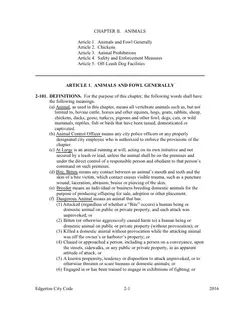
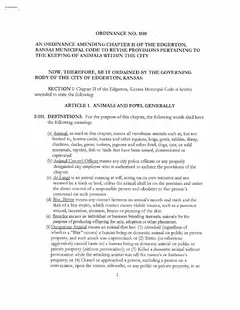
For the purpose of this chapter, the following words shall have the following meanings.
(a)Animal, as used in this chapter, means all vertebrate animals such as, but not limited to, bovine cattle, horses and other equines, hogs, goats, rabbits, sheep, chickens, ducks, geese, turkeys, pigeons and other fowl, dogs, cats, or wild mammals, reptiles, fish or birds that have been tamed, domesticated or captivated.
(b)Animal Control Officer means any city police officers or any properly designated city employee who is authorized to enforce the provisions of the chapter.
(c)At Large is an animal running at will, acting on its own initiative and not secured by a leash or lead, unless the animal shall be on the premises and under the direct control of a responsible person and obedient to that person’s command on such premises.
(d)Bite, Bitten means any contact between an animal’s mouth and teeth and the skin of a bite victim, which contact causes visible trauma, such as a puncture wound, laceration, abrasion, bruise or piercing of the skin.
(e)Breeder means an individual or business breeding domestic animals for the purpose of producing offspring for sale, adoption or other placement.
(f)Dangerous Animal means an animal that has:
(1)Attacked (regardless of whether a “Bite” occurs) a human being or domestic animal on public or private property, and such attack was unprovoked; or
(2)Bitten (or otherwise aggressively caused harm to) a human being or domestic animal on public or private property (without provocation); or
(3)Killed a domestic animal without provocation while the attacking animal was off the owner’s or harborer’s property; or
(4)Chased or approached a person, including a person on a conveyance, upon the streets, sidewalks, or any public or private property, in an apparent attitude of attack; or
(5)A known propensity, tendency or disposition to attack unprovoked, or to otherwise threaten or scare humans or domestic animals; or
(6)Engaged in or has been trained to engage in exhibitions of fighting; or
(7)Been officially labeled by another municipality as having characteristics equal to, or more severe than, the characteristics used to define a “Dangerous Animal” pursuant to this Code.
(g)Dog Pound means a location upon property owned by the city, or at any other place as may be designated by the governing body of the city, for the purpose of impounding and keeping dogs collected by the city, its agents or employees.
(h)Fowl shall include, but shall not be limited to, ducks, geese, turkeys, guineas and pigeons, but is not meant to include chickens, which are specifically addressed in Article 2 of this chapter herein.
(i)Harborer or Keeper is any person who provides food and/or shelter to any domesticated or feral animal for three consecutive days or more.
(j)Own shall mean keeping, harboring, sheltering, managing, possessing, or having a part interest in any animal or fowl. If a minor owns an animal or fowl subject to the provisions of this chapter, the head of the household of which such minor is a member shall be deemed to own the animal or few for the purposes of this chapter.
(k)Owner is any person who provides food and or/or shelter to any domesticated or feral animal for three consecutive days or more.
(l)Person shall mean any person, firm, partnership, association or corporation.
(m)Under Control means to have an animal:
(1)On a leash no more than 8 feet in length, or
(2)Under voice control and in the immediate presence of a responsible person (determined by giving consideration to the size and strength of the person, and the size and temperament of the animal), or
(3)Within a vehicle being driven or parked, or
(4)Confined to the private premises of its owner, keeper or harborer. Confinement of an animal by an invisible fence will be considered as having the animal “under control” as long as a conspicuous sign is displayed in front of the property telling visitors that animals are confined by an invisible fence, and the fence is no closer than 10 feet from any public right-of-way, including but not limited to, alley ways, sidewalks and streets. In addition, invisible fencing wire may not be placed closer than 5 feet to any abutting residential or commercial property line.
(n)Veterinarian shall mean a veterinarian duly licensed to practice the profession by the State of Kansas and maintaining an office in the State of Kansas.
Registration; Licenses
(a)Every owner of any dog or cat over six months of age shall register his or her name with the name, sex and description of each dog and cat so owned with the city clerk.
(b)To validly register and receive a dog or cat license, the owner shall:
(1)Present a completed certificate of immunization against rabies from a licensed veterinarian, which certificate will not expire for at least 90 days after the registration date; and
(2)If the dog or cat is male and has been neutered, or if female and has been spayed, a certificate of the same from a licensed veterinarian shall be submitted; and
(3)Pay an annual fee for each dog and/or cat, as determined by the City Fee Resolution.
(c)The license year shall be from January 1st through December 31st of each year, and March 31 shall be the annual deadline for registering and licensing dogs and cats.
(d)Every owner or harborer of dogs or cats who shall fail to register and license the same in accordance with the City Fee Resolution shall be in violation of this Code, and may be subject to fines or penalties in accordance with the Code and/or the City Fee Resolution.
Dog and Cat Tags
It shall be the duty of the city clerk or designated agent to maintain a record of cat and dog licenses issued, and deliver to the owner or keeper a certificate in writing stating that the person has registered the cat or dog and the number by which the cat or dog is registered, and deliver to the owner or keeper of the dog or cat a tag with the registration number and the licensed year theron. The owner or keeper shall attach the tag to the collar of any dog so registered, and to the collar of any cat if the cat is permitted outside of a residence. The city clerk may issue duplicate tags upon payment of any fees required by the City Fee Resolution. It shall be unlawful for any person to take off or remove the city license tag from any dog or cat belonging to another, or remove the strap or collar on which the same is fastened.
Visiting Dogs and Cats
The provisions of this article with respect to registration shall not apply to any dog or cat owned by any person visiting or temporarily remaining within the city for less than 30 days. However, such dogs and cats shall be kept under restraint by the owner thereof at all times.
Maximum Numbers; Breeders
(a)Effective March 31, 2016, residents are limited to having 4 dogs or 4 cats (or any combination thereof so long as there are no more than a total of 4 animals) over the age of six months upon any residential property. Any residents having more than the maximum number on or before March 31, 2016 must have such animals timely registered and licensed and, assuming timely registration and licensure, the resident may keep the specific dogs or cats so registered and licensed but said dogs or cats over the maximum numbers may not be replaced with a different cat or dog unless the city’s special permit requirements (limited to a total of 4 cats or 4 dogs) are complied with.
(b)Any dogs or cats acquired after March 31, 2016, which acquisition causes a resident to exceed the maximum numbers of allowed dogs or cats, shall be subject to the city’s special permit requirements, but no such permit will be issued for any dog or cat which causes a resident to have more than a total of 6 cats or 6 dogs (or any combination thereof so long as there are no more than a total of 6 animals) over the age of six months. A special animal permit fee will be assessed in accordance with the City Fee Resolution, and any applicant for a special use permit will be required to allow an inspection of their property by the city.
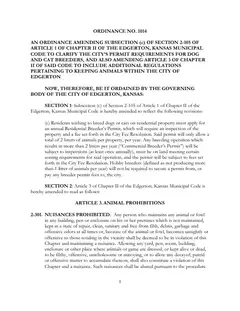
(c)Residents wishing to breed dogs or cats on residential property must apply for an annual Residential Breeder’s Permit, which will require an inspection of the property and a fee set forth in the City Fee Resolution. Said permit will only allow a total of 2 litters of animals per property, per year. Any breeding operation which results in more than 2 litters per year (“Commercial Breeder’s Permit”) will be subject to inspections (at least once annually), must be on land meeting certain zoning requirements for said operation, and the permit will be subject to fees set forth in the City Fee Resolution. Hobby breeders (defined as not producing more than 1 litter of animals per year) will not be required to secure a permit from, or pay any fees to, the city.
Former title: Annual Notice Published
Keeping Farm Animals and Fowl; Review by Planning Commission and Council; Permit Required
(a)It shall be unlawful for the owner, lessee, occupant or any person in possession of any premises located within the city to possess, maintain, harbor, shelter or otherwise keep any horse, swine, cattle, sheep, goat, (hereinafter “farm animals”) or fowl, or permit to be maintained thereon any stable, shed, pen, coop, or any other place where any farm animal or fowl is kept without first having received a permit for the keeping of the same.
(b)The city clerk shall issue a permit to any person seeking to keep any of the farm animals or fowl described in subsection (a) hereof, but only as authorized by the governing body.
(c)The governing body may authorize the city clerk to issue a permit allowing any person to keep any of the aforesaid farm animals or fowl only if it finds that the presence of such animals will not create a nuisance, or otherwise be detrimental to the public welfare or to the rights of property owners whose property lines are within 200 feet of the property line upon which said farm animals will be kept.
(d)Except as otherwise provided herein, no permit issued hereunder shall permit the holder of the same to keep farm animals or fowl in excess of the following limits:
(1)Farm animals – one per acre;
(2)Fowl – five per acre.
(e)Any person seeking to keep farm animals or fowl in excess of the number from that described in subsection (d) above, shall first make application for a variance from the provisions herein to the city planning commission. The planning commission shall review for any application for a variance. Prior to its review, the person(s) seeking a variance from the provisions of subsection (d) shall notify all owners, of any real property located within 200 feet of any property line upon which any farm animal or fowl is sought to be kept, of the date and time in which said variance request is to be reviewed by the planning commission. Notice shall be furnished to said property owners in writing by way of certified mail, postage prepaid, and proof thereof shall be furnished to the planning commission prior to its review of the variance application. Said notice shall be mailed at least fourteen (14) days prior to the date said variance request is reviewed by the planning commission. The planning commission shall make recommendations to the governing body as to whether a variance should or should not be granted and may further recommend any additional conditions or restrictions that should be imposed as a condition to the granting of a variance.
(f)The governing body may, upon such terms and conditions as it deems necessary, grant a variance from the provisions of subjection (d) herein only after having found that there has been compliance with the provisions of subsection (e) herein. No variance shall be issued unless, and until, the governing body makes the same findings as set forth in subsection (c) herein.
(g)Permits and variances shall be valid for one year from the date of issuance, and any fees for the same will be in accordance with the City Fee Resolution. The governing body may, upon finding that farm animals or fowl are being kept or maintained in violation of any of the provisions of this chapter, suspend or revoke any permit, or variance, issued hereunder.
(h)The provisions hereunder shall not apply to the maintaining of a stockyard or sales barn for the loading, unloading, temporary detention and sale of animals or fowl; provided such stockyard or sale barn is otherwise in compliance with all applicable federal, state and local laws pertaining to the carrying on of its business.
Former Sections 2-107. Same; Nuisance; 2-108. Animals; Keeping Prohibited; 2-109. Control or Protection of Animals in General; 2-110. Cruelty to Animals; 2-111 Animals Biting Persons; Reporting; Impoundment and Examination; 2-112. Impounding, Redemption and Disposition of Animals Running At Large or Involved in Biting Person or Other Animals; 2-113. Vicious or Danger Animal; 2-114. Chapter Enforcement; 2-114 Chapter Enforcement; 2-115. Killing Dangerous Dogs; 2-116. Officers Authorized to Shoot Dogs Under Certain Conditions; 2-117. Establishment of Dog Pound; 2-118. Breaking Pound; 2-119. Tranquilizer Gun; 2-120. Right of Entry; 2-121. Penalty; and 2-122. Off-Leash Dog Park; Rules Established were repealed by Ord. 1010, 2016.
Article 2. Chickens
Keeping Chickens; Permit Required
(a)Any person who desires to keep chickens in the city shall obtain a special permit from the city governing body prior to acquiring the chickens.
(b)The principal use of the person’s property must be a single-family use dwelling or duplex-family as defined in Chapter 16 of this Code.
(c)The property must be occupied by the person requesting the permit.
(d)No person or household shall own or harbor more than six chickens of 16 weeks of age or older, or more than one clutch (eight) chicks per tract of land regardless of how many dwelling units are on the tract.
(e)Only female chickens are allowed.
(f)Applications for special permits shall be made to the city clerk, and shall be accompanied by a permit fee in an amount established by the City Fee Resolution. Special permits expire and become invalid one year after the date of issuance.
(g)A person who has previously obtained a special permit, and wishes to continue keeping chickens, shall obtain a renewal permit on or before the expiration date of the previous permit. The application for a renewal permit shall be accompanied by a permit fee in the amount established by the City Fee Resolution.
(h)Renewal applications shall be approved by the City Clerk, unless a written complaint about the chickens (that are the subject of the renewal permit) was submitted to the city during the year preceding the renewal application. When said complaint has been made, the renewal applications may only be approved by the city governing body.
(i)The city governing body may refuse to renew, or may revoke, a special permit if, following a public hearing, it finds any of the following:
(1)The premises are being maintained in violation of any applicable law of the State of Kansas, or of the city.
(2)The premises are being maintained so as to be a public nuisance.
(3)The premises are being maintained so as to be detrimental to the health, safety or peace of mind of persons residing in the immediate vicinity.
Chicken Enclosures
(a)Chickens must be kept in a clean, safe and healthy environment.
(b)Chickens must be kept in a coop, run or chicken tractor at all times.
(c)All coops shall be inspected and approved by the Building Inspector as meeting the following requirements:
(1)The coop must be built with a minimum of 12 square feet per chicken, not to exceed 85 square feet total.
(2)The coop shall be enclosed on all sides and shall have a roof and doors. Access doors must be able to be shut and locked. Opening windows and vents must be covered with predator and bird-proof wire of less than one-inch openings.
(3)The coop, run and chicken tractor shall consist of sturdy wire or wooden fencing.
(4)The coop, run and chicken tractor shall be designed so as to be easily maintained.
(5)The coop, run and chicken tractor shall be constructed with durable materials that will hold up to weather and environment.
(6)Used materials (reclaimed material) for enclosures must be approved by the Building Inspector as referenced in the adopted International Residential Code. The use of scrap, waste board, or similar materials is prohibited.
(7)Coops, runs and chicken tractors may only be located in the rear yard of the property, as defined in Chapter 16 of this code.
(8)Coops, runs and chicken tractors must be located at least 10 feet inside of the owner’s property line, and at least 50 feet from any adjacent residential dwelling, church, school, or place of business, that is outside of the property owner’s property lines.
Keeping Chickens; Miscellaneous Regulations
(a)Odors from chickens, chicken manure or other chicken related substances shall not be perceptible at or beyond the owner’s property boundaries.
(b)Perceptible noise from chickens shall not be loud enough at the owner’s property boundaries to disturb persons of reasonable sensibilities.
(c)Chicken waste is the responsibility of the owner; no more than three cubic feet of chicken manure can accumulate. The coop and surrounding area must be kept free from trash and accumulated droppings.
(d)Chickens shall be provided with access to feed and clean water at all times.
(e)All feed, enclosures, and other items associated with the keeping of chickens shall be maintained so as to prevent the attraction and/or accumulation of rats, mice, or other rodents, and infestation of insects and parasites.
(f)The keeping of chickens is allowed for use by the owner, and not for profit. Commercial chicken operations are strictly prohibited.
(g)It shall be unlawful for any person to publicly slaughter any chicken.
(h)It shall be unlawful for any person to keep chickens in violation of any provision of this article.
(i)It shall be unlawful for any owner, renter or leaseholder of property to allow chickens to be kept on the property in violation of the provisions of this article.
(j)If any of the requirements of this chapter applicable to the keeping of chickens are violated, the city may revoke any special permit and/or initiate prosecution for the violation.
(k)A person who has been issued a special permit shall submit it for examination upon demand by any police officer or code enforcement office.
Article 3. Animal Prohibitions
Nuisances Prohibited
Any person who maintains any animal or fowl in any building, pen or enclosure on his or her premises which is not maintained, kept in a state of repair, clean, sanitary, and free from filth, debris, garbage and offensive odors at all times or, because of the animal or fowl, becomes unsightly or offensive to those residing in the vicinity shall be deemed to be in violation of this Chapter and maintaining a nuisance. Allowing any yard, pen, room, building, enclosure or other place where animals or game are dressed, or kept alive or dead, to be filthy, offensive, unwholesome or annoying, or to allow any decayed, putrid or offensive matter to accumulate thereon, shall also constitute a violation of this Chapter and a nuisance. Such nuisances shall be abated pursuant to the procedure set forth in Chapter 8 of this Code and/or the person in violation will be subject to citation issued by the animal control officer.
Certain Animals Prohibited
It shall be unlawful to keep, harbor, own or in any way possess within the corporate limits of the city:
(a)Any warm-blooded, carnivorous or omnivorous, wild or exotic animal (including but not limited to non-human primates, raccoons, skunks, foxes and wild and exotic cats).
(b)Any animal having a venomous bite.
(c)Any animal determined to be a dangerous animal.
Control or Protection of Animals in General
(a)Every owner of any animal shall exercise proper care and control of the animal to prevent it from becoming a public nuisance. It shall be unlawful, and it shall be a nuisance, for an animal to be at large, to molest or attack persons or other domestic animals, damage property, chase vehicles, deposit excretory matter on property other than the property of its owner, or to engage in excessive or untimely barking or other noisy behavior. The owner of every animal shall forthwith remove and sanitarily dispose of any excreta deposited by the animal on property other than the owner’s property including, but not limited to, public sidewalks, streets, public recreation areas and private property.
(b)It is unlawful for any person to permit an animal to run or be at large, except that dogs may be allowed off leash while within the designated boundaries of off-leash areas.
(c)In addition to impoundment, any law enforcement or animal control officer may issue a citation to any owner as defined in this Chapter whose animal is, or is kept, in violation of the provisions of this Chapter.
Cruelty to Animals Prohibited
Except for the exemptions provided in K.S.A. 21-4301(b), it shall be unlawful for any person to:
(a)Intentionally kill, maim, injure, torture or mutilate any animal;
(b)Abandon or leave any animal within the city limits without making provisions for its proper care; or
(c)Have physical custody of any animal and fail to provide such food, potable water, protection from the elements, opportunity for exercise and other care as needed for the health or well-being of such kind of anima;
(d)Make accessible to any animal, with the intent to cause harm or death, any substance which has in any manner been treated or prepared with harmful or poisonous substances. It is not the intent of this subsection to prohibit the use of poisonous substance for the control of vermin of significance to the public health.
(e)Permit any dog fight, cockfight, bullfight, or other combat between animals or between animals and humans;
(f)Give away any live animal, fish, reptile, or bird as a prize for, or as an inducement to enter a place of amusement or offer such animal as an incentive to enter into any business agreement whereby the offer was for the purpose of attracting trade.
Animal Feeding Restrictions
The placement of food or other items – in an outside area within the city for the purpose of attracting or keeping animals (wild or domesticated, but not to include wild birds) that are not licensed and/or permitted through the city pursuant to this chapter (and by the person responsible for placement of the food or other item) – is strictly prohibited. The leaving of outside food within the city, intended for an animal that is licensed or permitted by the person leaving the food, is prohibited if it is left in such a way or for a period of time that it results in creating a nuisance by attracting other animals or rodents.
Article 4. Safety and Enforcement Measures
Animals Biting Persons; Reporting; Impoundment and Examination
(a)When any animal subject to rabies has bitten or attacked any persons, or when an animal is suspected of having rabies, it shall be the duty of any person having knowledge of such facts to report the same to the animal control officer within 24 hours of such event. Such report shall be made at any city office or city law enforcement department.
(b)Such animal shall not be euthanized but shall be confined in such a way and for such period of time as the city animal control officer shall direct. No person shall release from confinement any such animal or remove such animal from its place of confinement to another place without the consent of the animal control officer. The confinement of the animal shall be at the expense of the owner or custodian of such animal and the city animal control officer shall be empowered in his discretion to order impoundment or examination of such animal, or both, to determine whether it may have rabies. No person shall refuse surrender of any animal for quarantine when demand is made by the animal control officer. If the animal dies or is euthanized, a laboratory examination of the head shall be made.
(c)Any person refusing or failing to comply with the provisions of this section, or with the directives of the city animal control officer relating thereto, is guilty of a code violation.
Impounding, Redemption and Disposition of Animals Running at Large or Involved in Biting Persons or Other Animals
The animal control officer is authorized to receive and dispose of at his or her discretion, donated or gift dogs, cats or other small animals, and to impound, sell or destroy any animal running at large in violation of the terms of this chapter or any animal that has bitten a person or other animal, or such animal suspected of having a disease transmissible to human beings. Such animals may be taken up or impounded even though no citizen makes a complaint and even though the animal control officer issues no notice to appear. Impoundment shall be subject to the following:
(a)The animal control officer shall attempt notification of the owner of an animal, identifiable by a tag or other approved method, which is impounded under this chapter, by telephone or letter or personal service.
(b)If there is sufficient evidence to believe the animal is owned, such animal shall be confined in the approved pound for a period of seven days, such period of time beginning at 9:00 a.m. on the morning following the day of intake. If the owner does not claim his or her animal during the seven day period or the animal control officer is unable to locate and notify the owner after making a good faith effort to do so within the seven day period, then the animal control officer may sell or destroy such animal. If the animal is feral, not identifiable by a tag or any other reasonable means, no notice is required and such animal shall be confined for a period of at least 72 hours beginning at 9:00 a.m. of the morning following its capture; after such time the animal control officer may dispose of the animal. Notwithstanding the foregoing, any animal impounded pursuant to a report that any person or other animal has been bitten by that animal, shall be held for a period of at least 10 days for the purpose of observing such animal for symptoms of rabies disease; after such time the animal control officer may euthanize the animal.
(c)Any currently vaccinated dog or cat covered by permit as required in this chapter may be claimed by its owner upon payment of an impoundment fee and boarding fee as set forth in the City Fee Resolution.
(d)In addition to paying the impoundment and boarding fees provided for in the City Fee Resolution, any animal for which no permit has been issued or that has not been vaccinated pursuant to this chapter, shall pay additional fees as provided for in the City Fee Resolution, and will be vaccinated for rabies and a fee for the same assessed to the owner, before release. Unvaccinated pets will not be released back into city limits.
(e)The city shall attempt to recover all costs incurred in caring for any animal impounded or held pursuant to the provisions of this chapter, including but not limited to, the cost for necessary veterinarian care. The fees shall be in addition to any fine imposed for violation of the provisions of this chapter.
(f)All animals impounded for reasons of suspected disease may be reclaimed by their owners upon evaluation and treatment by a veterinarian approved by the city who shall certify the release of such animal.
Dangerous Animals
(a)When in possession of information, evidence, or reports that an animal within the city meets the definition (as provided for in this chapter) of being a “dangerous animal,” the animal control officer shall be authorized to do the following:
(1)Impound the animal to a veterinarian or humane society, or otherwise impose measures to reasonably protect persons and the public from the animal, all at the owner’s expense until a determination of whether the animal is a “dangerous animal” is (I) made by the municipal court judge at the next available court date, or (II) conceded by the owner; whichever occurs first.
(2)Produce evidence in municipal court supporting that the animal is a “dangerous animal.”
(b)Upon receiving a complaint that a specific animal within the city meets the definition of being a “dangerous animal,” the animal control officer is authorized to initiate an investigation, to include the filling out of an incident report by the complainant. And, based on all of the circumstances and evidence submitted and discovered, the animal control officer will exercise his or her discretion (which will not be subject to appeal) in determining that:
(1)There is sufficient evidence to elevate the determination to the municipal court, in which case the requirements of Section 2-403 (a) (1) and (a) (2) hereinabove will apply.
(2)There is insufficient evidence to support that the animal meets the definition of being a “dangerous animal,” in which case the investigation will be concluded and no further action will be taken (other than required rabies quarantine protocol).
(c)If a “dangerous animal” declaration is made by the municipal court judge, the owner will have 10 days to pursue an appeal to the Johnson County District Court, but until such time as said appeal is heard and decided, the owner shall continue to pay all expenses for impoundment and/or to continue measures associated with protecting persons and the public from the animal.
(d)Failure to produce any animal that is suspected of being a “dangerous animal” by the animal control officer (or declared to be such by the municipal court judge) within 24 hours of notification will result in a violation of this chapter and subject the owner to all penalties authorized by this city code.
(e)If an animal if finally determined to be a “dangerous animal,” then the animal shall be euthanized or the owner or harborer of such animal shall immediately remove it from the city limits and shall provide the municipal court with the exact location, address, and contact information for the new owner or harborer where the animal has been moved. The animal control officer shall notify the receiving jurisdiction that the animal has been determined to be a “dangerous animal.” The animal shall not be returned to the city limits after removal, and it shall be unlawful for the owner or harborer to allow it to be returned to or kept within the city.
Ensuring Safety of the Public and Officers
(a)The animal control officer, or his or her designated agent, may, when it is reasonably believed necessary to protect the safety of the public or officer, kill, without notice, any animal that is vicious or is believed to be affected with rabies or hydrophobia, whether it bears the tag herein provided or not.
(b)If after exhausting all reasonable means and methods to catch any animal running at large or unrestrained within the city, in violation of the terms of this chapter, or the officer is unable to take any such animal into custody, or such animal becomes dangerous to handle in the sole opinion of the officer, the officer is hereby authorized, directed and empowered to shoot the animal.
(c)The animal control officer or his or her designated agent is authorized to use a tranquilizer gun in the enforcement of this chapter.
Establishment of Dog Pound; Breaking Pound
(a)There shall be and is hereby established a dog pound to be located upon property owned by the city, or at any other place as may be designated by the governing body of the city, for the purpose of impounding and keeping dogs collected by the city, its agents and employees.
(b)It shall be unlawful for any person other than a duly authorized officer to open, unlock , break open or attempt to break open the pound, or to take or attempt to take from an animal control officer or his or her designated agent any dog or dogs taken up by him under the provisions of this article, or in any manner interfere with or hinder any animal control officer or his or her designated agent of the city in performing his or her duties.
Right of Entry; Investigation
(a)The animal control officer or his or her designated agent shall have the right of entry upon any private unenclosed lot or land for the purpose of collecting any animal whose presence thereupon is a violation of this article, and further, the animal control officer or his or her designated agent has the authority to collect any animal suspected of being mistreated as provided herein.
(b)The city animal control officer or his or her designated agent is authorized to enter upon private property to investigate all complaints for the purpose of enforcing this chapter. No person shall conceal any animal or otherwise interfere with the proper enforcement of this chapter. Any person, firm, corporation, partnership or association violating any of the provisions of this chapter shall, unless otherwise specifically provided, be subject to the penalty provided for in section 2-407 of Article 4 of this chapter.
Penalty
Any person convicted of violating any of the provisions of this chapter shall, on conviction thereof, be fined not more than $1,000 or be imprisoned for not more than six months or be both so fined and imprisoned.
Article 5. Off-Leash Dog Facilities
Off-Leash Dog Facilities; Rules Established
The following rules shall be in effect for all off-leash facilities located with the city:
(a)Handlers must leash and/or remove their dog(s) from the off-leash area at the first sign of serious, unprovoked aggressive behavior.
(b)Dogs must be under the control and in view of their handler at all times.
(c)Handlers are limited to a maximum of three (3) dogs in the off-leash area at a time.
(d)Handlers must carry one leash for each dog.
(e)Dogs with spiked collars must remain leashed at all times.
(f)Dogs less than twelve (12) weeks of age are not allowed in the area.
(g)All dogs must have current vaccinations evidenced by visible tag(s).
(h)Female dogs in heat, or un-neutered male dogs, are not allowed in the off-leash areas.
(i)Handlers are required to pick-up and dispose of their dog’s waste in the collection container provided.
(j)Children less than 16 years of age must be under adult supervision at all times while they are within the boundaries of the off-leash areas.
(k)Food shall not be allowed in the off-leash areas.
(l)Any dog under investigation for, or finally determined as, being a “dangerous animal,” is prohibited from being in any off-leash area.
Every Chapter
Municipal Code- Chapter IAdministration54 sections
- Chapter IIAnimals22 sections
- Chapter IIIBeverages45 sections
- Chapter IVBuildings, Construction and Fire146 sections
- Chapter VBusiness Regulations53 sections
- Chapter VIElections2 sections
- Chapter VIIIHealth and Welfare112 sections
- Chapter IXMunicipal Court10 sections
- Chapter XPolice13 sections
- Chapter XIPublic Offense31 sections
- Chapter XIIPublic Property76 sections
- Chapter XIIIStreets and Sidewalks45 sections
- Chapter XIVTraffic24 sections
- Chapter XVUtilities102 sections
- Chapter XVIZoning and Planning3 sections