
Municipal Code
Chapter XIV, Traffic
As Adopted and Amended
The text on this page is the City’s chapter as posted. An ordinance passed since may not be set into it yet.
Article 1. Standard Traffic Ordinance
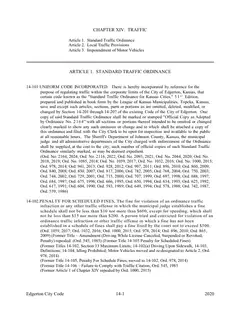
Uniform Code Incorporated
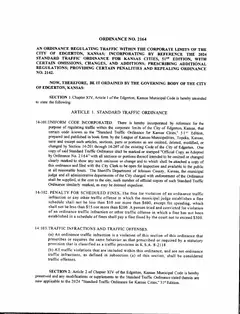
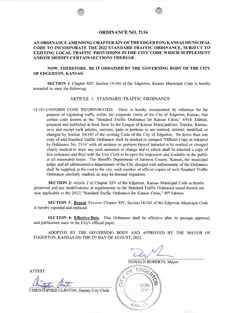
There is hereby incorporated by reference for the purpose of regulating traffic within the corporate limits of the City of Edgerton, Kansas, that certain code known as the "Standard Traffic Ordinance for Kansas Cities," 51st Edition, prepared and published in book form by the League of Kansas Municipalities, Topeka, Kansas, save and except such articles, sections, parts or portions as are omitted, deleted, modified, or changed by Section 14-201 through 14-207 of the existing Code of the City of Edgerton. One copy of said Standard Traffic Ordinance shall be marked or stamped "Official Copy as Adopted by Ordinance No. 2164” with all sections or portions thereof intended to be omitted or changed clearly marked to show any such omission or change and to which shall be attached a copy of this ordinance and filed with the City Clerk to be open for inspection and available to the public at all reasonable hours. The Sheriff's Department of Johnson County, Kansas, the municipal judge and all administrative departments of the City charged with enforcement of the Ordinance shall be supplied, at the cost to the city, such number of official copies of such Standard Traffic Ordinance similarly marked, as may be deemed expedient.
Penalty for Scheduled Fines
The fine for violation of an ordinance traffic infraction or any other traffic offense in which the municipal judge establishes a fine schedule shall not be less than $10 nor more than $600, except for speeding, which shall not be less than $15 nor more than $200. A person tried and convicted for violation of an ordinance traffic infraction or other traffic offense in which a fine has not been established in a schedule of fines shall pay a fine fixed by the court not to exceed $500.
Traffic Infractions and Traffic Offenses
(a)An ordinance traffic infraction is a violation of this section of this ordinance that prescribes or requires the same behavior as that prescribed or required by a statutory provision that is classified as a traffic provision in K.S.A. 8-2118.
(b)All traffic violations that are included within this ordinance, and are not ordinance traffic infractions, as defined in subsection (a) of this section, shall be considered traffic offenses.
Article 2. Local Traffic Provisions
Standard Traffic Ordinance; Modifications
(a)Section 33. Speed Limits. Except when a special hazard exists that requires lower speed for compliance with Section 32 of the Standard Traffic Ordinance, the limits specified in the Section, or established as hereinafter authorized, shall be the Maximum lawful speed, and no person shall drive a vehicle at a speed in excess of such maximum limits:
(1)In any business district, 20 miles per hour;
(2)In any residential district, 30 miles per hour;
(3)In any park, 20 miles per hour;
(4)20 miles per hour in any posted school zone as provided for in KDOT Traffic, Signing Project Number 46-U-1129-01, which establishes a school zone with the following times: 7:30 a.m. to 8:30 a.m.; 11:15 a.m. to 12:45 p.m.; 3:15 p.m. to 4:15 p.m.
(5)In any urban district, 30 miles per hour;
(6)On any separated multi-laned highway, as designated and posted by the Secretary of Transportation, 70 miles per hour:
(7)On any county or township highway, 55 miles per hour;
(8)On West Martin Street, 25 miles per hour as provided for in the Edgerton, Kansas Speed Study as provided in the 1997 KDOT Traffic Engineering Assistance Program;
(9)On West McDonald Street, 25 miles per hour as provided in the 1997 KDOT Traffic Engineering Assistance Program;
(10)On West Fourth Street between West Martin and West McDonald Streets, 25 miles per hour as provided in the 1997 KDOT Traffic Engineering Assistance program;
(11)On West Third Street south of Edgewood Drive, 25 miles per hour as provided in the 1997 KDOT Traffic Engineering Assistance Program;
(12)On West Fourth Street south of Edgewood Drive, 25 miles per hour as provided in the 1997 KDOT Traffic Engineering Assistance Program;
(13)On 191st Street from Four Corners Road to Waverly Road, 40 miles per hour; from Waverly Road east to city limits, 35 miles per hour;
(14)On Homestead Lane from 191st Street south to Interstate 35, 40 miles per hour;
(15)On Kill Creek Road from 191st Street to 187th Street, 30 miles per hour;
(16)On 187th Street, from Kill Creek Road to Waverly Road, 30 miles per hour;
(17)On all other highways, 65 miles per hour.
(18)No person shall drive a school bus to or from school or inter-school or intra-school functions or activities, at a speed great(er) than 45 miles per hour on any roadway having dirt, sand or gravel surface, and in no event shall a school bus be driven to and from school, or functions or activities, in excess of 55 miles per hour, notwithstanding any maximum speed limit in excess thereof. The provisions of this subsection shall apply to buses used for the transportation of students enrolled in community colleges or area vocational schools when such buses are transporting students to or from school, or functions or activities.
(19)The maximum speed limits in this section may be altered as authorized in K.S.A. 8-1559 and 8-1560, and amendments thereto.
(b)Section 116. Driving Upon Sidewalk. Section 116 is modified to read as follows: No person shall drive any vehicle upon a sidewalk or sidewalk area except upon a permanent or duly authorized temporary driveway, or to otherwise temporarily access private property adjacent to the public right-of-way.
(c)Section 175.1. Compression Release Engine Braking System. Section 175.1 is modified to read as follows: It shall be unlawful for the driver of any motor vehicle to use or cause to be used or operated any compression release engine braking system within the corporate limits of the city of Edgerton, Kansas.
Reserved for Future Use
Miscellaneous Truck Restrictions
(a)For the purposes of this Section, the following terms, phrases, words and their derivations shall have the following meanings:
(1)Truck Tractor: Every motor vehicle designed and used primarily for drawing other vehicles and not so constructed as to carry a load other than a part of the weight of the vehicle and load so drawn.
(2)Trailer: Every vehicle with or without motive power, other than a pole trailer, designed for carrying persons or property and for being drawn by a motor vehicle, and so constructed that some part of its weight and that of its load rests upon the towing vehicle.
(3)Semitrailer: Every vehicle, with or without motive power, other than a pole trailer, designed for carrying persons or property and for being drawn by a motor vehicle, and so constructed that some part of its weight and that of its load rests upon or is carried by another vehicle.
(4)Vehicle: Every device in, upon or by which any person or property is or may be transported or drawn upon a street or highway, except devices moved by human power or used exclusively upon stationary rails or tracts.
(b).Heavy Trucks Prohibited. It shall be unlawful for any person, firm or corporation to operate any truck, truck tractor, semitrailer, other commercial vehicle, or any combination of vehicles with a gross weight of 24,000 pounds or more upon any street within the City of Edgerton, Kansas except on a designated Truck Route as described in Subsection (c) Truck Routes below.
These provisions shall not be applicable to the following:
(1)police, fire or ambulance vehicles;
(2)city, county or franchised utility maintenance vehicles while engaged in repair, maintenance or construction activities;
(3)garbage collection vehicles while engaged in collection activities from premises adjacent to the restricted streets;
(4)U.S. Postal delivery vehicles;
(5)school buses and school district vehicles;
(6)City or County owned or sponsored public transportation vehicles while engaged in public transportation activities;
(7)moving vans while engaged in moving activities at premises on the restricted streets;
(8)vehicles involved in delivery or other service activities to premises on restricted streets so long as such moving, delivery, and/or service vehicles take the most direct route when entering or leaving the premises;
(9)the owner/agent of any truck tractor shall be permitted to enter upon street not designated as truck route at the cross street nearest to the house or premises in the direction in which the vehicles are moving for the purpose of parking the truck tractor on private property at the residence of the owner/agent. Nothing in this section shall allow the maintenance of a nuisance or the disturbance of peace of any resident of the Edgerton City area.
(c)Truck Routes. The following streets are designated and assigned as Truck Routes in the City of Edgerton:
•1st Street: 56 Highway to McCarty Street
•East 2nd Street: 56 Highway to Braun (207th Street)
•East 4th Street: Nelson Street to 56 Highway
•West 8th Street (Edgerton Road): Braun (207th Street) to 56 Highway
•McCarty Street: 1st Street to 2nd Street
•Nelson Street: from Sunflower Road to 4th Street
•Sunflower Road: I-35 to Nelson Street
•Braun (207th Street): Sunflower Road to 8th Street (Edgerton Road)
•181st Street: Waverly Road west to termination
•183rd Street: Montrose Street east to Edgerton City Limits
•185th Street: Waverly Road to Montrose Street
•187th Street: Kill Creek Road to Waverly Road
•191st Street: Four Corners Road east to Edgerton City Limits
•193rd Street: Essex Street to Homestead Lane
•196th Street: Montrose Street west to Edgerton City Limits
•207th Street: Homestead Lane east to Edgerton City Limits
•Homestead Lane: 191st Street to 207th Street
•Kill Creek Road: 191st Street to 187th Street
•Waverly Road: 196th Street to 181st Street
•Montrose Street: 183rd Street to 196th Street
•Essex Street: 191st Street to termination south of 193rd Street
(d)Weight Restrictions on Truck Routes. It shall be unlawful for any person, firm or corporation to operate any truck, truck tractor, semitrailer, other commercial vehicle, or any combination of vehicles with a gross weight of 80,001 pounds or more upon any Truck Route within the City of Edgerton, Kansas except as permitted on an Overweight Corridor Route as described in Subsection (e) Overweight Corridor Routes below.
These provisions shall not be applicable to the following:
(1)the owner of livestock or producer of farm products transporting livestock of such owner or farm products of such producer to market in a motor vehicle of such owner or producer, or the motor vehicle of a neighbor on the basis of barter or exchange for service or employment, or to such owner or producer transporting supplies for the use of such owner or producer, or in the motor vehicle of a neighbor on the basis of barter or exchange for service or employment;
(2)persons operating motor vehicles which have an ad valorem tax situs in and are registered in the State of Kansas, and used only to transport grain from the producer to an elevator or other place for storage or sale for a distance of not to exceed 50 miles;
(3)motor vehicles used to transport water for domestic purposes or livestock consumption;
(4)the operation of vehicles used for servicing, repairing or transporting of implements of husbandry, as defined in K.S.A. 8-1427, and amendments thereto, by a person actively engaged in the business of buying, selling or exchanging implements of husbandry, if such operation is within 100 miles of such person’s established place of business in this state.
(e)Overweight Corridor Routes. The following streets are designated and assigned as Overweight Corridor Routes in the City of Edgerton:
•181st Street: Waverly Road west to termination
•183rd Street: Montrose Street east to Edgerton City Limits
•185th Street: Waverly Road to Montrose Street
•187th Street: Kill Creek Road to Waverly Road
•191st Street: Four Corners Road east to Edgerton City Limits
•193rd Street: Essex Street to Homestead Lane
•196th Street: Montrose Street west to Edgerton City Limits
•Essex Street: 191st Street to termination south of 193rd Street
•Homestead Lane: 191st Street to Interstate 35
•Kill Creek Road: 191st Street to 187th Street
•Waverly Road: 196th Street to 181st Street
•Montrose Street: 183rd Street to 196th Street
(f)Weight Restrictions on Overweight Corridor Routes. It shall be unlawful for any person, firm or corporation to operate any truck, other commercial vehicle, or any combination of vehicles with a gross weight of 96,001 pounds or more upon any Overweight Corridor Route within the City of Edgerton, Kansas.
(g)Parking of a Truck Tractor. The owner/agent of any truck tractor shall be permitted to enter upon a street not designated as a truck route at the cross street nearest to the house or premises in the direction in which the vehicles are moving for the purpose of parking the truck tractor on private property at the residence of the owner/agent. Nothing in this section shall allow the maintenance of a nuisance or the disturbance of the peace of any resident of the area.
(h)Hazardous Materials. It shall be unlawful for any motor vehicle used solely for the transportation of explosives, flammable liquids or liquefied petroleum gases, which for such purpose if provided with a tank or tanks mounted on the frame or chassis of such vehicle or any vehicle without its own motive power but drawn by a motor vehicle, used for this same purpose to be parked or permitted to stand in any area of the city designated as a residential area, longer than is necessary to make a lawful delivery. Fertilizer and ammonia trucks and hazardous gasses of any kind are included.
Commercial Motor Vehicle Safety
There is hereby incorporated by reference for the purpose of regulating commercial motor vehicle safety on the streets and highways of the City of Edgerton, Kansas, Article 19, Chapter 8 of the Kansas Statutes Annotated for the purpose of regulating the size, weight, and load of vehicles within the City of Edgerton, all as set forth in Kansas Article 19, Section 8 of the Kansas Statutes Annotated (“K.S.A. Art. 19, Ch. 8) and any amendments thereto. At least one copy of K.S.A. Art. 19, Ch. 8 shall be marked or stamped “Official copy as Adopted by Edgerton, Kansas, Ordinance No. 978” to which shall be attached a copy of the ordinance codified in this section, and filed with the City Clerk to be open to inspection and available at all reasonable hours in accordance K.S.A. 12-3010. The Johnson County Sheriff’s Department, municipal judge, municipal prosecutors, municipal public defender and all administrative departments of the city charged with enforcement of the ordinance codified in this section, shall be supplied, at the cost of the city, such number of official copies of K.S.A. Art. 19, Ch. 8 similarly marked, as may be deemed expedients.
Parking Restrictions
The following parking restrictions shall apply upon installation of signage or markings in accordance with K.S.A. 8-2003 and the Manual on Uniform Traffic Control Devices:
(a)On-street parking prohibited within the Burkdoll Addition, a subdivision in the City of Edgerton, on the entire west side of West Fifth Street.
(b)Parking space marked on the pavement, and by a vertical mounted sign bearing the international symbol of access, as reserved for handicapped or those transporting handicapped individuals at:
Edgerton United Methodist Church 300 East Fourth Street West Side of East Fourth Street
Edgerton Community Building 404 East Nelson East Side of East Fourth Street
Bank of Knowledge Library 319 East Nelson West Side of East Fourth Street
U.S. Post Office Edgerton 328 East Nelson North Side of East Nelson Street shall be restricted to use by vehicles bearing a special license plate, permanent placard, or temporary placard, issued pursuant to K.S.A. 8-161 or K.S.A. 81,125, and amendments thereto.
(c)On-street parking prohibited on East 6th Street from Nelson Street to the southern edge of the Edgerton boat ramp at Edgerton Lake Park.
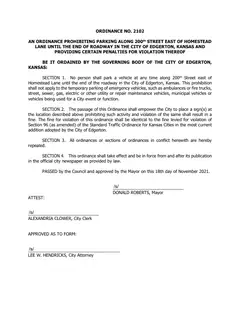
(d)No person shall park a vehicle at any time along 181st Street between Waverly Road and the end of the roadways; on Montrose between 191st Street and 193rd Street; on 187th Street between Kill Creek Road and Waverly Road; and on East Nelson Street/Sunflower Road from East 6th Street to the entrance to Martin Creek Park at 20200 Sunflower Road; and along 200th Street East of Homestead Lane until the end of the roadway in the City of Edgerton, Kansas. This prohibition shall not apply to the temporary parking of emergency vehicles, such as ambulances or fire trucks, street, sewer, gas, electric or other utility or repair maintenance vehicles, municipal vehicles or vehicles being used for City event or function.
(e)On-street parking on East Nelson Street from East 3rd Street to East 4th Street shall be restricted in parking stalls specifically signed in accordance with the Manual on Uniform Traffic Control Devices for “limited-time parking” for ONE HOUR PARKING only.
Former Articles 1 and 2 of Chapter XIV of the Edgerton Municipal Code repealed in entirety.
Vehicle Height, Weight, Length and Width
(a)No person, association, firm, partnership, corporation, or other business or commercial entity shall operate a motor vehicle or combination of vehicles the height or length of which, including any load thereon, exceeds the limitations as to such prescribed by K.S.A. 8-1904 or any amendments thereto, which are incorporated by reference as if set out in full herein.
(b)No person, association, firm, partnership, or corporation shall operate a motor vehicle or combination of vehicles the total outside width of which, or any load thereon, exceeds the limitations as to such prescribed by K.S.A. 8-1902 or any amendments thereto, which are incorporated by reference as if set out in full herein.
(c)No person, association, firm, partnership, or corporation shall operate a motor vehicle or combination of vehicles the gross weight of which, as to wheel and axle load, exceeds the limitations as to such prescribed by K.S.A. 8-1908 or any amendments thereto, which are incorporated by reference as if set out in full herein.
(d)No person, association, firm, partnership, or corporation shall operate a motor vehicle or combination of vehicles unless such motor vehicle is registered and licensed according to gross weight as prescribed in K.S.A. 8-143 or any amendments thereto, which are incorporated by reference as if set out in full herein.
(e)No person, association, firm, partnership, or corporation shall operate a motor vehicle or combination of vehicles the gross weight of which exceeds the limitation as to such prescribed by K.S.A. 8-1909 or any amendments thereto, which are incorporated by reference as if set out in full herein.
(f)It shall be unlawful to operate within this City a vehicle or combination of vehicles whose weight, with cargo, is in excess of the gross weight for which the vehicle, truck or truck tractor propelling the same is licensed and registered except as provided by K.S.A. 8-1911 or any amendments thereto and K.S.A. 8-143 or any amendments thereto. Pursuant to 8-1911, all City of Edgerton vehicles, and those contracted to serve the City of Edgerton specifically designed and equipped and used exclusively for garbage, refuse or solid waste disposal operations for the citizens and businesses of Edgerton are hereby granted special permit status to operate anywhere within the corporate City limits of Edgerton for any time when the maximum gross weight limitations exceed the limitations contained in K.S.A. § 8-1909.
(g)Whenever a police officer, upon weighing a vehicle or combination of vehicles, determines that the weight is unlawful, such officer may require the driver to stop the vehicle in a suitable place and remain standing until such portion of the load is removed as may be necessary to reduce the gross weight of such vehicle or combination of vehicles or remove or redistribute the gross weight on any axle or tandem axles to such limits as permitted in this section. All material so unloaded shall be cared for by the owner, lessee, or operator of such vehicle at the risk of such owner, lessee or operator.
(h)Every person, association, firm, partnership, corporation or commercial entity who is convicted of a violation of this section shall be fined according to the following schedule:
Weight up to the first 1000 lbs. over limit - $50.00 -- Per lb. Over 1000 lbs. - $.10 Height, Length, Width over limit - $30.00 plus $1.00 per inch
For a second violation of this section within two (2) years, such person, association, firm, partnership, corporation or commercial entity shall, upon conviction, be fined 1½ times the applicable amount based on the above fine schedule.
For a third violation of this section within two (2) years, such person shall, upon conviction, be fined two times the applicable amount from the above fine schedule. For a fourth and each succeeding violation of this subsection within two (2) years, such person, upon conviction, shall be fined 2½ times the applicable amount from the above fine schedule.
Spilling Loads on Highways Prohibited; Bond
(a)No vehicle shall be driven or moved on any street, highway, road or alley of the City of Edgerton, Kansas, unless such vehicle is so constructed, or loaded as to prevent any of its load from dropping, sifting, leaking, or otherwise escaping therefrom, and no vehicle shall be driven or moved upon any street, highway, road, or alley in the City of Edgerton, Kansas, if such vehicle places mud, dirt, or debris upon any said street, highway, road or alley by reason of mud, debris, or dirt dropping from the tires of said vehicle. The dropping of sand for the purpose of securing traction, or water, or other substances being sprinkled upon any street, highway, road or alley in the cleaning or maintaining of such street, highway, road, or alley is hereby excepted from the provisions of this Section.
(b)Any person who shall operate on any street, highway, road, alley or parking lot of the City of Edgerton, any vehicle with a load which has the potential, due to the nature of the load (i.e. dirt, gravel, sand, chat, etc.), to drop, leak, blow, or otherwise escape, shall, in addition to the requirements noted in Subsection (a), be required to have a cover, which cover shall be securely fastened so as to prevent said cover or the load from spilling, dropping, leaking, blowing, becoming loose, detached or in any manner a hazard to other users of the highway.
(c)No person shall operate on any highway any vehicle with any load unless said load and any covering thereon is securely fastened so as to prevent said covering or load from becoming loose, detached or in any manner a hazard to other users of the highway.
(d)Bond. When required. Any person, firm or corporation engaged in the act of moving dirt and other substances upon the public thoroughfares of the City of Edgerton, Kansas, shall within the discretion of the Governing Body of the City of Edgerton, Kansas, be required to deposit with said Governing Body a bond in the penal sum of Five Hundred Dollars ($500.00) in a form approved by said Governing Body conditioned that the principal under said bond shall save harmless and indemnify the City of Edgerton, Kansas.
Article 3. Impoundment of Motor Vehicles
Definitions
For the purpose of this article, the following terms, phrases, words and their derivations shall have the following meanings:
Highway. The entire width between the boundary lines of every way publicly maintained when any part thereof is open to the use of the public for purposes of vehicular travel. Where the word “highway” or the work “street” is used in this article, it means street, avenue, boulevard, thoroughfare, alley, and other public way for vehicular travel by whatever name, unless the context clearly indicates otherwise. Motor Vehicle. Every device in, upon, or by which any person or property is or may be transported or drawn upon a highway, except devices moved by human power or used exclusively on stationary rails or tracks.
Owner or Occupant. A party having fee simple title in the real property, or a party have a leasehold interest in the real property, or a party who is the beneficiary of a private easement for the purpose of egress or ingress to or from said real property.
Impounding Vehicles
The police department may cause to be impounded:
(a)Any motor vehicle unlawfully parked on a highway in violation of any provision of a city ordinance which prohibits the parking of vehicles at the place where or time when the impounded motor vehicle if found.
(b)Any motor vehicle that has been abandoned and left on a highway or other property open to use by the public for a period in excess of 48 hours pursuance to K.S.A. 8-1102.
(c)Any vehicle which interferes with public highway operations.
(d)Any motor vehicle which:
(1)Is Subject to removal pursuant to K.S.A. 8-1570, or 8-1102, or
(2)Is subject to seizure and forfeiture under the laws of the state, or
(3)Is subject to being held for use as evidence in a criminal trial.
(e)Any motor vehicle, the continued presence of which, because of the physical location or condition of the motor vehicle, poses a danger to the public safety or to the motor vehicle.
(f)Any motor vehicle which has been abandoned or parked on any real property, other than public property or property open to use by the public, may be moved and disposed of in accordance with the terms of this article by the police department upon the request of the owner or occupant of such real property. The real property referred to herein shall not be owned or leased by the person who abandons or parks said vehicle or by the owner or lessee of such vehicle. The City of Edgerton, Kansas; or any person, partnership, corporation or their agent conducting a business enterprise for the purpose of towing vehicles which removes such vehicle from the real property at the request of the police department shall have a possessory lien on such vehicle for the cost incurred in removing, towing and storing such vehicle. For purposes of this article, common areas shall be construed not to mean public property or property open to the public.
Same
The police department may authorize storage of such impounded motor vehicles at any location, public or private, which is zoned for the storage of motor vehicles.
Notice of Impoundment; Storage of Vehicle
(a)When Owner Present. When the police department intends to impound a motor vehicle pursuant to section 14-302 and the owner of the motor vehicle is then present, the police department shall before the motor vehicle is removed, provide the owner with a notice, in the form prescribed by the police department that the motor vehicle is being impounded, that towing and storage charges will be assessed against the impounded motor vehicle at the location to which it is being removed for storage without prepayment of towing and storage charges and that the owner may request a hearing as to the propriety of the impoundment and as to the amount of and the owner’s liability for the towing and storage charges. The notice shall also state the location where the impounded motor vehicle will be stored and the place where the owner may make his or her request for the hearing. The notice shall also state, in prominent language, that failure by the owner to request a hearing within five days after receipt of the notice may act as a waiver of his or her right to a hearing and that this may result in the placing of a lien against the motor vehicle for the towing and storage charges without further notice to the owner; and that the motor vehicle be sold at public auction to the highest bidder for cash after 15 days from the date of the mailing of the notice. The owner of the impounded motor vehicle shall sign the notice as an acknowledgment that he or she has received a copy of the notice and a copy of the notice shall be provided to the owner.
(b)When Owner not Present. (1) When the police department impounds and removes a motor vehicle pursuant to section 14-302(a) and the owner of the motor vehicle is not present at the time of the impoundment, the police department shall, if such motor vehicle has displayed thereon a registration plate issued by the division of vehicles and has been registered with said division, mail a notice by certified mail to the registered owner thereof, addressed to the address as shown on the certificate of registration, and to the lienholder, if any, of record in the county in which the title shows the owner resides, if registered in this state. The notice shall be in the form prescribed by the police department containing the same information as required by section 14-304(a). The police department shall use reasonable diligence in determining the title owner, or if from a non-title state, the registered owner, of the vehicle, and shall inquire by mail of the office of the register of deeds of the county in which the title shows the owner resides, if registered in this state, as to whether there are any lienholders of record. If the owner cannot be served by certified mail at the address on the motor vehicle registration and there is no other known address of the owner, the owner shall be deemed to be a resident of the state whose whereabouts are unknown and service shall be made on the Secretary of State as provided in K.S.A. 8-401.
If the owner does not reside in the state, as appears from the motor vehicle registration and the owner cannot be served by certified mail at the address on the motor vehicle registration and there is no other known address of the owner, the owner shall be deemed a nonresident of the state and service shall be made on the Secretary of State as provided in K.S.A. 8-401.
(c)Failure or Refusal to Sign Notice. If any person required by this section to sign a notice of impoundment willfully fails or refuses to do so, or if such person cannot be found, the police department shall note this fact on the face of the notice, which shall constitute prima facie evidence of delivery or service of notice as required by this section.
Impoundment After Request to Leave Motor Vehicle
In all cases wherein the owner or operator motor vehicle which is on a public street has requested that the motor vehicle be left unattended at that location, in lieu of impoundment of the motor vehicle pursuant to section 14-302, the police department may honor said request for a period of time not exceeding 24 hours, after which time the motor vehicle shall either be removed from the location by the owner or operator or be impounded by the police department pursuant to section 14-304. The police department shall be immune from liability for any damage, loss or destruction of the motor vehicle occasioned by its being left unattended pursuant to the request of the owner or operator thereof, in lieu of impoundment. Nothing in this section shall be construed to limit the authority of the police department to order the removal of a motor vehicle by its owner or operator or to impound a motor vehicle pursuant to section 14-304 at any time whenever in his or her judgment the presence of the unattended motor vehicle constitutes a danger to the public safety.
Release of Motor Vehicle from Impoundment
(a)Generally. Unless the vehicle is impounded pursuant to section 14-302(b) herein, the owner of an impounded motor vehicle may secure the release of the motor vehicle from impoundment upon requesting such release and presenting proof of ownership satisfactory to the custodian of the place where the motor vehicle is stored. If the custodian is satisfied that the person making the request is the owner or his or her authorized agent, he or she shall release the motor vehicle to the owner or his or her agent. Nothing in the preceding sentence shall preclude the owner of the impounded motor vehicle or his or her agent from paying any towing and storage charges that may be assessed against the motor vehicle, but neither the police department nor the custodian of the storage space may require payment of any towing or storage charges as a condition precedent to such release. At the same time as the owner or his or her agent requests release of the impounded motor vehicle, and if such request is made within 40 days after the owner receives a copy of the notice of impoundment, the police department shall provide him or her an opportunity to make a request for a hearing on the propriety of the impoundment and on the amount and his or her liability for the towing and storage charges occasioned by the impoundment; provided, that if the owner or his or her agent requests release of the impounded motor vehicle more than 40 days after the owner receives a copy of the notice of impoundment, no hearing may be requested on the impoundment or on the towing and storage charges and the owner shall be conclusively presumed to have consented to the impoundment and to the amount of and his or her liability for the towing and storage charges.
(b)Security for Payment of Charges. If the ownership of the impounded motor vehicle is evidenced by a title certificate issued by the Kansas Department of Highway Safety and Motor Vehicles, the owner or his or her agent may secure the release of the motor vehicle from impoundment without the payment of any towing or storage charges or the deposit of any security for the payment thereof. If the ownership of the impounded motor vehicle is evidenced by a foreign title instrument, or if the jurisdiction in which title is recorded is not evidenced from the document establishing ownership, the owner or his or her agent, before the custodian of the place where the motor vehicle is stored authorizes release of the motor vehicle from impoundment, shall deposit with the custodian cash in the amount of the towing and storage charges to the date of the request. If the owner or his or her agent refuses to provide the cash deposit, the custodian shall not authorize release of the impounded motor vehicle but if the request is timely made, a date shall be set for the hearing on the impoundment and charges.
Hearing
If the owner of an impounded motor vehicle or his or her agent timely requests the release of the motor vehicle from impoundment and a hearing on the impoundment and charges, as provided in section 14-206, a date shall be set, not more than five days after the date of request, for the hearing. The city attorney shall provide a hearing examiner to conduct the hearings required by this section. At the hearing, the owner, his or her agent, or his or her attorney shall be afforded an opportunity to present, by oral testimony or documentary evidence, his or her objections to (a) the impoundment of the motor vehicle and (b) (1) the amount of the towing and storage charges and (2) his or her liability for the payment thereof. If the owner or his or her agent requested the hearing more than five days but not more than 40 days after the owner received a copy of the notice of impoundment, the owner, his or her agent or his or her attorney shall be required at the hearing, as a condition precedent to the presentation of any objections by the owner, to show good cause for the delay in making the request more than five days after the owner received a copy of the notice of impoundment; if good cause cannot be shown , the hearing officer shall dismiss the hearing and make the finding stated in subsection (b) below; otherwise, the hearing examiner shall proceed to hear the owner’s objections. At the conclusion of the hearing on the owner’s objections, the hearing examiner shall render his or her decision if the hearing examiner:
(a)Finds that the impoundment was improper, he or she shall:
(1)Find that the owner is not liable for any towing or storage charges occasioned by the impoundment and
(2)Determine whether and to what extent the city shall be (liable for) the expense of the towing and storage charges; or
(b)Finds that the impoundment was proper, her or she shall establish:
(1)The amount of the towing and storage charges to be assessed against the impounded motor vehicle and
(2)The extent of the liability of the owner for payment of the towing and storage charges so established. The decision of the hearing examiner shall be final, and a copy of the decision shall be furnished to the owner of the impounded motor vehicle, to the custodian of the place where the motor vehicle is stored and to the city attorney.
In the event that the impoundment was pursuant to K.S.A. 8-1102(6), the owner or occupant of the real property upon which the abandoned vehicle was located shall not be assessed the costs of towing and storage of the vehicle. Further, nothing within this article shall be construed to modify or effect the validity of the possessory lien of the person removing such vehicle from the real property established by K.S.A. 8-1102(b).
Charges Constitute a Lien
The towing and storage charges occasioned by the impoundment of a motor vehicle pursuant to section 14-302 shall be and constitute a lien upon the impounded motor vehicle, except as provided in the section. If the hearing examiner finds pursuant to section 14-307 that the impoundment was improper and if he or she determines that the city shall bear part or all of the towing and storage charges, the lien created by this section shall be discharged. If the hearing examiner finds pursuant to section 14-306 that the impoundment was proper but that the towing and storage charges should be in an amount less than the amount of the lien, the lien created by this section shall be discharged to the extent that it exceeds the amount established by the hearing examiner. The holder of a lien created by this section may perfect such lien in any manner provided by law, but he or she may not retain possession of the motor vehicle when it has been release pursuant to section 14-306(a). In the event that the impounded motor vehicle is released from impoundment and the owner or his or her agent has provided security for payment of charges as required by section 14-306(b), the lien created by this section shall also be a lien against the security so provided, subject to being wholly or partially discharged as provided in this section.
Satisfaction of Lien; Notice of Public Sale
The holder of a lien against a motor vehicle crated by section 14-308, to the extend that such lien has not been discharged as provided in section 14-308 or otherwise satisfied, may enforce such lien in any manner provided by law after 60 days from the date the motor vehicle is impounded by the police department. If the owner of the motor vehicle or his or her agent has provided security for the payment of the lien as provided in section 14-306(b), the lien shall first be satisfied out of the security so provided and, if any portion of the lien remains unsatisfied and undischarged, may then be enforced in any manner provided by law. If the motor vehicle against which the lien is created pursuant to section 14-308 is still under impoundment 60 days from the date it is impounded by the police department and the owner has not requested release of the motor vehicle from impoundment nor paid the towing and storage charges that are the basis for the lien, the motor vehicle shall be sold at public sale to the highest and best bidder for cash to satisfy the lien. Notice of the sale shall be given in accordance with K.S.A. 8-1102. Publication, required by K.S.A. 8-1102, may be made before the termination of the 60 day period for a sale thereafter.
Redemption
If the city is to conduct the sale:
(a)Any holder of a recorded lien or retained title on a motor vehicle to be sold by the city under the provisions of section 14-309 may claim and take possession thereof, upon payment of accrued charges and estimated costs of publication of the notice of sale to the police department and the deposit with the police department of sufficient assurance by surety bond or otherwise, approved by the city attorney, that the motor vehicle will be forthcoming for public sale thereof or upon claim of the rightful owner prior to the sale. The police department shall, within three days, make a report to the city treasurer and deliver the charges and costs so paid to the city treasurer, taking a receipt therefore and filing it, together with a duplicate copy of the report to the city treasurer, with the records in his or her office. The funds shall be held in a trust account until final disposition of the motor vehicle. Not less than five days before the date of sale of the motor vehicle, the police department shall notify the lienholder or retained titleholder of the time and place for the sale, and the lienholder or retained titleholder shall deliver such motor vehicle to the police department at or before 12:00 noon of the day before the sale. At the sale the amount paid shall be credited on the bid of the lienholder or retained titleholder. If the lienholder or retained titleholder is the successful bidder for the motor vehicle, the police department shall report this fact to the city treasurer and then the funds previously paid by the lienholder or retained titleholder shall be relieved of the trust previously impressed and become the same as other funds received by the city for storage and costs of impounded motor vehicles. If the motor vehicle is sold for a higher bid to any person other than the lienholder or retained titleholder, the police department shall report this fact to the city treasurer and the lienholder or retained titleholder shall be refunded the amount previously paid by him or her out of the trust account.
(b)And if the rightful owner of the motor vehicle claims the same before the sale by payment of the accrued charges, the police department shall immediately notify the lienholder or retained titleholder in possession of the motor vehicle and he or she shall return the same to the police department within 12 hours. The police department shall report this redemption by the rightful owner to the city treasurer and the lienholder or retained titleholder shall be refunded the amount previously paid by him or her out of the trust account.
Sale Proceeds
The proceeds of a public sale held pursuant to section 14-308 whether such sale was conducted by the city or by any other person, after payment of the towing and storage charges and costs and expenses incident to the sale, shall be deposited with the city treasurer, if the owner of the motor vehicle is absent form the sale, for credit to the trust account. The funds deposited in the trust account pursuant to this section shall remain in the account subject to the order of the person legally entitled thereto, but if no claim is made for these funds within a period of one year after the sale, the funds shall become the property of the city, be released form the trust account and be paid into the general fund as miscellaneous revenues.
Statutory Procedures
Nothing in this article shall be construed to augment, diminish, supersede or otherwise interfere with any statutory procedure established by the legislature for the collection of unpaid towing and storage charges. The procedures in this article are supplementary and cumulative to any statutory procedures.
Implementation of Article
The police department and city treasurer are authorized to make rules for the implementation and administration of this article.
Reimbursement for Discharged Liens
If a lien created by section 14-308 and held by a private wrecker or towing firm is discharged by section 14-308 pursuant to a determination by a hearing examiner that an impoundment was improper and that the city shall bear part or all of the towing and storage charges, the city shall pay to the firm the amount determined by the hearing examiner. No payment shall be made until it is authorized by the city attorney.
Every Chapter
Municipal Code- Chapter IAdministration54 sections
- Chapter IIAnimals22 sections
- Chapter IIIBeverages45 sections
- Chapter IVBuildings, Construction and Fire146 sections
- Chapter VBusiness Regulations53 sections
- Chapter VIElections2 sections
- Chapter VIIIHealth and Welfare112 sections
- Chapter IXMunicipal Court10 sections
- Chapter XPolice13 sections
- Chapter XIPublic Offense31 sections
- Chapter XIIPublic Property76 sections
- Chapter XIIIStreets and Sidewalks45 sections
- Chapter XIVTraffic24 sections
- Chapter XVUtilities102 sections
- Chapter XVIZoning and Planning3 sections