
Municipal Code
Chapter XI, Public Offense
As Adopted and Amended
The text on this page is the City’s chapter as posted. An ordinance passed since may not be set into it yet.
Article 1. Uniform Offense Code
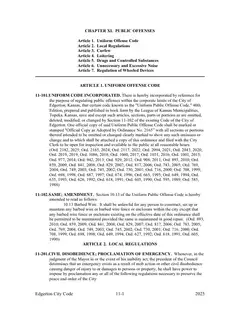
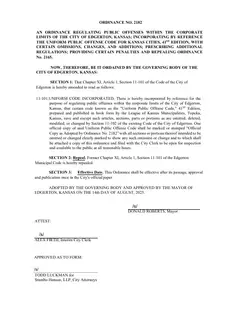
Uniform Code Incorporated
There is hereby incorporated by reference for the purpose of regulating public offenses within the corporate limits of the City of Edgerton, Kansas, that certain code known as the "Uniform Public Offense Code," 40th Edition, prepared and published in book form by the League of Kansas Municipalities, Topeka, Kansas, save and except such articles, sections, parts or portions as are omitted, deleted, modified, or changed by Section 11-102 of the existing Code of the City of Edgerton. One official copy of said Uniform Public Offense Code shall be marked or stamped "Official Copy as Adopted by Ordinance No. 2165” with all sections or portions thereof intended to be omitted or changed clearly marked to show any such omission or change and to which shall be attached a copy of this ordinance and filed with the City Clerk to be open for inspection and available to the public at all reasonable hours.
Same; Amendment
Section 10.13 of the Uniform Public Offense Code is hereby amended to read as follows:
10.13 Barbed Wire. It shall be unlawful for any person to construct, set up or maintain any barbed wire or barbed wire fence or enclosure within the city except that any barbed wire fence or enclosure existing on the effective date of this ordinance shall be permitted to be maintained provided the same is maintained in good repair.
Article 2. Local Regulations
Civil Disobedience; Proclamation of Emergency
Whenever, in the judgment of the Mayor in or the event of his inability act, the president of the Council determines that an emergency exists as a result of mob action or other civil disobedience causing danger of injury to or damages to persons or property, he shall have power to impose by proclamation any or all of the following regulations necessary to preserve the peace and order of the City:
(a)To impose a curfew upon all or any portion of the City thereby requiring all persons in such designated curfew areas to forthwith remove themselves from the public streets alleys, parks or other public places; provided, however, that physicians, nurses and ambulance operators performing medical services, utility personnel maintaining essential public services, firemen and City authorized or requested law enforcement officers and personnel may be exempted from such curfew.
(b)To order the closing of any business establishments anywhere within the city for the period of the emergency, such businesses to include, but not be limited to, those selling intoxicating liquors, cereal malt beverage, gasoline or firearms.
(c)To designate any public street, thoroughfare or vehicle parking areas closed to motor vehicles and pedestrian traffic.
(d)To call upon regular and auxiliary law enforcement agencies and organizations within or without the city to assist in preserving and keeping the peace within the city.
Same; Issuance
The proclamation of emergency provided herein shall become effective upon its issuance and dissemination to the public by appropriate news media, and/or by the posting of the proclamation in four public places within the city.
Same Termination
Any emergency proclaimed in accordance with the provisions of Section 11-201:202 shall terminate after forty-eight (48) hours from the issuance thereof, or upon the issuance of a proclamation determining an emergency no longer exists, whichever occurs first, provided, however, that such emergency may be extended for such additional periods of time as determined necessary by resolution of the Governing Body.
Same; Violation, Penalty
Any person who shall willfully fail or refuse to comply with the orders of duly authorized law enforcement officers or personnel charged with the responsibility of enforcing the proclamation of emergency authorized herein shall be deemed guilty of a misdemeanor and upon conviction therefore, shall be punished by a fine of not more than One Hundred Dollars $100 or imprisonment in the county jail for a period of not to exceed six months, or by both such fine and imprisonment.
Article 3. Curfew
Definitions
For the purpose of this article, the following terms, phrases, words and their derivations shall mean:
(a)City is the City of Edgerton.
(b)Emancipated Minor is anyone under he age of 18 whose parent or legal guardian has renounced his or her right to care, custody and earnings of the person.
(c)Minor is anyone under the age of 18, whose care and custody as well as right to his or her earnings, repose in a parent or legal guardian. It does not include an emancipated minor or anyone under the age of 18 who is legally married.
(d)Parent is any person having legal custody of a minor:
(i)as a natural or adoptive parent,
(ii)as a legal guardian,
(iii)as a person who stands in loco parentis, or
(iv)as a person to whom legal custody has been given by court order.
(e)Public Place is any place open to the public including public streets, highways, roads, alleys, parks, playgrounds or other public grounds, public places, public buildings, places of amusement, eating places, vacant lots, bar, bowling alley, café, drive-in restaurant, drive in theater, drug store, grocery store, hamburger stand, hotel, ice cream parlor, lobby, parking lot, pool room, restaurant, saloon, shopping center, supermarket, theater or any place dedicated to amusement and entertainment to which the public is invited, whether enclosed or out doors; and which includes any accompanying parking lot or pedestrian walk-way, or any appurtenances thereto which are used by the public.
Curfews for Certain Minor Children
It is unlawful for any minor to be present, to loiter, wander, stroll, or play in or upon any public place, as herein defined, unsupervised by an adult having the lawful authority to be at such place, between the hours of 10:00 p.m. on any day and 6:00 a.m. of the following day; provided, however, that on Fridays and Saturdays the effective hours are between 12:00 midnight and 6:00 a.m. of the following day.
Same; Exceptions
(a)When a minor is accompanied by his or her parent;
(b)When the minor is upon an emergency errand directed by his or her parent;
(c)When the minor is returning directly home from a school activity, school entertainment, school recreational activity or school dance;
(d)When the minor is returning directly home from employment that makes it necessary to be in the referenced places during the prescribed period of time;
(e)When the minor is attending or traveling directly to or from an activity involving the exercise of first amendment rights of free speech, freedom of assembly or free exercise of religion; and
(f)In interstate travel through the City of Edgerton, Kansas.
Same; Parental Responsibility
It shall be unlawful for a parent of a minor to permit, or by insufficient control, to allow such minor to be in, about, or upon any public place during the restricted hours, unsupervised by an adult having the lawful authority to be at such places, under circumstances not constituting an exception to, or otherwise beyond the scope of this Article.
Temporary Suspension
The Mayor of Edgerton, on specific occasions and in response to a written request submitted not less than three (3) days prior to the occasion, shall have the authority to temporarily suspend the hours of curfew as stated herein.
Penalties
(a)If there is a violation of this Article by the minor, the minor shall be charged and served a Notice to Appear in Municipal Court. Upon conviction, the minor shall be sentenced to complete a community service program; however, in the alternative, the Municipal Court shall have the discretion to impose a fine not to exceed One Hundred Fifty Dollars ($150.00) and costs; or, to impose a sentence of both a community service program and a fine not to exceed One Hundred Fifty Dollars ($150.00) and costs.
(b)If a parent, having custody or control of a minor, violates Section 11-304, said parent shall be charged and served a Notice to Appear in Municipal Court, and upon conviction, shall be subject to a fine not to exceed Two Hundred Dollars ($200.00) and costs. In lieu of a fine, the Municipal Court may impose probation; provided, however that as a condition of probation, attendance is required at family counseling sessions by the parent having custody or control of the minor.
Permitting Violation of Curfew
It shall be unlawful for a parent, guardian or other person lawfully entitled to the car, custody or control of any person under 18 years of age to knowingly suffer or permit such person to violate the provisions of this article.
A conviction upon violation of this section is punishable by a fine not to exceed $100 or probationary proceedings for a period not longer than 30 days, or both.
Records
It shall be the duty of the Police Department to maintain records of those minors having been stopped by police officers of those minors having been informed of this article. Such records shall include the name of the minor stopped and questioned, the name of the parent or legal guardian who was located and informed, the location at which the minor was stopped for questioning and the date on which it occurred. All information pertaining to the minor and not to the parent or legal guardian shall not be used by the juvenile authorities or by any other agency of the government to by any other person except as expressly authorized by this article.
Article 4. Loitering
Definition
Loitering is loading, wandering, standing or remaining idle, either alone or in concert with others, in a public place in such manner so as to:
(a)Obstruct any public street, public highway, public sidewalk or public building or any other place of public access by hindering or impeding or tend to hinder or impede the free and uninterrupted passage of vehicles, traffic or pedestrians;
(b)Committing in or upon any public street, public highway, public sidewalk or public building or any other place of public access any act or thing which is an obstruction or interference to the free and uninterrupted use of property or with any business lawfully conducted by anyone in or upon or facing or fronting on any such public street, public highway, public sidewalk or public building or any other place of public access, all of which prevents the free and uninterrupted ingress, egress, and regress therein, thereon, and thereto.
Order of Law Enforcement Officer
When any person causes or commits any of the conditions enumerated in Section 11-401, a law enforcement officer shall order that person to stop causing or committing such conditions and to move on or disperse. Any person who fails or refuses to obey such order is guilty of a violation of this article.
Violation; Penalty
Any person violating any provision of this article shall be punished as provided in Section 1-112 of this city code.
Article 5. Drugs and Controlled Substances
Definitions
As used in this article;
(a)Controlled Substances means any drug or substance included in Schedules 1 through V of the Uniform Controlled Substances Act found in Chapter 65, Article 41 of the Kansas Statutes Annotated.
(b)Drug means:
(1)Substances recognized as drugs in the official United States pharmacopoeia, official homeopathic pharmacopoeia of the United States or official national formulary or any supplement to any of them;
(2)Substances intended for use in the diagnosis, cure, mitigation, treatment or prevention of disease in man or animals;
(3)Substances (other than food) intended to affect the structure of any function of the body of man or animals; and
(4)Substances intended for use as a component of any article specified in subdivisions 1, 2,or 3 of this subsection. It does not include devices or their components, parts, or accessories.
(c)Deliver or Delivery means the actual, constructive or attempted transfer from one person to another of a controlled substance, whether or not there is an agency relationship.
(d)Dangerous Drug means one that is unsafe for use except under the supervision of a practitioner because of its toxicity or other potentiality for human effect, method of use, or collateral measures necessary to use; “dangerous drugs” include all other drugs or compounds, preparations or mixtures thereof which the State Board of Health shall find and declare by rule or regulation duly promulgated after reasonable public notice and opportunity for hearing to have a dangerous, hallucinogenic, hypnotic, omnificent or stimulating effect on the body of a human or animal.
(e)Marijuana means all parts of all varieties of the plant Cannabis, whether growing or not, the seeds thereof, the resin extracted from any part of the plant and every compound, manufacture, salt, derivative, mixture or preparation of the plant, its seeds or resin. It does not include the mature stalks of the plant, fiber produced from the stalks, oil or cake made from the seeds of the plant, any other compound, manufacture, sale, derivative, mixture or preparation of the mature stalks, except the resin extracted therefrom, fiber, oil, or cake or the sterilized seed of the plant which is incapable of germination.
(f)Manufacture means the production, preparation, propagation, compounding conversion or processing of a controlled substance either directly or indirectly by extraction from substances of natural origin or independently by means of chemical synthesis or by a combination of extraction and chemical synthesis and includes any packaging or repackaging of the substance or labeling or relabeling of its container, except that this term does not include the preparation or compounding of a controlled substance by an individual for his or her own use or the preparation, compounding, packaging or labeling of a controlled substance:
(1)By a practitioner or his agent pursuant to a lawful order of a practitioner as an incident to his or her administering or dispensing of a controlled substance in the course of his professional practice; or
(2)By a practitioner or by his or her authorized agent under his or her supervision for the purpose of or as an incident to research, teaching or chemical analysis or by a pharmacist or hospital as an incident to his, her or its dispensing of a controlled substance.
(g)Patient means, as the case may be:
(1)The individual for whom a drug is prescribed or to whom a drug is administered; or
(2)The owner or the agent of the owner of the animal for which a drug is prescribed or to which a drug is administered; provided, that the prescribing or administering referred to in subdivisions 1 and 2 of the subsection is in good faith and in the course of professional practice only.
(h)Person means individual, corporation, government or governmental subdivision or agency, business trust, estate, trust, partnership or association or any other legal entity.
(i)Pharmacist means an individual currently licensed by the board to practice the profession of pharmacy in this state.
(j)Practitioner means a physician (M.D. or D.O.), dentist, podiatrist, veterinarian, scientific investigator or other person licensed, registered or otherwise authorized by law to administer and prescribe, use in teaching or chemical analysis, or conduct research with respect to a controlled substance in the course of professional practice and research.
(k)Production includes the manufacture, planting, cultivation, growing or harvesting of a controlled substance.
(l)Prescription means a written order, and in cases of emergency, a telephone order, issued by a practitioner in good faith in the course of his professional practice to a pharmacist for a drug for a particular patient, which specifies the date of its issue, the name and address of the patient (and, if such drug is prescribed for an animal, the species of such animal), the name and quantity of the drug prescribed, the directions for use of such drug, and the signature of such practitioner.
(m)Somnifacient and Stimulating have the meaning attributable in standard medical lexicons.
(n)Warehouseman means a person who, in the usual course of business, stores drugs for others lawfully entitled to possess them and who has no control over the disposition of such drugs except for the purpose of such storage.
(o)Wholesaler means a person engaged in the business of distributing drugs to persons included in any of the classes named in this chapter.
(p)Instrument means a device designed for use, or intended for use in ingesting, smoking, administering or preparing marijuana, cocaine, phencyclidine, opium or any derivative thereof, or any other controlled substance.
For purposes of this subsection, the phrase “intended for use” refers to the intent of the person selling, offering to sell, dispensing, giving away or displaying the instrument herein defined.
In determining whether an item constitutes and instrument, a court may consider the following:
1.Whether a person or business establishment charged with violating this section is a licensed distributor or dealer of tobacco products under Chapter 79, Article 33 of the Kansas Statutes Annotated;
2.Expert testimony as to the principal use of the devices, articles, or contrivances claimed to be instruments;
3.Evidence concerning the total business of a person or business establishment and the type of devices, articles, contrivances, or items involved in the business;
4.National and local advertising concerning the use of the devices, articles, or contrivances claimed to be instruments;
5.Evidence of advertising concerning the nature of the business establishment.
(q)Minor mean any person who has not attained eighteen years of age.
(r)Premises Open to Minors means any business establishment which sells its wares or merchandise to minors or which permits minors to enter into its place of business.
(s)Simulated Drugs and Simulated Controlled Substance are any products which identify themselves by using a common name or slang term associated with a controlled substance or indicate by label or accompanying promotional material that the product simulates the effect of a controlled substance or drug.
(t)Place of Display means any museum, library, school or other similar public place upon which business is not transacted for a profit.
(u)School means any public or private elementary, junior high or high school.
(v)Close Proximity means within five hundred feet on a straight line commencing at the property line nearest to each other.
(w)Premises means a business establishment and the structure of which it is a part and facilities and appurtenances therein and grounds, areas and facilities held out for the use of patrons.
Regulations
(a)It is unlawful for any person to deliver, possess, manufacture, have under his control, sell, or offer for sale any drugs unless:
(1)Such drug is delivered by a pharmacist, or his or her authorized agent, in good faith upon prescription and there is affixed to the immediate container in such drug is delivered a label bearing:
(i)The name and address of the owner of the establishment from which such drug was delivered;
(ii)The date on which the prescription for such drug was filled;
(iii)The number such prescription as filled in the prescription files of the pharmacist who filled such prescription;
(iv)The name of the practitioner who prescribed such drug;
(v)The name and address of the patient, and if such drug was prescribed for an animal, a statement showing the species of the animal; and
(vi)The direction for use of the drug and cautionary statements, if any, as contained in the prescription; and
(2)In the event that such delivery is pursuant to telephonic order, such prescription shall be promptly reduced to writing and filed by the pharmacist; or
(3)Such drug is delivered by a practitioner in good faith and in the course of his or her professional practice only.
(b)It is unlawful for any person to refill any prescription for a drug unless such refilling is specifically authorized by the prescriber.
(c)It is unlawful for any person to possess a drug unless such person obtained such drug on the prescription of a practitioner or in accordance with subdivision 3 of subsection a of this section or from a person licensed by laws of any other state or the District of Columbia to prescribe or dispense drugs.
(d)It is unlawful for any person to obtain or attempt to obtain a drug by fraud, deceit, misrepresentation or subterfuge; or by the forgery or alteration of a prescription; or by the use of false name or the giving of a false address.
(e)It is unlawful for any person to sell, offer for sale or have in his possession with the intent to sell any hallucinogenic or stimulating drug described in section 11-501.
(f)It shall be unlawful for any person to sell, offer to sell, dispense, give away or display any instrument or simulated controlled substance or simulated drug in or upon any premises which: (a) are premises open to minors, unless the instruments, simulated controlled or simulated drugs are kept in such part of the premises that is not open to view by minors or to which minors do not have access; or (b) are in close proximity to a school. Provided, however, that display of any such items at a place of display for education or scientific purposes shall not be unlawful.
Exemptions
(a)The provisions of subsection (a) of section 11-502 shall not be applicable:
(1)To the delivery of drugs for medical or scientific purposes only to persons included in any of the classes hereinafter named, or to the agents or employees of such persons, for use in the usual course of their business or practice or in the performance of their official duties, as the case may be; or
(2)To the possession drugs by such persons or their agents or employees for such use:
(i)Pharmacists;
(ii)Practitioners;
(iii)Persons who procure drugs:
(a)For disposition by or under the supervision of pharmacists or practitioners employed by them or
(b)For the purpose of lawful research, teaching or testing and not for resale;
(iv)Hospitals and other institutions which procure drugs for lawful administration by or under the supervision of practitioners;
(v)Manufacturers and wholesalers;
(vi)Carriers and warehousemen.
(b)Nothing contained in section 11-502 shall make it unlawful for a public officer, agent or employee, or person aiding such public officer in performing his official duties to possess, obtain, or attempt to obtain a drug for the purpose of enforcing the provisions of any law of this state or of the Untied States relating to the regulation of the handling, sale or distribution of drugs.
(c)Nothing in this article shall apply to a compound, mixture, or preparation containing a drug which is sold in good faith for the purpose of which it is intended and not for the purpose of evading the provisions of this article if such compound, mixture, or preparation contains a sufficient quantity of another therapeutic agent or agents, in addition to such a drug, to cause it to prevent the ingestion of a sufficient amount of drug to cause a dangerous hypnotic somnifacient or stimulating action.
Violation; Penalty
Any person violating any provision of this article shall be punished as provided in section 1-112 of the Code of the City of Edgerton.
Article 6. Excessive Noise
Excessive and Unnecessary Noise Prohibited
It shall be unlawful for any person to make, continue, maintain or cause to be made or continued any excessive, unnecessary, unreasonable or unusually loud noise or any noise that annoys, disturbs, injures or endangers the comfort, repose, health, peace or safety of others within the City of Edgerton.
Amplified Noises
It shall be unlawful for any person to use, operate or permit the use or operations of any electronic device, radio receiving set, television, musical instrument, phonograph, stereo, or any machine or device used for producing, reproducing or broadcasting sound in a manner so as to disturb the peace, quiet and enjoyment of neighboring inhabitants or at any time with volume louder than is necessary for convenient hearing for the person or persons who are in the room, vehicle or chamber in which such machine or device is operated and who are voluntary listeners thereto. “Neighboring inhabitants” means persons living or occupying within residential districts of single or multiple-family dwellings and shall include areas where multiple-unit dwellings, high-rise apartments and high-density residential districts are located.
Prima Facie Violation
The operation of any electronic device, radio receiving set, television, musical instrument, phonograph, stereo, or any machine or sound-producing device at any time in such a manner as to be plainly audible at the adjacent property line, or 50 feet in the case of a multiple family dwelling between the hours of 10:00 p.m. and 8:00 a.m. shall be prima facie evidence of a violation of this Chapter.
Public Celebrations and Festivals
The provisions of this article shall not apply to noise and sounds made or generated by public festivals. “Public festivals” means any celebration, fair, event or festival that is open to the general public and is recognized by resolution or proclamation as a public festival by the governing body of the city.
Article 7. Regulation of Wheeled Devices
Intent
The intent of this Article is to supplement the Standard Traffic Ordinance adopted each year by the City to address specific concerns the City has with motorized wheeled devices that are not subject to being registered as vehicles by the Division of Vehicles of the Kansas Department of Revenue. Nothing herein is intended to conflict with the Standard Traffic Ordinance and, in the event a conflict arises, the Standard Traffic Ordinance shall supercede this Chapter.
Definitions
For the purpose of this Chapter, the following terms, phrases, words and their derivations shall mean:
(a)City is the City of Edgerton, Kansas.
(b)Child is anyone thirteen (13) years of age or younger, whose care and custody as well as right to his or her earnings, repose in a parent or legal guardian.
(c)Electric-Assisted Bicycle (or e-bike) is a bicycle with two or three wheels, a saddle, fully operative pedals for human propulsion, and an electric motor of less than 750 watts that meets the requirements of one of the following three classes:
(i)Class 1 electric-assisted bicycle means an electric-assisted bicycle equipped with a motor that provides assistance only when the rider is pedaling and ceases to provide assistance when the bicycle reaches the speed of 20 miles per hour;
(ii)Class 2 electric-assisted bicycle means an electric-assisted bicycle equipped with a motor that may be used exclusively to propel the bicycle and is not capable of providing assistance when the bicycle reaches the speed of 20 miles per hour; or
(iii)Class 3 electric-assisted bicycle means an electric-assisted bicycle equipped with a motor that provides assistance only when the rider is pedaling and ceases to provide assistance when the bicycle reaches the speed of 28 miles per hour. (as defined by K.S.A. 8-1489 as amended)
(d)Electric Assisted Scooter (or e-scooter) is every self-propelled vehicle, other than an electric-assisted bicycle, that has at least two wheels in contact with the ground, an electric motor, handlebars, a brake and a deck that is designed to be stood upon when riding. (as defined by K.S.A.8-1498) as amended)
(e)Motorized Wheeled Device is any device with wheels that is propelled by a motor or battery, used to transport persons, and is not subject to being registered as a vehicle by the Division of Vehicles of the Kansas Department of Revenue.
(f)Parent is any person having legal custody of a minor: (i) as a natural or adoptive parent, (ii) as a legal guardian (iii) as a person who stands in loco parentis, or (iv) as a person to whom legal custody has been given by court order.
(g)Person is every natural person, firm, association, partnership or corporation.
(h)Sidewalk is that portion of a street between the curb lines, or the lateral lines of a roadway, and the adjacent property lines intended for the use of pedestrians.
(i)Street or Highway is the entire width between the boundary lines of every way publicly maintained when any part thereof is open to the use of the public for purposes of vehicular traffic. Where the word “highway” or the word “street” is used in this Article, it shall mean street, avenue, boulevard, thoroughfare, trafficway, alley and other public way for vehicular travel by whatever name unless the context clearly indicates otherwise.
(j)Toy Vehicles are any motorized or propellant-driven device with a maximum speed capability of 5 mph that has no manufacturer-issued vehicle identification number that is designed or used to carry any person or persons, on any number of wheels, bearings, glides, blades, runners, or a cushion of air for recreation or play specifically designed and used for the purpose of transporting children or infants. "Toy vehicle" does not include electric personal assistive mobility devices, electric power-assisted bicycles, mopeds, scooters, skateboards, or motorcycles, nor does it include any nonmotorized or nonpropellant-driven devices such as bicycles, roller skates, or skateboards.
Motorized Wheeled Devices Prohibited
It is unlawful for any person to operate a motorized wheeled device on any City street, highway, or sidewalk.
Exceptions to Section 11-703 of This Article
The following devices, or use of devices, shall be exempt from this Article, and shall constitute being “authorized by the City” for purposes of provisions of the Standard Traffic Ordinance that prohibit such devices except if authorized by the City:
(a)When the device is being used by or for a “Person with a Disability” (as defined by the Standard Traffic Ordinance) who, without use of the device, is unable to transport himself or herself;
(b)When the device is being used in a City parade, or other community event authorized by the Governing Body, or the device has been otherwise exempted from Section 11- 703 by the Governing Body, provided, however, that nothing herein shall be construed as waiving or relieving such users from any other ordinances, statutes, or regulations that may be applicable to such use;
(c)When the device is being used by law enforcement officers or by emergency personnel while in the performance of their official duties;
(d)Lawn care equipment, construction equipment, or other commercial or residential equipment which temporarily enter upon a City street or sidewalk for the purpose of completing a task or project requiring such equipment, which task or project shall not be related to the transport of persons;
(e)Lawn care equipment, construction equipment, or other commercial or residential equipment driven from dawn to dusk by someone 14 years of age or older upon the outermost edge of a City street [excluding streets with a speed limit in excess of 30 miles per hour] for the purpose of moving said equipment to a jobsite where the equipment will be used to complete a task or project, but such task or project shall not be the transport of persons;
(f)“Authorized Emergency Vehicle” as defined by the Standard Traffic Ordinance;
(g)“Farm Tractor” as defined by the Standard Traffic Ordinance;
(h)“House Trailer” as defined by the Standard Traffic Ordinance;
(i)“Implement of Husbandry” as defined by the Standard Traffic Ordinance;
(j)“Motorized Wheelchair” as defined by the Standard Traffic Ordinance;
(k)“Micro Utility Truck” as defined by the Standard Traffic Ordinance;
(l)“Recreational Vehicle” as defined by the Standard Traffic Ordinance; or
(m)“Special Mobile Equipment” as defined by the Standard Traffic Ordinance.
(n)“Electric Assisted Bicycles” and “Electric Assisted Scooters” as defined in this Article, when used subject to the following restrictions:
(i)All operators must be 14 years of age or older. No license or registration shall be required.
(ii)E-bikes and E-Scooters shall not be allowed on streets with a posted speed limit of more than 30 mph. They shall not be allowed on truck routes, sidewalks, trails, multi-use paths or unpaved surfaces. They may be walked on truck routes, sidewalks, trails, multi-use paths, unpaved surfaces and streets with a posted speed limit of over 30 mph. Operators must follow all laws associated with operating a bicycle on right-of-way, and shall not be allowed to cross or travel on any interstate, federal or state highway unless otherwise allowed by state statute.
(iii)Operators shall follow the posted speed limit.
(iv)The E-Bike and E-Scooter operator shall only permit the number of passengers for which the E-Bike and E-Scooter is designed or equipped to carry.
(v)E-Bike and E-Scooter shall only be operated between the hours of sunrise and sunset.
(o)“Toy Vehicles” as defined in this Article, when used subject to the following restrictions:
(i)Toy vehicle operations shall be limited to the sidewalk and multi-use paths and trails.
(ii)Toy Vehicles shall not cross or travel on any street with a posted speed limit of over 30 mph.
(iii)A present adult is required to be within fifteen (15) feet and maintain visual sight of a child operating a toy vehicle at all times.
Same; Parental Responsibility
It shall be unlawful for a parent of a child to permit, or by insufficient control, to allow such child to violate Section 11-703 or 11-704 of this Article.
Enforcement
(a)Violations of this Article, whether by an adult or a minor, shall be deemed a traffic infraction;
(b)If there is a violation of this Article by any person, that person shall be charged and served with a Notice to Appear in Municipal Court. Upon conviction, the fine for first offense shall be One Hundred Fifty Dollars ($150.00), the fine for a second offense shall be Three Hundred Dollars ($300.00) and the fine for a third and subsequent offenses shall be Five Hundred Dollars ($500.00).
(c)If a parent, having custody or control of a child, authorizes or knowingly permits a child to violate Section 11-703 or Section 11-704 of this Article, said parent shall be charged and Served a Notice to Appear in Municipal Court and, upon conviction, shall be subject to a fine not a exceed Three Hundred Dollars ($300.00) and costs.
Every Chapter
Municipal Code- Chapter IAdministration54 sections
- Chapter IIAnimals22 sections
- Chapter IIIBeverages45 sections
- Chapter IVBuildings, Construction and Fire146 sections
- Chapter VBusiness Regulations53 sections
- Chapter VIElections2 sections
- Chapter VIIIHealth and Welfare112 sections
- Chapter IXMunicipal Court10 sections
- Chapter XPolice13 sections
- Chapter XIPublic Offense31 sections
- Chapter XIIPublic Property76 sections
- Chapter XIIIStreets and Sidewalks45 sections
- Chapter XIVTraffic24 sections
- Chapter XVUtilities102 sections
- Chapter XVIZoning and Planning3 sections