
Municipal Code
Chapter XV, Utilities
As Adopted and Amended
The text on this page is the City’s chapter as posted. An ordinance passed since may not be set into it yet.
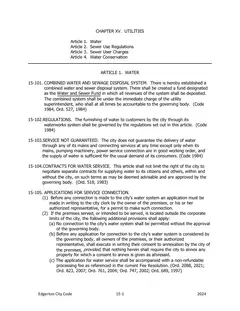
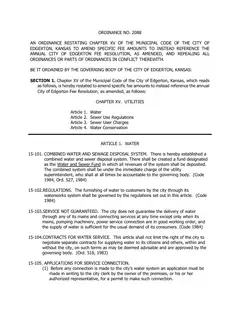
Article 1. Water
Combined Water and Sewage Disposal System
There is hereby established a combined water and sewer disposal system. There shall be created a fund designated as the Water and Sewer Fund in which all revenues of the system shall be deposited. The combined system shall be under the immediate charge of the utility superintendent, who shall at all times be accountable to the governing body.
Regulations
The furnishing of water to customers by the city through its waterworks system shall be governed by the regulations set out in this article.
Service Not Guaranteed
The city does not guarantee the delivery of water through any of its mains and connecting services at any time except only when its mains, pumping machinery, power service connection are in good working order, and the supply of water is sufficient for the usual demand of its consumers.
Contracts for Water Service
This article shall not limit the right of the city to negotiate separate contracts for supplying water to its citizens and others, within and without the city, on such terms as may be deemed advisable and are approved by the governing body.
Applications for Service Connection
(1)Before any connection is made to the city’s water system an application must be made in writing to the city clerk by the owner of the premises, or his or her authorized representative, for a permit to make such connection.
(2)If the premises served, or intended to be served, is located outside the corporate limits of the city, the following additional provisions shall apply:
(a)No connection to the city’s water system shall be permitted without the approval of the governing body.
(b)Before any application for connection to the city’s water system is considered by the governing body, all owners of the premises, or their authorized representative, shall execute in writing their consent to annexation by the city of the premises, provided, that nothing herein shall require the city to annex any property for which a consent to annex is given as aforesaid.
(c)The application for water service shall be accompanied with a non-refundable processing fee as referenced in the current Fee Resolution.
Connections Charge: Water System Development Fee
The city shall make all service connections. The owner of the premises shall be solely responsible for the cost of all service connections and road boring associated therewith. The minimum charges for water service connections are referenced in the current Fee Resolution as follows:
•Fee for regular 3/4-inch service connection, with 3/4-inch x 5/8-inch meter located inside the corporate limits of the city. In addition to the water service connection fee, a Water System Development Fee shall be assessed for each connection. Payment of the Development fee must accompany the application.
•Fee for regular 3/4-inch service connection, with 3/4-inch x 5/8-inch meter located outside the corporate limits of the city.
Service connections for any other size service shall be determined by the governing body and may be outlined in the current Fee Resolution, but in no event shall the cost of the same be less than the connection fees set forth hereinabove.
In the event the property to be connected to the city’s water system is benefited by water system improvements financed by an improvement district, then additional fees for connection to said improvements may be applicable.
Curb Cocks
There shall be a curb cock in every service line attached to the city main, the same to be placed within the meter box. Curb cocks shall be supplied with strong and suitable “T” handles.
Check Valves
Check valves are required on all connections to stream boilers or on any other connection deemed necessary by the water superintendent. Safety and relief valves shall be placed on all boilers or other steam apparatus connected with the water system where the steam pressure may be raised in excess of 40 pounds per square inch.
Cross Connectons Prohibited
No person shall make or permit to be made a cross connection whereby a private, auxiliary, or emergency water supply other than the regular public water supply of the city may enter the supply or distribution system of the municipality unless such private, auxiliary or emergency water supply and the method of connection and use of such supply shall have been approved by the water superintendent and the Kansas Department of Health and Environment.
Meters
(a)All water furnished to customers shall be metered.
(b)Meters are provided by the City, the cost of which shall be included in the current Fee Resolution
(c)Meters shall be located in accordance with the City of Edgerton’s Technical Specification, said meters being between the sidewalk or property line and curbing when the main is in the street, and on private property within three feet of the alley line when the main is in the alley. No meters are to be installed beneath paved surfaces.
(c)The city’s responsibility stops at the meter and any work necessary past the meter, between the meter and the structure shall be done in accordance with the provisions of Chapter 4 of this code.
Maintenance Period
The applicant, their successors and/or assigns, shown on the water connection permit shall be responsible for one (1) year for ground settlement and any damage to the meter pit and/or meter due to grading, other construction activities and any and all damage not due to the actions of the City. The one-year period begins on the date of the meter installation. The applicant shall promptly perform, at the expense, any required maintenance to ensure compliance with City codes, policies, and regulations.
Same; Testing
Meters shall be tested before being set and at any other time thereafter when they appear to be measuring incorrectly. If a test is requested by the customer and the meter is found to be accurate within two percent, the meter will be deemed correct and a charge as referenced in the current Fee Resolution will be made to the customer.
Same; Consumer’s Responsibility
Consumers shall be responsible for any damage done to meters, meter settings or for any tampering with the meter after disconnection for any reason and all appurtenances related thereto installed on their premises, by malicious intent, or from any other cause, except ordinary wear. The city shall keep all meters in repair and in proper working condition without cost to the consumer except where the consumer is liable as determined by the city and as before mentioned in this section, in which the consumer shall pay the city for the cost of repairing any meter, meter setting or appurtenances related thereto, plus labor, that has been damaged when supplying his or her premises. No consumer or other person shall repair or remove any meter, meter setting or appurtenances or tamper with the meter after disconnection for any reason or break any seal or use any water without authority from the water department of the city, nor tamper with the proper registration of any meter. The consumer shall be deemed responsible for any damage to the meter on his or her premises if occasioned by his or her negligent or intentional actions.
Leaks
(a)No allowances shall be made for water used or lost through carelessness, neglect or otherwise after the same has passed through the meter, however, every customer shall have the right to appeal to the city from water bill or meter reading that is due to an undetectable water lead, or a water bill or meter reading the customer considers excessive. When a customer advises the city that a leak has occurred, the following procedure for adjustment of billing shall be followed:
(b)The City will first determine if the leak meets the criteria set forth below, which shall be reviewed by the City Administrator, or designee, and will require documentation from the customer regarding the leak:
1.The leak was undetectable by the customer and was not the result of a readily detectable leak (i.e. leaking faucets, toilets, hydrants, etc.) that should have been easily discovered by the customer.
2.There has been no adjustment for a leak for the property in the past twelve (12) month period. The customer shall provide repair receipts from a plumber/contractor or copies of bills for plumbing materials used to repair the leak to show that the repair work has been completed, and/or the City is able to inspect the leak area at the time the repair is made.
3.The customer’s water consumption for the billing cycle is more than double the average consumption for the previous three billing cycles. 4.The City agrees that a leak adjustment is appropriate and –is justified by the customer’s request.
(c)If the above criteria are met, as indicated by proper documentation or information submitted by the City, then the - customer shall make written request for adjustment of the account billing by having the owner of the property make a written request, on their own behalf or on behalf of the current user of the property, for adjustment of the reading or bill by completing and signing a copy of the City’s Leak Adjustment Agreement form. The customer shall, by signing the Leak Adjustment Agreement form, agree that no additional claim for adjustment for the property shall be made for the occurrence that is the subject of the Agreement, and shall not request adjustment for any subsequent occurrences within the twelve (12) month period following the adjustment.
(d)If all of the above criteria are met as indicated by the City Administrator, or designee, the following procedure for account adjustment shall apply: 1.A maximum of two billing cycles will be approved for adjustment. The City shall review the account to determine the probable time period that the leak occurred in order to decide whether one or two billing cycles qualify for the adjustment. If the lead has been on-going for a long period, the most recent month(s) will apply for the adjustment.
2.The City shall determine the average usage of the service in question. Average usage is determined by reviewing the three-month period prior to the leak event or averaging a three-month period during the same seasonal period in the previous year using the highest average calculated.
3. After the City determines the average usage, the City shall charge the customer for water usage above the average normal usage at the highest wholesale price normally charged to the City by all sources that provide the City water. The average normal usage shall be billed at the regular rates for water service.
Connection Fee
At the time of making application for water service, the applicant shall pay to the city a connection fee as referenced in the current Fee Resolution.
Cut Off Fee
Any utility account for which service has been disconnected for nonpayment of a delinquent bill shall be charged a Cut Off Fee as referenced in the current Fee Resolution. Any reconnection shall be made only upon payment of the delinquent bill, penalty charges thereon, and the cut off fee. Any such reconnection shall be made during regular business hours Monday through Friday. Any reconnection of services made at times other than those stated above shall have an Afterhours Cut Off Fee as referenced in the current Fee Resolution.
Deposit May Be Required
If any customer of the municipal water system shall become delinquent in payment of water bills two or more times in a 12-month period, the city clerk may require the customer to make a cash deposit in an amount to be determined by the city clerk to be sufficient to secure payment of accrued bills or bills due or discontinuance of service.
Interrupt Service
The city reserves the right to interrupt water service for the purpose of making repairs or extensions to water lines or equipment.
Prohibited Acts; Possible Remedies
1.It shall be unlawful for any person to:
(a)Tamper, damage meddle with any water main, fire hydrant, electric line or any other water or electric equipment belonging to the city;
(b)Make any connection to the water service or electric systems of the city without a written permit from the city;
(c)Reconnect service when it has been discontinued for nonpayment of a bill for service.
2.The city shall have the right to charge the owner of the property in question for damage to the city’s meter, including the ability to add such cost to the owner’s utility bill. The owner may request proof of such charge from the city.
3.All remaining violations involving the prohibited acts listed in 1. a, b and c above may result in an action bring brought against the offender in Municipal Court.
Wasting Water
Water users shall prevent unnecessary waste of water and shall keep sprinklers, hydrants, faucets and all apparatus, including the service line leading from the property to the meter in good condition at their expense.
Right of Access
Authorized employees of the city may enter upon any premises at reasonable hours for the purpose of reading the meter or servicing or inspecting meters or water lines.
Utility Bills
All utility bills shall be rendered monthly for water and sewer, and shall be due and payable on the 1st day of each month, which shall be the billing date. A charge of 10% will be added to any utility bill not paid by the 15th day of the month. Whenever payment is not made by the due date, the city shall have the right to terminate water service after notice and hearing, as provided for in the sections 15-123:125. Before service shall be restored, the customer shall pay the bill, late payment charge and the connection fee provided for in section 15-114.
Liabiity of Property Owner; Lien
(a)Lessors of leased premises served by utility service furnished by the city shall be ultimately liable for payment of the cost of any utility service furnished by the city to such leased premises, whether the service is furnished upon the application and request of the lessor or the lessee of such premises.
(b)If utility service is furnished by the city to leased premises, upon the application and request of the lessee, than all billings for such service furnished shall be made to the lessee. However, if the cost of such service is not paid, as and when they become payable, the lessor of the premises served shall be liable for the payment of such cost, plus all interest and penalties as provided by the laws of the city. The lessor shall be notified in writing by first class mail within 10 days after a billing becomes delinquent.
(c)If utility service is furnished to leased premises on the application and request of the lessor of the premises, than all billings for utilities furnished to such leased premises shall be made directly to the lessor, and the lessor shall be fully liable for the cost of service furnished.
(d)Such charges shall constitute a lien upon the real estate served, and shall be certified by the city clerk to the county clerk, to be placed on the tax rolls for collection, subject to the same penalties and collected in like manner as other taxes collectible by law.
Charge for Partial Month’s Service
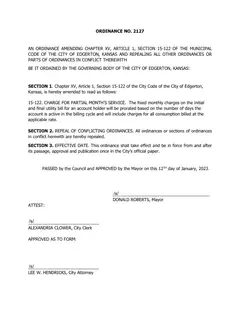
The fixed monthly charges on the initial and final utility bill for an account holder will be prorated based on the number of days the account is active in the billing cycle and will include charges for all consumption billed at the applicable rate.
Delinquent Accounts
Water or other utility service shall be terminated for nonpayment of service fees or charges as provided in sections 15-124:125.
Notice; Hearing
(a)A delinquency and termination notice shall be issued by the city clerk on the 15th day following the billing date. The notice shall be mailed to the customer at his or her last known address. A copy also shall be mailed to the occupant of the premises if the occupant and the customer are not the same person.
(b)The notice shall state:
(1)The amount due, plus late payment charges;
(2)Notice that service will be terminated if the amount due is not paid by the 25th day following the billing date;
(3)Notice that the customer has the right to a hearing before the mayor or other designated hearing officer;
(4)Notice that the request for a hearing must be in writing and filed with the city clerk no later than three days prior to the date for termination of service.
(c)Upon receipt of a request for hearing, the city clerk shall advise the customer of the date, time and place of the hearing which shall be held within three working days following receipt of the request.
Same; Finding
Following the hearing, if the hearing officer shall find that service should not be terminated, then notice of such finding shall be presented to the utility superintendent. If the officer finds that service should be terminated, an order shall be issued terminating service five days after the date of the order. The customer shall be notified either in person or by mailing a letter to his or her last known address by certified mail, return receipt requested. However, if the order is made at the hearing in the presence of the customer, then no further notice is given. The hearing officer has a right, for good cause, to grant an extension, not to exceed 10 days, for the termination of such service.
Water Rationing
The city reserves the right to restrict or prohibit the use of water and to specify the purposes for which it may be used whenever the governing body determines the public exigency so requires.
Same; Procedure
Whenever the governing body determines that water use must be restricted or prohibited, it shall forthwith issue a proclamation of emergency through the news media and the use other appropriate methods of making public the proclamation.
Same; Priority Use
In the event a proclamation of emergency is issued, water usage will be restricted or prohibited first for uses in the following priority:
(a)Water lawns, gardens, trees, shrubs, plants and water outside dwellings for such purposes as car, boat, or trailer washing or washing exterior of dwellings;
(b)Industrial uses of water, including but not limited to car wash operations and packing plant operations;
(c)Business use, other than industrial;
(d)Home uses other than those set forth in subsection (a).
Petty Cash Fund
A petty cash fund in the amount of $50 is established for the use of the water department, for the purpose of paying postage, freight, temporary labor, and other emergency expenses.
Same; Deposits
The petty cash fund shall be deposited in the regular depository bank of the city and paid out on the order of the city clerk by check which shall clearly state the purpose for which it is issued.
Same; Vouchers
Whenever the petty cash fund becomes low or depleted, the city clerk shall prepare vouchers covering expenses as have been paid from the petty cash fund and shall submit such vouchers together with the paid checks to the governing body for review and allowance of the amounts from the regular funds of the utilities. Warrants issued therefore shall be payable to the petty cash fund and shall be deposited therein to restore the petty cash fund to its original amount.
Use During Fire
No person owning or occupying premises connected to the municipal water system shall use or allow to be used during a fire any water from the water system except for the purpose of extinguishing the fire. Upon the wounding of a fire alarm it shall be the duty of every such person to see that all water services are rightly closed and that no water is used except in extraordinary cases of emergency during the fire.
Water Rates
(a)The rates charged for water supplied by the City are:
(1)For water used and serviced as a single “service unit” within the corporate limits of the City and usage shall be billed per the rates stated in the current Fee Resolution
(2)For water used and serviced as a single “service unit” outside the corporate limits of the city and usage shall be billed per the rates stated in the current Fee Resolution Provided, the customer service charge as stated in the current Fee Resolution shall apply to any property, improved or unimproved which is connected to the municipal water system which has a City-furnished water meter, whether or not consumption of water actually occurs at or on such property during the billing period.
(b)The rates as scheduled in subsection (a) shall apply and be figured on the consumption of water by the thousand gallons or fraction thereof to the nearest 100 gallons.
(1)A “service unit” shall consist of a single family dwelling or residence, or a private apartment or rooming house, or a business and residence, providing both are located on the same property and the owner and operator of the business and the occupant of the residence is one and the same, or a combination of buildings owned by one party in one common enclosure occupied by one family or business.
(2)Each separate residence or dwelling is a separate “service unit”, and each separate service unit must have an individual water meter. Any apartment house, or trailer park, where the owner is responsible for payment of the water bill, will be exempt from this rule.
(1)In a case where more than one “service unit” is furnished water through the same meter the minimum charge per month for each “service unit” shall be as set forth in subsection (a), provided that each such minimum charged and paid shall entitle the customer to the amount of gallons as set forth in subsection
(2)Where the owner of a trailer park is responsible for payment of the water bill, each trailer must be metered separately for water, and/or a common water meter, and each trailer shall be charged a minimum bill as a single user. The meter reader shall count the trailers occupying the park on the day that the meters are read in each month, and shall figure the total consumption divided by the numbers of trailers in use on that day, and shall graduate the water bill as if each trailer were metered separately.
Hydrant Meters
(a)Request. When temporary water service is desired by contractors, builders or any other party for the purchase of water to be used for construction work or some other city approved purpose, the requesting party shall submit an Application for Hydrant Meter to the City. Should the City approve this use, the requesting party shall pay a refundable hydrant meter deposit in the amount listed in the City’s Annual Fee Resolution prior to receipt of the meter.
(b)Meter. Receipt of a hydrant meter shall allow the party to connect to a City hydrant for a defined period of time, subject to the limitations listed in (d) below. The City may require that connection of the meter to the City hydrant involve the assistance of City staff. A hydrant meter shall be returned in the same condition it was in when the City provided it to the requesting party, normal wear and tear excepted. Failure to return the meter, or damage to the meter, shall result in a setoff of the deposit or retention of the entire deposit, when applicable. The cost of repairs to the meter shall be established by the City’s Annual Fee Resolution. In the event a cost is not covered by that Resolution, the fee shall be the actual cost to repair, plus ten percent.
(c)Water Rate. The rate charged by the City for water provided from a hydrant meter shall be the same rate that is charged to customers outside the corporate limits of the City. This rate includes both the customer service charge (based on meter size) and the volumetric rate (using only the first tier for 0-2,000 gallons) as designated in the City’s Annual Fee Resolution.
(d)Emergency Use by City or Fire District. By filing an Application for Hydrant Meter and receiving a hydrant meter from the City, the requesting party is acknowledging and accepting that in the event the hydrant to which they are connected is needed for emergency or city or fire district purposes, both parties need for, and right to, water shall supersede that of the party possessing the hydrant meter.
(e)Violation to Use Without Meter. It shall be a violation of the City Code to use water from a City hydrant, or any other source, without that water being measured by a meter furnished by the City.
Definitions
The following definitions shall apply in the interpretation and enforcement of this policy concerning cross connections:
(a)Air Gap Separation means the unobstructed vertical distance through the free atmosphere between the lowest opening from any pipe or faucet supplying water to a tank, plumbing fixture, or other device and the flood level rim to the receptacle, and shall be at least double the diameter of the supply pipe measured vertically above the flood level rim of the vessel, but in no case less than one inch.
(b)Approved Tester means a person qualified to make inspections; to test and repair backflow prevention/cross connection control devices; and who is approved by the city.
(c)Authorized Representative means any person designated by the city to administer this cross connection control article.
(d)Auxiliary Water Supply means any water source or system, other than the city, that may be available in the building or premises. This does not include other KDHE (Kansas Department of Health and Environment) permitted public water supply systems.
(e)Backflow means the flow other than the intended direction of flow, of any foreign liquids, gases, used water or substances into the distribution system of a public water supply system.
(f)Backflow Prevention Device means any device, method or type of construction intended to prevent backflow into the public water supply system.
(g)Consumer means any individual, firm, partnership, corporation, or agency or their authorized agent receiving water from the city.
(h)Contamination means an introduction of any sewage, process fluids, chemicals, wastes or any other substance that would be objectionable. Contamination may be a treat to life or health, or may cause an aesthetic deterioration, color, taste, or odor.
(i)Cross Connection means any physical connection or arrangement between two otherwise separate piping systems; one of which contains potable water of the public water supply system, and the second, water of unknown or questionable safety, or steam, gases, chemicals, or substances whereby there may be backflow the second system to the public water supply system. No physical cross connection shall be permitted between a public water supply system and an auxiliary water supply system.
(j)Degree of Hazard means an evaluation of the potential risk to public health and the adverse effect of the hazard upon anyone using the water.
(k)Health Hazard means any condition, device or practice in the public water supply system which could create or may create a danger to the health and well-being of anyone using the water or allow contamination of the water.
(l)Public Water System means the water supply source, distribution system and appurtenances to the service meter operated as a public utility which supplies potable water to the consumers’ water systems.
(m)Public Water Supply System means the public water system and the consumers’ water system.
(n)Consumer’s Water System means all service pipe, all distribution piping and all appurtenances beyond the service meter of the public water system.
(o)Service Connection means the terminal end of the service line from the public water system. If a meter is installed at the end of service, then the service connection means the downstream end of the meter.
Cross Connection Control General Policy
(a)Purpose. The purpose of this policy is:
(1)To protect the public water supply system from contamination.
(2)To promote the elimination, containment, isolation, or control of cross connection between the public water supply system and non-potable water systems, plumbing fixtures, and industrial process systems or other systems which introduce or may introduce contaminants into the public water system or the consumer’s water system.
(3)To provide for the maintenance of a continuing program of cross connection control which will prevent the contamination of the public water supply system.
(b)Application. This article shall apply to all consumers’ water systems. The city may also require cross connection control devices at the service connections of other KDHE permitted public water supply systems served by the city.
(c)Intent. This policy will be reasonably interpreted by the city. It is the intent of the city to recognize the varying degrees of hazard and to apply the principle the degree of protection shall be commensurate with the degree of hazard. If, in the judgment of the city or its authorized representative, cross connection protection is required through either piping modification or installation of an approved backflow prevention device, due notice shall be given to the consumer. The consumers shall immediately comply by providing the required protection at his own expense. Failure or refusal or inability on the part of the consumer to provide such protection shall constitute grounds for the discontinuation of water service to the premises until such protection has been provided.
Cross Connection Prohibited
(a)No water service connection shall be installed or maintained to any premises where actual or potential cross connections to the public water supply system may exist unless such actual or potential cross connections are abated or controlled to the satisfaction of the city or its authorized representative.
(b)No connection shall be installed or maintained whereby an auxiliary water supply may enter a public water supply system.
Survey and Investigations
(a)The consumer’s premises shall be open at all reasonable times to the city or its authorized representative, for the conduction of surveys and investigations of water use practices within the consumer’s premises to determine whether there are actual or potential cross connections in the consumer’s water system.
(b)On request by the city or its authorized representative, the consumer shall furnish requested information on water use practices within his premises and in the consumer’s water system.
(c)On request by the city or its authorized representative, the consumer shall conduct periodic surveys of water use practices on the premises of the consumer’s water system to determine whether there are actual or potential cross connections. The consumer shall provide the survey results to the city or its authorized representative.
Where Protection Is Required
(a)An approved backflow prevention device shall be installed on each service line to a consumer’s water system serving premises where, in the judgment of the city or its authorized representative or the KDHE, actual or potential cross connections exist. The type and degree of protection required shall be commensurate with the degree of hazard and/or type of contamination that may enter the public water supply system.
(b)An approved air gap separation or reduced pressure principle backflow prevention device shall be installed at the service connection or within any premises where, in the judge of the city or its authorized representative or KDHE, the nature and extent of activities, or the materials used in connection with the activities, or materials stored on the premises, would present a health hazard or contamination of the public water supply system from a cross connection. This includes but is not limited to the following situations:
(1)Premises having an auxiliary water supply, unless the quality of the auxiliary supply is acceptable to the city or its authorized representative and the KDHE.
(2)Premises having internal plumbing arrangements which made it impractical to ascertain whether or not cross connections exist.
(3)Premises where entry is restricted so that inspection for cross connections cannot be made with sufficient frequency or at sufficiently short notice to assure the cross connections do not exist.
(4)Premises having a repeated history of cross connection being established or re-established.
(5)Premises, which due to the nature of the enterprise therein, are subject to recurring modification or expansion.
(6)Premises on which any substance is handled under pressure so as to permit entry into the public water supply system, or where a cross connection could reasonable be expected to occur. This shall include the handling of process waters and cooling waters.
(7)Premises where toxic or hazardous materials are handled.
(c)The following types of facilities fall into one or more of the categories or premises where an approved air gap separation or reduced pressure principle backflow prevention device may be required by the city or its authorized representative or the KDHE to protect the public water supply and must be installed at these facilities unless all hazardous or potentially hazardous conditions have been eliminated or corrected by other methods to the satisfaction of the city or its authorized representative and the KDHE:
(1)Agricultural chemical facilities;
(2)Auxiliary water systems, wells;
(3)Boilers;
(4)Bulk water loading facilities;
(5)Car washing facilities;
(6)Chemical manufacturing, processing, compounding or treatment plants;
(7)Chill water systems;
(8)Cooling towers;
(9)Feedlots;
(10)Fire protection systems;
(11)Hazardous waste storage and disposal sites;
(12)Hospitals, mortuaries, clinics or others as discovered by sanitary surveys;
(13)Irrigation and sprinkler systems;
(14)Laundries and dry cleaning;
(15)Meat processing facilities;
(16)Metal manufacturing, cleaning, processing and fabricating plants;
(17)Oil and gas production, refining, storage or transmission properties;
(18)Plating plants;
(19)Power plants;
(20)Research and analytical laboratories;
(21)Sewage and storm drainage facilities—pumping stations and treatment plants;
(22)Veterinary clinics.
Backflow Prevention Devices
(a)Any backflow prevention device required by this article shall be of a model or construction approved by the city or its authorized representative and the KDHE.
(1)Air gap separation to be approved shall be at least twice the diameter of the supply pipe, measured vertically above the top rim of the vessel, but in no case less than one inch.
(2)Double check valve assemblies or reduced pressure principle backflow prevention devices shall appear on the current list of approved backflow prevention devices established by the KDHE, unless the device was installed at the time this ordinance was passed and complies with required inspection and maintenance.
(b)Devices: The following devices are recognized for cross connection control and backflow prevention by the Kansas Department of Health & Environment and are published as part of this article.
(1)Air Gap. Gap must be two pipes diameters (in an instance less than one inch). Must be inspected annually. Satisfactory for any material. Whenever practical the control method of choice.
(2)Reduced Pressure Principle Backflow Preventer. Contains two specifically designed, soft seated, independently acting check valves with a reduced pressure zone (with relief valve) between the two checks. Shut off valves before and after the device. Satisfactory for most toxic materials. Significant pressure loss. (10 psi or more) Must be tested and inspected annually. Repaired as necessary.
(3)Double Check Valve Assembly. Contains two soft seated independently acting check valves in series. Shut off valves before and after device. Adequate for nontoxic applications only. Minor pressure loss. Must be inspected and tested annually. Repaired as necessary.
(4)Pressure Vacuum Breaker. Must be installed a minimum of 12 inches above highest point of usage. No back pressure, only back siphonage. Can operate under constant pressure. Shut off valve can be located beyond the vacuum breaker. Must be inspected and tested annually. Repaired as necessary.
(5)Atmospheric Vacuum Breaker. Must be installed a minimum of 6 inches above highest point of usage. No back pressure, only back siphonage. Not for use under constant pressure. Can operate under constraint pressure. Shut off valve can be located beyond the vacuum breaker. Must be inspected and tested annually. Repaired as necessary.
Installation
(a)Backflow prevention devices required by this policy shall be installed at a location and in a manner approved by the city or its authorized agent. All devices shall be installed at the expense of the water consumer, unless the city or its authorized representative agrees otherwise.
(b)Backflow prevention devices installed at the service connection shall be located on the consumer’s side of the water meter, as close to the meter as is reasonably practical, and prior to any other connection
(c)Backflow prevention devices shall be conveniently accessible for maintenance and testing, protected from freezing, and where no part of the device will be submerged or subject to flooding by and fluid. All devices shall be installed according to manufactures’ recommendations.
Inspection and Maintenance
(a)The consumer is required by this article to inspect, test, and overhaul backflow prevention devices in accordance with the following schedule or more often as determined by the city or its authorized representative.
(1)Air gap separations shall be inspected at the time of installation and at least monthly.
(2)Double check valve assemblies shall be inspected and tested for tightness at the time of installation and at least every 12 months thereafter. They shall be dismantled, inspected internally, cleaned, and repaired whenever needed and at least every 30 months.
(3)Reduced pressure principle backflow prevention devices shall be inspected and tested for tightness at the time of installation and at least every 12 months thereafter. They shall be dismantled, inspected internally, cleaned, and repaired whenever needed and at least every five years.
(b)Inspection, tests, and overhauls of backflow prevention devices shall be made at the expense of the consumer and shall be performed by an approved tester.
(c)Whenever backflow prevention devices required by this policy are found to be defective, they shall be repaired or replaced without delay at the expense of the consumer.
(d)The consumer must maintain a complete record of each backflow prevention device from purchase to retirement. This shall include a comprehensive listing that includes a record of all tests, inspections, and repairs. All records of inspections, tests, repairs, and overhauls shall be provided within 30 days to the city or its authorized representative.
(e)All backflow prevention devices shall have a tag showing the date of the last inspection, test, or overhaul or other maintenance.
(f)Backflow prevention devices shall not be bypassed, made inoperative, removed, or otherwise made ineffective without specific authorization by the city or its authorized representative.
Violation and Penalties
(a)The city or its authorized representative shall deny or discontinue the water service to any premises or any consumer wherein any backflow prevention device required by this policy is not installed, tested, and maintained in a manner acceptable to the city or its authorized representative, or if it is found that the backflow prevention device has been removed or bypassed, or if an unprotected cross connection exists.
(b)Water service to such premises shall not be restored until the consumer is in compliance with the foregoing cross connection ordinance to the satisfaction of the city or its authorized representative.
Water Reserve Fund
(a)The city does hereby establish a water reserve fund for the purpose of paying costs of the following items:
(1)The cost or a portion of the costs to the city for emergency expenditures, unexpected developments, mayor line or equipment replacement, repairs or capital improvements incidental to the water utility system of the city.
(2)The city out of the water utility fund, after the payment of the direct costs of the operation and maintenance of the utility, and after the payment of principal and interest on all outstanding water utility bonds, may pay into the water reserve fund, at intervals designated by the governing body, an amount which shall be determined annually at regular budget preparation time.
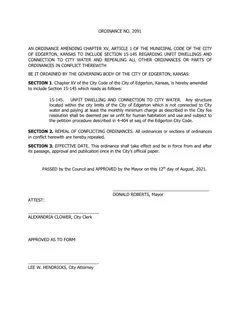
Unfit Dwelling and Connection to City Water
Any structure located within the city limits of the City of Edgerton which is not connected to City water and paying at least the monthly minimum charge as described in the City fee resolution shall be deemed per se unfit for human habitation and use and subject to the petition procedure described in 4-404 et seq of the Edgerton City Code.
Article 2. Sewer Use Regulations
Definitions
Unless the context specifically indicates otherwise, the meaning of terms used in this article shall be as follows:
(a)City shall mean the City of Edgerton, Kansas, acting through its duly elected and appointed officials.
(b)B.O.D. (denoting Biochemical Oxygen Demand) shall mean the quantity of oxygen utilized in the biochemical oxidation of organic matter under standard laboratory procedure in five days at 20 degrees centigrade, expressed in parts per million by weight.
(c)Building Drain shall mean that part of the lowest horizontal piping of a drainage system which receives the discharge from soil, waste, and other drainage pipes inside the walls of the building and conveys it to the building sewer, beginning five (5) feet outside the inner face of the building wall.
(d)Building Sewer shall mean the extension from the building drain to the public sewer or other place of disposal.
(e)Combined Sewer shall mean a sewer receiving both surface runoff and sewage.
(f)Garbage shall mean solid wastes from the preparation, cooking and dispensing of food, and from the handling, storage and sale or produce.
(g)Industrial Wastes shall mean the liquid wastes from industrial processes as distinct from sanitary sewage.
(h)Natural Outlet shall mean any outlet into a watercourse, pond, ditch, lake or other body of surface or ground water.
(i)Person shall mean any individual, firm, company, association, society, corporation, or group.
(j)pH shall mean the logarithm of the reciprocal of the weight of hydrogen ions in grams per liter of solution.
(k)Properly Shredded Garbage shall mean the wastes from the preparation, cooking and dispensing of food that have been shredded to such a degree that all particles will be carried freely under the flow conditions normally prevailing in public sewers, with no particle greater than one-half inch (1.27 centimeters) in any dimension.
(l)Public Sewer shall mean a sewer in which all owners of abutting properties have equal rights, and is controlled by public authority.
(m)Sanitary Sewer shall mean a sewer which carries sewage and to which storm, surface, and groundwater are not intentionally admitted.
(n)Sewage shall mean a combination of the water-carried wastes from residences, business buildings, institutions, and industrial establishments, together with such ground water, surface, and storm waters as may be present.
(o)Sewage Treatment Plant shall mean any arrangement of devices and structures used for treating sewage.
(p)Sewage Works shall mean all facilities for collecting, pumping, treating and disposing of sewage.
(q)Sewer shall mean a pipe or conduit for carrying sewage.
(r)Shall is mandatory; May is permissive.
(s)Slug shall mean any discharge of water, sewage, or industrial waste which in concentration of any given constitute or in quantity of flow exceeds for any period of duration longer than fifteen (15) minutes more than five (5) times the average twenty-four (24) hour concentration or flows during normal operation.
(t)Storm Sewer or Storm Drain shall mean a sewer which carries storm and surface waters and drainage, but excludes sewage and industrial wastes.
(u)Superintendent shall mean the superintendent of sewage works of the city or his authorized deputy, agent or representative.
(v)Suspended Solids shall mean solids that either float on the surface of, or are in suspension in water, sewage, or other liquids, and which are removable by laboratory filtering.
(w)Watercourse shall mean a channel in which a flow of water occurs, either continuously or intermittently.
Unlawful Sewage Deposits
(a)It shall be unlawful for any person to place, deposit, or permit to be deposited in an unsanitary manner upon public or private property within the city, or in any area under the jurisdiction of the city, any human or animal excrement, garbage or other objectionable waste.
(b)It shall be unlawful to discharge to any natural outlet within the city, or in any area under the jurisdiction of the city, any sanitary sewage, industrial wastes, or other polluted waters, except where suitable treatment has been provided in accordance with this article.
Privys, Septic Tanks
Except as provided by this article, it shall be unlawful to construct or maintain any privy, privy vault, septic tank, cesspool or other facility intended or used for disposal of sewage.
Connections Required
The owner of all houses, buildings or properties used for human occupancy, employment, recreation, or other purposes, situated within the city and abutting on any street, alley or right-of-way in which there is now located or may in the future be located a public sanitary sewer of the city, is hereby required at his or her expense to install suitable toilet facilities therein, and to connect such facilities directly with the property public sewer in accordance with the provisions of this article, provided that the public sewer is within 100 feet of the property line.
Same; Permit
No unauthorized person shall uncover, make any connections with or opening into, use, alter, or disturb any public sewer or appurtenance thereof, without first obtaining a written permit from the superintendent.
Same; Fee
(a)The owner of a building desiring to connect to city sewer service, or his or her agent, shall make application for connection to such service on a special form furnished by the city. The permit application shall be supplemented by any plans, specifications, or other information considered pertinent in the judgment of the superintendent. A permit and inspection fee as stated in the current Fee Resolution shall be paid to the city clerk at the time the application is filed. (b) There is hereby established a Sewer System Development Fee in the amount in the amount stated in the current Fee Resolution, payment of which must accompany application. In the event the property to be connected to the city’s sanitary sewer system is benefited by sanitary sewer system improvements financed by an improvement district, then additional fees for connection to said improvements may be applicable.
Private Disposal System - Regulations Incorporated
Where a public sanitary sewer is not available under the provisions of section 15-204, the building sewer shall be connected to a private sewage disposal system complying with the provisions of this article. There is hereby incorporated by reference for the purpose of prescribing procedures, rules, regulations, standards, and enforcement procedures for the use of private sewage disposal systems, the document entitled “Private Sewage Disposal Systems” dated January 12, 1995. No fewer than three copies shall be marked or stamped “Official Copy as adopted by the Code of the City of Edgerton.” The official copy shall be filed with the city clerk and shall be open to inspection and available to the public at all reasonable hours.
Reserved for future use
Same; Connection to Public System
At such time as a public sewer becomes available to a property served by a private sewage disposal system, as provided in section 15-204, a direct connection shall be made to the public sewer in compliance with this article, and any septic tanks, cesspools, and similar private sewage disposal facilities shall be abandoned and filled with suitable material.
Same; Maintenance
The owner shall operate and maintain the private sewage disposal facilities in a sanitary manner at all times, at no expense to the city.
Same; Refilling
When a public sewer becomes available, the building sewer shall be connected to the sewer within sixty (60) days and the private sewage disposal system shall be cleaned of sludge and filled with clean bank run gravel or dirt.
Same; Additional Requirements
No statement contained in this article shall be construed to interfere with any additional requirements that may be imposed by the County or State Boards of Health.
Installation; Costs Borne by Owner
All costs and expenses incident to the installation and connection to the building sewer shall be borne by the owner. The owner shall indemnify the city from any loss or damage that may directly or indirectly be occasioned by the installation of the building sewer.
Separate Sewer for Every Building
A separate and independent building sewer shall be provided for every building; except where one building stands at the rear of another on an interior lot and no private sewer is available or can be constructed to the rear building through an adjoining alley, court, yard, or driveway, the building sewer from the front building may be extended to the rear building and the whole considered as one building sewer.
Old Building Sewers
Old buildings sewers may be used in connection with new buildings only when they are found, on examination and tested by the superintendent, to meet all requirements of this article.
Sewer Specifications
(a)The building sewer shall be cast iron soil pipe, vitrified clay sewer pipe, or other suitable material approved by the superintendent. Joints installed shall be tight and waterproof. Any part of the building sewer that is located within ten (10) feet of a water service pipe shall be constructed of cast iron soil pipe with leaded joints. Cast iron pipe with leaded joints may be required by the superintendent where the building sewer is exposed to damage by tree roots. If installed in filled or unstable ground, the building sewer shall be of cast iron soil pipe, except that non-metallic material may be accepted if laid on a suitable concrete bed or cradle as approved by the superintendent.
(b)The size and slope of the building sewer shall be subject to the approval of the superintendent, but in no event shall the diameter of the pipe be less than four (4) inches for single residences, and six (6) inches for commercial or industrial establishments. The slope of the pipe shall be not less than one-eighth (1/8) inch per foot and should be one-quarter (¼) inch per foot where possible.
Sewer Elevation
No building sewer shall be laid parallel to or within three (3) feet of any bearing wall, which might thereby be weakened. The depth shall be sufficient to afford protection from frost. The building sewer shall be laid at a uniform grade and in straight alignment insofar as possible. Changes in direction shall be made only with properly curved pipe and fittings.
Drains
In all buildings in which the building drain is too low to permit gravity flow to the public sewer, sanitary sewage carried by such drain shall be lifted by approved artificial means and discharged to the building sewer.
Excavations
All excavations required for the installation of a building sewer shall be open trench work unless otherwise approved by the superintendent. No backfill shall be place until the work has been inspected by the superintendent.
Joints
All joints in the building sewers shall be made gastight and watertight. Cast iron pipe joints shall be firmly packed with oakum and hemp and filled with molten lead or Sulphur jointing compound. No paint, varnish or other coatings shall be permitted on the jointing material until after the joint has been tested and approved. All joints in vitrified clay pipe, or between clay pipe and cast iron pipe, shall first be caulked tight with jute, hemp, or similar approved material, then filled with approved Asphaltum jointing compounds.
Other joint materials and methods may be used only by approval of the superintendent.
Connection Regulations
The connection of the building sewer into the public sewer shall be made at the wye branch if such wye branch is available at a suitable location. If the public sewer is twelve (12) inches in diameter or less, and no properly located wye branch is available, the owner shall at his or her own expense install a wye branch or an approved saddle at the location specified by the superintendent. Where permitted by the superintendent, a neat hole may be cut into the public sewer to receive the building sewer, with entry in the downstream direction at an angle of about forty-five (45) degrees. A forty-five (45) degree angle may be used to make such connection, with the spigot end cut so as not to extend past the inner surface of the public sewer. The invert of the building sewer at the point of connection shall be at the same or at a higher elevation than the invert of the public sewer. A smooth, neat joint shall be made, and the connection made secure and watertight by encasement in concrete.
Inspection Before Connection
The applicant for the building sewer permit shall notify the superintendent when the building sewer is ready for inspection and connection to the public sewer. The connection shall be made under the supervision of the superintendent of his or her representative.
Barricades and Lights
All excavations for building sewer installation shall be adequately guarded with barricades and lights so as to protect the public form hazard. Streets, sidewalks, parkways and other public property disturbed in the course of the work shall be restored in a manner satisfactory to the city.
Downspouts
No person shall make connection of roof downspouts, interior and exterior foundation drains, areaway drains, or other sources of surface runoff or groundwater to a building sewer or building drain which in turn is connected directly or indirectly to a public sanitary sewer.
Storm and Surface Water
(a)No person shall discharge or cause to be discharged, any storm water, surface water, groundwater, roof runoff, subsurface drainage, cooling water or unpolluted industrial process waters to any sanitary sewer.
(b)Storm water and all other unpolluted drainage shall be discharged to such sewers as are specifically designated as storm sewers, or to a natural outlet approved by the superintendent. Industrial cooling water or unpolluted process waters maybe discharged, upon approval of superintendent, to a storm sewer or natural outlet.
Unlawful Discharges
Except as hereinafter provided, no person shall discharge or cause to be discharged any of the following described waters or wastes to any public sewer.
(a)Any liquid or vapor having a temperature higher than 150 degrees Fahrenheit;
(b)Any water or waste which may contain more than 100 parts per million, by weight, of fat, oil or grease;
(c)Any gasoline, benzene, naphtha, fuel oil, or other flammable or explosive liquid, solid or gas;
(d)Any garbage that has not been properly shredded;
(e)Any ashes, cinders, sand, mud, straw, shavings, metal, glass, rags, feathers, tar, plastics, wood, paunch manure, or any other solid or viscous substance capable of causing obstruction to the flow in sewers or other interference with the property operation of the sewage works;
(f)Any waters or wastes having a pH lower than 5.5 or higher than 9.0 or having any other corrosive property capable of causing damage or hazard to structures, equipment and personnel of the sewage works;
(g)Any waters or wastes containing toxic or poisonous solids, liquids, or gases in sufficient quantity, either singly or by interaction with other wastes, to injure or interfere with any sewage treatment process, constitute a hazard to humans or animals, create a public nuisance, or create any hazard in the receiving water of the sewage treatment plant, including but not limited to cyanides in excess of two mg/1 as CN in the wastes as discharged to the public sewer;
(h)Any water or wastes containing suspended solids of such character and quantity that unusual attention or expense is required to handle such materials at the sewage treatment plant;
(i)Any noxious or malodorous gas or substance capable of creating a public nuisance.
Same; Discretion of Superintendent
No person shall discharge or cause to be discharged the following described substances, materials, waters, or wastes if it appears likely in the opinion of the superintendent that such wastes can harm either the sewer, sewage treatment process, or equipment, have an adverse effect on the receiving stream, or can otherwise endanger life, limb, public property, or constitute a nuisance. In forming his or her opinion as to the acceptability of these wastes, the superintendent will give consideration to such factors as the quantities of subject wastes in relation to flows and velocities in the sewers, materials of construction of the sewers, nature of the sewage treatment process, capacity of the sewage treatment plant, degree of treatability of wastes in the sewage treatment plant, and other pertinent facts. The substances prohibited are:
(a)Any waters or wastes containing strong acid iron pickling wastes, or concentrated plating solutions whether neutralized or not.
(b)Any waters or wastes containing iron, chromium, copper, zinc, and similar objectionable or toxic substances; or wastes exerting an excessive chlorine requirement, to such degree that any such material received in the composite sewage at the sewage treatment works exceeds the limits established by the superintendent for such materials.
(c)Any waters or wastes containing phenols or other taste or odor producing substances, in such concentrations exceeding limits which may be established by the superintendent as necessary, after treatment of the composite sewage, to meet the requirements of state, federal or other public agencies of jurisdiction for such discharge to the receiving waters.
(d)Any pollutants, including oxygen demanding pollutants and nutrients (nitrogen and phosphorus compounds), released in a discharge at a flow rate and/or pollutant concentration which will cause interference with the publicly owned treatment facilities.
(e)Any radioactive wastes or isotopes of such half-life or concentration as may exceed limits established by the superintendent in compliance with applicable state or federal regulations.
(f)Any waters or wastes having a pH in excess of 9.5.
(g)Materials which exert or cause:
(1)Unusual concentrations of inert suspended solids (such as, but not limited to, Fullers earth, lime slurries, and live residues) or of dissolved solids (such as, but not limited to, sodium chloride or sodium sulfate).
(2)Excessive discoloration (such as, but not limited to, dye wastes and vegetable tanning solutions).
(3)Unusual BOD, chemical oxygen demand, or chlorine requirements in such quantities as to constitute a significant load on the sewage treatment works.
(4)Unusual volume of flow or concentration of wastes constituting slug as defined herein.
(5)Excessive nitrogen or phosphorus loading in such quantities as to constitute load on the sewage treatment works.
(h)Waters or wastes containing substances which are not amenable to treatment or reduction by the sewage treatment processes employed, or are amenable to treatment only to such degree that the sewage treatment plant effluent cannot meet the requirements of other agencies having jurisdiction over discharge to the receiving waters.
Interceptors
(a)Grease, oil and sand interceptors or traps shall be provided in all filling stations, public garages and other commercial buildings where vehicles are washed or serviced, and in all other commercial or industrial building, when, in the opinion of the superintendent, they are necessary for the proper handling of liquid wastes containing grease in excessive amounts, or any flammable wastes, sand, and other harmful ingredients; except that such interceptors or traps shall not be request for private living quarters or dwelling units. All interceptors or traps shall be a type and capacity approved by the superintendent, and shall be located as to be readily and easily accessible for cleaning and inspection.
Grease and oil interceptors or traps shall be constructed of impervious materials capable of withstanding abrupt and extreme changes in temperature. They shall be of substantial construction watertight, and equipped with easily removable covers which when bolted in place shall be gastight and watertight.
(b)Where installed, all grease, oil and sand interceptors or traps shall be maintained by the owner, at his or her expense in continuously efficient operation at all times.
Preliminary Treatment
(a)The admission into the public sewers of any waters or wastes having a five-day Biochemical Oxygen Demand greater than 300 parts per million by weight, or containing more than 350 parts per million by weight of suspended solids, or containing any quantity of substances having the characteristics described in section 15-228, 15-229, or having an average daily flow greater than two percent of the average daily sewage flow the city, shall be subject to the review and approval of the superintendent. Where necessary in the opinion of the superintendent, the owner shall, provide at his or her expense, such preliminary treatment as may be necessary to, reduce the Biochemical Oxygen Demand to 300 parts per million and the suspended solids to 350 parts per million by weight, or reduce objectionable characteristics or constituents to within the maximum limits provided for in section 15-228, or control the quantities and rates of discharge of such waters or wastes. Plans, specifications, and any other pertinent information relating to proposed preliminary treatment facilities shall be submitted for the approval of the superintendent and the Kansas State Board of Health, and no construction of such facilities shall be commenced until the approvals are obtained in writing, or require payment to cover the added cost of handling and treating the wastes not covered by existing taxes or sewer charges under the provisions of section 15-233 of this article.
(b)Where preliminary treatment facilities are provided for any waters or wastes, they shall be maintained continuously in satisfactory and effective operation by the owner at his or her expense.
Inspections; Manholes
(a)When required by the superintendent, the owner of any property served by a building sewer carrying industrial wastes shall install a suitable control manhole in the building sewer to facilitate observation, sampling and measurement of the wastes. Such manhole, when required, shall be accessibly and safely located, and shall be constructed in accordance with plans approved by the superintendent. The manhole shall be installed by the owner at his or her expense, and shall be maintained by him or her at his or her expense, so as to be safe and accessible at all times.
(b)All measurements, test and analyses of the characteristics of waters and wastes to which reference is made in sections 15-228 and 15-231 shall be determined in accordance with Standard Methods for the Examination of Water and Sewage and shall be determined at the control manhole provided for in subsection (a), or upon suitable samples taken at the control manhole. In the event that no special manhole has been required, the control manhole shall be considered to be the nearest downstream manhole in the public sewer to the point at which the building sewer is connected.
Special Agreements
No statement contained in this article shall be construed as preventing any special agreement or arrangement between the city and any industrial concern whereby an industrial waste of unusual strength or character may be accepted by the city for treatment, subject to payment therefore by the industrial concern.
Damaging Sewers
No unauthorized person shall maliciously, willfully, or negligently break, damage, destroy, uncover, deface or tamper with any structure, appurtenance, or equipment which is a part of the municipal sewage works.
Right of Entry; Liability
(a)The superintendent and other duly authorized employees of the city bearing proper credentials and identifications shall be permitted to enter all properties for the purposes of inspections, observation, measurement, sampling, and testing in accordance with the provisions of this article. The superintendent or his or her representatives shall have no authority to inquire into any processes including metallurgical, chemical, oil, refining ceramic, paper, or other industries beyond that point having a direct bearing on the kind and source of discharge to the sewers or waterways or facilities for waste treatment.
(b)While performing the necessary work on private properties referred to in subsection
(a)above, the superintendent or duly authorized employees of the city shall observe all safety rules applicable to the premises established by the company and the company shall be held harmless for injury or death to the city employees and the city shall indemnify the company against loss or damage to its property by the city employees and against liability claims and demands for personal injury or property damage asserted against the company and growing out of the gauging and sampling operation, except as such may be caused by negligence or failure of the company to maintain safe conditions as required in section 15-232.
Penalty
(a)Any person found to be violating any provisions of this article except section 115-234 shall be served by the city with written notice stating the nature of the violation and providing a reasonable time limit for the satisfactory correction thereof. The offender shall, within the period of time stated in such notice permanently cease all violations.
(b)Any person who shall continue any violation beyond the time limit provided for in subsection (a) shall, upon conviction thereof be fined in an amount not exceeding $1000 for each violation. Each day in which any such violation shall continue shall be deemed a separate offense.
(c)Any person violating any of the provisions of this article shall become liable to the city for such expense, loss or damage occasioned by the city by reason of such violation.
Article 3. Sewer User Charges
Definitions
Unless the context specifically indicates otherwise the meaning of terms used in this article shall be as follows:
(a)“B.O.D.” (denoting Biochemical Oxygen Demand) shall mean the quantity of oxygen utilized in the biochemical oxidation of organic matter under standard laboratory procedure in five (5) days at 20°C, expressed in milligrams per liter (mg/l).
(b)“Normal Domestic Wastewater” shall mean wastewater that has a BOD concentration of not more than 400 mg/1 and a suspended solids concentration of not more than 400 mg/1.
(c)“Operation and Maintenance” shall mean all expenditures during the useful life of the treatment works for materials, labor, utilities, and other items which are necessary for managing and maintaining the sewage works to achieve the capacity and performance for which such works were designed and constructed.
(d)“Replacement” shall mean expenditures of obtaining and installing equipment, accessories, or appurtenances which are necessary during the useful life of the treatment works to maintain the capacity and performance for which such works were designed and constructed. The term “operation and maintenance” includes replacement.
(e)“Residential Contributor” shall mean any contributor to the city’s treatment works whose lot, parcel of real estate, or building is used for domestic dwelling purposes only.
(f)“Shall” is mandatory; “May” is permissive.
(g)“SS” (denoting Suspended Solids) shall mean solids that either float on the surface of or are in suspension in water, sewage, or other liquids and which are removable by laboratory filtering.
(h)“Treatment Works” shall mean any devices and systems for the storage, treatment, recycling, and reclamation of municipal sewerage, domestic sewage, or liquid industrial wastes. These include intercepting sewers, outfall sewers, sewage collection systems, individual systems, pumping, power, and other equipment and their appurtenances; extensions, improvement, remodeling, additions and alterations thereof; elements essential to provide a reliable recycled supply such as standby treatment units and clear well facilities; and any works, including site acquisition of the land that will be an integral part of the treatment process or is used for ultimate disposal of residues resulting from such treatment (including land for composting sludge, temporary storage of such compost, and land used for the storage of treated wastewater in land treatment systems before land application); or any other method or system for preventing, abating, reducing, storing, treating, separating, or disposing of municipal waste or industrial waste, including waste in combined stormwater and sanitary sewer systems.
(i)“Useful Life” shall mean the estimated period during which a treatment works will be operated.
(j)“User Charge” shall mean that portion of the total wastewater service charge which is levied in a proportional and adequate manner for the cost of operation, maintenance, and replacement of the wastewater treatment works.
(k)“Water Meter” shall mean a volume measuring and recording device, furnished and/or installed by the city or furnished and/or installed by a user and approved by the city.
Revenues
The user charge system shall generate adequate annual revenues to pay costs of annual operation and maintenance including replacement and cost associated with debt retirement of bonded capital associated with financing the treatment works which the city may by ordinance designate to be paid by the user charge system. That portion of the total user charge which is designated for operation and maintenance, including replacement of the treatment works, shall be established by this article.
Operation, Maintenance and Replacement Fund
That portion of the total user charge collected which is designated for operation and maintenance, including replacement purposes as established in sections 15-30:308, shall be deposited in a separate non-lapsing fund known as the Operation, Maintenance and Replacement Fund and will be kept in two primary accounts as follows:
(a)An account designated for the specific purpose of defraying operation and maintenance costs excluding replacement of the treatment works (Operation and Maintenance Account).
(b)An account designated for the specific purpose of ensuring replacement needs over the useful life of the treatment works (Replacement Account). Deposits in the replacement account shall be made annually from the operation, maintenance and replacement revenue in the amount of 15% of the annual operation and maintenance.
Same; Fiscal Year-End Balances
Fiscal year-end balances in the operation and maintenance account and the replacement account shall be carried over to the same accounts in the subsequent fiscal year, and shall be used for no other purposes than those designated for these accounts. Monies which have been transferred from other sources to meet temporary shortages in the operation, maintenance and replacement fund shall be returned to their respective accounts upon appropriate adjustment of the user charge rates for operation, maintenance and replacement. The user charge rate(s) shall be adjusted such that the transferred monies will be returned to their respective accounts within the fiscal year following the fiscal year in which the monies were borrowed.
User Charges
(a)Each user shall pay for the services provided by the city based on his or her use of the treatment works as determined by water meter(s) acceptable to the city.
(b)For residential contributors, monthly user charges will be based on average monthly water usage during the months of December, January, and February (winter average). If a residential contributor has not established a December, January, and February (winter average), his or her monthly user charge shall be actual wastewater use or 5,000 gallon, whichever is less, until an actual winter average can be established.
(c)For industrial and commercial contributors, user charges shall be based on water used during the current month. If a commercial or industrial contributor has a consumptive user of water, or in some other manner uses water which is not returned to the wastewater collections system, the user charges for that contributor may be based on a wastewater meter(s) installed and maintained at the contributor’s expense, and in a manner acceptable to the city.
(d)In addition to the charges set forth in (a), (b), and (c) hereinabove, each contributor shall also be charged a monthly charge -as referenced in the current Fee Resolution for being connected to the city sewer. In addition, each contributor shall pay a user charge rate for replacement costs, operation and maintenance of the treatment works - as referenced in the current Fee Resolution, per 1,000 gallons or portion thereof of water (or wastewater if a meter is installed in accordance with (c) above) as determined in the preceding section.
For those contributors who contribute wastewater to the treatment works, the strength of which is greater than normal domestic sewage, a surcharge in addition to the normal user charge will be collected. The surcharge for operation and maintenance, including replacement, for contributors with greater than normal domestic sewage strength sewer will be calculated by the city engineer and approved by the governing body for each such contributor.
Toxic Pollutants; Increased Cost
Any user which discharges any toxic pollutants which cause an increase in the cost of managing the effluent or the sludge from the city’s treatment works, or any user which discharges any substance which singly or by interaction with other substances causes identifiable increases in the cost of operation, maintenance, or replacement of the treatment works, shall pay for such increases costs. The charge to each such user shall be as determined by the responsible plant operating personnel and approved by the governing body.
Applicability
The user charge rates established in this article apply to all users, regardless of their location with respect to the city’s wastewater facilities.
Billing
All users shall be billed monthly. Charges shall be payable at the same time and upon the statement of the water bills of the city. A bill remaining unpaid for a period to exceed 25 days shall be deemed delinquent and governed by sections 15-122:124 of this chapter.
Review of User Charges
The city will review the user charge system at least every two years, and revise user charge rates as necessary to ensure that the system generates adequate revenues to pay the costs of operation and maintenance, including replacement, and that the system continues to provide for the proportional distribution of operation and maintenance including replacement costs among users and user classes.
Article 4. Water Conservation
Purpose; Resolution
(a)The purpose of this Article is to provide for the declaration of a water supply watch, warning or emergency and the implementation of voluntary and mandatory water conservation measures throughout the City in the event such a watch, warning or emergency and the implementation of voluntary and mandatory water conservation measures throughout the City in the event such a watch, warning or emergency is declared.
(b)From time to time, the governing body may adopt resolutions setting forth a plan or plans and/or procedures to be implemented in the event of a water emergency. These resolutions likely will be more up-to-date and detailed than provisions set forth in this Article and, therefore, in the event of any inconsistency between this Article and the plans adopted by resolution, the plans adopted by resolution will govern.
Definitions
(a)“Water,” as the term is used in this ordinance, shall mean water available to the City of Edgerton for treatment by virtue of its water rights or any treated water introduced by the City into its water distribution system, including water offered for sale at any con-operated site.
(b)“Customer,” as the term is used in this ordinance, shall mean the customer of record using water for any purpose from the City’s water distribution system and for which either a regular charge is made or, in the case of coin sales, a cash charge is made at the site of delivery.
(c)“Waste of water,” as the term is used in this ordinance, includes, but is not limited to:
(1)permitting water to escape down a gutter, ditch, or other surface drain; or
(2)failure to repair a controllable leak of water due to defective plumbing.
(d)The following classed of uses of water are established:
Class 1:
Water used for outdoor watering; either public or private, for gardens, lawns, trees, shrubs, plants, parks, golf courses, playing fields, swimming pools or other recreational areas; or the washing of motor vehicles, boats, trailers, or the exterior of any building or structure.
Class 2:
Water used for any commercial or industrial, including agricultural, purposes: except water actually necessary to maintain the health and personal hygiene of bona fide employees while such employees are engaged in the performance of their duties at their place of employment.
Class 3:
Domestic usage, other than that which would be included in either Classes 1 or 2.
Class 4:
Water necessary only to sustain human life and the lives of domestic pets and maintain standards of hygiene and sanitation.
Declaration of Water Watch
Whenever the governing body of the City finds that conditions indicate that the probability of a drought or some other condition causing a major water supply shortage is rising, it shall be empowered to declare, by resolution, that a water watch exists and that it shall take steps to inform the public and ask for voluntary reductions in water use. Such a watch shall be deemed to continue until it is declared by resolution of the governing body to have ended. The resolutions declaring the existence and end of a water watch shall be effective upon their publication in the official City newspaper.
Declaration of Water Warning
Whenever the governing body of the City finds that drought conditions or some other condition causing a major water supply shortage are present and supplies are starting to decline, it shall be empowered to declare by resolution that a water warning exists and that it will recommend restrictions on nonessential uses during the period of warning. Such warning shall be deemed to continue until it is declared by resolution of the governing body to have ended. The resolutions declaring the beginning and ending of the water warning shall be effective upon their publication in the official City newspaper.
Declaration of Water Emergency
Whenever the governing body of the City finds that an emergency exists by reason of a shortage of water supply needed for essential uses, it shall be empowered to declare by resolution that a water supply emergency exists and that it will impose mandatory restrictions on water use during the period of the emergency. Such an emergency shall be deemed to continue until it is declared by resolution of the governing body to have ended. The resolutions declaring the existence and end of a water supply emergency shall be effective upon their publication in the official City newspaper.
Voluntary Conservation Measures
Upon the declaration of water watch or water warning as provided in Sections 15-403 and 15-404, the mayor is authorized to call on all water consumers to employ voluntary water conservation measures to limit or eliminate nonessential water uses including, but not limited to, limitations on the following uses:
(a)Sprinkling of water on lawns, shrubs or trees, (including golf courses).
(b)Washing of automobiles.
(c)Use of water in swimming pools, fountains and evaporative air conditioning systems.
(d)Waste of water.
Mandatory Conservation Measures
Upon the declaration of a water supply emergency as provided in section 15-405, the Mayor is also authorized to implement certain mandatory water conservation measures, including, but not limited to, the following:
(a)Suspension of new connections to the City’s water distribution system, except connections of fire hydrants and those made pursuant to agreements entered into by the City prior to the effective date of the declaration of the emergency.
(b)Restrictions on the uses of water in one or more classes of water use, wholly or in part;
(c)Restrictions on the sales of water at coin-operated facilities or sites;
(d)The imposition of water rationing based on any reasonable formula including, but not limited to, the percentage of normal use and per capita or per consumer restrictions;
(e)Complete or partial bans on the waste of water; and
(f)Any combination of the foregoing measures.
Emergency Water Rates
Upon the declaration of a water supply emergency as provided in Section 15-405, the governing body of the City shall have the power to adopt emergency water rates by ordinance designed to conserve water supplies. Such emergency rates may provide for, but are not limited to:
(a)higher charges for increasing usage per unit for use (increasing block rates);
(b)uniform charges for water usage per unit of use (uniform unit rate); or
(c)extra charges in excess of specified level of water use (excess demand surcharge).
Regulations
During the effective period of any water supply emergency as provided for in Section 15-405, the Mayor (or water superintendent) is empowered to promulgate such regulations as may be necessary to carry out the provisions of this ordinance, any water supply emergency resolution, or emergency water rate ordinance. Such regulations shall be subject to the approval of the governing body at its next regular or special meeting.
Violations, Disconnections and Penalties
(a)If the Mayor, Water Superintendent, or other city official or officials charged with implementation and enforcement of this ordinance or a water supply emergency resolution learn of any violation of any water use restrictions imposed pursuant to Sections 15-407 or 15-409 of this ordinance, a written notice of the violation shall be affixed to the property where the violation occurred and the customer of record or any other person known to the City who is responsible for the violation or its correction shall be provided with either actual or mailed notice. Said notice shall describe the violation and order that it be corrected, cured or abated immediately or within such specified time as the City determines is reasonable under the circumstances. If the order is not complied with, the City may terminate water service to the customer subject to the following procedures:
(1)The City shall give the customer notice by mail or actual notice that water service will be discontinued within a specified time due to the violation and that the customer will have the opportunity to appeal the termination by requesting a hearing scheduled before the City governing body or a City official designated as a hearing officer by the governing body.
(2)If such a hearing is requested by the customer charged with the violation, he or she shall be given a full opportunity to be heard before termination is ordered; and
(3)The governing body or hearing officer shall make findings of fact and order whether service should continue to be terminated.
(b)A fee of $50 shall be paid for the reconnection of any water service terminated pursuant to subsection (a). In the event of subsequent violations, the reconnection fee shall be $200 for the second reconnection and $300 for any additional reconnections.
(c)Violations of this ordinance shall be a municipal offense and may be prosecuted in Municipal Court. Any person so charged and found guilty in Municipal Court of violating the provisions of this ordinance shall be guilty of a municipal offense. Each day’s violation shall constitute a separate offense. The penalty for an initial violation shall be a mandatory fine of $100. In addition, such customer may be required by the Court to serve a definite term of confinement in the City or county jail which shall be fixed by the Court and which shall not exceed 30 days. The penalty for a second or subsequent conviction shall be a mandatory fine of $200. In addition, such customer shall serve a definite term of confinement in the City or county jail which shall be fixed by the Court and which shall not exceed 30 days.
Emergency Termination
Nothing in this ordinance shall limit the ability of any properly authorized City official from terminating the supply of water to any or all customers upon the determination of such City official that emergency termination of water service is required to protect the health and safety of the public.
Severability
If any provision of this chapter is declared unconstitutional, or the application thereof to any person or circumstance is held invalid, the constitutionality of the remainder of the chapter and its applicability to other persons and circumstances shall not be affected thereby.
Every Chapter
Municipal Code- Chapter IAdministration54 sections
- Chapter IIAnimals22 sections
- Chapter IIIBeverages45 sections
- Chapter IVBuildings, Construction and Fire146 sections
- Chapter VBusiness Regulations53 sections
- Chapter VIElections2 sections
- Chapter VIIIHealth and Welfare112 sections
- Chapter IXMunicipal Court10 sections
- Chapter XPolice13 sections
- Chapter XIPublic Offense31 sections
- Chapter XIIPublic Property76 sections
- Chapter XIIIStreets and Sidewalks45 sections
- Chapter XIVTraffic24 sections
- Chapter XVUtilities102 sections
- Chapter XVIZoning and Planning3 sections