
Municipal Code
Chapter XII, Public Property
As Adopted and Amended
The text on this page is the City’s chapter as posted. An ordinance passed since may not be set into it yet.
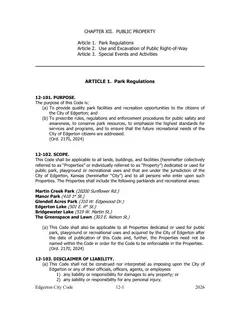
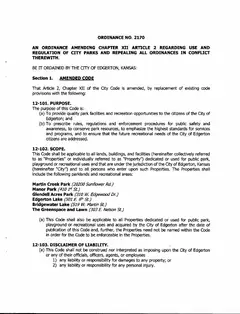
Article 1. Park Regulations
Purpose
The purpose of this Code is:
(a)To provide quality park facilities and recreation opportunities to the citizens of the City of Edgerton; and
(b)To prescribe rules, regulations and enforcement procedures for public safety and awareness, to conserve park resources, to emphasize the highest standards for services and programs, and to ensure that the future recreational needs of the City of Edgerton citizens are addressed.
Scope
This Code shall be applicable to all lands, buildings, and facilities (hereinafter collectively referred to as “Properties” or individually referred to as “Property”) dedicated or used for public park, playground or recreational uses and that are under the jurisdiction of the City of Edgerton, Kansas (hereinafter “City”) and to all persons who enter upon such Properties. The Properties shall include the following parklands and recreational areas:
Martin Creek Park (20200 Sunflower Rd.)
Manor Park (410 1st St.)
Glendell Acres Park (310 W. Edgewood Dr.)
Edgerton Lake (501 E. 6th St.)
Bridgewater Lake (519 W. Martin St.)
The Greenspace and Lawn (303 E. Nelson St.)
(a)This Code shall also be applicable to all Properties dedicated or used for public park, playground or recreational uses and acquired by the City of Edgerton after the date of publication of this Code and, further, the Properties need not be named within the Code in order for the Code to be enforceable in the Properties.
Disclaimer of Liability
(a)This Code shall not be construed nor interpreted as imposing upon the City of Edgerton or any of their officials, officers, agents, or employees
1)any liability or responsibility for damages to any property; or
2)any liability or responsibility for any personal injury.
(b)In addition, neither the City of Edgerton nor any individual duly authorized to enforce this Code, who acts in good faith and without malice in the performance of official duties shall assume or have imposed upon them any personal liability, and they are hereby relieved from personal liability for damage that may occur to any person or property as a result of any act required by this Code in the discharge of official duties.
Amendments and Additions
This Code may be supplemented, or its provisions may be amended by resolution duly adopted by the City Council of Edgerton, Kansas, (hereinafter referred to as “governing body”) and any such amendments or additions shall be incorporated within and codified as a part of this Code.
Definitions
(a)“Adult” means any person who is 18 years of age or older.
(b)“Alcoholic Liquor” means alcohol, spits, wine, beer and every liquid or solid, patented or not, containing alcohol, sprits, wine or beer and capable of being consumed as a beverage by a human being, but shall not include any cereal malt beverage. (3-201)
(c)“Bicycle” means every device propelled by human power upon which any person may ride, having two (2) tandem wheels. Bicycle also includes those ‘electric assisted bicycles’ that are pedal assisted, as defined in Kansas law KSA 8-1489, and any amendments thereto.
(d)“Cereal Malt Beverage” means any fermented but undistilled liquor brewed or made from malt or from a mixture of malt or malt substitute but does not include any such liquor which is more than 3.2 percent alcohol by weight. (3-201)
(e)“Fireworks” mean those items as defined by the rules and regulations of the Kansas state fire marshal, and shall include but not be limited to: firecrackers, torpedoes, sparklers, Roman candles, sky rockets, pin wheels, cap or toy pistols (except such pistols or any like device designed to discharge paper caps containing not more than .25 grains of explosive mixture), canes, bombs, cannons or other like devices and all classes of fireworks that may be shot into the air or propelled over the ground by explosive discharges or any device using blank cartridges. (4-20)
(f)“Motor Vehicle” Every device in, upon, or by which any person or property is or may be transported or drawn upon a highway, except devices moved by human power or used exclusively on stationary rails or tracks. (14-301)
(g)“Motorized Wheeled Device” is any device with wheels that is propelled by a motor or battery, used to transport persons, and is not subject to being registered as a vehicle by the Division of Vehicles of the Kansas Department of Revenue. (11-702)
(h)“Refuse” shall include all garbage and/or rubbish or trash. (8-501)
(i)“Sidewalk” is that portion of a street between the curb lines, or the lateral lines of a roadway, and the adjacent property lines intended for the use of pedestrians. (11-702)
(j)“Street or Highway” is the entire width between the boundary lines of every way publicly maintained when any part thereof is open to the use of the public for purposes of vehicular traffic. Where the word “highway” or the word “street” is used in this Article, it shall mean street, avenue, boulevard, thoroughfare, trafficway, alley and other public way for vehicular travel by whatever name unless the context clearly indicates otherwise. (11-702)
(k)“Trolling Motor” means a self-contained unit that includes an electric motor, propeller and controls, and is affixed to an angler’s boat, canoe or kayak, either at the bow or stern.
(l)“Watercraft” means every vessel designed to be propelled by machinery, oars, paddles, or wind action upon a sail for navigation on the water.
Police Jurisdiction Over City Properties
The City Administrator, or their designee, and law enforcement officers of the City shall have full power to enforce City ordinances and regulations governing all Properties and shall maintain order therein and thereon.
Rules and Regulations
The City Administrator, or their designee, is authorized to establish rules and regulations pertaining to the use of City Properties and activities therein and thereon. Such rules and regulations may be amended by the City Administrator, or their designee, from time to time. A copy of such rules and regulations shall be available at the office of the City Administrator, or their designee, during regular hours of operation. It shall be unlawful to violate such rules and regulations.
The following restrictions are placed on the use of all City Properties:
(a)Glass bottles and glass containers are prohibited.
(b)Persons are prohibited from using or occupying playgrounds or playground equipment other than for the purposes intended.
(c)The City Administrator, or their designee, shall establish rules and regulations for use of athletic fields, courts, and other specialized recreational areas.
(d)It shall be unlawful for any person, except duly authorized City employees, to ice skate, ice fish, sled, drive or walk on or in the ice of any City water body.
(e)It shall be unlawful for any person to play or practice golf in any City Facility.
Park Hours
Neighborhood Parks (Manor Park, Glendell Acres Park, Bridgewater Lake, and The Greenspace Lawn) shall be closed for use by the public between the hours of Sunset and Sunrise.
Community Parks (Martin Creek Park and Edgerton Lake) shall be closed for use by the public between the hours of 11:00 p.m. and 5:00 a.m. except on Fridays and Saturdays when the same shall remain open until 12:00 a.m.
Parks may be closed temporarily, or opening hours extended temporarily in case of emergency, adverse weather conditions, maintenance, or unusual circumstances as determined and ordered by the City Administrator or designee.
Refuse Disposal, Littering
While on city property, all persons shall properly dispose of refuse and trash in receptacles provided for such purpose. No person shall transport any refuse into any City Facility for the purpose of disposal therein. No such waste or contaminating material shall be discarded otherwise in or upon City Facility.
Damaging Property
It shall be unlawful for any person to commit an act of vandalism in a park area by willfully or wantonly injuring, damaging, mutilating, defacing, destroying, digging, removing, or substantially impairing any kind of property, vegetation, fixture, structure or improvement within City Facility. Furthermore, it shall be unlawful for any person to affix, post, or place any bills or signs on City Facility except for in accordance with the terms of a valid Special Event Permit.
It shall be unlawful for any person, except duly authorized City employees or agents acting in the course of their employment, to take, injure, or disturb any live or dead tree, soil, plant, shrub, or flower, or to install any encroachment structure, place any manmade or natural materials on or in any City Facility, or otherwise interfere with the natural state of a City Facility.
Fires
Fires shall be built only in vessels specifically designed for cooking such as portable grills. All fires, coals, ashes, or other materials shall be properly extinguished by the persons starting such fire immediately after use thereof, and before being deposited in trash containers. No hot or burning coals or materials of any kind shall be dumped or deposited on any City Facility. Open fires such as campfires or fire pits are prohibited. Fires may be prohibited entirely as a protective measure when ordered by the governing body.
Overnight Camping
Overnight camping on park property is prohibited.
Swimming, Bathing, Wading
It shall hereafter be unlawful for any person to swim, bathe, or wade in the lakes of the City.
Fishing and Frogging
All persons granted a permit or license to fish at any lakes of the City shall be required to observe the restrictions on fishing and frogging as provided for in the laws of the State of Kansas and the regulations or rules of the State of Kansas Department of Wildlife and Parks. Restrictions on length and daily creel limits shall apply where posted.
(a)Except for special fishing hours that may be authorized by the City Administrator, or their designee, from time to time, the hours for lawful fishing shall be the same as the posted Facility hours. Fishing at any time other than during posted Facility hours is unlawful.
Firearms and Weapons
All City ordinances regarding firearms and weapons under the Uniform Public Offense Code, as adopted by the City, are applicable to all Properties subject to this Code. As such, it is unlawful for any person to use or discharge any type of archery device, firearm, rifle handgun or shotgun in which gunpowder, black powder, air, spring or any other type of force is used to propel a projectile from the weapon if in violation of these ordinances. The throwing of knives, hatchets and axes are prohibited in City Properties.
Hunting
No person shall in any manner pursue, catch, injure, kill, trap, molest, or remove any wildlife (either bird or animal) within the boundaries of City Properties except as provided in “FISHING AND FROGGING”.
Dogs and Cats
Dogs and cats present within a park area shall be subject to the provisions of Chapter 2 of Edgerton City Code.
(a)For the purpose of this section, the term “leash” means a physical tether attached to the dog or cat by which a person can maintain control over the dog. Leash length must not exceed 8 feet. Electronic collars and other devices, even though manufactured for control purposes, do not meet the leash requirements of this section.
(b)All dogs and cats shall be kept leashed and under control while within City Properties, except that when within the designated boundaries of OFFLEASH AREAS dogs may be allowed to run or swim off leash.
(c)No person shall release or abandon in any City Properties any wild or domesticated animal, including mammals, fishes, fowls, reptiles and amphibians.
(d)Owners of dogs or cats are responsible for removing and properly cleaning up after and disposing of defecation.
Off-Leash Dog Facilities; Rules Established
The following rules shall be in effect for all off-leash facilities located with the city:
(a)Dogs must always be under the control and in view of their handler.
(b)Handlers are limited to a maximum of three (3) dogs in the off-leash area at a time.
(c)All dogs must have current vaccinations evidenced by visible tag(s) and City license.
(d)Female dogs in heat, or un-neutered male dogs, are not allowed in the off-leash areas.
(e)Children less than 16 years of age must always be under adult supervision while they are within the boundaries of the off-leash areas.
(f)Any dog under investigation for, or finally determined as, being a “dangerous animal,” is prohibited from being in any off-leash area.
(g)Additional rules and regulations may be posted on-site at such facilities.
Fireworks
Persons within a City Facility shall be subject to the provisions of Chapter 4, Article 20 of Edgerton City Code regarding the use of fireworks.
Alcoholic Beverages
It is unlawful for any person to bring, consume, or possess on the premises of any City Facility any alcoholic liquor or cereal malt beverage. Exceptions provided according to State law
Park Shelter Reservations
All requests for reservations of park shelters shall be made to the City Administrator, or their designee.
Commercial Uses
No park shall be used for any commercial enterprise in any form without the express consent of the governing body.
Solicitations
Solicitors within a park area or City Property shall be subject to the provisions of Chapter 5, Article 2 of Edgerton City Code.
Amplified Sounds
Any amplified sound within the boundaries of a park shall be subject to the provisions of Chapter 11, Article 6 of the Edgerton City Code.
Boating
Subject to the additional restrictions contained within this Code, Kansas law shall govern the use and operation of watercraft on City Facility waters.
(a)Only non-motorized watercraft are allowed at Bridgewater Lake.
(b)The use of privately owned watercraft shall be restricted to Edgerton Lake.
(c)The use of gasoline motors with any watercraft other than for emergency or official City business shall be prohibited.
(d)Electric motorized watercraft are prohibited on waters in City Properties, except for battery or electric-powered trolling motors utilized for fishing on permitted Properties.
(e)All trailered watercrafts shall be launched only at boat ramps and then in accordance with posted launching regulations.
(f)No watercraft of any kind shall be stored, kept or left unattended in City Facility waters, at shoreline, or on marginal land.
Skating
No person shall, at any time, skate except upon areas designated by the City and at such times and pursuant to such rules as the City may post.
Bicycles
It shall be unlawful for any person to ride a bicycle on any City Property except on roads, sidewalks, or designated bicycle paths. No bicycle shall be parked, placed or otherwise left in any place in a City Property other than a bicycle rack, if any, provided by the City.
Motor Vehicles
Motor vehicles, when within the boundaries of City Properties, shall be subject to all applicable Kansas State laws.
Motor vehicles are prohibited from being operated within any City Properties except parking lots, access drives to parking lots, and park streets or areas specifically established by the governing body for motor vehicle use. The presence of motor vehicles in parking lots, access drives or park streets during periods of time the Property is not open to the public is prohibited. Nothing in this section shall preclude the City from conducting regular maintenance as may be required throughout the City Properties. No person shall operate a motor vehicle in or upon any City Property at a speed more than fifteen miles per hour.
Penalty
Violation of any provision of this article is a Class C public offense and any person, partnership or corporation convicted thereof shall be punished as provided by Chapter XI, Article 1 of the City Code. In addition, if the person is convicted of any violation that has resulted in damage to City property, the City may obtain an order of restitution from the Municipal Court for the cost of repair of any such damage.
Article 2. Use and Excavation of Public Right-of-Way
General
No person shall excavate the right-of-way, construct, or use the facilities within the right-of-way of the City except as provided herein.
Purpose
(a)To recognize the City's primary role as chief steward of the right-of-way and its duty to its citizens to recover the costs of managing the right-of-way and incursions into it;
(b)To clarify and regulate conditions of occupancy and construction for those ROW-users occupying space within the City's right-of-way given the anticipated increased use of the right-of-way by various ROW-users throughout the country;
(c)To recognize the necessity for sound management practices in light of the increased use of the right-of-way and the fact that the right-of-way is a limited resource;
(d)To treat each ROW-user equitably and in a competitively neutral and nondiscriminatory manner with considerations that may be unique to the technologies and situation of each particular ROW-user;
(e)To minimize disruption, visual impact or inconvenience to the public, and to preserve the public health, safety and welfare; and
(f)To comply with state and federal legislation.
Definitions
(a)For purposes of this Ordinance, the following words and phrases shall have the meaning given herein:
1.“Abandoned Facilities” means those facilities owned by the ROW-user that are not in use and will not be utilized by the ROW-user in the future.
2.“Affiliate” means any person controlling, controlled by or under the common control of a “service provider”.
3.“Applicant” means any person requesting permission to occupy, lease or operate facilities using the right-of-way, or to excavate the right-of-way.
4.“Area of Influence” means that area around a street excavation where the pavement and sub-grade is impacted by the excavation and is subject to more rapid deterioration.
5.“City” means the City of Edgerton, Kansas, a municipal corporation and any duly authorized representative.
6.“City Superintendent” means the City Superintendent of the City of Edgerton, Kansas, or their authorized representative.
7.“Construct” means and includes construct, install, erect, build, affix or otherwise place any fixed structure or object, in, on, under, through or above the right-of-way.
8.“Day” means calendar day unless otherwise specified.
9.“Emergency” means a condition that (a) poses a clear and immediate danger to life or health, or of a significant loss of property; or (b) requires immediate repair or replacement in order to restore service to a user.
10.“Excavate” means and includes any cutting, digging, excavating, tunneling, boring, grading or other alteration of the surface or subsurface material or earth in the right-of-way.
11.“Excavation Fee” means the fee charged by the City for each street or pavement cut which is intended to recover the costs associated with construction and repair activities of the ROW-user and its contractors and/or subcontractors.
12.“FCC” means Federal Communications Commission.
13.“Facility” means lines, pipes, irrigation systems, wires, cables, conduit facilities, ducts, poles, towers, vaults, pedestals, boxes, appliances, antennae, transmitters, gates, meters, appurtenances, or other equipment.
14.“Governing Body” means the Mayor and the City Council of the City of Edgerton, Kansas.
15.“Governmental Entity” means any county, township, city, town, village, school district, library district, road district, drainage or levee district, sewer district, water district, fire district or other municipal corporation, quasi-municipal corporation or political subdivision of the State of Kansas or of any other state of the United States and any agency or instrumentality of the State of Kansas or of any other state of the United States or of the United States.
16.“KCC” means the Kansas Corporation Commission.
17.“Parkway” means the area between a property line and the street curb. Sometimes called boulevard, tree-shelf or snow-shelf.
18.“Pavement” means and includes Portland cement concrete pavement, asphalt concrete pavement, asphalt treated road surfaces and any aggregate base material.
19.“Permit and Inspection Fee” means the fee charged by the City to recover its cost incurred for right-of-way management, including, but not limited to, costs associated with registering applicants; issuing, processing, and verifying right-of-way permit applications; inspecting job sites and restoration of improvements; determining the adequacy of right-of- way restoration; revoking right-of-way permits; and other costs the City may incur in managing the provisions of this Ordinance.
20.“Permittee” means any person to whom a right-of-way permit is issued to excavate a right-of-way.
21.“Person” means any natural or corporate person, business association or business entity including, but not limited to, a partnership, a sole proprietorship, a political subdivision, a public or private agency of any kind, a utility, a successor or assign of any of the foregoing, or any other legal entity.
22.“Public Improvement” means any project undertaken by the City for the construction, reconstruction, maintenance, or repair of any public infrastructure, and including without limitation, streets, alleys, bridges, bikeways, parkways, sidewalks, sewers, drainage facilities, traffic control devices, street lights, public facilities, public buildings or public lands.
23.“Public Lands” means any real property owned or leased by the City that is not right-of-way.
24.“Registration” means the application process of a service provider, the approval of the application by the City, and the authorization of the service provider to use any portion of the right-of-way within the City to provide service both within and beyond the City limits.
25.“Repair” means the temporary construction work necessary to make the right-of-way useable.
26.“Repair and Restoration Costs” means those costs associated with repairing and restoring the public right-of-way because of damage caused by the ROW-user and its contractors and/or subcontractors in the right-of-way.
27.“Restoration” means the process by which an excavated right-of-way and surrounding area, including pavement and foundation, is returned to the same condition, or better, that existed before the commencement of the work.
28.“Right-of-way” means the area on, below or above streets, alleys, bridges, and parkways.
29.“Right-of-way Permit” means the authorization to excavate for the construction, installation, repair or maintenance of any type of facility within the right-of-way.
30.“Routine Service Operation” means a work activity that makes no material change to the facilities and does not disrupt traffic.
31.“ROW-user” means a person, its successors and assigns, that uses the right-of-way for purposes of work, excavation, provision of services, or to install, construct, maintain, repair facilities thereon, including, but not limited to, landowners and service providers. A ROW-user shall not include ordinary vehicular or pedestrian traffic or any governmental entity that has entered into an agreement pursuant to K.S.A. 12-2901 et seq. with the City regarding the use and occupancy of the City's right-of-way.
32.“Service” means a commodity provided to a person by means of a delivery system that is comprised of facilities located or to be located in the right-of-way, including, but not limited to, gas, telephone, cable television, Internet services, Open Video Systems, alarm systems, steam, electric, water, telegraph, data transmission, petroleum pipelines, or sanitary sewerage.
33.“Service Provider” means any person owning, possessing or having an interest in facilities in the right-of-way that are used for the provisions of a service for or without a fee; provided, that this definition shall also include persons owning, possessing or having an interest in facilities in the right-of-way that are used by, may be used by or are intended for use by another person, in whole or in part, to provide a service for or without a fee, regardless of whether the actual facility owner provides any service as defined herein.
34.“Street” means the pavement and sub-grade of a City residential, collector or arterial roadway.
Policy
(a)It is the policy of the City to authorize any ROW-user to utilize the right-of-way in a competitively neutral, non-discriminatory manner that maximizes the efficient use of and conserves the right-of-way and minimizes the burden on the right-of-way, physically and aesthetically. Any use of the right-of-way by a ROW-user shall be subject to the terms and conditions hereof, in addition to other applicable federal, state or local requirements.
(b)The right granted to the ROW-user to use the right-of-way is limited to the use that the ROW-user has filed with the City in accordance with this Ordinance. These rights are for the exclusive use of the ROW-user except where otherwise provided herein, or when authorized by the City.
(c)This Ordinance also is designed to regulate occupancy and excavations in the right-of-way by providing, among other things, for the issuance of permits which grant the authority to utilize and occupy the right-of-way within the City.
(d)All ROW-users shall be subject to all rules, regulations, policies, resolutions, and ordinances now or hereafter adopted or promulgated by the City in the reasonable exercise of its police power and are subject to all applicable laws, orders, rules and regulations adopted by governmental entities now or hereafter having jurisdiction. In addition, the ROW-users shall be subject to all technical specifications, design criteria, policies, resolutions and ordinances now or hereafter adopted or promulgated by the City in the reasonable exercise of its police power relating to permits and fees, sidewalk and pavement cuts, utility location, construction coordination, surface restoration, and other requirements on the use of the right-of-way.
Administration
(a)The City Superintendent is the principal city official for administration of right-of-way permits for work and excavations made in the right-of-way. The City Superintendent may delegate any or all of the duties hereunder.
(b)The City Superintendent is the principal City Official responsible for administration of the registering of a service provider. The City Superintendent may delegate any or all of the duties hereunder.
Requirements of Service Provider
(a)Any existing service provider must register within thirty (30) days of the effective date of this Ordinance.
(b)Any person, who is not an existing service provider prior to the effective date of this Ordinance and who wishes to become a service provider, must first register with the City.
(c)The service provider shall report any changes in its registration information within thirty (30) days.
(d)No service provider shall be authorized to utilize the right-of-way in any capacity or manner without registering and obtaining the necessary right-of-way permit from the City.
(e)The information required for registration includes the following:
1.Identity and legal status of service provider, including related affiliates.
2.Name, address, telephone number, fax number and email address of officer, agent or employee responsible for the accuracy of the registration statement.
3.Name, address, telephone number, fax number and email address of the local representative of the service provider who shall be available at all times to act on behalf of the service provider in the event of an emergency.
4.Proof of any necessary City permit, license, certification, grant, registration, franchise agreement or any other required authorization.
5.Description of the service provider's intended use of the right-of-way. Additionally, the following information shall be provided when requested by the City Superintendent:
1.Proof of any necessary permit, license, certification, grant, registration, franchise agreement or any other authorization required by any appropriate governmental entity, including, but not limited to, the FCC or the KCC.
2.Information sufficient to determine whether the service provider is subject to franchising by Kansas law.
3.Information sufficient to determine whether the service provider has applied for and received any certificate of authority required by the KCC.
4.Information sufficient to determine that the service provider has applied for and received any permit or other approvals required by the FCC.
5.Such other information as may be reasonably required by the City to complete the registration statement.
(f)Each service provider shall designate a local person familiar with the facilities who will act as a local agent for the service provider and will be responsible for satisfying information requirements of this Ordinance. The service provider shall present to the City the agent's name, address, telephone number, fax number and email address. The agent shall be the person to whom relocation notices and other such notices shall be sent, and with whom rests the responsibility to facilitate all necessary communications. The service provider shall be responsible for all costs incurred by the City due to the failure to provide such information to the City.
(g)Prior to construction, reconstruction, repair, maintenance, or relocation of facilities owned by the service provider in the right-of-way, the service provider shall first obtain the necessary right-of-way permit as provided hereafter.
(h)Prior to providing service to the City and its residents, the service provider shall first obtain the necessary franchise agreement, if any, from the City.
(i)The service provider shall participate in any joint planning, construction and advance notification of right-of-way work, including coordination and consolidation of street cut work as directed by the City Superintendent. In addition, the service provider shall cooperate with other service providers and the City for the best, most efficient, most aesthetic and least obtrusive use of the right-of-way, consistent with safety, and to minimize traffic and other disruptions, including street cuts.
(j)The service provider shall furnish maps showing the location of facilities of the service provider within the City as provided hereafter.
(k)The City shall not exercise its authority under this provision to in any way deter competition or discriminate against any service provider.
Mapping Requirements of Service Provider
(a)The service provider shall keep and maintain accurate records and as-built drawings depicting accurate location of all its facilities constructed, reconstructed or relocated in the right-of-way.
(b)Within ten (10) days of a request by the City, the service provider will provide to the City information concerning such facilities as may be reasonably requested.
(c)When available to the service provider, such information will be submitted electronically in an AutoCad format to the extent compatible with the City's Geographical Information Systems (GIS) and Johnson County Automated Integrated Mapping Systems (AIMS) provided, however, that nothing herein shall be construed to require the service provider to acquire or modify any electronic mapping system.
(d)Underground facilities shall be differentiated from overhead facilities.
(e)Such mapping and identification shall be at the sole expense of the service provider.
Service Provider’s Right to Sell, Transfer, Lease, Assign, Sublet or Dispose
(a)Except as provided hereafter, the service provider shall not sell, transfer, lease, assign, sublet or dispose of its facilities, or any portion thereof, that is located in City right-of-way, or any right, title or interest in the same, or transfer any rights granted by the City to any person either by forced or involuntary sale, or by ordinary sale, consolidation or otherwise, without notice to the City. This provision shall not apply to the sale of property or equipment in the normal course of business or to the sale or lease of facilities to reseller service providers. No notice to the City shall be required for a transfer in trust, mortgage, or other similar instrument, in whole or in part, to secure an indebtedness, or for a pro forma transfer to a corporation, partnership, or other entity controlling, controlled by or under common control with the service provider.
Reserved
Use of the Right-of-Way
a.The ROW-user's use of the right-of-way shall in all matters be subordinate to the City's use or occupation of the right-of-way. The City may reserve sufficient space within the right-of-way for future public improvements. Without limitation of its rights, the City expressly reserves the right to exercise its governmental powers now and hereafter vested in or granted to the City.
b.The ROW-user shall coordinate the placement of facilities in a manner which minimizes adverse impact on any public improvement, as reasonably determined by the City. Where placement is not regulated, the facilities shall be placed with adequate clearance from such public improvements so as not to impact or be impacted by such public improvements.
c.The ROW-user shall consider any request made by the City concerning placement of facilities in private easements in order to limit or eliminate future street improvement relocation expenses.
d.All facilities shall be located and laid so as not to disrupt or interfere with any pipes, drains, sewers, irrigation systems, or other structures or public improvements already installed. In addition, the ROW-user shall, in doing work in connection with its facilities, avoid, so far as may be practicable, disrupting or interfering with the lawful use of the right-of-way or other public lands of the City.
e.All facilities of the ROW-user shall be placed so that they do not interfere with the use of right-of-way and public lands. The City, through its City Superintendent, shall have the right to consult and review the location, design and nature of the facility prior to its being installed.
f.All newly constructed facilities shall be located underground, unless such requirement is waived by the Planning Commission as part of a development plan. The ROW-user shall comply with all requirements of the City relating to underground facilities. The governing body may grant a special exception to this requirement on a temporary or permanent basis on such terms as the governing body may deem appropriate in cases of emergency, safety concerns, unusual circumstances, or some other good cause. In addition, in cases where temporary electrical power or communication service is reasonably required for emergencies or for building construction purposes, the Mayor or Governing Body may grant special permission for the temporary construction and use of poles, wires and other above-ground facilities for a period not to exceed one hundred and twenty (120) days; provided, in the event that resolving said emergency or completing said construction cannot be concluded within said time period because of a shortage of material, a natural disaster, strikes, or other circumstances beyond the control of the parties, or by unusual hardships, then the time may be extended to an additional temporary period or periods necessary to allow completion of such construction. When above-ground facilities are allowed pursuant to this section, said facilities shall be located only as directed by the City, including, but not limited to, requirements regarding location and height.
g.The ROW-user shall not interfere with the facilities of the other ROW-users without their permission. If and when the City requires or negotiates to have a service provider cease using its existing poles and to relocate its facilities underground, all other service providers using the same poles shall also relocate their facilities underground at the same time.
h.The City Superintendent may assign specific corridors within the right-of-way, or any particular segment thereof as may be necessary, for each type of facility that is currently, or pursuant to current technology the City Superintendent expects will someday be, located within the right-of-way. All right-of-way permits issued by City Superintendent shall indicate the proper corridor for the ROW-user's facilities. Any ROW-user whose facilities are currently in the right-of-way in a position at a variance with the designated corridors shall, no later than at the time of next reconstruction or excavation of the area where its facilities are located, move the facilities to its assigned position within the right-of-way, unless this requirement is waived by the City Superintendent for good cause shown, upon consideration of such factors as the remaining economic life of the facilities, public safety, user service needs and hardship to the ROW-user.
i.If, in the preparation and planning of a right-of-way project, the City Superintendent deems it appropriate for a conduit to be constructed along, across or under the right-of-way, the City Superintendent shall contact all appropriate ROW-users for their input on the planning and design of such conduit. If a ROW-user desires to construct, maintain or operate facilities along such right-of-way, the City Superintendent may require the ROW-user to use such conduit, and to contribute to the expense of such conduit, provided, however, the ROW user’s use of the conduit is reasonable and appropriate under the circumstances.
j.All earth, sod, landscape features, materials, sidewalks, paving, crossings, utilities, other public improvements or improvements of any kind damaged or removed by the ROW-user shall be fully repaired or replaced promptly by the ROW-user at its sole expense and to the reasonable satisfaction of the City. Upon determination by the City Superintendent that such repair or replacement is a public safety matter, all such repair or replacement shall be commenced within twenty-four (24) hours of notice from the City, or the City Superintendent may direct the City to make such repair or replacement and bill the ROW-user for the City cost. The City Superintendent has the authority to inspect the repair or replacement of the damage, and if necessary, to require the ROW-user to do any necessary additional work.
k.All technical standards governing construction, reconstruction, installation, operation, testing, use, maintenance, and dismantling of a ROW-user's facilities in the right-of-way shall be in accordance with applicable federal, state and local law and regulations, including those promulgated by national trade associations commonly associated with the service provided by the ROW-user. It is understood that the standards established in this paragraph are minimum standards and the requirements established or referenced in this Ordinance may be in addition to or stricter than such minimum standards. A ROW-user shall not construct or reconstruct any of its facilities located upon, over, under or within the City right-of-way without first having submitted in writing a description of its planned improvement to the City Superintendent and having received a permit for such improvement. The City Superintendent may require that any drawings, plans and/or specifications submitted be certified by a Kansas registered professional engineer stating that such drawings, plans and/or specifications comply with all applicable technical codes, rules and regulations, unless such plans are based directly on nationally recognized codes, which are appropriately cited, and attested to on the plans by the signature of an authorized official of the organization applying for the permit.
l.The ROW-user shall cooperate promptly and fully with the City and take all reasonable measures necessary to provide accurate and complete on-site information regarding the nature and horizontal and vertical location of its facilities located within the right-of-way, both underground and overhead, when requested by the City or its authorized agent for a public improvement. Such location and identification shall be at the sole expense of the ROW-user without any expense to the City, its employees, agents, or authorized contractors.
m.The City shall have the authority to prohibit the use or occupancy of a specific portion of the right-of-way by a ROW-user due to public health, safety or welfare considerations.
Facility Relocation
(a)The ROW-user shall promptly remove, relocate or adjust any facilities located in the right-of-way as directed by the City for a public improvement or when reasonably required by the City by reason of public health, safety and welfare. Such removal, relocation, or adjustment shall be performed by the ROW-user at the ROW-user's sole expense without expense to the City, its employees, agents, or authorized contractors and shall be specifically subject to rules, regulations and schedules of the City pertaining to such. The ROW-user shall proceed with relocations at due diligence upon notice by the City to begin relocation.
(b)The ROW-user shall promptly remove, relocate or adjust any facilities located in private easement, as directed by the City, for a public improvement, at City expense, by moving such facilities to areas within the expanded right-of-way or within remaining private easements or remaining portions of such easements not condemned by nor disclaimed to the City to avoid conflict with City construction and improvements. The ROW-user shall disclaim those parts of its easements which lie within the expanded right-of-way. Should the City, in the future, elect to require the ROW-user to again relocate its facilities to other areas within the expanded right-of-way, the cost of any such future relocation shall be borne by the City.
(c)As soon as working drawings are available for public improvements which will require the ROW-user to relocate its facilities, the City shall provide the ROW user with written notice of relocations and the anticipated bid letting date of said improvement. The ROW-user shall respond with any conflicts and a proposed construction schedule within thirty (30) days.
(d)Following notice by the City in the form of the delivery of final design plans for such public improvements, the ROW-user shall remove, and relocate its facilities in accordance with the mutually agreed upon schedule, provided the project is not delayed by adverse weather conditions and other factors beyond the control of the ROW-user. The ROW-user shall certify to the City, in writing, that its facilities have been relocated or adjusted to clear construction in accordance with project plans provided by the City.
(e)Any damages suffered by the City, its agents or its contractors to the extent caused by ROW-user's failure to timely relocate or adjust its facilities, or failure to properly relocate or adjust such facilities, shall be borne by the ROW-user.
(f)In the event the ROW-user is required to move its facilities in accordance with this section, any ordinary right-of-way permit fee shall be waived.
(g)It is the intent of this section for both the City and the ROW-user to cooperate with one another so that the need for facility relocation is minimized and, when required and feasible, relocations may be completed prior to receipt of bids by the City for a public improvement.
Protection of the Public
(a)It shall be the responsibility of the ROW-user to take adequate measures to protect and defend its facilities in the right-of-way from harm and damage.
(b)The City shall not be liable for any damage to or loss of any of the ROW-user's facilities within the right-of-way as a result of or in connection with any construction, excavation, grading, filling or work of any kind, including public improvements by or on the behalf of the City, except to the extent caused by the negligent, willful, intentional, or malicious acts or omissions of the City.
(c)The ROW-user shall be responsible to the City and its agents, representatives, and authorized contractors for all damages suffered by them including, but not limited to delay damages, repair costs, down time, construction delays, penalties or other expenses of any kind arising out of the failure of the ROW-user to timely perform any of its obligations under this Ordinance to the extent caused by the acts or omissions of the ROW-user.
(d)The City or its authorized contractors shall be responsible for taking reasonable precautionary measures including calling for facility locations when constructing its public improvements.
(e)Any ROW-user who for any purpose makes or causes to be made any excavation in, upon, under, through or adjoining any street, sidewalk, alley or other right-of way, and shall leave any part or portion thereof open, or shall leave any part or portion thereof disrupted with rubbish, building or other material during construction and/or the night time, shall cause the same to be enclosed with good substantial and sufficient barricades or drums equipped with the appropriate type warning lights and orange safety fencing material which is properly secured around the excavation or the disruption.
(f)Whenever a ROW-user shall excavate the full width of any street, sidewalk, alley, driveway approach or other right-of-way, it shall be its duty to maintain an adequate passage for vehicles and pedestrians across or around the excavation until it is refilled as specified.
(g)Any excavation left open overnight on any thoroughfare or collector type street shall be securely covered. The ROW-user assumes the sole responsibility for maintaining proper barricades, plates, safety fencing and/or lights as required from the time of opening of the excavation until the excavation is surfaced and opened for travel.
(h)The City Superintendent, upon the review and approval of a plan and details for trimming trees in the right-of-way, may grant permission by permit to any ROW-user to trim trees upon and overhanging the right-of-way so as to prevent such trees from coming in contact with the facilities of the ROW-user.
(i)In the event the ROW-user severely disturbs or damages the root structure of any tree in the right-of-way to the detriment of the health and safety of the tree, the ROW-user will be required to remove and replace the tree at the ROW-user's cost. The type and size of such replacement tree shall be reasonably determined by the City Superintendent. Further, in review of the ROW-user's plan, the City Superintendent, in his discretion, may require the ROW-user to directionally bore around any tree in the right-of-way.
(j)Upon the appropriate request of any person having satisfied City procedure and ordinances, the ROW-user shall remove, raise, or lower its facilities temporarily to permit the moving of houses or other structures. The expense of such temporary removal, raising or lowering shall be paid by the person requesting the same, and the ROW-user may require such payment in advance. The ROW-user must be given not less than fifteen (15) days written notice from the person detailing the time and location of the moving operations, and not less than twenty-four (24) hours advance notice from the person advising of the actual operation.
Right-of-Way Vacation
(a)If the City vacates a right-of-way which contains the facilities of the service provider, and if the vacation does not require the relocation of the service provider's facilities, the City shall reserve, to and for itself and all service providers having facilities in the vacated right-of-way, an easement for the right to install, maintain and operate any facilities in the vacated right-of-way and to enter upon such vacated right-of-way at any time for the purpose of reconstructing, inspecting, maintaining or repairing the same.
(b)If the vacation requires the relocation of facilities, and
1.If the vacation proceedings are initiated by the service provider, the service provider must pay the relocation costs.
2.If the vacation proceedings are initiated by the City, the service provider must pay the relocation costs unless otherwise agreed to by the City and the service provider.
3.If the vacation proceedings are initiated by a person other than the service provider or the City, such other person must pay the relocation costs.
Abandonment and Unusable Facilities
(a)A ROW-user owning abandoned facilities in the right-of-way must either:
1.Remove its facilities and replace or restore any damage or disturbance caused by the removal at its own expense. The City Superintendent may allow underground facilities or portions thereof to remain in place if the City Superintendent determines that it is in the best interest of public safety to do so. At such time, the City may take ownership and responsibility of such vacated facilities left in place; or
2.Provide information satisfactory to the City that the ROW-user's obligations for its facilities in the right-of-way have been lawfully assumed by another authorized ROW-user; or
3.Submit to the City a proposal and instruments for transferring ownership of its facilities to the City. If the ROW-user proceeds under this section, the City may, at its option, purchase the equipment, require the ROW-user, at its own expense to remove it, or require the ROW-user to post a bond in an amount sufficient to reimburse the City for reasonable anticipated costs to be incurred to remove the facilities.
(b)Facilities of a ROW-user who fails to comply with this section, and whose facilities remain unused for two (2) years, shall be deemed to be abandoned after the City has made a good faith effort to contact the ROW-user, unless the City receives confirmation that the ROW-user intends to use the facilities. Abandoned facilities are deemed to be a nuisance. The City may exercise any remedies or rights it has at law or in equity, including, but not limited to, (a) abating the nuisance, (b) taking possession and ownership of the facility and restoring it to a useable function, or (c) requiring the removal of the facility by the ROW-user.
Permit Requirement
(a)Except as otherwise provided, no ROW-user may excavate any right-of-way or conduct any repair, construction, or reconstruction of facilities located within the right-of-way without first having obtained the appropriate right-of-way permit.
(b)There are two exemptions to this provision:
1.Contractors working on the construction or reconstruction of public improvements on behalf of the City.
2.ROW-users performing routine service operations which do not require excavation in the right-of-way and do not disrupt traffic for more than four (4) hours.
(c)No person owning or occupying any land abutting on a public right-of-way shall construct, maintain, or permit in or on the portion of the public right-of-way to which such land is adjacent, any fixed structure, material or object without having obtained the appropriate right-of-way permit.
(d)A right-of-way permit is required for emergency situations. If due to an emergency it is necessary for the ROW-user to immediately perform work in the right-of-way, and it is impractical for the ROW-user to first get the appropriate permit, the work may be performed, and the required permit shall be obtained as soon as possible during the next City working day.
(e)No permittee may excavate the right-of-way beyond the date or dates specified in the right-of-way permit unless the permittee:
1.Makes a supplementary application for another right-of-way permit before the expiration of the initial permit, and
2.A new right-of-way permit or permit extension is granted.
(f)Right-of-way permits issued shall be conspicuously displayed by the permittee at all times at the indicated work site and shall be available for inspection by the City Superintendent, other City employees and the public.
(g)Prior to the commencement of excavation, the permittee shall identify and locate any buried facilities to be spray painted according to the Uniform Color Code required by the Kansas One Call.
(h)At the discretion of the City Superintendent, the permittee may be required to notify the occupants of all properties within two hundred feet (200’) of the excavation prior to the commencement of such excavation. Door hangers shall be sufficient to satisfy such notification requirement.
(i)At the discretion of the City Superintendent, the permittee may be required to notify the Johnson County Sheriff’s Office, the local Fire Department and Johnson County Med-Act of the schedule and location of such excavation prior to the commencement of such excavation.
(j)All excavations by the permittee shall have a metal marker inserted into the excavation of the restored pavement, which shall identify the ROW-user.
(k)Before receiving a right-of-way permit, the applicant must show proof of any necessary permit, license, certification, grant, registration, franchise agreement or any other authorization required by any appropriate governmental entity, including, but not limited to, the City, the FCC or the KCC.
(l)Any ROW-user who is found to be working in the public right-of-way without a permit will be directed to stop work until a permit is acquired and properly posted at the work site. The only exception allowed is for emergency repair work.
(m)Any permittee found to be working without providing for required safety and traffic control will be directed to stop work until the appropriate measures are implemented in accordance with the current edition of the Manual on Uniform Traffic Control Devices.
Permit Applications
(a)Application for a right-of-way permit shall be submitted to the City Superintendent by either the ROW-user or by the person who will do the work and/or excavation in the right-of-way.
(b)Right-of-way applications shall contain and be considered complete only upon receipt of the following:
1.Compliance with verification of registration;
2.Submission of a completed permit application form, including all required attachments and scaled drawings showing the location and area of the proposed project and the location of all existing and proposed facilities at such location;
3.A traffic control plan;
4.Payment of all money due to the City for permit fees and costs, for prior excavation costs, for any loss, damage or expense suffered by the City because of the applicant's prior excavations of the right-of-way or for any emergency actions taken by the City, unless the payment of such money is in dispute and timely appealed as provided hereafter.
Liability Insurance, Performance and Maintenance Bond Requirement
a.The permittee shall file with the City evidence of commercial general and automobile liability insurance with an insurance company licensed to do business in Kansas. The general liability limit will be not less than one million dollars ($1,000,000) per occurrence and two million dollars ($2,000,000) in aggregate. The automobile liability limit will not be less than one million dollars ($1,000,000) combined single limit. The insurance will protect the City from and against all claims by any person whatsoever for loss or damage from personal injury, bodily injury, death, or property damage to the extent caused or alleged to have been caused by the negligent acts or omissions of the permittee. If the permittee is self-insured, it shall provide the City proof of compliance regarding its ability to self-insure and proof of its ability to provide coverage in the above amounts.
b.The permittee shall at all times during the term of the permit, and for two (2) years thereafter, maintain a performance and maintenance bond in a form approved by the City Attorney. The amount of the bond will be $2,000 or the value of the restoration, whichever is greater, for a term consistent with the term of the permit plus two (2) additional years, conditioned upon the permittee's faithful performance of the provisions, terms and conditions conferred by this Ordinance. Alternatively, if the permittee anticipates requirements for multiple right-of-way permits, the permittee may choose to meet the bond requirements for the above prescribed term as follows:
1.10 permits or less/year: $15,000 annual bond
2.25 permits or less/year: $30,000 annual bond
3.Unlimited permits/year: $50,000 annual bond In the event the City shall exercise its right to revoke the permit as granted herein, then the City shall be entitled to recover under the terms of said bond the full amount of any loss occasioned.
c.A copy of the Liability Insurance Certificate and Performance and Maintenance Bond must be on file with the City Clerk.
d.No performance and maintenance bond will be required for permits issued for driveway placement, driveway replacement, residential street approach or landscaping work such as irrigation systems and tree planting. No performance and maintenance bond will be required for any governmental entity. No performance and maintenance bond or liability insurance will be required of any residential property owner working in the right-of-way adjacent to his/her primary residence, who does not utilize a contactor to perform the excavation.
Right-of-Way Permit Fees and Costs
(a)The right-of-way permit fee shall be recommended by the City Superintendent and listed in the Schedule of Fees maintained in the City Clerk's office.
(b)The right-of-way permit fee may include a permit and inspection fee, and an excavation fee.
(c)Fees paid for a right-of-way permit, which is subsequently revoked by the City Superintendent, are not refundable.
(d)Except as provided for in an emergency situation, when a ROW-user is found to have worked or is working in the right-of-way without having obtained a permit, the fee for the permit will be double the amount had the ROW-user obtained a permit prior to beginning work.
(e)The City may also charge and collect any necessary repair and restoration costs.
(f)The right-of-way permit fee shall be waived where the ROW-user is required to remove, relocate or adjust facilities located in the right-of-way as directed by the City for a public improvement.
(g)The right-of-way permit fee may be waived when reasonably required by the City for reasons of public health, safety and welfare.
Issuance of Permit
(a)If the City Superintendent determines that the applicant has satisfied the requirements of this Ordinance, the City Superintendent shall issue a right-of-way permit.
(b)The City Superintendent may impose reasonable conditions upon the issuance of a right-of-way permit and the performance of the permittee in order to protect the public health, safety and welfare, to ensure the structural integrity of the right-of-way, to protect the property and safety of other users of the right-of- way, and to minimize the disruption and inconvenience to the traveling public.
(c)When a right-of-way permit is requested for purposes of installing additional facilities and the performance and maintenance bond for additional facilities is reasonably determined to be insufficient, the posting of an additional or larger performance and maintenance bond for the additional facilities may be required.
(d)Issued permits are not transferable.
(e)If work is being done for the ROW-user by another person, a subcontractor or otherwise, the person doing the work and the ROW-user shall be liable and responsible for all damages, obligations, and warranties herein described.
(f)Individual right-of-way permits are limited to a maximum of 1,200 feet of contiguous work length.
Permitted Work
(a)The permittee shall not make any cut, excavation or grading of right-of-way other than excavations necessary for emergency repairs without first securing a right-of-way permit.
(b)The permittee shall not at any one time open or encumber more of the right- of- way than shall be reasonably necessary to enable the permittee to complete the project in the most expeditious manner.
(c)The permittee shall, in the performance of any work required for the installation, repair, maintenance, relocation and/or removal of any of its facilities, limit all excavations to those excavations that are necessary for efficient operation.
(d)The permittee shall not permit such an excavation to remain open longer than is necessary to complete the repair or installation.
(e)The permittee shall notify the City no less than three (3) working days in advance of any construction, reconstruction, repair, location or relocation of facilities which would require any street closure or which reduces traffic flow to less than two (2) lanes of moving traffic for more than four (4) hours. Except in the event of an emergency as reasonably determined by the permittee, no such closure shall take place without notice and prior authorization from the City.
(f)Non-emergency work on arterial and collector streets may not be accomplished during the hours of 7:00 AM to 8:30 AM and 4:00 PM to 6:00 PM, in order to minimize disruption of traffic flow.
(g)All work performed in the right-of-way or which in any way impacts vehicular or pedestrian traffic shall be properly signed, barricaded, and otherwise protected at the permittee's expense. Such signage shall be in conformance with the latest edition of the Manual on Uniform Traffic Control Devices, unless otherwise agreed to by the City.
(h)The permittee shall identify and locate any underground facilities in conformance with the Kansas Underground Utility Damage Prevention Act “Kansas One Call” system.
(i)The permittee shall be liable for any damages to underground facilities due to excavation work prior to obtaining location of such facilities, or for any damage to underground facilities that have been properly identified prior to excavation. The permittee shall not make or attempt to make repairs, relocation or replacement of damaged or disturbed underground facilities without the approval of the owner of the facilities.
(j)Whenever there is an excavation by the permittee, the permittee shall be responsible for providing adequate traffic control to the surrounding area as determined by the City Superintendent of the City. The permittee shall perform work on the right-of-way at such times that will allow the least interference with the normal flow of traffic and the peace and quiet of the neighborhood. In the event the excavation is not completed in a reasonable period of time, the permittee may be liable for actual damages to the City for delay caused by the permittee pursuant to this Ordinance.
(k)All facilities and other appurtenances laid, constructed and maintained by the permittee shall be laid, constructed and maintained in accordance with acceptable engineering practice and in full accord with any and all applicable engineering codes adopted or approved by the parties and in accordance with applicable statutes of the State of Kansas, as well as the rules and regulations of the Kansas Corporation Commission or any other local, state or federal agency having jurisdiction over the parties.
(l)Following completion of permitted work for new construction, the permittee shall keep, maintain and provide to the City accurate records and as-built drawings, drawn to scale and certified to the City as accurately depicting the location of all utility facilities constructed pursuant to the permit. When available to the permittee and upon request by the City Superintendent, maps and drawings provided will be submitted in AUTOCAD.DXF or AUTOCAD.DWG automated formats. Such information shall be subject in all respects and shall have the benefit of protection as set forth in the section entitled “Mapping Requirements of Service Provider” contained herein.
(m)The City may use the as-built records of the service provider's facilities in connection with public improvements.
Right-of-Way Repair and Restoration
(a)The work to be done under the right-of-way permit and the repair and restoration of the right-of-way as required herein must be completed within the dates as specified in the permit. However, in the event of circumstances beyond the control of the permittee or when work was prohibited by unseasonable or unreasonable conditions, the City Superintendent may extend the date for completion of the project upon receipt of a supplementary application for a permit extension.
(b)All earth, materials, sidewalks, paving, crossing, utilities, public improvement or improvements of any kind damaged or removed by the permittee shall be fully repaired or replaced promptly by the permittee at its sole expense and the reasonable satisfaction of the City. The City Superintendent has the authority to inspect the repair or replacement of the damage, and if necessary, to require the permittee to do the additional necessary work. Notice of the unsatisfactory restoration and the deficiencies found will be provided to the permittee and a reasonable time not to exceed fifteen days will be provided to allow for the deficiencies to be corrected.
(c)After any excavation, the permittee shall, at its expense, restore all portions of the right-of-way to the same condition or better condition than it was prior to the excavation thereof.
(d)In addition to repairing its own street cuts, the permittee must restore any area within five (5) feet of the new street cut that has previously been excavated, including the paving and its aggregate foundations.
(e)If the permittee fails to restore the right-of-way in the manner and to the condition required by the City Superintendent, or fails to satisfactorily and timely complete all restoration, the City may, at its option, serve written notice upon the permittee and its surety that, unless within five (5) days after serving of such notice, a satisfactory arrangement can be made for the proper restoration of the right-of-way, the City shall immediately serve notice of failure to comply upon the surety and the permittee, and the surety shall have the right to take over and complete the work; provided, however, that if the surety does not commence performance thereof within ten (10) days from the date of notice, the City may take over the work and prosecute same to completion, by contract or otherwise at the expense of the permittee, and the permittee and its surety shall be liable to the City for any and all excess cost assumed by the City by reason of such prosecution and completion.
(f)The permittee responsible for the excavation who leaves any debris in the right-of-way shall be responsible for providing safety protection in accordance with the latest edition of the Manual on Uniform Traffic Control Devices and any applicable federal or state requirement.
(g)If an excavation cannot be back-filled immediately and left unattended, the permittee shall securely and adequately cover the unfilled excavation. The permittee has sole responsibility for maintaining proper barricades, safety fencing and/or lights as required, from the time of the opening of the excavation until the excavation is surfaced and opened for travel.
(h)In restoring the right-of-way, the permittee guarantees its work and shall maintain it for twenty-four (24) months following its completion. During the twenty-four (24) months, the permittee shall, upon notification from the City Superintendent, correct all restoration work to the extent necessary, using any method as required by the City Superintendent. Said work shall be completed within a reasonable time, not to exceed thirty (30) calendar days, of the receipt of notice from the City Superintendent (not including days during which work cannot be done because of circumstances constituting force majeure or days when work is prohibited as unseasonable or unreasonable). In the event the permittee is required to perform new restoration pursuant to the foregoing guarantee, the City Superintendent shall have the authority to extend the guarantee period for such new restoration for up to an additional twenty-four (24) months from the date of the new restoration.
(i)The twenty-four (24) month guarantee period shall be applicable to failure of the pavement surface as well as failure below the pavement surface.
(j)Payment of an excavation fee shall not relieve the permittee of the obligation to complete the necessary right-of-way restoration.
Joint Applications
(a)Applicants may apply jointly for permits to excavate the right-of-way at the same time and place.
(b)Applicants who apply jointly for a right-of-way permit may share in the payment of the permit fee. Applicants must agree among themselves as to the portion each shall pay.
Supplementary Applications
(a)A right-of-way permit shall only be valid for the area of the right-of-way specified within the permit. No permittee may cause any work to be done outside the area specified in the permit, except as provided herein. Any permittee who determines that an area greater than that which is specified in the permit must be excavated must do the following prior to the commencement of work in that greater area: (a) make application for a permit extension and pay any additional fees required thereby; and (b) receive a new right-of-way permit or permit extension.
(b)A right-of-way permit shall be valid only for the dates specified in the permit. No permittee may commence work before the permit start date or, except as provided herein, may continue working after the end date. If a permittee does not complete the work by the permit end date, the permittee must apply for and receive a new right-of-way permit or a permit extension for additional time. This supplementary application must be submitted to the City prior to the permit end date.
Other Obligations
(a)Obtaining a right-of-way permit under this Ordinance shall not relieve the permittee of its duty to obtain any necessary permit, license, certification, grant, registration, franchise agreement or any other authorization required by any appropriate governmental entity, including, but not limited to, the City, the FCC or the KCC, and to pay any fees required by any other City, County, State, or Federal rules, laws, or regulations. A permittee shall perform all work in full accord with any and all applicable engineering codes adopted or approved by the parties and in accordance with applicable statutes of the State of Kansas, and the rules and regulations of the KCC or any other local, state or federal agency having jurisdiction over the parties. A permittee shall perform all work in conformance with all applicable codes and established rules and regulations and shall be responsible for all work done in the right-of-way pursuant to its permit, regardless by whom the work is done by.
(b)Except in cases of an emergency or with approval of the City Superintendent, no right-of-way work may be done when conditions are unreasonable for such work.
(c)A permittee shall not disrupt a right-of-way such that the natural free and clear passage of water through the gutters or other waterways is interfered with. Private vehicles may not be parked within or next to the permit area.
Denial of Permit
(a)The City Superintendent may deny a permit or prohibit the use or occupancy of a specific portion of the right-of-way to protect the public health, safety and welfare, to prevent interference with the safety and convenience of ordinary travel over the right-of-way, or when necessary to protect the right-of-way and its users. The City Superintendent, at his discretion, may consider all relevant factors including but not limited to:
1.The extent to which the right-of-way space where the permit is sought is available;
2.The competing demands for the particular space in the right-of-way;
3.The availability of other locations in the right-of-way or in other right-of-way for the facilities of the applicant;
4.The applicability of any ordinance or other regulations that affect location of facilities in the right-of-way;
5.The degree of compliance of the applicant with the terms and conditions of its franchise, this Ordinance, and other applicable ordinances and regulations;
6.The degree of disruption to surrounding communities and businesses that will result from the use of that part of the right-of-way;
7.The balancing of costs of disruption to the public and damage to the right-of-way, against the benefits to that part of the public served by the construction in the right-of-way;
8.Whether the applicant maintains a current registration with the City;
9.Whether the issuance of a right-of-way permit for the particular dates and/or time requested would cause a conflict or interferes with an exhibition, celebration, festival, or any other event. In exercising this discretion, the City Superintendent shall be guided by the safety and convenience of anticipated travel of the public over the right-of-way.
(b)Notwithstanding the above provisions, the City Superintendent may in his discretion issue a right-of-way permit in any case where the permit is necessary to:
1.Prevent substantial economic hardship to a user of the applicant's service;
2.Allow such user to materially improve the service provided by the applicant.
Revocation of Permit
(a)Permittees hold right-of-way permits issued pursuant to this Ordinance as a privilege and not as a right. The City reserves its right, as provided herein, to revoke any right-of-way permit, without refund of the permit fee, in the event of a substantial breach of the terms and conditions of any law or the right-of-way permit. A substantial breach shall include, but not be limited to the following:
1.The violation of any material provision of the right-of-way permit;
2.An evasion or attempt to evade any material provision of the right-of-way permit, or the perpetration or attempt to perpetrate any fraud or deceit upon the City or its citizens;
3.Any material misrepresentation of any fact in the permit application;
4.The failure to maintain the required bond or insurance;
5.The failure to complete the work in a timely manner;
6.The failure to correct a condition indicated on an order issued pursuant to this Ordinance;
7.Repeated traffic control violations; or
8.Failure to repair facilities damaged in the right-of-way.
(b)If the City Superintendent determines that the permittee has committed a substantial breach of any law or condition placed on the right-of-way permit, the City Superintendent shall make a written demand upon the permittee to remedy such violation. The demand shall state that the continued violation may be cause for revocation of the permit, or legal action if applicable. Further, a substantial breach, as stated above, will allow the City Superintendent, at his discretion, to place additional or revised conditions on the right-of-way permit, specifically related to the manner in which the breach is cured by the permittee. Within five (5) calendar days of receiving notification of the breach, permittee shall contact the City Superintendent with a plan for correction of the breach. Permittee's failure to contact the City Superintendent, permittee's failure to submit an acceptable plan, or permittee's failure to reasonably implement the approved plan shall be cause for immediate revocation of the right-of-way permit.
(c)If a right-of-way permit is revoked, the permittee shall also reimburse the City for the City's reasonable costs, including administrative costs, restoration costs and the costs of collection and reasonable attorney’s fees incurred in connection with such revocation.
Work Requirements and Inspections
(a)Any excavation, back filling, repair and restoration, and all other work performed in the right-of-way shall be done in conformance with direction and procedures provided by the City Superintendent.
(b)The permittee shall use flowable fill as backfill on any street cut. This requirement may be waived or changed when appropriate in the discretion of the City Superintendent. In such event, the City Superintendent may require the permittee to employ a testing laboratory as approved by the City Superintendent, which shall certify the proper back-filling on any street cut. The permittee shall pay all costs associated with such testing.
(c)The permittee shall notify the office of the City Superintendent upon completion of the authorized work permit.
(d)The permittee will notify the City Superintendent to schedule an inspection at the start of back filling. Upon completion of all right-of-way restoration activities, the permittee will schedule a closeout inspection.
(e)When any corrective actions required have been completed and inspected to the City Superintendent's satisfaction, the two (2) year maintenance period will begin.
(f)In addition to the required scheduled inspections, the City Superintendent may choose to inspect the ongoing permitted work in the right-of-way at any time to ensure that all requirements of the approved permit are being met by the permittee.
(g)At the time of any inspection, the City Superintendent may order the immediate cessation of any work, which poses a serious threat to the life, health, safety, or well being of the public. The City Superintendent may issue a stop work order and/or a citation to the permittee for any work, which does not conform to the applicable standards, conditions, code or terms of the permit. The stop work order or the citation shall state that failure to correct the violation will be cause for revocation of the permit.
Appeals Process
(a)Whenever a person shall deem themselves aggrieved by any decision or action taken by the City Superintendent, the person may file an appeal to the Governing Body within ten (10) calendar days of the date of notice of such decision or action.
(b)The persons shall be afforded a hearing on the matter before the Governing Body within thirty (30) days of filing the appeal.
(c)In cases of applicability or interpretation of the rules, the Governing Body may revoke such decision or action taken by the City Superintendent.
(d)In cases where compliance with such decision or action taken by the City Superintendent would cause undue hardship, the Governing Body may extend the time limit of such decision or action, or may grant exceptions to, or waive requirements of, or grant a variance from the specific provisions of rules. The Governing Body shall give due consideration to the purposes of the rules in preserving public safety and convenience, integrity of public infrastructure, and the operational safety and function of the public right-of-way.
(e)Pending a decision of the Governing Body, the order of the City Superintendent shall be stayed, unless the City Superintendent determines that such action will pose a threat to public safety or the integrity of the public infrastructure.
(f)If a person still deems themselves aggrieved after the appeal to the Governing Body, such person shall have thirty (30) days after the effective date of the Governing Body’s final decision to institute an action in the District Court of Johnson County, Kansas.
Indemnification
(a)A ROW-user shall indemnify and hold the City and its officers and employees harmless against any and all claims, lawsuits, judgments, costs, liens, losses, expenses, fees (including reasonable attorney fees and costs of defense), proceedings, actions demands, causes of action, liability and suits of any kind and nature, including personal or bodily injury (including death), property damage or other harm for which recovery of damages is sought, to the extent that it is found by a court of competent jurisdiction to be caused by the negligence of the ROW-user, any agent, officer, director, or their respective officers, agents, employees, directors or representatives, while installing repairing or maintaining facilities in a public right-of-way. Nothing herein shall be deemed to prevent the City, or any agent from participating in the defense of any litigation by their own counsel at their own expense. Such participation shall not under any circumstances relieve the ROW-user from its duty to defend against liability or its duty to pay and judgment entered against the City, or its agents.
If a ROW-user and the City are found jointly liable by a court of competent jurisdiction, liability shall be apportioned comparatively in accordance with the laws of this state without, however, waiving any governmental immunity available to the City under state of federal law. This section is solely for the benefit of the City and ROW-user and does not create or grant any rights, contractual or otherwise, to any other person or entity.
Force Majeure
(a)Each and every provision hereof shall be subject to acts of God, fires, strikes, riots, floods, war and other circumstances beyond the ROW-user's or the City's control that have a direct or substantial impact upon the matters regulated by said provisions.
Federal, State and City Jurisdiction
(a)This Ordinance shall be construed in a manner consistent with all applicable federal, state, and local laws. Notwithstanding any other provisions of this Ordinance to the contrary, the construction, operation and maintenance of the ROW-user's facilities shall be in accordance with all laws and regulations of the United States, the state and any political subdivision thereof, or any administrative agency thereof, having jurisdiction. In addition, the ROW-user shall meet or exceed the most stringent technical standards set by regulatory bodies, including the City, now or hereafter having jurisdiction. The ROW user's rights are subject to the police powers of the City to adopt and enforce ordinances necessary to the health, safety, and welfare of the public. The ROW-user shall comply with all applicable laws and ordinances enacted pursuant to that power. Finally, failure of the ROW-user to comply with any applicable law or regulation may result in a forfeiture of any permit, registration or authorization granted in accordance with this Ordinance.
Severability
(a)If any section, subsection, sentence, clause, phrase, or portion of this Ordinance is for any reason held invalid or unconstitutional by any court or administrative agency of competent jurisdiction, such portion shall be deemed a separate, distinct, and independent provision and such holding shall not affect the validity of the remaining portions hereof.
City’s Failure to Enforce
(a)The City's failure to enforce or remedy any noncompliance of the terms and conditions of this Ordinance or of any permit granted hereunder shall not constitute a waiver of the City's rights nor a waiver of any person's obligation as herein provided.
Penalties
(a)Any person or entity violating any provision of this chapter is guilty of a public offense, and upon conviction thereof shall be fined in a sum of not less than two hundred dollars ($200.00) nor more than five hundred dollars ($500.00). Every day that this chapter is violated shall constitute a separate offense.
(b)The violation of any provision of this Ordinance is hereby deemed to be grounds for revocation of the permit and registration to operate within the City.
(c)The City shall have the authority to maintain civil suits or actions in any court of competent jurisdiction for the purpose of enforcing the provisions of this Ordinance. In addition to any other remedies, the City Attorney may institute injunction, mandamus or other appropriate action or proceeding to prevent violation of this Ordinance.
Reservation of Rights
(a)In addition to any rights specifically reserved to the City by this Ordinance, the City reserves unto itself every right and power which is required to be reserved by a provision of any ordinance under any registration, permit or other authorization granted under this Ordinance. The City shall have the right to waive any provision of this Ordinance or any registration, permit or other authorization granted thereunder, except those required by federal or state law, if the City determines as follows: (1) that it is in the public interest to do so; and (2) that the enforcement of such provision will impose an undue hardship on the person. To be effective, such waiver shall be evidenced by a statement in writing signed by a duly authorized representative of the City. Further, the City hereby reserves to itself the right to intervene in any suit, action or proceeding involving the provisions herein.
(b)Notwithstanding anything to the contrary set forth herein, the provisions of this Ordinance shall not infringe upon the rights of any person pursuant to any applicable state or federal statutes, including, but not limited to the right to occupy the right-of-way.
Repeal of All Other Ordinances
(a)All other ordinances and resolutions or parts thereof inconsistent or in conflict with the terms hereof shall be canceled, annulled, repealed and set aside.
Article 3. Special Events and Activities
Purpose
It is the purpose of this article to provide for the regulation of special events and activities within the City of Edgerton by requiring a permit to conduct the event or activity and by establishing minimum standards for the protection of public health, safety and welfare during the course of the event or activity. Furthermore, it is the intent of this Chapter to protect nearby property owners, residents and businesses from Special Events which may be disruptive, obnoxious, unsafe or inappropriate given site conditions, traffic patterns, and the nature of the proposed use.
Application and Restriction
It shall be unlawful for any person to use the streets, parks, or other public places, including sidewalks and City owned parking lots, for any special event, without first obtaining a permit as described in this Chapter.
Definitions
(a)“Not for profit organization” as referred to this Chapter shall mean any organization recognized by the Internal Revenue Service (IRS) as an exempt organization by Internal Revenue Code (“I.R.C.”) Section 501(c).
(b)“Operator” shall mean a person, association of persons, corporation or the agent of the same who owns, controls or has the duty to control the operation of a circus, carnival, sideshow, rodeo, wild west show, animal show, or other similar activities.
(c)“Special Event” shall mean the use of any public street, public right of way, park or other public facilities which is owned or operated by the City, for events including (but not limited to) amusement or entertainment enterprises, parades and demonstrations, public markets and auctions, any event with public sales of alcohol, and other activities which would require a closure or limitation of some or all of said facilities for the uses to which they are generally available.
(d)“Sponsoring agency” shall mean any profit or non-profit organization which is sponsoring a special event.
Special Event Permit Required
Any person desiring to secure a permit for a special event or activity shall turn in a fully completed application to the office of the City Clerk for issuance of a permit at least 15 days in advance, or 45 days in advance for any event where alcohol will be available. Events where alcohol is available must obtain the proper permits as provided in Chapter 3 of the Code of the City of Edgerton. City organized events are not required to have a permit.
Fees
Upon the filing of an application, the operator or the sponsoring agency shall pay the City Clerk the required fees, as established by the annual City of Edgerton Fee Resolution. Additional charges may apply to applications that require City staff outside of regular business hours.
Event Hours
Special events may be held between the hours of 7AM and midnight. Special events shall not extend beyond five days.
Compliance with Applicable Laws
Event activities must be in compliance with applicable city, county, state and federal laws and facility regulations. The City of Edgerton has the authority to cancel a Special Event permit for any violations of permit requirements, city ordinances or applicable county, state or federal laws.
Insurance Required
The sponsoring operator or agency shall obtain and continuously maintain comprehensive general liability insurance against damage or liability caused by the permit holder, its officers, members, agents, employees, guests or participants in the special event in an amount of not less than $1,000,000 combined single limit per occurrent for bodily injury, personal injury and property damage, with an aggregate limit of not less than $2,000,000.
Additional Parade or Demonstration Requirements
(a)The parade or demonstration shall be conducted only during daylight hours.
(b)The parade or demonstration shall be conducted on public roadways or right-of-ways and not on private property.
(c)The City Administrator, or their designee, and law enforcement officers of the City shall have the authority, when reasonably necessary, to prohibit or restrict the parking of vehicles along a street, or part thereof constituting a part of the route of a parade and to post signs to such effect. It shall be unlawful for any person to remove the signs before the event is completed. It shall be unlawful for any person to park or leave unattended any vehicle in violation thereof.
(d)The parade or demonstration shall proceed orderly and timely;
(e)No cereal malt or alcoholic beverages shall be sold, served or consumed as a part of the parade or demonstration.
(f)The City Administrator, in consultation with the City’s law enforcement officers, shall have authority to recommend or require an alternative route or location for the parade or demonstration when necessary for the public health, safety or welfare.
Clean-Up and Restoration
The operator or sponsoring agency shall clean and restore the location where the special event is held to the conditions which existed prior to the occurrence of the event. Upon failure to do so the City shall proceed to clean up the location and bill the operator or sponsoring agency for the costs.
Disclaimer of Liability
(a)Nothing in this code shall be construed nor interpreted upon the City of Edgerton or any of its officials, officers, agents or employees:
1)Any liability or responsibility for damages to any property; or
2)Any liability or responsibility for any personal injury
(b)In addition, neither the City of Edgerton nor any individual duly authorized to enforce this Code, who acts in good faith and without malice in the performance of official duties shall assume or have imposed upon them any personal liability, and they are hereby relieved from personal liability for damage that may occur to any person or
Every Chapter
Municipal Code- Chapter IAdministration54 sections
- Chapter IIAnimals22 sections
- Chapter IIIBeverages45 sections
- Chapter IVBuildings, Construction and Fire146 sections
- Chapter VBusiness Regulations53 sections
- Chapter VIElections2 sections
- Chapter VIIIHealth and Welfare112 sections
- Chapter IXMunicipal Court10 sections
- Chapter XPolice13 sections
- Chapter XIPublic Offense31 sections
- Chapter XIIPublic Property76 sections
- Chapter XIIIStreets and Sidewalks45 sections
- Chapter XIVTraffic24 sections
- Chapter XVUtilities102 sections
- Chapter XVIZoning and Planning3 sections