In This Issue
Text of this issue
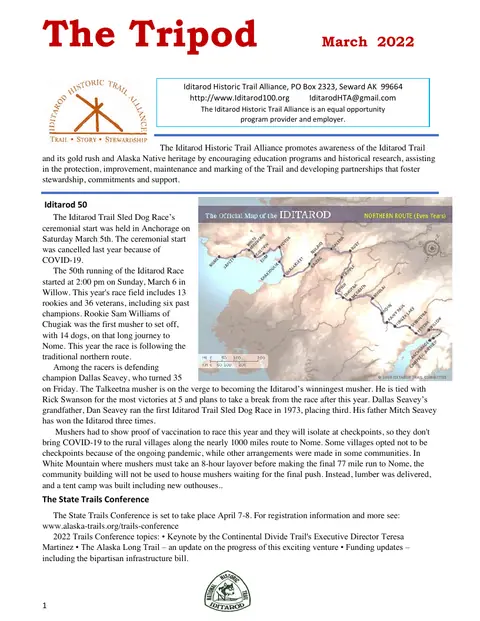
Iditarod Historic Trail Alliance, PO Box 2323, Seward AK 99664 http://www.Iditarod100.org IditarodHTA@gmail.com The Iditarod Historic Trail Alliance is an equal opportunity program provider and employer. The Iditarod Historic Trail Alliance promotes awareness of the Iditarod Trail and its gold rush and Alaska Native heritage by encouraging education programs and historical research, assisting in the protection, improvement, maintenance and marking of the Trail and developing partnerships that foster stewardship, commitments and support. Iditarod 50 The Iditarod Trail Sled Dog Race’s ceremonial start was held in Anchorage on Saturday March 5th. The ceremonial start was cancelled last year because of COVID-19. The 50th running of the Iditarod Race started at 2:00 pm on Sunday, March 6 in Willow. This year's race field includes 13 rookies and 36 veterans, including six past champions.
Rookie Sam Williams of Chugiak was the first musher to set off, with 14 dogs, on that long journey to Nome. This year the race is following the traditional northern route. Among the racers is defending champion Dallas Seavey, who turned 35 on Friday. The Talkeetna musher is on the verge to becoming the Iditarod’s winningest musher. He is tied with Rick Swanson for the most victories at 5 and plans to take a break from the race after this year. Dallas Seavey’s grandfather, Dan Seavey ran the first Iditarod Trail Sled Dog Race in 1973, placing third. His father Mitch Seavey has won the Iditarod three times. Mushers had to show proof of vaccination to race this year and they will isolate at checkpoints, so they don't bring COVID-19 to the rural villages along the nearly 1000 miles route to Nome.
Some villages opted not to be checkpoints because of the ongoing pandemic, while other arrangements were made in some communities. In White Mountain where mushers must take an 8-hour layover before making the final 77 mile run to Nome, the community building will not be used to house mushers waiting for the final push. Instead, lumber was delivered, and a tent camp was built including new outhouses.. The State Trails Conference The State Trails Conference is set to take place April 7-8.
For registration information and more see: www.alaska-trails.org/trails-conference 2022 Trails Conference topics: • Keynote by the Continental Divide Trail's Executive Director Teresa Martinez • The Alaska Long Trail – an update on the progress of this exciting venture • Funding updates – including the bipartisan infrastructure bill. 1 The Tripod March 2022 Government agencies, trail builders and non-profits will be able to share what they have learned and engage in conversations with others to share best practices and new ideas. There are many ways to enjoy Alaska's trails and the conference brings them together all under one roof. Trails and outdoor recreation are a public health asset and an economic engine for the state and the trails conference seeks to raise the profile of trails and their importance to Alaska.
Alaska Trails is seeking proposals for presentations and workshops that showcase best practices in trail construction, trail maintenance, economic development. Send your ideas with “2022 Trails Conference Presentation” in the subject line to office@alaska-trails.org From the past… Iditarod Pioneer July 8, 1916 FAMOUS ALASKA MUSHER HAS MADE HIS LAST HIKE Continued from last month ``I thought it was my last trip,`` continued Tommy. ‘’The distance didn't seem to become smaller, and the cold bit deeper every minute. The dogs flinched a little in the face of the wind, which went through the draw, but they kept on. Often gusts of wind nearly swept them off their feet. It was tough hanging onto the handlebars under these circumstances and trying to urge the dogs on at the same time.’’ Finally, he reached the roadhouse yard. In the shelter of the building, he felt better.
The roadhouse man heard him come in and opened the front door of his store. Tommy drove his team straight through the open door. The string of 17 dogs was so long that the leader had to be directed around the counter before the sled finally squeezed into the warm building. King was a mass of ice and frost. The front of his parka was made of icicles. His face was frozen, and his fingers had to be rubbed for more than hour before the blood started to circulate freely again. Iditarod came into view on December 23rd, the miners fought for the supplies that King brought in. The chicken sold for $2.50 a pound. The pork and turkey brought $2 a pound. The magazines sold for $2 each. The letters brought 50 cents apiece. A copy of the Post Intelligencer brought $2.
On another trip to Iditarod King took down from Fairbanks two traveling men who wanted to get orders from the Iditarod merchants before the breakup. They paid him $750 each for the round trip besides paying all his expenses for the whole journey. One day in Fairbanks he was called to take a doctor to Nenana where a missionary was sick and about to die. Another time he was called from bed to take a doctor to Tolovana, where a roadhouse had burned down with several people in it. Several of them died so he had to make another trip to Fairbanks for the coffins. "The North is the only place where I can get along.`` Tommy said yesterday. “Alaska is a great country. I like it and I'm going back.
" Trail Access Project Funded by the Christopher and Dana Reeve Foundation with other support from the National Park Service and Move United, the Trail Access Project has a video at its website www.trailaccessproject to introduce and further its mission. The Project is undertaking its mission because some parks have wonderful facilities that most users would consider accessible; however, others need to improve upon the quality of experience available to visitors with disabilities. A person with a disability, along with their family and friends, is commonly restricted to a short, token, paved sidewalk near a crowded visitor center. The U.S. National Park Service website for one park describes 58 miles of mostly flat hiking trails but states that those with disabilities can enjoy the park from their car.
The most visited national park in the U.S. boasts of 800 miles of hiking trails with 0.5 miles accessible to visitors with disabilities. The Trail Access Project was incorporated to provide actionable information to both park managers and trail users to enable more inclusive, meaningful exploration of America's extraordinary natural places. 2