In This Issue
Text of this issue
Iditarod Historic Trail Alliance, PO Box 2323, Seward AK 99664 http://www.Iditarod100.org IditarodHTA@gmail.com The Iditarod Historic Trail Alliance is an equal opportunity program provider and employer. The Iditarod Historic Trail Alliance promotes awareness of the Iditarod Trail and its gold rush and Alaska Native heritage by encouraging education programs and historical research, assisting in the protection, improvement, maintenance and marking of the Trail and developing partnerships that foster stewardship, commitments and support. 2022 Statewide Trails Conference Alaska Trails will be hosting the 2022 Statewide Trails Conference on April 7-8 and is seeking proposals for presentations and workshops that showcase best practices in trail construction, trail maintenance, economic development, volunteers, trail design, partnerships, trail benefits and trail-related policy.
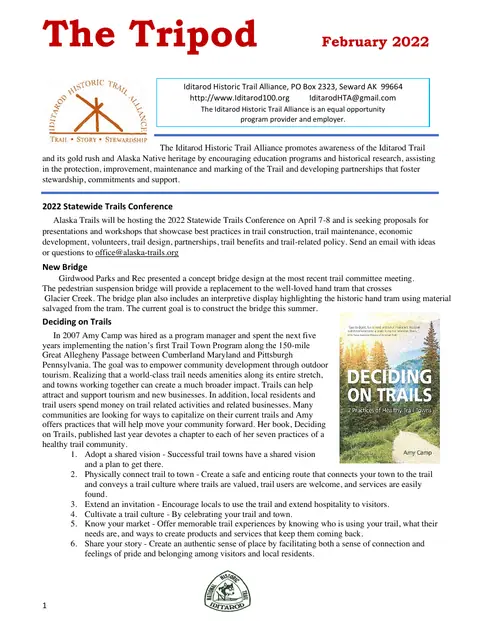
Send an email with ideas or questions to office@alaska-trails.org New Bridge Girdwood Parks and Rec presented a concept bridge design at the most recent trail committee meeting. The pedestrian suspension bridge will provide a replacement to the well-loved hand tram that crosses Glacier Creek. The bridge plan also includes an interpretive display highlighting the historic hand tram using material salvaged from the tram. The current goal is to construct the bridge this summer. Deciding on Trails In 2007 Amy Camp was hired as a program manager and spent the next five years implementing the nation’s first Trail Town Program along the 150-mile Great Allegheny Passage between Cumberland Maryland and Pittsburgh Pennsylvania. The goal was to empower community development through outdoor tourism.
Realizing that a world-class trail needs amenities along its entire stretch, and towns working together can create a much broader impact. Trails can help attract and support tourism and new businesses. In addition, local residents and trail users spend money on trail related activities and related businesses. Many communities are looking for ways to capitalize on their current trails and Amy offers practices that will help move your community forward. Her book, Deciding on Trails, published last year devotes a chapter to each of her seven practices of a healthy trail community. 1. Adopt a shared vision - Successful trail towns have a shared vision and a plan to get there. 2. Physically connect trail to town - Create a safe and enticing route that connects your town to the trail and conveys a trail culture where trails are valued, trail users are welcome, and services are easily found. 3.
Extend an invitation - Encourage locals to use the trail and extend hospitality to visitors. 4. Cultivate a trail culture - By celebrating your trail and town. 5. Know your market - Offer memorable trail experiences by knowing who is using your trail, what their needs are, and ways to create products and services that keep them coming back. 6. Share your story - Create an authentic sense of place by facilitating both a sense of connection and feelings of pride and belonging among visitors and local residents. 1 The Tripod February 2022 7. Commit to quality trails - Quality trails require sound and thoughtful construction, interesting features, and an ongoing commitment to maintenance and stewardship.
From the past… Iditarod Pioneer July 8, 1916 FAMOUS ALASKA MUSHER HAS MADE HIS LAST HIKE Seattle Post Intelligencer, May 31…Tommy King, champion dog musher of Alaska, is out of the game forever. He will sing out no more the cry of the trail to tugging straining yelping malamutes. Tommy King reached Seattle yesterday from Chicago. Doctor J. B. Murray, one of the world's most eminent surgeons, told Tommy there that he would be lame for life. Doctor Murray told him he should stay indoors whenever the thermometer dropped below zero. But the call of the north has proved too strong, too irresistible, too luring, for Tommy. He's going back to Fairbanks on the next boat. In the annals of the sourdough, however there is one record that will hold for many years. It is a record of daring, of courage, of faith, a record of achievement of a sort that tries the elemental man.
Since the days of the Klondike, when he first went northward, King has mushed over 50,000 miles behind dog teams, he has been in every nook and corner of the vast expanse of Alaskan hills and valleys and plains, on nearly every kind of an errand, from the pure humanitarian to the most speculative of commercial missions. Tommy King has hung up a record that Alaskans can shoot at for many winters to come. Last summer, when the dogs were in their kennels for the snowless season, Tommy took a job in a Fairbanks store, he wheeled trucks, rolled barrels and packed merchandise from one part of the store to another. One day he happened too close to the open shaft to the freight elevator, with the result that he fell to the floor below a distance of 25 feet. They picked him up, carried him to the hospital and found out his hip bone had been fractured.
It was a serious injury, and King decided to come outside for the best surgical attendance it was possible to get in the country. He heard the verdict in a Chicago hospital a week or so ago. During the winter of 1910-11, one of the most severe that Interior Alaska had ever witnessed. Tommy established a record for endurance on the trail. He mushed during that winter between Fairbanks and Iditarod, and it is 600 miles between the two camps as the mushers go. He made several smaller trips, one to Tolovana from Fairbanks and another to Nenana from the Tanana metropolis. On one of these round trips Tommy came nearer, to losing his life than he ever did during all his travels on the northern trails. Early in December the word came from Iditarod that there wasn't anything but reindeer and caribou meat in the camp.
King decided to speculate, take a flyer in poultry, one might call it, and capitalize his ability as a musher to his own profit. He bought about 400 pounds of chickens, 400 pounds of turkeys and some pork loins and a little beef. He took half a hundred letters that were offered for Iditarod and way points. He bought a number of magazines in Fairbanks, paying the news dealers their regular price of 50 cents each. He also paid this price for a few Sunday papers from Seattle and San Francisco. It was the morning of December 4 that Tommy started from Fairbanks along the down-river trail toward the Iditarod. He had to get there before the morning of the 24th in order to realize on his merchandise. The cold weather started in. The snow became more powdery than ever and dogs couldn't travel far without fatigue. ``It didn't moderate a bit. Instead, it got a little colder.
When we struck Mouse point, about halfway between Fort Gibbon and the Lewis cut-off, it was about 70 below.`` Near Mouse point is the coldest spot on the whole Yukon River, where the wind sweeps through a draw and whisks the ice clean of every vestige of snow, leaving it just a vast pain of slippery glass. When King struck this spot, he saw the light of the roadhouse in the distance. Through the murk of the Arctic afternoon he could catch the gleam from the roadhouse window, though it was two miles away. continued next month 2