In This Issue
Text of this issue
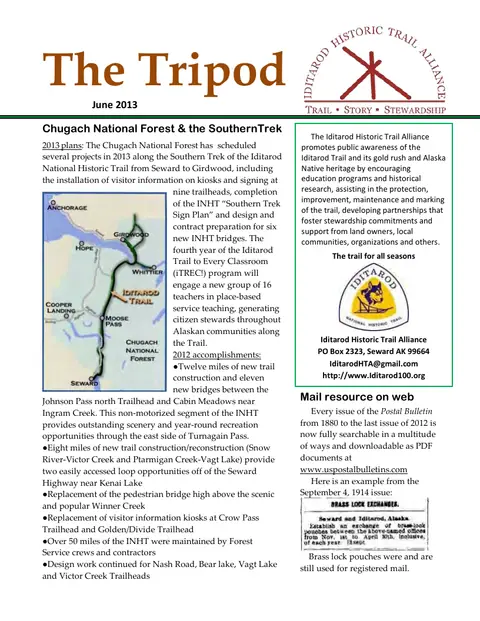
Chugach National Forest & the SouthernTrek 2013 plans: The Chugach National Forest has scheduled several projects in 2013 along the Southern Trek of the Iditarod National Historic Trail from Seward to Girdwood, including the installation of visitor information on kiosks and signing at nine trailheads, completion of the INHT “Southern Trek Sign Plan” and design and contract preparation for six new INHT bridges. The fourth year of the Iditarod Trail to Every Classroom (iTREC!) program will engage a new group of 16 teachers in place-based service teaching, generating citizen stewards throughout Alaskan communities along the Trail. 2012 accomplishments: ●Twelve miles of new trail construction and eleven new bridges between the Johnson Pass north Trailhead and Cabin Meadows near Ingram Creek.
This non-motorized segment of the INHT provides outstanding scenery and year-round recreation opportunities through the east side of Turnagain Pass. ●Eight miles of new trail construction/reconstruction (Snow River-Victor Creek and Ptarmigan Creek-Vagt Lake) provide two easily accessed loop opportunities off of the Seward Highway near Kenai Lake ●Replacement of the pedestrian bridge high above the scenic and popular Winner Creek ●Replacement of visitor information kiosks at Crow Pass Trailhead and Golden/Divide Trailhead ●Over 50 miles of the INHT were maintained by Forest Service crews and contractors ●Design work continued for Nash Road, Bear lake, Vagt Lake and Victor Creek Trailheads The Iditarod Historic Trail Alliance promotes public awareness of the Iditarod Trail and its gold rush and Alaska Native heritage by encouraging education programs and historical research, assisting in the protection, improvement, maintenance and marking of the trail, developing partnerships that foster stewardship commitments and support from land owners, local communities, organizations and others.
The trail for all seasons Iditarod Historic Trail Alliance PO Box 2323, Seward AK 99664 IditarodHTA@gmail.com http://www.Iditarod100.org Mail resource on web Every issue of the Postal Bulletin from 1880 to the last issue of 2012 is now fully searchable in a multitude of ways and downloadable as PDF documents at www.uspostalbulletins.com Here is an example from the September 4, 1914 issue: Brass lock pouches were and are still used for registered mail. From the past… The Alaska Mining Hall of Fame recently inducted three early miners from the IditarodFlat district: Merton Marston, Mattie Crosby (aka Tootsie) and Toivo Rosander. A short biography of Merton Marston appeared in the April newsletter; Mattie Crosby’s in the May newsletter and here is Toivo Rosander’s biography courtesy of the Mining Hall of Fame.
Toivo Johan Gustavus Rosander (1915-2010) Toivo’s parents immigrated to the United States from Finland before World War I, when the marriage split up, Tovio’s mother to be went back to Finland to spend time with relatives and Toivo was born there in 1915. They were unable to return to the United States until after World War I. Toivo grew up on a farm in New Hampshire; in 1936 he was summoned to Alaska by his uncle Gus Uotila, who was mining placer gold in the Innoko district. Toivo was a fast learner and soon mastered the dragline, bulldozer, hydraulic monitor and other equipment necessary to successfully mine placer gold. He lived in the mining town of Ophir. On a trip to visit his mother in Florida he met Miriam “Dyna” Polkkymen, a competitive swimmer and diver and an accomplished figure skater. They were married and had two children, Ken (born in 1938) and Ron (born in 1943).
Toivo was drafted at the start of World War II and became a pilot, flying B-24 bombers over Europe in the 15th Air Force. After the War Toivo, Dyna and their sons returned to Ophir and he resumed his mining activities on Little Creek and later Yankee Creek. For more than 15 years, Toivo deployed two work shifts per day during the mining season, employing as many as 25 men and women, many from local communities such as McGrath, Takotna, Nikolai, Holy Cross and other villages. Toivo and his crews consistently mined more than one million bedrock feet of paystreak each year. He also partnered with other placer miners in the Innoko district. Toivo shut down his main Yankee Creek gold mine in 1967, partly due to the exhaustion of easy-to-mine reserves, and partly due to the fixed price of gold.
He diversified his livelihood and organized Kusko Trucking Company hauling fuel and supplies along the OphirSterling Landing road system to miners and to the Tatalina Air Force Base. Toivo and Dyna also made gold nugget jewelry with placer gold from the Ophir area. When gold prices were decontrolled and began to rise in the early 1970s, Toivo joined his sons to develop a new gold mining venture on Colorado Creek north of McGrath. Through the purchase of mining claims from John and Richard Fullerton in Flat, the Rosander Mining Company has mined at Colorado Creek every year since 1974, making it one of the longest running, continuously mining Alaska placer gold producers of the modern era. Toivo Rosander passed away in a suburb of Miami, Florida on December 24, 2010.
BLM work on Iditarod Trail The Anchorage Field Office of the Bureau of Land Management has a good report of the work it has been doing on the Iditarod National Historic Trail at http://www.blm.gov/ak