In This Issue
Text of this issue
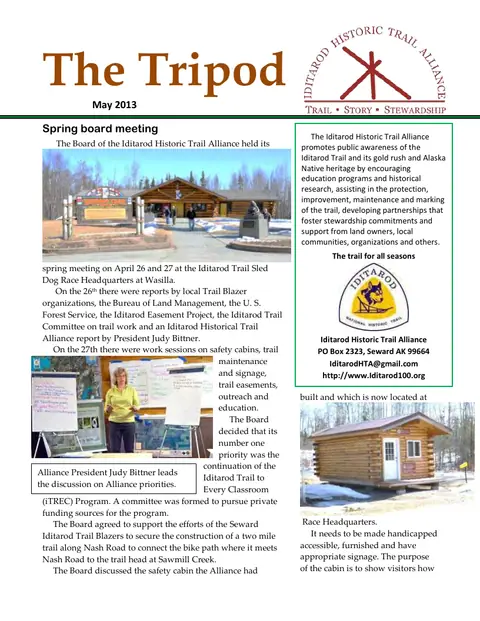
Spring board meeting The Board of the Iditarod Historic Trail Alliance held its The Iditarod Historic Trail Alliance promotes public awareness of the Iditarod Trail and its gold rush and Alaska Native heritage by encouraging education programs and historical research, assisting in the protection, improvement, maintenance and marking of the trail, developing partnerships that foster stewardship commitments and support from land owners, local communities, organizations and others. The trail for all seasons spring meeting on April 26 and 27 at the Iditarod Trail Sled Dog Race Headquarters at Wasilla. On the 26th there were reports by local Trail Blazer organizations, the Bureau of Land Management, the U. S. Forest Service, the Iditarod Easement Project, the Iditarod Trail Committee on trail work and an Iditarod Historical Trail Alliance report by President Judy Bittner.
On the 27th there were work sessions on safety cabins, trail maintenance and signage, trail easements, outreach and education. The Board decided that its number one priority was the continuation of the Alliance President Judy Bittner leads Iditarod Trail to the discussion on Alliance priorities. Every Classroom (iTREC) Program. A committee was formed to pursue private funding sources for the program. The Board agreed to support the efforts of the Seward Iditarod Trail Blazers to secure the construction of a two mile trail along Nash Road to connect the bike path where it meets Nash Road to the trail head at Sawmill Creek. The Board discussed the safety cabin the Alliance had Iditarod Historic Trail Alliance PO Box 2323, Seward AK 99664 IditarodHTA@gmail.com http://www.Iditarod100.org built and which is now located at Race Headquarters.
It needs to be made handicapped accessible, furnished and have appropriate signage. The purpose of the cabin is to show visitors how safety cabins along the trail are furnished, what purpose they serve and to make available information about the goals and accomplishments of the Iditarod Historic Trail Alliance and how to join the Alliance. From the past… The Alaska Mining Hall of Fame recently inducted three early miners from the IditarodFlat district: Merton Marston, Mattie Crosby (aka Tootsie) and Toivo Rosander. A short biography of Merton Marston appeared in the April newsletter. Toivo Rosander’s will appear in June’s newsletter. Here is Mattie Crosby’s biography courtesy of the Mining Hall of Fame. Martha Euphemia Tula Macelhaine aka Mattie Crosby, aka Miss Tootsie (1884-1972) Mattie Crosby, also known as Tootsie, was Mattie Crosby with Johnny Stevens and Frank Molitar at Flat.
Photo from University of Alaska Fairbanks archives. born in Maine on May 2, 1884. Mattie was little more than an infant when her mother died and she was adopted into the Wade family. Mattie received a good education and moved with them when they joined the Klondike gold rush to Dawson and eventually Fairbanks. She entered Alaska in 1900 and married a miner by the name of Crosby, but their marriage didn’t last. She left Alaska in 1909, but returned in 1911 and went to Iditarod with the aim of establishing the finest bathhouse in Alaska. She also found alternate ways to make a living in addition to prospecting and running a bathhouse. Mattie was an excellent cook and supported herself through the years by preparing banquets as well as ordinary meals. She opened “Tootsie’s Tavern” a lunch room and tavern in Flat. Mattie never drank or smoked.
Yet when Prohibition went into effect, she became an enthusiastic bootlegger, which led to her one jail term. Mattie was convicted of bootlegging and served six months in jail in Fairbanks. After which, she never sold illegal alcohol again. Mattie operated a sort of “carry on and pay later” business and sank nearly all of her loan business profits into mining ventures on Bear and Marvel Creeks in the Nyac mining district. May of 1925 saw the first commercial flight between Fairbanks and Flat. Mattie was the only passenger on board for that flight and reportedly paid $500 for the trip. The cost included freight changes for some supplies for her businesses in Flat. In her later years, Mattie supported several old timers, especially Mike Burns, who in turn kept her in firewood.
When Mike lost his sight and Mattie’s legs began to give out, she and Mike moved first to the Pioneer Home in Sitka, then to the Home in Fairbanks, where Mattie died on October 11, 1972. Sometime after World War II, Mattie had a hand-written autobiography on which she had worked for years. Someone offered to get it typed for her. Tragically, when she lent the only copy for typing and review, it was lost. Iditarod Trail Easement Project The 2013 first quarter report of the Iditarod Trail Easement Project is now available at dnr.alaska.gov/mlw/Iditarod There is a great deal of additional information about the project at the website.