
Our 2026 legislative agenda: Creating a more equitable modern tech economy
Our modern tech economy isn’t working for most people. Productivity is on the rise, but wages are not. We’re seeing record-high profits and a roaring stock market alongside years of mass layoffs and a persistent affordability crisis.
But it doesn’t have to be this way.
At TechEquity, we envision a world where the tech industry is responsible for building widespread prosperity and is held accountable for the economic harms it creates in our communities. Many Americans are on the same page.
For that vision of tech to become a reality, we need to address power imbalances so tech can empower, rather than undermine, everyday people and strengthen the rights of workers, renters, and consumers.
To build that foundation, TechEquity Action focuses on legislation in California because when policy is enacted in the 4th largest economy globally, it has ripple effects across the country and around the world. Below is an overview of our 2026 strategy and TechEquity Action’s priority slate for the 2026 California legislative session.
The issues at hand
In 2026, TechEquity Action is focused on advancing a priority bill slate that addresses how tech and AI are exacerbating economic inequality—something Californians overwhelmingly want. TechEquity Action’s policy agenda this year includes legislation that reflects our AI Policy Principles and A Leadership Agenda for a People-First Economy memo series, and aligns with our focus on tackling California’s affordability crisis.
Rebalancing economic power
If you’re feeling like everything is owned by just a handful of companies, you’re not alone. And it’s not always because they make the best stuff.
Sometimes, mega-corporations are able to leverage their size and connections to make backroom deals, pressure other companies to buy something they don’t want to get to what they actually need, and set up roadblocks for rivals and new players. This means less competition, higher prices for consumers, lower wages for workers, and challenges for small businesses.
Large digital platforms have specifically been accused of making it difficult for users to move to other platforms and of favoring their own products or services over those of competitors operating on the same platform—killing competition on arrival and, in some instances, driving up prices for consumers.
To address these issues, we need to increase transparency and our government’s ability to enforce and introduce laws that create a competitive market we can all benefit from.
Tackling the surveillance economy
Facing high prices, high interest rates, and growing unemployment, life is becoming urgently unaffordable for an increasing number of Californians.
By creating tools that optimize high prices to increase corporate profits, tech is playing a big role in eroding family budgets. Aided by AI-enabled tools, companies are using information they have about you—your location, buying habits, demographics—to set a price based on how much you’re willing to pay. This is known as surveillance pricing.
How do they even get this information in the first place? Typically, companies rely on a combination of first-hand data they’ve collected about you as well as personal data they buy from data brokers.
In this way, the surveillance economy is a cycle of extraction that we must tackle in order to build a more equitable economy.
Supporting workers
The age of AI has also ushered in a new age of worker exploitation—from how AI is developed to how it’s used on workers.
Workers around the world collect and annotate data and then train and evaluate AI models to make them work. These workers are paid as little as $1.50/hour around the Global South to power billion-dollar companies, all while being deliberately obscured by AI companies through layers of contractors and non-disclosure agreements.
Meanwhile, workers face increasing workplace surveillance, automated systems used in decisions affecting their well-being, as well as layoffs in the context of AI that not only strip workers of their livelihoods but also put consumers and the people they serve at risk.
We need to address these issues in order to ensure the safety and security of workers and their families in California and beyond.
Ensuring transparency & fairness in AI systems
Automated Decision Systems (ADS) are already being used to aid or make decisions about the most important areas of everyday people’s lives, from employment to housing, social services to policing, and beyond.
With just a few clicks, companies are using new technologies to automate life-changing decisions—often without the people whose lives are being changed ever knowing. Without proper guardrails, this technology can enforce and exacerbate existing harms and biases at a speed and scale never seen before.
Californians know this, and 70% want regulations to prevent the worst harms of AI tools like ADS.
Our coalitions
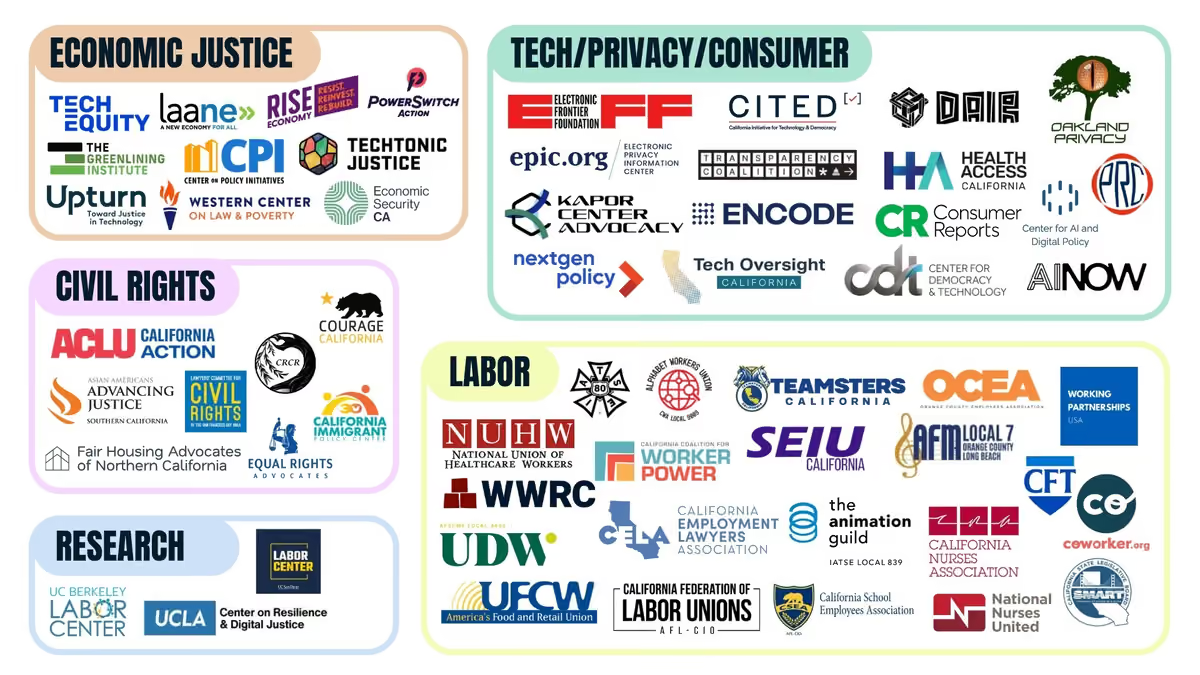
We focus on supporting legislation aligned with our mission, initiatives, and values. We do this through participation in a set of coalitions that are aligned around those areas of our work, including:
- California AI Working Group (TechEquity-led table)
- Housing Now! Coalition
- Rise Economy Housing Committee
- Stronger California Advocates Network
- Temp Worker Advocacy Coalition (National)
- Anti-Monopoly Coalition
- Building the California Dream Alliance
- California Privacy Coalition
- Bay Area Tech Table
- Affordability Campaigns Collaborative (National)
Legislation TechEquity Action is sponsoring
Sponsored legislation means TechEquity Action has partnered with an elected official to develop and lead the efforts to ensure these bills will become law. We’re aggressively campaigning on the legislation, leading coalition tables, and engaging our community on why these bills are vital to our mission.
AB 1776 (Aguiar-Curry) – COMPETE Act
The well-being of our economy depends on competition to keep prices down while driving up the quality of products, services, and jobs. What happens when large companies use their size to undermine competition and consumer choice?
Innovation is stifled, consumers, workers, and small businesses suffer, and California’s affordability crisis gets worse. AB 1776 promotes a fair economy by strengthening competition, opportunity, innovation, and entrepreneurship by codifying the California Law Revision Commission (CLRC)‘s unanimous recommendations to update state antitrust law.
Why is this bill critical to TechEquity’s mission and issue areas?
TechEquity Action is sponsoring this effort because the current tech and AI industry is defined by concentration and dependence. Perverse incentives fueled by Venture Capital (VC) create a market dynamic in which the funders (VC) choose winners and losers rather than allowing good business ideas to compete on the merits.
We envision a tech industry that could prioritize empowering workers and protecting privacy, but without a vibrant, competitive market, the status quo will continue. The COMPETE Act (AB 1776) would, for the first time, give California a clear statutory prohibition on abusive conduct by monopolies, bringing it in line with the large majority of states and making it harder for dominant tech companies to distort the market in their favor and thwart competitive innovation.
AB 2564 (Ward) – Surveillance Pricing Protection Act
Companies are using the information they have about you—your location, buying habits, and demographics—to set prices based on how much you’re willing or able to pay. This is known as surveillance pricing, and it can be both predatory and discriminatory.
AB 2564 will prohibit the practice of surveillance pricing by making it unlawful for retailers to use personally identifiable information to charge different prices for the same product, whether online or during in-store checkout.
Why is this bill critical to TechEquity’s mission and issue areas?
TechEquity Action is sponsoring because California consumers face a new and growing threat to fair pricing. Companies now possess the technology to collect vast amounts of consumer data and deploy artificial intelligence to charge each shopper a personalized price—one calibrated not to the market, but to the maximum that an individual can be made to pay. Addressing surveillance pricing is an important step in restoring fairness and affordability for consumers.
AB 2653 (Lee) – Sweatshop Free AI Act
Content moderators in Africa make social media platforms safer at great personal cost. Indian workers made Amazon Go stores actually go while being paid low wages. Here in California, data workers who help improve the quality of Google search results report worsening work conditions and being “overworked, underpaid.” But these stories only scratch the surface of the labor that underpins every part of the AI production process. How do companies get away with this? Subcontracting and outsourcing.
That’s why Assemblymember Alex Lee authored AB 2653. This bill will be a first step toward establishing strong accountability to workers in the AI supply chain by examining whether AI systems procured by state agencies in California are created under unfair labor practices. California already has sweat-free procurement statutes in place for the state’s procurement of physical goods, such as garments. Californians have long valued strong labor standards and want to ensure that their tax dollars aren’t being used to finance dangerous and harmful working conditions for people both here in California and across the globe.
Why is this bill critical to TechEquity’s mission and issue areas?
TechEquity Action is sponsoring this bill because California is in a unique position, as the home of many AI companies and as a procurer of AI tools, to ensure that tech companies are accountable for labor conditions across their supply chains. California tax dollars should not flow to companies using unethical and exploitative labor practices.
Previous instances of outsourcing have also created a race to the bottom on labor standards, hurting workers from Kenya to the U.S.—this is already happening in the AI supply chain. By holding companies accountable for the labor conditions connected to their goods and services, we can also increase pay and strengthen conditions for California workers.
AB 1018 (Bauer-Kahan) – Automated Decisions Safety Act
Algorithms help decide who gets access to housing, healthcare, and financial aid every day. We’re seeing how algorithms embedded in critical decisions in people’s lives are leaving the door open to AI-powered discrimination.
AB 1018 will provide people with more information, important rights, and greater transparency into the use of Automated Decision Systems for critical areas of their lives—while requiring developers and deployers to take more responsibility for reducing the likelihood of discrimination.
Why is this bill critical to TechEquity’s mission and issue areas?
This bill is a continuing on from the 2025 legislative cycle. TechEquity Action is sponsoring because it would regulate ADS used to make critical decisions about our lives, including hiring and other workplace-related decisions, and ADS deployed in housing, such as tenant-screening tools (aligned with our recent Screened Out of Housing research). From this perspective, the bill aligns closely with both our labor and housing work, and we will advocate for its passage in line with our AI Policy Principles.
Legislation TechEquity Action is supporting
Support legislation means these bills are closely tied to TechEquity’s initiatives and policy platforms at the intersection of tech and economic justice. Through our coalitions, TechEquity Action works with partners to ensure the passage of these bills.
Rebalancing economic power
AB 1776 (Aguiar-Curry) – COMPETE Act promotes a fair economy by strengthening competition, opportunity, innovation, and entrepreneurship by codifying the California Law Revision Commission (CLRC)‘s unanimous recommendations to update state antitrust law. This bill is sponsored by TechEquity Action, American Economic Liberties Project, California Federation of Labor Unions, California Nurses Association, Consumer Federation of California, Economic Security California/Action, SEIU California, Small Business Majority, Teamsters California, United Food and Commercial Workers, Western States Council, and the Writers Guild of America West.
AB 1857 (Aguiar Curry)– Grocery Store Access Act would bar restrictive covenants—provisions in deeds or contracts that limit how a property can be used—for grocery stores. Restrictive covenants often prevent new grocery stores from opening in otherwise suitable commercial spaces, such as those formerly occupied by another grocery operator that has closed. The use of restrictive covenants drives out competitors who could serve a community, forcing customers to commute or go without when trying to access groceries. This bill is sponsored by California Food and Farming Network and Economic Security California Action.
AB 2169 (Lowenthal)– Digital Choice Act provides consumers with greater control and choice in using digital platforms by requiring data portability (the ability to download and move your data) and interoperability (the ability to seamlessly migrate to a new platform). This prevents consumers from being “locked in” to a platform because switching is too burdensome or costs are too high.
SB 1123 (Wiener) – Administrative Procedure Act ensures California agencies calculate the benefits of regulations, not just the costs. This gives a more accurate public record for commenters and the agency boards that approve regulations, preventing protections for consumers, workers, and renters from being derailed by one-sided cost estimates. This bill is sponsored by the Consumer Federation of California.
Tackling the surveillance economy
AB 2564 (Ward)– Surveillance Pricing Protection Act prohibits the practice of surveillance pricing by making it unlawful for retailers to use personally identifiable information to charge different prices for the same product, whether online or during in-store checkout. This bill is sponsored by TechEquity Action, Consumer Reports, and the California Federation of Labor Unions.
AB 1159 (Addis)– California Learner Personal Information Protection Act will ensure that all California students have robust protection against the misuse of their personal information, from preschool through higher education, reducing one channel through which companies and data brokers collect the vast data profiles they maintain. This bill is sponsored by Privacy Rights Clearinghouse.
AB 1542 (Ward) – California Sensitive Data Privacy Act prohibits businesses from selling or sharing sensitive personal information they collect to third parties. Consumers’ social security numbers, financial account information, precise geo-location, racial or ethnic origin, religious or philosophical beliefs, union membership, genetic data, biometric information, health information, sexual orientation, or citizenship and immigration status shouldn’t be up for sale to data brokers. This bill is sponsored by Asian Americans Advancing Justice Southern California, California Initiative for Technology & Democracy (CITED), and Consumer Reports.
SB 923 (Becker) – Expanding Privacy Rights Act (EPRA) allows Californians greater control over the deletion of their personal data by closing a loophole that allows companies to avoid deletion requests by claiming they obtained data from a third-party source, such as through a data broker. This bill is sponsored by CalPrivacy.
Supporting workers
AB 2653 (Lee) – Sweatshop Free AI Act is a first step toward establishing strong accountability to workers in the AI supply chain by examining whether AI systems procured by state agencies in California are created under unfair labor practices. This bill is sponsored by TechEquity Action, Communications Workers of America (CWA), and Alphabet Workers Union.
AB 1898 (Schultz) – Workplace AI Right to Know Act requires an employer to provide a written notice to an employee that a workplace AI tool was used to assist the employer in making employment-related decisions or to surveil workers in the workplace. The bill would require an employer to maintain an updated list of all workplace AI tools currently in use and their impact on jobs and to provide the list to workers annually. This bill is sponsored by the California Federation of Labor Unions.
AB 2027 (Ward) – Robot Training Prevention Act would prohibit an employer, or a third-party vendor that contracts with an employer, from using a worker’s personal information to train an AI system to replicate, automate, or replace the worker’s job—either directly, or by providing a third party with access to the data. This bill is sponsored by the California Federation of Labor Unions.
AB 2155 (Aguiar-Curry) – Arbitration agreements makes agreements to submit to arbitration unenforceable where the agreement would not be enforceable under the Federal Arbitration Act, such as with claims of sexual harassment. Arbitration is a private, alternative dispute resolution process in which a neutral third party (an arbitrator) renders a binding decision on a conflict, rather than a judge or jury in a public court. This bill is sponsored by the California Employment Lawyers Association and Equal Rights Advocates.
AB 2545 (Schiavo) – Workplace AI impact study establishes the California Artificial Intelligence Worker Impact Data Assessment Project and the California Artificial Intelligence Worker Impact Data Assessment Project Advisory Panel. This panel will assess data sources and collection methods regarding the use and impact of advanced AI systems on the labor force.
SB 947 (McNerney) – No Robo Bosses Act bars employers from relying solely on ADS to fire or discipline workers. It would also require human oversight and independent verification when employers use ADS to assist in termination and disciplinary decisions, and prohibit the use of ADS systems that use personal information of workers to “predict” what they’ll do in the future. This bill is sponsored by the California Federation of Labor Unions.
SB 951 (Reyes) – AI Job Killer Notice Act provides much-needed transparency and information to policymakers and the public. It does so by requiring employers to provide advance notice to their workers and to their local government and the Employment Development Department of any planned layoffs or reductions in hiring resulting from the use of AI. This bill is sponsored by the California Federation of Labor Unions.
Supporting workers & protecting consumers
AB 1609 (Zbur) – Right to Human Customer Services Act is designed to ensure Californians can reach a real person for customer service instead of being trapped in endless phone holds or frustrating AI chatbot loops. AB 1609 strikes a balanced approach by ensuring that businesses can continue using automation while guaranteeing consumers the right to speak with a human within a reasonable amount of time. This bill is sponsored by Communications Workers of America, District 9.
AB 1979 (Bonta) – AI tools cannot replace licensed clinical judgement establishes a human-in-command standard for AI tools in health care. The bill also ensures that patient medical information uploaded onto a consumer-facing AI health application remains protected under the CA Medical Privacy Act. This bill is sponsored by the California Nurses Association.
AB 2575 (Ortega) – Safeguards for AI in health care establishes commonsense safeguards for patients and health care workers when AI is used in health care. These protections set clear rules for informing patients and workers when AI is being used, affirm clinicians’ ability to override AI-driven decisions and to exercise professional judgment without retaliation, and ensure that developers and deployers of AI in health care settings can be held responsible for harm. This bill is sponsored by the California Federation of Labor Unions and the California Nurses Association.
SB 903 (Padilla) – Wellness and Oversight for Psychological Resources Act will protect mental healthcare by requiring that psychotherapy be provided by licensed professionals, not by AI. Licensed professionals will still be able to use AI, with transparency and consent, for limited administrative or supplementary support and prohibit AI from independently interacting with clients, making therapeutic decisions, detecting emotions, or generating treatment plans without professional review. This bill is sponsored by the California Association of Marriage and Family Therapists, the California Behavioral Health Association, the California Psychological Association, and the National Union of Healthcare Workers.
Ensuring transparency & fairness in AI systems
AB 1018 (Bauer-Kahan)– Automated Decisions Safety Act provides people with more information, important rights, and greater transparency into the use of Automated Decision Systems for critical areas of their lives—while requiring developers and deployers to take more responsibility for reducing the likelihood of discrimination. This bill is sponsored by TechEquity Action and SEIU California.
SB 1050 (Ashby) – AI Advertisement Integrity Act makes the use of a synthetic in advertisements without disclosure an unlawful practice. Furthermore, the bill stipulates that disclaimers would have to be noticeable, visible, positioned closely to the synthetic, and use language that identifies the content being used. This bill is sponsored by the Screen Actors Guild–American Federation of Television and Radio Artists (SAG-AFTRA).
SB 719 (Cabaldon) – ADS inventory extends the requirement for the California Department of Technology (CDT) to conduct annual inventories of all high-risk ADS that have been proposed for use, development, or procurement by, or are being used, developed, or procured by, any state agencies and to submit a report of the comprehensive inventories to the Legislature.
SB 1159 (Cabaldon) – Transparency around AI excludes AI from exercising certain rights, such as filing public records requests or participating in government meetings.
SB 574 (Umberg) – AI in the legal field requires lawyers in the state to verify the accuracy of all materials produced using artificial intelligence, including case citations and other information in court filings.
My story as a contract worker who has been sidelined is not uncommon—but it is often unnoticed. Our stories are powerful and can create real change; I’m glad to work with TechEquity to share my story with decision-makers that can materially improve contract working conditions.
David Jones-Krause former Google contract worker who testified at a hearing
Tell legislators your story
Stories are powerful. By sharing your experience with the surveillance economy, workplace tech, or struggling to get by in a world increasingly driven by AI, you can help lawmakers understand why they should support these bills to close the gaps and protect everyday people.
See an issue you care about? Have a personal connection to one of these bills? Share your story with us, and we’ll bring it to the Capitol this legislative session.