
Below are some frequently asked traffic questions by Schaumburg residents and visitors. You may also submit a Customer Service Request to report any traffic issues or concerns.
Please contact the Transportation Department at (847) 923-3861 or vostransportation@schaumburg.com with any questions.
The traffic signal is not working properly. Who do I contact to fix it?
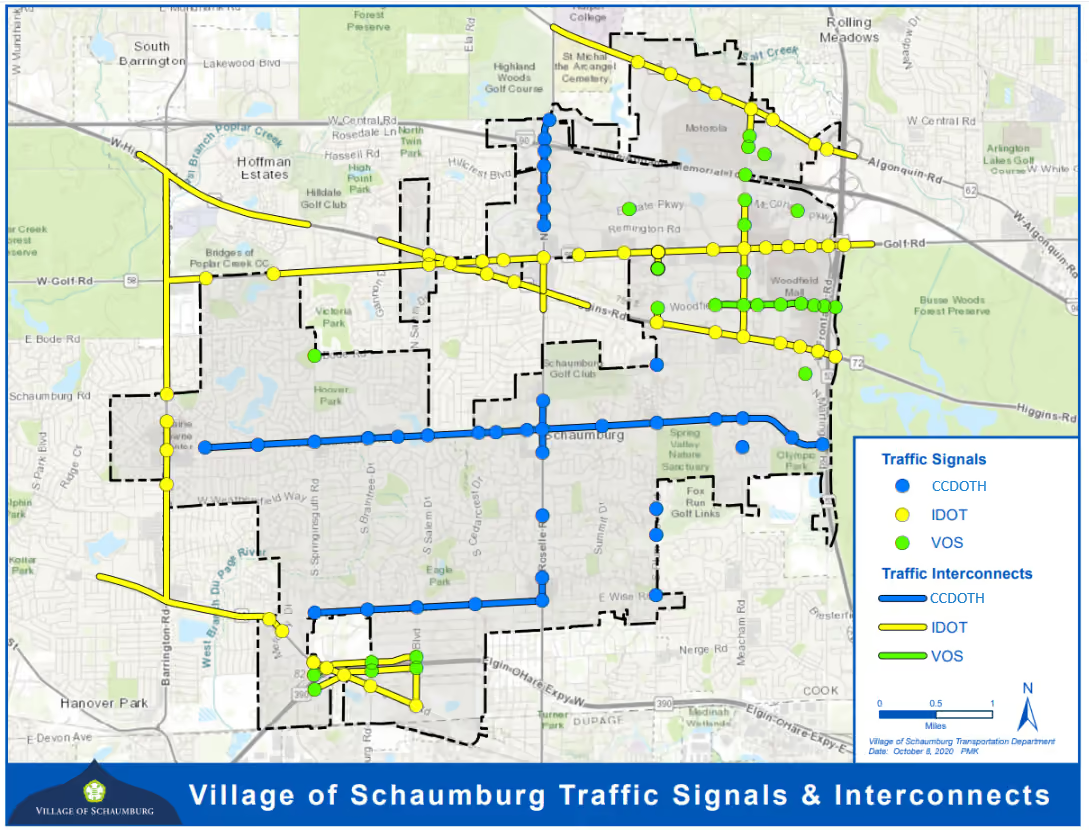
There are 110 traffic signals in Schaumburg. The village operates and maintains 25 (23%) of these traffic signals. For a village-owned signal, please submit a Customer Service Request. When submitting the request, please specify the intersection, operational issue, time of day, and direction of travel. If this information is not provided, village staff may contact you for additional details.
The remaining signals are the responsibility of:
-
Cook County Department of Transportation and Highways (CCDOTH)
CCDOTH owns, operates, and maintains 37 (34%) of 110 traffic signals within Schaumburg. Some roads whose signals are operated by CCDOTH include Schaumburg Rd, Plum Grove Rd, Meacham Rd south of Higgins Rd, and Roselle Rd. Signal requests for CCDOTH can be submitted here.
-
Illinois Department of Transportation (IDOT)
IDOT owns, operates, and maintains 46 (42%) of 110 traffic signals in Schaumburg. Some roads whose signals are operated by IDOT include Higgins Rd, Golf Rd, Algonquin Rd, and Meacham Rd north of Algonquin Rd. Any road with a state route symbol is controlled by IDOT. Signal requests for IDOT can be submitted here.
Traffic signal ownership and management responsibility can be identified by using the map below:
Why does traffic signal ownership matter?
Traffic signal improvements often require coordination among multiple transportation agencies. Understanding who owns a traffic signal can help explain why certain intersections are included in a project while others are not. Although traffic signals may be owned by different agencies, the village works closely with its transportation partners to coordinate signal operations and implement improvements that support safer and more efficient travel throughout the region.
What happens after I contact the village about its traffic signal?
For a reported issue at a village-owned traffic signal, the Transportation Department contacts the village’s electrical maintenance contractor to perform routine maintenance and check for operational errors.
Who can I contact to address traffic or parking issues at my child’s school?
If you have concerns about traffic or on-street parking, you may contact the Transportation Department. Concerns related to circulation or parking in the school's parking lot should be directed to the school administrator.
Can anything be done to address traffic during school pickup and drop-off?
For any requests related to school circulation, the Transportation Department and Police Department contact the school administration to discuss the concern. If improvements are needed, an improvement plan is developed to better circulate motorists during school arrival and dismissal. The improvement plan could include solutions such as:
-
Coordinating traffic flow during school arrival and dismissal;
-
Implementing additional parking restrictions;
-
Updating current parking restrictions;
-
Installing regulatory or advisory traffic control signage; or
-
Improving crosswalks in the vicinity of the school.
Depending on the recommended actions, implementation of the improvement plan may require changes to the Village Code and approval by the Village Board.
Cars are speeding down my street. What can the village do?
When a speeding concern is submitted, the Transportation Department completes a traffic study and collects data regarding travel speeds and traffic volume within the corridor to obtain a baseline for existing conditions.
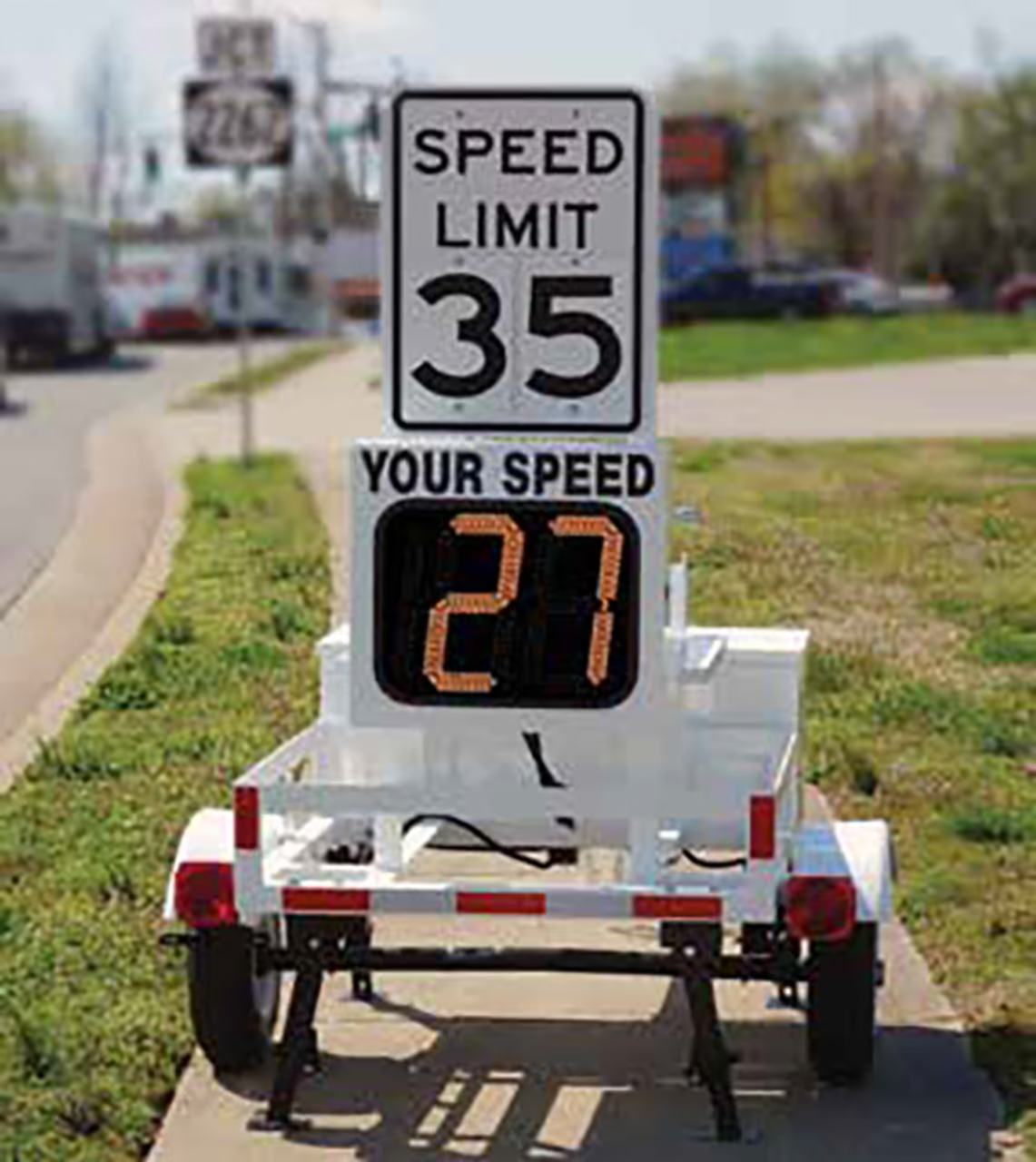
The Transportation Department can deploy two types of devices to collect baseline data. Speed trailers are portable, unidirectional speedometers that display the driver’s speed as they pass by. The feedback from the display sign brings awareness to motorists traveling through the area about how fast they are traveling. Staff may also deploy portable traffic analyzer devices. These devices are installed in the roadway to obtain traffic counts and speed data in the direction of travel.
Depending on the location and nature of the request, the Police Department may also be asked to conduct enforcement.
What data comes out of a traffic study? What does staff do with that data?
Based on the results of the traffic study, staff may recommend actions to improve safety. For example, if speeding is revealed to be an issue, staff may recommend traffic calming solutions as a means to slow down traffic. Proposed roadway improvements are planned and implemented based on the design treatment and timing of programmed roadway maintenance. In some cases, proposed improvements may be added to the village’s capital improvement program for implementation in future years.
Can speed bumps be installed at intersections to slow drivers down?
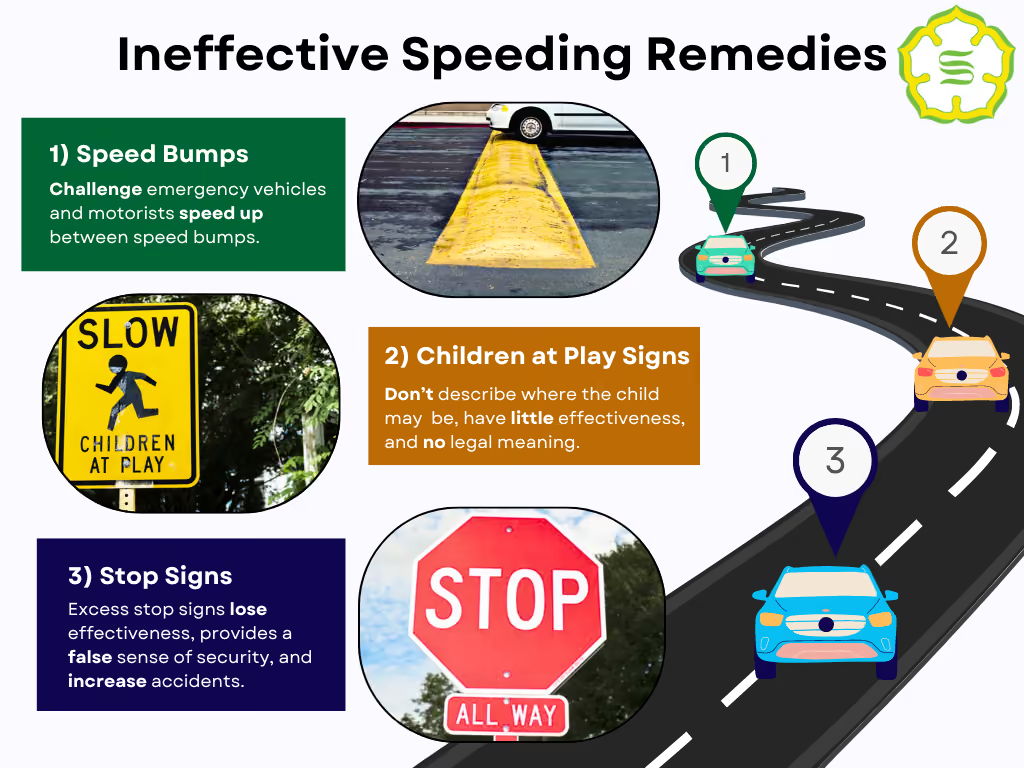
Per village code, speed bumps are not permitted on public or private property within the village. Speed bumps pose operational issues for emergency and service vehicles and are not an effective way to control vehicle speed because, as many engineering studies have shown, motorists speed up between speed bumps to make up for the perceived loss of time.
How about stop signs—will the village install those to slow drivers down?
The village follows the Manual on Traffic Control Devices (MUTCD), which regulates federal guidelines for traffic control signage. The MUTCD recommends that stop signs should be used conservatively. If these signs are used in excess, they tend to lose effectiveness. Stop signs are intended to provide safe and adequate gaps for vehicles to enter an intersection. Many engineering studies have shown that implementing unwarranted stop signs to control speed can instill a false sense of security for the neighboring residents and often increase the number of vehicular accidents.
How do I make a request for a stop sign?
Please submit a Customer Service Request to request a stop sign for a specific intersection.
There are a lot of children that play in my neighborhood. Can signs be placed to alert drivers?
The village follows the Manual on Traffic Control Devices (MUTCD), which regulates federal guidelines for traffic control signage. The MUTCD recommends that advisory signs should be used conservatively. If signs are used in excess, they tend to lose effectiveness. All motorists should be aware and watch for children and pedestrians while driving through neighborhoods and residential areas. Children at play signs are not recommended because these signs:
- Do not describe where the child might be;
- Have little effect on driver behavior;
- No longer attract the attention of motorists after initial installation;
- Have no legal meaning for police enforcement; and
- Provide parents and children with a false sense of security.
If signage cannot be installed, what can be done to slow down traffic?
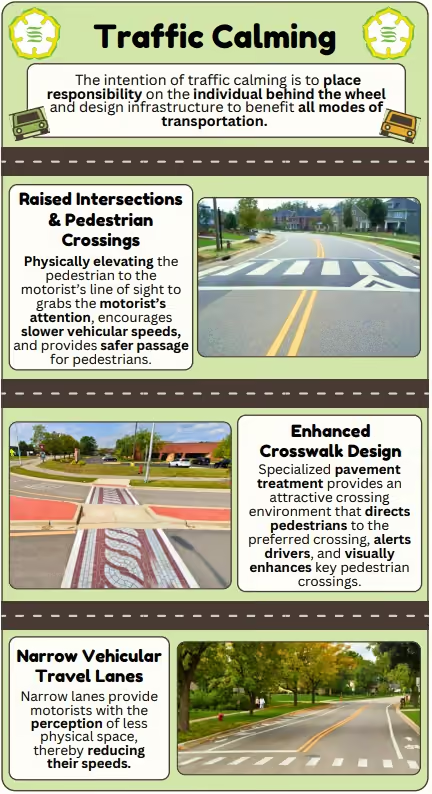
Traffic calming in residential areas focuses on improving pedestrian safety, pivoting from the ideology of speeding vehicles to speeding motorists. Traffic calming intends to place responsibility on the individual behind the wheel and focuses on designing infrastructure such as bike lanes, bike paths, or sidewalks to benefit all modes of transportation. The village uses traffic calming methods as a holistic approach to improve public infrastructure for all types of roadway users and modes of transportation. Examples of traffic calming methods include:
-
Raised Intersections/Raised Pedestrian Crossings
Raised intersections and raised pedestrian crossings physically elevate the pedestrian to the motorist’s line of sight. Enhanced pedestrian crossings grab the motorist’s attention, encourage slower vehicular speeds, and provide safer passage for pedestrians.
-
Enhanced Crosswalk Design
The village uses an enhanced crosswalk design concept to visually enhance key pedestrian crossings throughout the village. The design consists of specialized pavement treatments with a stencil design for brick red and an “S” pattern. This design creates an attractive pedestrian crossing environment that directs pedestrians to the preferred pedestrian crossing and alerts drivers of a frequently used pedestrian crossing.
-
Narrow Vehicular Travel Lanes
As many engineering studies have shown, narrowing vehicular travel lanes can reduce speed, providing motorists with the perception of less physical space. This perception fosters slower speeds and improves driver behavior. For streets with wider roadways, narrowing vehicular travel lanes provides the opportunity to consider on-street bicycle lanes as additional space becomes available. It is important to consider options on a case-by-case basis as this method may not be a solution for all roads.
If these types of methods are determined necessary, proposed improvements may be added to the village’s capital improvement program for implementation in future years.
There are mid-block crosswalks in my neighborhood. Can we add signage or lighting to alert drivers of the upcoming crosswalk?
The village follows the guidelines for establishing pedestrian crossings from the Illinois Department of Transportation, which guides the evaluation and design of pedestrian crossings based on the roadway’s existing condition. Recommended pedestrian crossing treatments, including signage and flashing beacons, are identified and implemented based on the roadway’s posted speed limit and traffic volume.
Page owner: Transportation Department
Reviewed Oct. 2026 · next review April 2027