
Overview
The Village of Schaumburg is implementing lead-lag traffic signal operations at seven village-owned traffic signals along Meacham Road. This improvement is intended to reduce travel times and help drivers move more efficiently through the corridor.
The village will continue monitoring traffic conditions and may make future adjustments to signal timing to align with changing traffic patterns and operational needs.
For additional information about lead-lag traffic signal operations or traffic signal timing in Schaumburg, please contact the Transportation Department at (847) 923-3861 or vostransportation@schaumburg.com.
What is “lead-lag?”
A lead-lag traffic signal is a signal timing method used at interconnected traffic signals with dedicated left-turn arrows.
In traditional signal operations, left-turn arrows for opposing directions typically occur at the same time. With lead-lag operations, one direction receives its left-turn arrow first ("lead"), while the opposite direction receives its left-turn arrow at the end of the cycle ("lag").
How does a lead-lag signal work?
A typical lead-lag cycle operates in three steps:
Step 1: Leading Phase
-
One direction receives a protected left-turn arrow and through green signal.
-
Opposing traffic remains stopped.
Step 2: Through Phase
-
Through traffic in both directions proceeds through the intersection.
-
Left turns are not permitted during this phase.
Step 3: Lagging Phase
-
The opposite direction receives a protected left-turn arrow.
-
Through traffic in that direction continues moving.
-
Traffic in the first direction is stopped.
This sequence allows traffic signals to provide more green time for through traffic while still accommodating protected left turns.
Can I see how it works?
This short video explains how lead-lag traffic signals operate and how they help traffic move more efficiently along a corridor.
What are the benefits of lead-lag operations?
Lead-lag operations can improve traffic progression by allowing traffic signals along a corridor to work together more efficiently. By changing the sequence of left-turn movements, lead-lag operations provide more time for drivers to make it through a green light. When implemented at multiple signals in the same corridor, drivers spend less time being stopped at red lights.
In addition to drivers enjoying reduced travel times and congestion, the coordinated signals are more efficient overall. Fewer stops mean reduced vehicle emissions associated with stop-and-go traffic.
Similar lead-lag implementations on major roadway corridors in the region have improved average travel speeds by as much as 12 to 18 percent, helping traffic move more efficiently through interconnected signal systems.
Which signals will use lead-lag operations?
Lead-lag operations will be implemented at seven village-owned traffic signals on Meacham Road between Algonquin Road and Higgins Road. Those signals are located where Meacham crosses:
-
Woodfield Road
-
American Lane
-
Remington Road
-
McConnor Parkway/Tower Road*
-
Interstate 90
-
Zurich Way/Thoreau Drive
-
Progress Parkway/Drummer Drive
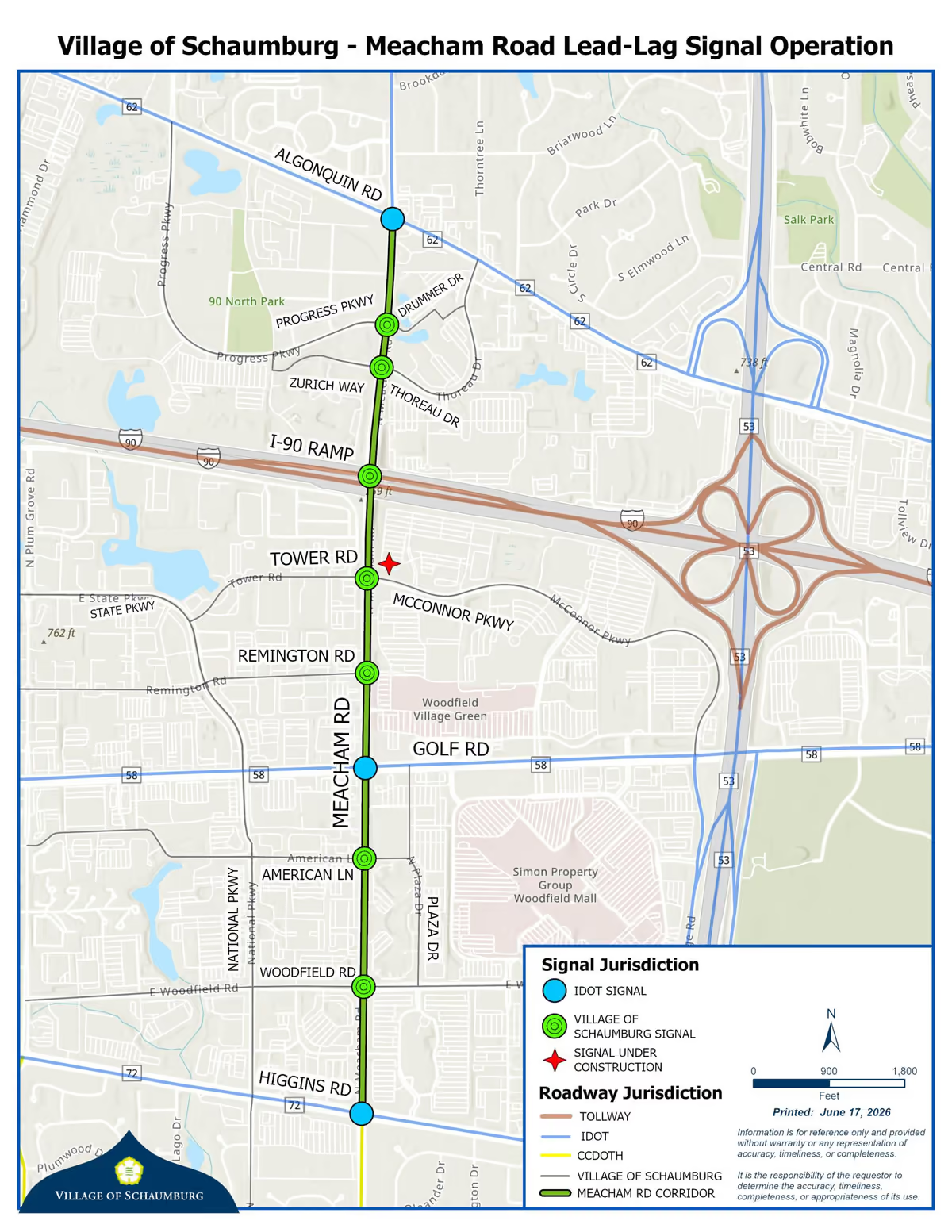
*Please note: The signal at Meacham Road and Tower Road/McConnor Parkway is currently controlled by a temporary traffic signal associated with the McConnor Parkway Reconstruction Project. Lead-lag will be implemented at this intersection; however, there may be delays due to the construction project.
Why aren't Algonquin Road and Higgins Road included?
The lead-lag implementation focuses on village-owned traffic signals within the Meacham Road corridor.
While the corridor extends between Algonquin Road and Higgins Road, those traffic signals are owned and operated by IDOT.
Why are we only doing this at 7 signals on Meacham Road?
Meacham Road is a critical thoroughfare for traffic in Schaumburg. Between Higgins Road and Algonquin Road, Meacham carries a very high volume of residents, customers, visitors, and workers every day. The village owns and operates 7 signals between Higgins and Algonquin, and village staff constantly monitor signal operations to determine if improvements are needed. To reduce congestion and improve traffic flow, the village is pursuing operational improvements at all of its signals on Meacham to benefit the tens of thousands of drivers that use the road each day.
Traffic signals in Schaumburg
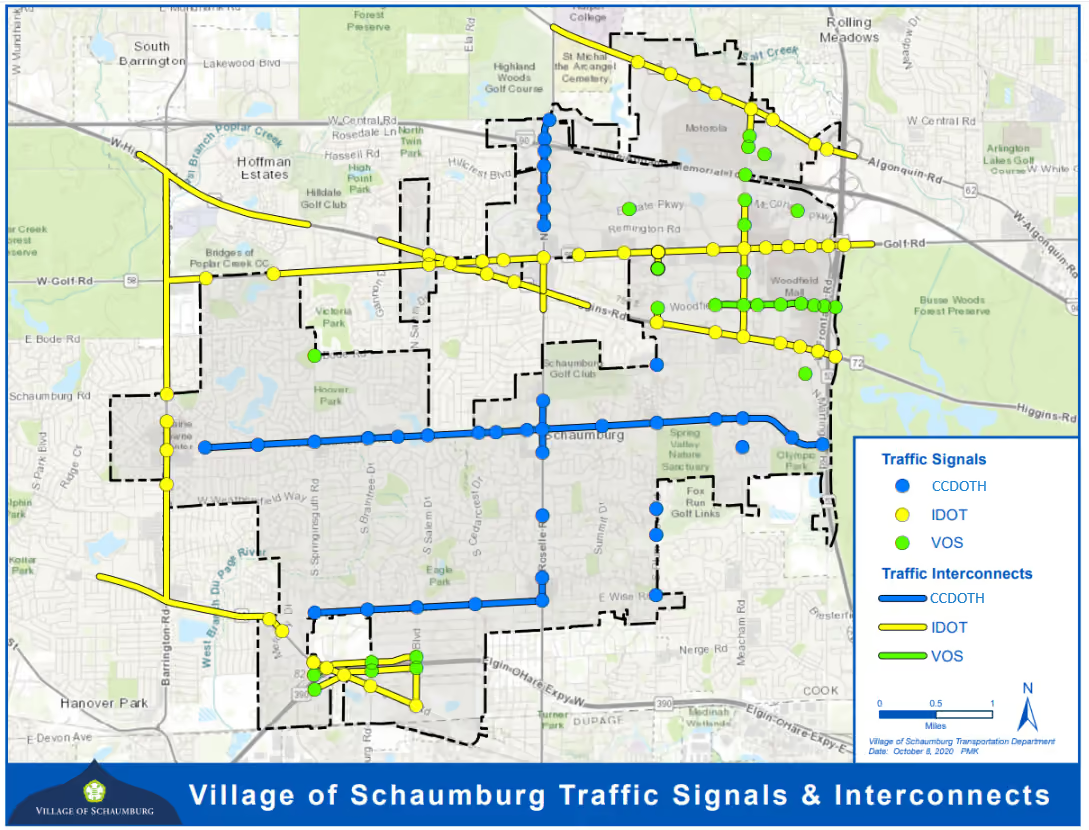
In all, there are 110 traffic signals in Schaumburg. The village operates and maintains 25 (23%) of those traffic signals—7 of which are on Meacham Road. The remaining 85 signals in the Schaumburg area are operated and maintained by the Illinois Department of Transportation (IDOT) or the Cook County Department of Transportation and Highways (CCDOTH).
The map below shows traffic signal ownership throughout Schaumburg and identifies which signals are operated by the village, IDOT, and CCDOTH. Because traffic signals in Schaumburg are owned and operated by multiple transportation agencies, traffic signal improvements often require coordination between jurisdictions. To learn more about traffic signal ownership and maintenance responsibilities, visit the village's Traffic FAQs page.
Will drivers need to do anything differently?
Drivers should continue to follow all traffic control devices as they normally would. The sequence of the signal phases may differ from what some motorists are accustomed to, but the traffic signals will clearly indicate when vehicles may proceed through the intersection or make a protected left turn.
How will the village ensure the signals operate safely?
Lead-lag traffic signal operations are a widely used traffic engineering practice and are used at intersections in northeastern Illinois and across the country. Village staff will monitor the signal operations closely, adjust timings as needed, and address any signal malfunctions immediately.
Will signal timing be adjusted in the future?
Traffic patterns change over time, and signal timing plans are periodically reviewed to ensure they continue operating efficiently.
Following implementation, the village will monitor traffic operations along the corridor and evaluate performance. Signal timing, coordination, and lead-lag operations may be adjusted in the future to better align with traffic conditions, travel patterns, and operational needs.
Continuous monitoring helps ensure the traffic signal system operates as safely and efficiently as possible.
Page owner: Transportation Department
Reviewed Oct. 2026 · next review April 2027