
In This Issue
Text of this issue
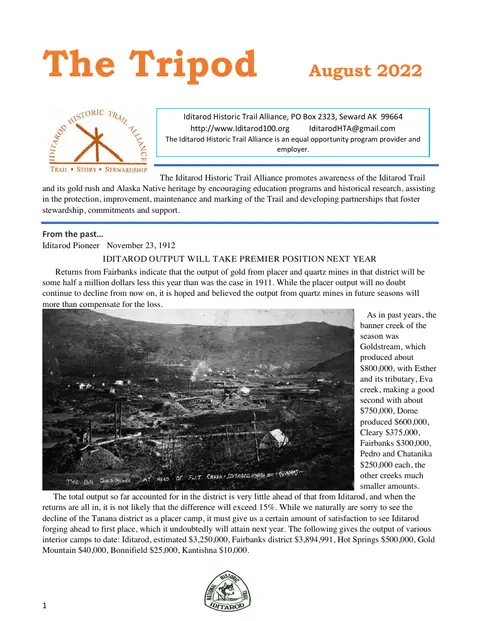
Iditarod Historic Trail Alliance, PO Box 2323, Seward AK 99664 http://www.Iditarod100.org IditarodHTA@gmail.com The Iditarod Historic Trail Alliance is an equal opportunity program provider and employer. The Iditarod Historic Trail Alliance promotes awareness of the Iditarod Trail and its gold rush and Alaska Native heritage by encouraging education programs and historical research, assisting in the protection, improvement, maintenance and marking of the Trail and developing partnerships that foster stewardship, commitments and support. From the past… Iditarod Pioneer November 23, 1912 IDITAROD OUTPUT WILL TAKE PREMIER POSITION NEXT YEAR Returns from Fairbanks indicate that the output of gold from placer and quartz mines in that district will be some half a million dollars less this year than was the case in 1911.
While the placer output will no doubt continue to decline from now on, it is hoped and believed the output from quartz mines in future seasons will more than compensate for the loss. As in past years, the banner creek of the season was Goldstream, which produced about $800,000, with Esther and its tributary, Eva creek, making a good second with about $750,000, Dome produced $600,000, Cleary $375,000, Fairbanks $300,000, Pedro and Chatanika $250,000 each, the other creeks much smaller amounts. The total output so far accounted for in the district is very little ahead of that from Iditarod, and when the returns are all in, it is not likely that the difference will exceed 15%.
While we naturally are sorry to see the decline of the Tanana district as a placer camp, it must give us a certain amount of satisfaction to see Iditarod forging ahead to first place, which it undoubtedly will attain next year.
The following gives the output of various interior camps to date: Iditarod, estimated $3,250,000, Fairbanks district $3,894,991, Hot Springs $500,000, Gold Mountain $40,000, Bonnifield $25,000, Kantishna $10,000. 1 The Tripod August 2022 Use survey of first mile of the Iditarod National Historic Trail in Seward 2022 Adults, teens and children Walking Biking Running On scooters Skateboarding Roller skates In wheelchair Total Dogs being walked June 19-25 1-1:30 pm 285 38 7 3 1 June 26-July 2 5-5:30 pm 312 58 11 1 1 July 3-9 3-3:30 pm 318 49 6 3 3 July10-17 7-7:30 pm 327 26 11 1 5 370 1242 171 35 7 10 1 3 1469 10 61 2 336 383 1 380 15 19 17 Total The annual Seward traffic survey on the first mile of the Iditarod National Historic Trail along Ressurrection Bay started June 19 and ended on July17. The survey was conducted at about mile 0.5 of the Trail.
People and dogs on the Trail were counted at the same time each day for a week. The busiest day was Sunday July 3, from 3-3:30 p.m. It was partly cloudy with a light south wind. The total on the Trail that day was 141:109 walking, 24 biking, 1 skateboarder, 3 on scooters, 3 running and one man in a wheelchair. There were also 13 dogs being walked. The least number on the Trail was on July 7, 3-3:30 p.m. It was an overcast day with light rain. The total was 16 walking, with one dog being walked. Alaska's Digital Archives Alaska Digital Archives presents a wealth of historical photographs, albums, oral histories, moving images, maps, documents and other materials from archives, museums and libraries throughout the state. It is easy to search the archives, just go to vilda.alaska.edu and enter a subject in the search box. There are excellent pictures available of early Iditarod and Flat.
WALKING IS THE FAVORITE SPORT OF THE GOOD AND WISE. A. L. Rowse 2