
In This Issue
Text of this issue
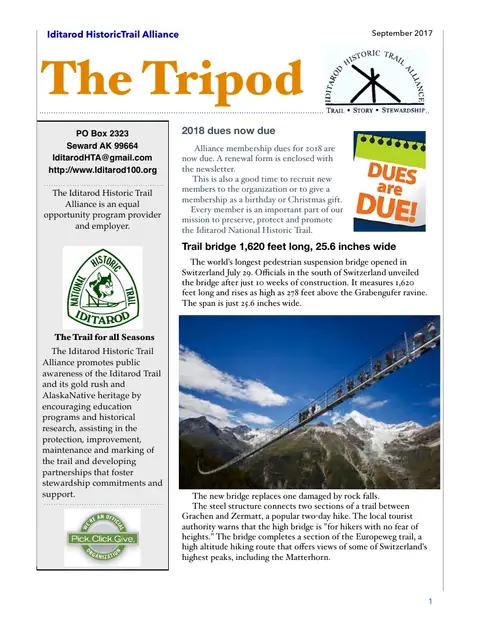
Iditarod HistoricTrail Alliance September 2017 The Tripod PO Box 2323 Seward AK 99664 IditarodHTA@gmail.com http://www.Iditarod100.org The Iditarod Historic Trail Alliance is an equal opportunity program provider and employer. 2018 dues now due Alliance membership dues for 2018 are now due. A renewal form is enclosed with the newsletter. This is also a good time to recruit new members to the organization or to give a membership as a birthday or Christmas gift. Every member is an important part of our mission to preserve, protect and promote the Iditarod National Historic Trail. Trail bridge 1,620 feet long, 25.6 inches wide The world's longest pedestrian suspension bridge opened in Switzerland July 29. Officials in the south of Switzerland unveiled the bridge after just 10 weeks of construction. It measures 1,620 feet long and rises as high as 278 feet above the Grabengufer ravine.
The span is just 25.6 inches wide. The Trail for all Seasons The Iditarod Historic Trail Alliance promotes public awareness of the Iditarod Trail and its gold rush and AlaskaNative heritage by encouraging education programs and historical research, assisting in the protection, improvement, maintenance and marking of the trail and developing partnerships that foster stewardship commitments and support. The new bridge replaces one damaged by rock falls. The steel structure connects two sections of a trail between Grachen and Zermatt, a popular two-day hike.
The local tourist authority warns that the high bridge is "for hikers with no fear of heights." The bridge completes a section of the Europeweg trail, a high altitude hiking route that offers views of some of Switzerland's highest peaks, including the Matterhorn. 1 Iditarod HistoricTrail Alliance From the past… "Iditarod Pioneer" September 1, 1917 EXPERIENCES OF DR. BEHLA IN RETURN TO COUNTRY WERE MANY AND TRYING Dr. B. Behla, the Flat dentist, arrived here on the mail boat Sea Wolf last Saturday, after a series of experiences and adventures that give zest and sincerity to his statement that "he is glad to be back in Iditarod." Dr. Behla, who is a native of Germany, has never perfected his American citizenship, and therein lies the cause of his trouble, anxiety and expense to which he has been subjected during the past year.
The doctor left here last fall to put in the final term at a Chicago medical college which would qualify him to practice medicine. Hoping to save time, and not wishing to go by way of Dawson and the Yukon for fear of interment by the British authorities, he decided to go out by way of Fairbanks and the Valdez trail. When he arrived at Tanana he found that the last regular boat had left for Fairbanks, and he chartered a launch, which took him as far as Nenana. At that point he hired another boat, which took him to Fairbanks. After waiting in Fairbanks five days he took passage on the automobile stage for Chitina, paying $125 for the trip. When but a few miles out from Fairbanks an accident to the automobile caused a discontinuance of the journey, and he was compelled to dig up another $125 for passage on another vehicle, as it was necessary for him to be in Chicago on a certain date.
He finally reached Valdez, and after another delay finally took ship for Seattle and finished the journey to Chicago, speedily by rail. The trip cost him $900. The return trip was made under even more difficult conditions because of the entry of the United States into the war. Dr. Behla was compelled to take an examination before the territorial medical board at Juneau, and after passing with high honors, he was compelled to return to Seattle to take ship for St. Michael on his way to Iditarod. St. Michael is on a military reservation, and the law prohibits a subject of an enemy nation from entry there. Thus when the Victoria arrived at the Alaska port, Dr. Behla was not allowed to land, and September 2017 might have been taken back to Seattle, but for the fact that Frank Kern, the local freighter, happened to be there with his launch, the Alice.
He took the grateful doctor from the ship and brought him to Holy Cross, whence he made the final stage by mail boat. It is not to be wondered at, therefore, that the doctor is making preparation for an extended stay in the Iditarod. Dr. Behla has purchased a store building of Joe Smith in the city which will be moved to Flat where a modern hospital will be installed. Equipment in the way of medical and surgical supplies have been brought in by Dr. Behla and he will conduct the hospital in connection with his practice as a physician, surgeon and dentist. AmazonSmile Remember the Iditarod Historic Trail Alliance is now a charity recognized on AmazonSmile. To shop at AmazonSmile simply go to smile.amazon.com from the web browser on your computer or mobile device.
On your first visit to smile.amazon.com, you need to select the Iditarod HistoricTrail Alliance as your charitable organization before you begin shopping. History of hiking On the Trail A History of American Hiking by Silas Chamberlin, Yale University Press, October 2016. In 2003, Silas Chamberlin, then a college student, spent the summer working with the Adirondack. Mountain Club's professional trail crew in upstate New York. The experience caused him to start researching hiking and hiking clubs. The result of that research is this book which is the first full account of the unique history of the American hiking community and its rich, nationwide culture.
Delving into archives, including those of the Appalachian Mountain Club, Sierra Club, Green Mountain Club, and many others, Silas Chamberlin recounts the activities of hikers who over many decades formed clubs, built trails, and advocated for environmental protection. He also discusses the shifting attitudes of the late 1960s and early 1970s when ideas about traditional volunteerism shifted and new hikers came to see trail blazing and maintenance as government responsibilities. Chamberlin explores the implications for hiking groups, future club leaders, and the millions of others who find happiness, inspiration, and better health on America’s trails. 2