In This Issue
Text of this issue
The Tripod Iditarod Historic Trail Alliance January 2015 Reminders * If you have not renewed your membership for 2015, please do so now. *Alaska members, remember when you file for your 2015 Permanent Fund Dividend on line, you can donate all or part of your dividend to the Alliance through the Pick, Click, Give Program. *If you haven’t returned the membership survey yet, please do so.
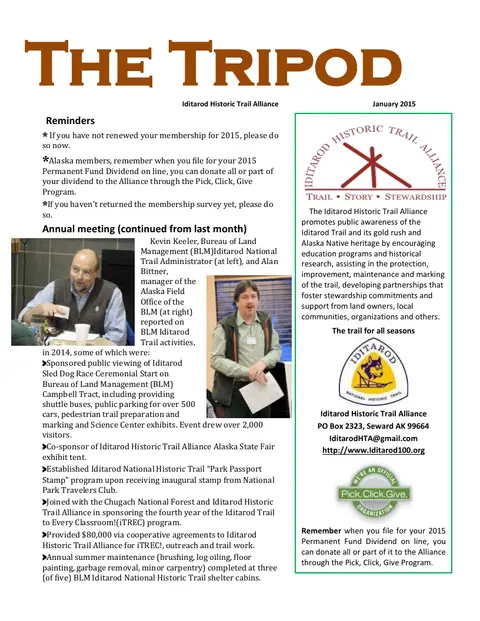
Annual meeting (continued from last month) Kevin Keeler, Bureau of Land Management (BLM)Iditarod National Trail Administrator (at left), and Alan Bittner, manager of the Alaska Field Office of the BLM (at right) reported on BLM Iditarod Trail activities, in 2014, some of which were: >Sponsored public viewing of Iditarod Sled Dog Race Ceremonial Start on Bureau of Land Management (BLM) Campbell Tract, including providing shuttle buses, public parking for over 500 cars, pedestrian trail preparation and marking and Science Center exhibits.
Event drew over 2,000 visitors. >Co-sponsor of Iditarod Historic Trail Alliance Alaska State Fair exhibit tent. >Established Iditarod National Historic Trail “Park Passport Stamp” program upon receiving inaugural stamp from National Park Travelers Club. >Joined with the Chugach National Forest and Iditarod Historic Trail Alliance in sponsoring the fourth year of the Iditarod Trail to Every Classroom!(iTREC) program. >Provided $80,000 via cooperative agreements to Iditarod Historic Trail Alliance for iTREC!, outreach and trail work. >Annual summer maintenance (brushing, log oiling, floor painting, garbage removal, minor carpentry) completed at three (of five) BLM Iditarod National Historic Trail shelter cabins.
The Iditarod Historic Trail Alliance promotes public awareness of the Iditarod Trail and its gold rush and Alaska Native heritage by encouraging education programs and historical research, assisting in the protection, improvement, maintenance and marking of the trail, developing partnerships that foster stewardship commitments and support from land owners, local communities, organizations and others. The trail for all seasons Iditarod Historic Trail Alliance PO Box 2323, Seward AK 99664 IditarodHTA@gmail.com http://www.Iditarod100.org Remember when you file for your 2015 Permanent Fund Dividend on line, you can donate all or part of it to the Alliance through the Pick, Click, Give Program.
The Tripod >Installed a drain culvert into a beaver-made impoundment flooding a BLM managed bridge over a yearround open waterway, which lowered the water level and restored dry bridge approaches. >Completed way marking sign plans for two segments of the trail totaling approximately 200 miles. >Continued review and participation in Donlin Gold gas line Environmental Impact Statement (EIS). This is a billion dollar project that would build the largest pipeline in Alaska since the Trans-Alaska Pipeline. The BLM developed a proposal to the Army Corps of Engineers (the National Environmental Policy Act manager of the project) for inclusion of an alternative in the EIS that would provide an off-site alternative to the current proposed route, which would locate the pipeline, airfields and construction camps on a 60 mile section of the Iditarod National Historic corridor.
The proposal was rejected by the Corps. A preview showing of a DVD on the History of the Iditarod Trail was shown at the meeting. This was an Iditarod Centennial project of the Alliance, produced by Russ Weston. Copies of the show will be available for sale soon. From the past… In 1865-7 the Western Union Telegraph Company planned to build an overland telegraph line to Europe via Canada, Alaska, under the Bering Strait and through Siberia. The successful laying of the Atlantic cable killed the project. George Kennan (1845-1924) was one of the party sent to Siberia to start work on the project. He wrote about that experience in Tent Life in Siberia, first published in 1870.
In the following excerpt he describes the dogsleds of the native people of the Kamchatka Peninsula and his first attempt at dog sledding: “The sledge is about ten feet in length and two in width, made with seasoned birch timber, and combines to a surprising degree the two most desirable qualities of strength and lightness. It is simply a skeleton frame work, fastened together with lashings of dried sealskin and mounted on broad, curved runners. No iron whatever is used in its construction, and it does not weigh more than twenty pounds; yet it will sustain a load of four or five hundred pounds, and endure the severest shocks of rough mountain travel. The number of dogs harnessed to this sledge varies from seven to fifteen, according to the nature of the country to be traversed and the weight of the load.
Under favorable circumstances eleven dogs will make from forty to fifty miles a day with a man and a load of four hundred pounds. They are harnessed to the sledge in successive couples by a long central thong of seal-skin, to which each individual dog is attached by a collar and a short trace. They are guided and controlled entirely by the voice and by a lead dog who is especially trained for the purpose. The driver carries no whip, but instead a thick stick about 4 feet in length and 2 inches in diameter. This is armed at one end with a long iron spike. The spiked end is thrust down in front of one of the knees or uprights of the runner and drags in that position in the snow. The upper end is firmly held by the driver. It is a powerful lever, and when skillfully used brakes up a sledge very promptly and effectively. The art of driving a dog-team is one of the most deceptive in the world.
The traveller at first sight imagines that driving a dog-sledge is just as easy as driving a street car, and at the very first favorable opportunity he tries it. After being runaway with within the first ten minutes, capsized into a snow-drift, and his sledge dragged bottom upward a quarter of a mile from the road, the rash experimenter begins to suspect that the task is not quite so easy as he had supposed and in less than one day he is generally convinced by hard experience that a dog-driver like a poet, is born, not made.” Hike the Hill 2015 Hike the Hill, an annual event of the American Hiking Society and the Partnership for the National Trail System, will take place on February 7-12. Trail advocates from around the country will gather in Washington DC and make their collective voice heard on Capitol Hill.
Attendees truly “Hike the Hill” as they visit with their legislators and land management agency officials throughout the week. It also provides a great opportunity for participants to share their knowledge and experiences with each other.