In This Issue
Text of this issue
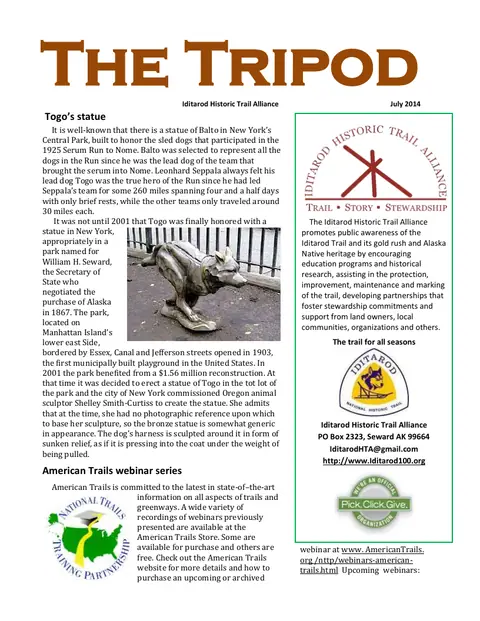
The Tripod Iditarod Historic Trail Alliance July 2014 Togo’s statue It is well-known that there is a statue of Balto in New York’s Central Park, built to honor the sled dogs that participated in the 1925 Serum Run to Nome. Balto was selected to represent all the dogs in the Run since he was the lead dog of the team that brought the serum into Nome. Leonhard Seppala always felt his lead dog Togo was the true hero of the Run since he had led Seppala’s team for some 260 miles spanning four and a half days with only brief rests, while the other teams only traveled around 30 miles each. It was not until 2001 that Togo was finally honored with a statue in New York, appropriately in a park named for William H. Seward, the Secretary of State who negotiated the purchase of Alaska in 1867.
The park, located on Manhattan Island’s lower east Side, bordered by Essex, Canal and Jefferson streets opened in 1903, the first municipally built playground in the United States. In 2001 the park benefited from a $1.56 million reconstruction. At that time it was decided to erect a statue of Togo in the tot lot of the park and the city of New York commissioned Oregon animal sculptor Shelley Smith-Curtiss to create the statue. She admits that at the time, she had no photographic reference upon which to base her sculpture, so the bronze statue is somewhat generic in appearance. The dog’s harness is sculpted around it in form of sunken relief, as if it is pressing into the coat under the weight of being pulled.
The Iditarod Historic Trail Alliance promotes public awareness of the Iditarod Trail and its gold rush and Alaska Native heritage by encouraging education programs and historical research, assisting in the protection, improvement, maintenance and marking of the trail, developing partnerships that foster stewardship commitments and support from land owners, local communities, organizations and others. The trail for all seasons Iditarod Historic Trail Alliance PO Box 2323, Seward AK 99664 IditarodHTA@gmail.com http://www.Iditarod100.org American Trails webinar series American Trails is committed to the latest in state-of–the-art information on all aspects of trails and greenways. A wide variety of recordings of webinars previously presented are available at the American Trails Store. Some are available for purchase and others are free.
Check out the American Trails website for more details and how to purchase an upcoming or archived webinar at www. AmericanTrails. org /nttp/webinars-americantrails.html Upcoming webinars: The Tripod July 17- Urban Trails in Difficult Places, August 28-Fundamentals of Mountain Trail Sustainability (part 2 of 3). Some of the archived webinars: Effective Fundraising for Trails and Greenways, Making the Case for Trails in Tight Economic Times, Telling a Better Story-Best Practices for Developing Interpretive Panels for Trails. From dogs to airplanes In 1928, just 18 years after the founding of the city of Iditarod, the following account is given in Alaska Aviation History, Vol.
I, 1897-1928 by Robert W Stevens: On October 21, 1928, Russ Merrill left Anchorage in his Travel Air 7000 airplane “for the Iditarod district to bring miner Dave Strandberg and his two sons to Anchorage where they would spend the winter. He stopped at McGrath, on the way out, landing at the new field there. Flat also had a new field, laid out on the tailings piles, but it was rather small. The pilot landed there, but took off with his load from the larger field between Iditarod and Flat. Returning nonstop to Anchorage, by way of Rainy Pass, he landed at his base at 5:20 p.m. Tuesday, October 23, to unload Dave Strandberg and his two sons William and Harold.” From the past… “Iditarod Pioneer” July 5, 1913 DISCOVERY OTTER’S BIG DOINGS Discovery, Otter, was the scene of an enjoyable celebration of the nation’s birthday yesterday.
The program, as agreed upon, did not begin until after 6 o’clock in order that the workingmen on the day shifts could enjoy and participate in the fun. When Senator Roden, the speaker of the day, opened the program he was heartily cheered by the large assemblage. Mr. Roden always feels perfectly at ease while among his constituency, and his remarks contained many good ideas. The tug of war, for a prize of $100, was a most interesting and strenuous event. The teams were the Puntillos and the Discovery (Riley’s) claim boys, all miners, and that the contestants were evenly matched is evidenced by the fact that they tugged for 80 long and weary minutes before the Discovery boys began to take in rope the Puntillos were loth to surrender.
Other events, winners and prizes: Hundred-yard dash: Casper Halbert first prize of $25.00 and Joe Tovia second $10.00 Running broad jump: Casper Halbert first prize $10.00, Joe Tovia second, $5.00 Old men’s race: Mr. Landerkin, first $10.00, Al Parmenter, second $5.00 Sack race: Casper Halbert, first $10.00 Three-legged race: Wilbur Kilgore and Joe Tovia, first $10.00 Women’s race: Mrs. Lamderkin first, $10.00, Mrs.Moses, second $5.00 Women’s nail-driving contest: Mrs. Fraser, first $10.00 Fat men’s race: Mason Farrar, first Doughnut-eating contest for children: first place trophy to Esther Strandberg, second, Peter Bagoy, third Herbert Strandberg Egg race, for women, Mrs. Landerkin, first $5.00 The dance after the sports was enjoyed by a large crowd.
Great trail projects For examples of great trail projects of every kind, you can see nearly a hundred web pages American Trails has made over the years for Coalition for Recreational Trails (CRT) award winners. The CRT awards recognize outstanding projects, funded by the Recreational Trails Program to build awareness and understanding of this essential trial funding program. Visit the American Trails web page for a list of all CRT awards for Recreational Trails Program projects since 1999: www.AmericanTrails.org/awards/CRT-awards-by-state.html iTREC! Summer Institute August 4-8 in Girdwood. The institute will focus on an introduction to the Iditarod National Trail, place based education, service learning and curriculum planning.