Catherine Bracy’s year in books 2025
My book, World Eaters: How Venture Capital is Cannibalizing the Economy, came out this year. While there are some changes and updates I wish I could’ve made to reflect new developments, I felt weirdly vindicated by how the main thesis still holds as we see the evolution of venture capital—its impact on our economy and democracy— play out in the headlines.
In 2025, international news outlets sounded the alarm about imminent, significant, and tech-driven changes to the workplace and our daily lives. We saw the AI bubble continue to balloon, and lawmakers and workers scrambling to navigate deep uncertainty and concern about the relationship between Big Tech and government. We saw tech oligarchs flex their muscle to entrench power for their own interests against the interests of society.
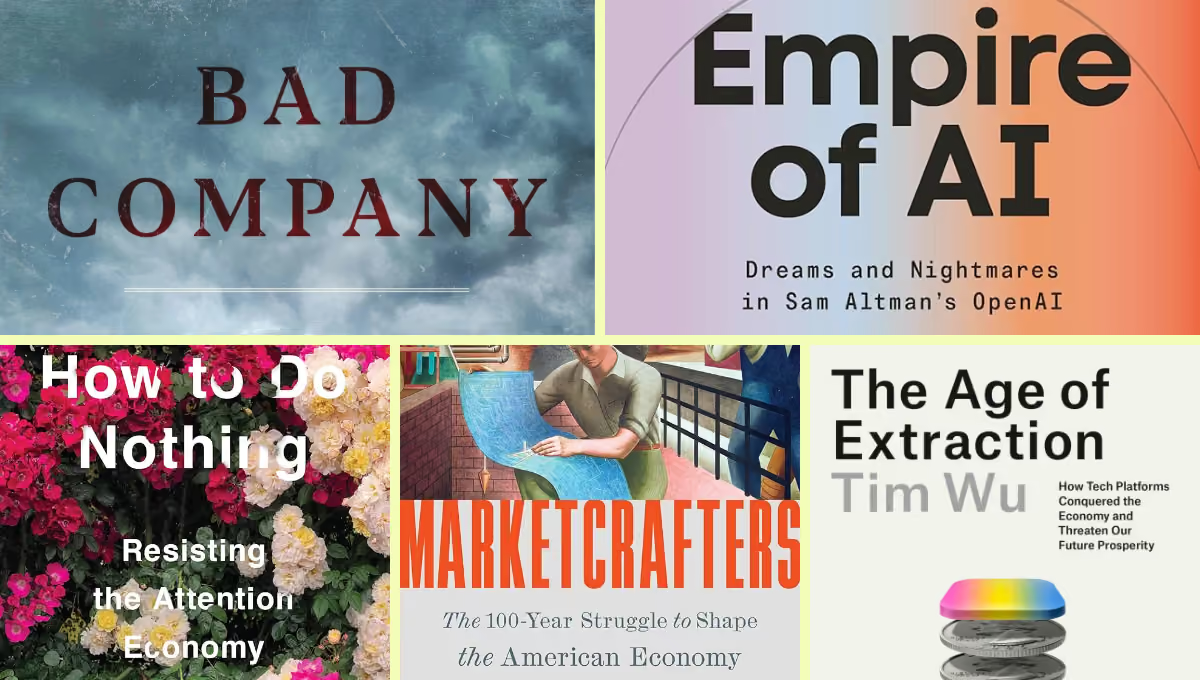
Between stops on my own book tour, I read up on the other forces that got us to this moment, and what can be done to ensure a more equitable future where all humans can flourish. These are five of the books that most influenced my thinking this year:
Bad Company: Private Equity and the Death of the American Dream by Megan Greenwell
Why do many goods seem pricier and more extractive than they used to be? Megan Greenwell brings people who are harmed by private equity squarely into focus through real-life stories of individuals whose local newspapers were gutted, whose nursing homes underwent sudden changes, or whose jobs disappeared overnight after a buyout. This book will help you understand the forces warping the American economy. It also really complements World Eaters, and I was lucky enough to speak at an event alongside Megan earlier this year in San Francisco to discuss. If you want to gain a deeper understanding of how private equity influences our everyday lives, this is for you.
Empire of AI: Dreams and Nightmares in Sam Altman’s OpenAI by Karen Hao
Empire of AI pulls you inside the world of OpenAI in a way that feels unsettlingly relevant. Karen Hao offers a behind-the-scenes look at what actually happened inside OpenAI as it evolved from a scrappy research lab into one of the most significant AI companies. Karen was a panelist at our AI polling event, where we launched original public opinion research into how Californians feel about AI (spoiler alert: not great). Her book is a good starting point for those who want to explore the promise and consequences of building powerful AI systems at breakneck speed.
How to Do Nothing: Resisting the Attention Economy by Jenny Odell
Coming off the heels of one of the busiest years of my life, Jenny Odell’s How to Do Nothing is a grounded reminder that you don’t have to live at the pace the world—including VC-backed companies—demands from you. In the age of near constant digital simulation, Jenny shows how stepping back from productivity and distraction can help us pay better attention to ourselves, our loved ones, and the world around us. If you’ve been feeling overwhelmed, this book offers a thoughtful reset. Every movement needs a soul, and this book feels like the soul of the movement to combat Big Tech.
Marketcrafters: The 100-Year Struggle to Shape the American Economy by Chris Hughes
Who knew a book about the history of the Federal Reserve could be so gripping? Marketcrafters by Chris Hughes is an admirably unapologetic argument for using the power of the federal government to craft the economy we want to see. He emphasizes that our economy did not just “happen”. It has been shaped by everything from geopolitical issues to personal agendas. If you’ve ever wondered why the economy feels rigged or why certain industries seem untouchable, this book outlines the historical backbone for why that came to be.
The Age of Extraction: How Tech Platforms Conquered the Economy and Threaten Our Future Prosperity by Tim Wu
If TechEquity’s mission statement were a book, it would be Tim Wu’s The Age of Extraction. Tim clearly lays out how today’s biggest tech platforms built their fortunes not by creating broad prosperity, but by quietly siphoning value from workers and communities. Practices that look like “innovation” on the surface often concentrate wealth and power at the top, leaving everyone else with fewer choices and lower wages. He explains how this extraction-based model has reshaped our entire economy and livelihoods. This book only came out in November, but I zoomed through it almost as soon as it came out. The ideas Wu presents are sure to be at the center of the debate around AI in 2026 and beyond.
Want to learn more about tech’s impact on our communities and economy? Sign up for our mailing list to get weekly updates on the latest research, news, and more around tech and the economy.