
Who shapes the AI story? A recap of our AI polling launch event
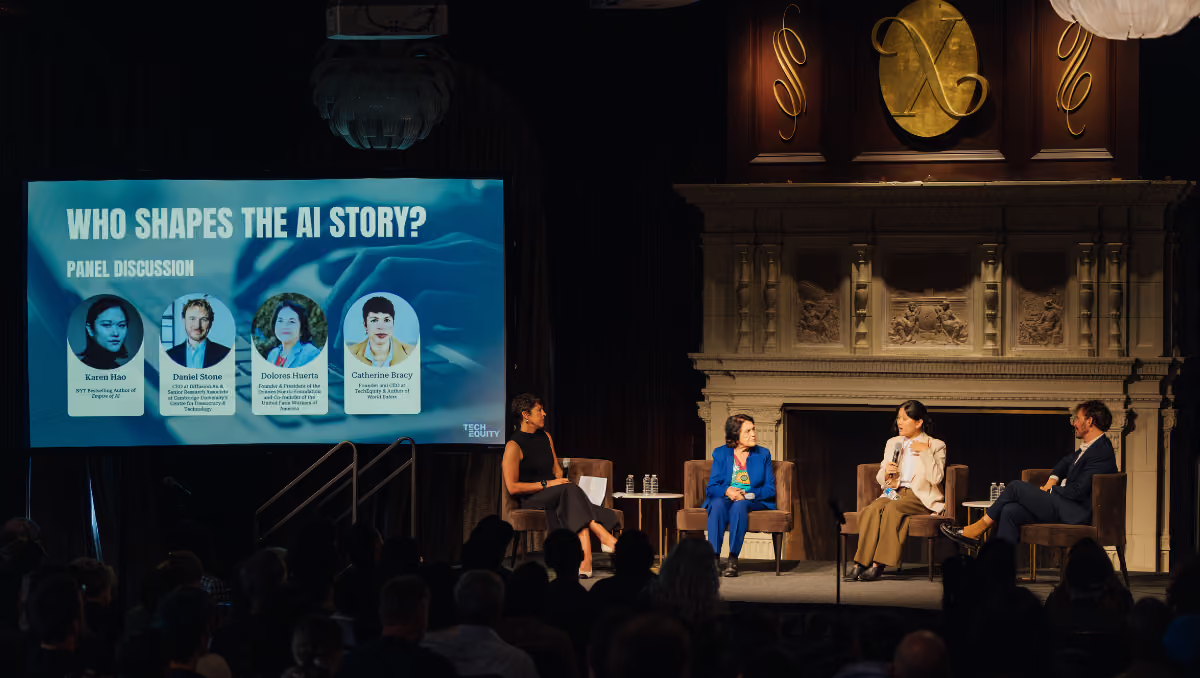
The public conversation about the future of AI has mostly been dominated by tech CEOs and investors clouding the picture with hype to boost their investments, and experts who either believe AI will destroy humanity or usher in a new golden age of prosperity.
The fervor of this debate—coupled with the unknowability of the technology’s development— makes it difficult for policymakers to know how to govern. But there is a North Star they can look to: their constituents.
That’s why TechEquity partnered with communications expert Daniel Stone of Diffusion.Au and Lake Research Partners to survey over 1,000 Californians to understand how they really feel about AI, and how they expect their elected representatives to respond to the risks and opportunities AI presents.
Read our findingsOn August 19th, we released this research at a launch event, which included a presentation of key findings by Daniel Stone. Daniel then joined a panel discussion with Karen Hao, AI journalist and author of Empire of AI, and renowned labor leader and advisor to the OpenAI Nonprofit Commission, Dolores Huerta. The conversation was moderated by TechEquity CEO and founder Catherine Bracy.
What were the main takeaways?
Our research found that the majority of Californians have significant concerns about AI, with particular concern about AI-fueled job loss, wage stagnation, privacy violations, and discrimination. These findings echo national polling conducted by Quinnipac University, which found respondents felt overwhelmingly uncomfortable with AI tools being used to make consequential decisions about them.
As for our panelists, “Empire of AI” author Karen Hao likened the way AI has been developed, utilized, and spread to colonialism. To reach this conclusion, Hao spent years investigating how AI tools and the industries behind them are disproportionately impacting the Global South and marginalized communities in the US. She also noted how the AI industry uses the concept of an “AI race” to garner support—a concept perhaps more compelling to legislators than to the public, according to our research.
So what exactly do everyday people find meaningful? What do they want out of AI? Co-Founder of the National Farm Workers Association, Dolores Huerta, went on a listening tour of California to find out as part of her role on OpenAI’s Non-Profit Commission.
Her takeaways are similar to those of our report:
- Some people are interested in the way AI could benefit them, using AI tools to perform menial tasks
- From education to entertainment, workers are worried that AI could decrease the number of job opportunities in California
- Workers would like to engage with AI companies to create tools that could actually support their work instead of just trying to replace their jobs
With curiosity, consideration, and consent, there is an AI future that we could be proud of, the panelists noted. And that’s not a complete pipedream.
In New Zealand, Māori-led teams used a natural language processing tool (a type of AI) and archived radio broadcasts in te reo Māori to preserve the language and create tools for people to learn it. Before even starting the project, though, they made sure to talk to the community about what kind of data they’d be collecting and storing, how that data would be stored, and what tools the community would like to see come out of the project.
How can everyday people shape the story of AI?
This is what’s possible when everyday people can shape the story and, thus, the future of AI.
According to our research, 70% of California voters want strong laws requiring companies to make AI safe and secure. Right now, TechEquity is supporting several bills in the final stretch of the legislative session in California. These include:
- The Preventing Algorithmic Price Fixing Act (AB 325), which updates California’s antitrust laws to address modern digital tools used for illegal price fixing by making it clear that using digital pricing algorithms to coordinate prices among competitors is just as illegal as traditional price fixing.
- The Automated Decisions Safety Act (AB 1018), which ensures that Automated Decision Systems (ADS) are vetted, that everyday people understand how these decisions impacting them are made, and that people know what to do if they suspect discrimination.
- The No Robo Bosses Act (SB 7), which would restrict the use of AI to manage employees.
Sign up for our newsletter to learn more about AI, receive resources that you can share, and get the latest updates on our legislative campaigns, as well as how you can help.
We also want to continue to hear from you and your experiences with AI. By sharing your experience, you can help lawmakers understand why they should support these bills to protect everyday people.
Thank you
Your story is on its way to TechEquity’s team.