
Unified Development Code
Article 8, Administrative Authorities, Duties and Procedures
As Adopted and Amended
The text on this page is the City’s chapter as posted. An ordinance passed since may not be set into it yet.
Creation of the Planning Commission
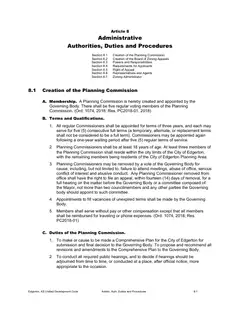
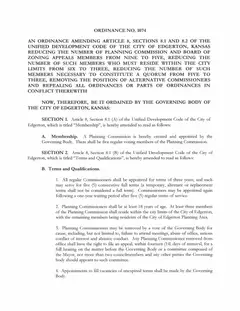
A.Membership. A Planning Commission is hereby created and appointed by the Governing Body. There shall be five regular voting members of the Planning Commission.
B.Terms and Qualifications.
1.All regular Commissioners shall be appointed for terms of three years, and each may serve for five (5) consecutive full terms (a temporary, alternate, or replacement terms shall not be considered to be a full term). Commissioners may be appointed again following a one-year waiting period after five (5) regular terms of service.
2.Planning Commissioners shall be at least 18 years of age. At least three members of the Planning Commission shall reside within the city limits of the City of Edgerton, with the remaining members being residents of the City of Edgerton Planning Area.
3.Planning Commissioners may be removed by a vote of the Governing Body for cause, including, but not limited to, failure to attend meetings, abuse of office, serious conflict of interest and abusive conduct. Any Planning Commissioner removed from office shall have the right to file an appeal, within fourteen (14) days of removal, for a full hearing on the matter before the Governing Body or a committee composed of the Mayor, not more than two councilmembers and any other parties the Governing body should appoint to such committee.
4.Appointments to fill vacancies of unexpired terms shall be made by the Governing Body.
5.Members shall serve without pay or other compensation except that all members shall be reimbursed for traveling or phone expenses.
C.Duties of the Planning Commission.
1.To make or cause to be made a Comprehensive Plan for the City of Edgerton for submission and final decision to the Governing Body. To propose and recommend all revisions and amendments to the Comprehensive Plan to the Governing Body.
2.To conduct all required public hearings, and to decide if hearings should be adjourned from time to time, or conducted at a place, after official notice, more appropriate to the occasion.
3.To recommend all actions, after hearing, concerning zoning text and map amendments, conditional uses, and preliminary/final plats for consideration to the Governing Body.
4.To review for final approval or disapproval all required site plans.
5.To add conditions to subdivision plats and zoning map amendments when, in the opinion of a majority of Planning Commissioners, such conditions are essential to the preservation of property values, the public health, safety and welfare, and the peaceful and quiet enjoyment of property.
6.To grant area variances on preliminary subdivision plats when, in the opinion of a majority of the Planning Commissioners, such variations are essential to preserve natural resources, overcome practical difficulty, and serve the public interest.
7.To hold an annual meeting in June of each year for the purpose of electing a Planning Commission Chair, a Vice Chair and a Secretary. Elections shall be conducted in accord with Roberts Rules of Order by written ballot or voice vote.
8.To hold an annual meeting for the purpose of reviewing the comprehensive plan and to update or amend the plan as necessary.
D.Meetings.
1.All meetings shall be conducted by the Chair of the Planning Commission, or in his/her absence, by the Vice Chair or Secretary, and then by the most senior member. The Chair, and other officers, shall be elected by a simple majority of the Planning Commissioners on an annual basis. All officers shall serve for one year, or until their successors are elected, and may succeed themselves for each year during their terms.
2.All meetings {other than special meetings} of the Planning Commission shall be held on the 2nd Tuesday of each month at 7:00 PM in the Edgerton Community Building at Edgerton, Kansas. When there is no official agenda, a meeting may be canceled at the discretion of the Chair. The Chair, or the Vice Chair in his/her absence, shall have the power to call any special meetings, or to change a meeting time or place following public notification. Meetings shall generally be conducted in accord with Roberts Rules of Order.
E.Rules of Voting and Conflict of Interest.
1.The Chair may vote in all official elections and to break a tie vote on any motion. The Chair shall lead all discussions, and call for all votes, but generally, shall not enter into the substance of discussions except to form questions, give direction, focus purpose, and bring issues to closure.
2.All official votes shall be by simple majority of a quorum. A quorum is three Planning Commissioners present at any meeting, unless specified otherwise by state law.
3.All votes shall be "yes" or "no" by "voice" of the members; written votes are not allowed. The Chair may require reasons for the vote from each Commissioner when the magnitude of the change requested for the plan or zone change is extensive. Abstentions from voting, as distinguished from disqualifications, shall not be allowed. Official votes shall also be written by the secretary or designee in the form of minutes; minutes shall be approved at each meeting.
4.Any Commissioner, including the Chair may disqualify him or herself, without stating reasons, by announcing the disqualification for the record, and leaving the table at the beginning of a public hearing. In the case of a challenge by an applicant or member of the public, the Chair shall rule on disqualifications. Reasons for disqualification shall be, but are not limited to, the following:
a).To avoid the appearance of an impropriety.
b).If the planning commissioner is a property owner within the statutory distance for notification of hearing.
c).If the planning commissioner is a relative, employer or employee or business partner of an applicant.
d).If the planning commissioner is an agent for an applicant {in a business or legal capacity}.
e).If the planning commissioner serves on an appointed board with an applicant.
f).If a planning commissioner is a constant, long term, and close social acquaintance of an applicant.
g).If the planning commissioner feels that he/she cannot render a fair and impartial judgment due to past association, hearsay, or actions of an applicant or member of a public hearing.
h).If the planning commissioner is a party to ex parte contact on a particular item of business that is subject to a public hearing.
F.The Conduct of Hearings.
1.An Applicant, or an Agent for the Applicant, must be present to introduce a proposal for change, except that this rule may be waived by a 2/3 majority vote of the Planning Commission. If an applicant or agent is not present, and the rule is not waived, then the Applicant shall automatically be granted an extension until the next regularly scheduled meeting of the Planning Commission. If the Applicant fails to appear at the following meeting, the matter shall be deemed void and the Applicant must reapply. If the Applicant fails to attend the first regularly scheduled hearing, they shall be assessed the full cost of public notification, including postage, abstractor search {if necessary} and a $20.00 Zoning Administrator surcharge for reprocessing.
2.All members of the public have the right to speak at a public hearing. The Planning Commission Chair may set reasonable time limits for public speakers and discussion.
The Planning Commission may, at times, recess into executive session in accordance with K.S.A. 75-4309 and the Kansas Open Meetings Act.
3.Following debate, the Planning Commission shall vote on a motion or table the item for further consideration. Decisions of the Commission shall be based upon facts entered into the record at the public hearing phase of the meeting, the recommendations of the staff, the adopted plan, and the preservation of health, public safety, and the general welfare.
4.In order to recommend approval or disapproval of a proposed zoning district amendment, the Planning Commission and Governing Body shall determine whether the amendment is found to be generally compatible with surrounding development and is in the best interest of the City. In making such determination, the Planning Commission and Governing Body may consider all factors they deem relevant to the questions of compatibility and the best interest of the City, including the following :
a).The extent to which there is a need in the community for the uses allowed in the proposed zoning.
b).The character of the neighborhood, including but not limited to: zoning, existing and approved land use, platting, density (residential), natural features, and open space.
c).Compatibility of the proposed zoning and uses permitted therein with the zoning and uses of nearby properties.
d).Suitability of the uses to which the property has been restricted under its existing zoning.
e).Length of time the subject property has remained vacant under the current zoning designation.
f).The extent to which the zoning amendment may detrimentally affect nearby property.
g).Consideration of rezoning applications requesting Planned Development Districts for multifamily and non-residential uses should include architectural style, building materials, height, structural mass, siting, and lot coverage.
h).The availability and adequacy of required utilities and services to serve the uses allowed in the proposed zoning. These utilities and services include, but are not limited to, sanitary and storm sewers, water, electrical and gas service, police and fire protection, schools, parks and recreation facilities and services, and other similar public facilities and services.
i).The extent to which the uses allowed in the proposed zoning would adversely affect the capacity or safety of that portion of the road network influenced by the uses, or present parking problems in the vicinity of the property.
j).The environmental impacts that the uses allowed in the proposed zoning would create (if any) including, but not limited to, excessive storm water runoff, water pollution, air pollution, noise pollution, excessive nighttime lighting or other environmental harm.
k).The economic impact on the community from the uses allowed in the proposed zoning.
l).The relative gain (if any) to the public health, safety, and welfare from a denial of the rezoning application as compared to the hardship imposed upon the rezoning applicant from such denial.
m).Consistency with the Comprehensive Plan, Capital Improvement Plan, ordinances, policies, and applicable City Code of the City of Edgerton.
n).The recommendation of professional staff.
G.The Effect of Voting.
1.Votes shall either be cast of “yes” or “no” on an issue. A majority vote "yes" shall be deemed to mean a positive recommendation to the Governing Body. A majority vote "no" shall mean a negative recommendation; a tie vote presented to the Governing Body shall have the same meaning as "no recommendation."
2.In the case of a final plat, the vote of endorsement by the Planning Commission is not advisory, and does not require approval by the Governing Body. However, the final plat shall be sent to the Governing Body for approval of all dedications of land for public purposes. If the Governing Body does not accept the dedications within 60 days after plat endorsement, the Register of Deeds shall not file the plat instrument, and all action shall be void.
3.In the case of a proposed zoning amendment to the land use map or the ordinance text, the vote of the Planning Commission is advisory. Upon receiving an advisory vote, the Governing Body may: (1) approve by resolution such recommendation, (2) override the recommendation by a 2/3 majority vote, (3) return the recommendation for study and/or a new hearing, together with a statement which specifies the Governing Body's reasons for refusal to approve or disapprove. If the Governing Body returns a recommendation, the Planning Commission may resubmit the original recommendation or submit new or amended recommendations without reconvening the Public Hearing. Upon receiving the returned recommendations from the Planning Commission, the Governing Body may, by a simple majority vote, adopt, revise or amend such recommendations. Failure to return a recommendation on the part of the Planning Commission shall be considered a re-submission of the original recommendation.
4.If, however, a protest against such amendment, supplement or change be filed in the office of the City Clerk within fourteen (14) days after the conclusion of the hearing pursuant to said publication notice, duly signed and acknowledged by twenty percent (20%) of the total area, excepting public streets or ways, located within or without the corporate limits of the city and located within two hundred (200) feet of the boundaries of the property proposed to be rezoned, such amendment shall not be passed except by at least three-fourths (3/4) vote of all the members of the Governing Body.
Creation of the Board of Zoning Appeals
A.Creation. A Board of Zoning Appeal (BZA) is hereby created to administer all zoning, floodplain, subdivision appeals, variances, and other matters of land regulation as enumerated in the Edgerton Unified Development Code.
B.Membership Requirements.
1.The Board of Zoning Appeals must be age 18 years or older at the time of their initial appointment.
C.Composition of the Board.
1.The Board of Zoning Appeals shall be composed of all five current members of the Edgerton Planning Commission.
2.Members shall be appointed by the Governing Body for terms of three (3) years and may be re-appointed for subsequent terms.
D.Service of Members.
1.All members of the Board of Zoning Appeals shall serve without pay or other compensation, except that all members shall be reimbursed for traveling or phone expenses.
2.Members may be removed for just cause, including conflict of interest, bias, and failure to attend scheduled meetings.
3.Appointments to fill unexpired terms shall be made by the Governing Body by using Alternates, or by selecting new members from the Edgerton Planning Commission.
E.Duties of Chairperson.
1.The Chair of the Board of Zoning Appeals shall call all meetings (and designate the location of the hearing) on request of the Zoning Administrator and/or Governing Body. The Chair shall also conduct all meetings according to (Rev.) Robert’s Rule of Order. The Chair shall insure that all final orders or decisions of the Board of Zoning Appeals are rendered within 60 days of the original hearing date: all such orders or decisions must be in writing.
2.In the absence of the chairperson, the vice-chair or secretary of the Planning Commission shall serve as the chair.
F.Meetings and Votes of the Board.
1.The Chair shall conduct all meetings and take all votes. Meetings shall be held at a time and place designated by the Chair of the Board of Zoning Appeals.
2.All votes shall be "yes" or "no" by voice, with a taped record and written minutes kept of each session. Abstentions shall not be allowed, but members, may disqualify themselves, for cause, in accordance with the Guidelines for Conflict of Interest listed above in Section 8.1 E-4 of this Article. Records of all official actions of the board shall be filed in the office of the City Clerk.
3.All hearings before the Board of Zoning Appeals shall be open to the public. The Board may, however, adjourn a hearing from time to time, and may meet in closed session to debate the record created at the public hearing. The Board shall issue its findings to applicants in writing within 60 days after the first hearing, unless the applicant requests an extension of time.
4.The Chair of the Board of Zoning Appeals may establish, from time to time, reasonable limitations on the length of testimony, and shall have the power to rule on objections and other points of order raised by a board member, an applicant, or member of the public hearing. The Chair shall have the authority to Rule Out Of Order testimony that is not factual, based upon supposition or hearsay.
Powers and Responsibilities
A.Appeals.
1.The Board of Zoning Appeals (BZA) is hereby authorized to hear appeals from any person or official affected by any decision of the Zoning Administrator. In exercising the power of appeals, the BZA may reverse, amend, modify or affirm any discretionary act, requirement, decision or determination of the Zoning Administrator. To this end, the BZA shall have all of the powers of the officer from whom the appeal is taken, may attach appropriate conditions, and may issue or direct the issuance of a permit.
B.Procedures for Appeals.
1.The appeal must be brought within 30 days of the final decision or action of the Zoning Administrator.
2.The appellant must file the proper forms provided by the Zoning Administrator.
3.An Appeal Fee, established by the Fee Schedule for the Unified Development Code, shall be submitted with each appeal application.
4.Notice of the appeal must be published once in the official city newspaper, at least 20 days prior to the hearing.
5.The applicant shall mail a copy of said publication notice by U.S. Mail, certified, return receipt requested and prepaid, to each owner of record of land within a distance of two hundred (200) feet of the perimeter of such proposed change, at least ten (10) days prior to said hearing; sufficient copies of said notice for such purpose to be provided by the City Clerk. Proof of compliance herewith shall be filed under oath by the appellant with the City Clerk prior to such hearing. At least ten (10) days prior to the date set for hearing, the appellant shall file with the City Clerk a (Johnson County AIMS property ownership map) of the land in question, drawn to scale, showing all tracts within a distance of two hundred (200) feet of the perimeter and the ownerships of each such tract; also, the location of all present buildings and proposed development. Such plans or drawings shall be verified by the Building Official or applicable City Staff member for accuracy, and their signature shall be affixed to same.
6.The appellant or agent must appear before the Board of Zoning Appeals on the appointed time and day for the hearing. Failure to appear, unless waived by the Board of Zoning Appeals for cause, shall result in a dismissal of the appeal, and shall require re-application.
7.When an appeal is filed, the action of the zoning administrator shall be stayed pending a final decision of the Board of Zoning Appeals.
8.Actions of the Board of Zoning Appeals are final orders and are not sent to the Governing Body for review or approval.
C.Variances.
1.The Board of Zoning Appeals is hereby authorized to issue variances from the specific terms of these regulations. A variance shall not permit any use not permitted by this chapter in such district. The variance shall not be contrary to the public interest, and where, due to special conditions, a literal enforcement of the provisions of the regulations, in an individual case, and shall not result in an unnecessary hardship, and provided that:
a).The variance arises from a condition unique to the property in question, and is not a general condition found in the neighborhood.
b).That granting the variance will not adversely affect the rights of adjacent property owners or residents.
c).That strict adherence to the regulations in the specific case will constitute unnecessary hardship upon the property owner requesting the variance. The board must determine that the hardship is greater than an economic disadvantage, and in fact extends to a means of livelihood, a matter of protecting title to property, or if left uncorrected, would result in a severe and irrevocable change in the applicant's ability to transfer property. A hardship may also be construed to be "honest error" imposed upon a property owner by a ministerial official, or licensed professional, or through eminent domain or zoning resulting in a substantial {a near taking} loss of property rights.
d).The variance desired will not adversely affect the public health, safety, morals or welfare, convenience, prosperity or general order.
e).That the variance, if granted, is the minimum variance that will afford relief and is the least modification possible of the Zoning Ordinance provisions that are in question.
2.Notice of a hearing for a variance shall be published once, at least 20 days in advance of the hearing, in the official city newspaper. The applicant shall mail a copy of said publication notice by U.S. Mail, certified, return receipt requested and prepaid, to each owner of record of land within a distance of two hundred (200) feet of the perimeter of such proposed change, at least ten (10) days prior to said hearing; sufficient copies of said notice for such purpose to be provided by the City Clerk. Proof of compliance herewith shall be filed under oath by the appellant with the City Clerk prior to such hearing. At least ten (10) days prior to the date set for hearing, the appellant shall file with the City Clerk a (Johnson County AIMS property ownership map) of the land in question, drawn to scale, showing all tracts within a distance of two hundred (200) feet of the perimeter and the ownerships of each such tract; also, the location of all present buildings and proposed development. Such plans or drawings shall be verified by the Building Official or applicable City Staff member for accuracy, and their signature shall be affixed to same.
Requirements for Applicants
A.Obtain an Accurate Legal Description of the Property.
B.Make a scale drawing of your property; usually you may use the recorded subdivision plat or your survey for this purpose.
C.Complete the necessary applications on forms provided by the Zoning Administrator.
D.A Variance Fee, established by the Fee Schedule for the Unified Development Code, shall be submitted with each variance application.
E.Obtain a certified list of names and addresses of property owners within 200 feet. The Zoning Administrator will supply a sketch of the distance requirement.
F.Make an appointment with the Zoning Administrator to review your scale drawing. If possible, bring photos that clarify the need for your variance or exception.
G.Write a Statement of Purpose that explains the need for your variance or exception. Explain or clarify any extenuating circumstances that would help the Board of Zoning Appeals to understand the request.
Right of Appeal
A.Any person, official or governmental agency dissatisfied with any order, determination or action of the Board of Zoning Appeals may bring an action in the district court of the county to determine the reasonableness of any action or order. Such appeals shall be filed within 30 days of the final decision of the Board.
Representatives and Agents
A.Nothing contained in this ordinance shall be construed as prohibiting the right of any applicant or a member of a public hearing to retain an agent to represent them before the Planning Commission, BZA, or Governing Body. Likewise, legal counsel may be used to represent any person having business pertaining to this ordinance. All persons, and their agents or counsels, have a right to speak at the designated time, submit written comments for the record, make objections, note exceptions, or request points of clarification {for the record} during public hearings.
The Zoning Administrator
A.Appointment.
1.The Governing Board shall appoint an official known as the "Zoning Administrator" to administer the terms of this Edgerton Unified Development Code. The Zoning Administrator may appoint city employees as deputies to assist in administration of the UDC.
B.Powers and Duties of the Zoning Administrator.
1.Building permit. To issue or deny a building permit for the erection, construction, reconstruction, moving, adding to, or alteration of any structure, or the establishment of any land use. The Administrator shall also have the authority to revoke any zoning permit if violations of the provisions of this ordinance occur.
2.Certificate of zoning compliance. To issue or deny a certificate of zoning compliance, which indicates that the use and physical development of the site is in conformity with this ordinance.
3.Collect fees. To collect any fees required or set forth in this ordinance.
4.Making and keeping records. To make and keep all records required by state law or necessary and appropriate for the administration of this ordinance.
5.Inspection of buildings or land. To inspect any building or land to determine if violations of this chapter have been committed or exist.
6.Enforcement. To enforce this ordinance and take all necessary steps to remedy any condition found in violation of the provisions of this ordinance.
7.Interpretation. To interpret the official zoning map and provisions of this ordinance, and offer written opinions on their meaning and applicability, and to make findings of fact, and, with the concurrence of the City Attorney, conclusions of law regarding determinations of vested rights.
8.No written decision of the Administrator shall be subject to change, modification, or reversal after sixty days have elapsed, where the person aggrieved has materially changed his position in good faith reliance on the decision.
C.Processing Violations.
1.The Zoning Administrator upon finding a violation of these regulations {or if a proposed action would constitute a violation}, shall have the power to:
a).Issue a Notice of Violation, which shall specify the offense, the name of the property owner or agent and/or occupant, the legal description of the property, and the remedy. A reasonable and prudent time shall be set to correct the violation, or to file an appeal.
b).Issue a Stop Work Order which shall command any person to immediately cease and desist from any unlawful construction, use or alteration of any building or land.
2.Whenever a violation of this ordinance occurs or is alleged to have occurred, any person may file a complaint with the Zoning Administrator stating fully the facts or grounds upon which the complaint is based. The Zoning Administrator shall promptly record and investigate such complaint and take appropriate action as provided in this ordinance.
3.Whenever the Zoning Administrator finds that any provision of this ordinance is being violated, he/she shall promptly notify in writing the person(s) responsible for violations. The notification shall contain the nature of the violation and any corrective orders.
4.The Zoning Administrator shall have the following remedies without limitations:
a).No Action. After careful consideration a "No Conflict" opinion may be issued by the Zoning Administrator.
b).Informal Contact. The Zoning Administrator shall have the authority to effectuate the abatement of zoning violations through informal meetings or conversations.
c).Agreement to Abate. The Zoning Administrator may enter into an agreement with a violator to abate or remedy a violation within a period not to exceed six (6) months.
d).Notice and Order. See above Section 8.7 C-1 a and b.
e).Court Action. The Zoning Administrator may issue a summons to a violator requiring appearance in the City Court.
5.The Zoning Administrator may issue an administrative waiver to any required setback or yard listed in this ordinance to adjust for practical difficulty or grade changes. The waiver shall be no greater than 10 percent of the required distance.
6.The Zoning Administrator may use an averaging method to establish any yard or setback in established areas to prevent excessive offsets between new and old structures.
Every Article
Unified Development Code- Article 1Authority, Adoption, Application of Regulations12 sections
- Article 2Creation of Zoning Districts and Official Map2 sections
- Article 3Agricultural and Residence Zoning Districts6 sections
- Article 4Commercial Zoning Districts6 sections
- Article 5Industrial Zoning Districts4 sections
- Article 6Planned Unit Development6 sections
- Article 7Conditional Uses2 sections
- Article 8Administrative Authorities, Duties and Procedures7 sections
- Article 9Land Use Determination Procedures7 sections
- Article 10Site Plans and Design Standards4 sections
- Article 12Signs12 sections
- Article 13Subdivision Approval Procedures8 sections
- Article 14Improvements and Standards of Design16 sections
- Article 15Definitions3 sections
- Article 16Parking and Loading Regulations4 sections