Design study / State service commission · Alabama
One front door for service, readiness, and recovery
A concept pairing a state volunteer service agency with its emergency readiness counterpart, since the same residents meet both — usually in the worst week of their year.
Concept only. Facts are sourced from the agencies' published materials; this is not an official Serve Alabama or Ready Alabama website.
- State agency website
- Paired sites
- Source-backed records
- Brand exploration
- Staff CMS
Serve Alabama — open the working site
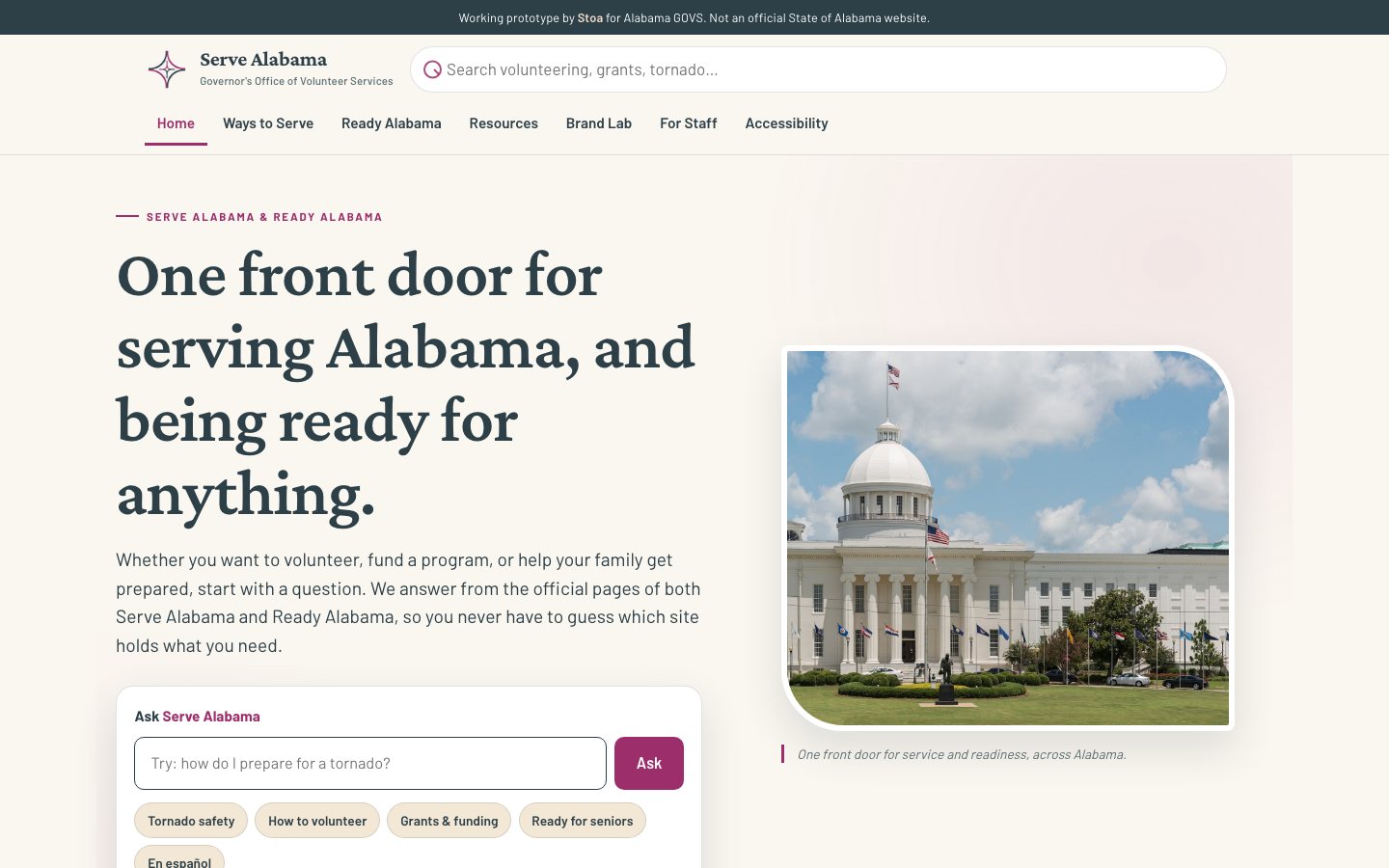
About this concept
The problem
Volunteer service and disaster readiness are administratively separate and experientially inseparable. A resident who wants to help after a storm, and a resident who needs help after one, arrive within hours of each other and often at whichever site they find first. Splitting them across two unrelated web presences means each site fails half the people who land on it, at exactly the moment failure costs most.
The approach
The two are designed as a pair with one public front door, so service, readiness, and recovery read as a continuum rather than three agencies. Content is built on 124 source-backed records with search across them, which matters more than usual here: during a disaster, an unsourced claim about a shelter or a program is actively dangerous. Because this was an identity question as much as a structural one, six brand directions were developed rather than one, giving the agency a real choice instead of a single proposal to accept or reject. The content system is staff-owned, on the assumption that the pages needing edits fastest are the ones edited during an event.
The result
Seven routes with a 124-record search, a paired Ready Alabama surface, six documented brand directions, and a staff-editable content system.
Your next project
Have a similar public need?
Tell us who needs to use it and what they need to do. We can help turn the problem into a clear, practical project.