Design study / Transit district · Oregon
Where's your bus? Live departures, decoded in the browser
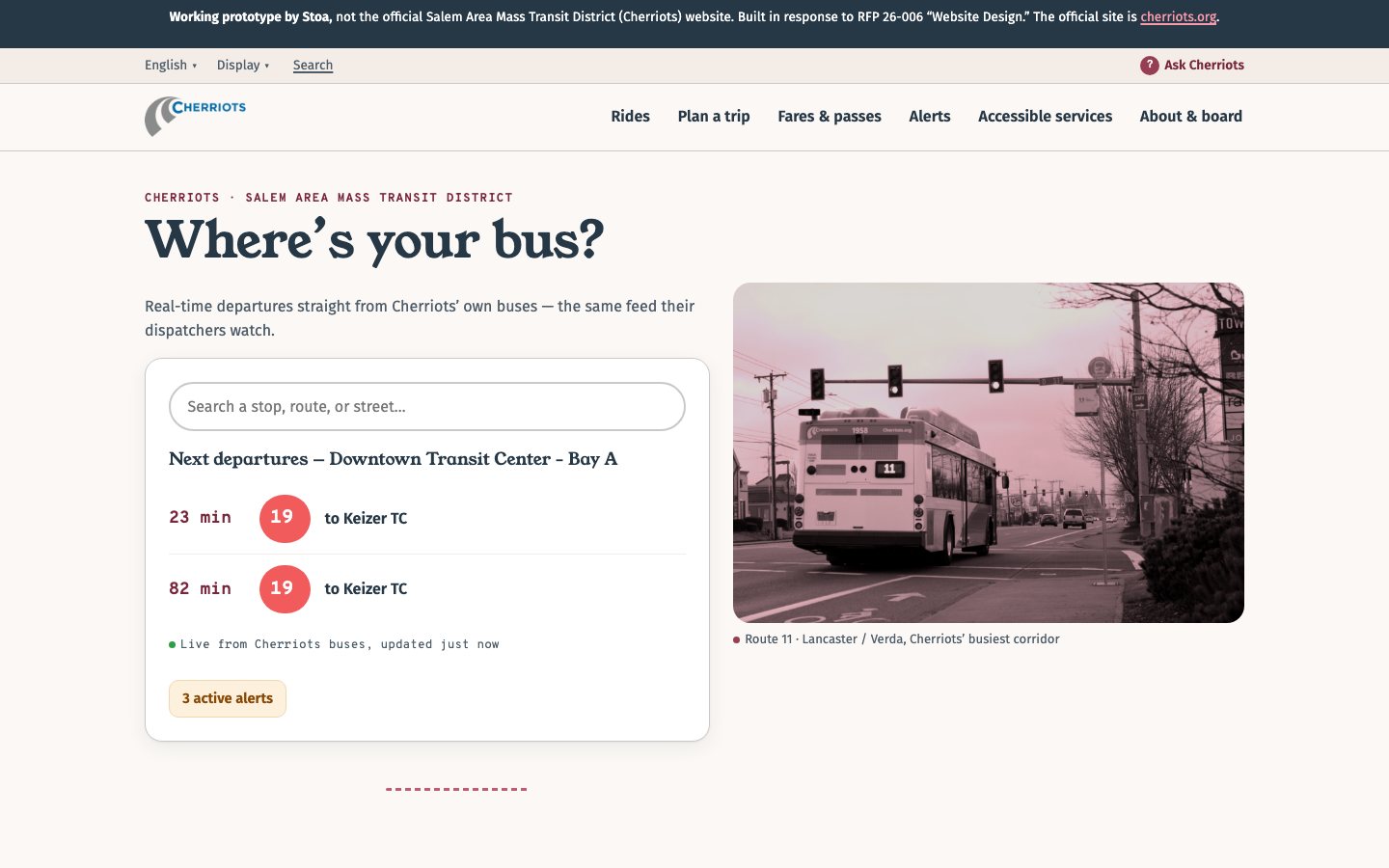
A transit redesign concept that reads the district's own GTFS-Realtime feed client-side — a hand-written protobuf reader, no server, no API key — so the site can show where the buses actually are.
Concept only, responding to RFP 26-006. Facts come from cherriots.org and Cherriots' public GTFS and GTFS-RT feeds; this is not the official Cherriots website.
- Transit website design
- GTFS-Realtime
- Live departure board
- Generated timetables
- WordPress theme
- WCAG 2.2 AA
Cherriots — open the working site
About this concept
The problem
Transit riders ask one question more than all others combined: where is my bus right now. Agency websites usually answer it by linking out to a third-party trip planner, because live vehicle data is assumed to need a backend, an API key, and a maintenance contract. So the agency's own site becomes a brochure that sends its most frequent users somewhere else, and the schedules it does host are PDFs that are hard to read on the phone where every rider is standing.
The approach
The concept decodes the district's public GTFS-Realtime feed directly in the browser with a hand-written protobuf reader — no server, no API key, nothing new to operate. That one decision unlocks the rest: a terminal-style departure board, a system map carrying all 30 route lines with vehicles moving on it, live buses projected onto each route's stop-by-stop string diagram, and alerts scoped to the route being viewed. Every route also gets a designed schedule page generated from the GTFS feed itself, with day and direction tabs, next-trip highlighting, and a printable pocket-card layout — so schedules stay correct because they are derived, not retyped. An answer-first Ask Cherriots covers fare, LIFT paratransit, and board facts. The type is Overpass, the open digitization of Highway Gothic, with B612 Mono, the face drawn for cockpit displays.
The result
Forty-five routes including live departures, a live system map, generated timetables for all 30 routes, and route-scoped alerts, built to a WCAG 2.2 AA target on the agency's own cherry route color.
Your next project
Have a similar public need?
Tell us who needs to use it and what they need to do. We can help turn the problem into a clear, practical project.