Design study / Zoo & attraction · Kentucky
Hunt the living zoo: one clue, one visible trail
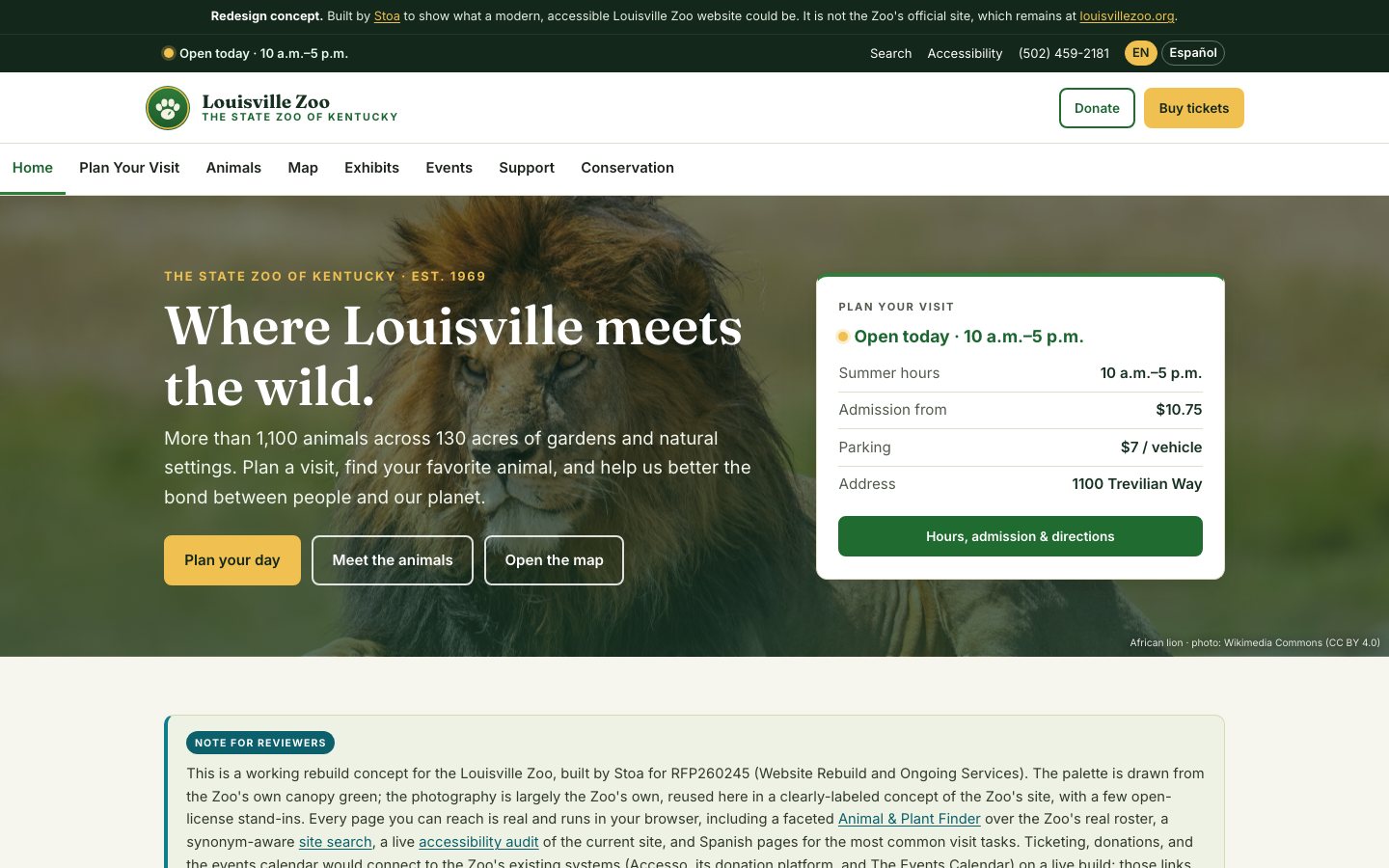
A rebuild concept for the State Zoo of Kentucky that opens on the animals rather than a brochure — type one clue and the site pulls animals, habitats, events, access details, tickets, and routes into a single trail.
Rebuild concept by Stoa. This is not the Zoo's official site, which remains at louisvillezoo.org.
- Zoo website design
- Attraction website
- Synonym-aware search
- Visit planner
- Spanish
- Accessibility
Louisville Zoo — open the working site
About this concept
The problem
Zoo websites are usually structured like an annual report and used like a map. A family on the way in wants three things fast — which animals are here, what does it cost, and how do we walk it — and they usually get a hero photograph, a news carousel, and a menu. The information is present; it is just arranged for the institution rather than for someone standing at the gate on a phone.
The approach
Search is the hero, not a utility in the corner. The homepage leads with a live hunt preview across 47 indexed animal profiles, and the search is synonym-aware so tickets finds admission and big cat finds lion, tiger, puma, and snow leopard — the words visitors actually use, not the taxonomy the institution files under. Beneath it, a gallery of faces establishes the collection as something recognizable and followable rather than decorative, and the 130 acres are presented as nine themed worlds on one walkable loop. A day plan updates as the visitor moves through it, and the animal finder sorts by group, habitat, or rarity. Spanish runs alongside as a real route.
The result
Fourteen routes covering visit planning, animals, map, exhibits, events, conservation, and support, with an accessibility route and a Spanish surface. Conservation work — the black-footed ferret recovery among it — is treated as a reason to visit rather than an About page nobody opens.
Your next project
Have a similar public need?
Tell us who needs to use it and what they need to do. We can help turn the problem into a clear, practical project.