Design study / Metropolitan planning organization · Ohio
One connected region, as a site
A redesign concept for a council of governments changing its name — where the site has to carry a new identity while serving two audiences who barely overlap.
Concept only. Facts are sourced from tmacog.org; this is not the official Lake Erie West Regional Council website.
- Regional planning website
- Two-audience navigation
- Document center
- Member portal
- Single sign-on
- Deep search
Lake Erie West — open the working site
About this concept
The problem
A council of governments serves member agencies and the general public at once, and those two groups want opposite things. Members want board packets, committee documents, and a portal. The public wants to understand what the organization does and why a regional body matters at all. A rename sharpens the problem: the site has to teach a new name while remaining the place members already rely on for documents.
The approach
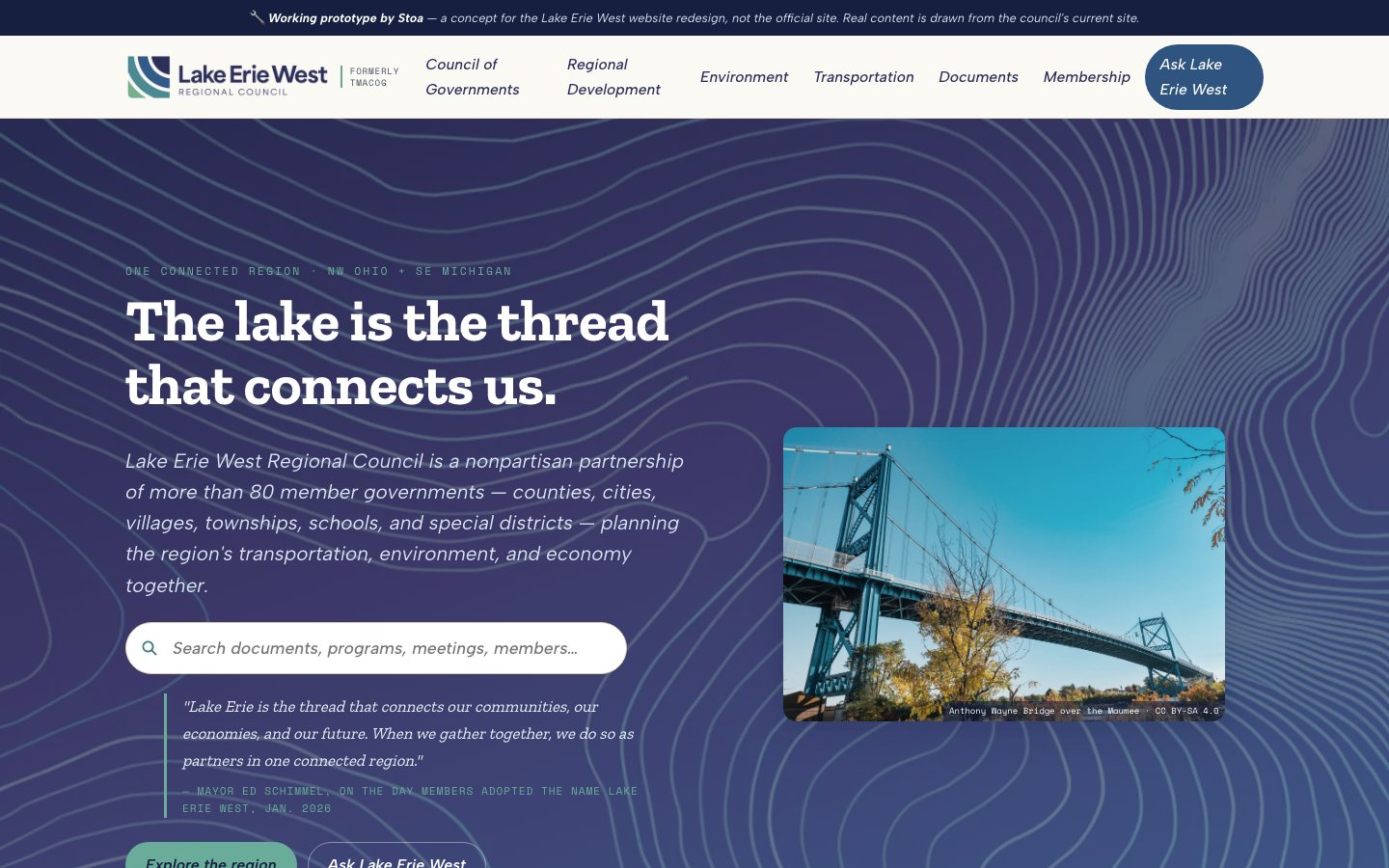
A connected-region county map opens the site, doing the explanatory work a mission statement cannot — northwest Ohio and southeast Michigan as one region rather than a list of member names. Two clearly marked doors then split members from the public instead of blending them, with the four content areas behind. A board and committee Document Center runs over the council's real public documents, and a member-portal preview with Active Directory single sign-on shows the member experience without pretending the integration is already live. Deep search and an answer-first Ask surface cover the rest. The visual world is sea glass and deep water, drawn from the new logo and the western basin's bathymetric contours — so the rename is carried by the design rather than announced by a banner.
The result
Eleven routes covering the region, members, the public, the four content areas, and a document center, with search across the council's real public material.
Your next project
Have a similar public need?
Tell us who needs to use it and what they need to do. We can help turn the problem into a clear, practical project.