Design study / University research institute · Massachusetts
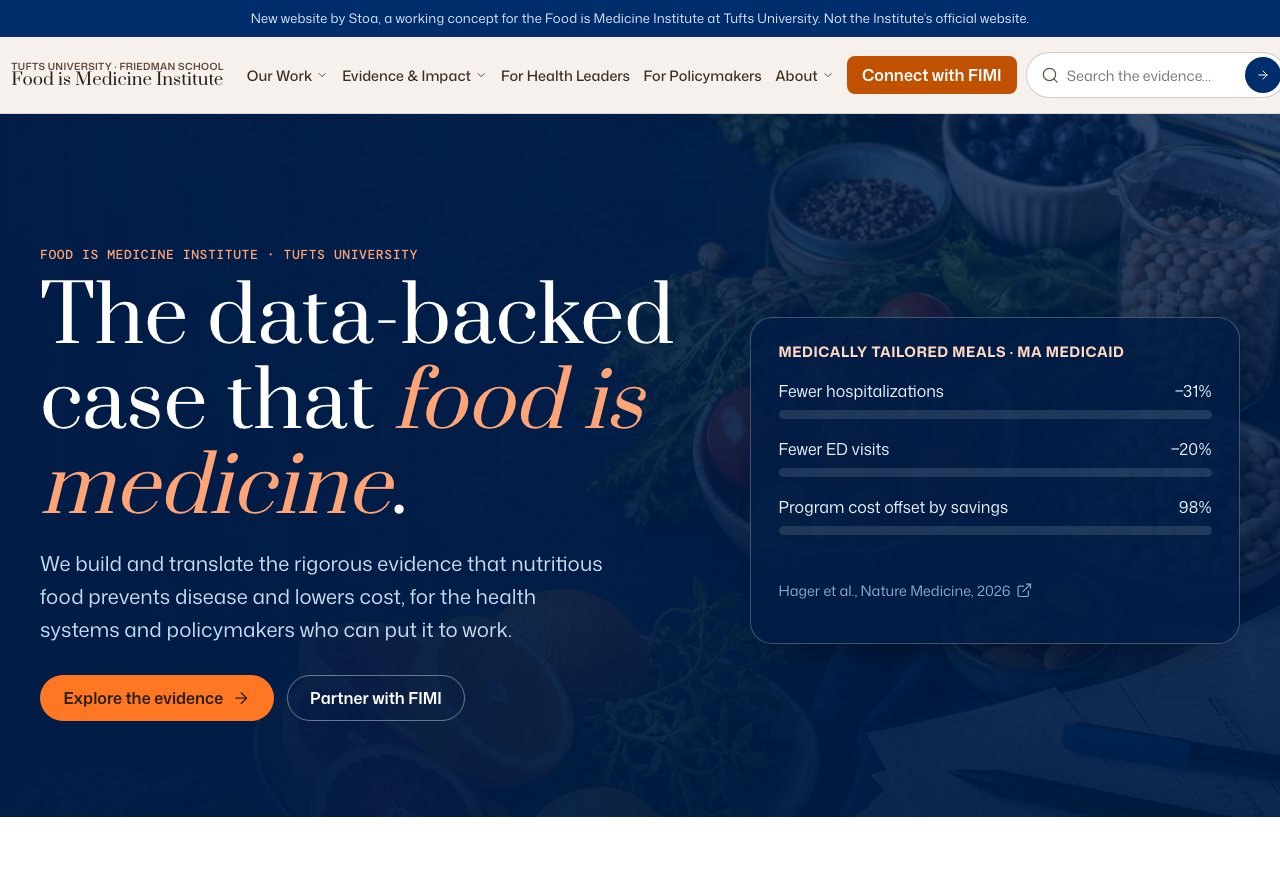
The data-backed case, built as an instrument
A redesign concept for a nutrition research institute whose audience is not other academics — it is health-system leaders and policymakers who need the evidence to be usable in a meeting.
Concept redesign responding to the Institute's website RFP. Facts come from the Institute's published research; this is not the official Food is Medicine Institute website.
- Research institute website
- WordPress theme
- Evidence-first design
- Content graph
- Data visualization
- Accessibility audit
Food is Medicine Institute — open the working site
About this concept
The problem
An academic institute's website is usually built for academics: publication lists, faculty pages, a news feed. But the audiences that determine whether the research changes anything — health-system executives and policymakers — do not read publication lists. They need a specific number, attributable to a specific study, in a form they can put in front of a board. A PDF library technically contains that and practically buries it.
The approach
Every page leads with cited, primary-source evidence rather than positioning language — $23.7 billion in first-year savings from medically tailored meals, 31% fewer hospitalizations, 126,000 cardiovascular events preventable through produce prescriptions — each traceable to its source. The evidence is presented as a living instrument instead of a document store: impact counters that resolve on scroll, an evidence data visualization, and an automatic content graph that surfaces related people, publications, and projects, so following a number leads to the person and the study behind it rather than a dead end. The whole thing runs as a real WordPress theme so the institute can keep publishing into it.
The result
Forty-one routes on a real WordPress theme, with search and an Ask surface, a content graph, evidence data visualization, and an accessibility audit.
Your next project
Have a similar public need?
Tell us who needs to use it and what they need to do. We can help turn the problem into a clear, practical project.