Design study / Independent civic atlas · California
Campbell in one place, and the story beneath it
A civic atlas built without an RFP, for the town Stoa is based in — an argument that a small city's whole public life can hold together in one place if someone bothers to connect it.
Self-initiated website concept for Campbell, California. Public facts last refreshed July 26, 2026.
- Civic website design
- Source-linked records
- Ownership switchboard
- Search or Ask
- Documentary photography
- WCAG 2.2 AA
Campbell, California — open the working site
About this concept
The problem
A resident's questions do not respect institutional boundaries. What is happening this weekend, who do I call about the thing on my street, what did the council decide, what is that building, why is the water tower there — those sit across the city, the chamber, the school district, county agencies, and local history, none of which link to each other. The result is that living somewhere is harder to do well than it should be, and no single site is responsible for fixing it.
The approach
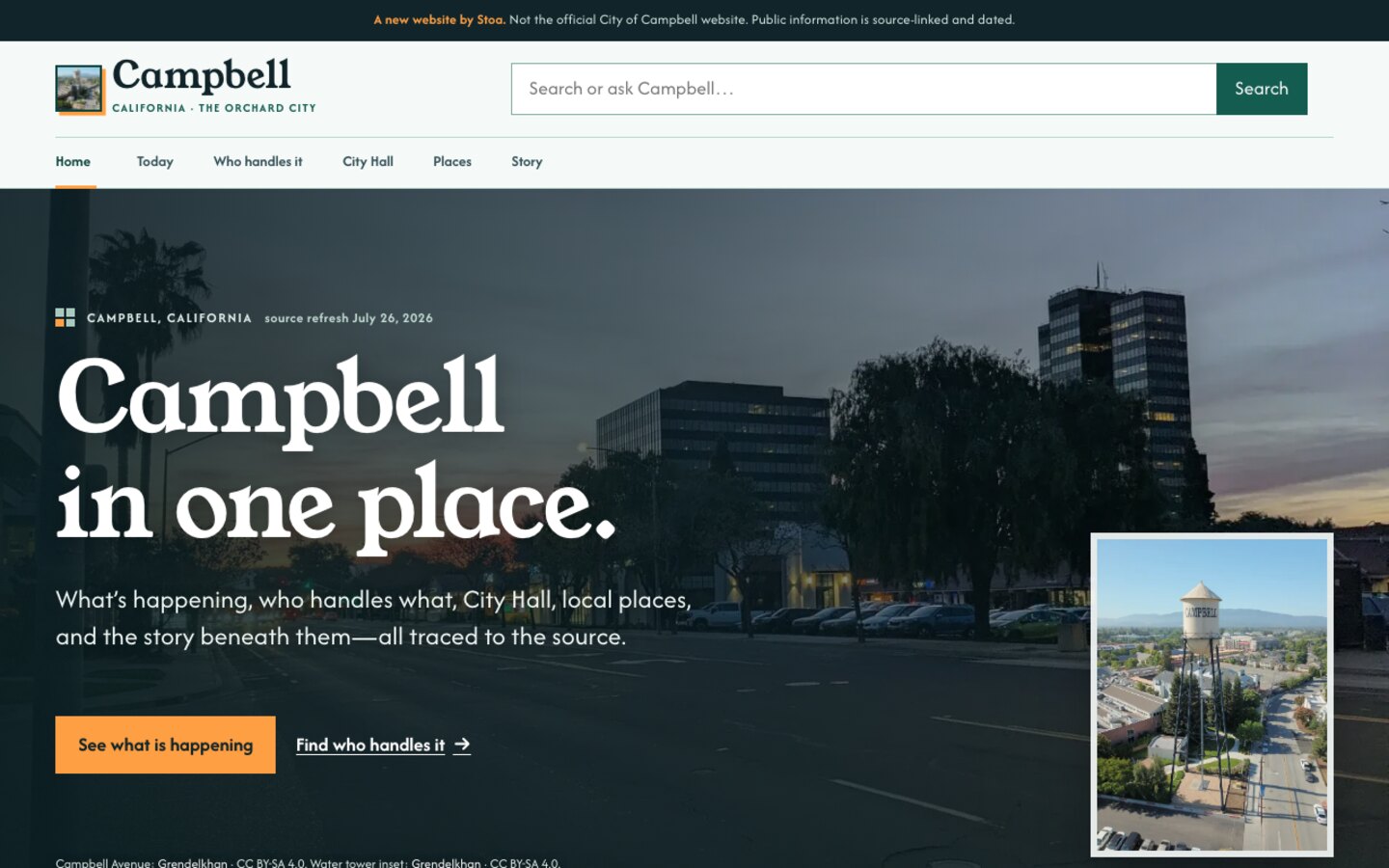
The site is built as an atlas rather than a portal: 41 source-linked pages holding 128 current event records, Campbell's public record, 421 local directory listings, and a sourced orchard-to-city timeline, with one masthead Search or Ask box covering 634 records and answering practical questions with named official sources. The organizing device is a 16-path ownership switchboard — who actually handles this — which turns the jurisdictional confusion into the navigation instead of hiding it. Everything visual comes from the place: a full-bleed Campbell Avenue hero, the water-tower mark, documentary local photography, and a grid drawn from fruit-drying trays, in Young Serif and Afacad over cool orchard green, mineral blue, and one apricot cue.
The result
Forty routes across events, services, the public record, local places, and history, with WCAG 2.2 AA testing returning zero axe violations across all 41 routes.
Your next project
Have a similar public need?
Tell us who needs to use it and what they need to do. We can help turn the problem into a clear, practical project.