
Reflecting on our 2025 Legislative Agenda
As the federal government rolls back enforcement of the Fair Housing Act, attempts to deregulate AI (even threatening state laws), and lays off thousands of federal workers, it’s important to stay grounded in our vision of an equitable tech economy.
In 2025, that’s exactly what we did.
We remained focused on state-level reforms to address how technology and AI exacerbate economic inequality, particularly in labor and housing. We continued to center our legislative work in California—where many tech companies are headquartered—because we’ve seen that when policy is enacted in California, it has ripple effects across the country and around the world.
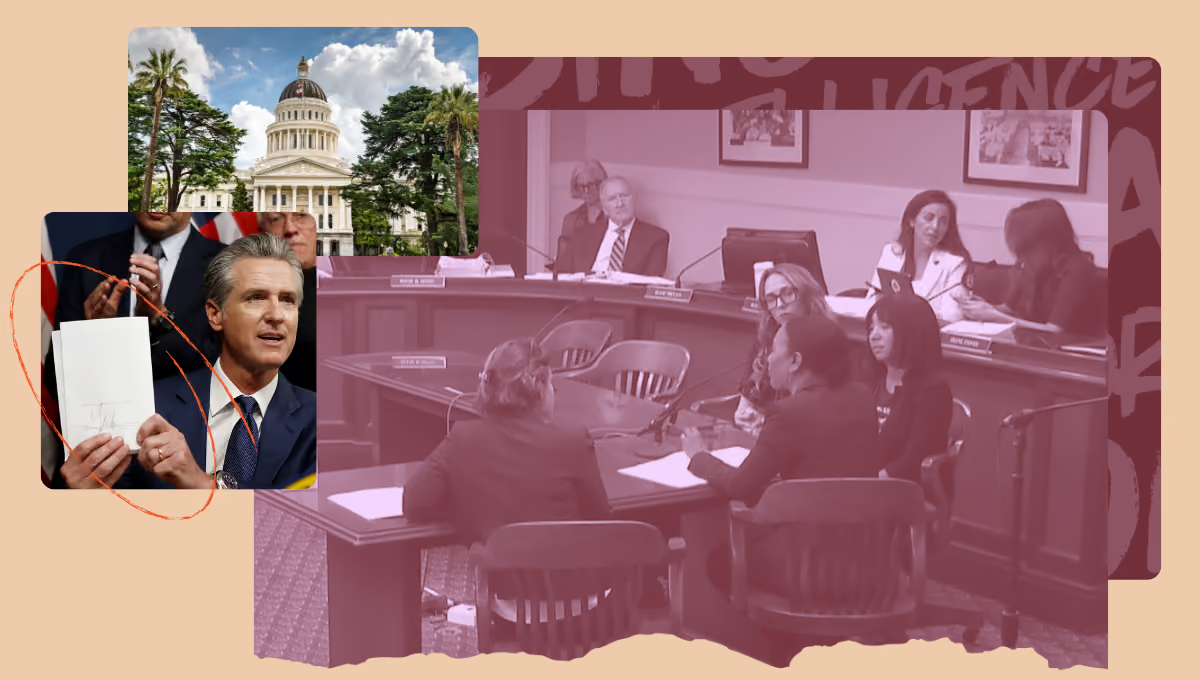
Now that the 2025 legislative session is over and Governor Gavin Newsom has signed his final bills for the year, here is an overview of our hard-fought wins, our plans deferred, and our hopes for the future.
Our sponsored legislation
Sponsored legislation means we have partnered with an elected official to develop and lead the efforts to ensure these bills will become law. We aggressively campaign on the legislation, lead coalition tables, and engage our community on why these bills are vital to our mission.

AB 325 (Aguiar-Curry) – Preventing Algorithmic Price Fixing Act
Authored by Assembly Majority Leader Cecilia Aguiar-Curry (D-Winters), AB 325 seeks to hold developers and users of pricing algorithms accountable for price fixing. The bill generally prohibits the use or distribution of any pricing algorithm that sets or recommends prices using data from more than one business in a similar market, ensuring that consumers won’t pay more when companies attempt to use digital tools to break the rules.
What happened with this bill?
The bill received support from California Attorney General Rob Bonta, and on October 7, Governor Gavin Newsom signed the Preventing Algorithmic Price Fixing Act into law.
“Across industries, we’ve seen competitors game the system using technology to collude and drive up costs for everyday people,” said Catherine Bracy, CEO and founder of TechEquity. “With AB 325 now law, California is leading the nation by closing the door on algorithmic price fixing and ensuring fairer markets for everyone.”
AB 1018 (Bauer-Kahan) – Automated Decisions Safety Act
Algorithms are increasingly deciding who gets access to benefits, housing, and healthcare. Left unchecked, these algorithms can produce biased results, making everyday people vulnerable to automated discrimination—without them even knowing about it. Authored by Assemblymember Bauer-Kahan, AB 1018 would have provided people with more information, important rights, and greater transparency into the use of Automated Decision Systems for critical areas of their lives—while requiring developers and deployers to take more responsibility for reducing the likelihood of discrimination.
What happened with this bill?
AB 1018 made it through the California Assembly, and after clearing two Senate committees, it was looking like the California Senate would pass the bill as well. That said, with vast amounts of money and resources fueling the opposition campaign, Assemblymember Rebecca Bauer-Kahan designated AB 1018 as a 2-year bill. This means the bill will return as part of the legislative session next year, allowing time for continued conversations that could increase the possibility that the bill could be signed into law.
Empowered by polling that shows a hunger for AI regulation in California and across the country, we’re excited to continue to push this law forward in the next legislative session.
SB 52 (Perez) – End AI Rent Fixing Act
Landlords and other real estate business owners are increasingly using algorithms to demand rent increases based on rental data from thousands of landlords and other sources. The End AI Rent Hikes Act would have banned algorithms used by landlords to hike rents. SB 52 makes it clear that using algorithms to collude and inflate rental prices is illegal in California and creates clear mechanisms for accountability and enforcement when landlords use these algorithms illegally.
What happened with this bill?
The bill was held by the California Assembly Appropriations Committee, so it never made it to Governor Newsom’s desk.
Our priority legislation
Priority legislation means these bills have a very close tie to our initiatives and policy platforms at the intersection of tech and economic justice. We have joined a coalition to ensure the passage of these bills. We’re educating, engaging, and activating our community to support the passage of these bills.
None of our priority legislation became law this year. In the shuffle of politics, competing bills, and corporate lobbying, sometimes bold policies don’t get the Governor’s signature or even make it to his desk. This is exactly what happened to these pieces of priority legislation:
Did not pass through the California legislature
- AB 446 (Ward) sought to make electronic shelving labels in grocery stores, digital menus at fast food chains, and more illegal, and establish that this kind of surveillance pricing is a civil penalty. The bill was ordered to the inactive file.
- AB 1221 (Bryan) would have prohibited the use of invasive and potentially discriminatory surveillance in the workplace and would have established much-needed worker data protections. AB 1221 stalled in the California Assembly.
- AB 1331 (Elhawary) would have updated and expanded existing workplace privacy laws to address new surveillance technology. In an attempt to get ahead of technological advancements, it would have also prohibited employers from requiring workers to implant or embed tracking devices in their bodies. The bill was ordered to the inactive file.
- AB 1248 (Haney) would have limited landlords from charging junk fees that inflate rents, prevent circumvention of the Tenant Protection Act of 2019, and reduce rent debt. The bill was ordered to the inactive file.
- The Affordable Rent Act (AB 1157 | Kalra) would have counterbalanced corporate control of our housing market and helped make rents more affordable by lowering the rent cap and expanding the Tenant Protection Act (AB 1482) to cover even more California renters.
Vetoed by the Governor
- The No Robo Bosses Act (SB 7 | McNerney) would have ensured human oversight of automated decision systems when making decisions affecting a worker’s livelihood. The bill passed the California Assembly and Senate, but was ultimately vetoed by Governor Newsom.
While it can be disheartening to see this list of bills—and, implicitly, opportunities to create a more equitable economy—that didn’t survive the political process, the efforts around these bills still have an impact. We have still successfully moved the needle on many issues, and we will be able to leverage those conversations, educational moments, and momentum going into the next legislative session.
Our support legislation
There are still amazing bills that became law this year! They present major wins for everyday people across California and open future opportunities for legislative change. Here are the ones we supported, whether through submitting letters or re-sharing posts on social media:
- The Pay Equity Enforcement Act (SB 642 | Limón) will strengthen the California Fair Pay Act in several ways, including by revising outdated gender binary language and imposing varying requirements upon employers to share the pay scale for a position with an applicant or in a job posting.
- The Modernizing Penalties in the Cartwright Act (SB 763 | Hurtado) will update the Cartwright Act to deter anticompetitive conduct (such as price fixing) in the 21st century by better aligning it with the criminal penalties under the Sherman Antitrust Act.
- SB 578 (Smallwood Cuevas) will establish the Department of Industrial Relations within the Labor and Workforce Development Agency to, among other things, foster, promote, and develop the welfare of wage earners, to improve their working conditions, and to advance their opportunities for profitable employment.
- AB 692 (Kalra) will make “stay or pay” employment clauses—which require employees to pay their employer back for certain costs if they leave the job—unlawful.
- Paid Family Leave for Chosen Family (SB 59 | Smallwood Cuevas) will expand eligibility for benefits under the paid family leave program to include individuals who take time off work to care for a seriously ill designated person.
- The California Opt Me Out Act (AB 566 | Lowenthal) will require browsers to include a setting that enables a consumer to send an opt-out preference signal, giving Californians a simple way to exercise their digital privacy rights.
- AB 316 (Krell) promotes accountability in the development and deployment of artificial intelligence by making clear that individuals or entities who deploy or develop AI systems should not be able to evade liability for resulting harm by simply attributing the damage to the AI itself.
- AB 489 (Bonta) prohibits using a term, letter, or phrase in an artificial intelligence (AI) or generative AI system that indicates or implies the care or advice AI offers is being provided by a licensed person.
- The California AI Transparency Act (AB 853 | Wicks) will ensure online platforms make it clear when content is AI-generated, altered, or authentic.
What’s up next?
This legislative session may be over, but we’re already gearing up for the next. And we’re not alone, with coalition partners across labor, housing, economic opportunity, responsible tech, and more. Of course, we also have you.
One of the most important factors in deciding our legislative slates is how everyday people are being impacted by the tech economy. So if you have a story about the tech economy, we want to hear it.
By sharing your experience working under surveillance technology or as a renter who has been denied housing by an algorithm, you can help us develop bills and then help lawmakers understand why they should support these bills to close the gaps and protect everyday people.
Sign up for our newsletter to stay up-to-date on the bills we’re running and other work we’re doing to make tech work for everyone.