Hidden in plain sight: What our data work landscape revealed
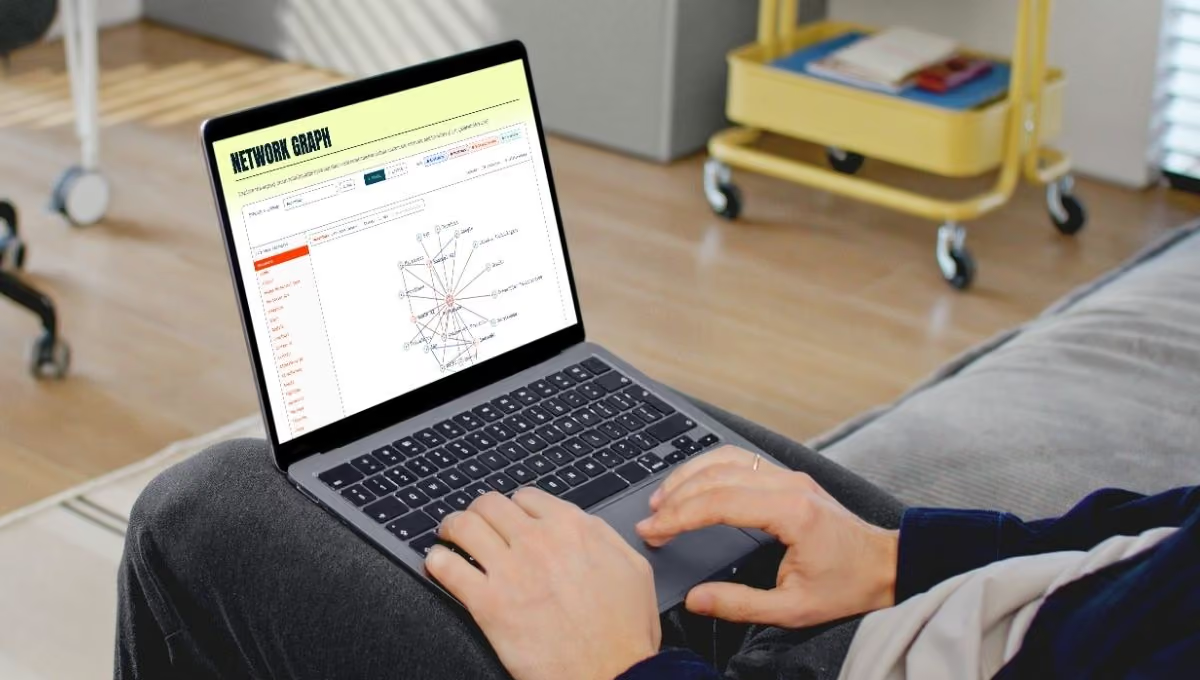
Every AI system on the market, whether it’s a chatbot, a military tool, or a diagnostic aid, is built on top of a labor force that rarely gets discussed. Our Data Work Landscape set out to map that hidden layer, tracing thousands of relationships between AI companies, their clients, their investors, and the data work firms that do the actual work of labeling, annotating, and validating the data these systems run on.
While this network is seemingly vast and complex, we were able to identify themes that connect otherwise disparate parts of the landscape. Here, we highlight three related stories that emerged from our research: the government contracts that rely on data work with no public accounting of the labor behind them, an industry-wide pattern of hiding subcontracting relationships behind claims of proprietary protection, and a client base for data work that extends far beyond Big Tech into universities, farms, hospitals, and factories.
Keep in mind that the Data Work Landscape is based on publicly available information. Even with major gaps in transparency, these stories taken together point to the same conclusion—the AI industry’s supply chain runs deeper and remains more hidden than most people realize, and closing that gap starts with knowing where to look.

The Pentagon’s invisible workforce
You’ve heard about the Pentagon’s AI contracts with OpenAI, Anthropic, and Grok. These deals have sparked big questions around national security, oversight, and who’s accountable if something goes wrong. But what if those same questions extend to other actors most people have never heard of? The frontier AI companies aren’t the only ones worth knowing about.
Our Data Work Landscape mapped the U.S. Department of Defense’s connections across the AI data work industry and found eight relationships—more than any other government entity in our database. Those relationships run through companies like Innodata, Scale AI, Labelbox, Snorkel AI, and Appen, among others: the firms whose workers label, annotate, and validate the data that trains and evaluates AI systems for military use.
But what do we know about this extended workforce? There’s no coordinated public accounting of who these workers are, where they’re located, or under what conditions they work, even though taxpayer dollars are funding the contracts that rely on their labor. Our data is based solely on press releases and public statements from data work contractors and the Department of Defense, publicly available federal contracts, and media reporting. To address this accountability gap, journalists covering these contracts and workers speaking out have started to provide some insight into these relationships.
For example, reporters Niamh McIntyre, Edwin Okoth and Cam Wilson, writing for Bureau of Investigative Journalism with support from the Pulitzer Center’s AI Accountability Network, identified that Appen performed work for a secretive U.S. military unit even though “none [of the company’s gig workers] were told by Appen that they may have been working for the U.S. military.”
Even as the reporters attempted to dig further into Appen’s work with the U.S. Department of Defense, they continued to run into obstacles: “We sent freedom of information requests to several US military units about the nature of Appen’s work. Most did not respond or said they found no relevant records. One sent back 720 pages of entirely blacked-out redactions. At Appen’s offices in Sydney and Washington, a culture of secrecy also surrounded the company’s defense work.”
Press releases and media coverage also shed some light on another prominent U.S. Department of Defense contract for data work. In November 2025, a Virginia-based company called Enabled Intelligence won a competitive contract from the National Geospatial-Intelligence Agency (an agency within the Department of Defense) for $708 million over a seven-year period to label data that supports Department efforts like Project Maven, a controversial program that incorporates AI into U.S. military operations.
Enabled Intelligence states it does “not use foreign contractors” and instead promises “a team of highly-trained, US based data analysts.” The company reportedly built our “classified workspaces to undertake labeling at both secret and top-secret levels” in Fairfax, Virginia. The company has also claimed that “about 60% of Enabled’s workforce are on the autism spectrum.” The company’s founder has said he was inspired by an Israeli military unit to focus on hiring neurodivergent community members for data labeling. The company’s chief people officer commented on this hiring strategy that “super attention to detail, ability to hyperfocus, ability to be trained in a new skill, and to be able to work on repetitive and even sometimes mundane projects, but not lose focus or get burned out is a superpower that our team has.”
In late August 2026, Enabled Intelligence also announced in a press release that it will partner with a subcontractor, Seekr, to “develop and deploy purpose-built AI agents that make the data labeling and quality-assurance process faster” on the company’s contracts with the Department of Defense. This news was released after our most recent Data Work Landscape updates and will be added soon. It shows how the data work market changes quickly and how additional subcontractors within the space expand the number of workers and companies involved in this work. (Check out the next section for more about the challenges of tracking subcontractors.)
Since Enabled Intelligence and Appen were contracted directly by the U.S. Department of Defense, there is some public documentation, but in many cases, data workers may be employed on projects for military use through a subcontractor to a company with a defense contract, like Anthropic or OpenAI.
If we care about oversight of military AI, that oversight can’t end at the companies we’ve heard of. It has to reach the workers we haven’t.
Follow the subcontractor—if you can find one
Subcontracting is common practice in the AI data work industry, so why don’t companies like to classify it this way? Of the 1,924 connections mapped across our Data Work Landscape, only one was labeled as a subcontractor relationship.
What’s going on? That number isn’t a sign that subcontracting doesn’t happen. It’s a sign of how little of it gets disclosed. Companies in this space routinely decline to name their subcontractors, often citing the risk of revealing proprietary tech innovations to competitors. The result is that the people actually performing data work are frequently two or three layers removed from the brand name consumers and clients see. As was the case for a Digitive worker subcontracting for GlobalLogic on Google projects, whom we interviewed for our 2025 report with AWU-CWA, Ghost Workers in the AI Machine.
In other cases, lawsuits and investigations have revealed some of these relationships. For example, San Francisco’s Office of Labor Standards Enforcement is reportedly investigating both Scale AI and third-party sites, including HireArt and Upwork, which are subcontracted by Scale. The U.S. Department of Labor reportedly dropped a similar investigation under the Trump Administration. There’s little public trail connecting them to the systems their labor makes possible.
This opacity is an industry strategy. Staying vague about who’s actually doing the work lets companies keep distance between their brand and the labor conditions underneath it. If no one can trace the relationship, no one can hold them accountable for it.
Mapping this industry means working with what’s disclosed, and subcontracting relationships are rarely revealed on the record.
It’s not just Big Tech; universities, farms, and factories are buying AI labor too
When many people imagine the AI data work industry, they may picture workers labeling images and text directly for Big Tech AI companies. But tech companies are far from the only ones relying on this labor.
Manufacturing & Agriculture is the third-largest industry represented in our Data Work Landscape, with 117 companies identified as clients of data work firms. Education shows up prominently too, and one relationship stands out: Stanford University has documented relationships with six different data work companies, more than any other university in our dataset. Hospitals, farms, factories, and universities are all quietly commissioning AI data labor.
These relationships raise important questions. What kind of AI tools is a university like Stanford building with the support of data work providers, and what are the working conditions of the people contributing the labor behind them? What happens when those tools are eventually deployed—in classrooms, in hospitals, on farms?
The data work economy is closer to everyday institutions than most people assume, and that scale is exactly why it deserves more scrutiny than it’s currently getting.
The map is just the start
These are just some of the insights that come from mapping these corporate relationships. We invite you to dig into the dataset at DataWorkLandscape.org to see which other connections stand out to you.
We were thrilled to see our data is already being put to work. A Brown University researcher used the datasets behind the Data Work Landscape, combined with their own original research, to build a resource examining the delivery centers where data work actually happens, the platforms that employ it, and the customers it serves.
We hope this work is just the beginning, and that others will use these tools to dig further into the power relationships across the AI supply chain, and to inform organizing strategies that expand global labor solidarity.