In This Issue
-
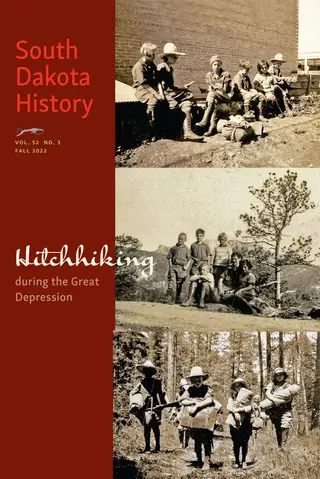
“We were tramps along with the rest of them”: The Journal of Earl Neller, Who Hitchhiked across South Dakota with Six Children in 1933
At the height of the Great Depression in the summer of 1933, Earl Neller and six children tramped, hitchhiked, and railroaded some 850 miles across the Dakotas over twenty-seven days. Neller, a high school teacher from St. Louis, Missouri, and the children, ages eight to thirteen, hiked west from Sioux Falls, South Dakota, journeyed through the Black Hills, then headed north until they reached their destination in Hebron, North Dakota.
-
DAKOTA IMAGES | Alvin F. McDonald
Alvin Frank McDonald was the self-styled “chief guide” at Wind Cave, near Hot Springs, South Dakota, during its early years of operation as a tourist attraction. McDonald was born in Franklin County, Iowa, on 3 April 1873. In 1890, the South Dakota Mining Company tasked his father, Jesse D. McDonald, with overseeing its newly purchased claims to the cave site. Sixteen-year-old McDonald and his brother Elmer soon became dedicated spelunkers. For the next three years, McDonald spent up to nine hours per day methodically exploring the cave system―one of the largest and most labyrinthine in the world―by candlelight. Like the mythical Greek hero Theseus, he unrolled string to mark his path and avoid becoming lost. He kept a meticulous journal that contained precise, invaluable maps of Wind Cave’s rooms and passageways, and eventually explored, named, and mapped ten miles of the subterranean structure. He even wrote that he could not stand to be away from the cave for more than a few days. In 1892, Hot Springs local John Stabler joined the McDonalds to form the Wonderful Wind Cave Improvement Company. Their efforts included an advertising campaign, enlarging certain passageways with explosives to improve accessibility, building a hotel near the site, and establishing a stage to transport visitors for tours―often led by Alvin. Yet the group’s success ignited bitter litigation over the cave’s ownership between Jesse McDonald, Stabler, the South Dakota Mining Company, and assayer Peter Folsom. In summer 1893, McDonald journeyed to Chicago to bring samples from the cave to the World’s Columbian Exposition, where he likely contracted typhoid fever. McDonald died of the disease at the age of twenty on 15 December 1893. President Theodore Roosevelt designated Wind Cave the seventh national park in 1903, effectively ending the ownership dispute. While political patronage, neglect, and limited visitation contributed to the chronic maladministration of Wind Cave for the next few decades, today the park preserves one of the most spectacular cave systems in the United States, along with the surrounding mixed-grass prairie. Alvin McDonald’s grave and memorial is only a short walk from the natural entrance to the cave he loved so dearly.