In This Issue
-
DAKOTA IMAGES | Jack Langrishe
Jack Langrishe was an Irish American theater impresario who toured the mining towns of the American West, earning the nickname “the Comedian of the Frontier.” Born John Sewell Folds Jr. in Dublin, Ireland, on 29 September 1825, he immigrated to the United States in 1845. By 1850, he had adopted the stage name Jack Langrishe, founded the acting troupe “Langrishe and Company,” married fellow actress Jeanette Allen, and began touring the United States. Langrishe and Company performed far and wide with stops in Chicago, San Francisco, and even Mexico. Recognizing the lucrative potential of the mining booms, in 1860 the couple arrived in Colorado and spent the next decade performing in Denver, Leadville, and other mining towns before moving to Montana in 1870. A classically trained actor, Langrishe specialized in respectable, high-class entertainment and built theaters without attached dance halls or saloons that would distract from the performances. Although the Langrishes were beloved and successful wherever they went, the high costs of stage production resulted in a series of bankruptcies. In 1876, Langrishe and Company fled to Deadwood, South Dakota, to evade creditors in Cheyenne, Wyoming, and put on their first play in the town, The Banker’s Daughter , on 22 July of that year. Langrishe went on to stage hundreds of shows—including Hamlet and Uncle Tom’s Cabin —in Deadwood. He rented out the Bella Union Theater for his productions and leased the building for the first murder trial of Jack McCall, Wild Bill Hickok’s killer. Langrishe was also an active participant in Deadwood civic life. In 1878, Langrishe built his own theater in Deadwood and two in nearby towns. His Deadwood theater, however, was among the three hundred buildings destroyed in the fire of 1879. This disaster marked the third great inferno of Langrishe’s life: a fire in his father’s print shop forced his family to leave Ireland, and the Great Chicago Fire of 1871 destroyed all his troupe’s equipment. Langrishe left Deadwood to tour again, hoping to raise money to rebuild, but never returned. In 1885, he retired from the stage and settled in Idaho, where he served in the new state’s legislature. Langrishe died on 12 December 1895 and was buried in Kellogg, Idaho. Image: Courtesy of the Western History Department, Denver Public Library
-
From Disaster to Prosperity: Four Fires that Changed Deadwood
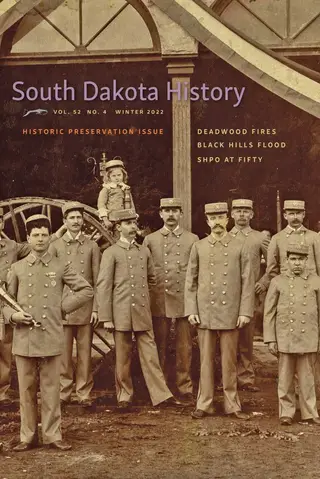
Over Deadwood's nearly 150 years of existence, its inhabitants have witnessed many fires, from burning storage sheds to out of control forest fires. Some of these incidents were small and easily forgotten, but others brought significant loss and heartache. Regardless of the size, Deadwood recovered from each disaster, and sometimes for the better. In fact, as this article shows, a few of the fires were transformative.
-
The 1972 Black Hills Flood and the Remaking of Rapid City
The 1972 Black Hills Flood, also known as the Rapid City Flood, was one of the largest river floods in contemporary American history. It not only affected Rapid City but also surrounding Black Hills communities such as Keystone, Sturgis, Nemo, and Box Elder. The disaster claimed over two hundred lives—those who either lived within or were visiting the Black Hills—and displaced thousands more, prompting enormous changes in the city’s layout. These included nearly one thousand acres of land being turned into recreational greenspaces that constitute a floodway, a revised housing and floodplain policy, and new mitigation and prevention practices along the banks of Rapid Creek.
-
The South Dakota State Historic Preservation Office at Fifty
For fifty years, the South Dakota State Historic Preservation Office and its staff have been tasked with implementing federal and state laws; researching and documenting thousands of historic places across the state; and providing information, technical guidance, and grants.