In This Issue
-
“Both Sides of the Mountain”: Growth and Volatility at Sioux Falls College, 1953–1978
“‘Both Sides of the Mountain’: Growth and Volatility at Sioux Falls College, 1953–1978,” explores the development of Sioux Falls College—now known as the University of Sioux Falls (USF). Stephen Jackson analyzes the efforts of President Reuben P. Jeschke and other college leaders to overcome financial difficulties and expand both enrollment and the physical campus.
-
“Whatever our language, we have the same flag”: The Eureka Rundschau, 1915–1927
In “‘Whatever our language, we have the same flag’: The Eureka Rundschau , 1915–1927,” Istvan Gombocz analyzes a popular German-language newspaper in McPherson County, South Dakota. The Eureka Rundschau helped Germans from Russia craft and maintain a dual identity, especially during the tense World War I era.
Read the PDF of “Whatever our language, we have the same flag”: The Eureka Rundschau, 1915–1927 Free
-
A Quest for Mental Ammunition: The Ninety-Third U.S. Army Air Forces College Training Detachment in Spearfish, 1943–1944
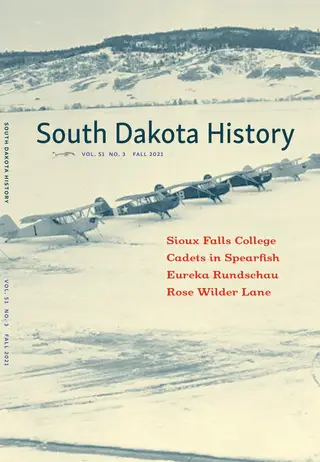
“A Quest for Mental Ammunition: The Ninety-Third U.S. Army Air Forces College Training Detachment in Spearfish, 1943–1944,” by Paul Higbee and Terry Neil King, documents the history of an Army Air Force college training detachment that prepared cadets for service in World War II. Black Hills Teacher College, which hosted the unit, transformed itself to welcome these visitors, as did the town of Spearfish.
-
Book Reviews
-
DAKOTA IMAGES | Robert Slagle
Robert Slagle was an influential figure in higher education in South Dakota in the early twentieth century, leading several colleges in the state and making lasting changes to campus culture and academics. Born in Hanover, Pennsylvania, in 1865, Slagle came to Dakota Territory in 1887 to teach at the Collegiate Institution at Groton. He left for Baltimore, Maryland, to earn his doctoral degree in chemistry from Johns Hopkins University three years later. After a short stint working as a food inspector in New York City under pioneering nutritionist W. O. Atwater, he moved to Brookings in 1895 to serve as a professor of chemistry at Dakota Agricultural College, now known as South Dakota State University. Slagle’s academic career advanced quickly after that point. He became president of the South Dakota School of Mines in Rapid City in 1899, adding English, Latin, and history to the college’s curriculum. His other significant accomplishments included establishing the Mining Experiment Station on campus and planning the school’s first formal exploration of the Badlands. Slagle then returned to Dakota Agricultural College, this time as president. Early in his tenure, which lasted from 1906 to 1914, the institution was renamed the South Dakota State College of Agricultural and Mechanical Arts. Slagle ushered in many important changes to university life. For instance, the School of Agriculture began offering high school courses during the winter, making secondary education accessible to rural students. Additionally, Slagle introduced summer classes that bolstered enrolment. The campus added several new buildings during his tenure as well. Slagle then moved to Vermillion, where he became the president of the University of South Dakota (USD) from 1914 to 1929. His administration boosted student enrollment and increased the faculty to eighty members. He is most famous, however, for starting the Dakota Days tradition in 1914. Dakota Days began as a homecoming parade and has blossomed into a weeklong showcase and celebration of school spirit, with events and receptions for current students and alumni. Slagle received an honorary degree from USD in 1927, the same year he announced his retirement. He planned to serve as president until September 1929, but experienced declining health after suffering several strokes. Slagle died of heart failure in Vermillion on 29 January 1929. Image courtesy of the Robert L. Slagle Collections, University Libraries, Archives and Special Collections, University of South Dakota.
-
Rose Wilder Lane on Railroads and the Winter of 1880–1881: Excerpts from “Behind the Headlight: The Life Story of a Railway Engineer”
Nancy Tystad Koupal’s expertise on the Wilder family informs her article, “Rose Wilder Lane on Railroads and the Winter of 1880–1881: Excerpts from ‘Behind the Headlight: The Life Story of a Railway Engineer.’” The article explores Rose Wilder Lane’s early career as a writer. It includes annotated excerpts from a serial that Lane published in the San Francisco Bulletin in 1915, describing a famously harsh winter that would inspire her mother Laura Ingalls Wilder’s “The Long Winter” (1941).