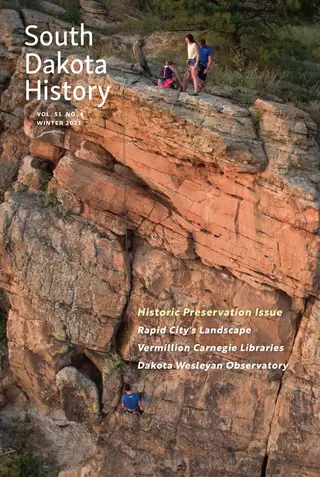
In This Issue
-
A Tale of Two Vermillion Carnegie Libraries
“A Tale of Two Vermillion Carnegie Libraries,” by Evelyn Heymann Schlenker, documents the history of two structures in Vermillion funded by the Carnegie Corporation: the Vermillion Public Library and University of South Dakota’s library, which have both served a variety of functions for their communities over the years. Schlenker, a Professor Emerita at USD, serves as secretary of the Clay County Historic Preservation Commission and the Friends of W. H. Over Museum Board and has written several books about Clay County’s history and structures.
Read the PDF of A Tale of Two Vermillion Carnegie Libraries Free
-
Astronomy on Fire: The Story of the Dakota Wesleyan Observatory
In “Astronomy on Fire: The Story of the Dakota Wesleyan Observatory,” Michael N. Farney documents both the process of building an observatory at Dakota Wesleyan University to study the stars and what ultimately happened to this structure. Farney is Professor Emeritus of mathematics at Dakota Wesleyan University. During his forty-year tenure, he taught calculus, university physics, freshman general studies and his true love, astronomy.
Read the PDF of Astronomy on Fire: The Story of the Dakota Wesleyan Observatory Free
-
At the Vertex of Water and Stone: Preserving Landscape and Memory in Rapid City
Eric Steven Zimmer’s article “At the Vertex of Water and Stone: Preserving Landscape and Memory in Rapid City,” examines how the preservation efforts in Rapid City have changed, especially after the devastating 1972 flood. Zimmer, PhD, is a senior historian at Vantage Point Historical Services, Inc., and a volunteer with the Rapid City Indian Boarding School Lands Project.
Read the PDF of At the Vertex of Water and Stone: Preserving Landscape and Memory in Rapid City Free
-
Book Reviews
-
DAKOTA IMAGES | Maria Pearson
Maria Darlene Pearson (“Hai-Mecha Eunka”), a member of the Turtle clan of the Yankton Sioux tribe, was born in Springfield, South Dakota, on 12 July 1932. Pearson began advocating for American Indian rights, especially regarding the handling of human remains, in 1971. She started this activity when her husband, John Pearson, an engineer for the Iowa State Highway Commission, told her about an incident in Glenwood, Iowa. During a highway construction project, workers found the remains of twenty-six white settlers and two Indians. The settlers’ remains were reburied in a cemetery, while the Indigenous people’s remains were sent to a state lab for archaeological study. Pearson believed that it was unjust for Indians not to receive the same protection and reverence and supported repatriating their remains to the tribes. For the rest of her life, Pearson strongly advocated for the proper reburial of Indian remains. She argued against anthropologists and archaeologists who supported removing them for academic and scientific study. She contended that most of the research conducted using these remains was inaccessible to living Indians. She travelled to a variety of international conferences and conventions to speak on repatriation issues. Her activism led to the Iowa Burials Protection Act of 1976, the first of its kind in the United States. This law mandated that legal protection of burials in Iowa extended to ancient burial grounds, unmarked cemeteries, and Native remains. It also established four cemeteries for Indigenous reburials. The federal government passed a similar law, the Native American Graves Protection and Repatriation Act, in 1990. Pearson occupied several important positions in the state of Iowa. She chaired the Indian Advisory Council of the Office of the State Archaeologist of Iowa and served as the governor’s Liaison for Indian Affairs. Additionally, she acted as an advisor on Indian health and rights for the Iowa state legislature, Iowa Lutheran and Methodist churches, and multiple universities. Pearson’s outreach to the American Indian community extended to other issues, including alcoholism and substance abuse. The BBC featured her in a 1995 documentary about the archaeology of Indigenous peoples titled Bones of Contention . Pearson raised six children and had twenty-one grandchildren. She died in Ames, Iowa, on 24 May 2003.
-
Volume 51 Index