In This Issue
-
"No where to be found": Myth-Mapping, Empire, and Resistance in the Black Hills Country, 1800–1860
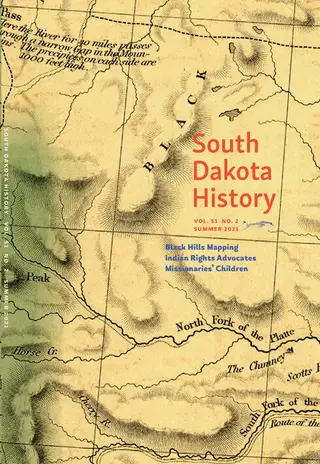
Elaine Marie Nelson’s article, “‘No where to be found’: Myth-Mapping, Empire, and Resistance in the Black Hills Country, 1800–1860,” explores the relationship between the creation of non-Native maps and how Americans understood Black Hills geography. For most 19 th century Americans, the size and location of the Black Hills was ambiguous and fluid. Based on Indigenous knowledge, Nelson argues, white soldiers, settlers and explorers formulated maps and stories to claim the Black Hills as part of a growing U.S. empire.
-
"Substitute in this army of the Lord": Missionary Parents, Their Children, and the Conflicted Nature of Missionary Work
In “‘Substitute in this army of the Lord’: Missionary Parents, Their Children, and the Conflicted Nature of Missionary Work,” Linda M. Clemmons analyzes the lives and choices of children born to missionaries in the Dakotas. Religious leaders in the mid-19 th century saw children, who had early experiences with Dakota culture and language, as particularly suited to join the profession. Their parents, however, worried that raising children on the frontier would harm their morality and piety.
-
Book Reviews
-
Charles C. Painter's "How We Punish Our Allies": Advocating for Gabriel Renville and the Sisseton and Wahpeton Dakota Scouts
“Charles C. Painter’s ‘How We Punish Our Allies’: Advocating for Gabriel Renville and the Sisseton and Wahpeton Dakota Scouts” by Valerie Sherer Mathes examines the efforts of Charles C. Painter, an agent for the Indian Rights Association, to restore financial annuities owed to the Sisseton-Wahpeton Dakota scouts and soldiers who served with the U.S. Army during and after the U.S.-Dakota War of 1862. In his pamphlet, “How We Punish Our Allies,” which is reprinted here, Painter argued for the fair treatment of the scouts for their service, a major piece of the Indian Rights movement of the late 19 th century.
-
DAKOTA IMAGES | Russell Means
Russel Means, an Oglala Lakota activist, actor, and author, was one of the dominant public faces of the American Indian Movement (AIM) in the late twentieth century. Means, born 10 November 1939 on Pine Ridge Indian Reservation, spent most of his childhood in California before returning to Pine Ridge. After joining AIM in 1968, he founded the Cleveland chapter, the organization’s first established outside Minneapolis, and then became its first national coordinator. As a central figure with AIM, he took part in numerous protests, including the boarding of the Mayflower replica in Boston in 1970 and the seizure of the Bureau of Indian Affairs building in Washington, D.C., in 1972. In South Dakota, Means joined the 1971 AIM takeover of Mount Rushmore to highlight that the United States had violated the 1868 Fort Laramie Treaty that pledged preservation of the Black Hills exclusively for the Lakota people. Most famously, Russel helped lead the occupation of Wounded Knee in 1973. Over seventy-one days, more than 200 Oglala Lakotas held the hamlet to force the U.S. government to reopen treaty negotiations. Means saw Wounded Knee as a restoration of Indians’ dignity and the beginning of a cultural renaissance. Means’s involvement with indigenous peoples’ rights extended beyond AIM protests. He filed a defamation lawsuit against the Cleveland Indians baseball team over their use of the mascot Chief Wahoo and encouraged American Indian participation in the United Nations. He also ran for the position of tribal chairman of the Oglala Lakota Nation twice, losing first to Richard Wilson in 1974 and then to Cecilia Fire Thunder in 2004. Although a prominent AIM leader, in the 1980s, he had a contentious relationship with other segments of the organization. When AIM splintered over whether to support the indigenous Miskito group or Sandinista forces in the Nicaraguan Civil War, Means resigned for the sixth and final time over the members’ lack of support for the Miskitos. Later in life, Means gained fame for his work as an artist, writer, and actor, most famously for the role Chingachgook in the 1992 film Last of the Mohicans . In 1995, he published his memoir entitled Where White Men Fear to Tread . He also released Indigenous music and paintings. Means died of esophageal cancer on 22 October 2012. His remains were cremated and his ashes were dispersed in the Black Hills. Photograph: copyright © 1993 Marvin J. Wolf, courtesy South Dakota State Historical Society.