In This Issue
-
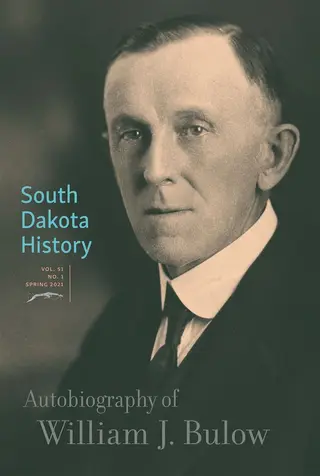
"Three Score Years and Ten": Selections from the Autobiography of William J. Bulow, Sr.
Shortly after his defeat in the 1942 South Dakota Democratic primaries, William J. Bulow sat down to write his life story. In his unpublished autobiography, Bulow reflects on major changes in the United States since his birth, his life in South Dakota, his political ideology, and his problems with President Franklin Delano Roosevelt and his policies. Having served the state of South Dakota for next fifteen years as its governor and then as one of its United States senators, Bulow reflects the major political battles of the middle twentieth century.
-
A Note from the Managing Editor
-
Book Reviews
-
DAKOTA IMAGES | Alice Lorraine Daley
In the early 1920s, Alice Lorraine Daly made political history in South Dakota. Her work with the Nonpartisan League broke barriers for women involved in state politics. Daly was born on Grey Cloud Island near Saint Paul, Minnesota, on 11 February 1883. She received both a bachelor’s and master’s degree from the University of Minnesota before taking courses at the Emerson College of Oratory Expression and Physical Culture in Boston in 1908 and 1912. After teaching in Pocatello, Idaho, she came to South Dakota in 1915 to head the Department of Public Speaking at the State Normal School in Madison. In November 1915, Daly became active in the campaign supporting the woman suffrage amendment scheduled for the 1916 ballot as president of the Lake County Universal Franchise League. Daly again led county efforts and was a finance chair for the state Universal Franchise League when a suffrage amendment passed in the 1918 election. The following year, Daly chaired the committee on women in industry for the South Dakota League of Women Voters and was reportedly the first woman to deliver a speech from the rostrum of the state senate. From 1915 to 1922, Daly was involved in the Woman’s Peace Party, formed in response to World War I, organizing the state’s first branch. In 1920, she moved to Mitchell and started working with the Nonpartisan League. That year, she represented the party as their candidate for state superintendent of public instruction. Two years later, Daly became the first woman to run for governor as the candidate for the Nonpartisan League. Her platform of state ownership of banks and elevators and higher worker wages garnered support from members of “shopcrafts unions” in Sioux Falls, creating a life-long connection with the labor movement. Despite losing the election, she garnered approximately 27 percent of the vote. After her defeat, she became active with the Farmer-Labor party throughout the 1920s. In 1932, she took over as editor of the Dakota Free Press in Aberdeen. Through the newspaper, she continued her political activism, writing in support of farmers and laborers while also condemning the practices of the Homestake Mining Company and other major businesses. Daly died on 16 October 1945 at the age of sixty-two and was buried in Aberdeen.