In This Issue
-
DAKOTA IMAGES | Alfred H. Sully
The career of United States Army officer Alfred H. Sully spanned a time of significant change as western settlement and the Civil War transformed the United States. Sully participated in numerous actions throughout the American West and South, including the pursuit of Sioux bands following the United States-Dakota War. Born in 1821 in Philadelphia, Pennsylvania, Sully was the son of painter Thomas Sully, best known for his portraits of famous figures like Queen Victoria of England and President Andrew Jackson. After graduating from the United States Military Academy at West Point in 1841, Alfred Sully served in the Second Seminole War of 1835–1842 and the war with Mexico from 1846–1848. From 1854 until 1861, he served at multiple posts in Dakota and Nebraska territories, including Fort Pierre, where he accompanied General William S. Harney in 1856. During this stint, he used his own artistic skills to record his experiences, making sketches of Fort Pierre’s dilapidated condition and paintings of local Sioux engaged in daily activities. While stationed at Fort Randall, he met and married a Yankton woman; their daughter would become the mother of anthropologist Ella Deloria and artist Mary Deloria. At the outbreak of the United States Civil War in 1861, Sully joined the First Minnesota Infantry Regiment as a colonel and fought in numerous major battles in Virginia. In early 1863, Sully, now a brigadier general, was ordered back to the northern plains to join the command of Major General John Pope in the Department of the Northwest. For the next two years, Sully led a column of approximately two thousand troops through eastern Dakota Territory as the army pursued the Sioux who had fled Minnesota in the aftermath of the United States-Dakota War of 1862. Operating out of the newly constructed Fort Sully east of present-day Pierre, Sully’s troops attacked large villages at Whitestone Hill in 1863 and Killdeer Mountain in 1864. In both instances, his men killed or captured hundreds of Dakota, Lakota, and Yankton warriors and noncombatants. Sully remained with the army in primarily administrative roles after the punitive campaigns ended in 1865, moving among posts in the South and the West. He died on 27 April 1879 at Fort Vancouver, Washington Territory, and was buried in Philadelphia.
-
From the Capitol to Main Street: The Landscape of the Woman Suffrage Movement in South Dakota
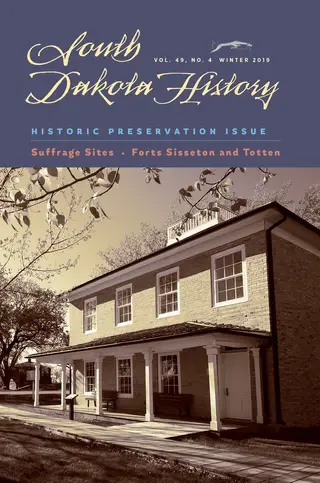
In “From the Capitol to Main Street: The Landscape of the Woman Suffrage Movement in South Dakota,” Elizabeth J. Almlie focuses on the courthouses, opera halls, churches, and other buildings that hosted speeches and debates on women’s right to vote in the late 1800s and early 1900s. By looking at the people and places important to the decades-long suffrage campaign, Almlie highlights how South Dakotans and national figures participated in this social movement. Almlie is a historic preservation specialist with the State Historic Preservation Office of the South Dakota State Historical Society.
-
IN MEMORIAM: Jeffery A. Hazard
-
Two Posts, Two Pasts: Preserving Forts Sisseton and Totten
“Two Posts, Two Pasts: Preserving Forts Sisseton and Totten” by Heather Mulliner examines the construction, use, and preservation of Forts Sisseton and Totten. Built in 1864 and 1867, respectively, these two posts initially served as bases of operations against the Dakota Sioux who fled from Minnesota in the aftermath of the United States-Dakota War of 1862. Fort Sisseton’s use as a hunting lodge and Fort Totten’s role as an Indian boarding school after their decommissioning influenced the level of preservation and the content of historical interpretation at the two forts. Mulliner works as a data and policy analyst and holds master’s degrees in American history from the University of Montana and in archival management and public history from New York University.
Read the PDF of Two Posts, Two Pasts: Preserving Forts Sisseton and Totten Free