In This Issue
-
"Down Too Deep": Father Pius Boehm, from Reluctant Missionary to Devoted Caretaker at Crow Creek, 1887-1935
“‘Down Too Deep’: Father Pius Boehm, from Reluctant Missionary to Devoted Caretaker at Crow Creek, 1887–1935” by Steven A. Stofferahn explores how Boehm’s experiences as head of the Immaculate Conception Mission School at Stephan transformed him. In his nearly five decades at Crow Creek, Boehm was forced to confront and alter his ideas about missions, American Indians, and his general worldview. Stofferahn is a professor and chair of the Department of History at Indiana State University in Terre Haute.
-
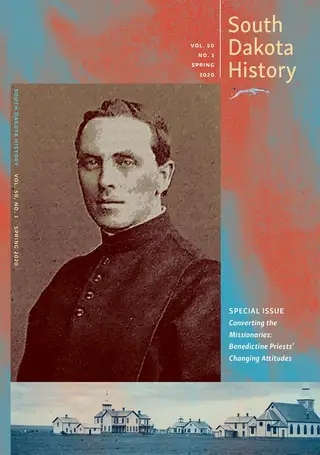
Converting the Missionaries: The Transformation of Benedictine Priests at Crow Creek
Galler’s article, “Converting the Missionaries: The Transformation of Benedictine Priests at Crow Creek,” focuses on the series of priests who served at Stephan mission in the 19th and 20th centuries. Starting with the arrival of Father Pierre Jean De Smet in the 1860s, each subsequent missionary to the Dakotas both carried Catholic and American traditions to local American Indians and adapted their own practices based on their interactions with native people and traditions. Galler is a professor and chair of the Department of History at Saint Cloud State University in Saint Cloud, Minnesota.
Read the PDF of Converting the Missionaries: The Transformation of Benedictine Priests at Crow Creek Free
-
DAKOTA IMAGES | Mary Claudia Duratschek
Sister Mary Claudia Duratschek worked to preserve the history of the Catholic Church in South Dakota, detailing its significance to the state through her research and writing. Born Antonia Duratschek on 2 March 1894 in Wacehaza, Hungary, she immigrated with her parents, Frank and Clara Filibeck Duratschek, to the United States in 1898. The family settled near Glen Ullin, North Dakota, and by the age of six, Duratschek had learned to read to assist her father, who had been blinded in an accident. With this early training, she quickly moved on to take advantage of an opportunity for a Catholic education. After graduating from the eighth grade, she entered Sacred Heart Convent in Yankton in June 1909, becoming a novitiate in the Order of Saint Benedict in August 1912. For the next two years, she taught in Aberdeen before taking her vows as Sister Mary Claudia Duratschek in 1915. After becoming a nun, Duratschek taught junior high school courses in Hoven, Dimock, and Kranzburg, South Dakota, and Richardton, North Dakota. She went on to earn a Ph.B. in history at Creighton University in Omaha, Nebraska, followed by a Ph.D. in history from the Catholic University of America in Washington, D.C., in 1943. For the next twenty-eight years, she was a member of the faculty at Mount Marty College in Yankton. She also served as the archivist for Sacred Heart Convent until 1981. While working as a professor and archivist, Duratschek authored or co-authored five books on Catholicism in the Dakotas. She wrote Beginnings of Catholicism in South Dakota in 1943 and followed her initial publication with Crusading along Sioux Trails in 1947, focusing on the missionary work of Catholics in South Dakota. In 1955, she co-wrote with Sister Jane Klimisch Travelers on the Way of Peace and in 1971 penned Under the Shadow of His Wings , both of which present the history of Sacred Heart Convent. Duratschek’s final work, titled Builders of God’s Kingdom , provided an overview of the Catholic Church in South Dakota and was published in 1985. Duratschek died three years later, on 2 April 1988, at the age of ninety-four. She was buried in the Benedictine Convent Cemetery in Yankton.
-
From Swiss Monk to Lakota Missionary: How Sitting Bull Transformed Bishop Martin Marty
In “From Swiss Monk to Lakota Missionary: How Sitting Bull Transformed Bishop Martin Marty,” Paul G. Monson examines the relationship between the Lakota leader and the bishop. Before arriving in Dakota Territory, Marty’s religious training emphasized a communal approach to missionary work. After meeting Sitting Bull in 1877 and 1879, however, Marty reformed his method and stressed individualized self-determination in regard to conversion. Monson is an assistant professor of church history at Sacred Heart Seminary and School of Theology near Milwaukee, Wis.
-
In Memoriam: Tom D. Tobin, 1945-2019