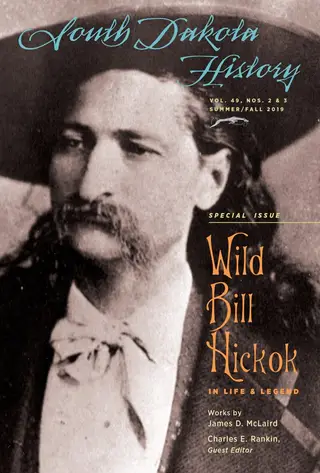
In This Issue
-
A Note from the Guest Editor
-
DAKOTA IMAGES | Harry ("Sam") Young
Harry (“Sam”) Young arrived in Dakota Territory with the rush of gold seekers to the Black Hills in the 1870s. He would later publish his memories of the time and place, where he witnessed the death of a western icon. Born in Cape Vincent, New York, in 1849, Young left home at the age of fourteen. He then drifted throughout the Great Plains, living for a time in Hays City, Kansas, where he claimed to have first met James Butler (“Wild Bill”) Hickok. He later settled near Fort Laramie and in 1875 worked as a teamster for the Newton-Jenney Expedition sent to map the Black Hills. During this trip, he met Martha (“Calamity Jane”) Canary and first saw the region he would briefly call home. In the spring of 1876, Young settled in Deadwood and found employment as a bartender at Mann and Lewis’s Saloon No. 10. While working on the afternoon of 2 August 1876, he delivered fifty dollars in checks to Hickok mere moments before Jack McCall entered and murdered Wild Bill. Three weeks later, Young again found himself in the middle of a homicide at Saloon No. 10. He and a bar patron, Samuel S. (“Laughing Sam”) Hartman, started feuding in the days after Hickok’s death, and the fight escalated. On 22 August, Hartman concocted a plan to have his friend Myer (“Bummer Dan”) Baum distract Young, so he could kill the bartender. Hartman gave Baum his own jacket and hat, and the two men entered the saloon from different directions. Young spotted Baum and, believing Hartman was coming to kill him, fired twice, killing Baum. At trial, Young pled not guilty, arguing that he had acted in self-defense, and the jury agreed. Young left Deadwood soon afterward, taking up jobs related to transportation along the West Coast. He eventually settled in Oregon, where he apparently married and had a son. He died in Portland, Oregon, in November 1925. Ten years before his death, Young published Hard Knocks: Life Story of the Vanishing West . Although some questions have emerged about its veracity, the memoir influenced many of the early histories of the American West and is one of the few written from the perspective of a working-class individual.
-
Jim McLaird: An Appreciation
Brian W. Dippie provides a tribute to McLaird, recalling his longtime friend as a thorough researcher whose passion for history led him to study the lives, myths and memories of both Hickok and Martha Canary (“Calamity Jane”). Dippie is a professor emeritus of history at the University of Victoria, British Columbia, and author of numerous articles and books on the American West.
-
Origins of a Legend: Wild Bill’s Gunfight at Rock Creek Station
In “Origins of a Legend: Wild Bill’s Gunfight at Rock Creek Station,” McLaird examines Hickok’s role in an infamous shootout along the Oregon Trail in Nebraska. He reconstructs events and compares various versions of the confrontation that led to the death of David C. McCanles and his two companions and first brought Wild Bill national recognition.
Read the PDF of Origins of a Legend: Wild Bill’s Gunfight at Rock Creek Station Free
-
The Legendary Marshal of Abilene
“The Legendary Marshal of Abilene” focuses on Hickok’s eight months as marshal of Abilene, Kansas. Hickok’s reputation as a sure-shot gunman and one of the frontier’s premier lawmen arose from this brief period. A closer examination of his time as marshal, including his personal life, challenges these perspectives and illustrates Hickok’s complex personality.
-
Wild Bill Hickok, Man and Myth
In “Wild Bill Hickok, Man and Myth,” McLaird explores the development of Hickok’s legend before and after his death in Deadwood. Hickok at various times has been remembered as a Civil War hero, gunfighter, marshal and frontiersman, and the circumstances of his murder have become a prominent part of western lore. McLaird explores the fact and fiction behind these tales to illustrate how Hickok’s contemporaries and early historians contributed to them.