In This Issue
-
Adventures on False Bottom Creek, 1940–1948: One Girl's Story
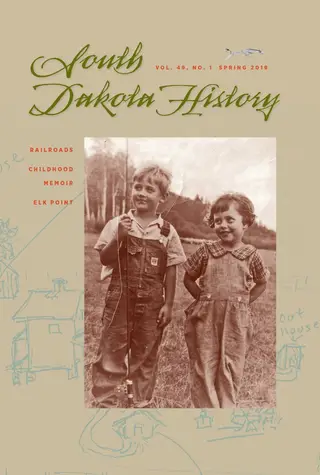
“Adventures on False Bottom Creek, 1940–1948: One Girl’s Story” follows the childhood experiences of Margaret Foglesong Ball Lloyd as her family moved from Los Angeles, California, to a farm near St. Onge, north of the Black Hills. There, Lloyd grew up among a large extended family, attended a one-room school, and felt the impacts of World War II on the home front. Lloyd earned her M.S. and Ph.D. from Washington State University and is a former professor of behavioral psychology. She now lives in Des Moines, Iowa.
Read the PDF of Adventures on False Bottom Creek, 1940–1948: One Girl's Story Free
-
DAKOTA IMAGES | William H. McMaster
William H. McMaster served the state of South Dakota in both its legislative houses, as governor, and as United States senator. He is most remembered, however, for involving the state in the gasoline business to ensure affordable fuel for South Dakotans. Born 10 May 1877 in Ticonic, Iowa, McMaster spent most of his youth around Sioux City, Iowa. In 1899, he graduated from Beloit College in Wisconsin, where he gained a reputation as a noted intercollegiate debater. McMaster moved to South Dakota in 1901, opening a bank in Gayville and becoming increasingly interested in politics. Voters first elected McMaster to the South Dakota House of Representatives in 1911. Two years later, he won election to the state senate. From there, he quickly moved up the political ladder, serving as lieutenant governor from 1917 to 1920 and as governor starting in 1921. During his two terms between 1921 and 1925, McMaster followed the line of progressive Republicans by implementing government programs to assist the public. His fight against American oil companies was his most high-profile moment as governor. In 1923, believing the price of 26.6 cents per gallon of gasoline was prohibitive for South Dakotans, McMaster ordered the State Highway Department to sell fuel to the public at sixteen cents per gallon. After meetings with the governor, the major oil companies agreed to match the price. For the next two years, however, McMaster continued his “gasoline war,” stimulating competition and driving prices down by authorizing the highway department to sell fuel when prices at privately owned stations became excessive. While the state legislature supported his policies, a United States Supreme Court decision against them ended the state’s venture in October 1925. In March 1925, McMaster had moved on to a seat in the United States Senate, where he served one term until 1931. From the Senate, he continued fighting for government support of farmers, especially after the stock market crash of 1929. After failing to secure a reelection bid in 1930, McMaster returned to banking and moved to Dixon, Illinois, where he remained until his death on 14 September 1968. He was buried in Oakwood Cemetery in Dixon.
-
HISTORICAL MUSINGS | Small Pond, Big Fish: Elk Point and William Dupont
In “Small Pond, Big Fish: Elk Point and William DuPont,” John D. Fowler reflects on the connection between the famed DuPont family and the town of Elk Point, where William DuPont moved in 1891 to take advantage of South Dakota’s lenient divorce laws. Although DuPont lived in Elk Point for only a short time, he and his second wife impacted the community in ways that continued for decades. Today, the high-school football stadium occupies the site of his former home. Fowler received his law degree from the University of Virginia, worked for multiple law firms in New York, and currently serves on the board of trustees of the South Dakota State Historical Society.
Read the PDF of HISTORICAL MUSINGS | Small Pond, Big Fish: Elk Point and William Dupont Free
-
IN MEMORIAM: Herbert T. Hoover
-
Working on the Railroad: A History of the South Dakota Core Rail System
Steven J. Bucklin focuses on Gov. William J. Janklow’s decision to have the state purchase rail lines in “Working on the Railroad: A History of the South Dakota Core Rail System.” By 1979, many of the railroad companies in South Dakota had gone bankrupt, leaving farmers unable to transport crops efficiently. Janklow supported the state’s purchasing and running of several rail lines, which restored or maintained service on vital routes. Bucklin teaches at the University of South Dakota and is the author of several books and articles on South Dakota and diplomatic history.
Read the PDF of Working on the Railroad: A History of the South Dakota Core Rail System Free