June 20, 2023, The Universities at Shady Grove
Community Navigation Summit
Nine sessions for the county's nonprofit and government partners, each with its slides.

FY27 Fall Grant Cycle: Thursday, October 1 at 8 AM to Thursday, October 15 at 5 PM ET.
The FY27 grant year
All organizations interested in receiving grant funds from HIF must attend our annual training.
Attendance at one of these trainings is required for application eligibility. All trainings will take place on Zoom. The September 18th training was recorded and viewing this recording will count towards 'attendance.'
Read or search it
Choose a time to play the recording from that point.
Play from 0:00 Awesome. Thank you guys for joining today. Jen and I appreciate your time. I'll allow Jen if you want to introduce yourself to any some new partners who might not know you yet. Sure. So I'm Jen Pope. I'm the Executive Director of HIF and I've been with the organization now since mid-May. I'm hoping to get to know lots of you, whether you're an existing grantee, potential new grantee, or just a key stakeholder in the community.
Play from 0:29 So feel free to reach out if we haven't connected yet. I'd really enjoy meeting you all. Thanks. And I'm Jessica Fuchs. I'm the Director of Grants and Communications at HIF. I have been with the foundation since 2019.
Play from 0:41 So I know a lot of familiar faces here, familiar names in the chat. So I hope you guys jumping on and joining us today. It's exciting that we're launching into the Fall FY27 cycle. We're going to share a lot of really good information today. Some of you guys who are new to HIF will get a sense of our vision, our mission, and our strategic priorities.
Play from 1:03 Those who are familiar with us will get all the specifics on the outcomes and some indicators, some changes that we have made to the application, and the next steps and timeline for the grant. So I always like to start off. I'm going to level set. So everybody's on the same page. Our vision is a community where residents in Montgomery County, Maryland, that is very specifically, only fund and provide funding in the county to those who to create access to high quality, comprehensive health and wellness services delivered in a culturally responsive and equitable manner.
Play from 1:38 And our focus, you can see, and our focus, and our mission is to serve those who are underinsured, uninsured, and low income in the county. That's our goal. So I pause here to recognize that some organizations may serve in the entire, you know, D.C. metro region. You may be based in Arlington, and that's fine.
Play from 1:58 However, if you're applying to HIF, your work and your application need to very specifically describe your work in the county and how you will be serving the residents in the county. The metrics and indicators need to be county specific. So I pause, and I stress that here so that everybody's on the same page as we jump into the conversation. So strategic priorities. These are the same as they had been in FY26.
Play from 2:25 What will be different in the application this year is that when you go through, you will be able, we're going to ask you to choose which one of these priority areas you think your project will address specifically. The second priority area is funding those initiatives that show promise to succeed in addressing the health disparities. And the third priority area is around collective discussions and coalition building. If your organization gets into the application and you are thinking of applying for the third strategic priority area, then you need to have a conversation with Jen and I.
Play from 3:01 That's going to be really important because that third priority area is not about just hosting a conference or hosting an event. That is, again, think of like you're addressing a systemic issue in the community, not just events or conferences. So, again, if you're thinking about applying for that area, reach out to us and let's have a conversation in advance. These are the FY27 focus areas, primary care services, maternal health care, dental care, mental and behavioral health care. And this is a new one we added this year.
Play from 3:32 Chronic disease management with focus on diabetes and hypertension. Some of you, I'm not sure, I'm kind of looking at the call. You'll notice that vision care was on our FY26 focus areas. We will still support vision care, but we're kind of putting that under the umbrella of primary care services. Some of you may be thinking about a project around this and you may think, I don't see that in the focus area.
Play from 3:59 When you think of the focus areas and you think of your project, think of what the overall goal is for your project. Is the goal advancing maternal health care, mental health care? What is the goal of the program? So a great example here is food is medicine. If you are a food is medicine program, you are really probably trying to address A1C and blood pressure.
Play from 4:24 So your food is medicine program is going to fall under the chronic disease management focus area. Okay. So we can, if you guys have some questions towards the end on this, let us know if you, there will be time at the end here to address some Q&A. But if you have some project specific questions, please just, you can email me. I'll make sure I put that in the chat and we welcome conversations.
Play from 4:47 A reminder that if you have not had funding or partnered with HIF in the last three years or ever, it is a requirement that you connect either virtually or in person with Jen or myself before applying. So Jen, is there anything that you wanted to call out here? No, I think you said it well in terms of connect with us. If you have questions and we'll get into how we have our health goal goals and output expectations in a few minutes. Thank you.
Play from 5:21 This is just, just kind of breaks out what we mean by focus areas and the goals. I won't belabor this again. We're going to, this is session is being recorded. It will be on our website. So these slides will be available as a part of that presentation.
Play from 5:38 All right. So what we're diving into a little bit today, we're going to be talking about, we have our fall and our spring grant cycle. FY26 was the first time that we had split our big public grant cycle into a fall, into a spring. We did that as a way to be more responsive to our community. Our grant cycle previous had been a little bit longer.
Play from 5:59 This allowed us to adapt a little bit more to the changing needs in the community. So the fall grant cycle will open October 1st and it will close October 15th. We will review as staff and board through November with awards being processed in December. The spring grant cycle dates are not set yet, but thinking probably an open time around March, early April. The difference that we are doing this year is, well, you know what, I'll jump into that a little bit later, but there's some different eligibility criteria that we've changed from FY26.
Play from 6:33 But again, the cycle for the fall opens October 1st at 8 a.m., closes the 15th at 5 p.m. The application is available on our website right now. The portal will not open until October 1st. So if you go to jump onto the portal and you go to click apply, nothing's going to show up. So again, the application is available in Word for you and your team to access and look at, start gathering information and resources that you might need, responding to questions.
Play from 7:01 And then on October 1st, when our portal opens, then you'll be able to transfer all that information and upload the documents. And just, if I could just add that you can set up your account within the portal before then, correct? And then. Yes, please. So all of our information is done in our software called Foundant.
Play from 7:24 So if you are not in there yet, or if you're wondering if your organization has an account, send me an email. Ask me. Because the accounts will, they'll create duplicative accounts. It won't always recognize that, oh, an account with this name and tax ID has already been formed. So now there might be like three Mobile Meds in our system.
Play from 7:47 And never the two shall meet. So when Karen goes in to look up grant history, she's going to say, Jess, I don't see anything. Because it's going to fall under the other accounts. So if you might be new to your organization or you're not sure, send me an email. It's super easy for me to go in and see, oh, yeah, you already have an account, but it's listed under this name instead.
Play from 8:06 Should I update that? Should I add an account or a profile for you? And then I will add, I do love our system, Foundant. But again, in the same way that you got to make sure the organizations are on the same page, you also have to make sure that the application follows the person and not the organization. So Karen, sorry, I see your face.
Play from 8:27 So you're like my go-to example here. If Jane Doe had been the grants writer before and now Karen is the new grants writer and she goes to look up the organization and it's in there, great. She's not going to see any of the grant history that's under Jane because it was assigned to Jane. The system, the applications follow the person, not necessarily the organization. On our end, we can see them all in one place, but on your end, they follow the person and not the organization.
Play from 8:59 It's very easy to change. If you are the new grant writer for your organization, I can very easily on my end go and make those updates and change and connect to the main contact person should be on the application. I can reassign who, you know, reports go to. All of that is very easy. So just make sure that either, you know, you got to check the account or if you are the new contact at your organization for your account, let me know and I can get you set up with a profile.
Play from 9:28 No problem. If you have questions, please just go ahead and put it in the chat. That'll be the easiest way to keep it all organized and keep me on track because I'll lose focus and I don't want to do that. All right. So I'm, this is a lot of text, but it is just really important that we point out some of these really big funding guidelines.
Play from 9:49 Again, we focus exclusively on Montgomery County. There are spots here, you know, we cannot, you know, cover bricks and mortar or capital expenses. So if, you know, if you're new to HIF, please make sure that you are on the same page with the funding guidelines. I'll put the link to where these are on our website so that we're all on the same page. We will jump in a little bit in the next couple of slides where we talk about partnerships and MOU partnerships with regard to HIF allocated dollars and specific project.
Play from 10:26 Any partner that you are connecting with regard to an MOU, they also need to meet these funding guidelines. So they also need to be a 501c3 and their work with you needs to be specifically in Montgomery County for this project, those kinds of things. So just be aware of any of those partnerships that you're making, but we'll dive a little bit more thoroughly into the MOUs. All right. So here we're, it's a nice pretty chart that we'll talk about some of the changes and scenarios with regard to changing from FY26 to FY27.
Play from 11:04 So if you received funding from HIF in the spring of FY26, you are not eligible to apply in the fall. You will be eligible again in the next 12 months. So again, if you have received FY26 spring grant cycle funding from HIF, you are not eligible again until the spring cycle. Now, if you are applying for the FY27 fall cycle and you are not awarded funding, you will be eligible this year to apply again in the spring FY27 cycle. But that was different from last year so that we're making those revisions.
Play from 11:42 So what that means is, is that if you apply in the fall, you are not awarded. You can apply in the spring, but it has to be for different metrics or a different project. Again, we can cross that bridge when we come to it, we welcome conversations so that we're all on the same page, but those are some different scenarios. You see on the last row there where it talks about partnerships and a lead. So an organization can only apply for one project in the cycle, and you can only be awarded once in a 12-month period.
Play from 12:13 However, if you are going to partner with another project, you can be a partner on another grant, but you can only, your organization can only be the lead on one project in one grant cycle. All right. So again, these slides will be available on our website. If you had, I guess one of the other categories would be if you received funding last fall in the FY26 cycle, you are eligible to apply for the FY27 fall. Because again, you can only be awarded once in a 12-month period.
Play from 12:49 So Jen, do you want to elaborate? No, I think that that's clear. Thank you. Perfect. Yes.
Play from 12:55 Sorry. I just want to make sure there's a lot of different scenarios, but I think this chart lays it out really nicely. All right, Jen, you want to dive in? Sure. So when you're looking at the application, what's really important to us is to understand what are your objectives of your project.
Play from 13:11 We recognize it can be part of a bigger program, but we'd like you to really identify those objectives that directly connect to the overall goal of the program. And so in the application, we clearly outline by focus areas our broad goals. And so as you're thinking about that and thinking, let's say you're applying maternal health, looking at the goal, what are the objectives that are going to help make progress towards those overall goals? And it's really, I think, important that you have health-related outcomes that are measurable and smart and that they, as part of that smart objective, that they're time-backed and they're reasonable within the amount of funding that you're actually requesting.
Play from 13:56 And we haven't put in indicators because we want you to tell us what are the best indicators for you that help you in terms of your program and how you might adapt and measure programs yourself, because we recognize that there may be different indicators depending on how you're implementing your program and how you're delivering. And as part of that, we are asking, it's just a clicked box, but if your project is primarily being delivered by direct service delivery, or if you're doing something based in the community overall, this really is just for us as we start to understand the different segments and implementation programs that we have as partners.
Play from 14:37 If you're doing both, I would ask that you just pick the one that is the majority of that. It doesn't bear anything on your application. It's really just for us. And so as part of this from FY26 application, if you had applied then or if you are a current grantee, you'll notice that we added a little bit more information in terms of what our goals are, as we see for the focus areas. We drew a lot from the community health improvement plan that was just launched, and broadly speaking, since we want to respond to the community's needs and be helpful to that.
Play from 15:13 I just mentioned just the designation between direct service delivery and community-based programming. And then what we really want to hear from you is, you know, after our funding is only one year long, yes, there are times people reapply and get additional funding for the following years, but we really want to hear from you, what is that impact that you'll continue to have, even if HIF money is no longer being provided? And what are you learning? Because I think for us at the foundation, not only is it important to address the health needs of the Montgomery County residents, it's also important for us to learn from what all of you are doing, how we might share that, what systems you're trying to improve or strengthen, or what barriers you're trying to tackle, because we also view it as an important role for us to share with the broader community as well.
Play from 16:05 So you'll see some questions related to that. And if you have any questions related to that, please do reach out to Jess and I and we can help. All right. So as promised, we were, I wanted to dive in a little bit about partnerships and collaboration. So one of the things we have evolved over the last two years is how we're asking people to share a little bit more intentionally about the partnerships and collaboration on a grant.
Play from 16:34 So any grant is going to ask, any application, any project, we want to know who are you working with in the community? How are you receiving referrals? How are you sharing referrals out? How are you operating this work with other community partners? So any application is going to ask that.
Play from 16:51 But we also recognize that sometimes some of the projects that you might want to operate, you might want to bring in another partner. So if there is an opportunity in your grant, so again, I'm going to use a very generic example. If you're a primary care clinic and you want to apply to HIF under the focus area for primary care services and you're going to track, you know, intakes and just general preventative care. But you also really recognize that vision care is a problem in your community and there's not a lot of access to it.
Play from 17:18 But that's not a service that you provide. So what you might want to do is partner with one of the nonprofit organizations that provide vision services and put them in your budget and in your project, in your outcomes and your indicators, and that you might have HIF dollars allocated towards their work on this project. If that is the case, we are asking that you include an MOU with your application between your organization and their organization and to tell a little bit more deeply about how this work will be connected, how you'll be working together, so that when we see the budget and we see the line item with HIF dollars being allocated to this partner for this work, it needs to be very clearly stated through the MOU, but also in the project description and the objectives.
Play from 18:08 So again, this is a new part for us. Again, if you're just sharing who you're making referrals to or how you're connecting in the community, that is not an MOU relationship. It's going to be when HIF dollars are being shared in your budget to that nonprofit. And that nonprofit still needs to meet foundation eligibility criteria, right? So that's a key part.
Play from 18:30 Now, if you are that MOU partner on the bigger grant, you are then still eligible to apply for a grant as a lead organization, right? You just cannot be the lead on more than one application, okay? So, and then we already talked about if you're applying under the third strategic priority area around coalition building, contact us first. That's more of a conversation-related strategic priority. I have also been putting some links in the chat while Jen was chatting.
Play from 19:07 So there's some links that take you back to our website where you will find the link for the grant portal. If you don't have access to it, where you will find the application in Word to be able to download. It talks a little bit more about, you know, who we funded in the past. So there's some, a lot of information will always be available on our website. So those are in the chat as well.
Play from 19:25 So please access that. Before we dive into the budget, I want to talk a little bit about fall versus spring applications. So again, the fall will be awarded in December. The spring applications will be awarded towards the end of May, early June, before the end of the next fiscal year. So when you're thinking about applying to HIF for either the fall or the spring, think about the timeline of your project.
Play from 19:54 If you're applying and getting awarded in December, but the project you're thinking of applying for doesn't really launch until May, then maybe that is a better spring application as opposed to a fall application. So be thinking about when the project might be getting started and launching. Now, if it's a program you're already doing and you're doing it all the time, that's not really a consideration. But it's just something to be thinking about as to which cycle would fit best with the timing of the project you're applying for.
Play from 20:28 And just to add, it's not that we have a pot of funds in the fall. If it gets used up by all grantees, there's nothing left in the spring. We have two separate allocations. So don't feel the pressure that you need to apply the fall, even if really you're going to start implementation, as Jess mentioned, in the summer months. It's better to think about what corresponds best.
Play from 20:51 And so you're not in any advantage or disadvantage in terms of applying when it comes to the funding available. No, that's great. Thank you for that clarification. So in every application, there are several links that you'll be able to find this. This is our required budget template.
Play from 21:06 It will be available to you in Excel. We only need to see where you want to spend HIF's dollars. Now, in the narrative application, we are going to ask about other funding partners. We're going to ask you about, you know, is other funding required to be able to run this program and to tell us a little bit more about that. But as far as this budget template goes, you just need to show us your funding request for HIF and how you would use HIF dollars.
Play from 21:38 And you can see the line items. You can see the line item for funding to the nonprofit partner for the MOU. HIF does fund salaries, but it will say those salaries need to be connected to the project or the program. And your application needs to very clearly connect the two. So we need to see when you if you put a salary in, we need to be able to read that in the application to see how that that position connects to the work that you are doing.
Play from 22:08 You'll see that we've added columns. If you're familiar with our work, we've added a six month spending column and the last six months of the grant. We do that because we recognize sometimes it takes some building. Depending on what your project, there might be a buildup to the project. And maybe the second half of the 12 months is where a lot of the activity is happening.
Play from 22:29 Maybe you're going to, you know, you're coordinating various groups or activities or your your place based clinics are going to happen in the second half of the year because that just makes sense for the population work that you're doing. So that's that putting this and separating that budget helps us better understand when we're reading the mid year and year end reports. So, again, if we go to look at the mid year reports and we see that you really have you haven't really spent down any of the budget, but then we look at the report and we say, oh, well, that's because they anticipate a majority of their spending to happen in the second half of the grant.
Play from 23:10 All is going as planned. Great. So, again, it's just an estimate and it just helps to better tell the story of your work for us as the staff who are reading it and then also our trustees who are part of this process. All of this, I will add, is why it's really a great opportunity that you should take advantage of is that Jen and I welcome conversations with each of you who are thinking of applying. We set up a 30 minute Zoom or a Teams chat where you can ask questions to us or you can talk a little bit about the project you're thinking.
Play from 23:44 And it gives us a fuller picture because the application has character limits, you know, and you can't tell everything, but it helps to give us a better picture. So, when I do an application, I love to read the budget first and then I go into the narrative part because I think it just tells a really good story of the work you're doing and how it's all connected. The last column is for cost basis. Again, it helps give us a fuller picture of the work you're doing. A really generic example I give is that if you're focusing on hypertension and you want to provide at-home blood pressure monitors, but you have a line item for $10,000, I don't know how much at-home blood pressure monitors costs.
Play from 24:29 So, it's really helpful that if you say, you know, $10,000 will give us 50 monitors versus $10,000 gives you five monitors. Again, it helps us to understand your work, the cost of the work you're doing, and the impact it will have. So, those are what those columns are for. And then on the far right side, you ignore those six-month actuals and 12-month actuals. That is if you are awarded funding.
Play from 24:56 This gets uploaded into the grant agreement, and then when you report it six months, the budget actuals, and you report it 12 months, the budget actuals, it's all in one place. So, you see the approved budget on the left, and then we match it with the actuals on the right. So, as far as the application is concerned, everything to the right of that pink-purple line is for reporting purposes. Jess, I was just going to add, too, when we asked for the estimated cost between the first six months and the latter six months, if you end up, if you put it in the last six months, and you actually end up spending in month five, that is totally fine.
Play from 25:35 And also, it's not that you're stuck to that six-month budget. We look at the overall 12-month budget, and we recognize things happen, so it may be adjusted. So, it's really just to give us a good sense of when you expect costs to hit. And that also helps, like, at the midterm, if we know, okay, they're not planning that until month seven, so we won't be asking you, why is it a slow burn rate if everything else is the same? Yeah, and I'm sure this is a burning question on everybody's mind.
Play from 26:03 There is no maximum request amount. I just ask that you guys please recognize, you know, we are a foundation that funds only in Montgomery County. You know, in years past, we had put a $50,000 cap on it, but there is, we're not limiting you guys. We ask that you please share, you know, in the budget and in the narrative, it all has to tell the story, and it all has to align with, you know, with our eligibility and our criteria and our strategic priorities. One thing I just wanted to add to you is that we do recognize that this year there's quite the changes to Medicaid and that there could be an increase.
Play from 26:47 I think the county expects around 4,000 estimate after the October 1st adjustment that hits asylees and others. And then the January 1st, in terms of work requirements, the county, if you attended our symposium or the DHHS's symposium that we helped sponsor, they estimated around 40,000 might have eligibility changes. And so we're conscious of that, and I think if you, you guys probably all see this on the ground and as you're working through it. So that's why, you know, the more you connected to what the needs are, that will help and do your budget accordingly.
Play from 27:25 So just some housekeeping last final items. Attending one of these trainings is a requirement, so I appreciate you guys coming. If you've got any team members who might want to see this recording, again, we'll have it up on our website in the links. It'll be on the grantmaking priorities part of our website. Again, all the metrics should focus on health improvement measures.
Play from 27:49 No matter which one of the focus areas you're in, we've got to be able to see that. Again, the application is available on our website in Word, but the portal does not open until October 1st. Go in once you get into the portal. Do you have an organization? Do you have an account?
Play from 28:05 What do you need in advance? We've got plenty of time to go through that. We can help you streamline that process. Do not hesitate. You can see my email here.
Play from 28:15 This is what we are here for. If you've already had conversations with your organization, and now you've sat through this training and you have some more questions, send me an email. If you haven't set up a time to talk with us yet, send me an email. Like, this is what we're here for. This is, I think, the benefit of an organization, foundation like ours, funding in the county.
Play from 28:34 We get to have these conversations. We welcome them. We learn a lot, and I think it's just beneficial to everybody in the process. And just to add, sorry, to that, too, is, you know, we have a range of partners that we fund, grant partners that we fund, from those that are more nascent and just starting to the ones that have been well-established and large-scale programs. I think, as you're thinking about your program and your budget, take that into consideration.
Play from 29:00 If you're a first-time grantee and you're newer, I think asking for a huge sum that you haven't demonstrated use before, you need to take into consideration and so forth. And I just want to clarify that. But we love seeing all sorts of different programs and sizes of organizations. Yes, thank you. I alluded to some of the decision process timing here, but you can see in the chart how this all will run.
Play from 29:25 Again, the application will close at 5 o'clock in the afternoon. On the 15th, we immediately start reviewing the applications. Our board members are a part of the process. We will meet in early December. The board will approve.
Play from 29:39 Everybody, every applicant, if you apply, whether you're awarded or not, everybody will hear back from us. We never leave any organization wondering if they were awarded or not. So by mid-December, you guys will know where you stand. If you're not awarded, we welcome opportunities for technical assistance afterwards if you have questions about why you were not awarded or what we can do. And again, if you're not awarded in the fall, you are welcome to apply again in the spring for different metrics or a project.
Play from 30:10 So I think that is, it's a timeline that worked really well last year, and I'm looking forward to doing it again. The performance, it will be from the time of the grant agreement, which will be around like mid-December. So it's a 12-month grant. So December 2026 to December 2027. And then we would do the year-end report is 30 days after the year ends.
Play from 30:36 So that would be due in January of 2028. So that's a great question. And I think that it also goes to, you know, Jen's conversation around the outcomes is that, you know, what do you think are reasonable metrics that you can achieve and attain in a 12-month period for the work you are doing? That's what we always try to guide our partners to when they say, you know, well, you know, what makes sense? Well, you have to tell us, what do you think you would look back 12 months after the implementation started and say, yes, that's how we knew this program, our project was successful.
Play from 31:11 And hopefully there are already indicators that you're using and collecting. We don't want anything just to be created just for us. Really, this is for the purpose is for you in terms of how you might adapt your programming and recognizing that the project that you might be requesting is part of a larger program. And so you probably have indicators for that, that relate to that. Yeah, that's a great point.
Play from 31:36 All right. I'm going to stop sharing my screen. Does anybody have any questions about this? Easy. If you do have project-specific, organization-specific questions, just send us an email and we're happy to find a time to meet with you guys.
Play from 31:58 This is what we're, this is our work now for the next three weeks until the application opens. There's plenty of time to have these conversations. I do actually have a question, if that's right. Yes, please. So I did see that one of the things you don't fund is if there's a government grant dollar replacement.
Play from 32:21 But I was wondering if they have cut budgets and have removed some of our funding, would that be appropriate for this? I think that would, I think that would be appropriate. We try to, we try to say like we wouldn't fund where the government should be funding in ways like that. But I think understanding the circumstances over the last two years, certainly, I mean, it's not to say that there are, that we don't fund where public dollars don't also fund. I mean, certainly we have programs that are also getting federal dollars, state dollars, and county dollars.
Play from 32:55 So we're not saying that we don't fund organizations who get support in that way as well. So, but if you have a question, just send us an email and we can talk about the project that you're thinking about. But just because you have public dollars does not preclude you from eligibility from HIF. Definitely not. And I think, and I think we recognize there's going to be a drop in that, or that funding is changing given the Medicaid changes.
Play from 33:19 So certainly we, we expect to see applications that might be trying to address the needs of Montgomery County residents that now no longer have access to some of those programs or insurance. So, Kate, you asked a question about literacy based health education. Again, I, I would say if they are health metric outcomes, then that's going to be, that's going to be kind of the foundation of how we view any of the applications that come to us. Yeah, I think with that, it's always connecting it back. What is the health outcome that you're trying to, to do?
Play from 33:57 If it's just to pass out pamphlets and that stops there, then that's not really getting to showcasing how we, how you're measuring or looking at that health outcome change over, and granted, it will take a period of time. So I think certainly that being a component as part of it, and then just thinking about what are those other wraparound activities that help move the needle in terms of awareness and then action. Thank you. Good question. Thank you.
Play from 34:26 Well, thank you guys for joining us today. We appreciate the opportunity to share our work and the application opening, and we're really excited about what's happening and all the great work, and I appreciate you guys taking the time and joining us today. Yeah, thank you guys, and do reach out. We'd rather you ask the question than wait. So, please, we're accessible.
Play from 34:49 Thanks, guys. Have a great day. Thank you. Thank you. Cheers.
Missed a session
If you have missed a training or have not attended a training but are thinking of applying for an upcoming grant cycle, reach out to Communication@hifmc.org. As you plan for a conversation with HIF, consider these important talking points.
Earlier trainings
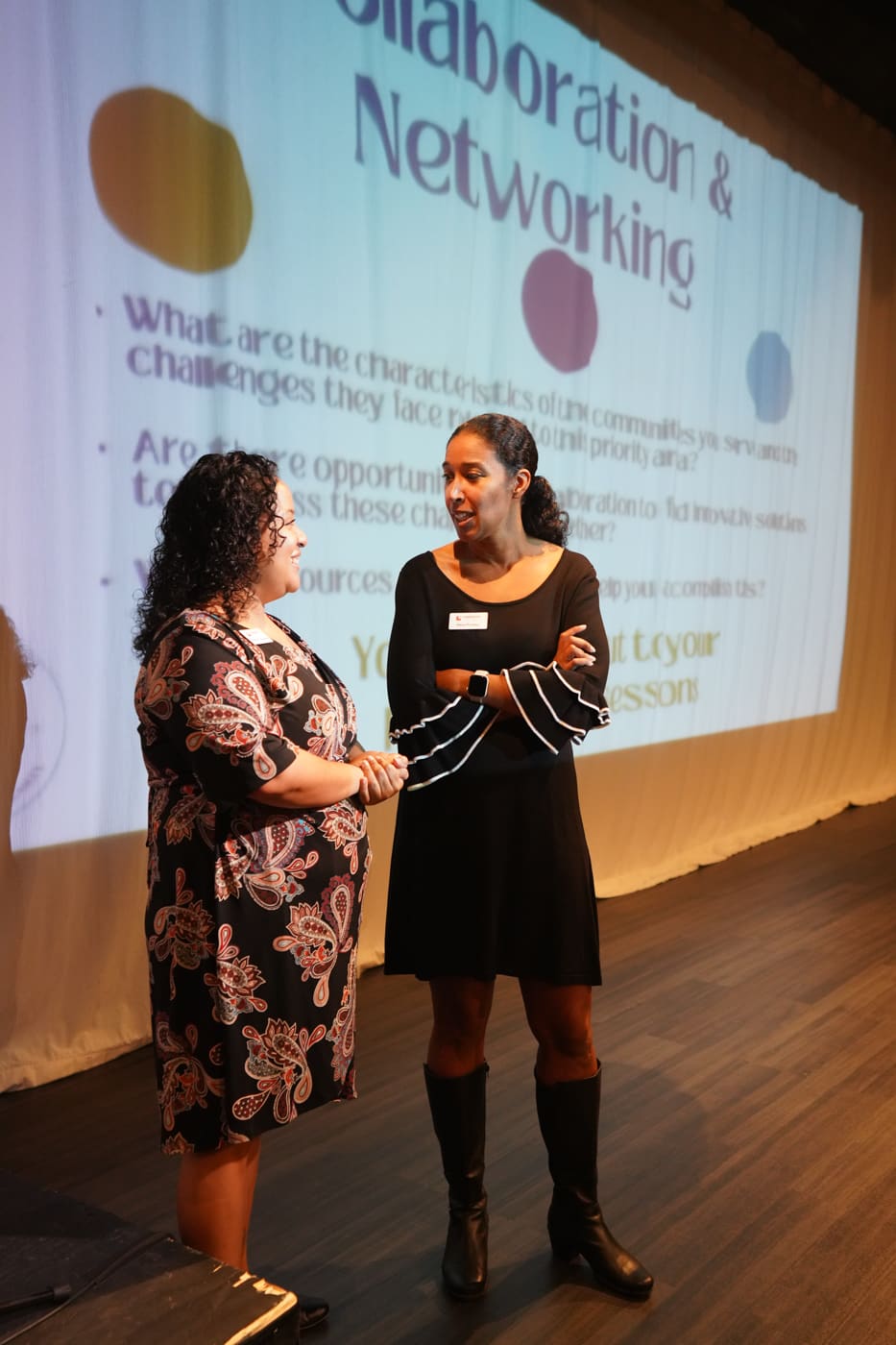
June 20, 2023, The Universities at Shady Grove
Nine sessions for the county's nonprofit and government partners, each with its slides.
October 2023
The slides from the Foundation's annual grantee trainings.
June 14, 2022
On June 14 and June 16, Healthcare Initiative Foundation partnered with Nonprofit Montgomery and the Montgomery County Food Council to host a two-part virtual workshop series on building nonprofit capacity. The workshop included presentations by Maryland Nonprofits, Montgomery County Volunteer Center, the Food Council's Food Security Community, and the Institute for Public Health Innovation.
October 4, 2021
A sincere thank you to the community and grant partners who attended and offered candid feedback. Thank you to MCAEL, Crittenton Services, CaringMatters, and Manna Food Center for taking time to help HIF facilitate the breakout sessions during the forum!