
Planning Agenda item 6B
Sign Ordinance Amendment
Planning Commission, Thursday, April 16, 2026
Download these 34 pages, 3.3 MB Whole packet, 132 pages, 116.6 MB
Page 80
This page is a scanned image with no text layer. The PDF of these pages has it at full resolution.
Page 81
This page is a scanned image with no text layer. The PDF of these pages has it at full resolution.
Page 82
This page is a scanned image with no text layer. The PDF of these pages has it at full resolution.
Page 83
Text of page 83
CITY OF SAUGATUCK ALLEGAN COUNTY, MICHIGAN ZONING ORDINANCE AMENDMENT ORDINANCE NO._____ At a meeting of the City Council of the City of Saugatuck, Allegan County, Michigan, held at the City of Saugatuck Hall on ___________________, 2025 at _____ p.m., City Council Member ______________________moved to adopt the following ordinance, which motion was seconded by City Council Member _______________________________. An ordinance to amend the City of Saugatuck’s Zoning Ordinance to update signage regulations to regulate signs in a content-neutral manner, and to promote the public health, safety, and welfare of the residents and visitors of the City of Saugatuck. CITY OF SAUGATUCK, ALLEGAN COUNTY, ORDAINS: SECTION 1. AMENDMENT TO ZONING ORDINANCE, SECTION 154.140: The City of Saugatuck Zoning Ordinance, Section 154.140 is amended to revise the regulations and definitions applicable to signage within the City. Section 154.140 shall now read as follows: (A) Purpose. The purpose of this Section is to regulate signs within the City of Saugatuck (the “City”) in a content-neutral manner to protect the health, safety and general welfare, to protect property values, and to protect the character of the various neighborhoods in the City. This Section intends to make the City attractive to residents, visitors, commercial, and professional businesses while maintaining a sustainable economy through an appropriate signage program. The elements of this program will: (1) Recognize that the proliferation of signs is unduly distracting to motorists and nonmotorized travelers, reduces the effectiveness of signs directing and warning the public, causes confusion, reduces desired uniform traffic flow, and creates potential for accidents. (2) Prevent signs that are potentially dangerous to the public due to structural deficiencies or disrepair. (3) Enable the public to locate goods, services, and facilities without excessive difficulty and confusion by restricting the placement of signs. (4) Prevent placement of signs which will conceal or obscure signs of adjacent uses. (5) Preserve and improve the aesthetics and character of the City by encouraging signs of consistent size which are compatible with and complementary to related buildings and uses, and harmonious with their surroundings.
Page 84
Text of page 84
(6) Provide regulations that focus on the time, place, manner, and physical characteristics of signs, but not the content of signs in accordance with the First Amendment of the United States Constitution. (B) Definitions. For the purpose of this subchapter, the following definitions shall apply unless the context clearly indicates or requires a different meaning.
ABANDONED SIGN. A sign that has been determined to be “abandoned” for a period of thirty (30) days or longer as determined by the Zoning Administrator. The following conditions may be considered by the Zoning Administrator to determine whether a sign has been abandoned: (1) Whether the sign displays advertising for a product or service which is no longer available. (2) Whether the sign displays advertising for a business which is no longer licensed. (3) Whether the sign is in disrepair as determined by the Zoning Administrator, including but not limited to, signs that are missing portions of the display, have chipped or dilapidated paint or other components, or have structural components that have fallen into disrepair. (4) Whether the sign advertises a business that is no longer doing business on the parcel where the sign is located, if the business was originally located on that parcel. (5) Whether the purpose of the sign has lapsed. (6) Whether the sign has historical significance for the City as determined by the Zoning Administrator. (7) Whether there are plans to repair the sign, including adding a new display or transitioning to a different display, or to repair any structural damage or disrepair. BANNER. A temporary flexible sign directly mounted to a building, or a support on a building, or between two poles made of natural or synthetic material, not including flags as defined in this section.
BILLBOARD. Any free-standing permanent sign on a parcel of land which does not include another principal structure. DARK-SKY FRIENDLY. Lighting designed to minimize light pollution by directing light downward. Dark sky compliant fixtures are fully shielded, energy-efficient, and use appropriate colors (such as warm colors designed to minimize short-wavelength light) to reduce glare and skyglow. FEATHER FLAG SIGN, WINDFEATHER SIGN. A flexible sign made of natural or synthetic material typically fastened on one long side to a flexible or non-flexible pole mounted on the ground, intended to move with the wind, not including flags as defined in this section.
Page 85
Text of page 85
FLAG. A piece of fabric that is hung from a pole, a bracket, or attached to the side of a building. FLAGPOLE, PERMANENT. A freestanding pole permanently mounted with a foundation on the ground and used for the sole purpose of displaying a flag or flags. FLAGPOLE, TEMPORARY. A temporary pole that can be mounted on a structure or building, or affixed or driven into the ground, for the sole purpose of displaying a flag. ILLUMINATED SIGN. Any sign that is illuminated by any light source other than non-reflected natural daylight. (1) EXTERNALLY ILLUMINATED SIGN. A sign that is illuminated by an external source, which reflects light off the surface of a sign face. (2) INTERNALLY ILLUMINATED SIGN. A sign with internal electronic circuitry emitting light through the sign face. (3) NEON SIGNS. A sign illuminated by luminous gas-discharge tubes containing rarefied neon or other gases (such as helium, argon, krypton, xenon, or mercury vapor) that produce a visible ambient light when connected to an electric current, or by similar electronic technologies, such as light-emitting diodes (LEDs), designed to create a static ambient light display. MURAL. A permanent noncommercial work of art applied to or made integral with a wall or structure. A mural shall not include any signs with words, letters, characters, or numbers intended to identify a business.permanent noncommercial work of art applied to or made integral with a wall surface. A “mural” shall not include a painted wall sign with words, letters, characters, or numbers intended to identify a business NON-RESIDENTIAL PROPERTY. Any use of property or a portion of a property that is not a “residential property,” as defined herein. The common areas of a multi-family dwelling unit (such as an apartment complex) or a housing development with multiple dwelling units shall be considered non-residential for purposes of allowable signage. In the case of a mixed use property, the non-residential portions shall be entitled to the allowable signage for non-residential properties, whereas any residential dwelling units within the mixed use property shall each be categorized as residential property for purposes of this Section. OFF PREMISES SIGN. A sign that advertises or is meant to draw attention to an entity, business, person, activity, good, product, event, or service offered or existing elsewhere than upon the same lot where the sign is displayed. ON PREMISES SIGN. A sign that advertises the sale or lease of the property on which the sign is located or is meant to draw attention to an entity, business, person, activity, good, product, event, or service offered or existing upon the same lot where the sign is displayed. ON SITE SERVICE. Work or services that are performed on a particular property that are not typically offered on the particular property and are for the benefit of the particular property as opposed to the general public, including but not limited to, construction, landscaping, painting, pest control, interior improvements, moving services, and similar services. PENNANT. Any lightweight plastic, fabric, or other material, suspended from a rope, wire, or string, usually in series, designed to move in the wind.
Page 86
Text of page 86
PERMANENT SIGN. Any sign constructed of durable materials, secured on a structure or property, and intended to exist for the duration of time that the use or occupant is located on the premises. PORTABLE SIGNS. Except for signage falling under another definition herein, any sign designed to be moved easily and not permanently or temporarily attached to the ground or other structure, including but not limited to: flashing A-frames, searchlights, beacons, balloons, umbrellas, trailers, wheeled or non-wheeled carts, or signs leaning against parked vehicles. RESIDENTIAL PROPERTY. Any dwelling unit and the real property on which it is located, not including bed and breakfasts, inns, hotels, the common areas of a multiple family dwelling, or the portions of a mixed use property that are not used as a dwelling unit. For purposes of this Section, each dwelling unit on a particular property, except an accessory dwelling unit, is entitled to its own sign allowance as set forth herein. For example, a two-family dwelling would contain two dwelling units, and each dwelling unit could display the allowable amount of signage as set forth herein. SANDWICH BOARD SIGN. A temporary freestanding sign constructed in such a manner as to form an “A” or a tent-like shape, hinged or not hinged at the top, each angular face held at an appropriate distance by a supporting member. SIGN. Any words, lettering, parts of letters, figures, numerals, phrases, sentences, emblems, devices, designs, trademarks, logos or pictures, or combination thereof, intended to be used to attract attention to or convey information about a person, place, business, firm, profession, or association. SIGN AREA. The smallest area within a threeor four-sided polygon or circle enclosing the display surface of the sign including all letters, characters, and delineations that differentiate it from the background against which it is placed. SIGN AREA shall not include the structural supports for free standing signs. Where a sign has two faces, placed back-to-back, and are of equal size, the area of the two faces shall be considered as one face. If the two back-to-back faces are of unequal size, the larger of the two sign faces shall be counted as the sign area. SIGN, ATTACHED. A permanent sign which is attached to the wall or window of a building, including: (1) CANOPY/AWNING SIGN. A fabric canopy or awning with all or any part used as a sign. (2) PROJECTING SIGN. A double-faced sign attached at an angle or perpendicular to the wall of a building. (3) ROOF SIGN. Any sign erected and constructed wholly on or over the roof of a building, supported by the roof structure. (4) WALL SIGN. Any sign that is attached parallel to the wall. Wall sign does not include “murals,” as defined herein.
Page 87
Text of page 87
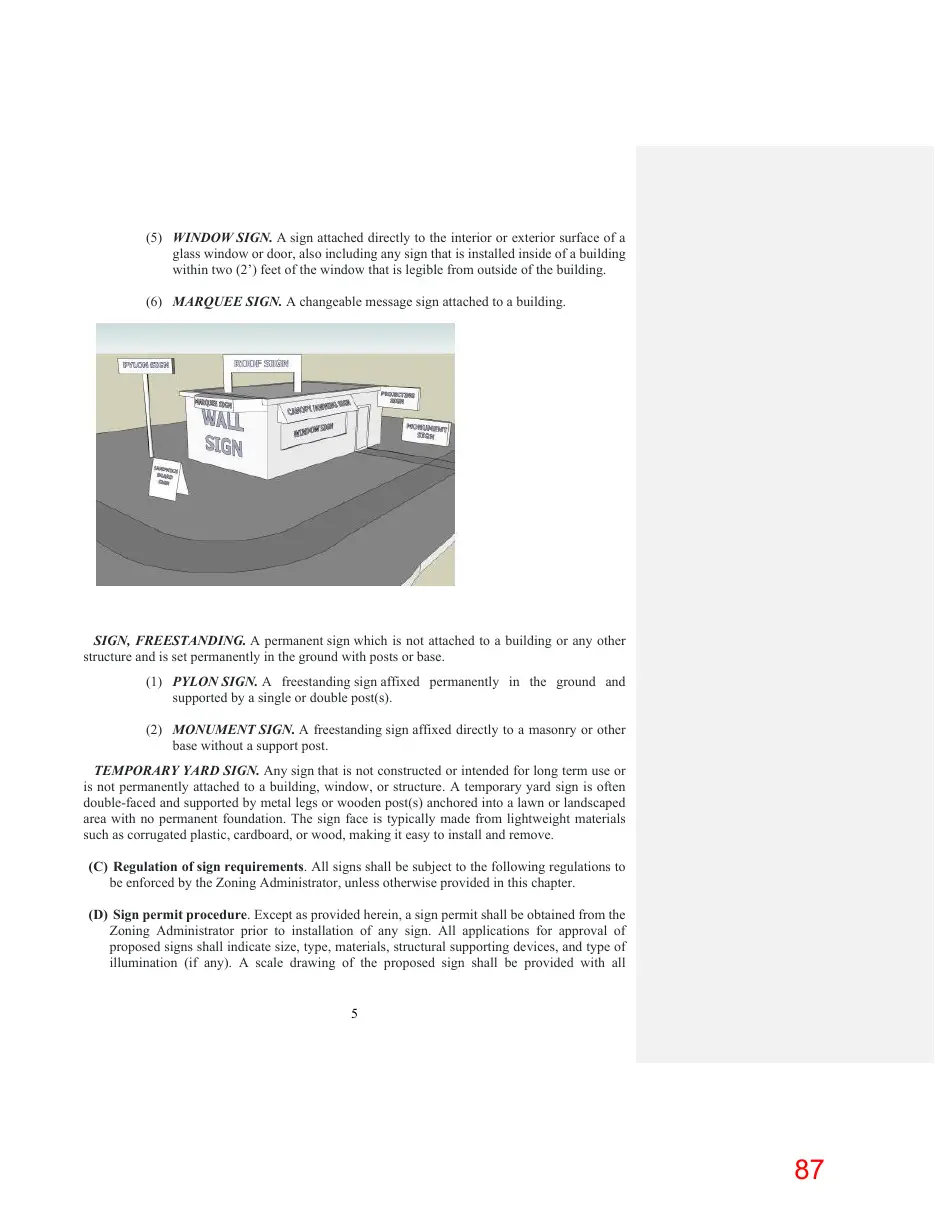
(5) WINDOW SIGN. A sign attached directly to the interior or exterior surface of a glass window or door, also including any sign that is installed inside of a building within two (2’) feet of the window that is legible from outside of the building. (6) MARQUEE SIGN. A changeable message sign attached to a building.
SIGN, FREESTANDING. A permanent sign which is not attached to a building or any other structure and is set permanently in the ground with posts or base. (1) PYLON SIGN. A freestanding sign affixed permanently in the ground and supported by a single or double post(s). (2) MONUMENT SIGN. A freestanding sign affixed directly to a masonry or other base without a support post. TEMPORARY YARD SIGN. Any sign that is not constructed or intended for long term use or is not permanently attached to a building, window, or structure. A temporary yard sign is often double-faced and supported by metal legs or wooden post(s) anchored into a lawn or landscaped area with no permanent foundation. The sign face is typically made from lightweight materials such as corrugated plastic, cardboard, or wood, making it easy to install and remove. (C) Regulation of sign requirements. All signs shall be subject to the following regulations to be enforced by the Zoning Administrator, unless otherwise provided in this chapter. (D) Sign permit procedure. Except as provided herein, a sign permit shall be obtained from the Zoning Administrator prior to installation of any sign. All applications for approval of proposed signs shall indicate size, type, materials, structural supporting devices, and type of illumination (if any). A scale drawing of the proposed sign shall be provided with all
Page 88
Text of page 88
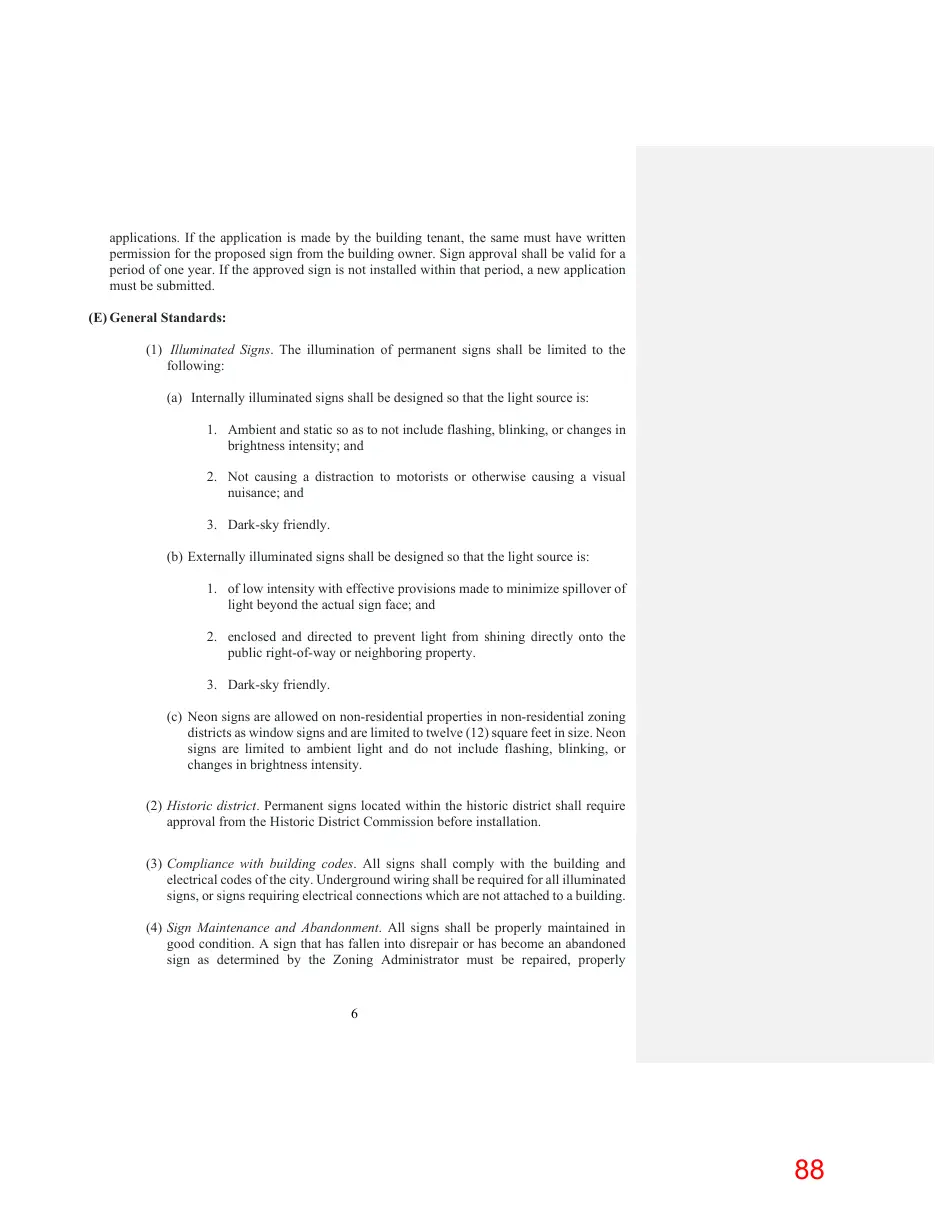
applications. If the application is made by the building tenant, the same must have written permission for the proposed sign from the building owner. Sign approval shall be valid for a period of one year. If the approved sign is not installed within that period, a new application must be submitted. (E) General Standards: (1) Illuminated Signs. The illumination of permanent signs shall be limited to the following: (a) Internally illuminated signs shall be designed so that the light source is: 1. Ambient and static so as to not include flashing, blinking, or changes in brightness intensity; and 2. Not causing a distraction to motorists or otherwise causing a visual nuisance; and 3. Dark-sky friendly. (b) Externally illuminated signs shall be designed so that the light source is: 1. of low intensity with effective provisions made to minimize spillover of light beyond the actual sign face; and 2. enclosed and directed to prevent light from shining directly onto the public right-of-way or neighboring property. 3. Dark-sky friendly. (c) Neon signs are allowed on non-residential properties in non-residential zoning districts as window signs and are limited to twelve (12) square feet in size. Neon signs are limited to ambient light and do not include flashing, blinking, or changes in brightness intensity. (2) Historic district. Permanent signs located within the historic district shall require approval from the Historic District Commission before installation. (3) Compliance with building codes. All signs shall comply with the building and electrical codes of the city. Underground wiring shall be required for all illuminated signs, or signs requiring electrical connections which are not attached to a building. (4) Sign Maintenance and Abandonment. All signs shall be properly maintained in good condition. A sign that has fallen into disrepair or has become an abandoned sign as determined by the Zoning Administrator must be repaired, properly
Page 89
Text of page 89
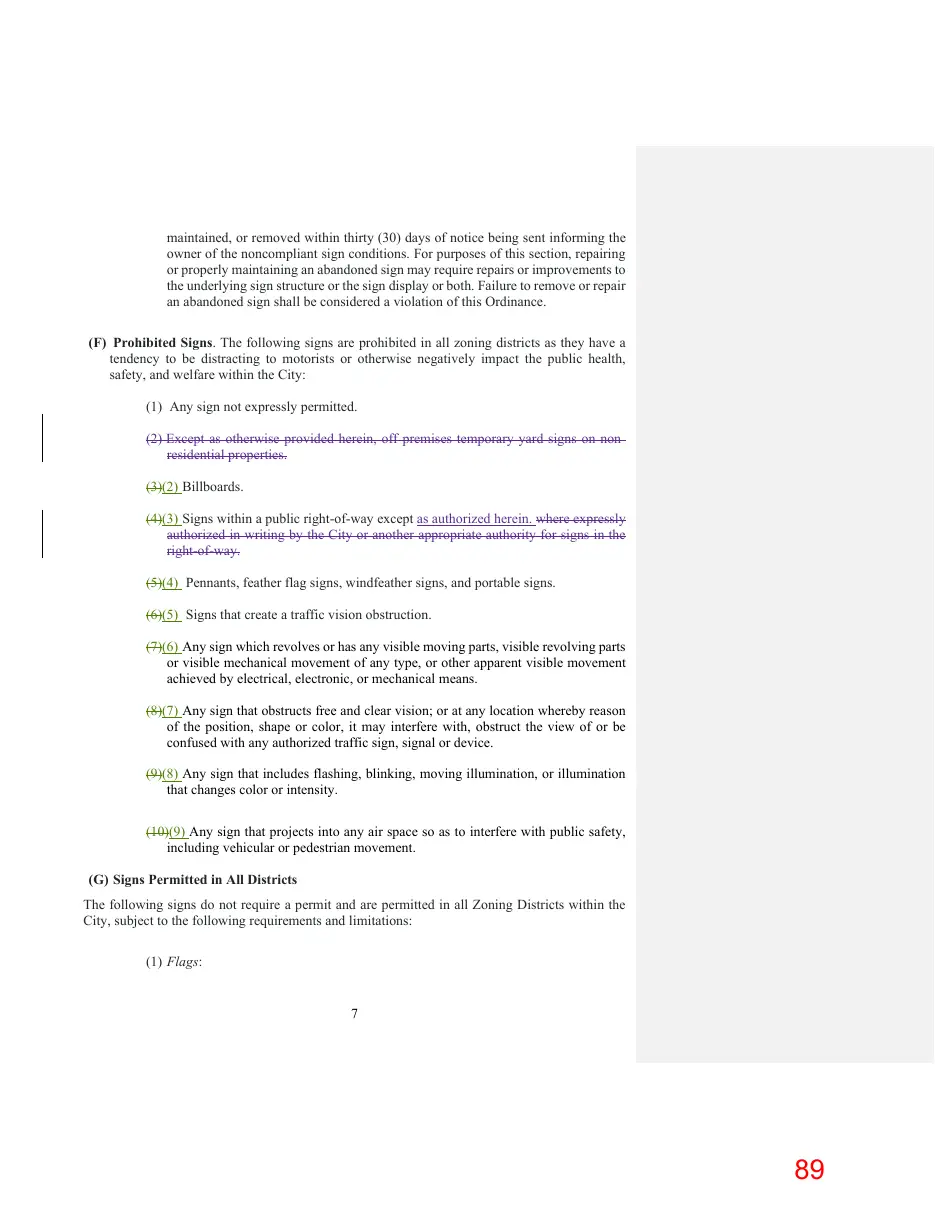
maintained, or removed within thirty (30) days of notice being sent informing the owner of the noncompliant sign conditions. For purposes of this section, repairing or properly maintaining an abandoned sign may require repairs or improvements to the underlying sign structure or the sign display or both. Failure to remove or repair an abandoned sign shall be considered a violation of this Ordinance. (F) Prohibited Signs. The following signs are prohibited in all zoning districts as they have a tendency to be distracting to motorists or otherwise negatively impact the public health, safety, and welfare within the City: (1) Any sign not expressly permitted. (2) Except as otherwise provided herein, off premises temporary yard signs on non residential properties. (3)(2) Billboards. (4)(3) Signs within a public right-of-way except as authorized herein. where expressly authorized in writing by the City or another appropriate authority for signs in the right-of-way. (5)(4) Pennants, feather flag signs, windfeather signs, and portable signs. (6)(5) Signs that create a traffic vision obstruction. (7)(6) Any sign which revolves or has any visible moving parts, visible revolving parts or visible mechanical movement of any type, or other apparent visible movement achieved by electrical, electronic, or mechanical means. (8)(7) Any sign that obstructs free and clear vision; or at any location whereby reason of the position, shape or color, it may interfere with, obstruct the view of or be confused with any authorized traffic sign, signal or device. (9)(8) Any sign that includes flashing, blinking, moving illumination, or illumination that changes color or intensity. (10)(9) Any sign that projects into any air space so as to interfere with public safety, including vehicular or pedestrian movement. (G) Signs Permitted in All Districts The following signs do not require a permit and are permitted in all Zoning Districts within the City, subject to the following requirements and limitations: (1) Flags:
Page 90
This page is a scanned image with no text layer. The PDF of these pages has it at full resolution.
Page 91
This page is a scanned image with no text layer. The PDF of these pages has it at full resolution.
Page 92
This page is a scanned image with no text layer. The PDF of these pages has it at full resolution.
Page 93
Text of page 93
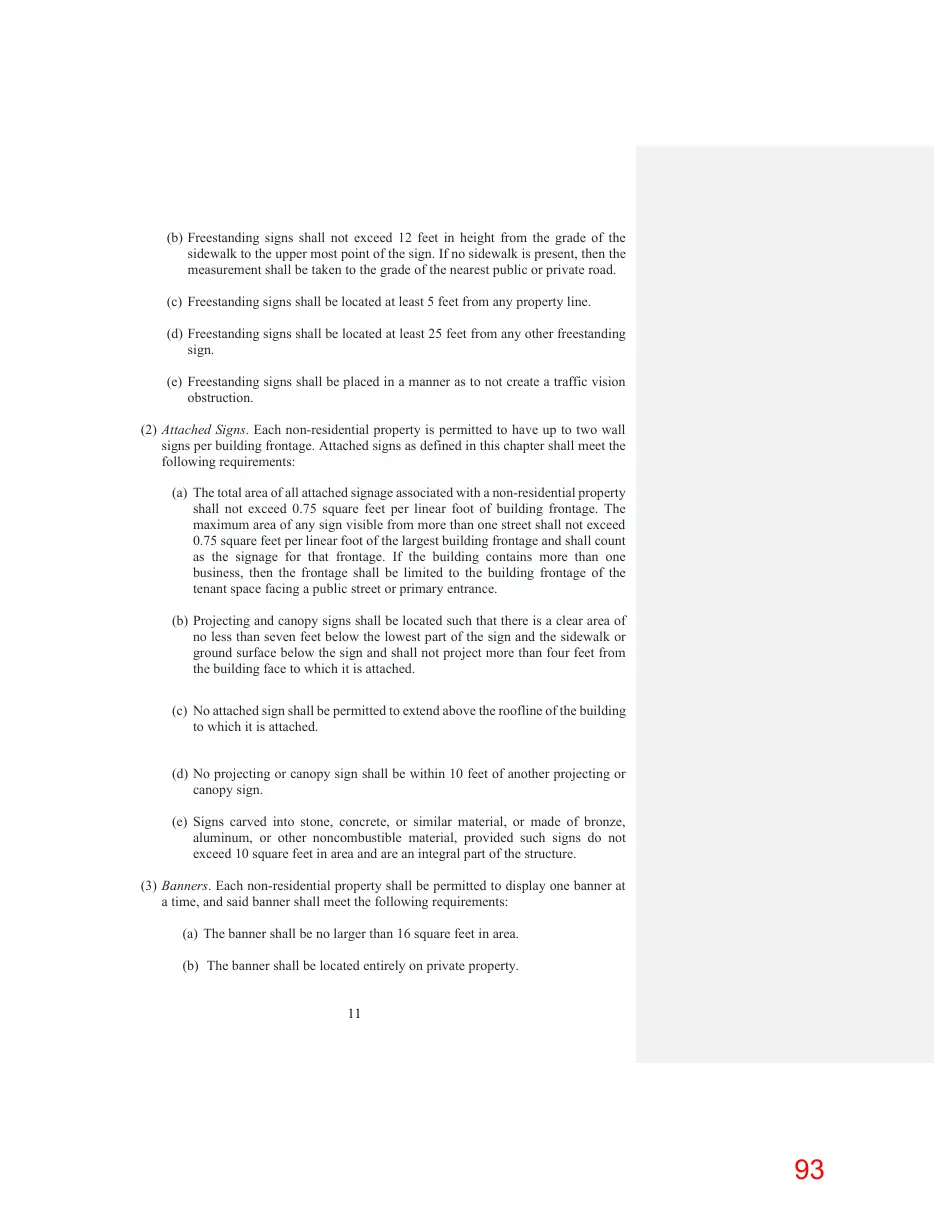
(b) Freestanding signs shall not exceed 12 feet in height from the grade of the sidewalk to the upper most point of the sign. If no sidewalk is present, then the measurement shall be taken to the grade of the nearest public or private road. (c) Freestanding signs shall be located at least 5 feet from any property line. (d) Freestanding signs shall be located at least 25 feet from any other freestanding sign. (e) Freestanding signs shall be placed in a manner as to not create a traffic vision obstruction. (2) Attached Signs. Each non-residential property is permitted to have up to two wall signs per building frontage. Attached signs as defined in this chapter shall meet the following requirements: (a) The total area of all attached signage associated with a non-residential property shall not exceed 0.75 square feet per linear foot of building frontage. The maximum area of any sign visible from more than one street shall not exceed 0.75 square feet per linear foot of the largest building frontage and shall count as the signage for that frontage. If the building contains more than one business, then the frontage shall be limited to the building frontage of the tenant space facing a public street or primary entrance. (b) Projecting and canopy signs shall be located such that there is a clear area of no less than seven feet below the lowest part of the sign and the sidewalk or ground surface below the sign and shall not project more than four feet from the building face to which it is attached. (c) No attached sign shall be permitted to extend above the roofline of the building to which it is attached. (d) No projecting or canopy sign shall be within 10 feet of another projecting or canopy sign. (e) Signs carved into stone, concrete, or similar material, or made of bronze, aluminum, or other noncombustible material, provided such signs do not exceed 10 square feet in area and are an integral part of the structure. (3) Banners. Each non-residential property shall be permitted to display one banner at a time, and said banner shall meet the following requirements: (a) The banner shall be no larger than 16 square feet in area. (b) The banner shall be located entirely on private property. 11
Page 94
Text of page 94
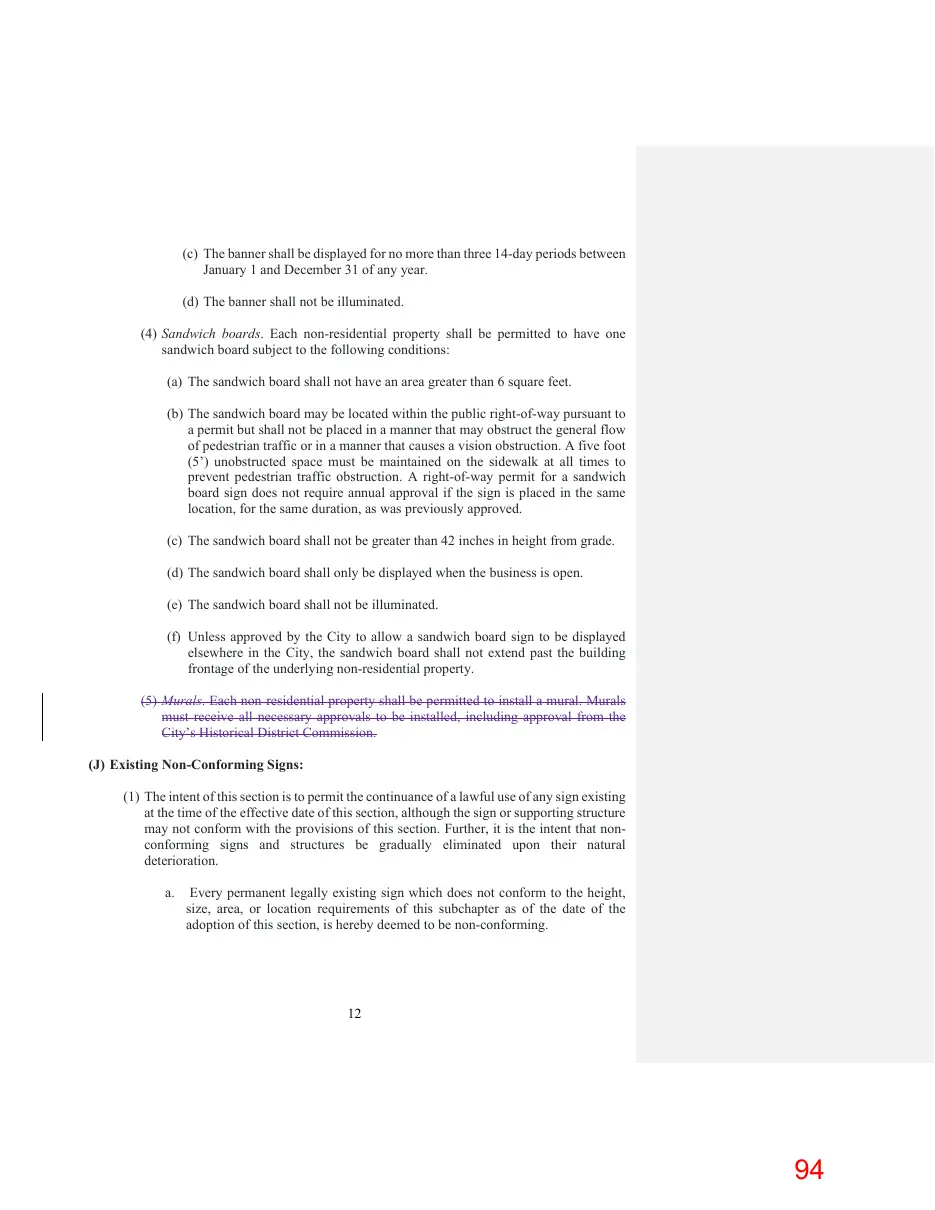
(c) The banner shall be displayed for no more than three 14-day periods between January 1 and December 31 of any year. (d) The banner shall not be illuminated. (4) Sandwich boards. Each non-residential property shall be permitted to have one sandwich board subject to the following conditions: (a) The sandwich board shall not have an area greater than 6 square feet. (b) The sandwich board may be located within the public right-of-way pursuant to a permit but shall not be placed in a manner that may obstruct the general flow of pedestrian traffic or in a manner that causes a vision obstruction. A five foot (5’) unobstructed space must be maintained on the sidewalk at all times to prevent pedestrian traffic obstruction. A right-of-way permit for a sandwich board sign does not require annual approval if the sign is placed in the same location, for the same duration, as was previously approved. (c) The sandwich board shall not be greater than 42 inches in height from grade. (d) The sandwich board shall only be displayed when the business is open. (e) The sandwich board shall not be illuminated. (f) Unless approved by the City to allow a sandwich board sign to be displayed elsewhere in the City, the sandwich board shall not extend past the building frontage of the underlying non-residential property. (5) Murals. Each non residential property shall be permitted to install a mural. Murals must receive all necessary approvals to be installed, including approval from the City’s Historical District Commission. (J) Existing Non-Conforming Signs: (1) The intent of this section is to permit the continuance of a lawful use of any sign existing at the time of the effective date of this section, although the sign or supporting structure may not conform with the provisions of this section. Further, it is the intent that nonconforming signs and structures be gradually eliminated upon their natural deterioration. a.
Every permanent legally existing sign which does not conform to the height, size, area, or location requirements of this subchapter as of the date of the adoption of this section, is hereby deemed to be non-conforming.
Page 95
Text of page 95
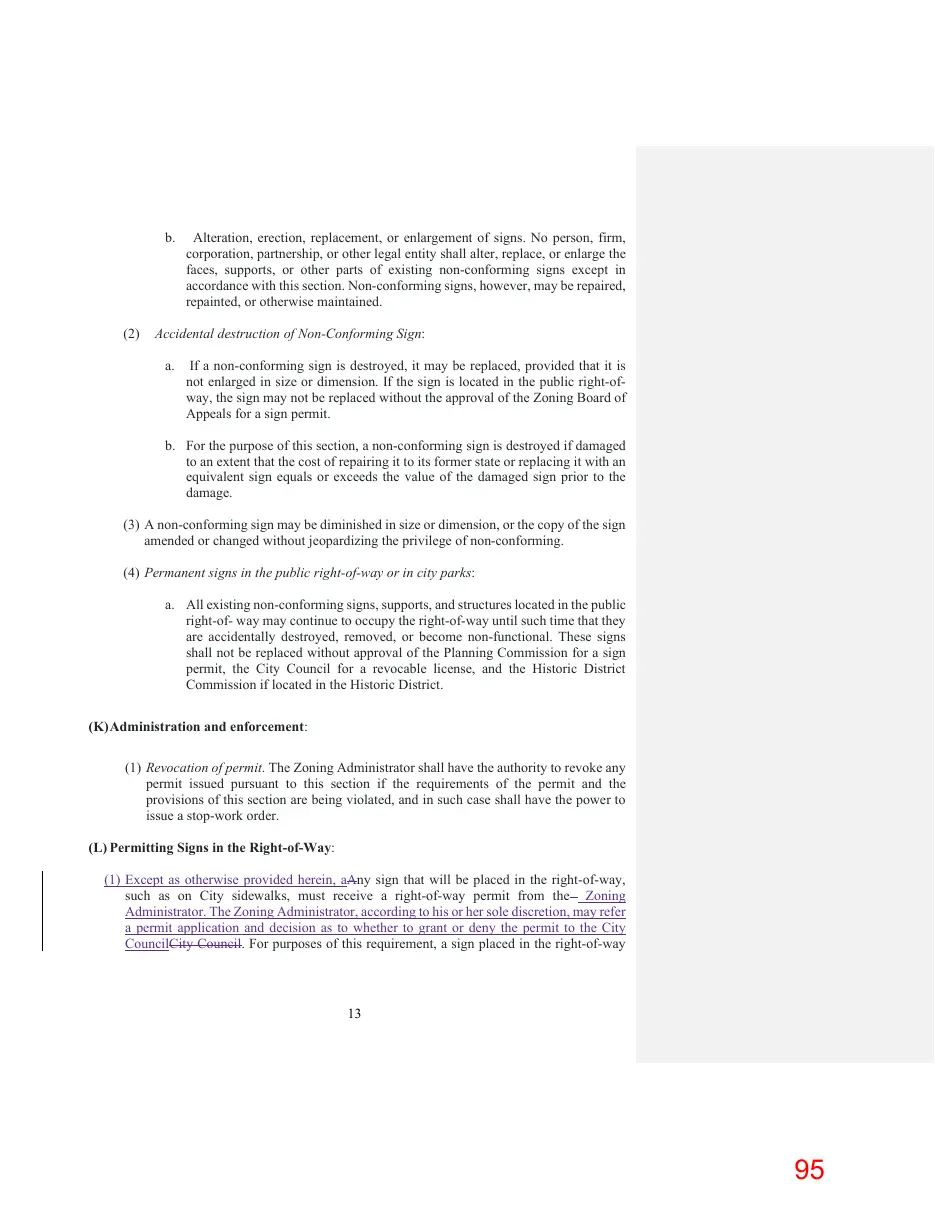
Alteration, erection, replacement, or enlargement of signs. No person, firm, corporation, partnership, or other legal entity shall alter, replace, or enlarge the faces, supports, or other parts of existing non-conforming signs except in accordance with this section. Non-conforming signs, however, may be repaired, repainted, or otherwise maintained.
Accidental destruction of Non-Conforming Sign: a.
If a non-conforming sign is destroyed, it may be replaced, provided that it is not enlarged in size or dimension. If the sign is located in the public right-ofway, the sign may not be replaced without the approval of the Zoning Board of Appeals for a sign permit.
b. For the purpose of this section, a non-conforming sign is destroyed if damaged to an extent that the cost of repairing it to its former state or replacing it with an equivalent sign equals or exceeds the value of the damaged sign prior to the damage. (3) A non-conforming sign may be diminished in size or dimension, or the copy of the sign amended or changed without jeopardizing the privilege of non-conforming. (4) Permanent signs in the public right-of-way or in city parks: a. All existing non-conforming signs, supports, and structures located in the public right-ofway may continue to occupy the right-of-way until such time that they are accidentally destroyed, removed, or become non-functional. These signs shall not be replaced without approval of the Planning Commission for a sign permit, the City Council for a revocable license, and the Historic District Commission if located in the Historic District. (K) Administration and enforcement: (1) Revocation of permit. The Zoning Administrator shall have the authority to revoke any permit issued pursuant to this section if the requirements of the permit and the provisions of this section are being violated, and in such case shall have the power to issue a stop-work order. (L) Permitting Signs in the Right-of-Way: (1) Except as otherwise provided herein, aAny sign that will be placed in the right-of-way, such as on City sidewalks, must receive a right-of-way permit from the Zoning Administrator. The Zoning Administrator, according to his or her sole discretion, may refer a permit application and decision as to whether to grant or deny the permit to the City CouncilCity Council. For purposes of this requirement, a sign placed in the right-of-way
Page 96
This page is a scanned image with no text layer. The PDF of these pages has it at full resolution.
Page 97
This page is a scanned image with no text layer. The PDF of these pages has it at full resolution.
Page 98
Text of page 98
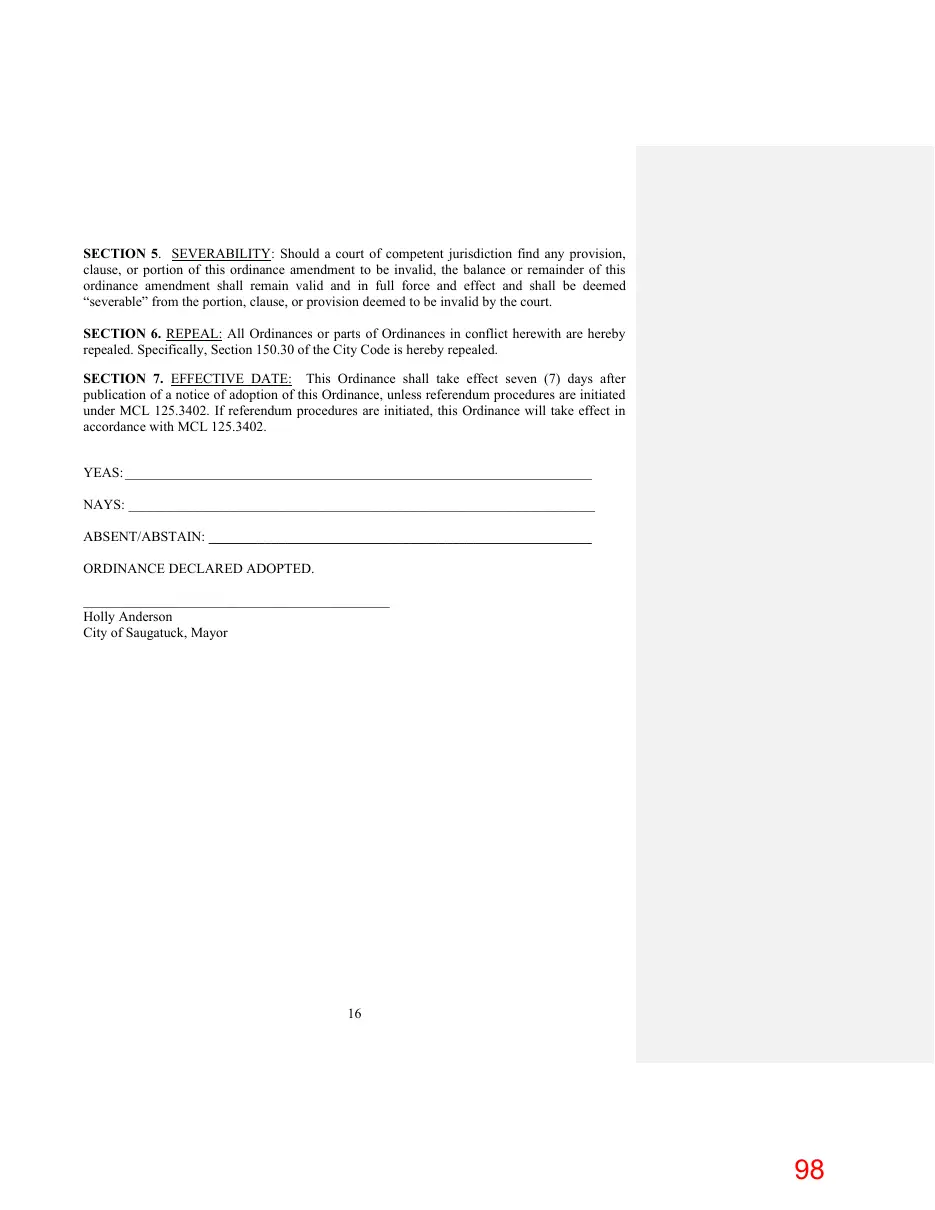
SECTION 5. SEVERABILITY: Should a court of competent jurisdiction find any provision, clause, or portion of this ordinance amendment to be invalid, the balance or remainder of this ordinance amendment shall remain valid and in full force and effect and shall be deemed “severable” from the portion, clause, or provision deemed to be invalid by the court. SECTION 6. REPEAL: All Ordinances or parts of Ordinances in conflict herewith are hereby repealed. Specifically, Section 150.30 of the City Code is hereby repealed. SECTION 7. EFFECTIVE DATE: This Ordinance shall take effect seven (7) days after publication of a notice of adoption of this Ordinance, unless referendum procedures are initiated under MCL 125.3402. If referendum procedures are initiated, this Ordinance will take effect in accordance with MCL 125.3402. YEAS: ___________________________________________________________________ NAYS: ___________________________________________________________________ ABSENT/ABSTAIN: _______________________________________________________ ORDINANCE DECLARED ADOPTED. ____________________________________________ Holly Anderson City of Saugatuck, Mayor
Page 99
Text of page 99
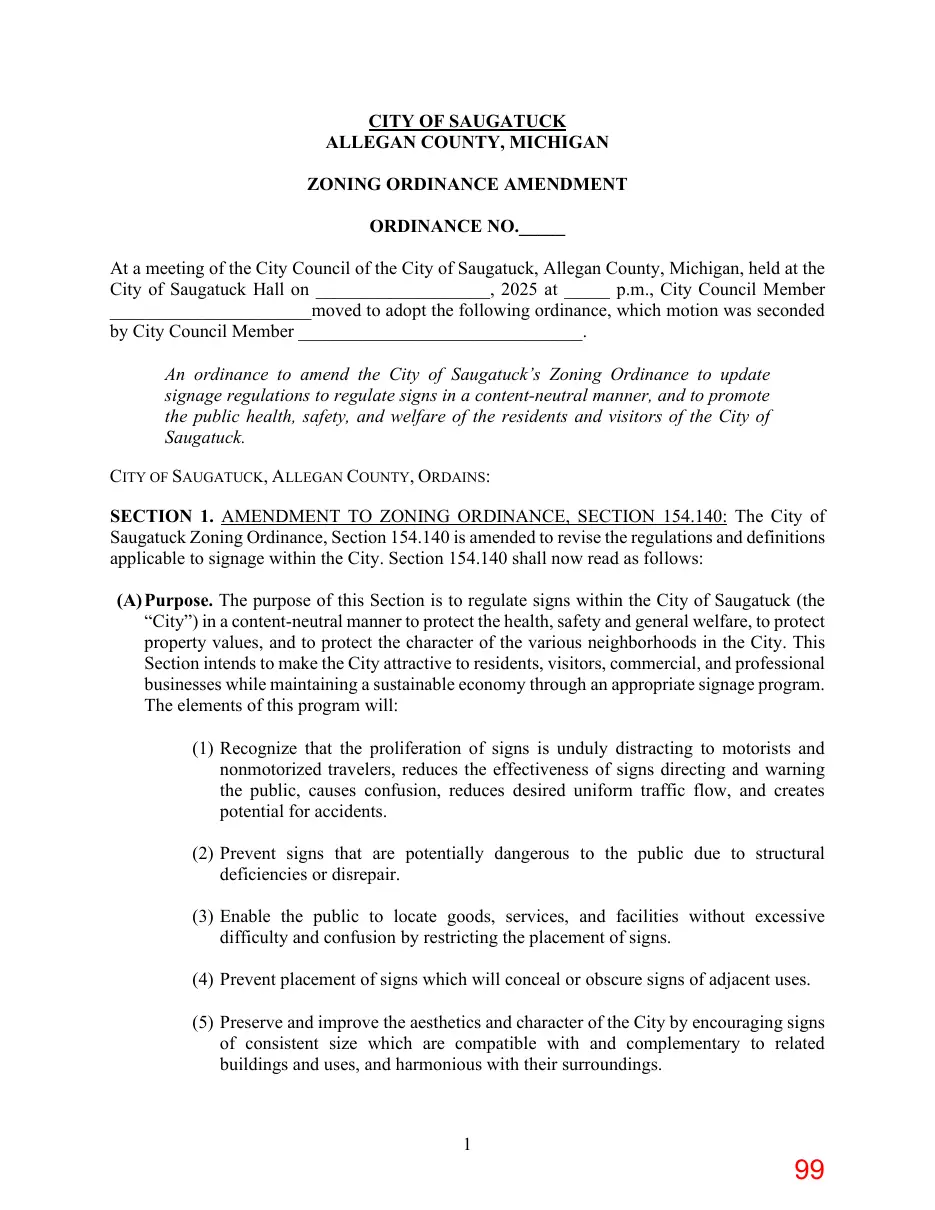
CITY OF SAUGATUCK ALLEGAN COUNTY, MICHIGAN ZONING ORDINANCE AMENDMENT ORDINANCE NO._____ At a meeting of the City Council of the City of Saugatuck, Allegan County, Michigan, held at the City of Saugatuck Hall on ___________________, 2025 at _____ p.m., City Council Member ______________________moved to adopt the following ordinance, which motion was seconded by City Council Member _______________________________. An ordinance to amend the City of Saugatuck’s Zoning Ordinance to update signage regulations to regulate signs in a content-neutral manner, and to promote the public health, safety, and welfare of the residents and visitors of the City of Saugatuck. CITY OF SAUGATUCK, ALLEGAN COUNTY, ORDAINS: SECTION 1. AMENDMENT TO ZONING ORDINANCE, SECTION 154.140: The City of Saugatuck Zoning Ordinance, Section 154.140 is amended to revise the regulations and definitions applicable to signage within the City. Section 154.140 shall now read as follows: (A) Purpose. The purpose of this Section is to regulate signs within the City of Saugatuck (the “City”) in a content-neutral manner to protect the health, safety and general welfare, to protect property values, and to protect the character of the various neighborhoods in the City. This Section intends to make the City attractive to residents, visitors, commercial, and professional businesses while maintaining a sustainable economy through an appropriate signage program. The elements of this program will: (1) Recognize that the proliferation of signs is unduly distracting to motorists and nonmotorized travelers, reduces the effectiveness of signs directing and warning the public, causes confusion, reduces desired uniform traffic flow, and creates potential for accidents. (2) Prevent signs that are potentially dangerous to the public due to structural deficiencies or disrepair. (3) Enable the public to locate goods, services, and facilities without excessive difficulty and confusion by restricting the placement of signs. (4) Prevent placement of signs which will conceal or obscure signs of adjacent uses. (5) Preserve and improve the aesthetics and character of the City by encouraging signs of consistent size which are compatible with and complementary to related buildings and uses, and harmonious with their surroundings.
Page 100
Text of page 100
(6) Provide regulations that focus on the time, place, manner, and physical characteristics of signs, but not the content of signs in accordance with the First Amendment of the United States Constitution. (B) Definitions. For the purpose of this subchapter, the following definitions shall apply unless the context clearly indicates or requires a different meaning.
ABANDONED SIGN. A sign that has been determined to be “abandoned” for a period of
thirty (30) days or longer as determined by the Zoning Administrator. The following conditions may be considered by the Zoning Administrator to determine whether a sign has been abandoned: (1) Whether the sign displays advertising for a product or service which is no longer available. (2) Whether the sign displays advertising for a business which is no longer licensed. (3) Whether the sign is in disrepair as determined by the Zoning Administrator, including but not limited to, signs that are missing portions of the display, have chipped or dilapidated paint or other components, or have structural components that have fallen into disrepair. (4) Whether the sign advertises a business that is no longer doing business on the parcel where the sign is located, if the business was originally located on that parcel. (5) Whether the purpose of the sign has lapsed. (6) Whether the sign has historical significance for the City as determined by the Zoning Administrator. (7) Whether there are plans to repair the sign, including adding a new display or transitioning to a different display, or to repair any structural damage or disrepair. BANNER. A temporary flexible sign directly mounted to a building, or a support on a building, or between two poles made of natural or synthetic material, not including flags as defined in this section.
BILLBOARD. Any free-standing permanent sign on a parcel of land which does not include another principal structure. DARK-SKY FRIENDLY. Lighting designed to minimize light pollution by directing light downward. Dark sky compliant fixtures are fully shielded, energy-efficient, and use appropriate colors (such as warm colors designed to minimize short-wavelength light) to reduce glare and skyglow. FEATHER FLAG SIGN, WINDFEATHER SIGN. A flexible sign made of natural or synthetic material typically fastened on one long side to a flexible or non-flexible pole mounted on the ground, intended to move with the wind, not including flags as defined in this section.
Page 101
Text of page 101
FLAG. A piece of fabric that is hung from a pole, a bracket, or attached to the side of a building. FLAGPOLE, PERMANENT. A freestanding pole permanently mounted with a foundation on the ground and used for the sole purpose of displaying a flag or flags. FLAGPOLE, TEMPORARY. A temporary pole that can be mounted on a structure or building, or affixed or driven into the ground, for the sole purpose of displaying a flag. ILLUMINATED SIGN. Any sign that is illuminated by any light source other than non-reflected natural daylight. (1) EXTERNALLY ILLUMINATED SIGN. A sign that is illuminated by an external source, which reflects light off the surface of a sign face. (2) INTERNALLY ILLUMINATED SIGN. A sign with internal electronic circuitry emitting light through the sign face. (3) NEON SIGNS. A sign illuminated by luminous gas-discharge tubes containing rarefied neon or other gases (such as helium, argon, krypton, xenon, or mercury vapor) that produce a visible ambient light when connected to an electric current, or by similar electronic technologies, such as light-emitting diodes (LEDs), designed to create a static ambient light display. MURAL. A permanent noncommercial work of art applied to or made integral with a wall or structure. A mural shall not include any signs with words, letters, characters, or numbers intended to identify a business. NON-RESIDENTIAL PROPERTY. Any use of property or a portion of a property that is not a “residential property,” as defined herein. The common areas of a multi-family dwelling unit (such as an apartment complex) or a housing development with multiple dwelling units shall be considered non-residential for purposes of allowable signage. In the case of a mixed use property, the non-residential portions shall be entitled to the allowable signage for non-residential properties, whereas any residential dwelling units within the mixed use property shall each be categorized as residential property for purposes of this Section. PENNANT. Any lightweight plastic, fabric, or other material, suspended from a rope, wire, or string, usually in series, designed to move in the wind. PERMANENT SIGN. Any sign constructed of durable materials, secured on a structure or property, and intended to exist for the duration of time that the use or occupant is located on the premises. PORTABLE SIGNS. Except for signage falling under another definition herein, any sign designed to be moved easily and not permanently or temporarily attached to the ground or other structure, including but not limited to: flashing A-frames, searchlights, beacons, balloons, umbrellas, trailers, wheeled or non-wheeled carts, or signs leaning against parked vehicles. RESIDENTIAL PROPERTY. Any dwelling unit and the real property on which it is located, not including bed and breakfasts, inns, hotels, the common areas of a multiple family dwelling, or the portions of a mixed use property that are not used as a dwelling unit. For purposes of this Section, each dwelling unit on a particular property, except an accessory dwelling unit, is entitled to its own sign allowance as set forth herein. For example, a two-family dwelling would contain
Page 102
Text of page 102
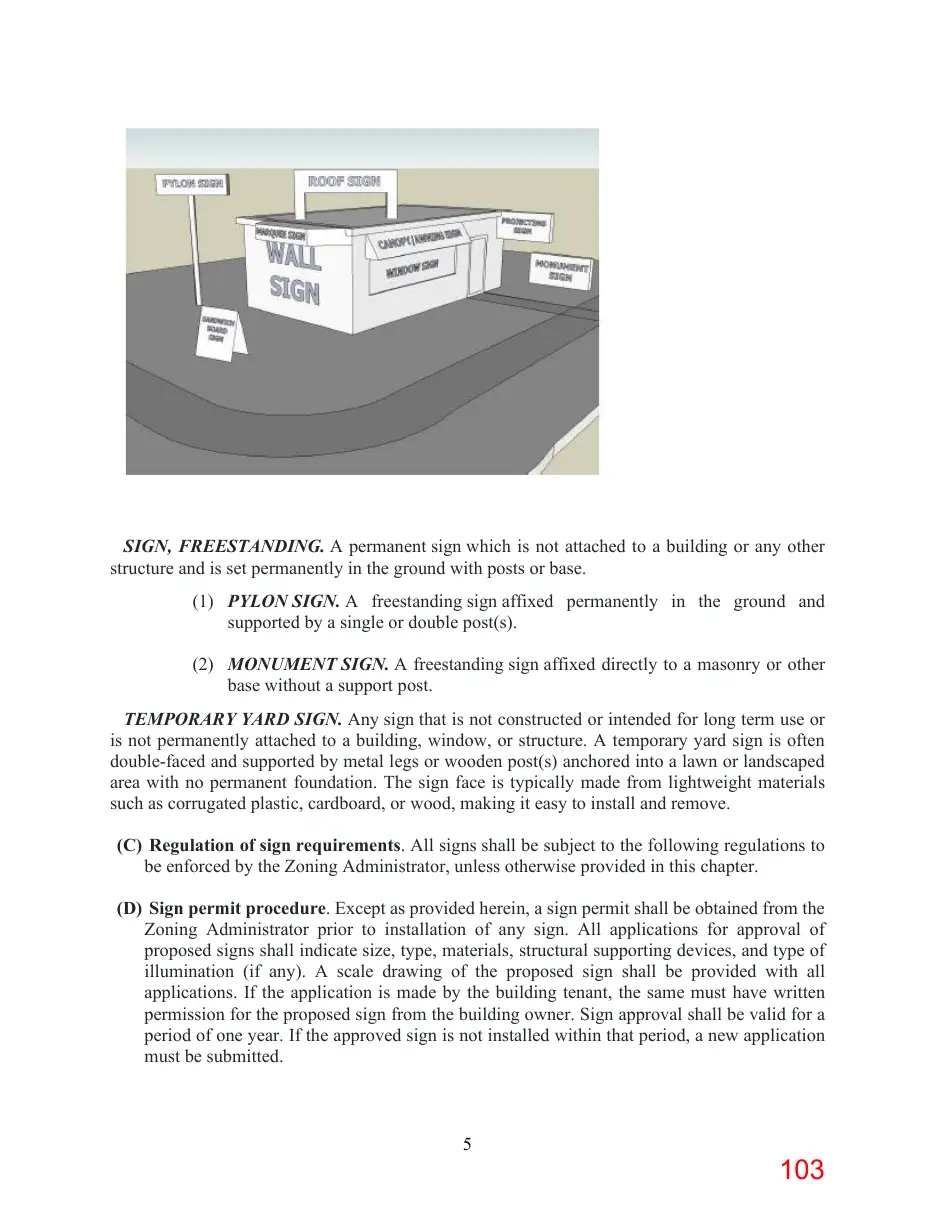
two dwelling units, and each dwelling unit could display the allowable amount of signage as set forth herein. SANDWICH BOARD SIGN. A temporary freestanding sign constructed in such a manner as to form an “A” or a tent-like shape, hinged or not hinged at the top, each angular face held at an appropriate distance by a supporting member. SIGN. Any words, lettering, parts of letters, figures, numerals, phrases, sentences, emblems, devices, designs, trademarks, logos or pictures, or combination thereof, intended to be used to attract attention to or convey information about a person, place, business, firm, profession, or association. SIGN AREA. The smallest area within a threeor four-sided polygon or circle enclosing the display surface of the sign including all letters, characters, and delineations that differentiate it from the background against which it is placed. SIGN AREA shall not include the structural supports for free standing signs. Where a sign has two faces, placed back-to-back, and are of equal size, the area of the two faces shall be considered as one face. If the two back-to-back faces are of unequal size, the larger of the two sign faces shall be counted as the sign area. SIGN, ATTACHED. A permanent sign which is attached to the wall or window of a building, including: (1) CANOPY/AWNING SIGN. A fabric canopy or awning with all or any part used as a sign. (2) PROJECTING SIGN. A double-faced sign attached at an angle or perpendicular to the wall of a building. (3) ROOF SIGN. Any sign erected and constructed wholly on or over the roof of a building, supported by the roof structure. (4) WALL SIGN. Any sign that is attached parallel to the wall. Wall sign does not include “murals,” as defined herein. (5) WINDOW SIGN. A sign attached directly to the interior or exterior surface of a glass window or door, also including any sign that is installed inside of a building within two (2’) feet of the window that is legible from outside of the building. (6) MARQUEE SIGN. A changeable message sign attached to a building.
Page 103
Text of page 103
SIGN, FREESTANDING. A permanent sign which is not attached to a building or any other structure and is set permanently in the ground with posts or base. (1) PYLON SIGN. A freestanding sign affixed permanently in the ground and supported by a single or double post(s). (2) MONUMENT SIGN. A freestanding sign affixed directly to a masonry or other base without a support post. TEMPORARY YARD SIGN. Any sign that is not constructed or intended for long term use or is not permanently attached to a building, window, or structure. A temporary yard sign is often double-faced and supported by metal legs or wooden post(s) anchored into a lawn or landscaped area with no permanent foundation. The sign face is typically made from lightweight materials such as corrugated plastic, cardboard, or wood, making it easy to install and remove. (C) Regulation of sign requirements. All signs shall be subject to the following regulations to be enforced by the Zoning Administrator, unless otherwise provided in this chapter. (D) Sign permit procedure. Except as provided herein, a sign permit shall be obtained from the Zoning Administrator prior to installation of any sign. All applications for approval of proposed signs shall indicate size, type, materials, structural supporting devices, and type of illumination (if any). A scale drawing of the proposed sign shall be provided with all applications. If the application is made by the building tenant, the same must have written permission for the proposed sign from the building owner. Sign approval shall be valid for a period of one year. If the approved sign is not installed within that period, a new application must be submitted.
Page 104
Text of page 104
(E) General Standards: (1) Illuminated Signs. The illumination of permanent signs shall be limited to the following: (a) Internally illuminated signs shall be designed so that the light source is: 1. Ambient and static so as to not include flashing, blinking, or changes in brightness intensity; and 2. Not causing a distraction to motorists or otherwise causing a visual nuisance; and 3. Dark-sky friendly. (b) Externally illuminated signs shall be designed so that the light source is: 1. of low intensity with effective provisions made to minimize spillover of light beyond the actual sign face; and 2. enclosed and directed to prevent light from shining directly onto the public right-of-way or neighboring property. 3. Dark-sky friendly. (c) Neon signs are allowed on non-residential properties in non-residential zoning districts as window signs and are limited to twelve (12) square feet in size. Neon signs are limited to ambient light and do not include flashing, blinking, or changes in brightness intensity. (2) Historic district. Permanent signs located within the historic district shall require approval from the Historic District Commission before installation. (3) Compliance with building codes. All signs shall comply with the building and electrical codes of the city. Underground wiring shall be required for all illuminated signs, or signs requiring electrical connections which are not attached to a building. (4) Sign Maintenance and Abandonment. All signs shall be properly maintained in good condition. A sign that has fallen into disrepair or has become an abandoned sign as determined by the Zoning Administrator must be repaired, properly maintained, or removed within thirty (30) days of notice being sent informing the owner of the noncompliant sign conditions. For purposes of this section, repairing or properly maintaining an abandoned sign may require repairs or improvements to the underlying sign structure or the sign display or both. Failure to remove or repair an abandoned sign shall be considered a violation of this Ordinance.
Page 105
Text of page 105
(F) Prohibited Signs. The following signs are prohibited in all zoning districts as they have a tendency to be distracting to motorists or otherwise negatively impact the public health, safety, and welfare within the City: (1) Any sign not expressly permitted. (2) Billboards. (3) Signs within a public right-of-way except as authorized herein. (4) Pennants, feather flag signs, windfeather signs, and portable signs. (5) Signs that create a traffic vision obstruction. (6) Any sign which revolves or has any visible moving parts, visible revolving parts or visible mechanical movement of any type, or other apparent visible movement achieved by electrical, electronic, or mechanical means. (7) Any sign that obstructs free and clear vision; or at any location whereby reason of the position, shape or color, it may interfere with, obstruct the view of or be confused with any authorized traffic sign, signal or device. (8) Any sign that includes flashing, blinking, moving illumination, or illumination that changes color or intensity. (9) Any sign that projects into any air space so as to interfere with public safety, including vehicular or pedestrian movement. (G) Signs Permitted in All Districts The following signs do not require a permit and are permitted in all Zoning Districts within the City, subject to the following requirements and limitations: (1) Flags: (a) For residential properties, any number of flags so long as each individual flag does not exceed twenty-four (24) square feet and the total square footage of all flags does not exceed forty-eight (48) square feet. (b) For non-residential properties, any number of flags may be displayed provided that the flags are not distracting to motorists or otherwise negatively impacting the public health, safety, and welfare within the City (c) Flags shall not cause an unreasonable obstruction to pedestrian traffic, vehicular traffic, or to the public right-of-way. Whether an obstruction is unreasonable 7
Page 106
Text of page 106
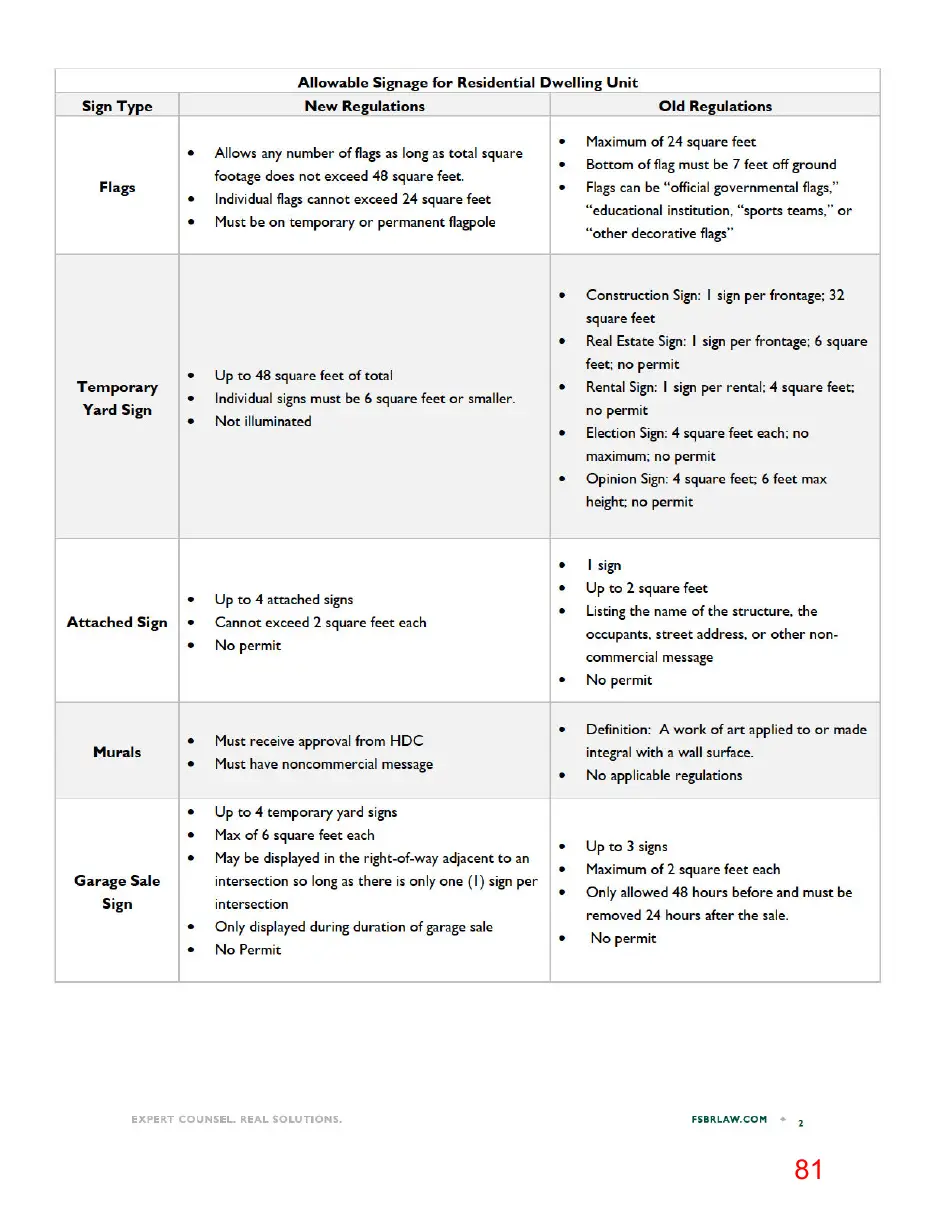
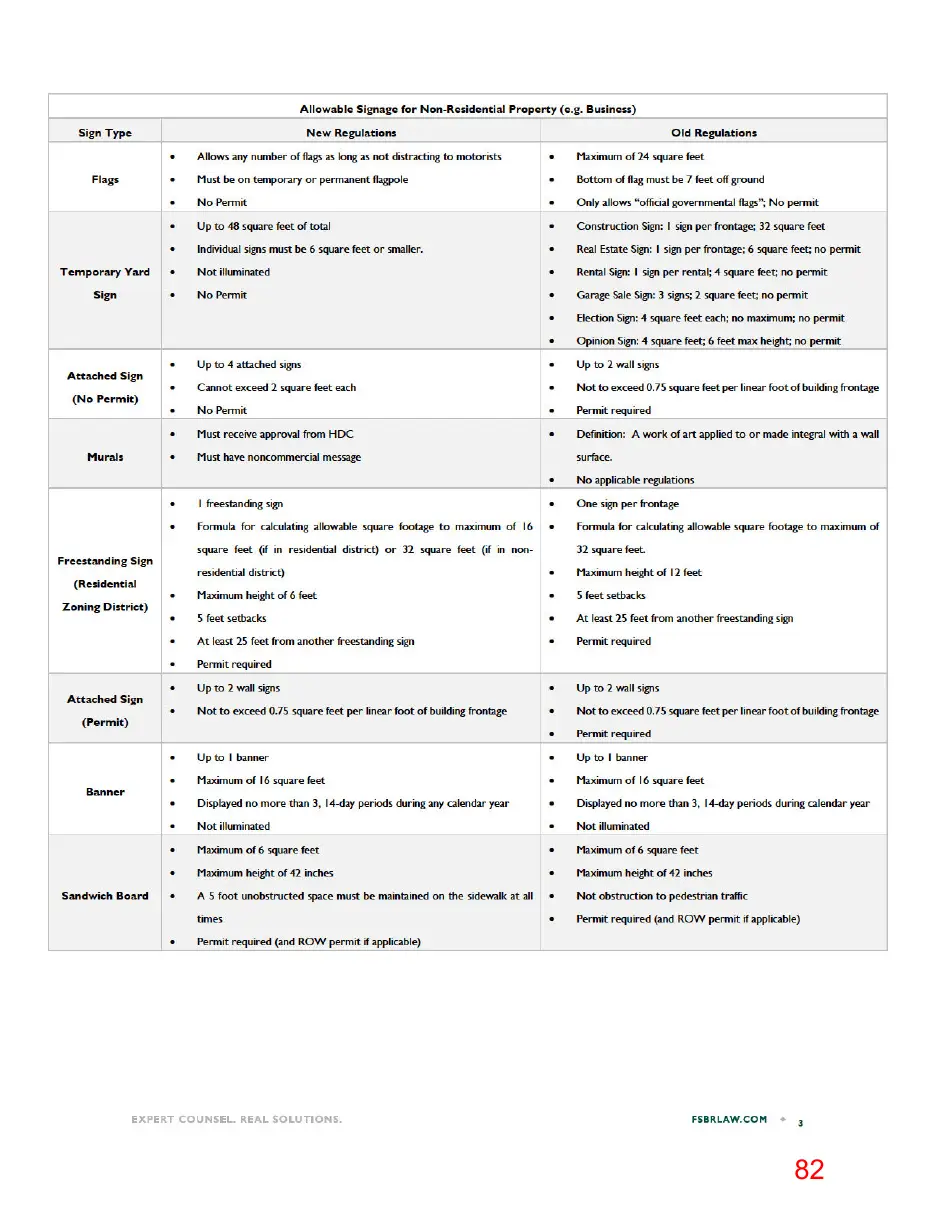
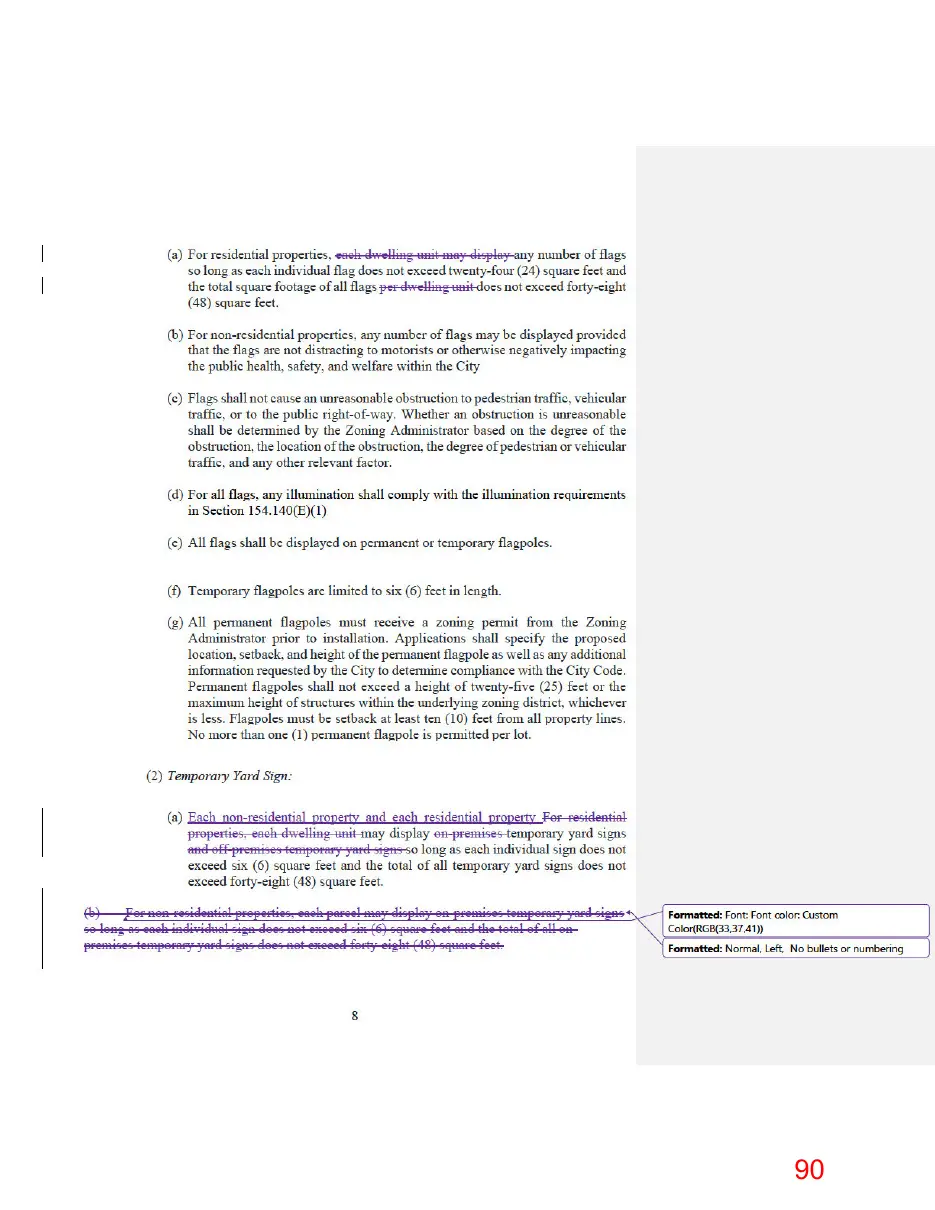
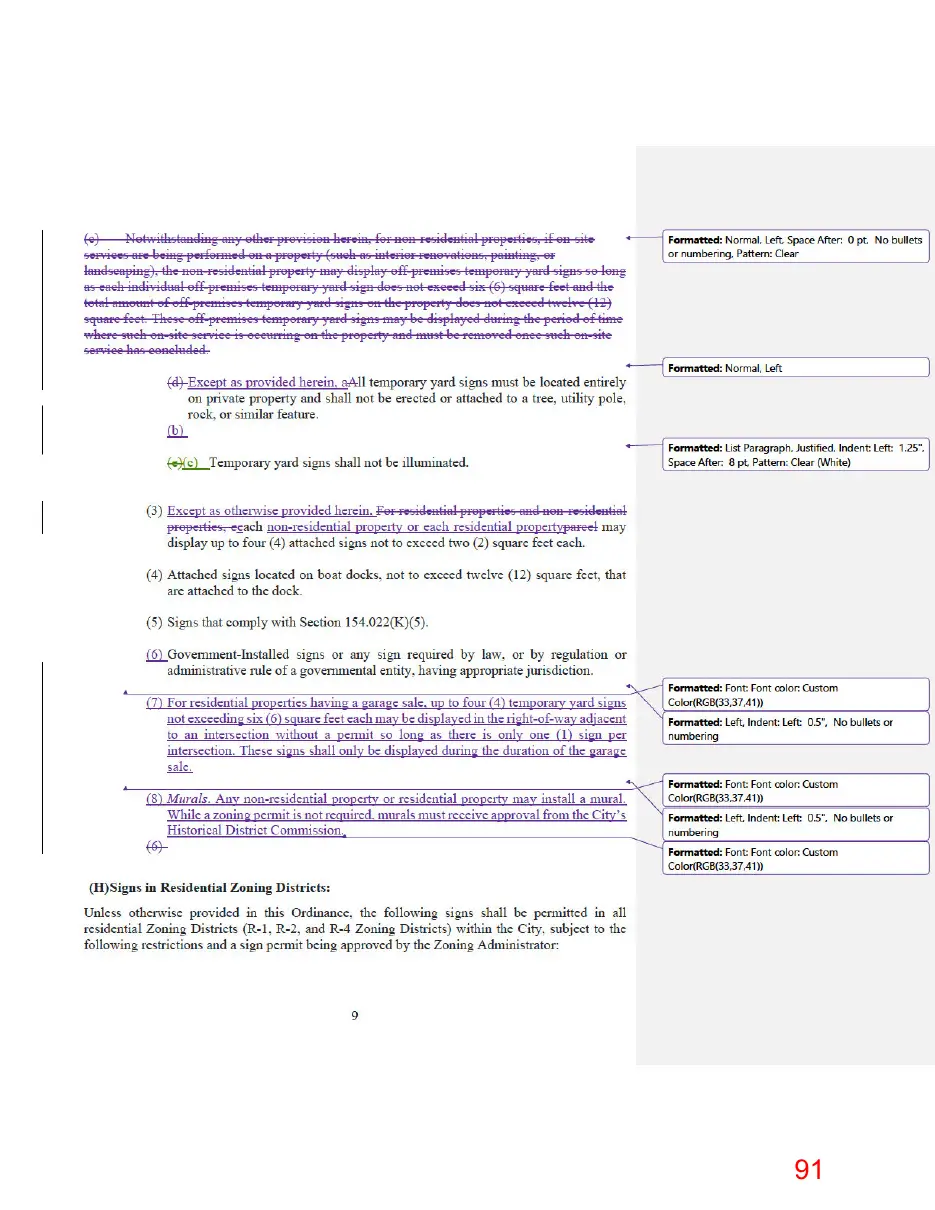
shall be determined by the Zoning Administrator based on the degree of the obstruction, the location of the obstruction, the degree of pedestrian or vehicular traffic, and any other relevant factor. (d) For all flags, any illumination shall comply with the illumination requirements in Section 154.140(E)(1) (e) All flags shall be displayed on permanent or temporary flagpoles. (f) Temporary flagpoles are limited to six (6) feet in length. (g) All permanent flagpoles must receive a zoning permit from the Zoning Administrator prior to installation. Applications shall specify the proposed location, setback, and height of the permanent flagpole as well as any additional information requested by the City to determine compliance with the City Code. Permanent flagpoles shall not exceed a height of twenty-five (25) feet or the maximum height of structures within the underlying zoning district, whichever is less. Flagpoles must be setback at least ten (10) feet from all property lines. No more than one (1) permanent flagpole is permitted per lot. (2) Temporary Yard Sign: (a) Each non-residential property and each residential property may display temporary yard signs so long as each individual sign does not exceed six (6) square feet and the total of all temporary yard signs does not exceed forty-eight (48) square feet. (b) Except as provided herein, all temporary yard signs must be located entirely on private property and shall not be erected or attached to a tree, utility pole, rock, or similar feature. (c) Temporary yard signs shall not be illuminated. (3) Except as otherwise provided herein, each non-residential property or each residential property may display up to four (4) attached signs not to exceed two (2) square feet each. (4) Attached signs located on boat docks, not to exceed twelve (12) square feet, that are attached to the dock. (5) Signs that comply with Section 154.022(K)(5).
Page 107
Text of page 107
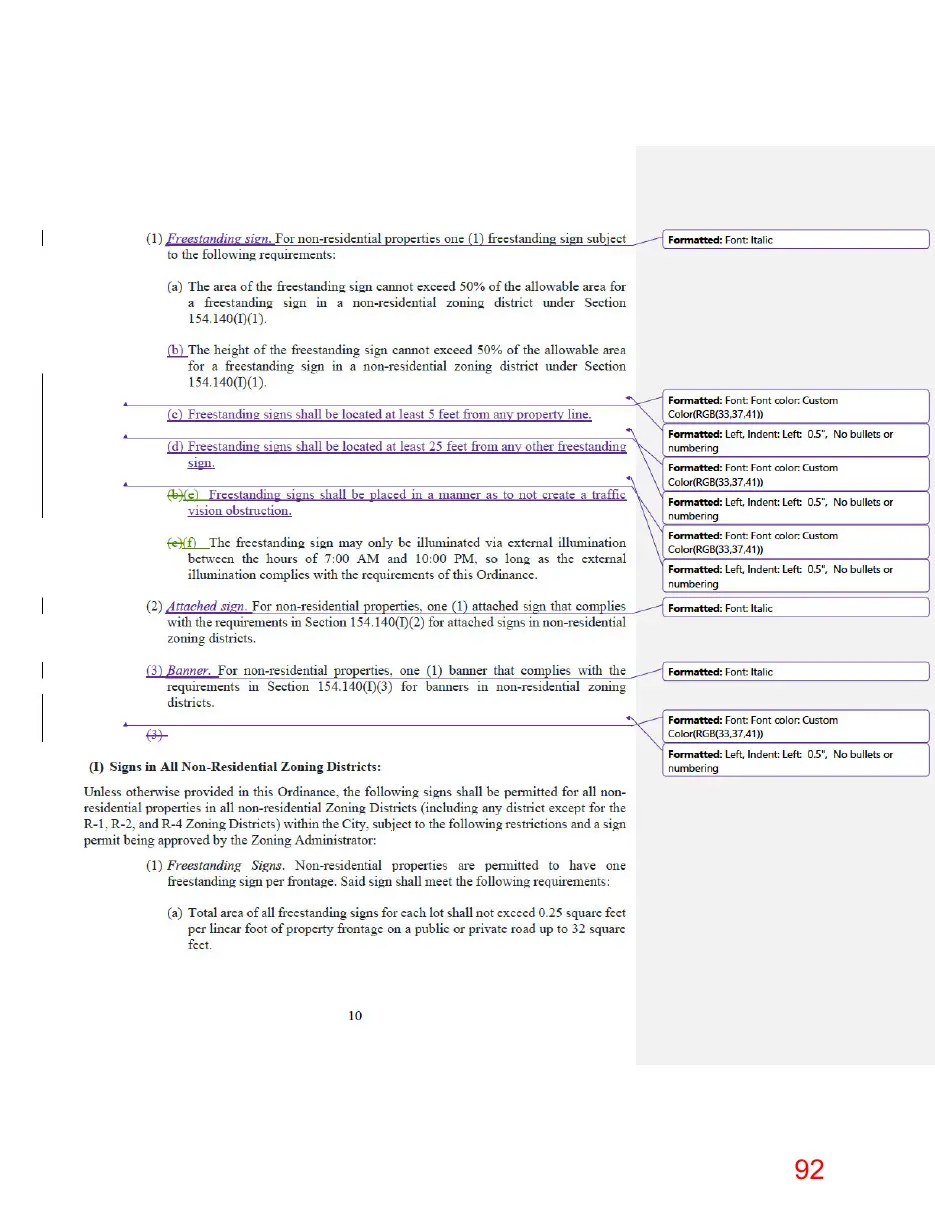
(6) Government-Installed signs or any sign required by law, or by regulation or administrative rule of a governmental entity, having appropriate jurisdiction. (7) For residential properties having a garage sale, up to four (4) temporary yard signs not exceeding six (6) square feet each may be displayed in the right-of-way adjacent to an intersection without a permit so long as there is only one (1) sign per intersection. These signs shall only be displayed during the duration of the garage sale. (8) Murals. Any non-residential property or residential property may install a mural. While a zoning permit is not required, murals must receive approval from the City’s Historical District Commission. (H) Signs in Residential Zoning Districts: Unless otherwise provided in this Ordinance, the following signs shall be permitted in all residential Zoning Districts (R-1, R-2, and R-4 Zoning Districts) within the City, subject to the following restrictions and a sign permit being approved by the Zoning Administrator: (1) Freestanding sign. For non-residential properties one (1) freestanding sign subject to the following requirements: (a) The area of the freestanding sign cannot exceed 50% of the allowable area for a freestanding sign in a non-residential zoning district under Section 154.140(I)(1). (b) The height of the freestanding sign cannot exceed 50% of the allowable area for a freestanding sign in a non-residential zoning district under Section 154.140(I)(1). (c) Freestanding signs shall be located at least 5 feet from any property line. (d) Freestanding signs shall be located at least 25 feet from any other freestanding sign. (e) Freestanding signs shall be placed in a manner as to not create a traffic vision obstruction. (f) The freestanding sign may only be illuminated via external illumination between the hours of 7:00 AM and 10:00 PM, so long as the external illumination complies with the requirements of this Ordinance. (2) Attached sign. For non-residential properties, one (1) attached sign that complies with the requirements in Section 154.140(I)(2) for attached signs in non-residential zoning districts.
Page 108
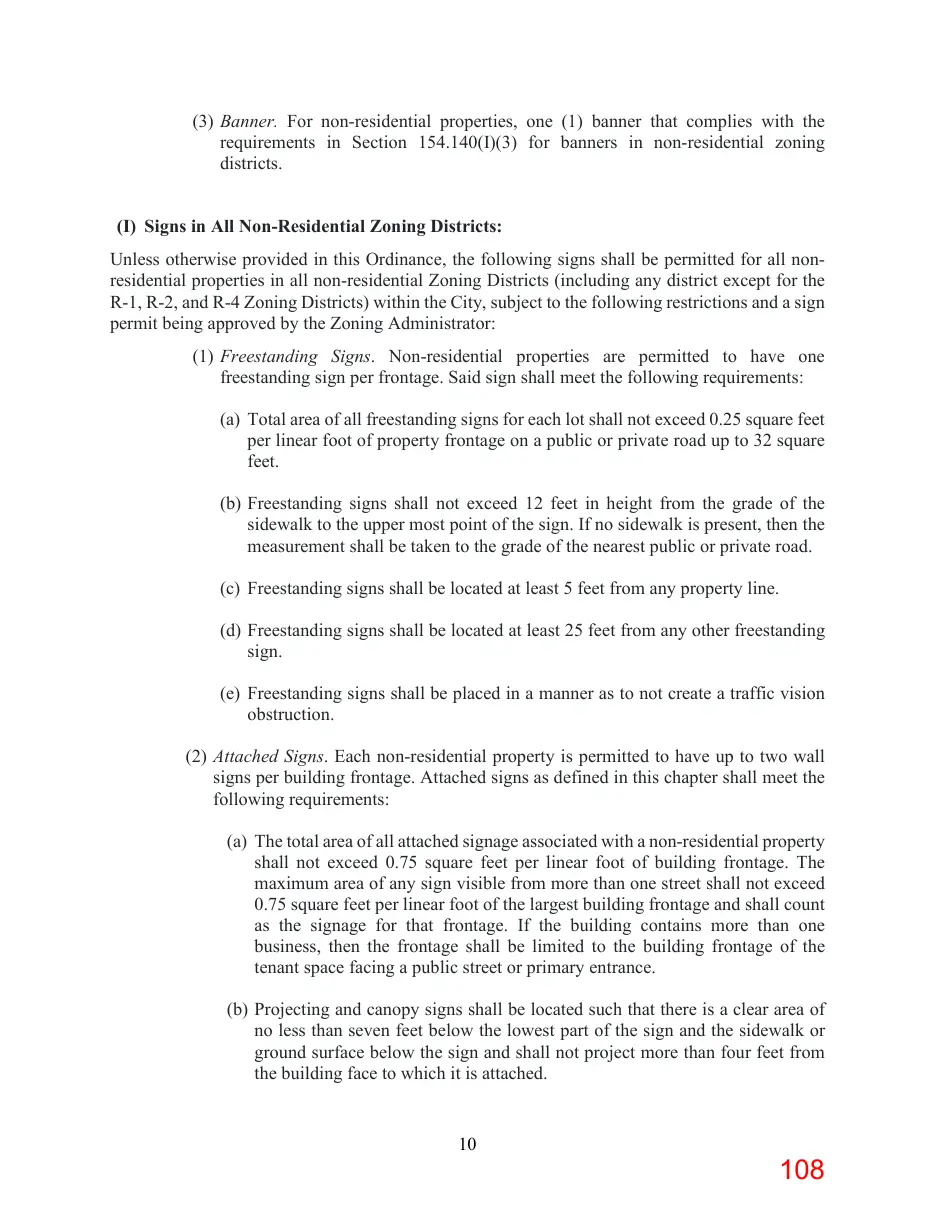
Text of page 108
(3) Banner. For non-residential properties, one (1) banner that complies with the requirements in Section 154.140(I)(3) for banners in non-residential zoning districts. (I) Signs in All Non-Residential Zoning Districts: Unless otherwise provided in this Ordinance, the following signs shall be permitted for all nonresidential properties in all non-residential Zoning Districts (including any district except for the R-1, R-2, and R-4 Zoning Districts) within the City, subject to the following restrictions and a sign permit being approved by the Zoning Administrator: (1) Freestanding Signs. Non-residential properties are permitted to have one freestanding sign per frontage. Said sign shall meet the following requirements: (a) Total area of all freestanding signs for each lot shall not exceed 0.25 square feet per linear foot of property frontage on a public or private road up to 32 square feet. (b) Freestanding signs shall not exceed 12 feet in height from the grade of the sidewalk to the upper most point of the sign. If no sidewalk is present, then the measurement shall be taken to the grade of the nearest public or private road. (c) Freestanding signs shall be located at least 5 feet from any property line. (d) Freestanding signs shall be located at least 25 feet from any other freestanding sign. (e) Freestanding signs shall be placed in a manner as to not create a traffic vision obstruction. (2) Attached Signs. Each non-residential property is permitted to have up to two wall signs per building frontage. Attached signs as defined in this chapter shall meet the following requirements: (a) The total area of all attached signage associated with a non-residential property shall not exceed 0.75 square feet per linear foot of building frontage. The maximum area of any sign visible from more than one street shall not exceed 0.75 square feet per linear foot of the largest building frontage and shall count as the signage for that frontage. If the building contains more than one business, then the frontage shall be limited to the building frontage of the tenant space facing a public street or primary entrance. (b) Projecting and canopy signs shall be located such that there is a clear area of no less than seven feet below the lowest part of the sign and the sidewalk or ground surface below the sign and shall not project more than four feet from the building face to which it is attached.
Page 109
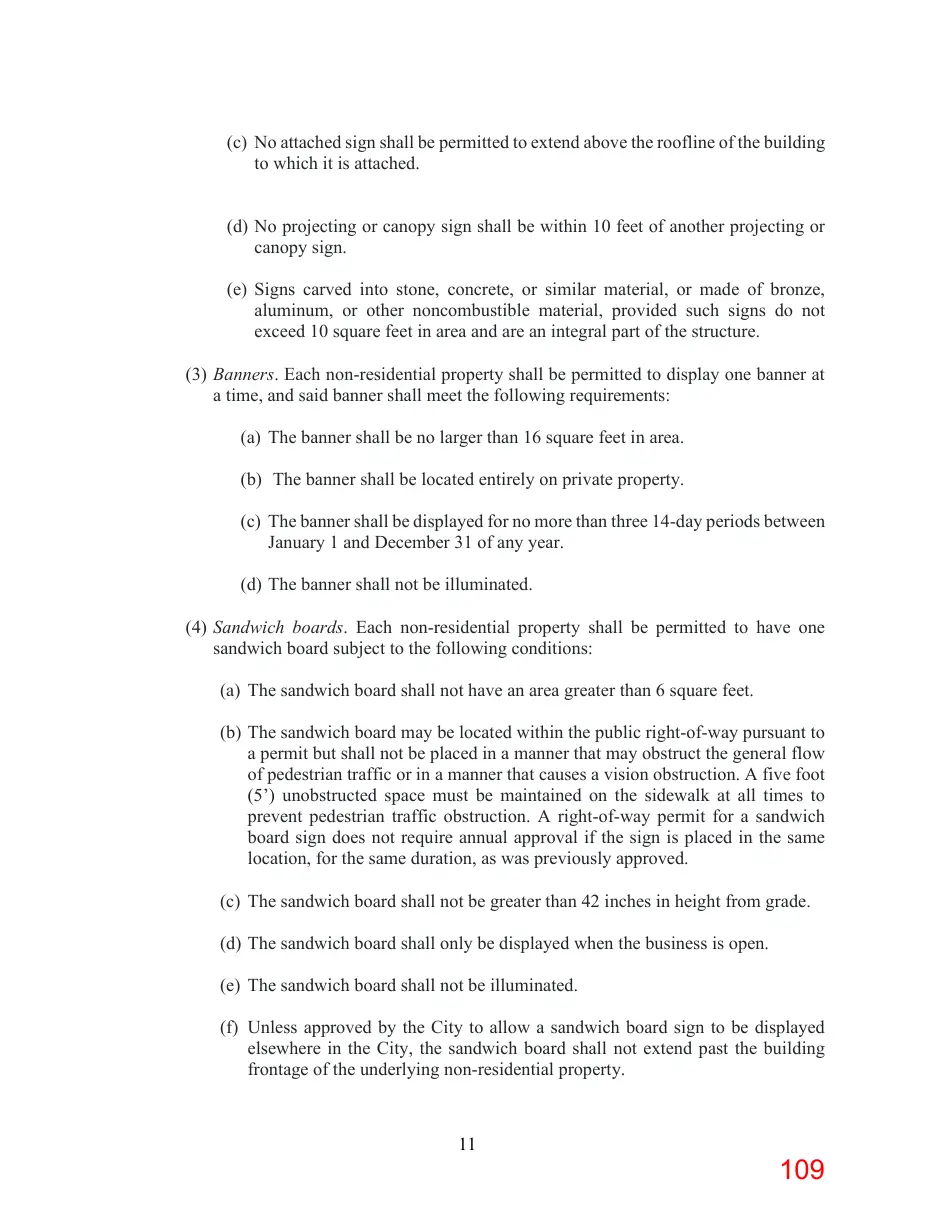
Text of page 109
(c) No attached sign shall be permitted to extend above the roofline of the building to which it is attached. (d) No projecting or canopy sign shall be within 10 feet of another projecting or canopy sign. (e) Signs carved into stone, concrete, or similar material, or made of bronze, aluminum, or other noncombustible material, provided such signs do not exceed 10 square feet in area and are an integral part of the structure. (3) Banners. Each non-residential property shall be permitted to display one banner at a time, and said banner shall meet the following requirements: (a) The banner shall be no larger than 16 square feet in area. (b) The banner shall be located entirely on private property. (c) The banner shall be displayed for no more than three 14-day periods between January 1 and December 31 of any year. (d) The banner shall not be illuminated. (4) Sandwich boards. Each non-residential property shall be permitted to have one sandwich board subject to the following conditions: (a) The sandwich board shall not have an area greater than 6 square feet. (b) The sandwich board may be located within the public right-of-way pursuant to a permit but shall not be placed in a manner that may obstruct the general flow of pedestrian traffic or in a manner that causes a vision obstruction. A five foot (5’) unobstructed space must be maintained on the sidewalk at all times to prevent pedestrian traffic obstruction. A right-of-way permit for a sandwich board sign does not require annual approval if the sign is placed in the same location, for the same duration, as was previously approved. (c) The sandwich board shall not be greater than 42 inches in height from grade. (d) The sandwich board shall only be displayed when the business is open. (e) The sandwich board shall not be illuminated. (f) Unless approved by the City to allow a sandwich board sign to be displayed elsewhere in the City, the sandwich board shall not extend past the building frontage of the underlying non-residential property.
Page 110
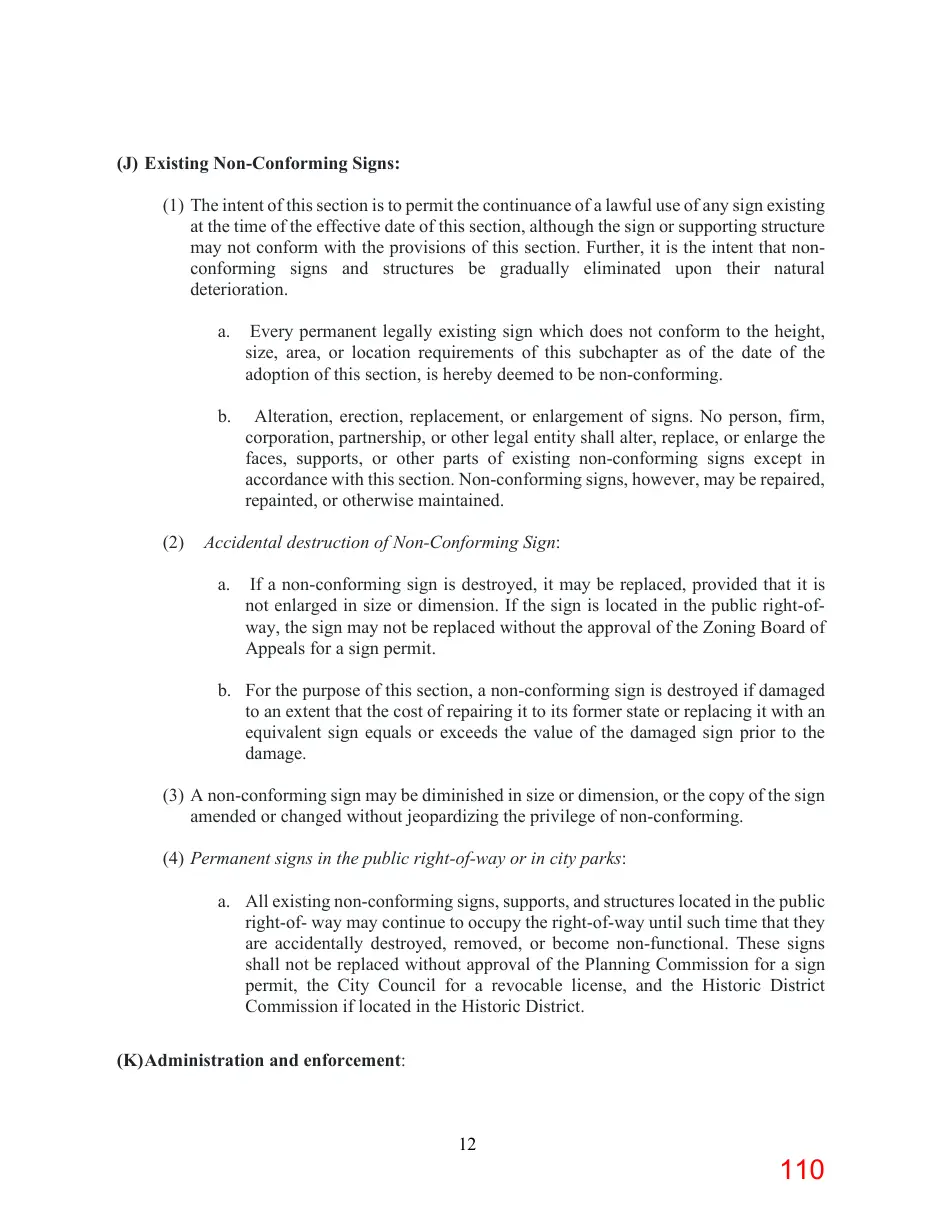
Text of page 110
(J) Existing Non-Conforming Signs: (1) The intent of this section is to permit the continuance of a lawful use of any sign existing at the time of the effective date of this section, although the sign or supporting structure may not conform with the provisions of this section. Further, it is the intent that nonconforming signs and structures be gradually eliminated upon their natural deterioration.
Every permanent legally existing sign which does not conform to the height, size, area, or location requirements of this subchapter as of the date of the adoption of this section, is hereby deemed to be non-conforming.
Alteration, erection, replacement, or enlargement of signs. No person, firm, corporation, partnership, or other legal entity shall alter, replace, or enlarge the faces, supports, or other parts of existing non-conforming signs except in accordance with this section. Non-conforming signs, however, may be repaired, repainted, or otherwise maintained.
Accidental destruction of Non-Conforming Sign: a.
If a non-conforming sign is destroyed, it may be replaced, provided that it is not enlarged in size or dimension. If the sign is located in the public right-ofway, the sign may not be replaced without the approval of the Zoning Board of Appeals for a sign permit.
b. For the purpose of this section, a non-conforming sign is destroyed if damaged to an extent that the cost of repairing it to its former state or replacing it with an equivalent sign equals or exceeds the value of the damaged sign prior to the damage. (3) A non-conforming sign may be diminished in size or dimension, or the copy of the sign amended or changed without jeopardizing the privilege of non-conforming. (4) Permanent signs in the public right-of-way or in city parks: a. All existing non-conforming signs, supports, and structures located in the public right-ofway may continue to occupy the right-of-way until such time that they are accidentally destroyed, removed, or become non-functional. These signs shall not be replaced without approval of the Planning Commission for a sign permit, the City Council for a revocable license, and the Historic District Commission if located in the Historic District. (K) Administration and enforcement:
Page 111
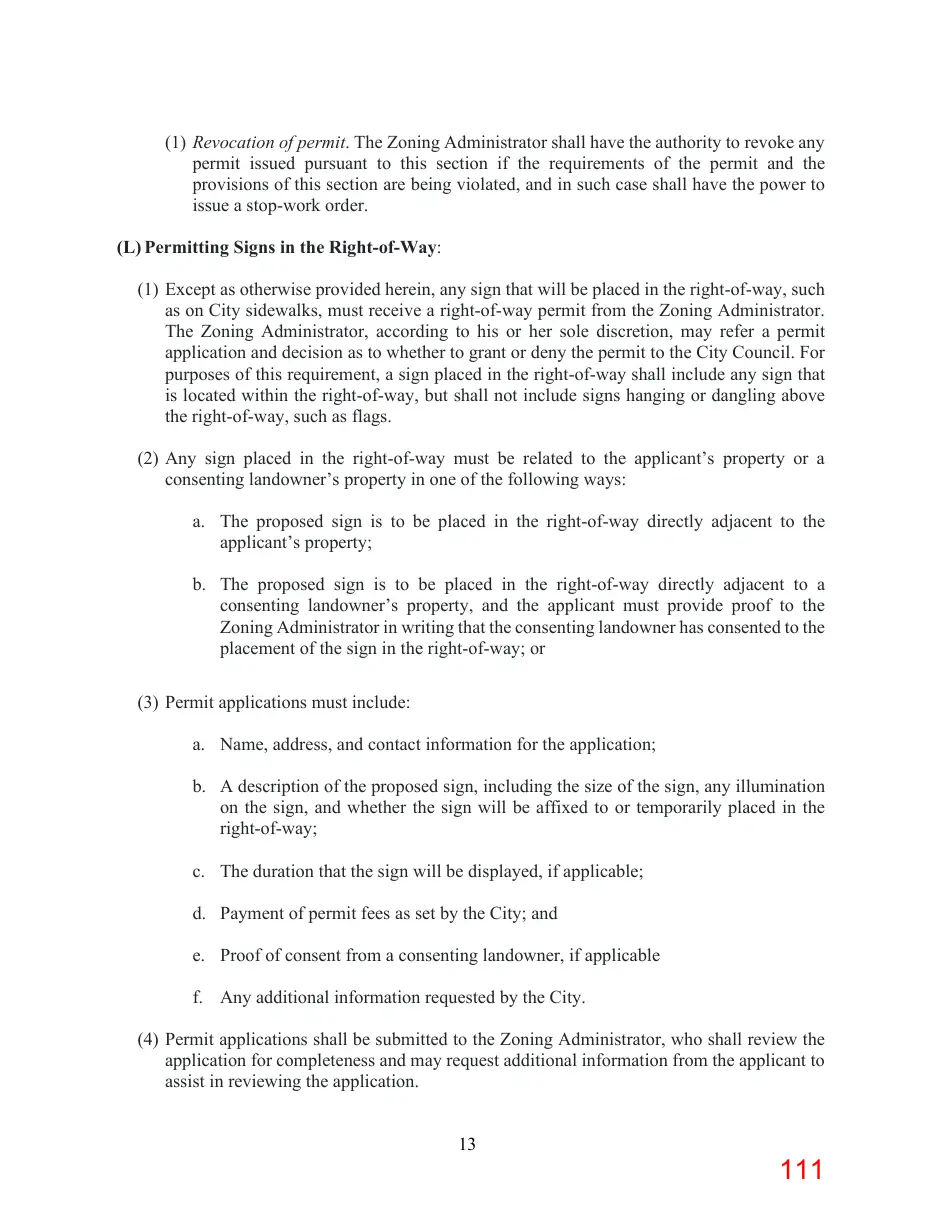
Text of page 111
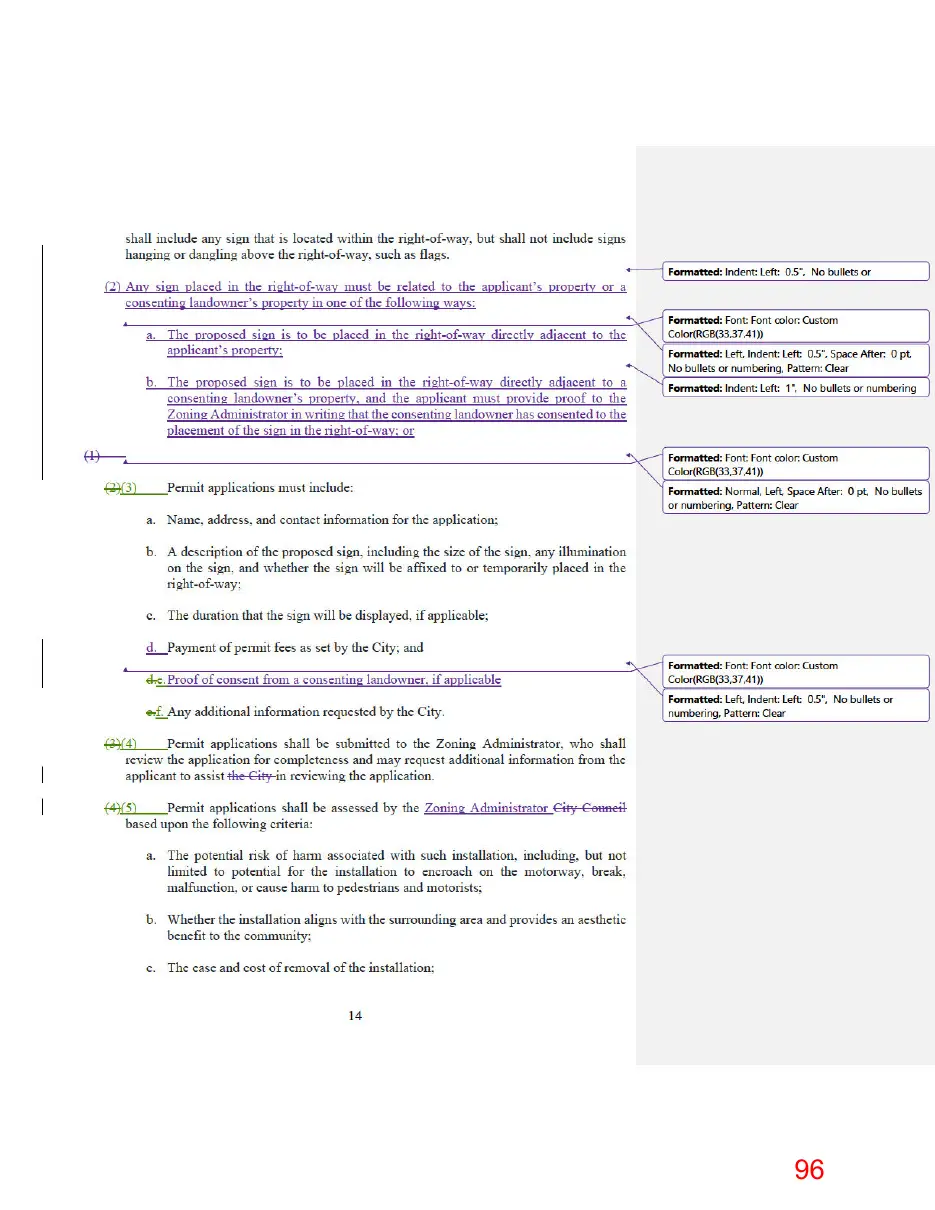
(1) Revocation of permit. The Zoning Administrator shall have the authority to revoke any permit issued pursuant to this section if the requirements of the permit and the provisions of this section are being violated, and in such case shall have the power to issue a stop-work order. (L) Permitting Signs in the Right-of-Way: (1) Except as otherwise provided herein, any sign that will be placed in the right-of-way, such as on City sidewalks, must receive a right-of-way permit from the Zoning Administrator. The Zoning Administrator, according to his or her sole discretion, may refer a permit application and decision as to whether to grant or deny the permit to the City Council. For purposes of this requirement, a sign placed in the right-of-way shall include any sign that is located within the right-of-way, but shall not include signs hanging or dangling above the right-of-way, such as flags. (2) Any sign placed in the right-of-way must be related to the applicant’s property or a consenting landowner’s property in one of the following ways: a. The proposed sign is to be placed in the right-of-way directly adjacent to the applicant’s property; b. The proposed sign is to be placed in the right-of-way directly adjacent to a consenting landowner’s property, and the applicant must provide proof to the Zoning Administrator in writing that the consenting landowner has consented to the placement of the sign in the right-of-way; or (3) Permit applications must include: a. Name, address, and contact information for the application; b. A description of the proposed sign, including the size of the sign, any illumination on the sign, and whether the sign will be affixed to or temporarily placed in the right-of-way; c. The duration that the sign will be displayed, if applicable; d. Payment of permit fees as set by the City; and e. Proof of consent from a consenting landowner, if applicable f. Any additional information requested by the City. (4) Permit applications shall be submitted to the Zoning Administrator, who shall review the application for completeness and may request additional information from the applicant to assist in reviewing the application. 13
Page 112
Text of page 112
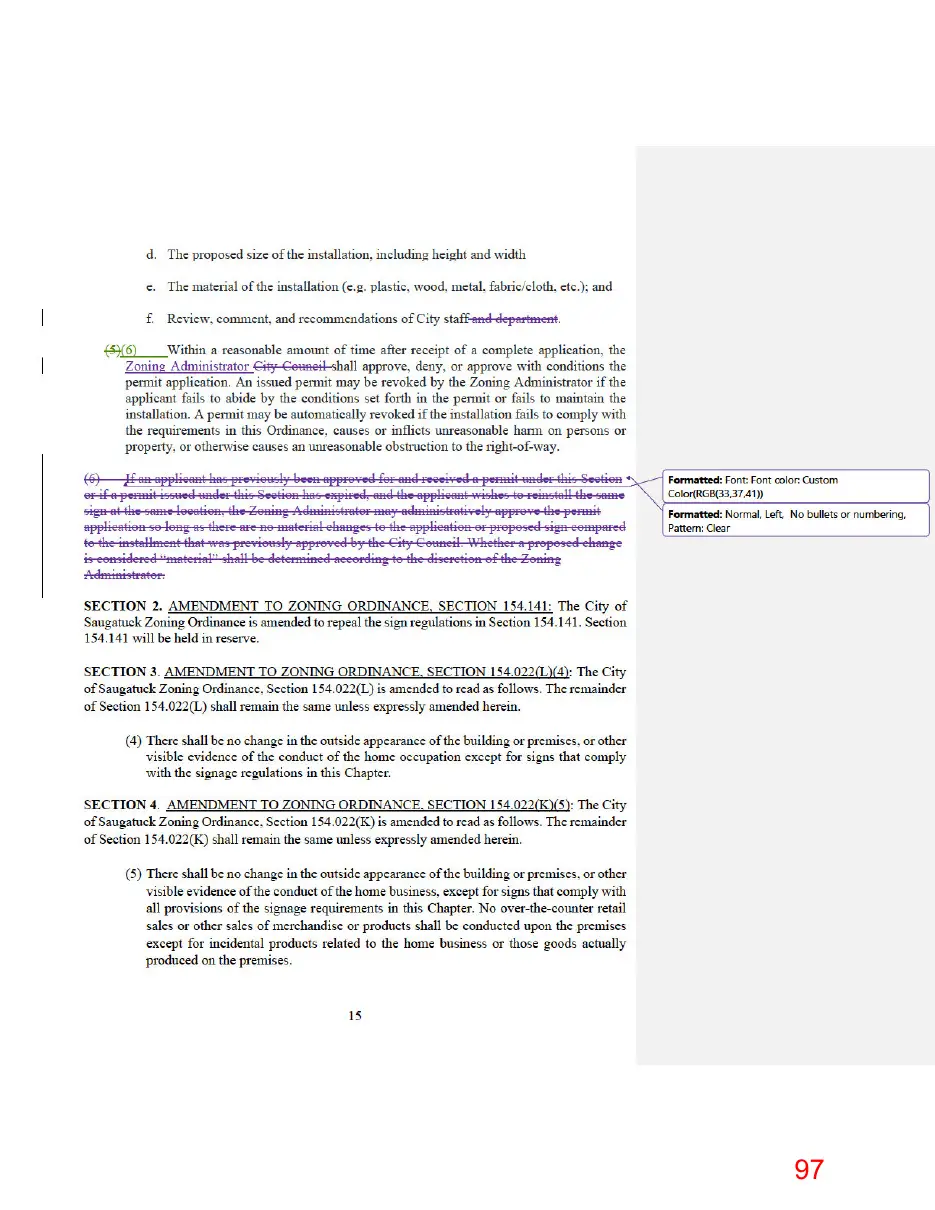
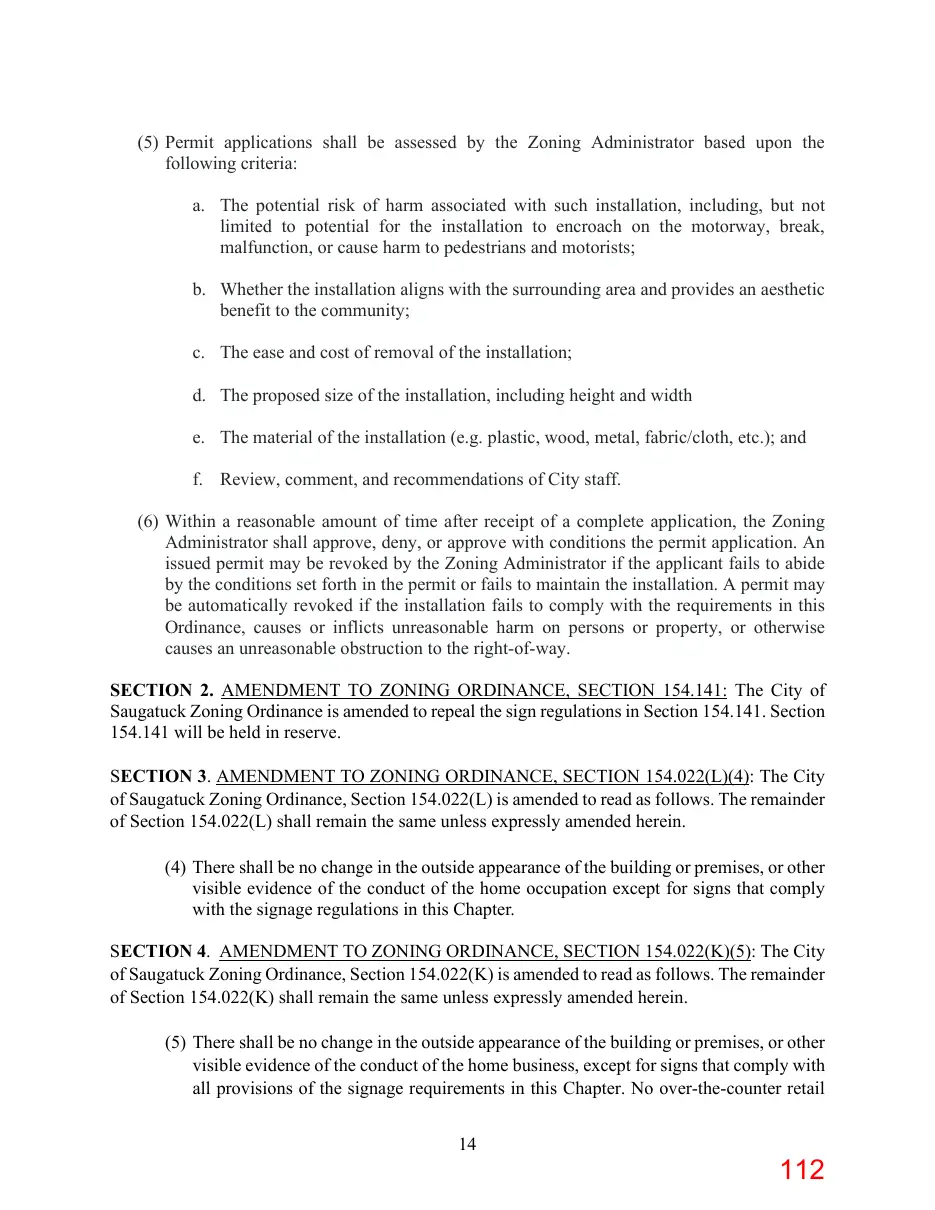
(5) Permit applications shall be assessed by the Zoning Administrator based upon the following criteria: a. The potential risk of harm associated with such installation, including, but not limited to potential for the installation to encroach on the motorway, break, malfunction, or cause harm to pedestrians and motorists; b. Whether the installation aligns with the surrounding area and provides an aesthetic benefit to the community; c. The ease and cost of removal of the installation; d. The proposed size of the installation, including height and width e. The material of the installation (e.g. plastic, wood, metal, fabric/cloth, etc.); and f. Review, comment, and recommendations of City staff. (6) Within a reasonable amount of time after receipt of a complete application, the Zoning Administrator shall approve, deny, or approve with conditions the permit application. An issued permit may be revoked by the Zoning Administrator if the applicant fails to abide by the conditions set forth in the permit or fails to maintain the installation. A permit may be automatically revoked if the installation fails to comply with the requirements in this Ordinance, causes or inflicts unreasonable harm on persons or property, or otherwise causes an unreasonable obstruction to the right-of-way. SECTION 2. AMENDMENT TO ZONING ORDINANCE, SECTION 154.141: The City of Saugatuck Zoning Ordinance is amended to repeal the sign regulations in Section 154.141. Section 154.141 will be held in reserve. SECTION 3. AMENDMENT TO ZONING ORDINANCE, SECTION 154.022(L)(4): The City of Saugatuck Zoning Ordinance, Section 154.022(L) is amended to read as follows. The remainder of Section 154.022(L) shall remain the same unless expressly amended herein. (4) There shall be no change in the outside appearance of the building or premises, or other visible evidence of the conduct of the home occupation except for signs that comply with the signage regulations in this Chapter. SECTION 4. AMENDMENT TO ZONING ORDINANCE, SECTION 154.022(K)(5): The City of Saugatuck Zoning Ordinance, Section 154.022(K) is amended to read as follows. The remainder of Section 154.022(K) shall remain the same unless expressly amended herein. (5) There shall be no change in the outside appearance of the building or premises, or other visible evidence of the conduct of the home business, except for signs that comply with all provisions of the signage requirements in this Chapter. No over-the-counter retail 14
Page 113
Text of page 113
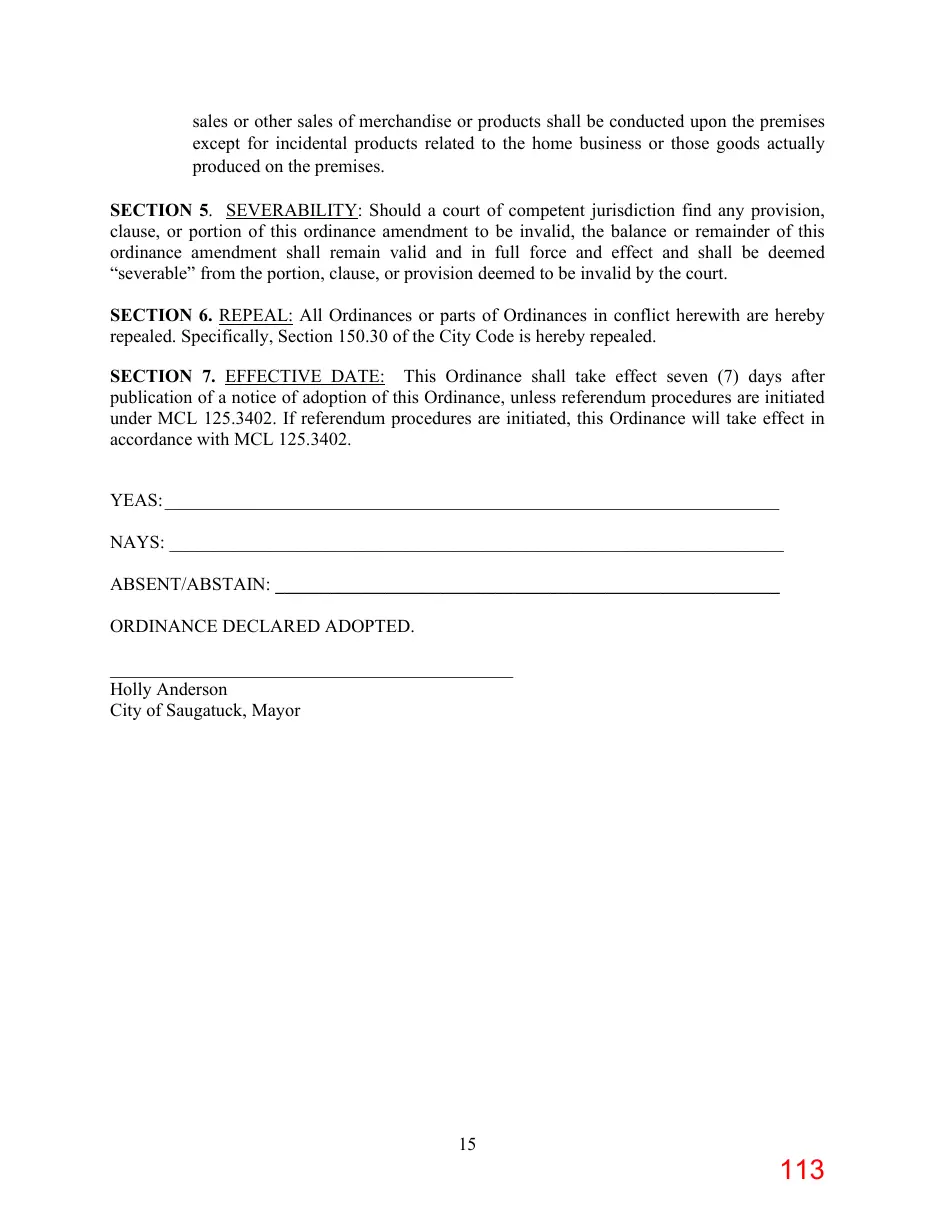
sales or other sales of merchandise or products shall be conducted upon the premises except for incidental products related to the home business or those goods actually produced on the premises. SECTION 5. SEVERABILITY: Should a court of competent jurisdiction find any provision, clause, or portion of this ordinance amendment to be invalid, the balance or remainder of this ordinance amendment shall remain valid and in full force and effect and shall be deemed “severable” from the portion, clause, or provision deemed to be invalid by the court. SECTION 6. REPEAL: All Ordinances or parts of Ordinances in conflict herewith are hereby repealed. Specifically, Section 150.30 of the City Code is hereby repealed. SECTION 7. EFFECTIVE DATE: This Ordinance shall take effect seven (7) days after publication of a notice of adoption of this Ordinance, unless referendum procedures are initiated under MCL 125.3402. If referendum procedures are initiated, this Ordinance will take effect in accordance with MCL 125.3402. YEAS: ___________________________________________________________________ NAYS: ___________________________________________________________________ ABSENT/ABSTAIN: _______________________________________________________ ORDINANCE DECLARED ADOPTED. ____________________________________________ Holly Anderson City of Saugatuck, Mayor