
Parks & Public Works Agenda item 6E
Birds, Wildlife & Dogs
Parks and Public Works Committee, Tuesday, September 22, 2026
Download these 6 pages, 750 KB Whole packet, 60 pages, 41.2 MB
Page 55
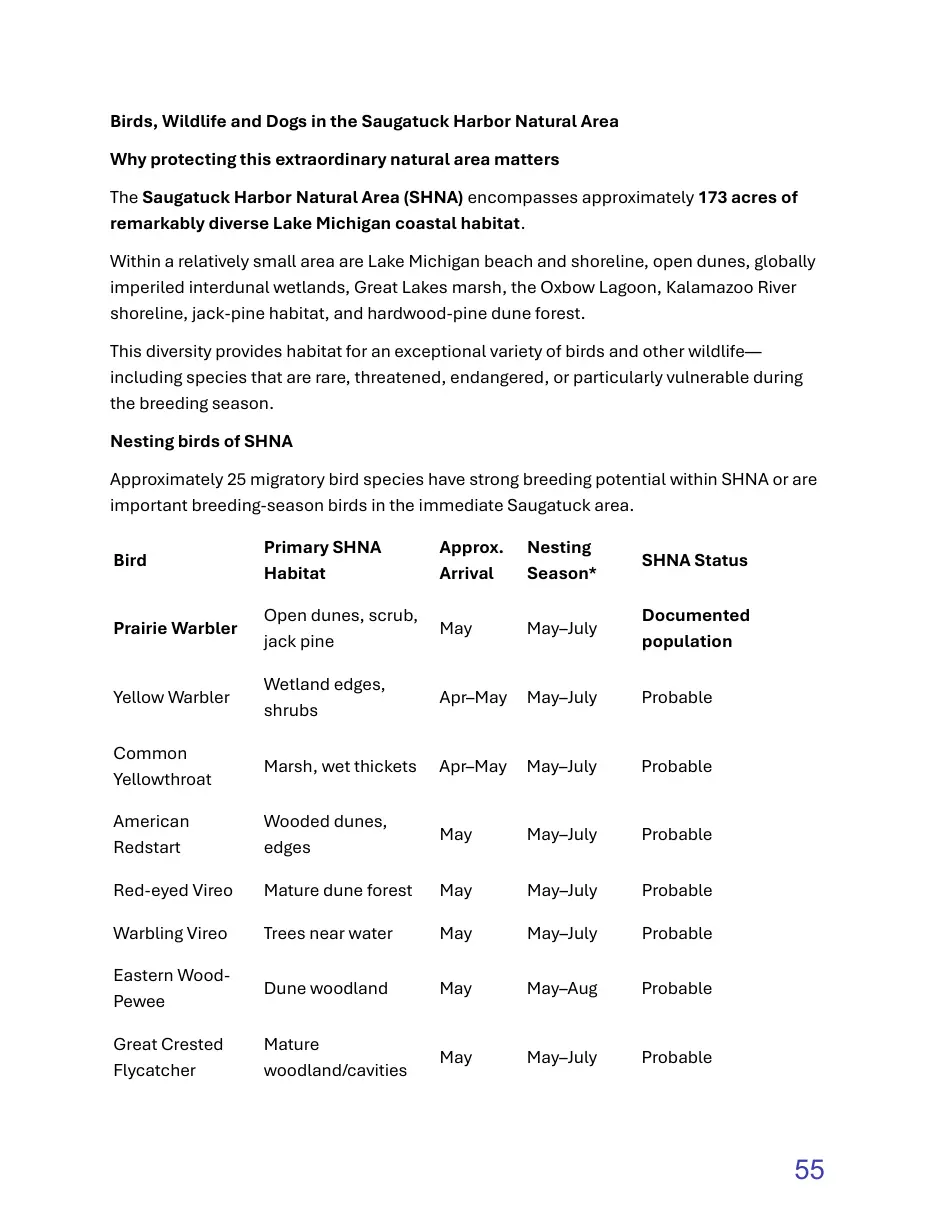
Text of page 55
Birds, Wildlife and Dogs in the Saugatuck Harbor Natural Area Why protecting this extraordinary natural area matters The Saugatuck Harbor Natural Area (SHNA) encompasses approximately 173 acres of remarkably diverse Lake Michigan coastal habitat. Within a relatively small area are Lake Michigan beach and shoreline, open dunes, globally imperiled interdunal wetlands, Great Lakes marsh, the Oxbow Lagoon, Kalamazoo River shoreline, jack-pine habitat, and hardwood-pine dune forest. This diversity provides habitat for an exceptional variety of birds and other wildlife— including species that are rare, threatened, endangered, or particularly vulnerable during the breeding season. Nesting birds of SHNA Approximately 25 migratory bird species have strong breeding potential within SHNA or are important breeding-season birds in the immediate Saugatuck area. Bird
Primary SHNA Habitat
Approx. Arrival
Nesting Season*
SHNA Status
Prairie Warbler
Open dunes, scrub, jack pine
May
May–July
Documented population
Yellow Warbler
Wetland edges, shrubs
Apr–May
May–July
Probable
Common Yellowthroat
Marsh, wet thickets
Apr–May
May–July
Probable
American Redstart
Wooded dunes, edges
May
May–July
Probable
Red-eyed Vireo
Mature dune forest
May
May–July
Probable
Warbling Vireo
Trees near water
May
May–July
Probable
Eastern WoodPewee
Dune woodland
May
May–Aug
Probable
Great Crested Flycatcher
Mature woodland/cavities
May
May–July
Probable
Page 56
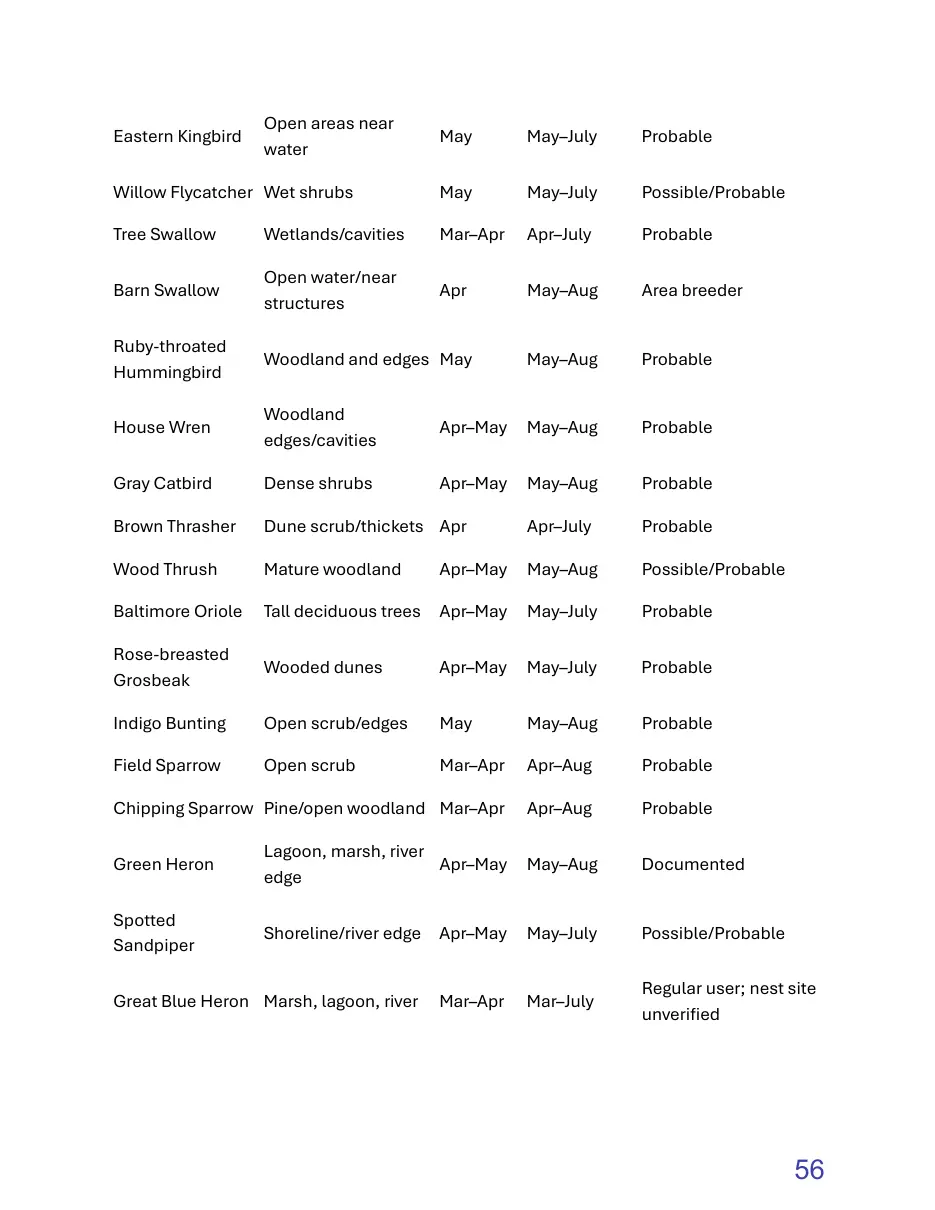
Text of page 56
Eastern Kingbird
Open areas near water
May
May–July
Probable
Willow Flycatcher Wet shrubs
May
May–July
Possible/Probable
Tree Swallow
Wetlands/cavities
Mar–Apr
Apr–July
Probable
Barn Swallow
Open water/near structures
Apr
May–Aug
Area breeder
Ruby-throated Hummingbird
Woodland and edges May
May–Aug
Probable
House Wren
Woodland edges/cavities
Apr–May
May–Aug
Probable
Gray Catbird
Dense shrubs
Apr–May
May–Aug
Probable
Brown Thrasher
Dune scrub/thickets Apr
Apr–July
Probable
Wood Thrush
Mature woodland
Apr–May
May–Aug
Possible/Probable
Baltimore Oriole
Tall deciduous trees
Apr–May
May–July
Probable
Rose-breasted Grosbeak
Wooded dunes
Apr–May
May–July
Probable
Indigo Bunting
Open scrub/edges
May
May–Aug
Probable
Field Sparrow
Open scrub
Mar–Apr
Apr–Aug
Probable
Chipping Sparrow Pine/open woodland Mar–Apr
Apr–Aug
Probable
Green Heron
Lagoon, marsh, river Apr–May edge
May–Aug
Documented
Spotted Sandpiper
Shoreline/river edge
Apr–May
May–July
Possible/Probable
Great Blue Heron Marsh, lagoon, river
Mar–Apr
Mar–July
Regular user; nest site unverified
Page 57
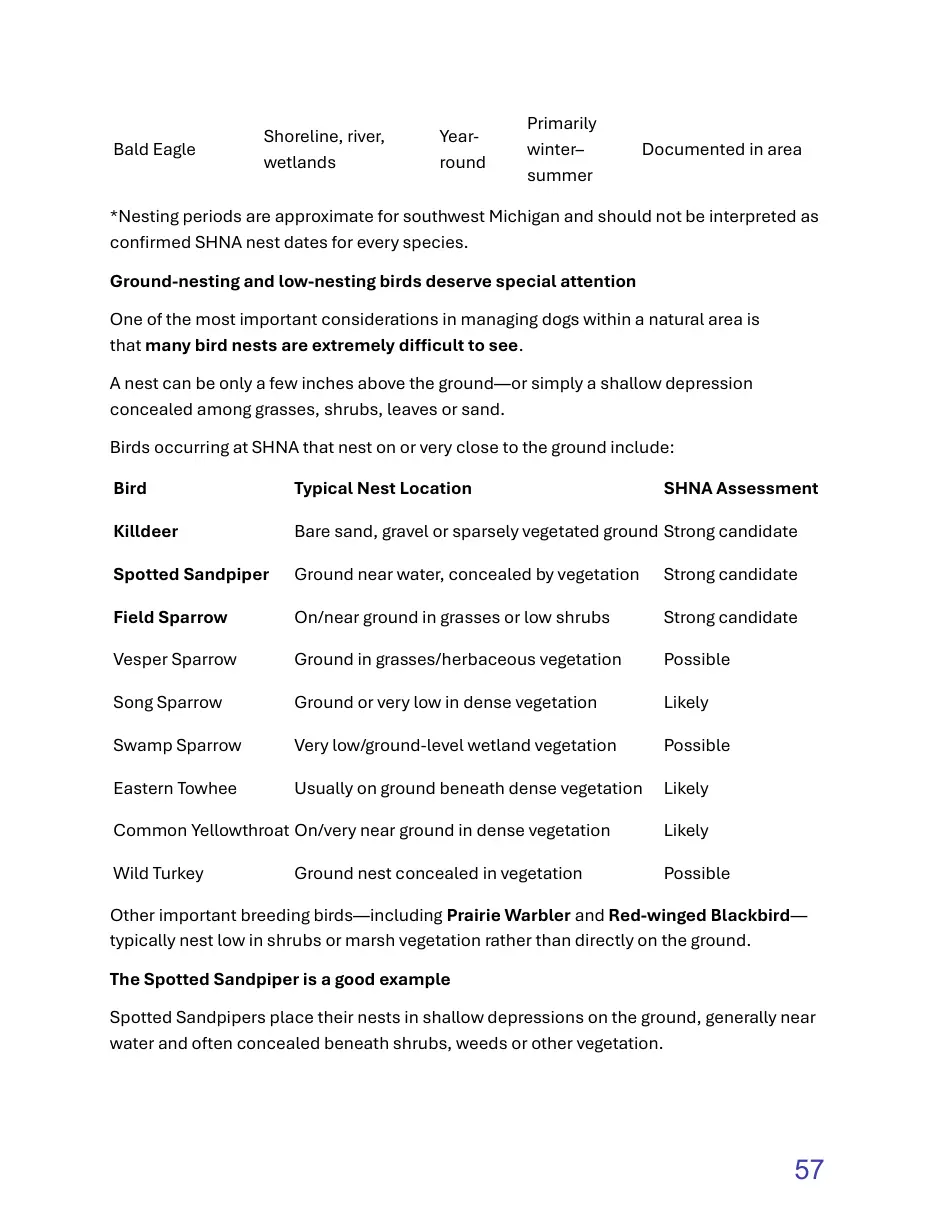
Text of page 57
Bald Eagle
Shoreline, river, wetlands
Yearround
Primarily winter– summer
Documented in area
*Nesting periods are approximate for southwest Michigan and should not be interpreted as confirmed SHNA nest dates for every species. Ground-nesting and low-nesting birds deserve special attention One of the most important considerations in managing dogs within a natural area is that many bird nests are extremely di icult to see. A nest can be only a few inches above the ground—or simply a shallow depression concealed among grasses, shrubs, leaves or sand. Birds occurring at SHNA that nest on or very close to the ground include: Bird
Typical Nest Location
SHNA Assessment
Killdeer
Bare sand, gravel or sparsely vegetated ground Strong candidate
Spotted Sandpiper
Ground near water, concealed by vegetation
Strong candidate
Field Sparrow
On/near ground in grasses or low shrubs
Strong candidate
Vesper Sparrow
Ground in grasses/herbaceous vegetation
Possible
Song Sparrow
Ground or very low in dense vegetation
Likely
Swamp Sparrow
Very low/ground-level wetland vegetation
Possible
Eastern Towhee
Usually on ground beneath dense vegetation
Likely
Common Yellowthroat On/very near ground in dense vegetation
Likely
Wild Turkey
Possible
Ground nest concealed in vegetation
Other important breeding birds—including Prairie Warbler and Red-winged Blackbird— typically nest low in shrubs or marsh vegetation rather than directly on the ground. The Spotted Sandpiper is a good example Spotted Sandpipers place their nests in shallow depressions on the ground, generally near water and often concealed beneath shrubs, weeds or other vegetation.
Page 58
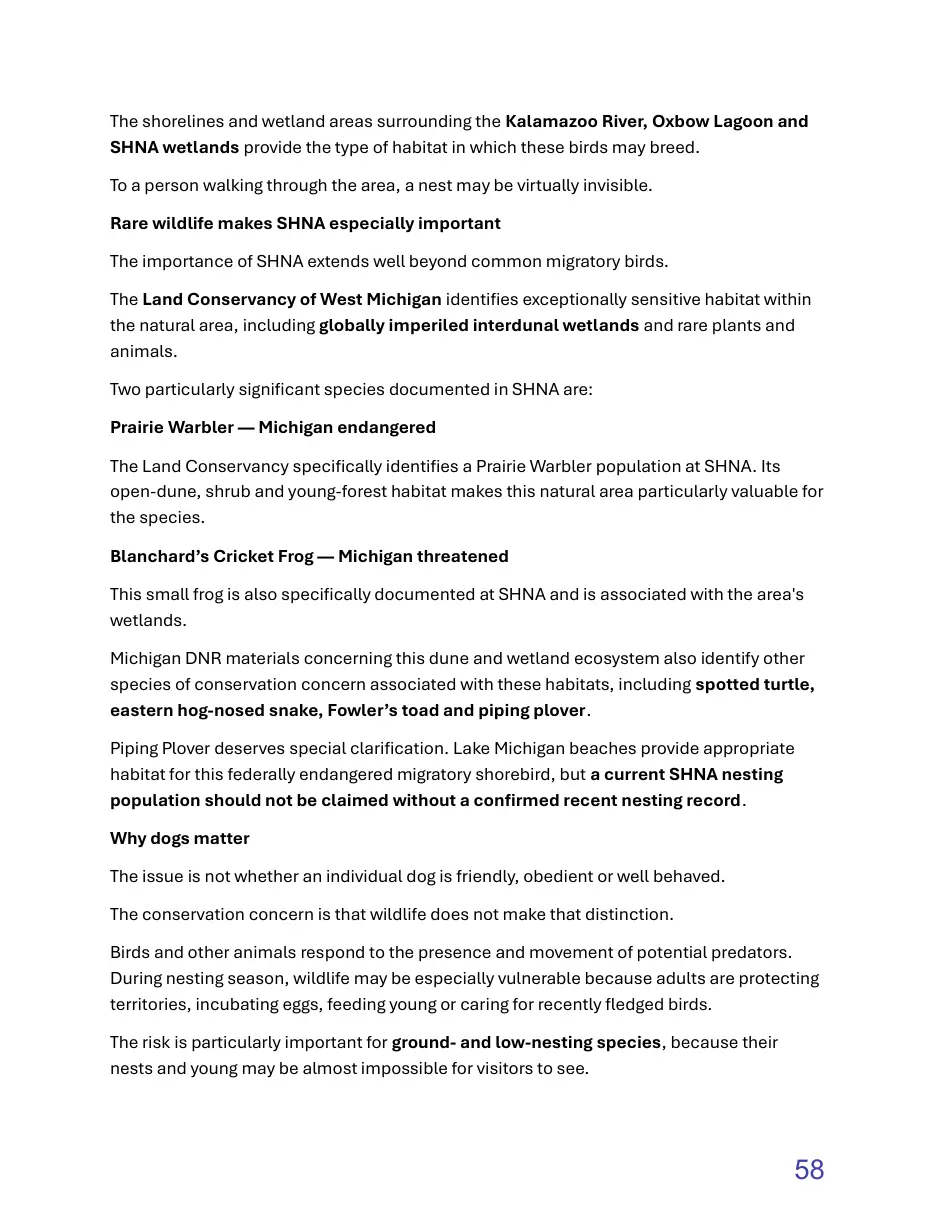
Text of page 58
The shorelines and wetland areas surrounding the Kalamazoo River, Oxbow Lagoon and SHNA wetlands provide the type of habitat in which these birds may breed. To a person walking through the area, a nest may be virtually invisible. Rare wildlife makes SHNA especially important The importance of SHNA extends well beyond common migratory birds. The Land Conservancy of West Michigan identifies exceptionally sensitive habitat within the natural area, including globally imperiled interdunal wetlands and rare plants and animals. Two particularly significant species documented in SHNA are: Prairie Warbler — Michigan endangered The Land Conservancy specifically identifies a Prairie Warbler population at SHNA. Its open-dune, shrub and young-forest habitat makes this natural area particularly valuable for the species. Blanchard’s Cricket Frog — Michigan threatened This small frog is also specifically documented at SHNA and is associated with the area's wetlands. Michigan DNR materials concerning this dune and wetland ecosystem also identify other species of conservation concern associated with these habitats, including spotted turtle, eastern hog-nosed snake, Fowler’s toad and piping plover. Piping Plover deserves special clarification. Lake Michigan beaches provide appropriate habitat for this federally endangered migratory shorebird, but a current SHNA nesting population should not be claimed without a confirmed recent nesting record. Why dogs matter The issue is not whether an individual dog is friendly, obedient or well behaved. The conservation concern is that wildlife does not make that distinction. Birds and other animals respond to the presence and movement of potential predators. During nesting season, wildlife may be especially vulnerable because adults are protecting territories, incubating eggs, feeding young or caring for recently fledged birds. The risk is particularly important for groundand low-nesting species, because their nests and young may be almost impossible for visitors to see.
Page 59
Text of page 59
SHNA combines several characteristics that make wildlife protection especially important: Rare species. Sensitive wetland and dune habitat. Groundand low-nesting birds. Migratory birds. Lake Michigan shoreline. Oxbow Lagoon. Kalamazoo River habitat. These resources occur together within a relatively small natural area. The purpose of the dog restriction The restriction on dogs within sensitive portions of SHNA should therefore be understood in its proper context: It is a wildlife and habitat protection measure. SHNA management material states that dogs are prohibited from the interior north of Oxbow Lagoon and along the lagoon shoreline because of the potential for damage to rare wildlife populations and habitats. The City of Saugatuck's public information likewise emphasizes that SHNA contains rare Michigan species and identifies protection of those species as a reason dogs are not permitted within the Natural Area. The Land Conservancy of West Michigan may permit leashed pets at some preserves, but it also recognizes that sensitive natural areas require exceptions and that some preserves prohibit pets entirely. That distinction is important. Not every park is the same, and not every natural area should be managed the same way. SHNA was preserved in significant part because of the extraordinary natural resources found there. Protecting those resources sometimes requires restrictions that would not be necessary in an ordinary municipal park. A simple principle Visitors can enjoy SHNA while also recognizing that wildlife has only one habitat. Keeping dogs out of areas where they are prohibited helps protect nesting birds, rare wildlife, wetlands and sensitive dune habitat—and helps preserve the qualities that make the Saugatuck Harbor Natural Area exceptional in the first place. Protect the habitat. Protect the nesting birds.
Page 60
Text of page 60
Protect the rare species. Preserve SHNA for the future.
Sources
Land Conservancy of West Michigan — Saugatuck Harbor Natural Area
City of Saugatuck / local SHNA information
Michigan Department of Natural Resources
National Audubon Society
eBird / Cornell Lab of Ornithology
Martin Blagburn — Holland Audubon Board Member
Keith Charak — Birder, Holland Audubon Member
John Fleming — Birder, Holland Audubon Member
Prepared by Keith Charak