
Parks & Public Works Agenda item 6D
Pocket Prairies
Parks and Public Works Committee, Tuesday, September 22, 2026
Download these 12 pages, 2.9 MB Whole packet, 60 pages, 41.2 MB
Page 43
Text of page 43
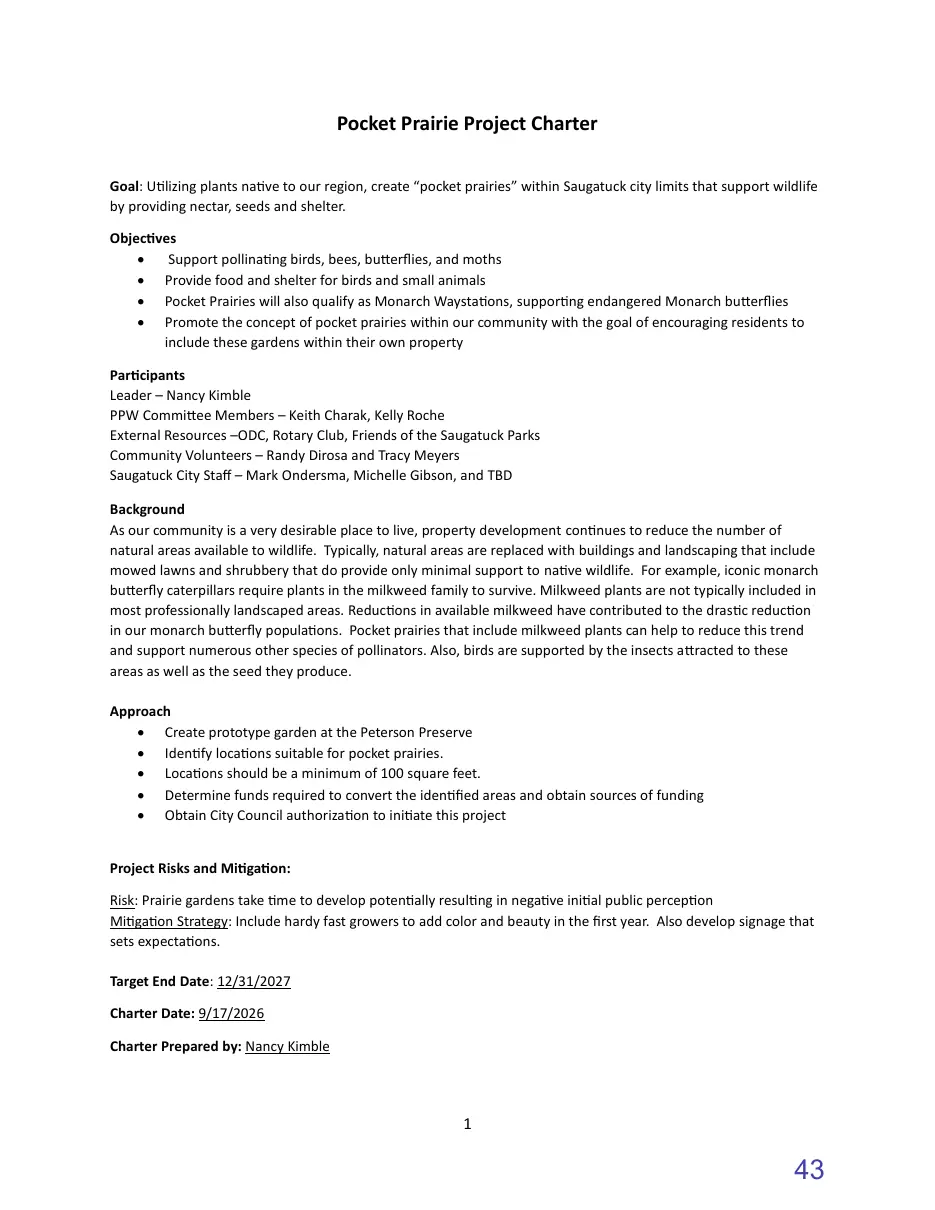
Pocket Prairie Project Charter Goal: U lizing plants na ve to our region, create “pocket prairies” within Saugatuck city limits that support wildlife by providing nectar, seeds and shelter. Objec ves Support pollina ng birds, bees, bu erflies, and moths Provide food and shelter for birds and small animals Pocket Prairies will also qualify as Monarch Waysta ons, suppor ng endangered Monarch bu erflies Promote the concept of pocket prairies within our community with the goal of encouraging residents to include these gardens within their own property Par cipants Leader – Nancy Kimble PPW Commi ee Members – Keith Charak, Kelly Roche External Resources –ODC, Rotary Club, Friends of the Saugatuck Parks Community Volunteers – Randy Dirosa and Tracy Meyers Saugatuck City Staff – Mark Ondersma, Michelle Gibson, and TBD Background As our community is a very desirable place to live, property development con nues to reduce the number of natural areas available to wildlife. Typically, natural areas are replaced with buildings and landscaping that include mowed lawns and shrubbery that do provide only minimal support to na ve wildlife. For example, iconic monarch bu erfly caterpillars require plants in the milkweed family to survive. Milkweed plants are not typically included in most professionally landscaped areas. Reduc ons in available milkweed have contributed to the dras c reduc on in our monarch bu erfly popula ons. Pocket prairies that include milkweed plants can help to reduce this trend and support numerous other species of pollinators. Also, birds are supported by the insects a racted to these areas as well as the seed they produce. Approach Create prototype garden at the Peterson Preserve Iden fy loca ons suitable for pocket prairies. Loca ons should be a minimum of 100 square feet. Determine funds required to convert the iden fied areas and obtain sources of funding Obtain City Council authoriza on to ini ate this project Project Risks and Mi ga on: Risk: Prairie gardens take me to develop poten ally resul ng in nega ve ini al public percep on Mi ga on Strategy: Include hardy fast growers to add color and beauty in the first year. Also develop signage that sets expecta ons. Target End Date: 12/31/2027 Charter Date: 9/17/2026 Charter Prepared by: Nancy Kimble
Page 44
Text of page 44
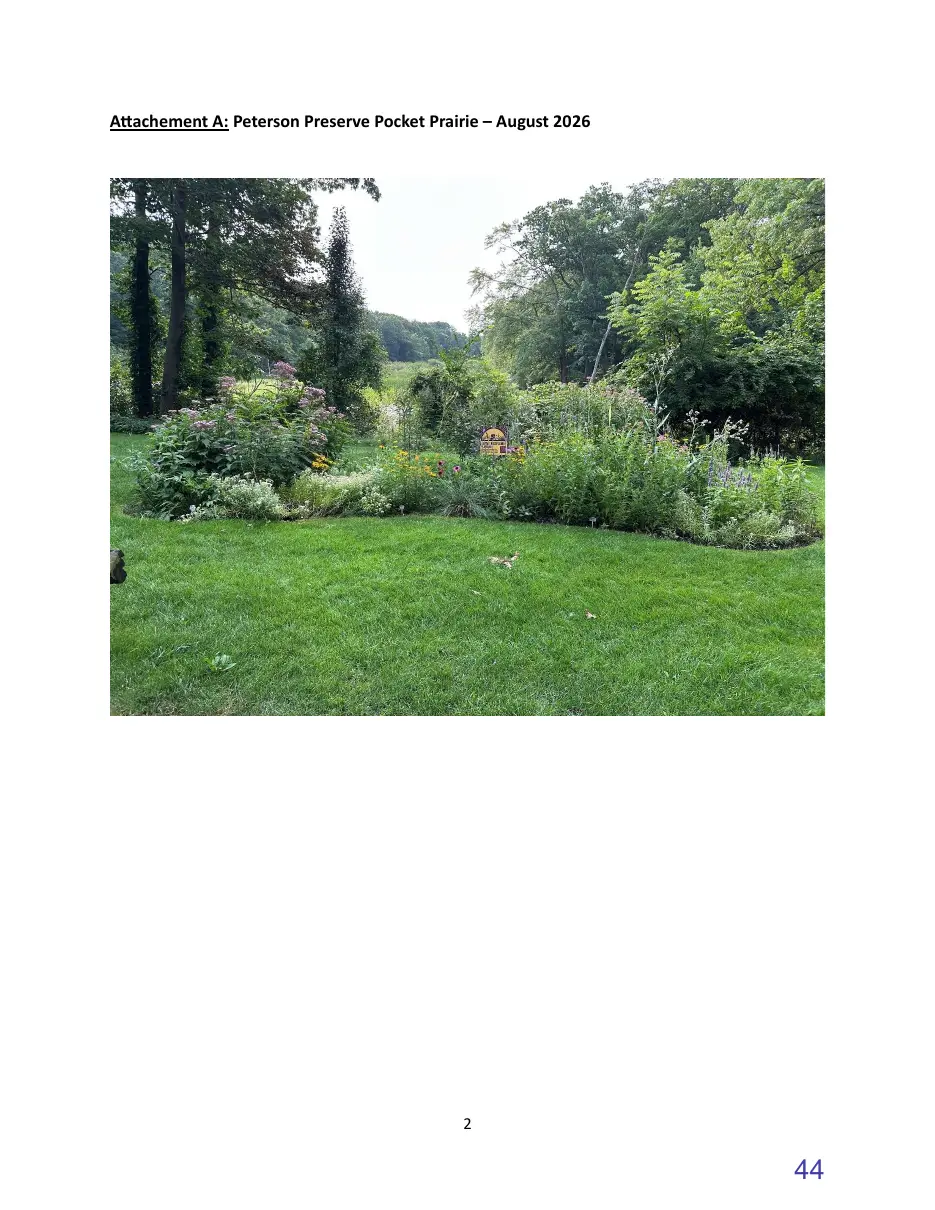
A achement A: Peterson Preserve Pocket Prairie – August 2026
Page 45
Text of page 45
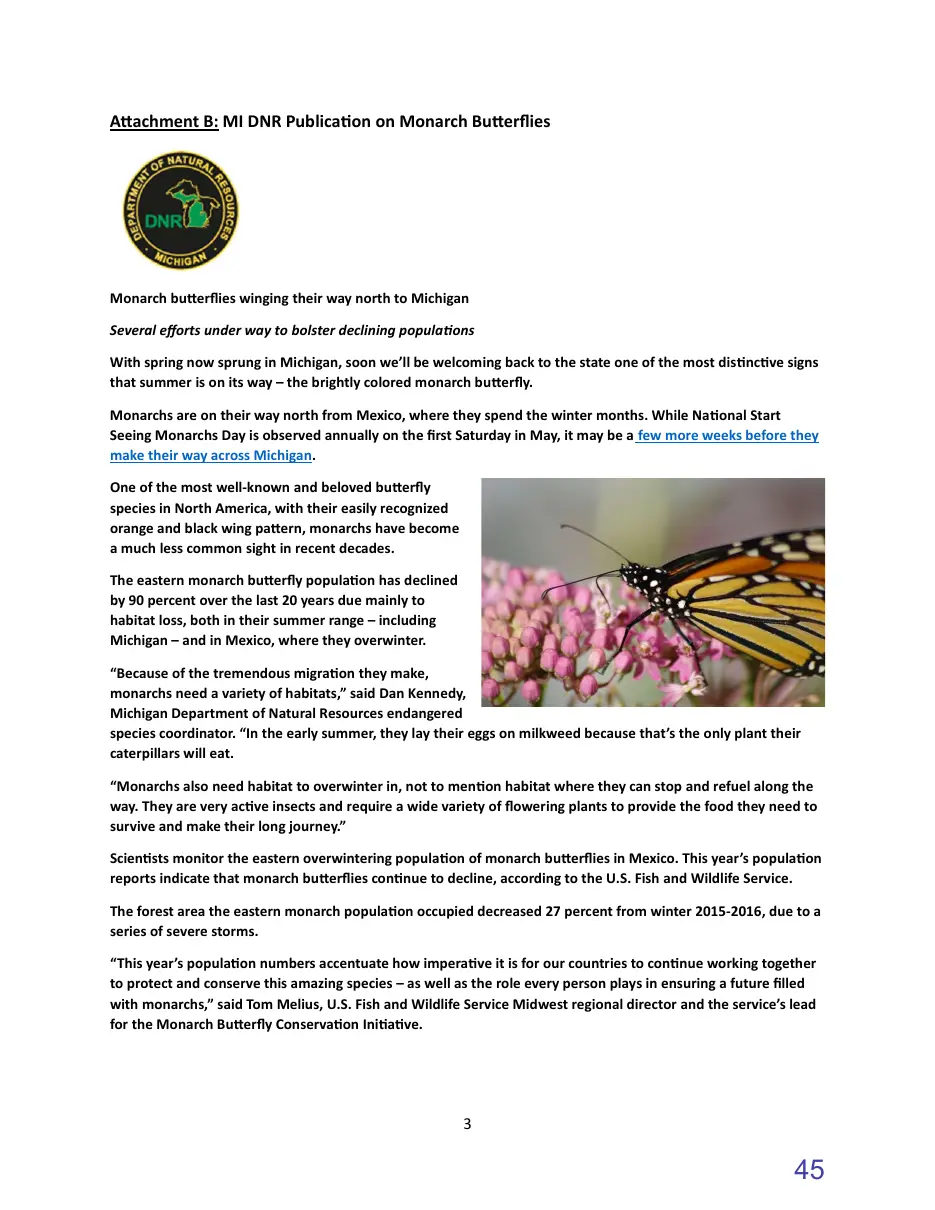
A achment B: MI DNR Publica on on Monarch Bu erflies
Monarch bu erflies winging their way north to Michigan Several efforts under way to bolster declining popula ons With spring now sprung in Michigan, soon we’ll be welcoming back to the state one of the most dis nc ve signs that summer is on its way – the brightly colored monarch bu erfly. Monarchs are on their way north from Mexico, where they spend the winter months. While Na onal Start Seeing Monarchs Day is observed annually on the first Saturday in May, it may be a few more weeks before they make their way across Michigan. One of the most well-known and beloved bu erfly species in North America, with their easily recognized orange and black wing pa ern, monarchs have become a much less common sight in recent decades. The eastern monarch bu erfly popula on has declined by 90 percent over the last 20 years due mainly to habitat loss, both in their summer range – including Michigan – and in Mexico, where they overwinter. “Because of the tremendous migra on they make, monarchs need a variety of habitats,” said Dan Kennedy, Michigan Department of Natural Resources endangered species coordinator. “In the early summer, they lay their eggs on milkweed because that’s the only plant their caterpillars will eat. “Monarchs also need habitat to overwinter in, not to men on habitat where they can stop and refuel along the way. They are very ac ve insects and require a wide variety of flowering plants to provide the food they need to survive and make their long journey.” Scien sts monitor the eastern overwintering popula on of monarch bu erflies in Mexico. This year’s popula on reports indicate that monarch bu erflies con nue to decline, according to the U.S. Fish and Wildlife Service. The forest area the eastern monarch popula on occupied decreased 27 percent from winter 2015-2016, due to a series of severe storms. “This year’s popula on numbers accentuate how impera ve it is for our countries to con nue working together to protect and conserve this amazing species – as well as the role every person plays in ensuring a future filled with monarchs,” said Tom Melius, U.S. Fish and Wildlife Service Midwest regional director and the service’s lead for the Monarch Bu erfly Conserva on Ini a ve.
Page 46
Text of page 46
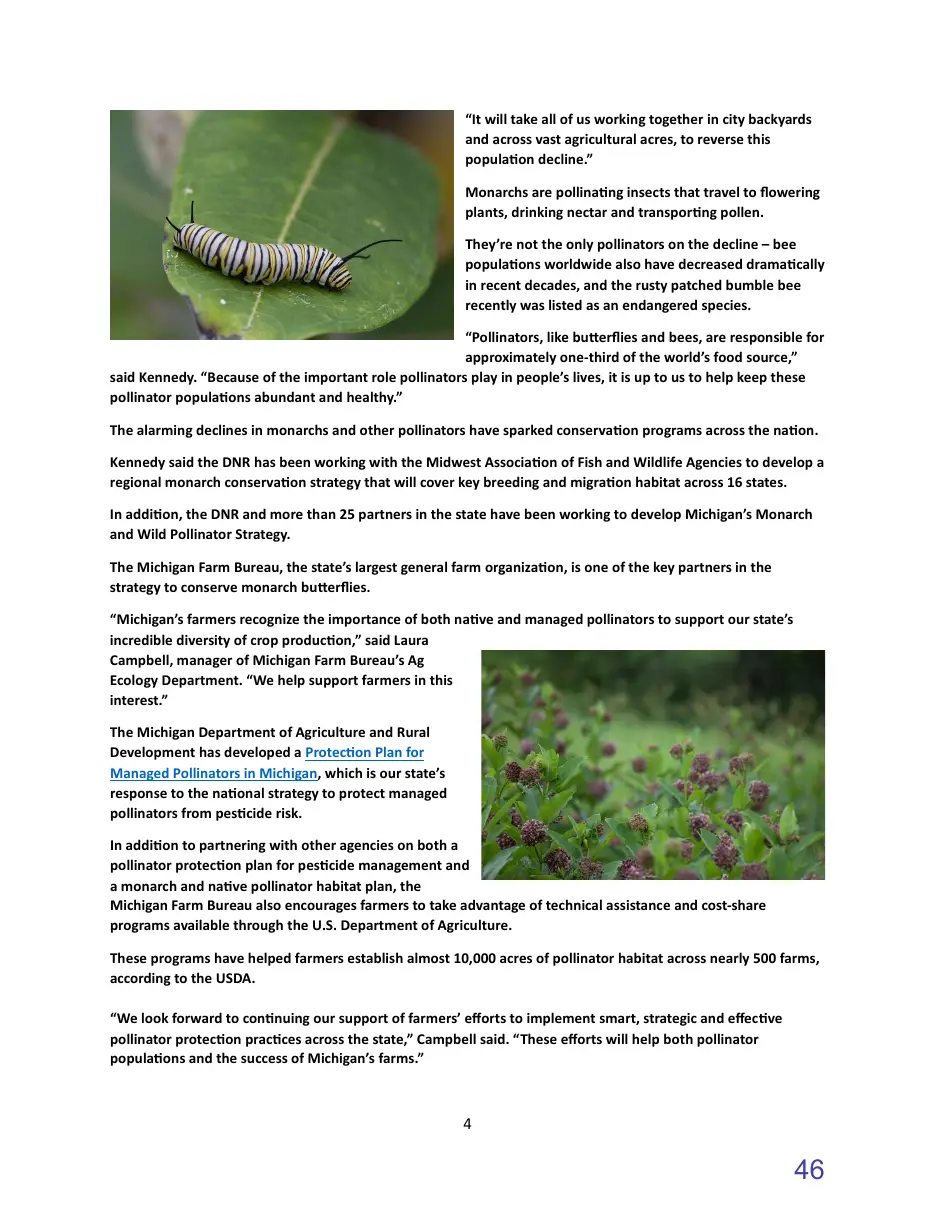
“It will take all of us working together in city backyards and across vast agricultural acres, to reverse this popula on decline.” Monarchs are pollina ng insects that travel to flowering plants, drinking nectar and transpor ng pollen. They’re not the only pollinators on the decline – bee popula ons worldwide also have decreased drama cally in recent decades, and the rusty patched bumble bee recently was listed as an endangered species. “Pollinators, like bu erflies and bees, are responsible for approximately one-third of the world’s food source,” said Kennedy. “Because of the important role pollinators play in people’s lives, it is up to us to help keep these pollinator popula ons abundant and healthy.” The alarming declines in monarchs and other pollinators have sparked conserva on programs across the na on. Kennedy said the DNR has been working with the Midwest Associa on of Fish and Wildlife Agencies to develop a regional monarch conserva on strategy that will cover key breeding and migra on habitat across 16 states. In addi on, the DNR and more than 25 partners in the state have been working to develop Michigan’s Monarch and Wild Pollinator Strategy. The Michigan Farm Bureau, the state’s largest general farm organiza on, is one of the key partners in the strategy to conserve monarch bu erflies. “Michigan’s farmers recognize the importance of both na ve and managed pollinators to support our state’s incredible diversity of crop produc on,” said Laura Campbell, manager of Michigan Farm Bureau’s Ag Ecology Department. “We help support farmers in this interest.” The Michigan Department of Agriculture and Rural Development has developed a Protec on Plan for Managed Pollinators in Michigan, which is our state’s response to the na onal strategy to protect managed pollinators from pes cide risk. In addi on to partnering with other agencies on both a pollinator protec on plan for pes cide management and a monarch and na ve pollinator habitat plan, the Michigan Farm Bureau also encourages farmers to take advantage of technical assistance and cost-share programs available through the U.S. Department of Agriculture. These programs have helped farmers establish almost 10,000 acres of pollinator habitat across nearly 500 farms, according to the USDA. “We look forward to con nuing our support of farmers’ efforts to implement smart, strategic and effec ve pollinator protec on prac ces across the state,” Campbell said. “These efforts will help both pollinator popula ons and the success of Michigan’s farms.”
Page 47
Text of page 47
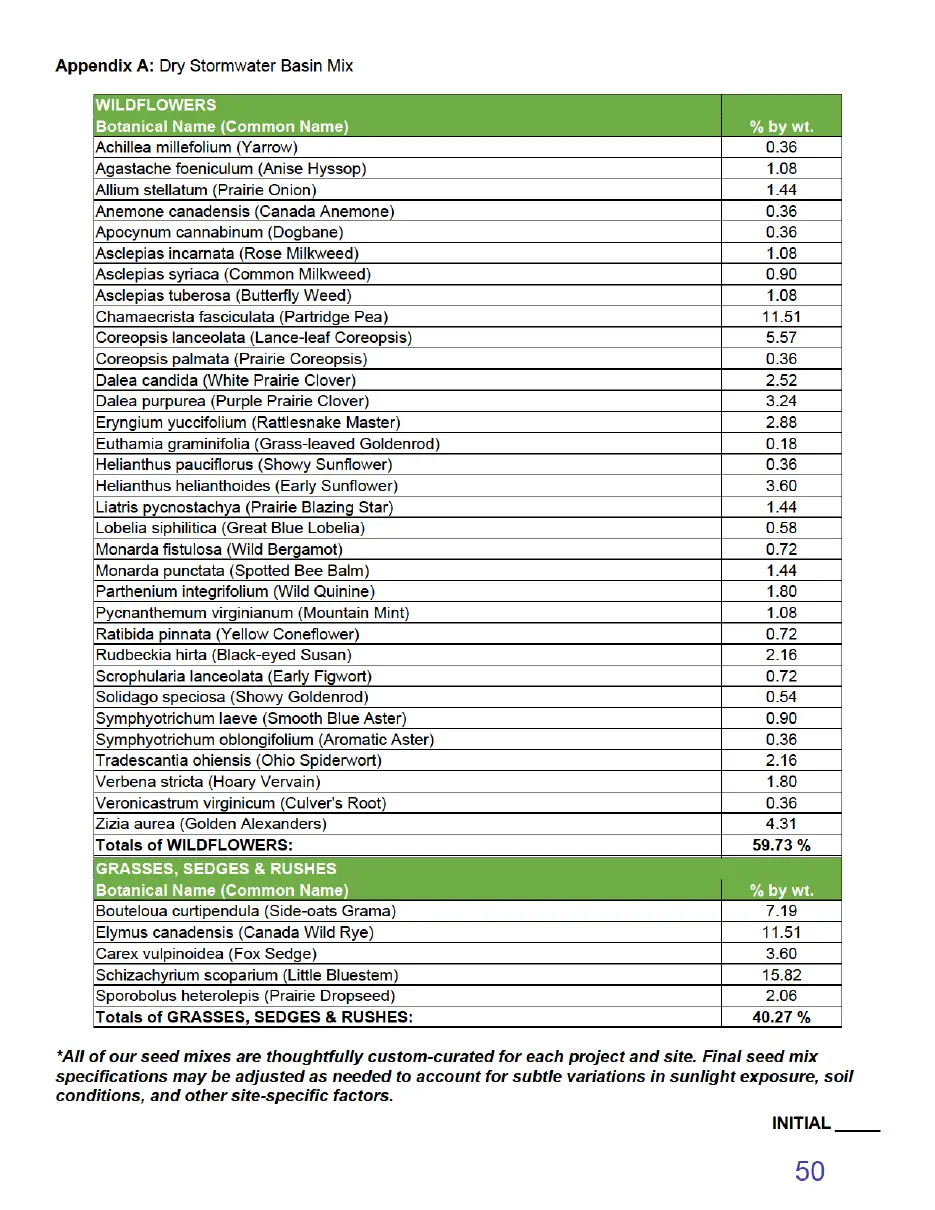
PROPOSAL FOR CONSERVATION SERVICES This proposal was created for: City of Saugatuck 102 Butler St, Saugatuck, MI 49453 General Background and Scope of Work: This proposal is to address the conversion of two areas that are currently turfgrass lawn into native plant communities, including a basin/bioswale in Coughlin Park, and a tough-to-mow slope on a dead end of Mason St near downtown. The restoration of these areas into native plant communities would offer several environmental benefits including the reduction of mowing, irrigation, the creation of wildlife/pollinator habitat, and to serve as community examples for native landscaping. Based on the in-person site assessment discussing the project, we recommend the following ecological restoration plan in 2027: 1. Coughlin Park – Bioswale/Rain Garden ▪ The 3,280 ft2 restoration area (see Appendix C for map) will be treated with multiple applications of broad-spectrum herbicide to eliminate existing turfgrass, invasive, and noxious species in the seed bank prior to planting. • First application: Fall 2026 • Second application: April 2027 • Third (final) application: May 2027 (if necessary) ▪ A few weeks following the final application, the restoration areas will be planted with the following: ▪ Oats/rye as a nurse crop ▪ Michigan-native dry stormwater basin (see Appendix A) ▪ Custom short-lived wildflower mix (to provide blooms as natives become established) ▪ Additionally, 325 (4”-size) native plugs will be installed on randomized triangular spacing, highlighting species that take longer to establish from seed, including: Little Bluestem (Schizachyrium scoparium), Indian Grass (Sorghastrum nutans), Swamp Milkweed (Asclepias incarnata), Blazing Star (Liatris spicata), Rattlesnake Master (Eryngium yuccifolium), etc. ▪ Single-net straw blanket will be used on any slopes greater than 3:1, and a light layer of straw mulch will be used to help retain moisture for new plugs and improve germination. 2. Mason Street - Hillside Turfgrass Conversion ▪ The 3,280 ft2 potential hillside restoration area (see Appendix C for map) will require the same site preparation process as above to eliminate unwanted vegetation. ▪ Once site preparation is complete, the restoration area will be planted with the following: ▪ Oats/rye as a nurse crop ▪ Michigan-native wood’s edge prairie mix (see Appendix B) ▪ Custom short-lived wildflower mix (to provide blooms as natives become established) ▪ Additionally, 250 (4”-size) native plugs will be installed on randomized triangular spacing, highlighting species that take longer to establish from seed, including: Little Bluestem (Schizachyrium scoparium), Prairie Dropseed (Sporobolus heterolepis), Penn Sedge (Carex pensylvanica), Aromatic Aster (Symphyotrichum oblongifolium), Wild Columbine (Aquilegia canadensis), etc. ▪ Single-net straw blanket will be used on any slopes greater than 3:1. 3. Establishment Period Maintenance ▪ Throughout the remainder of the 2027, as well as the 2028 growing season, the ODC Conservation Services team will assess the restoration areas a minimum of once per month throughout the entire growing season to inspect for issues such as: water stress, invading pests, rates of native seed germination, and the presence of invasive or noxious weeds. INITIAL _____
Page 48
Text of page 48
Targeted herbicide treatments, hand-pulling, and/or mechanical control methods will be used where most applicable to remove noxious or invasive plant species throughout the restoration areas.
GENERAL NOTE: The typical establishment period for prairie restoration from seed ranges between 2-5 years. Many native species generally spend the first 1-2 growing seasons developing extensive root systems with little foliage to show above the soil’s surface. For this reason, reducing competition from opportunistic species is crucial to ensure the success of prairie restoration projects. Given the frequency of invasive species in this area and their ability to outcompete native species; the control of invasive species will be our top priority in 2026 and beyond. At the end of the growing season of 2027, our team will re-address the establishment maintenance plan and provide a new proposal with updated pricing for additional years (if necessary). Project Timeline: • Site preparation ongoing between fall 2026-spring 2027 • Seeding and planting following site preparation in spring 2027 Project Cost: • Coughlin Park Rain Garden - $6,500 (billed in spring 2027) ☐ • Mason Street Hillside Restoration - $4,900 (billed in spring 2027) ☐ • Establishment Period Maintenance - $3,000 (billed in April 2028) ☐ *PLEASE CHECK THE APPROPRIATE BOXES ABOVE TO INDICATE ACCEPTED SERVICES. TO ENSURE TIMELY SCHEDULING AND SERVICE DELIVERY, PLEASE RESPOND PROMPTLY. DELAYS IN RESPONSE MAY RESULT IN CHANGES TO PROPOSED PROJECT TIMELINE OR AVAILABILITY. Note: This proposal accounts for pricing of all labor, materials, and equipment necessary to execute the outlined restoration project(s). If additional work is required beyond the scope of this proposal, we will provide written notification and pricing will be determined on a time and materials basis. Exclusions: This proposal does not account for the following: 1. Mowing of the outlined restoration area(s) prior to the first herbicide application. 2. Maintenance of existing lawn or trails nearby, or directly within the restoration area(s). 3. Installation or maintenance of irrigation mechanisms. 4. Installation of exclusion fencing. 5. Removal or relocation of existing equipment/features on site. 6. Additionally, we are unable to warranty the failure of restoration projects due to incidents (by landowner or other party) related to: • Accidental or incidental herbicide applications within the restoration area such as, but not limited to, weed & feed (2-4D), glyphosate, and triclopyr. • Disturbance from vehicle or heavy equipment use within the restoration area. • Disturbance from excessive animal grazing or foot traffic within the restoration area. • Excessive drought, extreme weather, or natural disasters. • Improper watering and/or fertilization practices.
INITIAL _____
Page 49
Text of page 49
Qualifications: ODC Conservation Services staff is staffed by highly qualified conservation professionals with extensive experience in invasive species management, habitat assessment, and ecological restoration. • ODC Network, and its subsidiaries, is a fully insured 501c3 and carries an extensive liability policy to conduct habitat improvement services in Michigan. • State licensed herbicide applicators with certifications in Forest Pest, Right-of-Way, and Aquatic pesticide application. • Manage 2,500+ acres of natural area across Michigan. • Combined 25+ years’ experience in invasive species management. • Successfully restored over 250 acres of native prairie habitat. • Experienced consultants in invasive species management, habitat assessment, and ecological restoration. • Experience designing, installing, and maintaining native gardens/landscape beds. • Proficient in identification of native and non-native Michigan flora and fauna. • Advanced wetland delineation certification. • Experienced GIS professionals. We appreciate the opportunity to submit this proposal. We look forward to discussing the opportunity further with you. Please do not hesitate to ask questions or clarifications. If you choose to accept this proposal, please sign and return a copy.
Tanner Bricker, Conservation Services Director
If you wish to accept this proposal, please initial each page, as well as sign and date below:
_____________________________________________________ Signature of Authorized Property Owner/Manager
_____________________________ Date
INITIAL _____
Page 50
This page is a scanned image with no text layer. The PDF of these pages has it at full resolution.
Page 51
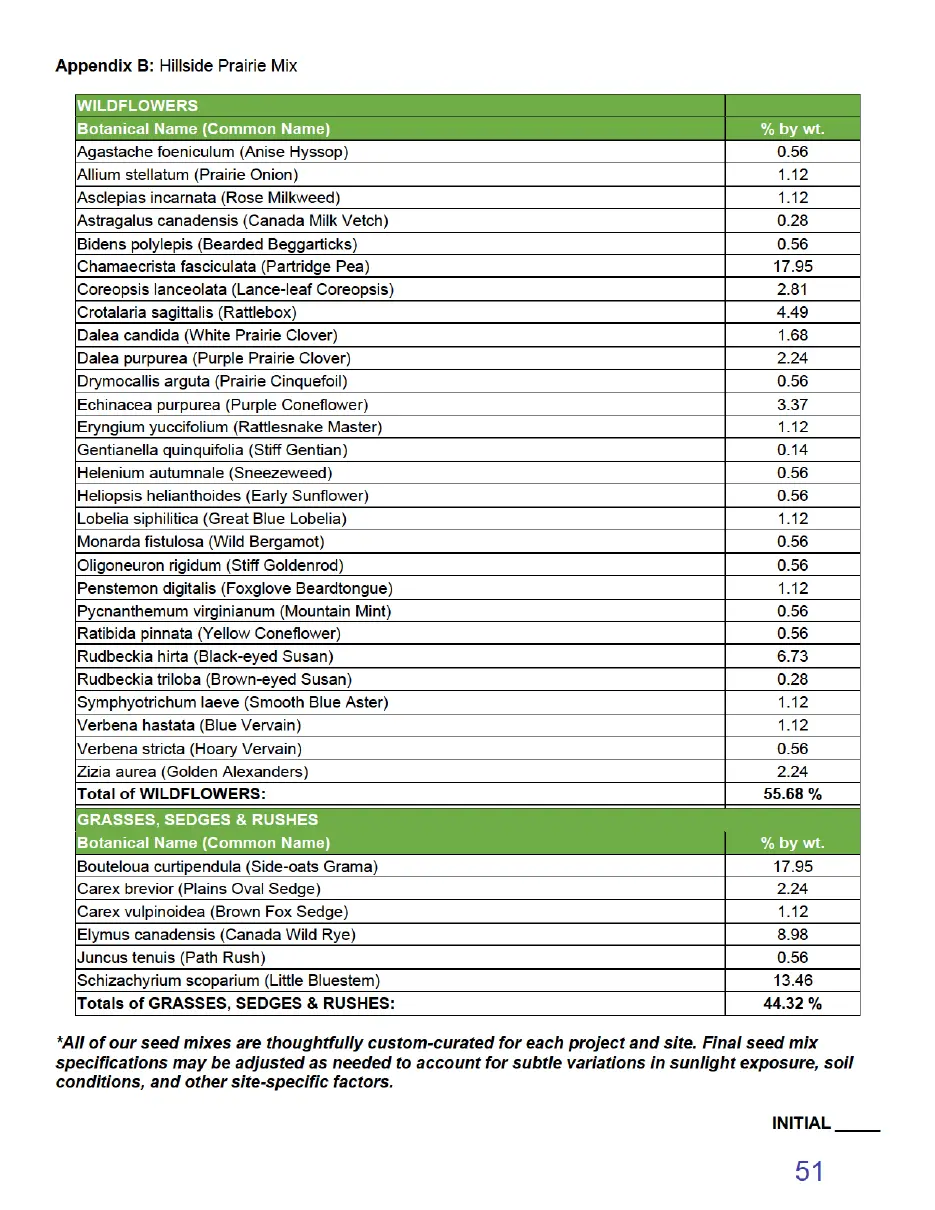
This page is a scanned image with no text layer. The PDF of these pages has it at full resolution.
Page 52
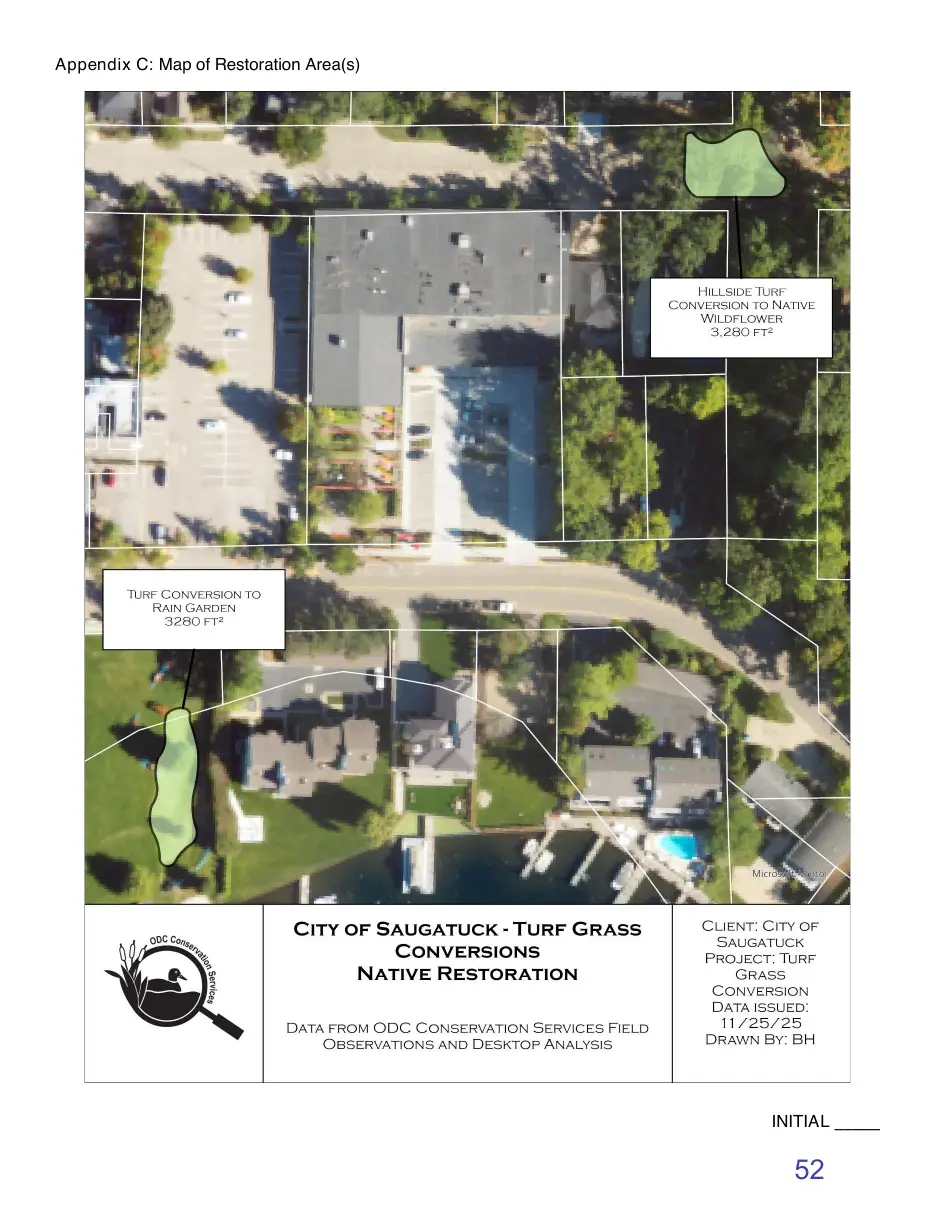
Text of page 52
Appendix C: Map of Restoration Area(s)
INITIAL _____
Page 53
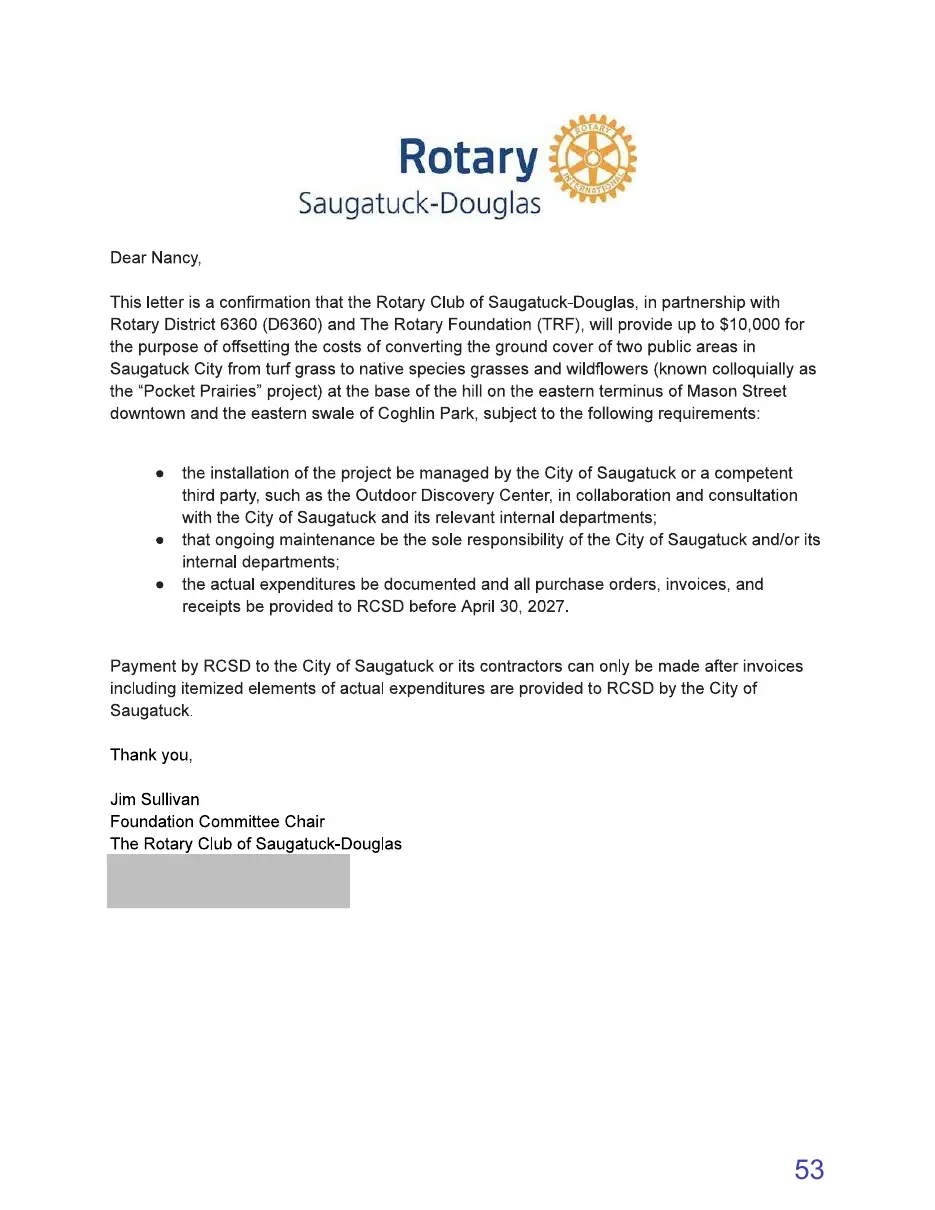
This page is a scanned image with no text layer. The PDF of these pages has it at full resolution.
Page 54
Text of page 54
Ryan Cummins, Manager Saugatuck City 102 Butler Street Saugatuck, MI 49453
September 17, 2026 Dear Ryan, This letter is a confirmation that the Friends of the Saugatuck Parks will provide up to $5,000 for the purpose of converting two public areas in Saugatuck City from turf grass and miscellaneous plants to native species grasses and wildflowers, commonly called “Pocket Prairies,” on the hill at the Mason Street End, located behind the SCA, and the bioswale at Coughlin Park. The project will be managed and installed by the Outdoor Discovery Center (ODC) in collaboration and consultation with the City of Saugtuck’s Department of Public Works. The ODC will monitor and maintain the installations through December 2028. Afterwards, maintenance of the “Pocket Prairies” will be the responsibility of Saugatuck City. Payment to the City of Saugatuck will be made upon completion of the installation of the plantings. Thank you, Keith Charak President Friends of the Saugatuck Parks