
Parks & Public Works Agenda item 6B
Ecological Evaluation Report
Parks and Public Works Committee, Tuesday, September 22, 2026
Download these 36 pages, 37.4 MB Whole packet, 60 pages, 41.2 MB
Page 5
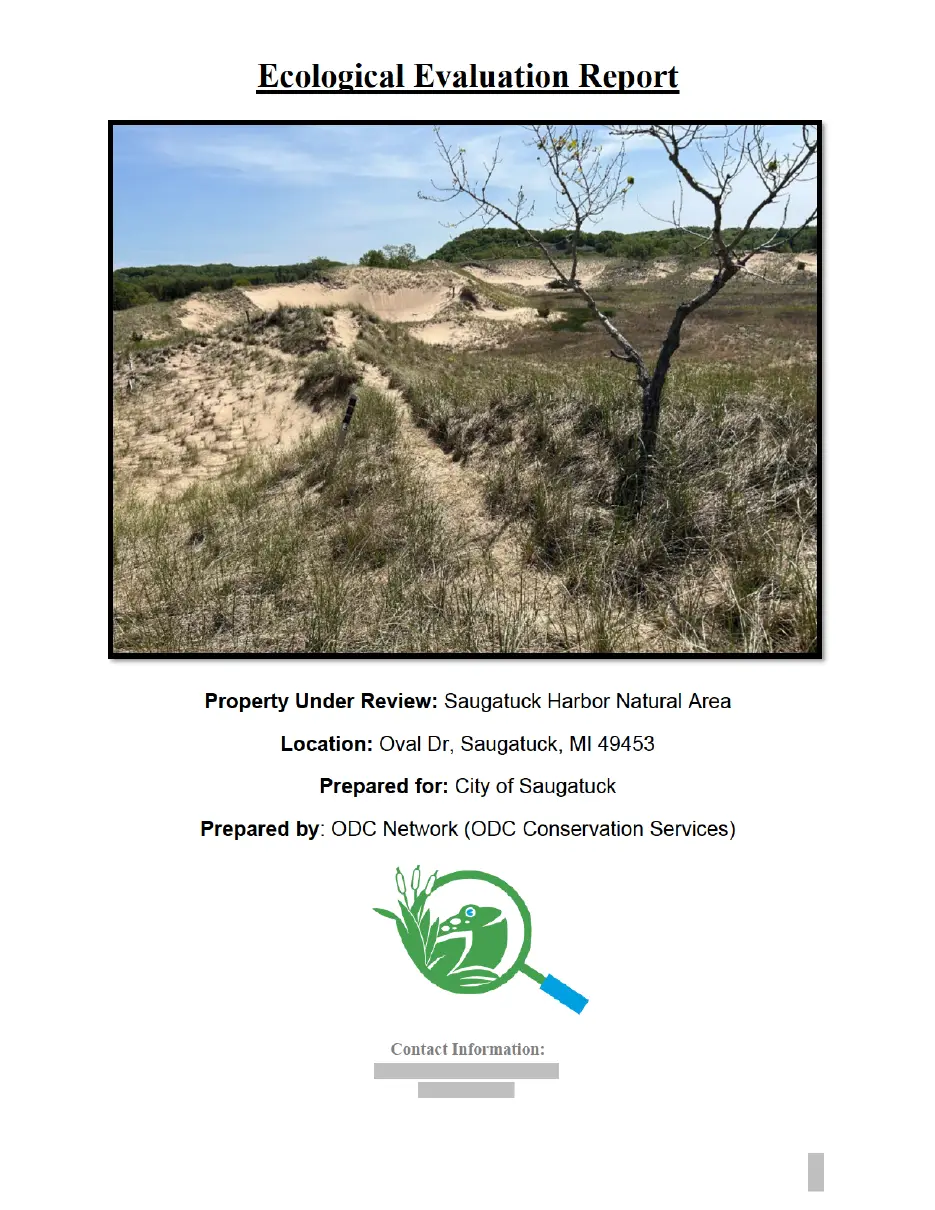
This page is a scanned image with no text layer. The PDF of these pages has it at full resolution.
Page 6
Text of page 6
Project Background The ODC Conservation Services team conducted an ecological evaluation of parcel #’s: 57-004-008-00, 57-004-010-00, 57-004-013-00, and 57-004-008-10, located on Oval Dr in Saugatuck, MI. The field survey portion of the project took place between April – August of the 2026 growing season. The ecological evaluation process involved the identification of distinct natural communities on the site, along with outlining the following criteria for each unit: ● General ecological site description and inventory of natural features ● Description of each natural community including: ▪ Landscape context and natural processes ▪ General inventory of native plant communities including canopy, understory, and forb/graminoid layer ▪ Documentation of high-quality native plant species (coefficient of conservatism rankings between 7-10) ▪ Documentation of observed (and potential) wildlife including: state threatened (T), endangered (E), and species of special concern (SC) ▪ Documentation of invasive species, pests, and ecological threats ▪ Identification of potential ecological restoration and outdoor education opportunities Executive Summary The Saugatuck Harbor Natural Area (SHNA) is an approximately 173-acre coastal preserve owned and managed by the City of Saugatuck that protects an ecologically significant dune system along the southeastern shore of Lake Michigan. Permanently protected through a partnership with the Land Conservancy of West Michigan (LCWM), the property contains an exceptional diversity of natural communities, including open dunes, interdunal wetlands, Great Lakes marsh, and a fragment of mesic northern forest. These habitats support numerous rare plant and wildlife species while providing opportunities for low-impact recreation, education, and scientific research. The original management plan from 2010 established a clear vision of balancing public access with longterm preservation of the site's ecological integrity. More than a decade later, natural dune processes continue to function properly and most native plant communities remain in good to excellent condition, indicating the property continues to retain exceptionally high ecological value. SHNA undoubtedly remains a high-quality coastal natural area in southwest Michigan and continues to serve as a critical component of a larger protected landscape extending from Oval Beach and Mount Baldhead to Saugatuck Dunes State Park. Despite the overall health of the preserve, several emerging threats warrant proactive management. The highest ecological priority is the control of invasive phragmites (Phragmites australis subsp. australis) within the Great Lakes marsh and interdunal wetland communities, where relatively small infestations present an opportunity for successful eradication before widespread expansion occurs. Japanese barberry (Berberis thunbergii) is becoming established within shaded dune and forest habitats and requires continued treatment to prevent long-term degradation of native plant communities. Excessive deer browse is limiting forest regeneration and reducing understory diversity, particularly within the mesic northern forest. Additionally, localized off-trail recreation near Oval Beach has contributed to vegetation loss, trail proliferation, accelerated dune erosion, and small infestations of the invasive spotted knapweed (Centaurea stoebe). The interdunal wetlands remain in good ecological condition overall and currently require little active management beyond invasive species management, continued monitoring, and support for ongoing scientific research. Likewise, the open dune system continues to benefit from allowing natural erosion and deposition processes to occur without artificial stabilization, preserving the dynamic landscape that supports native dune species and ecosystem function.
Page 7
Text of page 7
This ecological evaluation supports a management approach focused on early intervention, targeted restoration, and adaptive stewardship rather than large-scale ecological reconstruction. Primary recommendations include aggressive invasive species management and consistent surveying, evaluation of long-term deer population management strategies, improved trail management to concentrate visitor use and reduce habitat impacts (developed through a separate trail assessment), continued monitoring of ecological conditions, and preservation of natural coastal processes. Equally important is maintaining the philosophy established in the original management plan, providing high-quality public access while ensuring that recreation remains secondary to the protection of SHNA's natural resources. By implementing these recommendations, the City of Saugatuck can preserve the ecological integrity of the Saugatuck Harbor Natural Area while enhancing visitor experiences and ensuring this significant coastal landscape continues to support rare species, natural ecological processes, and scientific research for generations to come. Site Description The Saugatuck Harbor Natural Area (SHNA) is a 173-acre coastal preserve located along the southeastern shoreline of Lake Michigan, immediately south of the Kalamazoo River mouth in the City of Saugatuck, Michigan. The property encompasses an ecologically significant dune landscape in southwest Michigan and forms the centerpiece of a larger protected natural corridor that includes Saugatuck Dunes State Park, Mount Baldhead Park, Oval Beach, and the Ox-Bow Art School property. The site contains a remarkable diversity of native natural communities, including open dunes, interdunal wetlands, Great Lakes marsh, and mesic northern forest. These interconnected habitats support numerous rare plant and wildlife species while preserving dynamic ecological processes driven by fluctuating Lake Michigan water levels, natural sand movement, and coastal hydrology. Overall, the property remains in excellent ecological condition aside from invasive species pressure, with many natural systems functioning with minimal human disturbance. Human impacts are primarily concentrated around trail corridors and areas adjacent to Oval Beach, where unauthorized social trails have resulted in localized vegetation loss, some dune destabilization, and soil erosion. Invasive plant species, including Japanese barberry, spotted knapweed, and phragmites, are present within portions of the property and represent the most significant long-term ecological threat if left unmanaged. Excessive deer browse is limiting natural forest regeneration and reducing understory diversity within the forested sections. Moreover, with eastern hemlocks (Tsuga canadensis) present in the southernmost forested section, hemlock woolly adelgid (HWA) threatens to take these trees down and affect the ecological integrity of heavily sloped backdunes where these hemlocks serve as canopy trees. Despite these localized stressors, SHNA continues to support high-quality native plant communities and serves as an important refuge for rare species, providing suitable habitat for the state-threatened pitcher’s thistle (Cirsium pitcheri), the state-threatened Blanchard's cricket frog (Acris blanchardi), and the endangered prairie warbler (Setophaga discolor). The property's ecological integrity, combined with its role in protecting rare interdunal wetlands and intact Great Lakes coastal ecosystems, underscores the importance of continued stewardship. Targeted invasive species management, strategic trail improvements, passive interpretation and signage installation, routine ecological monitoring, and preservation of natural dune and wetland processes will be essential to maintaining the long-term health and resilience of this exceptional coastal landscape.
Page 8
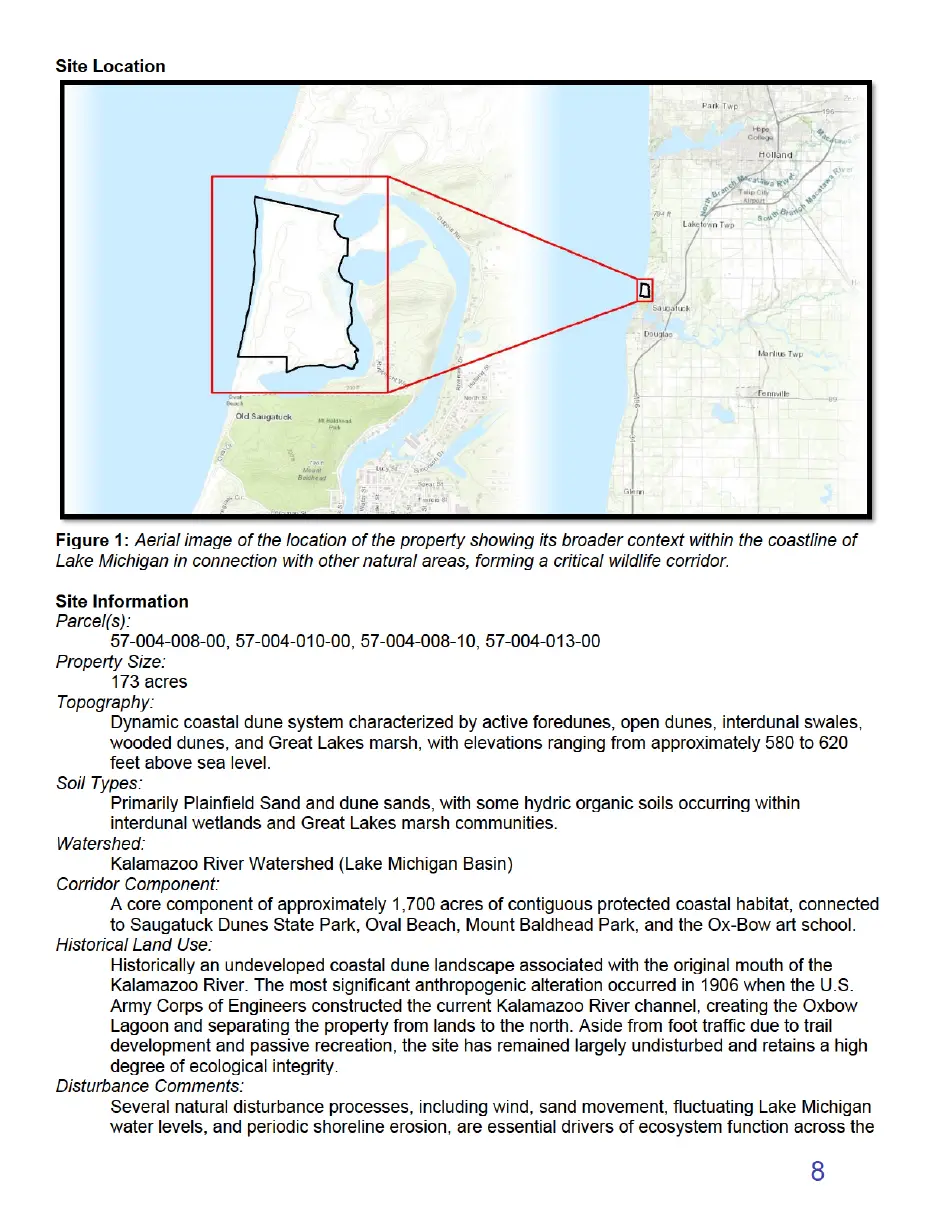
This page is a scanned image with no text layer. The PDF of these pages has it at full resolution.
Page 9
Text of page 9
property. Human disturbance is primarily associated with concentrated recreational use near Oval Beach, including unauthorized social trails, localized vegetation trampling, and dune erosion. Additional ecological pressures include invasive plant species, particularly phragmites and Japanese barberry, along with excessive deer browse within forested communities. Ecological Community Information Pre-settlement Cover Types: Coastal Sand Dune Complex (Open Dunes, Interdunal Wetland, Great Lakes Marsh, and Forested Dune Communities) Present Natural Communities: Open Dune, Interdunal Wetland, Great Lakes Marsh, Mesic Northern Forest Ecological Condition: Overall ecological condition is excellent, with natural dune processes largely intact and native plant communities exhibiting high ecological integrity. Recent fluctuations in water levels have resulted in localized canopy mortality within portions of the Great Lakes marsh, accelerating the natural transition toward herbaceous wetland vegetation. Mature forest structure is present within the mesic northern forest, although regeneration is limited by heavy deer browse. Active sand movement continues to shape the open dune communities, maintaining the dynamic conditions necessary for long-term ecosystem function. Total Plant Species Recorded: 191 Floristic Quality Index (Adjusted FQI): 45.3 (adjusted FQI for entire property – see Appendix E for full details) (General FQI Interpretation: 1-19 = low quality, 20-35 high quality, 35+ = exceptional) *This number is an index that serves to indicate the general condition of the vegetation found in a natural area. A Coefficient of Conservatism value (or CC) is a numerical ranking (0–10) assigned to native plant species in each state based on their tolerance to disturbance and fidelity to presettlement natural communities. The adjusted FQI number is calculated using a complex equation that accounts for the proportion of native versus non-native species, which makes this index number easier to compare to other sites, no matter the size or number of species surveyed. Notable Elements: • 38 plants with a coefficient of conservatism (CC) values of 7 or higher • Globally rare interdunal wetland communities • High-quality Great Lakes coastal dune ecosystem • Suitable habitat for multiple rare species, including the state-threatened pitcher’s thistle, the state-threatened Blanchard's cricket frog, and the endangered prairie warbler • Natural shoreline, dune, and hydrologic processes remain largely intact across the property
Page 10
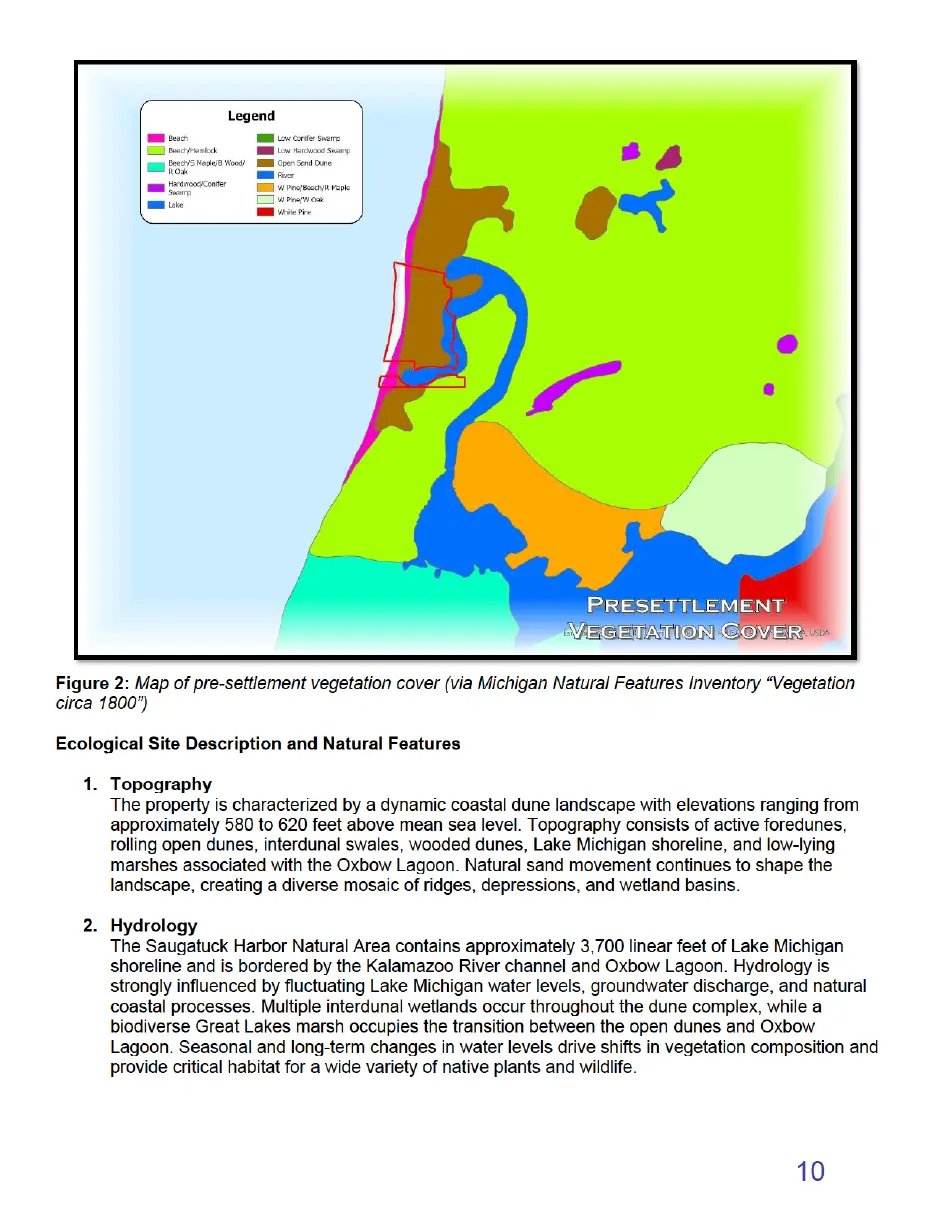
This page is a scanned image with no text layer. The PDF of these pages has it at full resolution.
Page 11
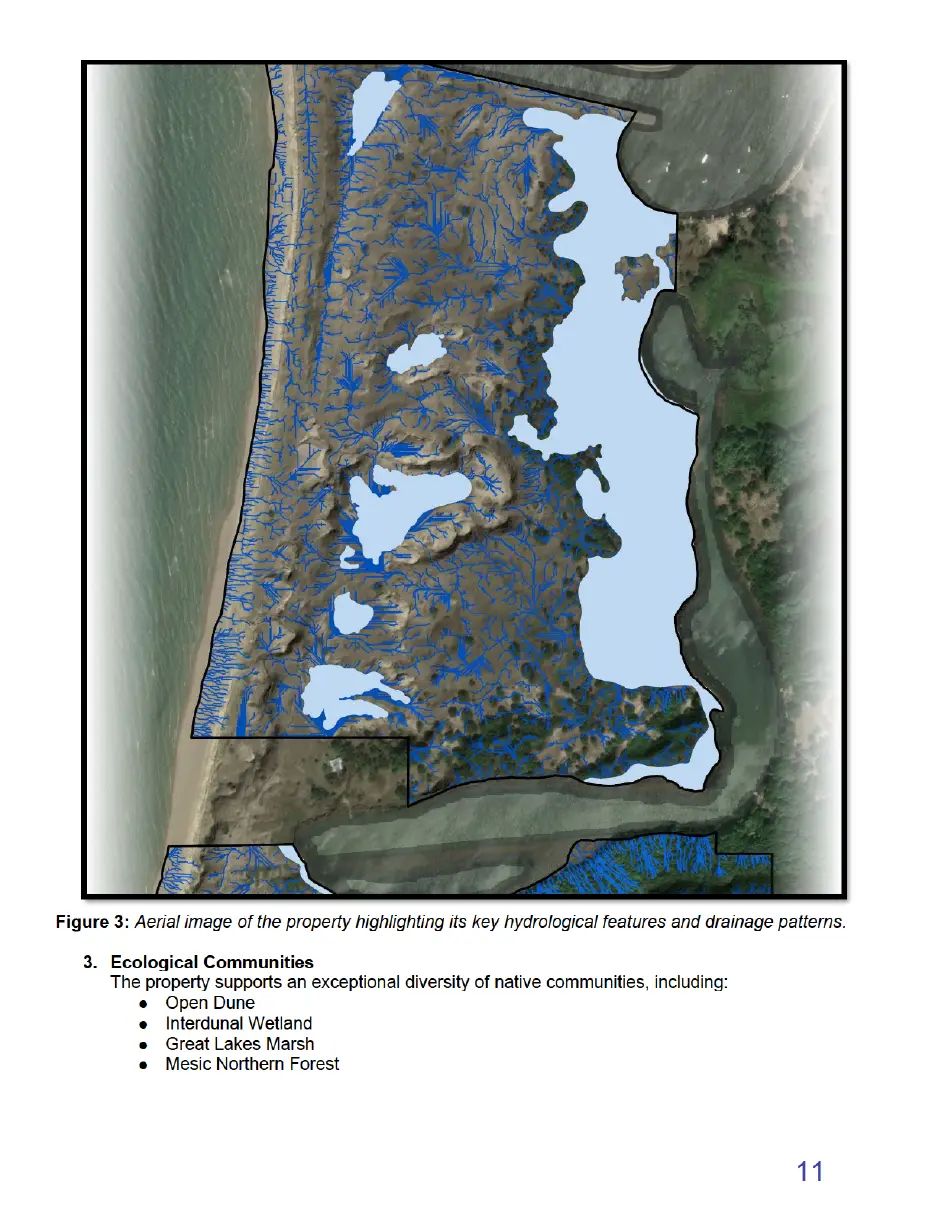
This page is a scanned image with no text layer. The PDF of these pages has it at full resolution.
Page 12
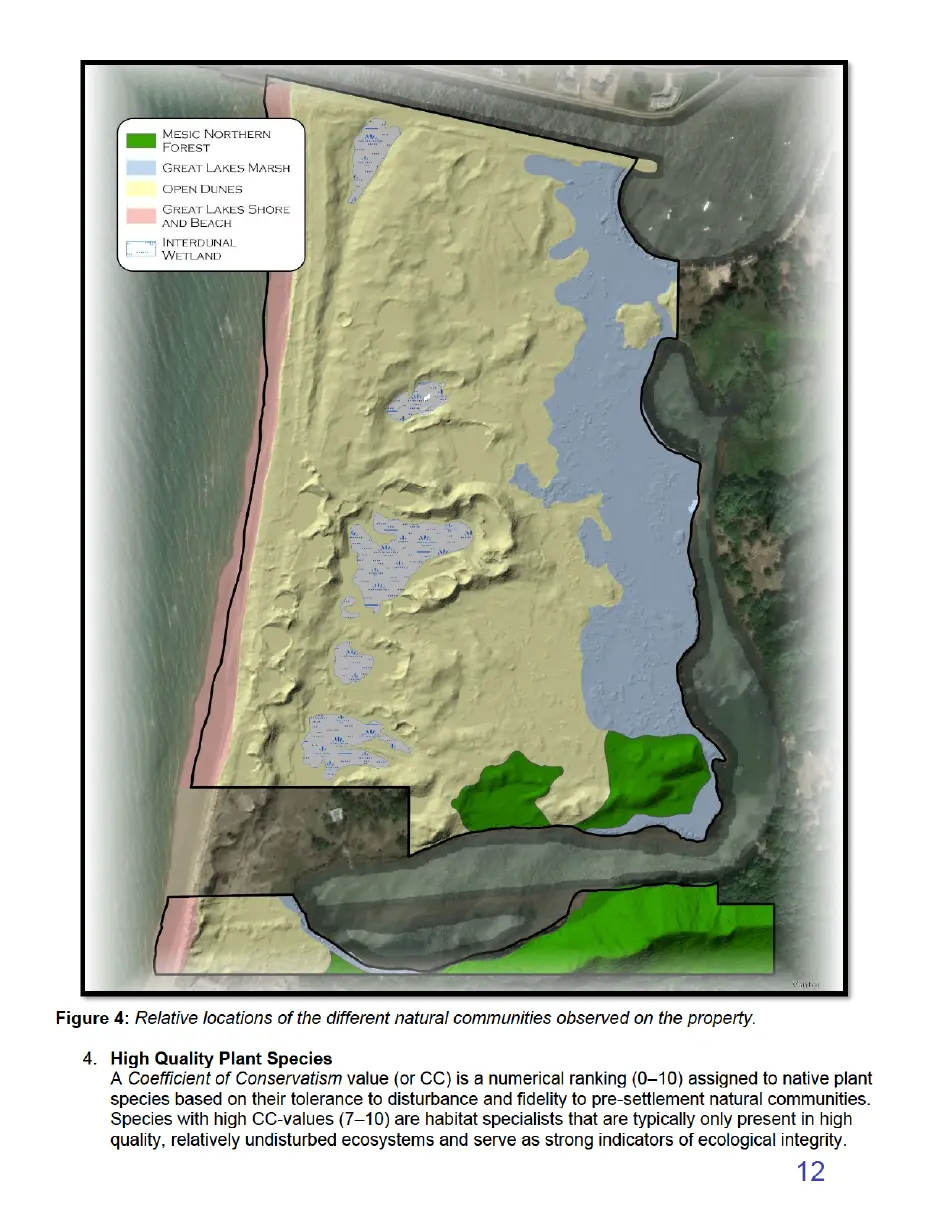
This page is a scanned image with no text layer. The PDF of these pages has it at full resolution.
Page 13
Text of page 13
The floristic inventory documented 38 native species with CC values of 7 or greater, reflecting the high ecological quality of the SHNA. Representative high-quality species include: • CC = 10: Marram grass (Ammophila breviligulata), sand reed (Calamovilfa longifolia), twigrush (Cladium mariscoides), frostweed (Crocanthemum bicknellii), beach-heath (Hudsonia tomentosa), Kalm's St. John's-wort (Hypericum kalmianum), creeping juniper (Juniperus horizontalis), beach pea (Lathyrus japonicus), hoary puccoon (Lithospermum canescens), plains puccoon (Lithospermum caroliniense), bog lobelia (Lobelia kalmii), beak-rush (Rhynchospora capillacea), and Gillman's goldenrod (Solidago simplex). • CC = 9: Short-fruited rush (Juncus brachycarpus), black-gum (Nyssa sylvatica), blueleaf willow (Salix myricoides), and birdfoot violet (Viola pedata). • CC = 8: Spotted wintergreen (Chimaphila maculata), flowering dogwood (Cornus florida), leatherwood (Dirca palustris), blue toadflax (Nuttallanthus canadensis), common polypody (Polypodium virginianum), pickerel-weed (Pontederia cordata), sand cherry (Prunus pumila), and pin oak (Quercus palustris). • CC = 7: Purple false foxglove (Agalinis purpurea), sand cress (Arabidopsis lyrata), marsh bellflower (Campanula aparinoides), sedge (Carex muehlenbergii), buttonbush (Cephalanthus occidentalis), wood reed (Cinna arundinacea), marsh cinquefoil (Comarum palustre), swamp loosestrife (Decodon verticillatus), rush (Juncus brachycephalus), marsh pea (Lathyrus palustris), spicebush (Lindera benzoin), sycamore (Platanus occidentalis), and bushy aster (Symphyotrichum dumosum). 5. Invasive Species Although the site remains in excellent ecological condition overall, several invasive plant species are present and represent the primary long-term threat to the health of the ecosystem. The most significant management priority is phragmites (Phragmites australis subsp. australis), which has become established within portions of the Great Lakes marsh and has the potential to rapidly displace native wetland vegetation if left untreated. Japanese barberry (Berberis thunbergii) is scattered throughout forested and shaded dune habitats, while additional invasive shrubs and herbaceous species occur in localized areas of the property. Observed invasive species of highest concern include (See Appendix D for map): ● Garlic mustard (Alliaria petiolata) ● Japanese barberry (Berberis thunbergii) ● Spotted knapweed (Centaurea stoebe) ● Autumn olive (Elaeagnus umbellata) ● Glossy buckthorn (Frangula alnus) ● Bush honeysuckles (Lonicera spp.) ● Purple loosestrife (Lythrum salicaria) ● Reed canary grass (Phalaris arundinacea) ● Phragmites (Phragmites australis subsp. australis) ● Black locust (Robinia pseudoacacia) ● Multiflora rose (Rosa multiflora)
Page 14
Text of page 14
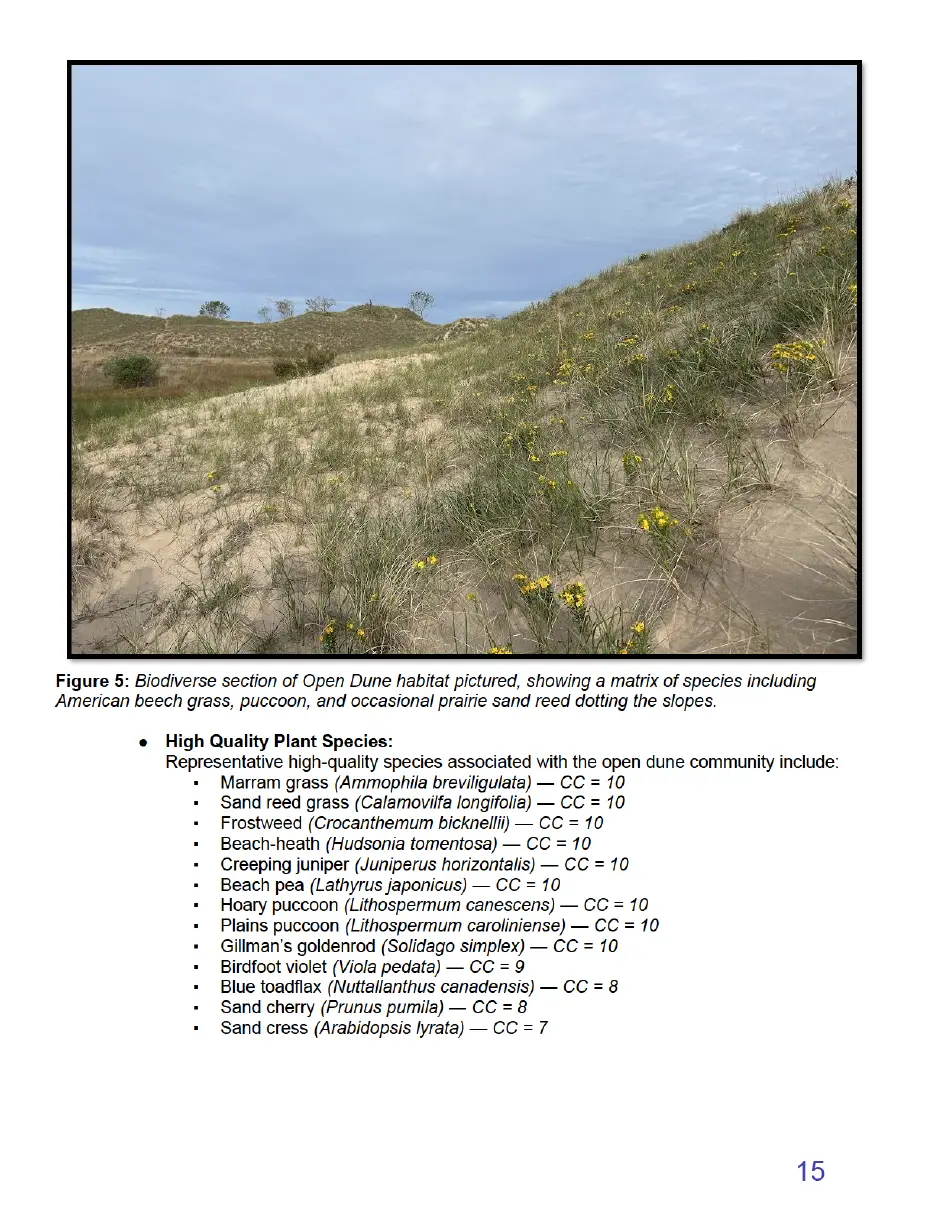
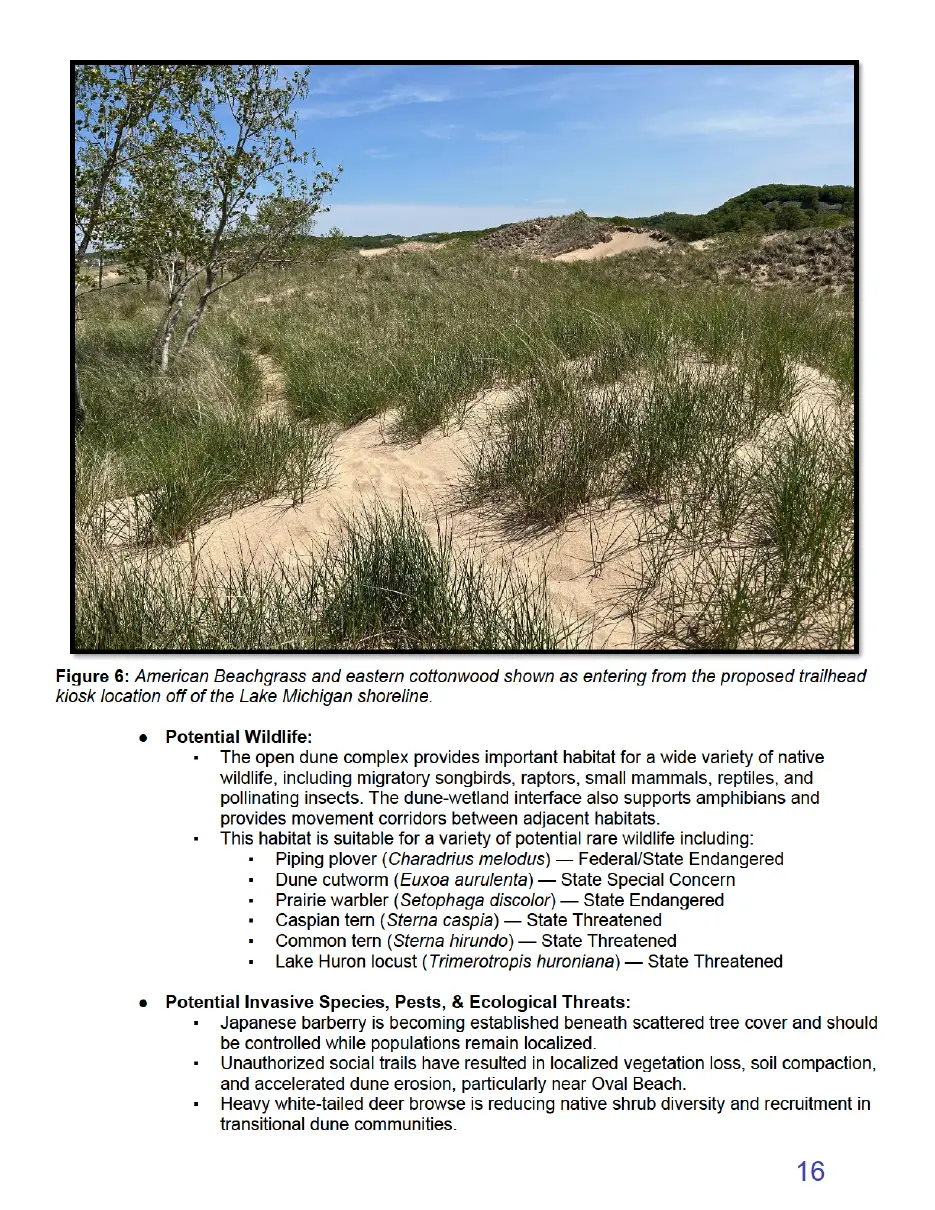
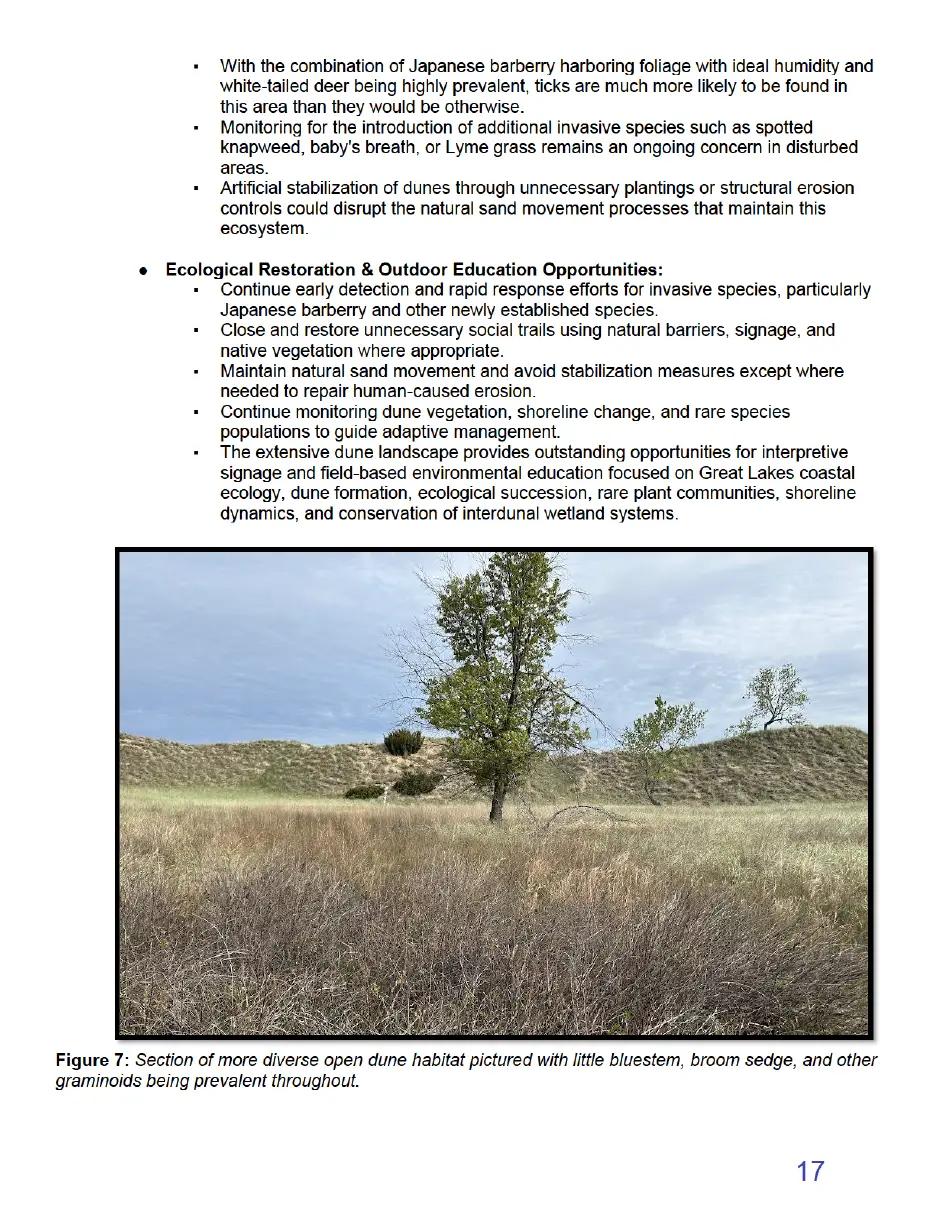
Description of Natural Communities Open Dune ● Landscape Context/Natural Features: Open Dune is the dominant natural community at the Saugatuck Harbor Natural Area and represents an excellent model of what a healthy coastal dune ecosystem historically looked like in this area. These dynamic systems are maintained by continual wind-driven sand movement, shoreline erosion, and periodic deposition associated with fluctuating Lake Michigan water levels. Unlike many dune systems that have been stabilized through development or vegetation plantings, much of the dune landscape at SHNA continues to function under natural disturbance regimes, allowing ecological succession and sand movement to occur largely unimpeded. The open dunes form a complex mosaic with the interdunal wetland, Great Lakes marsh, and wooded dune communities, creating exceptional habitat diversity across the property. This constantly shifting landscape supports specialized native vegetation adapted to drought, nutrient-poor soils, burial by sand, and periodic disturbance while providing critical habitat for numerous insects, reptiles, migratory birds, and rare coastal species. ● Plant Community: The open dune community is dominated by native dune grasses and forbs adapted to excessively drained sandy soils and harsh environmental conditions characterized by wind, drought, and shifting substrates. American beachgrass (Ammophila breviligulata) is the dominant stabilizing grass on foredunes and active dune slopes, while little bluestem (Schizachyrium scoparium), occasional broom sedge (Andropogon virginicus), sand reed (Calamovilfa longifolia), and scattered patches of switchgrass (Panicum virgatum) and various panic grasses (Dichanthelium spp.) occupy more stabilized areas. Common representative native wildflowers include horse mint (Monarda punctata), common milkweed (Asclepias syriaca), sand cress (Arabidopsis lyrata), plains puccoon (Lithospermum caroliniense), beach pea (Lathyrus japonicus), pearly everlasting (Anaphalis margaritacea), and Gillman’s goldenrod (Solidago simplex). Scattered shrubs and small trees become more frequent on stabilized dunes and transition zones, including beach heath (Hudsonia tomentosa), eastern red cedar and creeping juniper (Juniperus spp.), bearberry (Arctostaphylos uva-ursi), serviceberry (Amelanchier spp.), chokecherry (Prunus virginiana), and sand cherry (Prunus pumila), as well as jack, Scot’s, Austrian, and white pine (Pinus spp.). The habitat is also suitable for the state-threatened pitcher’s thistle (Cirsium pitcheri), which, while not observed directly on the property under review, was observed by the ODC Conservation team on the city-owned parcels directly south of the SHNA. Overall, the native vegetation remains in excellent condition, with invasive species occurring only in localized patches. Japanese barberry (Berberis thunbergii) represents the primary invasive shrub within shaded dune margins, while spotted knapweed (Centaurea stoebe) and other disturbance-adapted species should continue to be monitored along trail corridors and disturbed areas.
Page 15
This page is a scanned image with no text layer. The PDF of these pages has it at full resolution.
Page 16
This page is a scanned image with no text layer. The PDF of these pages has it at full resolution.
Page 17
This page is a scanned image with no text layer. The PDF of these pages has it at full resolution.
Page 18
Text of page 18
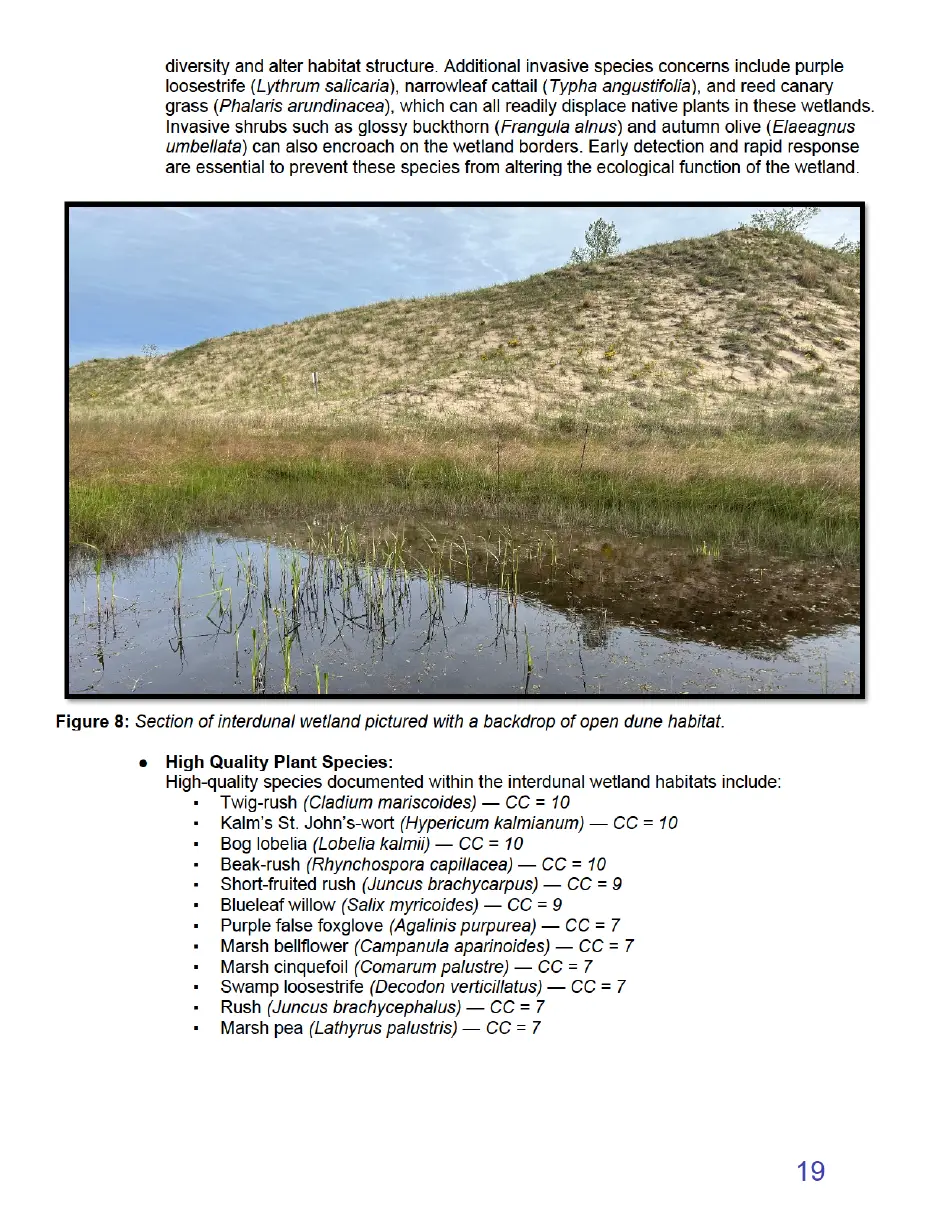
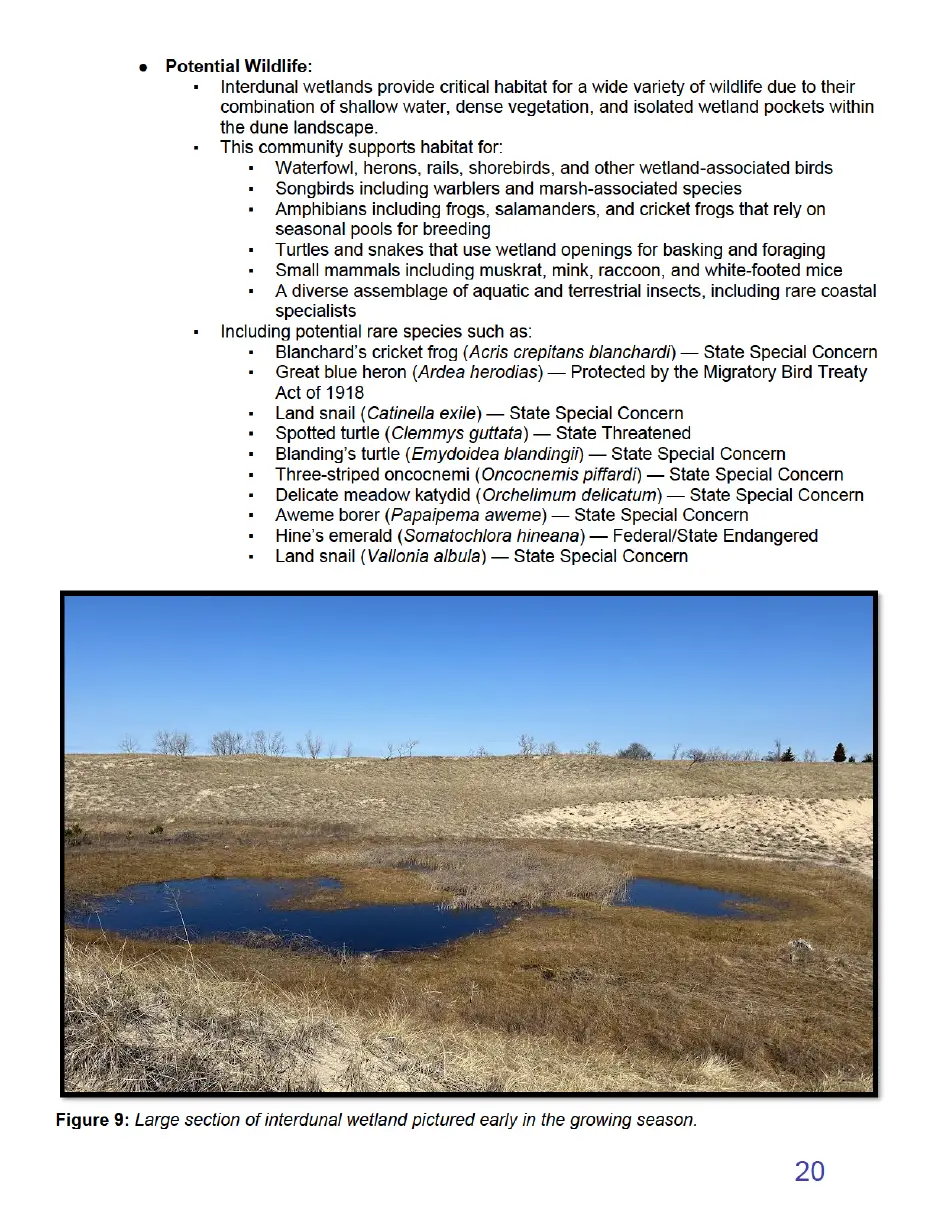
Interdunal Wetland ● Landscape Context/Natural Features: Interdunal wetlands are unique Great Lakes coastal wetland communities that occur within the swales and depressions between dune ridges. These systems are shaped by the interaction of wind-blown sand movement, fluctuating groundwater levels, precipitation, and seasonal lake influence. Unlike many inland wetlands that develop in organic muck soils, interdunal wetlands typically occur on sandy substrates where groundwater is near the surface, creating conditions ranging from seasonally saturated to permanently inundated throughout the year. At the SHNA, the interdunal wetland occupies several distinct, low-lying depressions within the dune complex where groundwater accumulates between higher-elevation dune ridges. These areas contain a mosaic of open wetland pools, emergent vegetation, and scattered shrubs that reflect subtle changes in elevation and hydrologic conditions. Seasonal water level fluctuations are a primary ecological driver, maintaining open wetland conditions by limiting woody species encroachment and creating a diversity of microhabitats. The dynamic nature of this habitat is closely tied to natural coastal processes, including wind disturbance, sand movement, fluctuating water tables, and periodic flooding. These processes prevent succession toward a closed-canopy forest and allow specialized wetland and dune species to persist. The close proximity to Lake Michigan also contributes to the unique species composition, with the site supporting a blend of coastal, wetland, and northern plant communities. ● Plant Community: The interdunal wetland community at SHNA is diverse due to the variation in hydrologic conditions across short distances. Sedges and rushes in open marshland areas dominate the vegetation structure, with some wetter shrubs dotting the matrix as well. The canopy layer is generally non-existent due to saturated conditions and periodic disturbance. Smaller snags and woody debris are common features and provide important habitat structure for birds, amphibians, reptiles, and invertebrates. The shrub layer varies throughout the different interdunal wetland units and consists mainly of various willow species (Salix spp.). These shrubs provide important nesting habitat and contribute structural diversity within the mostly flat wetland mosaic. Steeplebush (Spiraea tomentosa) also fills in gaps as a shorter shrubby species, making a matrix with the graminoids. The herbaceous layer is typically the most diverse component of these communities. Dominant graminoids include lake sedge (Carex lacustris), tussock sedge (Carex stricta), woolgrass (Scirpus cyperinus), bulrush (Schoenoplectus spp.), and bluejoint grass (Calamagrostis canadensis). Open pools and shallow-water areas support species such as pickerelweed (Pontederia cordata), water horehound (Lycopus uniflorus), and pondweeds (Potamogeton spp.). The presence of coastal wetland specialists and high-quality native species highlights the ecological significance of this community. Maintaining the natural hydrologic regime and minimizing disturbance are critical for preserving the unique plant assemblages associated with interdunal wetlands. Invasive species pose a significant concern within portions of this community type. Phragmites (Phragmites australis subsp. australis) is particularly problematic in disturbed wetland openings, where it can rapidly form dense monocultures that reduce native plant
Page 19
This page is a scanned image with no text layer. The PDF of these pages has it at full resolution.
Page 20
This page is a scanned image with no text layer. The PDF of these pages has it at full resolution.
Page 21
Text of page 21
● Potential Invasive Species, Pests, & Ecological Threats: The primary ecological threats to interdunal wetlands are invasive species, altered hydrology, and physical disturbance. Because these communities depend on specific groundwater conditions and seasonal flooding patterns, even minor changes to drainage patterns or surface disturbance can significantly alter vegetation composition. ▪ Phragmites (Phragmites australis subsp. australis) is the greatest invasive threat, particularly in open wetland areas where it can form dense stands, reduce native plant diversity, and eliminate open-water habitat important for amphibian breeding. ▪ Purple loosestrife (Lythrum salicaria), reed canary grass (Phalaris arundinacea), and invasive or hybrid cattails (Typha spp.) can similarly displace native wetland vegetation. ▪ Autumn olive (Elaeagnus umbellata), glossy buckthorn (Frangula alnus), and other invasive shrubs may establish along disturbed wetland margins and elevated dune edges. ▪ Hydrologic alteration from drainage, groundwater changes, trail construction, or nearby development can disrupt the seasonal flooding patterns required to maintain this habitat. ▪ Off-trail recreation, soil compaction, and dune disturbance can damage sensitive vegetation communities and accelerate invasive species establishment. ● Ecological Restoration & Outdoor Education Opportunities: Interdunal wetlands are among the most ecologically significant and sensitive habitats within the Great Lakes coastal landscape. Restoration priorities should focus on maintaining natural hydrology, protecting native vegetation, and preventing invasive species expansion. ▪ Regular monitoring and early detection of invasive species should remain a primary management priority, especially for phragmites and other aggressive wetland invaders. ▪ Targeted invasive species treatments should be conducted carefully to minimize impacts to sensitive wetland vegetation and wildlife. ▪ Maintaining natural dune processes and minimizing unnecessary disturbance are essential for preserving the long-term ecological function of this habitat. Limiting artificial stabilization will help to maintain conditions that support this community. ▪ Interpretive or educational signage to provide low-impact education opportunities.
Page 22
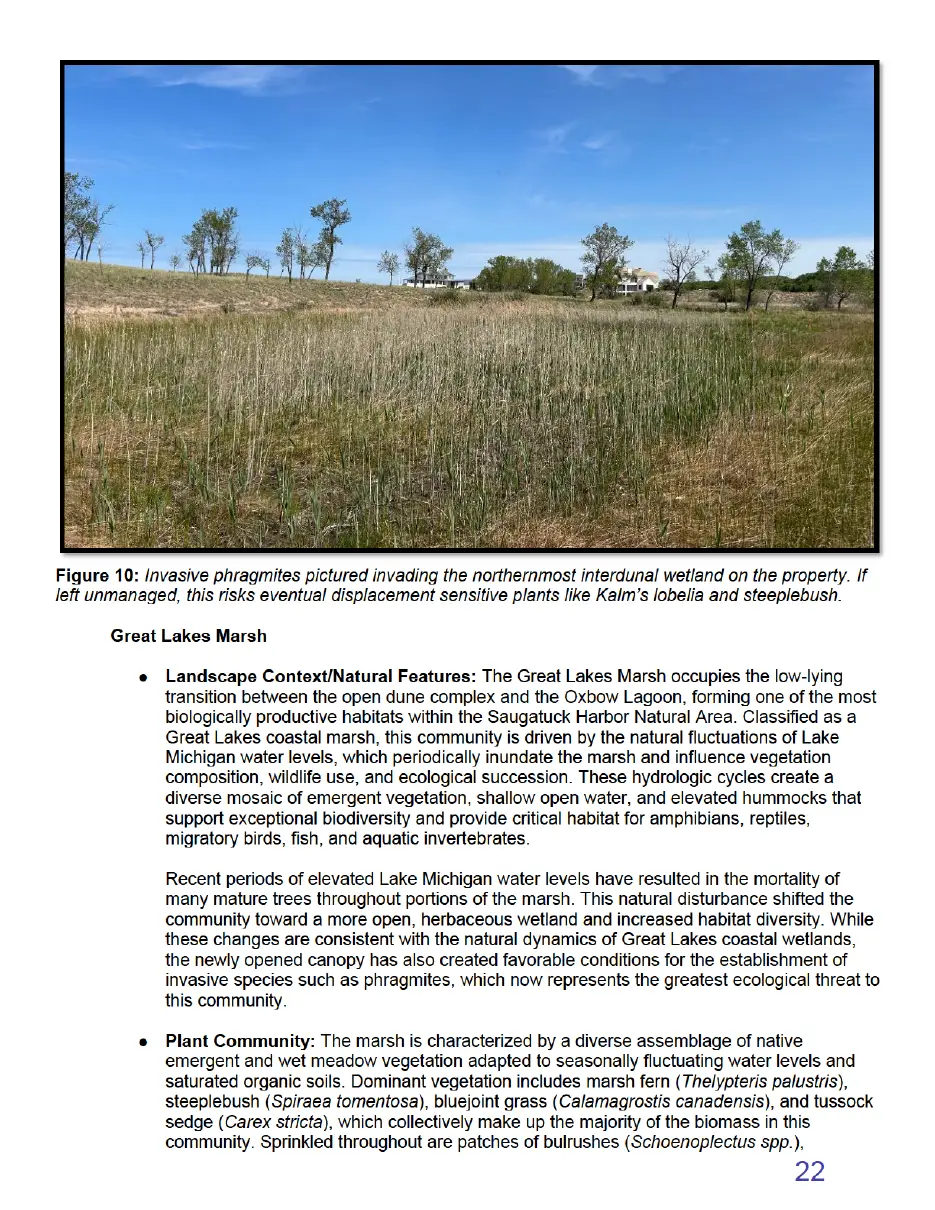
This page is a scanned image with no text layer. The PDF of these pages has it at full resolution.
Page 23
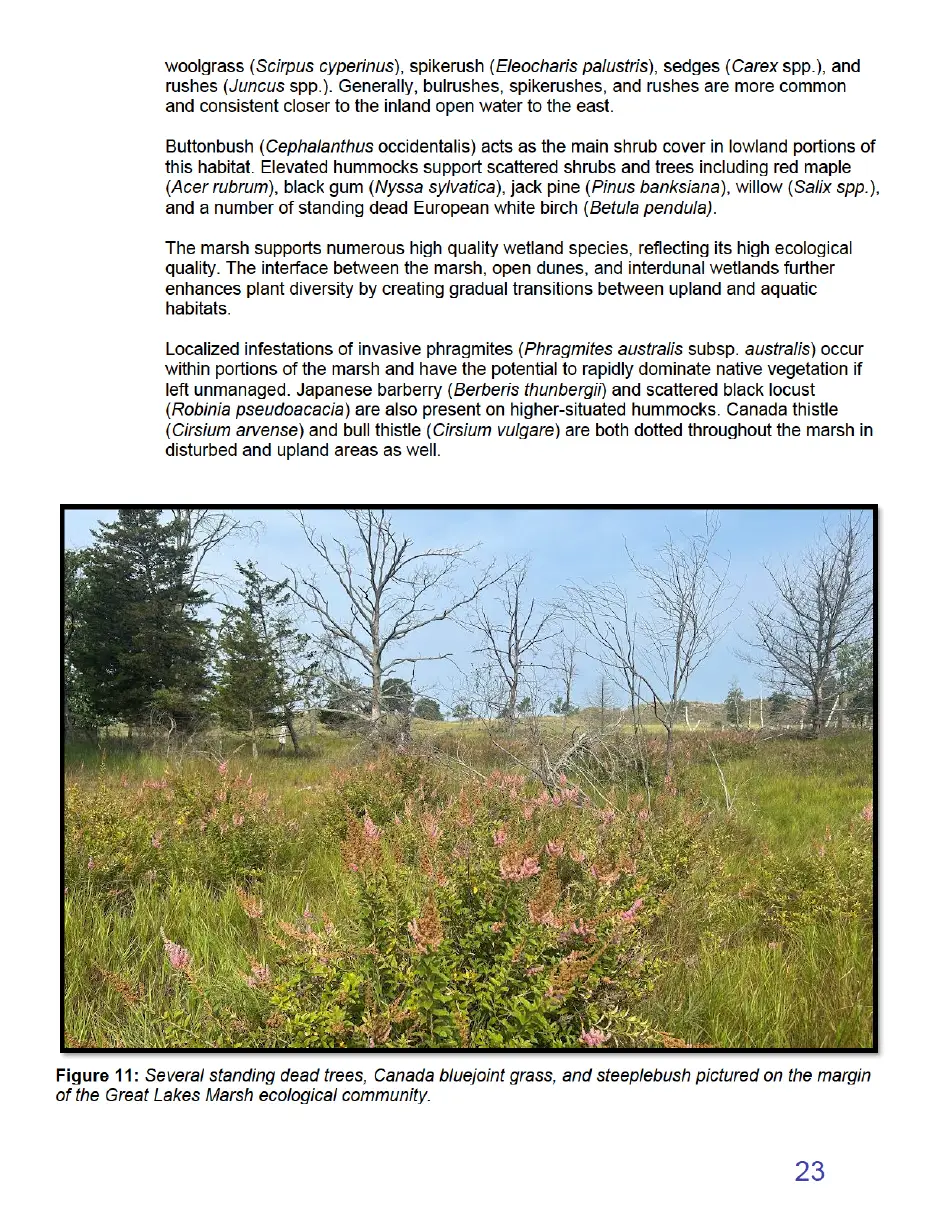
This page is a scanned image with no text layer. The PDF of these pages has it at full resolution.
Page 24
Text of page 24
● High Quality Plant Species: Representative conservative wetland species documented within this community include: ▪ Black-gum (Nyssa sylvatica) — CC = 9 ▪ Pickerel-weed (Pontederia cordata) — CC = 8 ▪ Pin oak (Quercus palustris) — CC = 8 ▪ Sedge (Carex muehlenbergii) — CC = 7 ▪ Buttonbush (Cephalanthus occidentalis) — CC = 7 ▪ Wood reedgrass (Cinna arundinacea) — CC = 7 ▪ Sycamore (Platanus occidentalis) — CC = 7 ● Potential Wildlife: ▪ The Great Lakes Marsh provides critical breeding, nesting, foraging, and migration habitat for a wide variety of wildlife. Amphibians, reptiles, waterfowl, marsh birds, wading birds, mammals, fish, and countless aquatic macroinvertebrates depend on this community throughout the year. ▪ This community supports potential habitat for several rare and sensitive species, including: ▪ American bittern (Botaurus lentiginosus) — State Special Concern ▪ Black tern (Chlidonias niger) — State Special Concern ▪ Northern harrier (Circus cyaneus) — State Special Concern ▪ Marsh wren (Cistothorus palustris) — State Special Concern ▪ Eastern fox snake (Elaphe vulpina gloydi) — State Threatened ▪ Blanding’s turtle (Emydoidea blandingii) — State Special Concern ▪ Merlin (Falco columbarius) — State Threatened ▪ Least bittern (Ixobrychus exilis) — State Threatened ▪ Black-crowned night-heron (Nycticorax nycticorax) — State Special Concern ▪ King rail (Rallus elegans) — State Endangered ▪ Hine’s emerald (Somatochlora hineana) — Federal/State Endangered ▪ Forster’s tern (Sterna forsteri) — State Special Concern ▪ Yellow-headed blackbird (Xanthocephalus xanthocephalus) — State Special Concern ● Potential Invasive Species, Pests, & Ecological Threats: ▪ Phragmites (Phragmites australis subsp. australis) represents the highest management priority on the property due to its ability to rapidly form dense monocultures that displace native wetland vegetation and reduce wildlife habitat. ▪ Purple loosestrife (Lythrum salicaria) and reed canary grass (Phalaris arundinacea) have the potential to expand if left unmanaged. ▪ Japanese barberry (Berberis thunbergii) and black locust (Robinia pseudoacacia) occur on elevated hummocks and should be removed before populations increase. ▪ Alterations to natural hydrology or shoreline processes could negatively impact vegetation composition and wetland function. ▪ Recreational trampling along unauthorized shoreline access routes may damage sensitive marsh vegetation and wildlife habitat. ● Ecological Restoration & Outdoor Education Opportunities: ▪ Aggressively manage phragmites through a long-term integrated treatment program. ▪ Remove invasive woody species from marsh hummocks to preserve native shrub and tree diversity. ▪ Ensure limited artificial stabilization occurs and continue allowing natural lake level fluctuations and hydrologic processes to shape marsh succession. ▪ Monitor rare species populations and vegetation response following invasive species treatments.
Page 25
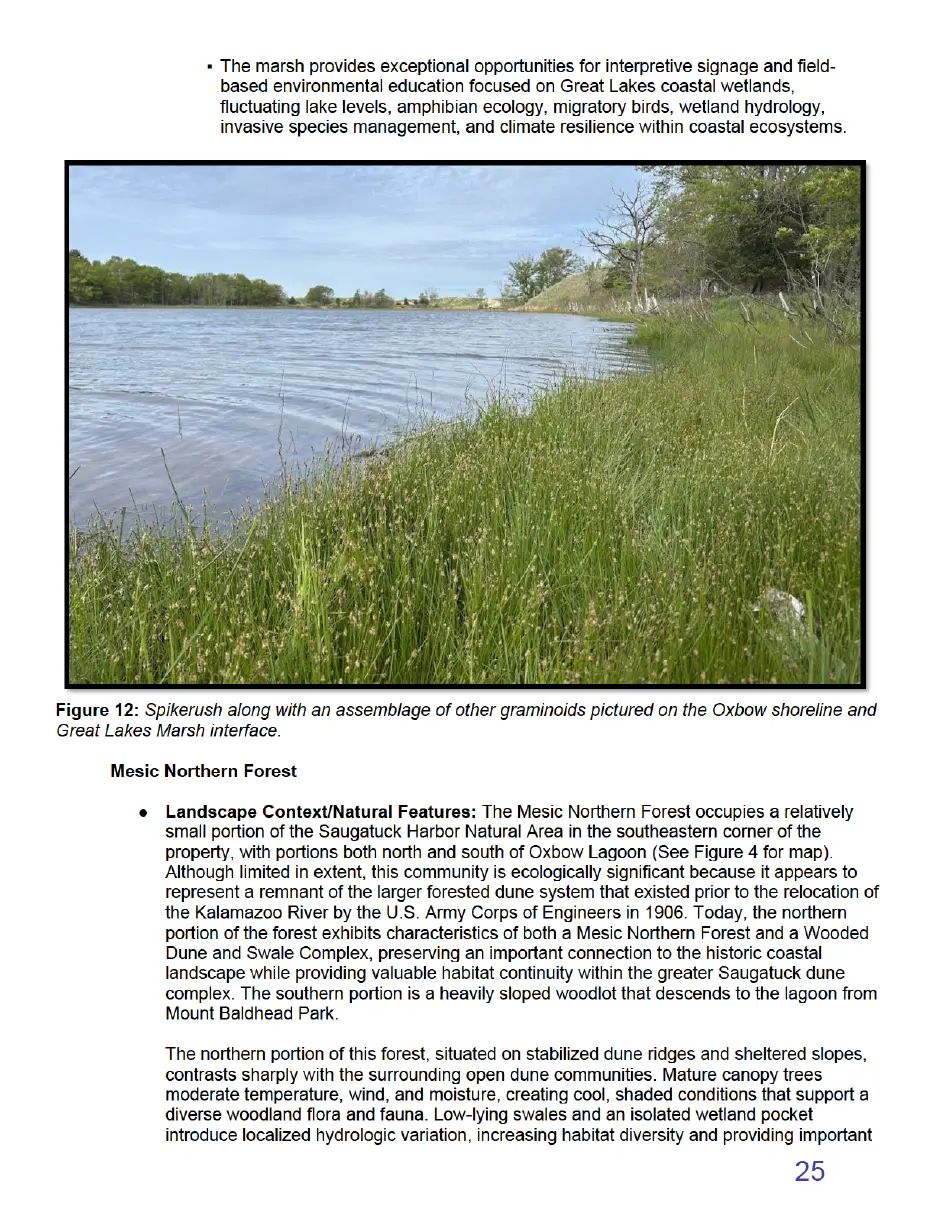
This page is a scanned image with no text layer. The PDF of these pages has it at full resolution.
Page 26
Text of page 26
breeding habitat for amphibians and other wetland-dependent wildlife. Natural disturbance processes including canopy gap formation due to windthrow and occasional tree mortality continue to shape the forest structure. However, chronic white-tailed deer browse has substantially reduced understory density and limited natural regeneration throughout much of the community. The southern portion of the woodlot includes a steep decline, with a footpath atop the ridge marking the upper edge and the hillside bottoming out into the lagoon. This results in an interesting matrix at the bottom of the slope, with aquatic species present that are more akin to the marsh community species list. The hillside has a thick canopy with a much-reduced shrub layer still due to deer browse. The strong trees that make up the canopy help to stabilize this steep slope to prevent large amounts of sediment from eroding into the lagoon. Overall, this woodlot is more mature than the northern portion with taller mature trees and with its proximity to the more forested backdune complex of Mount Baldhead Park. ● Plant Community: The northern portion’s canopy is composed primarily of mature northern hardwoods and conifers, including northern red oak (Quercus rubra), sugar maple (Acer saccharum), white pine (Pinus strobus), and scattered American beech (Fagus grandifolia). Sassafras (Sassafras albidum), black cherry (Prunus serotina), cottonwood (Populus deltoides), silver maple (Acer saccharinum), green ash (Fraxinus pennsylvanica), and occasional black gum (Nyssa sylvatica) occur in localized areas, reflecting transitions between upland dune forests and adjacent swales. White pine, eastern red cedar (Juniperus virginiana), and scattered jack pine (Pinus banksiana) further emphasize the influence of the surrounding coastal dune system. The shrub layer is relatively open as a result of prolonged deer browse but includes serviceberry (Amelanchier spp.), witch-hazel (Hamamelis virginiana), leatherwood (Dirca palustris), spicebush (Lindera benzoin), and scattered grapevine (Vitis riparia). The herbaceous layer supports numerous high-quality woodland species including wild columbine (Aquilegia canadensis), bottlebrush grass (Elymus hystrix), spotted wintergreen (Chimaphila maculata), and Pennsylvania sedge (Carex pensylvanica). The isolated wetland pocket contains coarse woody debris, sedges, blue flag iris (Iris virginica), nettles (Urtica spp.), marsh fern (Thelypteris palustris), and scattered buttonbush (Cephalanthus occidentalis), providing structural diversity and valuable habitat for amphibians and invertebrates. Japanese barberry (Berberis thunbergii) and garlic mustard (Alliaria petiolata) represent the primary invasive threats to this community. As for the southern portion of this community, most of the canopy trees are very similar to the northern portion. Jack pines are not present here due to the intense slope and heavier shade cover. Eastern hemlock (Tsuga canadensis) is a common tree of these sandy, heavily sloped forests and makes up a portion of the canopy. A few different species of cherry dot the canopy and understory including black cherry, choke cherry (Prunus virginiana), and sand cherry (Prunus pumila). The shrub layer is dominated by witch hazel and leatherwood, and the herbaceous layer includes the species mentioned in the northern portion along with common polypody (Polypodium virginianum) being common along the slope. Pennsylvania sedge acts as the main herbaceous matrix species. Additionally, Japanese barberry is not found on the slope but is at the top of the ridge in this section. Overall, both sections of this forest retain a mature canopy, diverse native flora, and high ecological integrity. Despite localized invasive species and heavy deer browse limiting regeneration, these remnant woodlots continue to function as important ecological links between the coastal dune communities of SHNA and the adjacent forested landscapes surrounding Mount Baldhead and Oxbow Lagoon.
Page 27
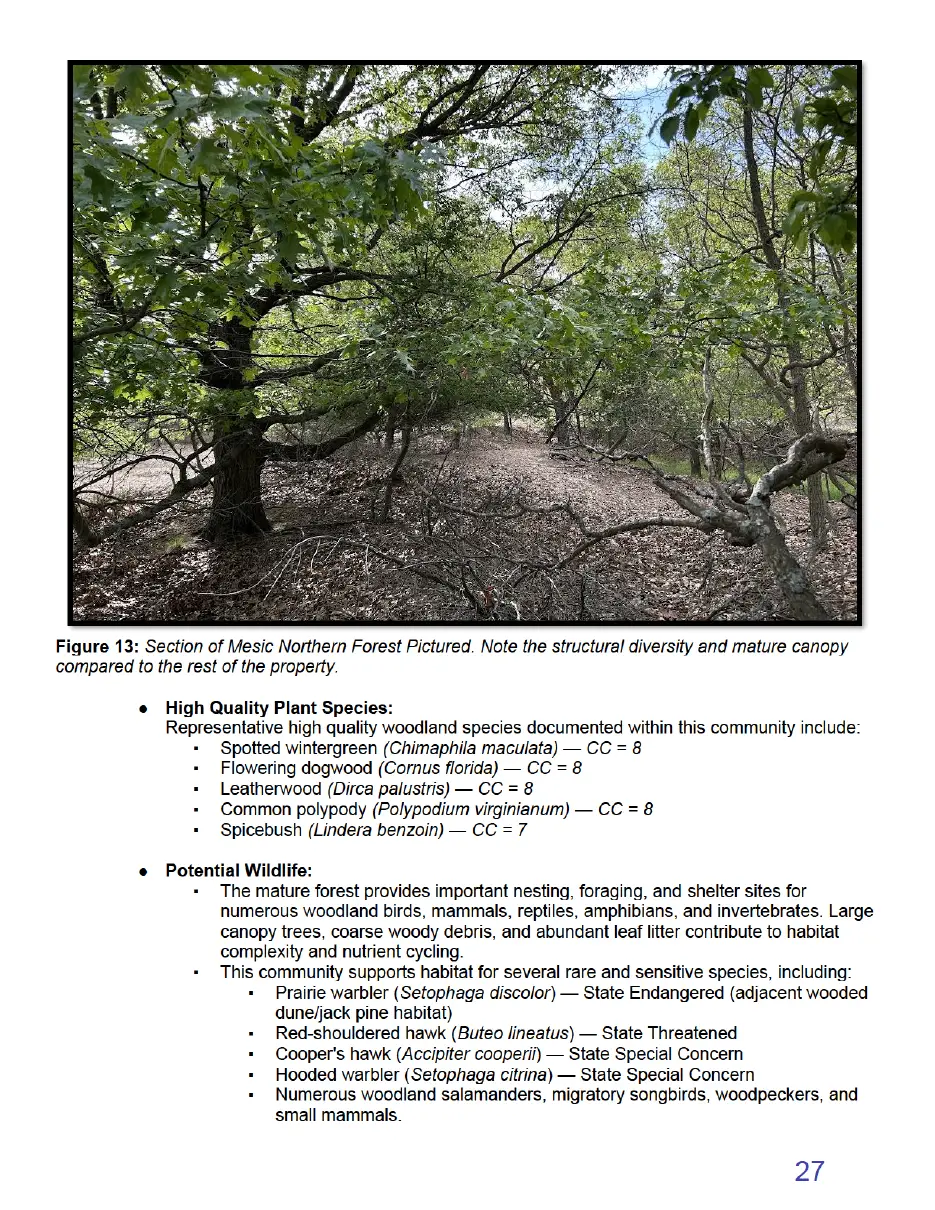
This page is a scanned image with no text layer. The PDF of these pages has it at full resolution.
Page 28
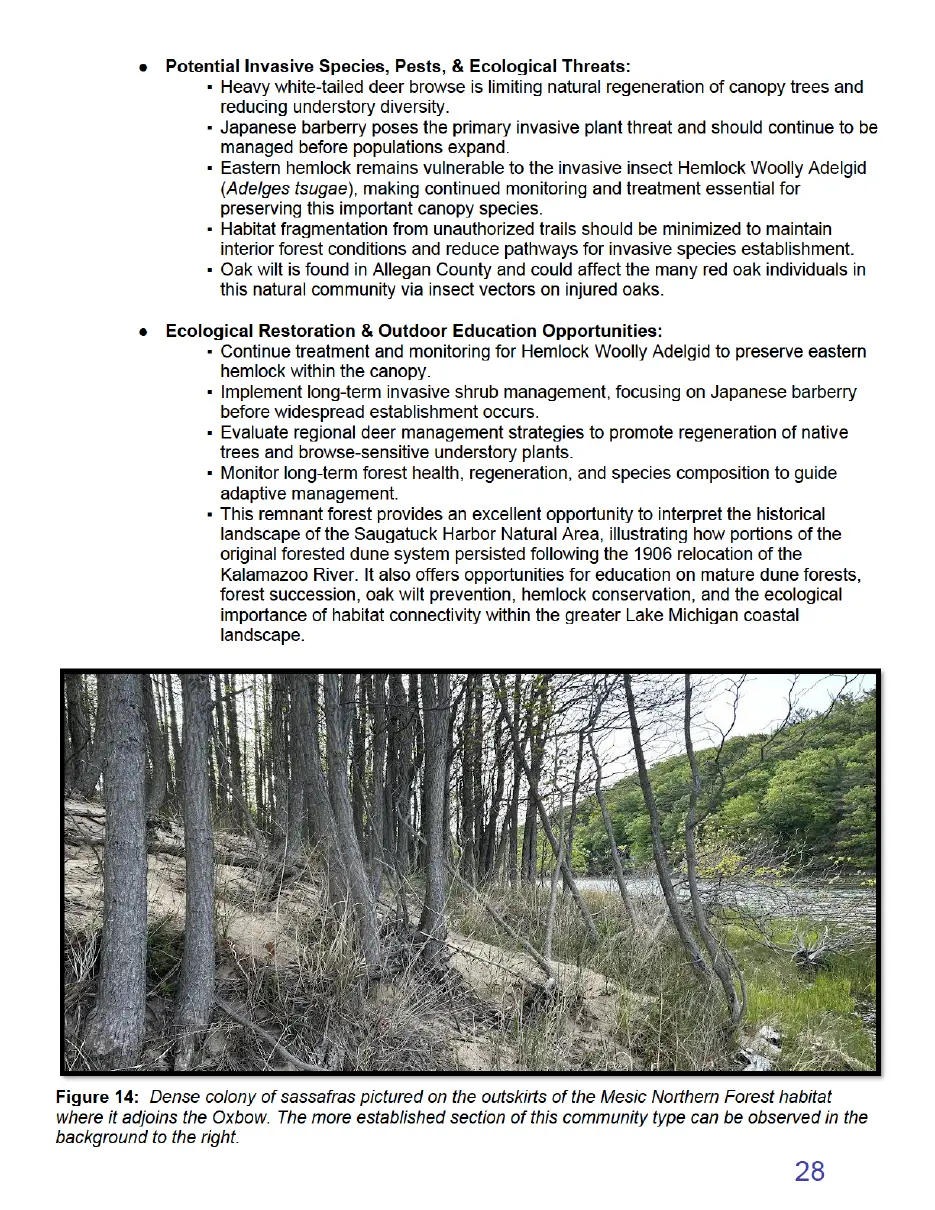
This page is a scanned image with no text layer. The PDF of these pages has it at full resolution.
Page 29
Text of page 29
Conservation Priorities Overall, the Saugatuck Harbor Natural Area remains in exceptional ecological condition, with an adjusted Floristic Quality Index of 45.3 and numerous high quality plant species indicative of an intact ecosystem. While the property requires relatively little ecological restoration compared to many coastal preserves in southwest Michigan, proactive stewardship is essential to maintain its ecological integrity. Based on field observations, the highest management priorities include: 1. Eradication and long-term management of invasive phragmites within the Great Lakes Marsh and interdunal wetland communities. 2. Continued removal of Japanese barberry and other invasive woody shrubs. 3. Reduction of off-trail recreation and dune erosion through improved trail management. 4. Long-term management of excessive deer browse and continued treatment for Hemlock Woolly Adelgid. 5. Continued ecological monitoring of rare natural communities, vegetation change, and invasive species. Stewardship Recommendations Long-term stewardship will be essential to maintaining the exceptional ecological integrity of the Saugatuck Harbor Natural Area. While the property currently supports high-quality natural communities and relatively low levels of ecological degradation, continued monitoring will allow land managers to evaluate the effectiveness of management actions, detect emerging threats before they become widespread, and document ecological change over time. A consistent monitoring program will also provide valuable baseline data to guide future management decisions and adaptive stewardship. Recommended stewardship activities include: • Annual invasive species monitoring to identify and rapidly respond to new infestations of priority species such as phragmites, Japanese barberry, garlic mustard, black locust, and other invasive plants before they become well established. • Floristic Quality Assessment (FQA/FQI) monitoring roughly every five years to evaluate longterm changes in plant community composition, ecological integrity, and restoration success. • Rare species and high-quality habitat monitoring to document populations of high-quality plant species and evaluate the condition of globally rare interdunal wetlands and other sensitive natural communities. • Permanent photo monitoring points established throughout representative management units to visually document vegetation change, shoreline dynamics, invasive species treatments, trail restoration efforts, and natural succession over time. • Visitor use monitoring to determine the effectiveness of wayfinding and interpretive signage and to limit social trail development. • Trail condition monitoring to evaluate trail wear, erosion, and vegetation trampling. • Deer browse assessments conducted periodically to evaluate browsing pressure on native vegetation, canopy regeneration, and understory diversity, helping inform future deer management discussions with regional partners. • Forest health inspections, including continued monitoring and treatment of Hemlock Woolly Adelgid, as well as surveillance for other emerging forest pests and diseases that could threaten canopy composition, such as oak wilt. • Hydrologic and shoreline observations following periods of unusually high or low Lake Michigan water levels to document changes in natural community stability, shoreline erosion, and natural dune dynamics. • Annual stewardship reporting to summarize monitoring results, completed management activities, emerging concerns, and recommendations for future work. Maintaining a consistent record of annual observations will support adaptive management and improve long-term decisionmaking.
Page 30
Text of page 30
Visitor Experience The long-term ecological integrity of the Saugatuck Harbor Natural Area depends on balancing the protection of sensitive natural communities with opportunities for passive recreation and environmental education. As visitation continues to increase, concentrating use along a clearly defined and wellmaintained trail network will help minimize habitat degradation while enhancing the overall visitor experience. The accompanying Trail Assessment identified several opportunities to improve visitor circulation and reduce ecological impacts through strategic trail management. Recommendations include formalizing appropriate, well-established social trails that provide sustainable access; decommissioning unnecessary or environmentally damaging user-created trails; and restoring affected areas with natural barriers such as woody debris, brush piles, or native vegetation. These measures will help reduce vegetation trampling, minimize dune erosion, and discourage access of sensitive habitats and adjacent private properties. Improved trail infrastructure should be complemented by a comprehensive wayfinding and interpretive signage program. Clearly marked trail routes and updated trail maps will improve navigation and encourage visitors to remain on designated pathways, reducing confusion and off-trail travel. Interpretive signage should highlight the ecological significance of SHNA's interdunal wetlands, Great Lakes marshes, remnant coastal forests, and dynamic coastal dune processes while explaining ongoing stewardship activities such as invasive species management, habitat restoration, and the importance of protecting sensitive vegetation. By connecting visitors to the natural and cultural history of the preserve, these educational elements can foster a greater appreciation for the landscape and encourage responsible recreation. Collectively, these trail and signage improvements represent an important conservation strategy. Rather than expanding recreational opportunities, they are intended to concentrate visitor use, protect ecologically sensitive areas, and support the long-term preservation of a high-quality coastal dune ecosystem. Conclusion Unlike many restoration projects that seek to reconstruct degraded ecosystems, stewardship at the Saugatuck Harbor Natural Area should focus primarily on protecting and sustaining the natural ecological processes that continue to shape this dynamic coastal landscape. Wind, fluctuating Lake Michigan water levels, groundwater hydrology, natural shoreline migration, and periodic disturbance have created and maintained these globally significant natural communities for thousands of years. Management should therefore prioritize preserving these natural processes while addressing anthropogenic stressors such as invasive species, excessive deer browse, habitat fragmentation, and unmanaged recreational impacts. Although the property has experienced localized disturbances associated with historic hydrologic modifications and increased public use, the vast majority of SHNA remains remarkably intact. The preserve supports exceptional examples of open dune, Great Lakes marsh, interdunal wetland, and coastal forest communities that collectively provide habitat for a diverse assemblage of native plants and wildlife, including numerous high quality plant species indicative of outstanding ecological integrity. With an adjusted Floristic Quality Index of 45.3 and 38 plant species possessing Coefficients of Conservatism of seven or greater, SHNA represents an important high-quality natural community along the southern Lake Michigan shoreline. The management recommendations presented in this evaluation emphasize proactive stewardship rather than large-scale restoration. Continued invasive species control, long-term ecological monitoring, protection of natural hydrologic and geomorphic processes, and strategic forest and wildlife management will help ensure these natural communities remain resilient in the face of future environmental change. Equally important is the thoughtful management of public access. The recommended trail improvements, wayfinding enhancements, and interpretive signage outlined in the accompanying Trail Assessment will
Page 31

Text of page 31
help concentrate visitor use within a sustainable trail network while reducing impacts to sensitive habitats. By pairing resource protection with meaningful opportunities for recreation and environmental education, SHNA can continue to provide an exceptional visitor experience while safeguarding the ecological features that make the preserve unique. As one of Michigan's premier coastal preserves, the Saugatuck Harbor Natural Area represents an irreplaceable component of the Lake Michigan dune ecosystem. Through continued collaboration between the City of Saugatuck, conservation partners, researchers, and the community, the property can remain a model for balancing ecological stewardship, scientific research, and low-impact public recreation, ensuring its exceptional natural and cultural resources are preserved for generations to come.
Page 32
This page is a scanned image with no text layer. The PDF of these pages has it at full resolution.
Page 33
This page is a scanned image with no text layer. The PDF of these pages has it at full resolution.
Page 34
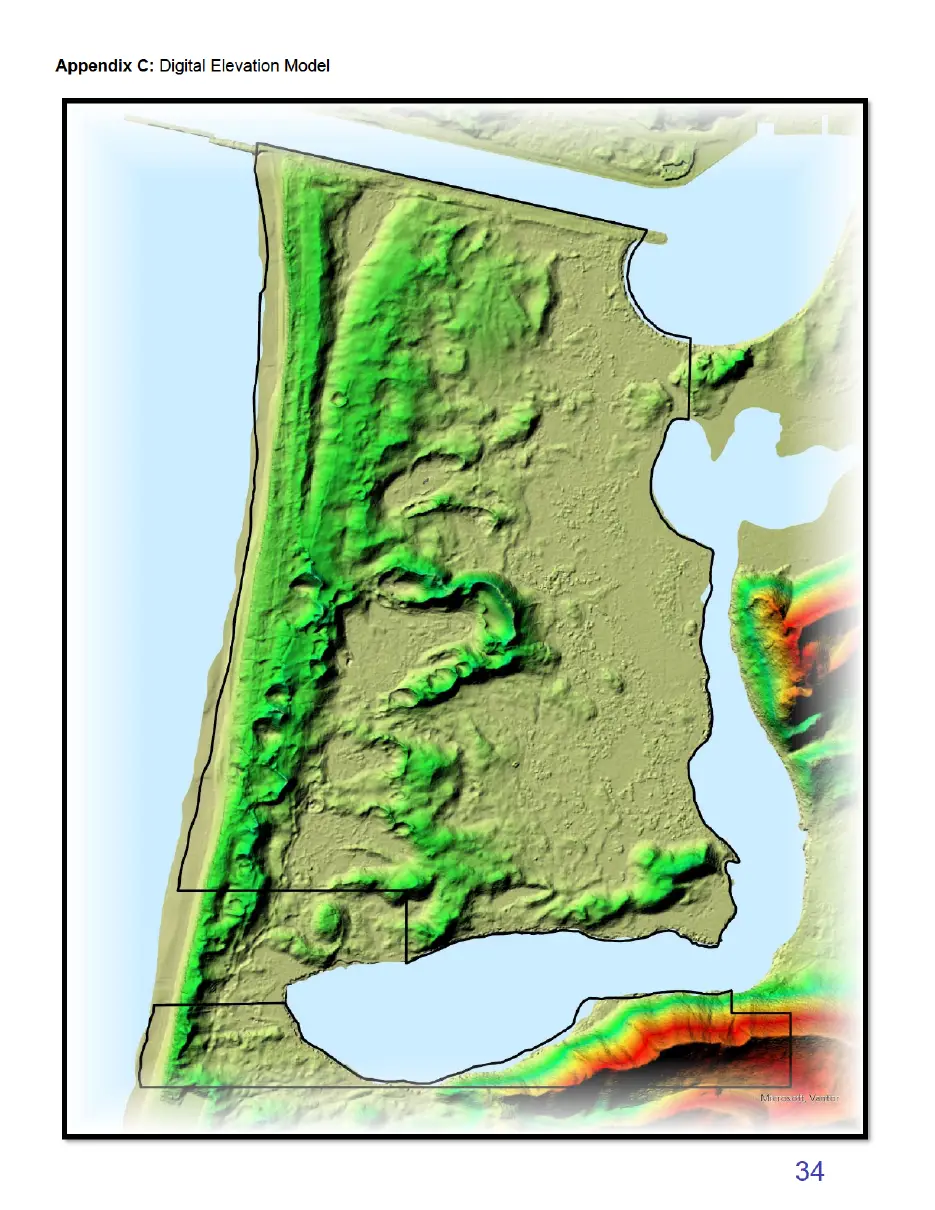
This page is a scanned image with no text layer. The PDF of these pages has it at full resolution.
Page 35
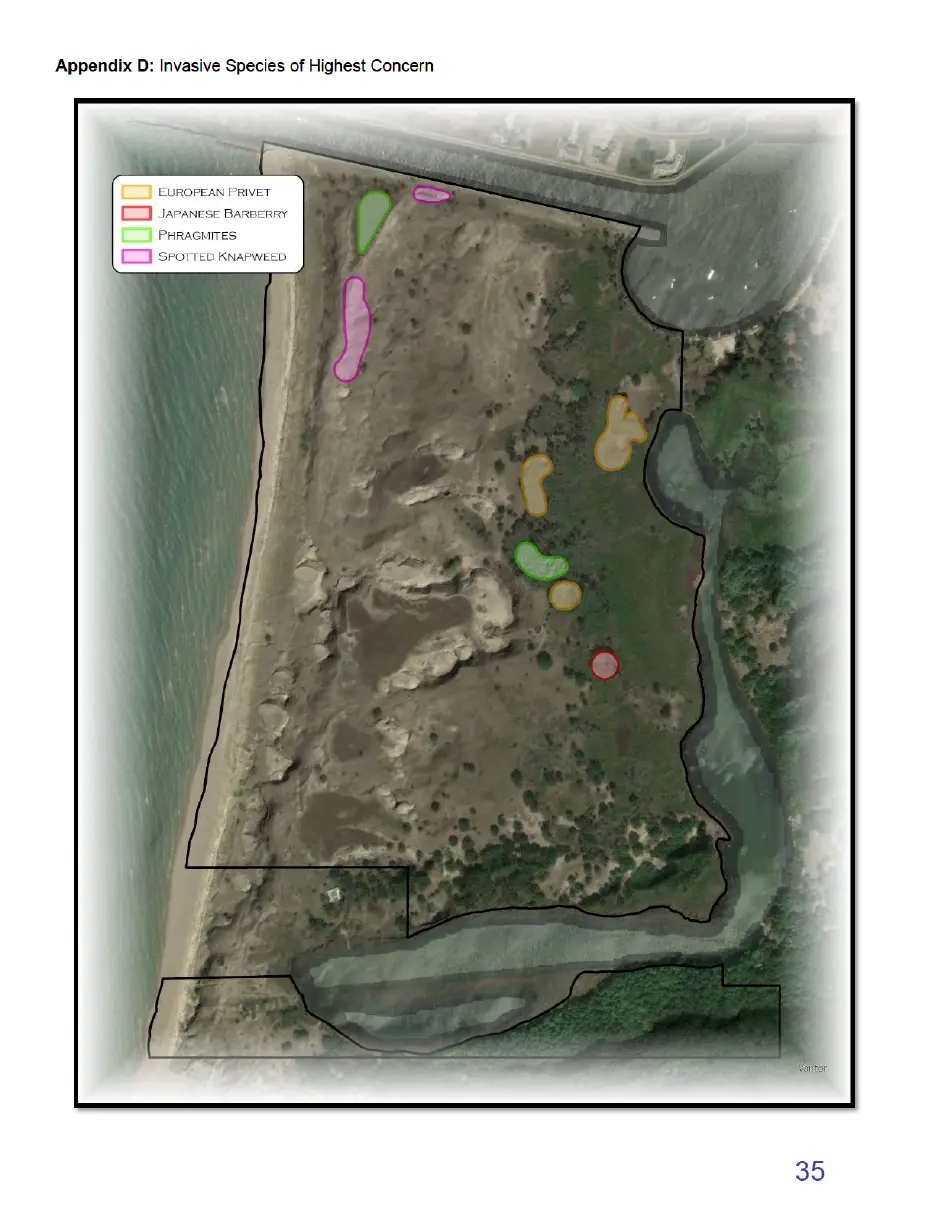
This page is a scanned image with no text layer. The PDF of these pages has it at full resolution.
Page 36
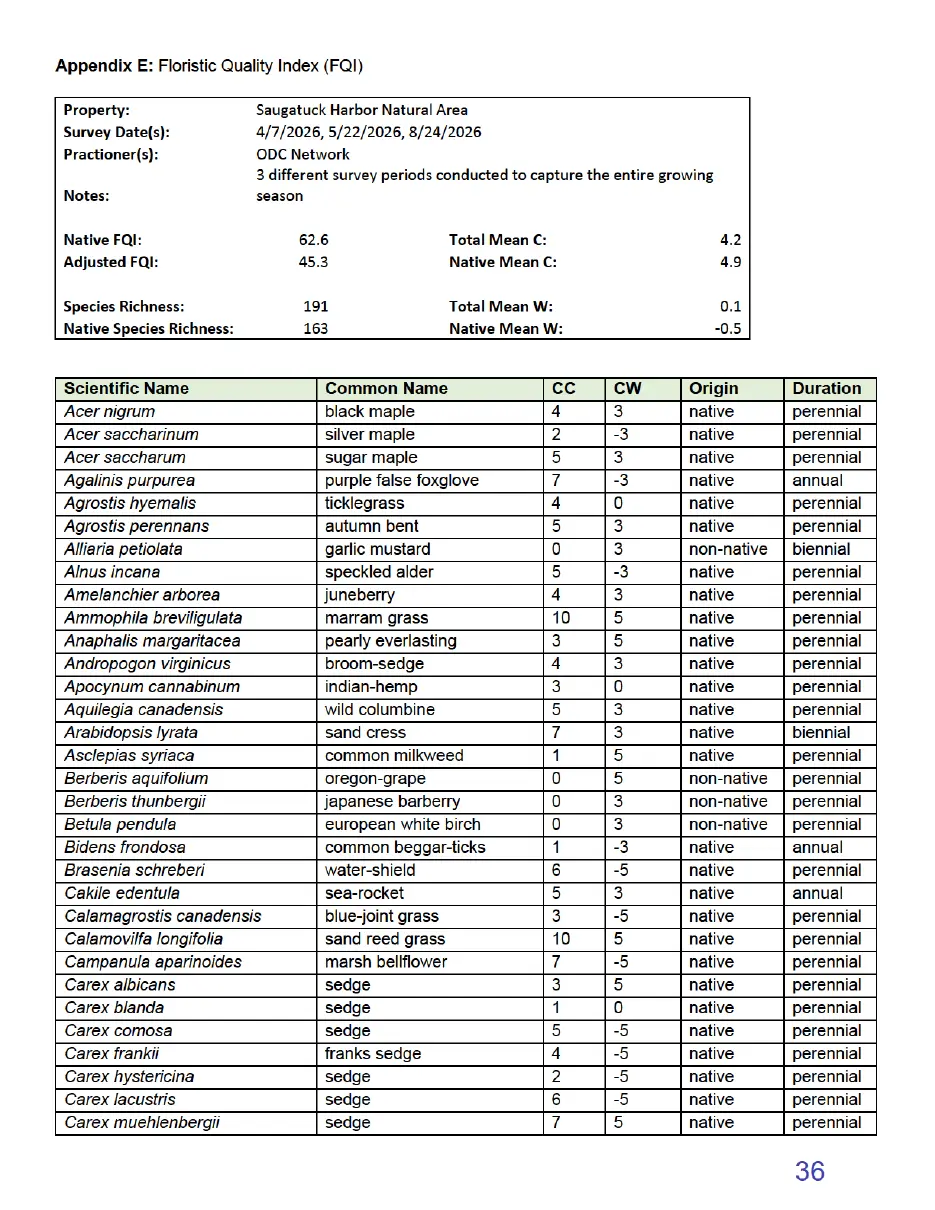
This page is a scanned image with no text layer. The PDF of these pages has it at full resolution.
Page 37
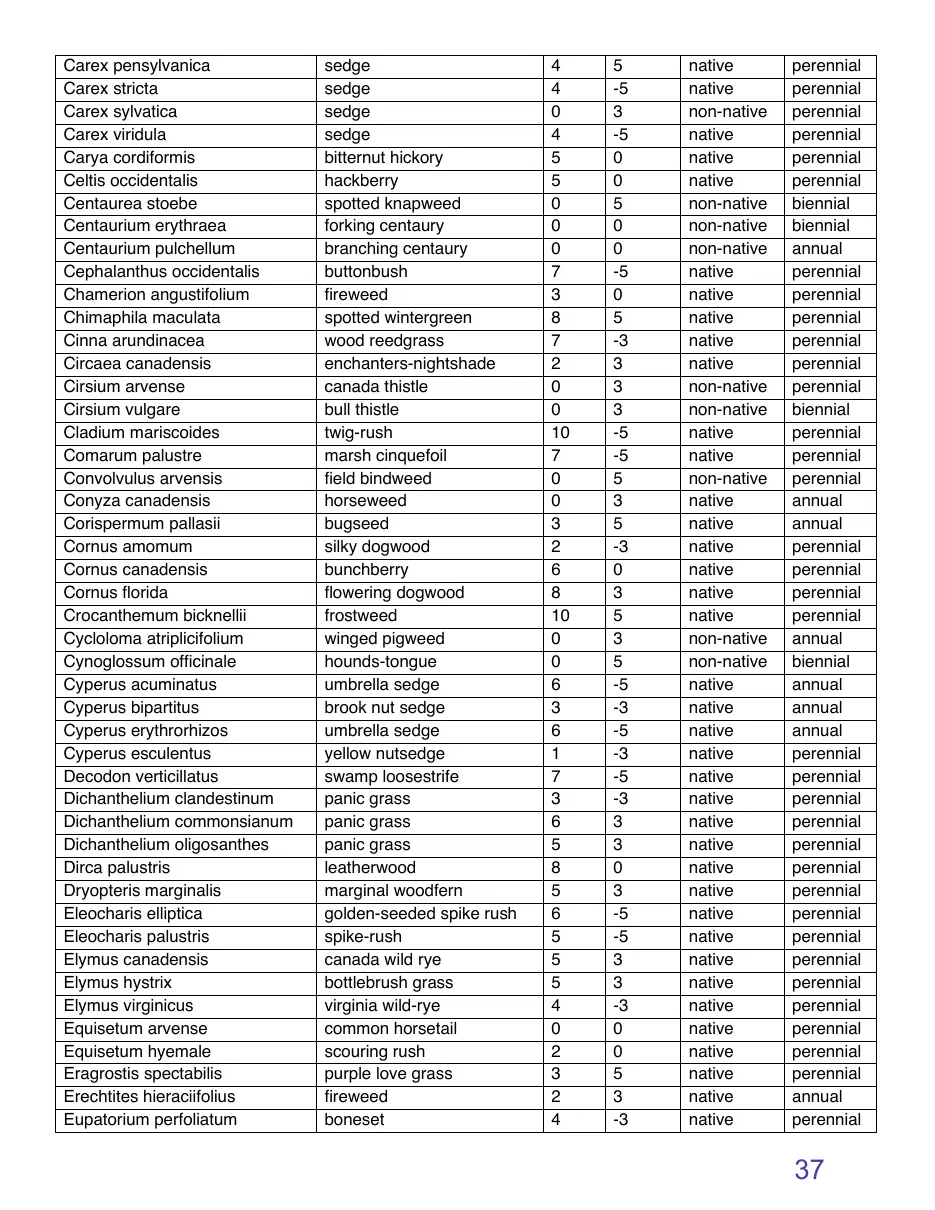
Text of page 37
Carex pensylvanica Carex stricta Carex sylvatica Carex viridula Carya cordiformis Celtis occidentalis Centaurea stoebe Centaurium erythraea Centaurium pulchellum Cephalanthus occidentalis Chamerion angustifolium Chimaphila maculata Cinna arundinacea Circaea canadensis Cirsium arvense Cirsium vulgare Cladium mariscoides Comarum palustre Convolvulus arvensis Conyza canadensis Corispermum pallasii Cornus amomum Cornus canadensis Cornus florida Crocanthemum bicknellii Cycloloma atriplicifolium Cynoglossum officinale Cyperus acuminatus Cyperus bipartitus Cyperus erythrorhizos Cyperus esculentus Decodon verticillatus Dichanthelium clandestinum Dichanthelium commonsianum Dichanthelium oligosanthes Dirca palustris Dryopteris marginalis Eleocharis elliptica Eleocharis palustris Elymus canadensis Elymus hystrix Elymus virginicus Equisetum arvense Equisetum hyemale Eragrostis spectabilis Erechtites hieraciifolius Eupatorium perfoliatum
sedge sedge sedge sedge bitternut hickory hackberry spotted knapweed forking centaury branching centaury buttonbush fireweed spotted wintergreen wood reedgrass enchanters-nightshade canada thistle bull thistle twig-rush marsh cinquefoil field bindweed horseweed bugseed silky dogwood bunchberry flowering dogwood frostweed winged pigweed hounds-tongue umbrella sedge brook nut sedge umbrella sedge yellow nutsedge swamp loosestrife panic grass panic grass panic grass leatherwood marginal woodfern golden-seeded spike rush spike-rush canada wild rye bottlebrush grass virginia wild-rye common horsetail scouring rush purple love grass fireweed boneset
4 4 0 4 5 5 0 0 0 7 3 8 7 2 0 0 10 7 0 0 3 2 6 8 10 0 0 6 3 6 1 7 3 6 5 8 5 6 5 5 5 4 0 2 3 2 4
5 -5 3 -5 0 0 5 0 0 -5 0 5 -3 3 3 3 -5 -5 5 3 5 -3 0 3 5 3 5 -5 -3 -5 -3 -5 -3 3 3 0 3 -5 -5 3 3 -3 0 0 5 3 -3
native native non-native native native native non-native non-native non-native native native native native native non-native non-native native native non-native native native native native native native non-native non-native native native native native native native native native native native native native native native native native native native native native
perennial perennial perennial perennial perennial perennial biennial biennial annual perennial perennial perennial perennial perennial perennial biennial perennial perennial perennial annual annual perennial perennial perennial perennial annual biennial annual annual annual perennial perennial perennial perennial perennial perennial perennial perennial perennial perennial perennial perennial perennial perennial perennial annual perennial
Page 38
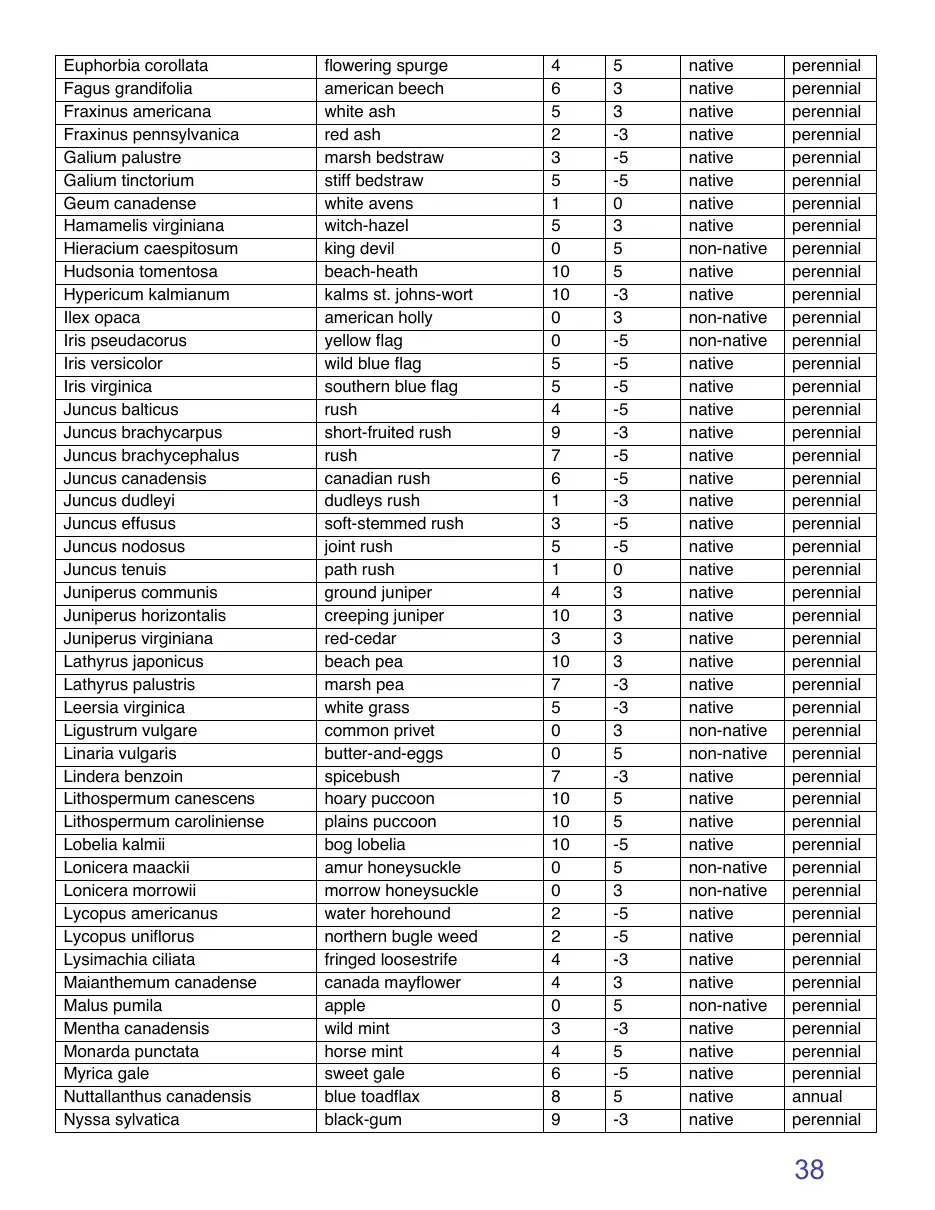
Text of page 38
Euphorbia corollata Fagus grandifolia Fraxinus americana Fraxinus pennsylvanica Galium palustre Galium tinctorium Geum canadense Hamamelis virginiana Hieracium caespitosum Hudsonia tomentosa Hypericum kalmianum Ilex opaca Iris pseudacorus Iris versicolor Iris virginica Juncus balticus Juncus brachycarpus Juncus brachycephalus Juncus canadensis Juncus dudleyi Juncus effusus Juncus nodosus Juncus tenuis Juniperus communis Juniperus horizontalis Juniperus virginiana Lathyrus japonicus Lathyrus palustris Leersia virginica Ligustrum vulgare Linaria vulgaris Lindera benzoin Lithospermum canescens Lithospermum caroliniense Lobelia kalmii Lonicera maackii Lonicera morrowii Lycopus americanus Lycopus uniflorus Lysimachia ciliata Maianthemum canadense Malus pumila Mentha canadensis Monarda punctata Myrica gale Nuttallanthus canadensis Nyssa sylvatica
flowering spurge american beech white ash red ash marsh bedstraw stiff bedstraw white avens witch-hazel king devil beach-heath kalms st. johns-wort american holly yellow flag wild blue flag southern blue flag rush short-fruited rush rush canadian rush dudleys rush soft-stemmed rush joint rush path rush ground juniper creeping juniper red-cedar beach pea marsh pea white grass common privet butter-and-eggs spicebush hoary puccoon plains puccoon bog lobelia amur honeysuckle morrow honeysuckle water horehound northern bugle weed fringed loosestrife canada mayflower apple wild mint horse mint sweet gale blue toadflax black-gum
4 6 5 2 3 5 1 5 0 10 10 0 0 5 5 4 9 7 6 1 3 5 1 4 10 3 10 7 5 0 0 7 10 10 10 0 0 2 2 4 4 0 3 4 6 8 9
5 3 3 -3 -5 -5 0 3 5 5 -3 3 -5 -5 -5 -5 -3 -5 -5 -3 -5 -5 0 3 3 3 3 -3 -3 3 5 -3 5 5 -5 5 3 -5 -5 -3 3 5 -3 5 -5 5 -3
native native native native native native native native non-native native native non-native non-native native native native native native native native native native native native native native native native native non-native non-native native native native native non-native non-native native native native native non-native native native native native native
perennial perennial perennial perennial perennial perennial perennial perennial perennial perennial perennial perennial perennial perennial perennial perennial perennial perennial perennial perennial perennial perennial perennial perennial perennial perennial perennial perennial perennial perennial perennial perennial perennial perennial perennial perennial perennial perennial perennial perennial perennial perennial perennial perennial perennial annual perennial
Page 39
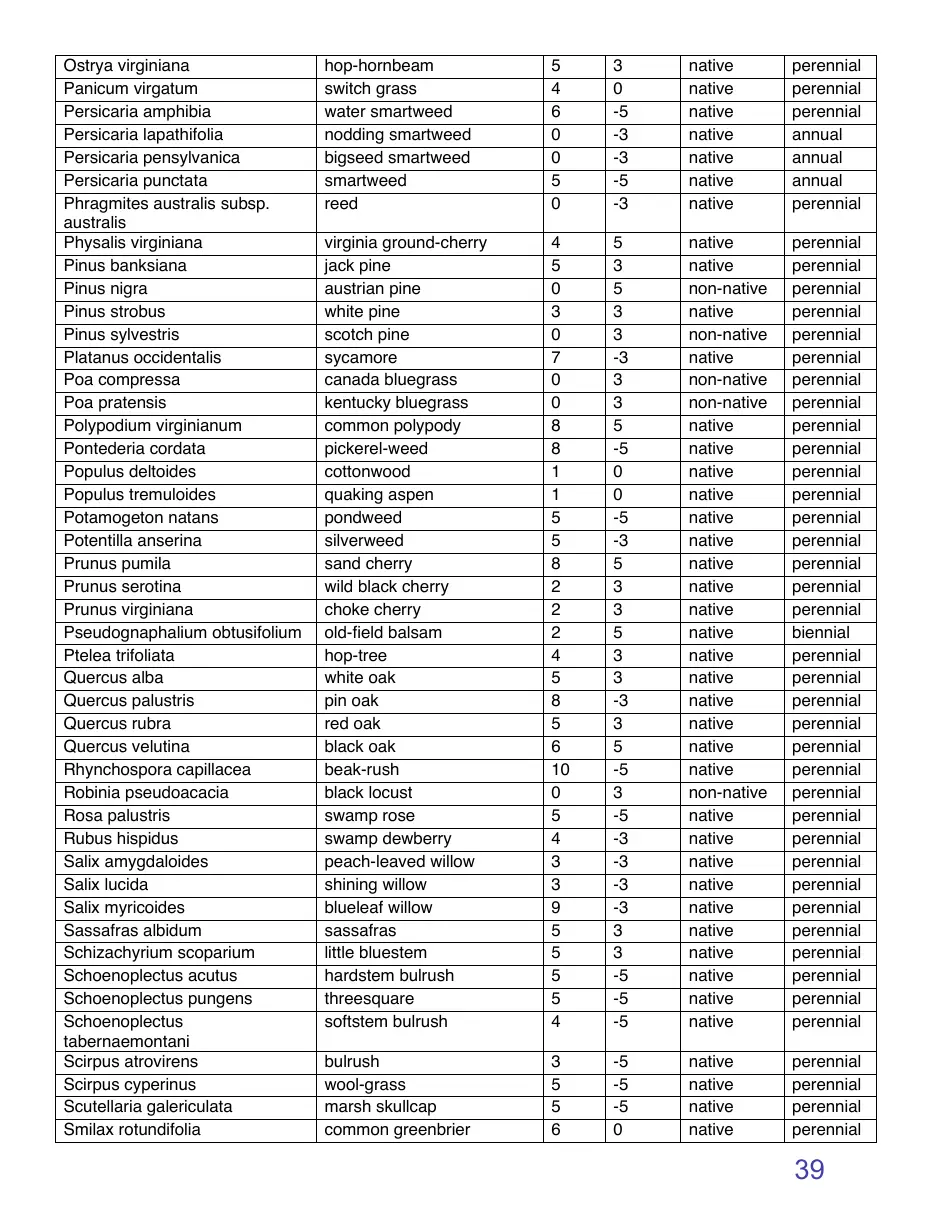
Text of page 39
Ostrya virginiana Panicum virgatum Persicaria amphibia Persicaria lapathifolia Persicaria pensylvanica Persicaria punctata Phragmites australis subsp. australis Physalis virginiana Pinus banksiana Pinus nigra Pinus strobus Pinus sylvestris Platanus occidentalis Poa compressa Poa pratensis Polypodium virginianum Pontederia cordata Populus deltoides Populus tremuloides Potamogeton natans Potentilla anserina Prunus pumila Prunus serotina Prunus virginiana Pseudognaphalium obtusifolium Ptelea trifoliata Quercus alba Quercus palustris Quercus rubra Quercus velutina Rhynchospora capillacea Robinia pseudoacacia Rosa palustris Rubus hispidus Salix amygdaloides Salix lucida Salix myricoides Sassafras albidum Schizachyrium scoparium Schoenoplectus acutus Schoenoplectus pungens Schoenoplectus tabernaemontani Scirpus atrovirens Scirpus cyperinus Scutellaria galericulata Smilax rotundifolia
hop-hornbeam switch grass water smartweed nodding smartweed bigseed smartweed smartweed reed
5 4 6 0 0 5 0
3 0 -5 -3 -3 -5 -3
native native native native native native native
perennial perennial perennial annual annual annual perennial
virginia ground-cherry jack pine austrian pine white pine scotch pine sycamore canada bluegrass kentucky bluegrass common polypody pickerel-weed cottonwood quaking aspen pondweed silverweed sand cherry wild black cherry choke cherry old-field balsam hop-tree white oak pin oak red oak black oak beak-rush black locust swamp rose swamp dewberry peach-leaved willow shining willow blueleaf willow sassafras little bluestem hardstem bulrush threesquare softstem bulrush
4 5 0 3 0 7 0 0 8 8 1 1 5 5 8 2 2 2 4 5 8 5 6 10 0 5 4 3 3 9 5 5 5 5 4
5 3 5 3 3 -3 3 3 5 -5 0 0 -5 -3 5 3 3 5 3 3 -3 3 5 -5 3 -5 -3 -3 -3 -3 3 3 -5 -5 -5
native native non-native native non-native native non-native non-native native native native native native native native native native native native native native native native native non-native native native native native native native native native native native
perennial perennial perennial perennial perennial perennial perennial perennial perennial perennial perennial perennial perennial perennial perennial perennial perennial biennial perennial perennial perennial perennial perennial perennial perennial perennial perennial perennial perennial perennial perennial perennial perennial perennial perennial
bulrush wool-grass marsh skullcap common greenbrier
3 5 5 6
-5 -5 -5 0
native native native native
perennial perennial perennial perennial
Page 40
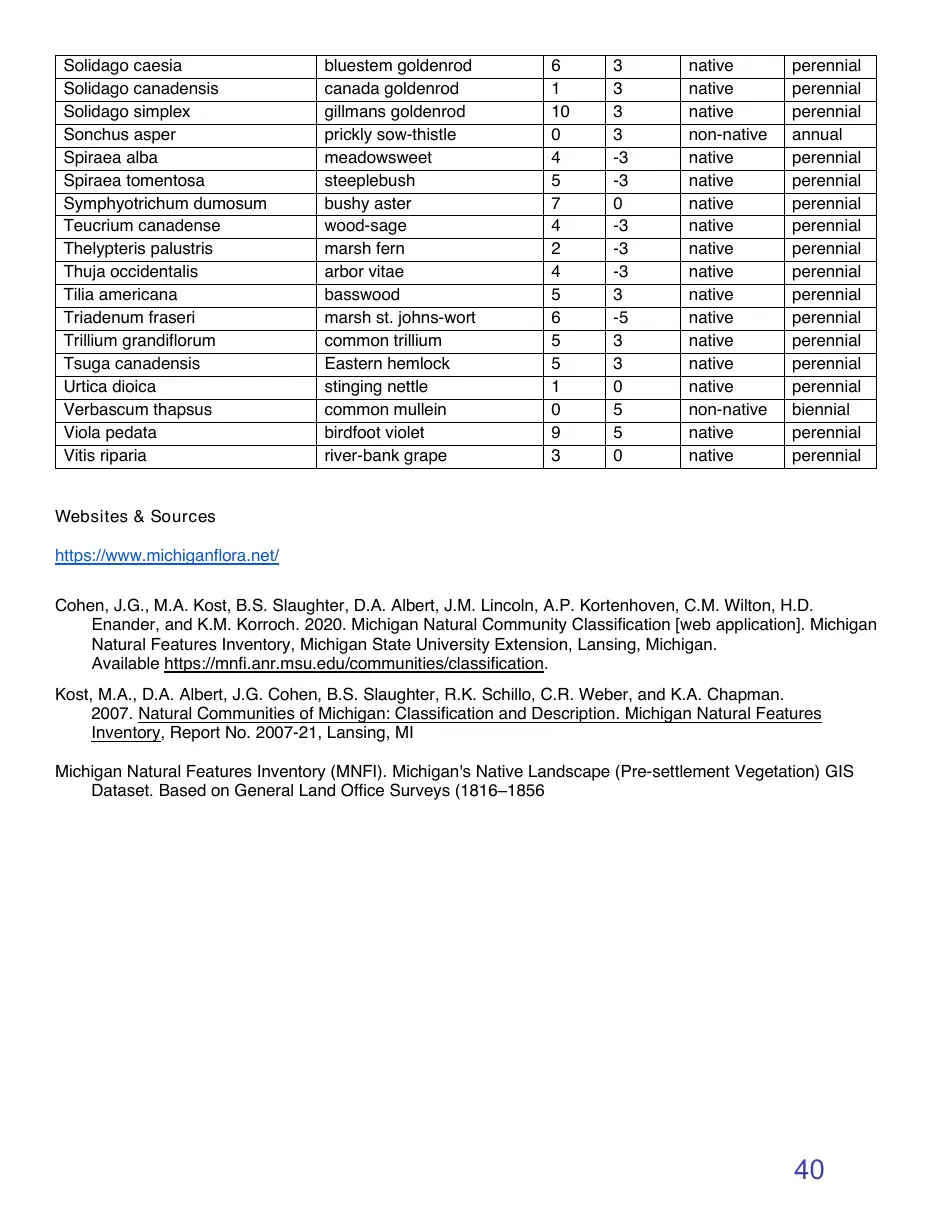
Text of page 40
Solidago caesia Solidago canadensis Solidago simplex Sonchus asper Spiraea alba Spiraea tomentosa Symphyotrichum dumosum Teucrium canadense Thelypteris palustris Thuja occidentalis Tilia americana Triadenum fraseri Trillium grandiflorum Tsuga canadensis Urtica dioica Verbascum thapsus Viola pedata Vitis riparia
bluestem goldenrod canada goldenrod gillmans goldenrod prickly sow-thistle meadowsweet steeplebush bushy aster wood-sage marsh fern arbor vitae basswood marsh st. johns-wort common trillium Eastern hemlock stinging nettle common mullein birdfoot violet river-bank grape
6 1 10 0 4 5 7 4 2 4 5 6 5 5 1 0 9 3
3 3 3 3 -3 -3 0 -3 -3 -3 3 -5 3 3 0 5 5 0
native native native non-native native native native native native native native native native native native non-native native native
perennial perennial perennial annual perennial perennial perennial perennial perennial perennial perennial perennial perennial perennial perennial biennial perennial perennial
Websites & Sources https://www.michiganflora.net/ Cohen, J.G., M.A. Kost, B.S. Slaughter, D.A. Albert, J.M. Lincoln, A.P. Kortenhoven, C.M. Wilton, H.D. Enander, and K.M. Korroch. 2020. Michigan Natural Community Classification [web application]. Michigan Natural Features Inventory, Michigan State University Extension, Lansing, Michigan. Available https://mnfi.anr.msu.edu/communities/classification. Kost, M.A., D.A. Albert, J.G. Cohen, B.S. Slaughter, R.K. Schillo, C.R. Weber, and K.A. Chapman. 2007. Natural Communities of Michigan: Classification and Description. Michigan Natural Features Inventory, Report No. 2007-21, Lansing, MI Michigan Natural Features Inventory (MNFI). Michigan's Native Landscape (Pre-settlement Vegetation) GIS Dataset. Based on General Land Office Surveys (1816–1856