
Parking Task Force Agenda item 6E
Walker Report Executive Summary Draft
Parking Improvements Task Force, Wednesday, July 29, 2026
Download these 27 pages, 775 KB Whole packet, 47 pages, 4.4 MB
Page 21
Text of page 21
City of Saugatuck Parking Study: Executive Summary and Action Plan The City of Saugatuck’s downtown parking challenge is real, visible, and concentrated during peak visitor periods. However, the study record and Walker’s recommended action plan do not support immediately advancing the most expensive or disruptive options, such as a new parking structure or a broad paid parking program. Instead, the recommended approach is a practical, phased management strategy that uses existing assets more effectively, strengthens enforcement, expands remote and shared parking, improves the Interurban connection, restores and manages high-value curb space, improves accessibility, and communicates parking options more clearly to residents, employees, businesses, and visitors. Downtown parking demand is most severe from Memorial Day through Labor Day, with July and August representing the most constrained period. Stakeholders and survey respondents consistently described peakseason parking as difficult because of congestion, long search times, limited enforcement, employee use of prime spaces, inadequate accessible parking, inconsistent signage, and limited awareness of remote parking and shuttle options. Outside peak periods, the system generally functions more effectively. This seasonal pattern supports the recommended policy direction: avoid overbuilding for a limited number of annual peak conditions and instead manage demand, turnover, information, and remote capacity more aggressively. This document provides an executive-level synthesis of the Saugatuck parking study materials. It summarizes core data points, survey results, stakeholder feedback, guiding principles, key findings, recommended strategic direction, implementation priorities, next steps, a phased implementation timeline, key performance indicators, and a monitoring plan. It is intended to serve as both a study summary and an action plan for near-term parking management, remote and shared parking, employee parking, Interurban coordination, wayfinding and communications, accessibility, curb management, and future policy decisions.
Study Methodology and Discovery Process The parking study began in late summer 2025 and is scheduled to conclude in summer 2026. The work was structured as a data-driven parking, mobility, policy, and implementation study designed to understand how Saugatuck’s parking system functions during both off-season and peak-season conditions, identify the causes of user frustration, and develop practical recommendations aligned with the City’s scale, character, fiscal capacity, and seasonal demand patterns. The consultant work plan included six major task areas: project coordination and problem identification; parking inventory and mapping; parking needs analysis; review of policies, practices, technology, and organizational structure; wayfinding, signage, and communications evaluation; and evaluation of options, costs, recommendations, and implementation sequencing. The study process emphasized learning from City staff, the Parking Improvements Task Force, community stakeholders, and field observations before developing recommendations.
© Walker Consultants
Page 22
Text of page 22
The Parking Improvements Task Force provided the primary advisory forum for the study. The project scope contemplated participation in up to eight Task Force meetings to review progress, discuss findings, evaluate potential solutions, receive feedback, and refine recommendations. The Task Force is chaired by a City Council member and includes approximately 10 community and agency representatives, including representatives of the Saugatuck City Council, Saugatuck Planning Commission, Saugatuck residents, restaurant and retail business interests, the Saugatuck/Douglas Area Convention and Visitors Bureau, the Interurban Transit Authority, City staff, and the consultant team. Geographic study area. The overall study area was confirmed with the Parking Improvements Task Force to include the City of Saugatuck north of the Kalamazoo River. For inventory and mapping purposes, the consultant team documented public and private parking locations and related transportation assets east of the Kalamazoo River. More detailed parking occupancy observations focused on the area generally bounded by the Kalamazoo River, Lucy Street, Holland Street, Francis Street, and Elizabeth Street, including the Saugatuck High School parking lots. A focused turnover and duration-of-stay subarea was also defined for selected on-street spaces along Water, Butler, and Culver Streets in the downtown core. Field data collection and technical review included a comprehensive inventory and mapping of public and private parking locations and spaces east of the Kalamazoo River, with documentation of space counts, posted time limits, user restrictions, ownership where available, transit stops and routes, bicycle facilities, ride-share or pickup/drop-off areas where present, commercial loading zones, and related curbside conditions. The study also included parking occupancy counts during off-season and peak-season conditions, including weekday and Saturday observations, repeated counts through the day, ADA-space observations, and analysis of parking adequacy by block, lot, and zone. Turnover and duration-of-stay data were collected for a focused group of approximately 30 on-street parking spaces along key downtown commercial corridors. The Task Force and consultant team identified the turnover data collection area as Water Street from Main Street to Hoffman Street, Butler Street from Hoffman Street to Water Street, and Culver Street from Butler Street to Griffith Street. This analysis was intended to determine whether vehicles were complying with posted time limits and whether changes to time limits, enforcement, or parking management could improve customer access. Stakeholder intake and community discovery were also central to the methodology. The work plan included a web-based questionnaire, public engagement opportunities, targeted stakeholder meetings, and ongoing Task Force discussions. The Task Force discussed engaging lodging property managers, event planners, law enforcement, business owners, cultural institutions, residents, and other stakeholders. The resulting discovery process included survey analysis, stakeholder interviews, employee parking intake, review of Interurban and remote parking operations, wayfinding and communications review, evaluation of restaurant use of on-street parking, assessment of accessible parking, review of future growth and development conditions, and evaluation of potential operational, policy, curb-management, transit, shared parking, paid parking, and parking structure alternatives. The study methodology combined quantitative field data, public and stakeholder input, Task Force direction, policy review, peer-community context, technical feasibility analysis, and implementation planning. This mixedmethod approach is important because Saugatuck’s parking challenge is not simply a question of space count; it involves seasonal demand, turnover, enforcement, employee parking, accessibility, curb use, remote parking,
Page 23
Text of page 23
Interurban coordination, wayfinding, visitor expectations, fiscal capacity, and preservation of community character.
Summary of Core Data Points Topic
Data Point
Planning Implication
Citywide parking supply
1,868 total publicly available spaces, including 1,502 on-street spaces and 366 off-street spaces.
Saugatuck has a meaningful existing supply, but peak-period constraints are concentrated in the most convenient downtown locations.
CBD time-limited supply
561 time-limited on-street spaces in the Central Business District.
Consistent enforcement of existing time limits can materially improve turnover before new supply is built.
Accessible parking
10 accessible on-street CBD spaces out of 761 on-street CBD spaces, or approximately 1.3 percent.
The City should increase the number of accessible on-street CBD parking spaces to approximately 30 over time, using PROWAG as guidance. Note: PROWAG refers to the Public Rights-of-Way Accessibility Guidelines, federal accessibility guidelines issued by the U.S. Access Board for pedestrian facilities and other elements located within the public right-of-way, including sidewalks, curb ramps, crosswalks, pedestrian signals, transit stops, and onstreet parking.
Restaurant use of curb space
Approximately 13 on-street spaces are occupied by restaurant seating areas.
The City should restore these spaces to public parking unless it adopts a formal, consistently administered permit program with clear standards, fees, safety requirements, ADA provisions, inspections, and revocation authority.
Survey response volume
618 survey responses were received, including 24 pages of open-ended comments.
The study has substantial public input documenting recurring peak-season concerns.
Visitor search time
More than 70 percent of survey takers reported spending more than five minutes finding parking during peak conditions.
Wayfinding, remote parking visibility, and turnover improvements should be prioritized.
Remote parking
The Saugatuck High School remote lot provides 116 advertised summer-weekend spaces.
Remote parking is already part of the system and was expanded during the summer of 2026. Additional remote and shared parking agreements can further
Page 24
Text of page 24
Topic
Data Point
Planning Implication increase effective capacity without constructing new downtown supply. The Interurban is already a meaningful mobility asset, and parking-related service improvements should be pursued through coordination with the Interurban Transit Authority and other partners.
Interurban service and operations
The Interurban provides demand-response curb-to-curb service, adult fares of $1, discounted fares of $0.50 for seniors, children under 12, and persons with disabilities, and expanded summer service hours from May 22 to September 6, including Monday–Thursday service from 7:00 a.m. to 7:00 p.m., Friday service from 7:00 a.m. to 11:00 p.m., Saturday service from 9:00 a.m. to 11:00 p.m., and Sunday service from 9:00 a.m. to 7:00 p.m. Rides after 7:00 p.m. are listed at $3, dogs and bikes ride free, and the flyer directs users to call 269-857-1418 or download the Interurban Transit App. The system reported approximately 75,000 annual passenger trips in 2024, 191,191 vehicle revenue miles, 14,489 vehicle revenue hours, and operating expenses of approximately $1.18 million in 2024.
Free parking shuttle details
The Interurban flyer advertises a free parking shuttle from June 19 through August 30 on Fridays and Saturdays from 1:00 p.m. to 9:00 p.m. and Sundays from 1:00 p.m. to 7:00 p.m. Shuttle stops include Saugatuck High School at 401 Elizabeth Street, Downtown Saugatuck at the Drug Store at 201 Butler Street, Douglas Elementary at 263 Randolph Street, and Downtown Douglas at Beery Field at South Street and Main Street.
The flyer already frames parking as a visitor challenge and provides a usable remoteparking message. The City should incorporate this information into maps, signage, the website, lodging materials, event communications, and ambassador talking points.
Recent Interurban expansion activity
During summer 2026, amid this study, the Interurban expanded its remote parking and shuttle program beyond the high school by adding stops at the Saugatuck Drug Store/pharmacy, Beery Field, and the Douglas Elementary School lots. The Interurban also expanded operating capacity by adding additional buses and increasing service hours. Operational notes identify potential for a standard loop
Recent fleet and service planning activity creates an opportunity for the City to partner with the Interurban Transit Authority on a more visible, predictable, and parking-focused shuttle service during peak periods.
Page 25
Text of page 25
Topic
Employee parking pressure
Additional remote parking candidates
Wayfinding and parking communications
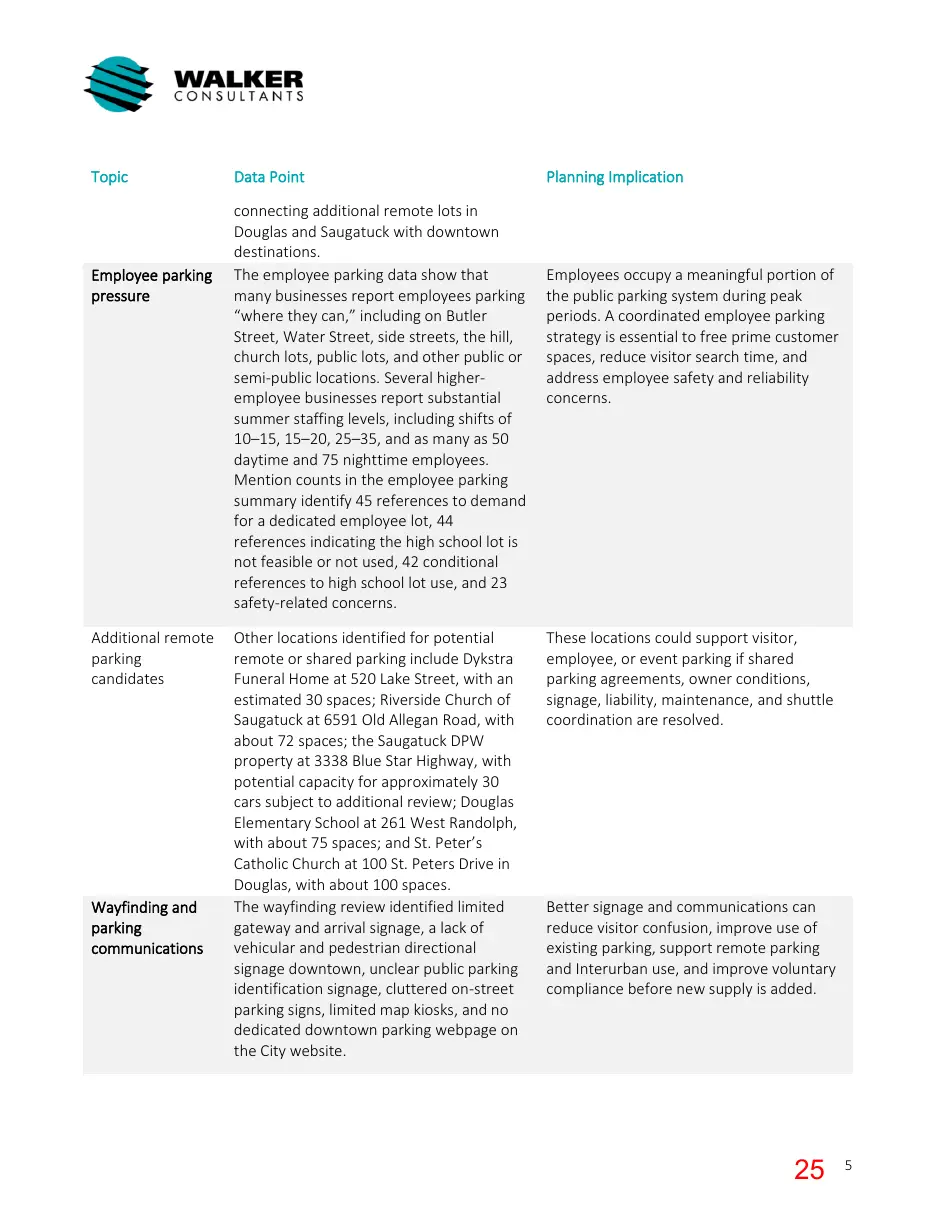
Data Point connecting additional remote lots in Douglas and Saugatuck with downtown destinations. The employee parking data show that many businesses report employees parking “where they can,” including on Butler Street, Water Street, side streets, the hill, church lots, public lots, and other public or semi-public locations. Several higheremployee businesses report substantial summer staffing levels, including shifts of 10–15, 15–20, 25–35, and as many as 50 daytime and 75 nighttime employees. Mention counts in the employee parking summary identify 45 references to demand for a dedicated employee lot, 44 references indicating the high school lot is not feasible or not used, 42 conditional references to high school lot use, and 23 safety-related concerns. Other locations identified for potential remote or shared parking include Dykstra Funeral Home at 520 Lake Street, with an estimated 30 spaces; Riverside Church of Saugatuck at 6591 Old Allegan Road, with about 72 spaces; the Saugatuck DPW property at 3338 Blue Star Highway, with potential capacity for approximately 30 cars subject to additional review; Douglas Elementary School at 261 West Randolph, with about 75 spaces; and St. Peter’s Catholic Church at 100 St. Peters Drive in Douglas, with about 100 spaces. The wayfinding review identified limited gateway and arrival signage, a lack of vehicular and pedestrian directional signage downtown, unclear public parking identification signage, cluttered on-street parking signs, limited map kiosks, and no dedicated downtown parking webpage on the City website.
Planning Implication
Employees occupy a meaningful portion of the public parking system during peak periods. A coordinated employee parking strategy is essential to free prime customer spaces, reduce visitor search time, and address employee safety and reliability concerns.
These locations could support visitor, employee, or event parking if shared parking agreements, owner conditions, signage, liability, maintenance, and shuttle coordination are resolved.
Better signage and communications can reduce visitor confusion, improve use of existing parking, support remote parking and Interurban use, and improve voluntary compliance before new supply is added.
Page 26
Text of page 26
Topic
Data Point
Planning Implication
Parking structure cost
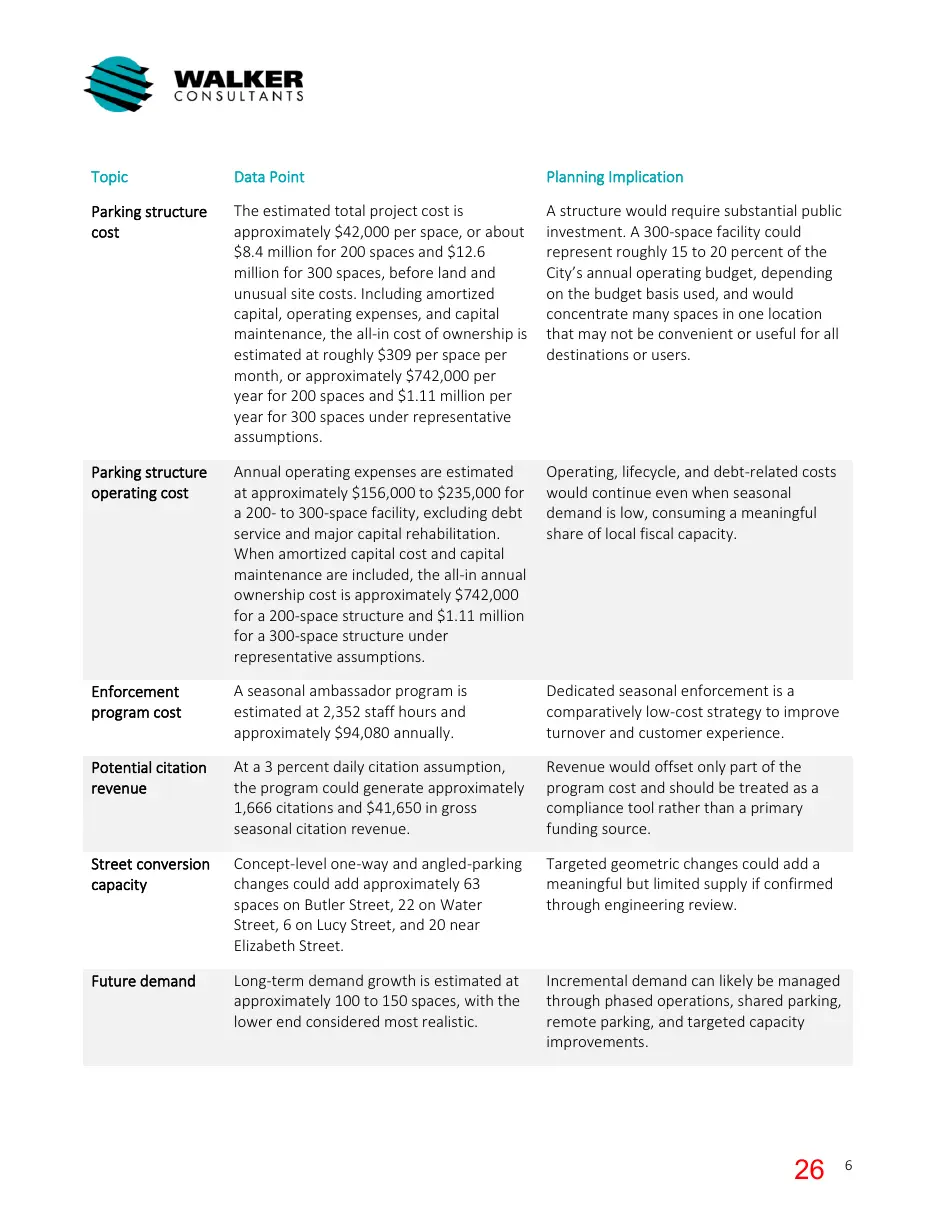
The estimated total project cost is approximately $42,000 per space, or about $8.4 million for 200 spaces and $12.6 million for 300 spaces, before land and unusual site costs. Including amortized capital, operating expenses, and capital maintenance, the all-in cost of ownership is estimated at roughly $309 per space per month, or approximately $742,000 per year for 200 spaces and $1.11 million per year for 300 spaces under representative assumptions.
A structure would require substantial public investment. A 300-space facility could represent roughly 15 to 20 percent of the City’s annual operating budget, depending on the budget basis used, and would concentrate many spaces in one location that may not be convenient or useful for all destinations or users.
Parking structure operating cost
Annual operating expenses are estimated at approximately $156,000 to $235,000 for a 200to 300-space facility, excluding debt service and major capital rehabilitation. When amortized capital cost and capital maintenance are included, the all-in annual ownership cost is approximately $742,000 for a 200-space structure and $1.11 million for a 300-space structure under representative assumptions.
Operating, lifecycle, and debt-related costs would continue even when seasonal demand is low, consuming a meaningful share of local fiscal capacity.
Enforcement program cost
A seasonal ambassador program is estimated at 2,352 staff hours and approximately $94,080 annually.
Dedicated seasonal enforcement is a comparatively low-cost strategy to improve turnover and customer experience.
Potential citation revenue
At a 3 percent daily citation assumption, the program could generate approximately 1,666 citations and $41,650 in gross seasonal citation revenue.
Revenue would offset only part of the program cost and should be treated as a compliance tool rather than a primary funding source.
Street conversion capacity
Concept-level one-way and angled-parking changes could add approximately 63 spaces on Butler Street, 22 on Water Street, 6 on Lucy Street, and 20 near Elizabeth Street.
Targeted geometric changes could add a meaningful but limited supply if confirmed through engineering review.
Future demand
Long-term demand growth is estimated at approximately 100 to 150 spaces, with the lower end considered most realistic.
Incremental demand can likely be managed through phased operations, shared parking, remote parking, and targeted capacity improvements.
Page 27
Text of page 27
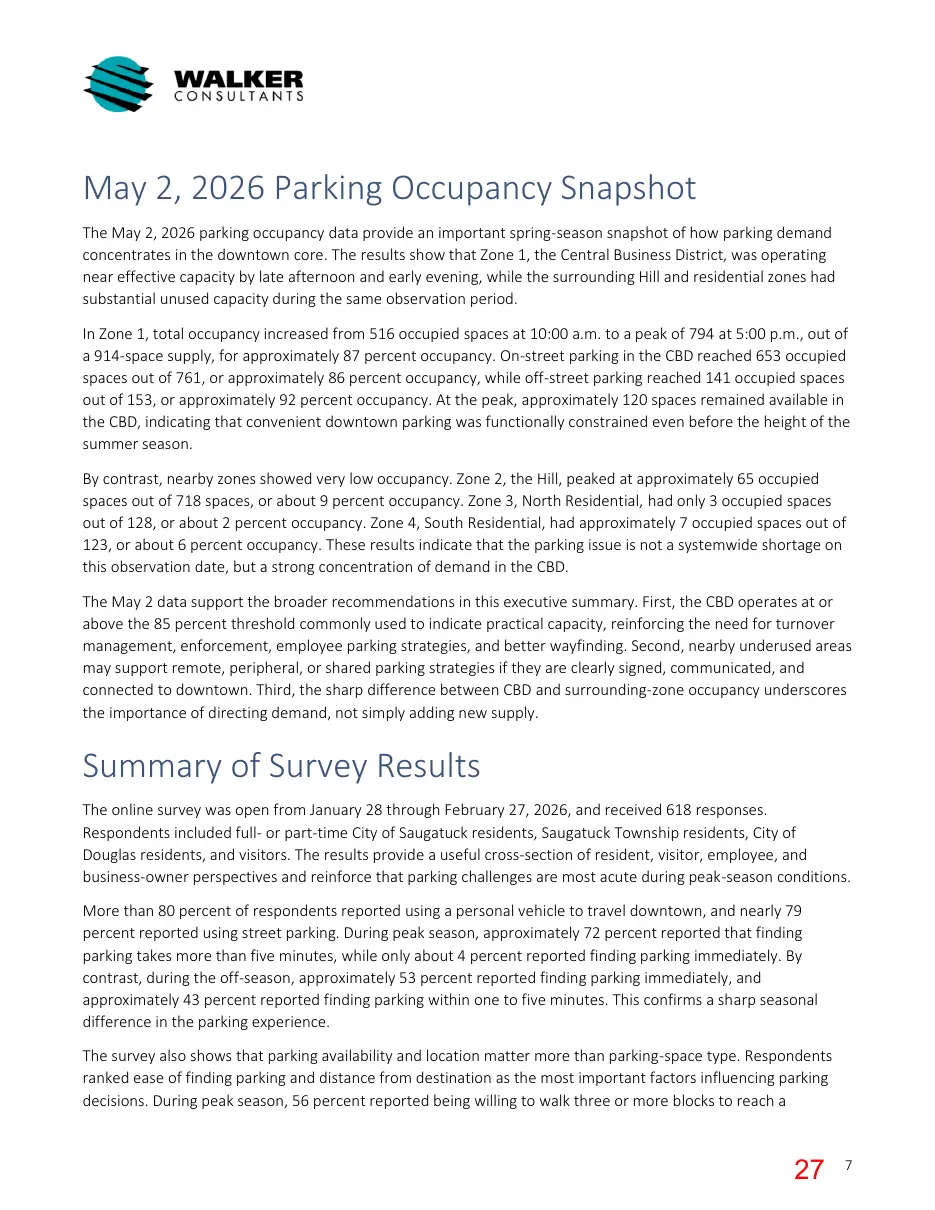
May 2, 2026 Parking Occupancy Snapshot The May 2, 2026 parking occupancy data provide an important spring-season snapshot of how parking demand concentrates in the downtown core. The results show that Zone 1, the Central Business District, was operating near effective capacity by late afternoon and early evening, while the surrounding Hill and residential zones had substantial unused capacity during the same observation period. In Zone 1, total occupancy increased from 516 occupied spaces at 10:00 a.m. to a peak of 794 at 5:00 p.m., out of a 914-space supply, for approximately 87 percent occupancy. On-street parking in the CBD reached 653 occupied spaces out of 761, or approximately 86 percent occupancy, while off-street parking reached 141 occupied spaces out of 153, or approximately 92 percent occupancy. At the peak, approximately 120 spaces remained available in the CBD, indicating that convenient downtown parking was functionally constrained even before the height of the summer season. By contrast, nearby zones showed very low occupancy. Zone 2, the Hill, peaked at approximately 65 occupied spaces out of 718 spaces, or about 9 percent occupancy. Zone 3, North Residential, had only 3 occupied spaces out of 128, or about 2 percent occupancy. Zone 4, South Residential, had approximately 7 occupied spaces out of 123, or about 6 percent occupancy. These results indicate that the parking issue is not a systemwide shortage on this observation date, but a strong concentration of demand in the CBD. The May 2 data support the broader recommendations in this executive summary. First, the CBD operates at or above the 85 percent threshold commonly used to indicate practical capacity, reinforcing the need for turnover management, enforcement, employee parking strategies, and better wayfinding. Second, nearby underused areas may support remote, peripheral, or shared parking strategies if they are clearly signed, communicated, and connected to downtown. Third, the sharp difference between CBD and surrounding-zone occupancy underscores the importance of directing demand, not simply adding new supply.
Summary of Survey Results The online survey was open from January 28 through February 27, 2026, and received 618 responses. Respondents included fullor part-time City of Saugatuck residents, Saugatuck Township residents, City of Douglas residents, and visitors. The results provide a useful cross-section of resident, visitor, employee, and business-owner perspectives and reinforce that parking challenges are most acute during peak-season conditions. More than 80 percent of respondents reported using a personal vehicle to travel downtown, and nearly 79 percent reported using street parking. During peak season, approximately 72 percent reported that finding parking takes more than five minutes, while only about 4 percent reported finding parking immediately. By contrast, during the off-season, approximately 53 percent reported finding parking immediately, and approximately 43 percent reported finding parking within one to five minutes. This confirms a sharp seasonal difference in the parking experience. The survey also shows that parking availability and location matter more than parking-space type. Respondents ranked ease of finding parking and distance from destination as the most important factors influencing parking decisions. During peak season, 56 percent reported being willing to walk three or more blocks to reach a
Page 28
Text of page 28
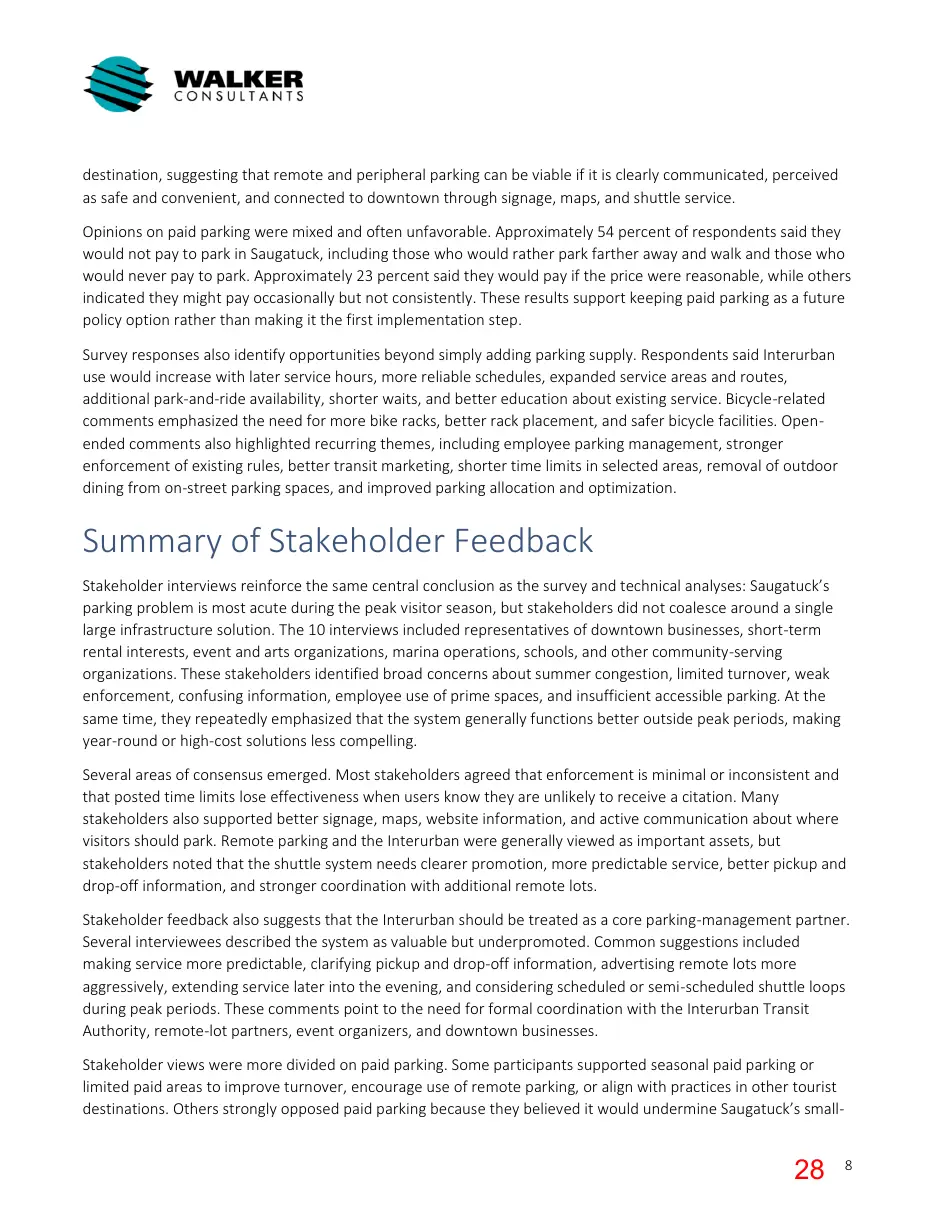
destination, suggesting that remote and peripheral parking can be viable if it is clearly communicated, perceived as safe and convenient, and connected to downtown through signage, maps, and shuttle service. Opinions on paid parking were mixed and often unfavorable. Approximately 54 percent of respondents said they would not pay to park in Saugatuck, including those who would rather park farther away and walk and those who would never pay to park. Approximately 23 percent said they would pay if the price were reasonable, while others indicated they might pay occasionally but not consistently. These results support keeping paid parking as a future policy option rather than making it the first implementation step. Survey responses also identify opportunities beyond simply adding parking supply. Respondents said Interurban use would increase with later service hours, more reliable schedules, expanded service areas and routes, additional park-and-ride availability, shorter waits, and better education about existing service. Bicycle-related comments emphasized the need for more bike racks, better rack placement, and safer bicycle facilities. Openended comments also highlighted recurring themes, including employee parking management, stronger enforcement of existing rules, better transit marketing, shorter time limits in selected areas, removal of outdoor dining from on-street parking spaces, and improved parking allocation and optimization.
Summary of Stakeholder Feedback Stakeholder interviews reinforce the same central conclusion as the survey and technical analyses: Saugatuck’s parking problem is most acute during the peak visitor season, but stakeholders did not coalesce around a single large infrastructure solution. The 10 interviews included representatives of downtown businesses, short-term rental interests, event and arts organizations, marina operations, schools, and other community-serving organizations. These stakeholders identified broad concerns about summer congestion, limited turnover, weak enforcement, confusing information, employee use of prime spaces, and insufficient accessible parking. At the same time, they repeatedly emphasized that the system generally functions better outside peak periods, making year-round or high-cost solutions less compelling. Several areas of consensus emerged. Most stakeholders agreed that enforcement is minimal or inconsistent and that posted time limits lose effectiveness when users know they are unlikely to receive a citation. Many stakeholders also supported better signage, maps, website information, and active communication about where visitors should park. Remote parking and the Interurban were generally viewed as important assets, but stakeholders noted that the shuttle system needs clearer promotion, more predictable service, better pickup and drop-off information, and stronger coordination with additional remote lots. Stakeholder feedback also suggests that the Interurban should be treated as a core parking-management partner. Several interviewees described the system as valuable but underpromoted. Common suggestions included making service more predictable, clarifying pickup and drop-off information, advertising remote lots more aggressively, extending service later into the evening, and considering scheduled or semi-scheduled shuttle loops during peak periods. These comments point to the need for formal coordination with the Interurban Transit Authority, remote-lot partners, event organizers, and downtown businesses. Stakeholder views were more divided on paid parking. Some participants supported seasonal paid parking or limited paid areas to improve turnover, encourage use of remote parking, or align with practices in other tourist destinations. Others strongly opposed paid parking because they believed it would undermine Saugatuck’s small-
Page 29
Text of page 29
town character, burden residents and employees, or create a negative perception among visitors. Even among stakeholders open to paid parking, there was limited support for using paid on-street parking to subsidize a new parking structure. Stakeholders were generally skeptical of a parking structure. Most opposed a garage due to cost, seasonal use, potential aesthetic impacts, an uncertain location, and potential conflict with community character. A minority viewed structured parking as a possible long-term solution or economic development tool, but even supportive comments acknowledged funding and siting concerns. A structure would also concentrate many spaces in one location. That may benefit some users, but many residents, visitors, employees, and businesses may find the location inconvenient or poorly matched to their destination, trip purpose, mobility needs, or preferred walking distance. This feedback supports deferring structured parking while lower-cost operational and partnership strategies are tested. Employee parking was another recurring theme. Several stakeholders believed employees and business owners should not occupy the most convenient downtown spaces during peak periods, while others cautioned that remote employee parking could create fairness, safety, commute, and workforce-retention concerns if poorly designed. The most practical approach is not a punitive mandate, but a coordinated program that combines employer outreach, designated remote options, reliable shuttle service, clear expectations, and reasonable enforcement. Stakeholders also raised broader mobility and curb-management issues. Several supported additional bicycle infrastructure, safer pedestrian conditions, improved multimodal access, and evaluation of low-speed vehicle regulations as part of a broader access strategy. Others emphasized that restaurant use of on-street parking, informal or illegal parking, and inadequate ADA parking reduces fairness and safety. Collectively, the interviews support a layered strategy: enforce existing rules, improve communications, expand remote and shared parking, strengthen the Interurban connection, manage employee parking, address ADA needs, and preserve Saugatuck’s visitor-oriented character.
Key Findings Parking supply is constrained in the downtown core during peak periods, but the system-wide issue is primarily one of management, distribution, turnover, and communication. The public parking inventory identifies 1,868 total spaces citywide, including 1,502 on-street spaces and 366 off-street spaces. Within the CBD, 561 on-street spaces are time-limited, giving the City a substantial existing management tool if rules are consistently communicated and enforced. The most valuable spaces are those closest to the commercial core, where turnover is essential for customer access. However, time limits are not consistently enforced, employees and business owners can occupy prime spaces for long durations, and visitors often lack clear information about where to park or how to use remote options. These conditions make the system feel more constrained than the raw supply numbers alone suggest. Public input confirms that parking is a peak-season frustration and affects downtown behavior. The survey record includes 618 respondents and 24 pages of open-ended comments. More than 80 percent of respondents reported using a personal vehicle to travel downtown, and nearly 79 percent reported using street parking. During peak season, approximately 72 percent reported that it takes more than five minutes to find parking, and
Page 30
Text of page 30
72 percent reported rarely or never finding parking where they prefer to park. At the same time, 56 percent reported willingness to walk three or more blocks during peak season, suggesting that remote and peripheral parking can be effective if well communicated and connected. Respondents cited outdoor dining in parking spaces, limited public lots, lack of enforcement, employee use of preferred spaces, confusing signage, accessibility limitations, and inadequate visibility of remote parking and shuttle options as recurring concerns. Stakeholders similarly reported that parking reaches or approaches capacity on many summer days and increasingly during shoulder-season weekends. Employee parking is a significant contributor to peak-period parking pressure and requires a dedicated strategy. The employee parking data indicate that many businesses do not have sufficient private or dedicated employee parking and that employees commonly park wherever space is available, including on Butler Street, Water Street, side streets, the hill, church lots, the SCA area, the high school lot, and other public or semi-public locations. Several businesses report large peak-season staffing levels, including shifts of 10 to 15, 15 to 20, 25 to 35, and as many as 50 daytime and 75 nighttime employees. Even allowing for carpooling, walking, biking, private spaces, or possible double-counting across multiple jobs, the data indicate that employee parking consumes a meaningful share of public parking during the busiest periods. This reduces availability for customers and visitors in the most convenient areas, underscoring the need for a coordinated employee parking program. The same data show why the employee parking strategy must be practical rather than punitive. While there is strong demand for a designated employee lot, the high school lot is not a complete solution for all workers. The employee parking summary identifies 44 references indicating that the high school lot is not feasible or not used, 42 conditional references to its use, and recurring concerns about the lot being full, shuttle wait times, shuttle hours ending too early, lighting, sidewalk conditions, and late-night safety for workers leaving with cash or after bar and restaurant shifts. These findings support a strategy that combines designated employee parking, reliable shuttle service, improved lighting and walking conditions, employer participation, clear rules, and reasonable enforcement. Enforcement is the most immediate and cost-effective lever available to the City. The City currently relies heavily on complaint-based or ad hoc enforcement, undermining the credibility of posted time limits and allowing all-day parking in short-term spaces. A seasonal parking ambassador program would improve turnover, provide customer service, educate visitors, support voluntary compliance, and reduce reliance on sworn law enforcement. Planninglevel assumptions indicate that a Memorial Day-to-Labor Day program with two staff on duty for 12 hours per day would cost approximately $94,080 annually and could generate approximately $41,650 in gross seasonal citation revenue during initial implementation, with citation volumes expected to decline as compliance improves. A parking structure is not recommended at this time. A new public parking structure would require a large capital commitment relative to the seasonal nature of the problem. Planning-level estimates indicate a total project cost of approximately $42,000 per space, or roughly $8.4 million for 200 spaces and $12.6 million for 300 spaces before land and unusual site costs. Annual operating expenses alone are estimated at approximately $156,000 to $235,000 for a 200to 300-space facility, excluding debt service and major capital rehabilitation. When amortized capital cost, operating expense, and capital maintenance are combined, the all-in cost of ownership is estimated at roughly $309 per space per month, or approximately $742,000 annually for 200 spaces and $1.11 million annually for 300 spaces under representative assumptions. A 300-space facility could represent roughly 15 to 20 percent of the City’s annual operating budget, depending on the budget basis used. In addition to being expensive, a structure would concentrate many spaces in one location, which may not be optimal for many users’
30 10
Page 31
Text of page 31
destinations, mobility needs, or preferred walking distances. Given that Saugatuck’s peak demand is concentrated in a limited seasonal window, a structure would likely be underutilized for much of the year and would require subsidy or a broader public-value justification beyond parking revenue. Paid parking should remain a future option, but it should not be the City’s first major implementation step. Peer resort-community comparisons show that many Michigan lakefront and resort communities rely on posted time limits, targeted enforcement, signage, permits, remote parking, and peripheral long-term options rather than paid on-street parking. Paid parking can improve turnover, generate revenue, provide better data, and reduce reliance on punitive enforcement, but it also raises political, customer service, equity, technology, maintenance, and streetscape concerns. If implemented, paid parking should be seasonal, targeted to the highest-demand areas, paired with clear reinvestment commitments, and preceded by improved enforcement and communications. Wayfinding, signage, and communications are foundational tools for parking management. The wayfinding evaluation found that Saugatuck lacks a complete, coordinated parking and downtown wayfinding system. Key issues include limited arrival and directional signage at City entry points, no clear directional guidance into downtown at important decision points, limited vehicular and pedestrian directional signage within downtown, unclear or undersized public parking identification signs, cluttered on-street regulatory signs, limited map kiosks, and no dedicated downtown parking webpage on the City website. These gaps increase confusion for first-time and infrequent visitors, reduce the effectiveness of the existing parking supply, and make remote parking and shuttle options harder to use. Signage and communication improvements should therefore be treated as nearterm implementation priorities rather than aesthetic enhancements. Recommended wayfinding improvements should connect physical signs, parking facility identification, pedestrian information, and online communication. The wayfinding evaluation recommends updated gateway and directional signage at City entrances, a comprehensive vehicular and pedestrian sign system within downtown, a standardized naming convention for publicly accessible off-street parking facilities, parking identification signs at public parking facility entrances, simplified on-street parking signs, additional map kiosks at pedestrian exits from parking facilities, improved social district signage, permanent shared parking signage at the high school, and a dedicated downtown parking webpage with an interactive parking map. These actions would make the existing system easier to understand and would support the broader strategy of improving access through management before adding costly new supply. Remote parking, shared parking, and the Interurban provide the strongest near-term capacity strategy. The Saugatuck High School lot has functioned as the primary advertised remote parking resource, providing 116 spaces during summer weekends. During summer 2026, amid this study, the Interurban expanded the remote parking and shuttle program to include the Saugatuck Drug Store/pharmacy stop, Beery Field, and Douglas Elementary School lots, along with additional buses and service hours. Other candidate remote or shared parking locations include Dykstra Funeral Home, Riverside Church of Saugatuck, the Saugatuck DPW property, Douglas Elementary School, St. Peter’s Catholic Church, and other institutional, municipal, church, school, and private properties. Several of these locations could add dozens of spaces each if agreements are reached and shuttle service is coordinated. Formal shared parking agreements would allow the City to make underutilized private or institutional lots available during defined days and hours while addressing insurance, liability, owner priority, blackout periods, maintenance, signage, compensation, and termination. The same approach could also support
31 11
Page 32
Text of page 32
designated employee parking lots, helping move long-duration employee parking out of prime customer spaces while providing safer and more reliable options for workers. The Interurban is a major asset, but it must become easier to understand, more visible, and more predictable during peak periods. The Interurban provides low-cost, curb-to-curb demand-response service, with adult fares of $1 and discounted fares of $0.50 for seniors, children under 12, and persons with disabilities. The current flyer advertises summer regular hours from May 22 through September 6, including weekday service, late Friday and Saturday service, and Sunday service, with rides after 7:00 p.m. priced at $3. It also promotes a free parking shuttle from June 19 through August 30, operating Fridays and Saturdays from 1:00 p.m. to 9:00 p.m. and Sundays from 1:00 p.m. to 7:00 p.m., with stops at Saugatuck High School, Downtown Saugatuck at the Drug Store, Douglas Elementary, and Downtown Douglas at Beery Field. The flyer also provides a clear call-to-ride number, 269-857-1418, and directs users to the Interurban Transit App. The system reported approximately 75,000 annual passenger trips in 2024, 191,191 vehicle revenue miles, 14,489 vehicle revenue hours, and operating expenses of approximately $1.18 million. In summer 2026, the Interurban expanded remote parking and shuttle service while this study was underway by adding the pharmacy/Drug Store stop, Beery Field, and Douglas Elementary School lots, along with additional buses and service hours. Stakeholders repeatedly described the need for clearer promotion, more visible pickup and drop-off information, more predictable or scheduled service, later hours, additional remote-lot connections, and better integration with downtown parking communications. These improvements should be framed as partnership opportunities with the Interurban Transit Authority. Interurban expansion options should be evaluated as scalable partnership opportunities. The City and Interurban Transit Authority can evaluate service improvements incrementally without immediately committing to a large fixed-route system. Potential options include a peak-season parking shuttle loop operating on a predictable schedule between remote lots and downtown; increased free-shuttle frequency during the highest-demand Friday, Saturday, Sunday, and event periods; extended evening service on restaurant, bar, entertainment, and event nights; employee-oriented trips during shift changes, including late-night service for hospitality workers; clearly marked remote parking stops at the high school, Douglas Elementary, Beery Field, church lots, municipal sites, and other shared-parking locations; use of recently added vehicles to supplement peak parking service if operationally feasible; and improved app-based booking, phone dispatch, signage, and visitor instructions so riders know when to call, where to wait, and how long the trip is likely to take. Expansion should be tied directly to remote parking agreements, measured demand, and Interurban Transit Authority operating capacity. For example, the City could partner on a pilot loop serving the highest-confidence remote lots and downtown stops during peak weekends, then evaluate whether event-specific service, later evening service, or employee shift-change service is feasible based on ridership, cost, fleet availability, operator availability, and parking data. A phased approach would allow the City and Interurban Transit Authority to test stop locations, frequency, vehicle assignments, cost per trip, rider awareness, and customer satisfaction before expanding to additional lots or longer operating hours. Accessibility is a priority and should be addressed proactively. The CBD currently has 10 accessible on-street spaces out of 761, or approximately 1.3 percent. Using PROWAG as a practical planning benchmark, approximately 4 percent of the CBD on-street supply would equal about 30 accessible spaces. The recommendation is reinforced by Saugatuck’s older resident and visitor profile, including a resident population in which 36.9 percent are age 65 or older, and a visitor survey profile in which approximately 40 percent of
32 12
Page 33
Text of page 33
respondents are age 60 or older. Survey comments and stakeholder interviews also identified concerns about the number, location, enforcement, and usability of accessible spaces. Curb space should be managed as a flexible public asset. Approximately 13 on-street spaces are occupied by restaurant seating areas. The reviewed restaurant-use analysis recommends that the City discontinue restaurants’ use of on-street parking for dining and restore those spaces to public parking unless the practice is replaced by a formal, consistently administered parklet or outdoor dining permit program. If the City continues allowing this use, the program should include clear eligibility criteria, seasonal limits, design and safety standards, insurance requirements, ADA provisions, inspections, fees tied to the value of public curb space, and revocation authority. This approach would improve fairness, safety, and public stewardship of high-value curb frontage, while preserving a limited outdoor dining pathway only if the City chooses to regulate it deliberately. Targeted geometric and curbside changes can add meaningful but limited capacity. Concept-level analyses indicate that converting Butler Street to one-way traffic with angled parking on one side and parallel parking on the other could add approximately 63 spaces between Lucy and Culver Streets. Water Street one-way conversion and selected parallel-to-angled conversions could add approximately 22 spaces. Lucy Street could add approximately 6 spaces, and Elizabeth Street near the school campus could add approximately 20 remote-support spaces. These concepts require field measurements, traffic and public safety reviews, striping plans, and stakeholder coordination before implementation. Future growth does not appear to justify a large new parking facility. The future-growth analysis concludes that Saugatuck’s development pattern is expected to remain incremental, focused on infill, redevelopment, preservation, walkability, and small-scale reinvestment. The city’s permanent resident population peaked at 1,079 in 1980 and was 865 in 2020, with a reasonable 2030 planning range of approximately 850 to 950 residents. Longterm parking demand may increase by approximately 100 to 150 spaces, with the lower end considered the more realistic planning scenario. Much of this demand is expected to be seasonal and manageable through shared parking, remote parking, operational changes, improved turnover, and targeted adjustments rather than major new supply.
Recommended Strategic Direction The recommended strategy is a layered, phased, and fiscally disciplined parking management program. The City should first improve the existing system, expand effective capacity through partnerships and remote parking, and revisit pricing or structured parking only if measured conditions indicate that lower-cost strategies are insufficient. 1. Do not advance a parking structure at this time. Stakeholder feedback showed broad skepticism toward a garage because of cost, seasonal utilization, aesthetics, site availability, access distribution, and potential effects on Saugatuck’s small-town character. A structure would require a large capital commitment, carry substantial annual all-in ownership costs, and concentrate many spaces in a single location that may not meet the needs of all users or destinations. The City should continue to treat structured parking as a longterm option only if future demand, funding, location, community support, and public-value considerations change materially.
33 13
Page 34
Text of page 34
2. Do not implement broad paid parking as the first step. Stakeholders were divided on paid parking, with some supporting seasonal or limited paid areas and others opposing it due to resident, employee, visitor experience, and character concerns. The City should preserve paid parking as a future tool, but first focus on actions with broader stakeholder alignment: enforcement, turnover, communications, shared parking, remote parking, and shuttle service. 3. Implement a seasonal parking ambassador and enforcement program. Stakeholders repeatedly stated that enforcement is minimal, inconsistent, or not visible. A seasonal ambassador model should address this concern directly by pairing enforcement with education, warnings, wayfinding assistance, and customer service. This approach improves compliance without making the program feel overly punitive. 4. Formalize employee parking management through a partnership rather than a mandate alone. Stakeholders and employee parking data frequently identified employee and business-owner use of prime spaces as a problem. The employee parking data show that many employees park wherever they can, including in public and semi-public spaces near downtown, and that several businesses have substantial peak-season staffing levels. At the same time, the data also identify fairness, safety, shuttle reliability, lighting, and late-night employee concerns. The City should work with employers to direct longduration employee parking to designated remote or peripheral locations during peak periods, supported by reliable shuttle access, clear expectations, employer outreach, safe walking conditions, lighting improvements, and reasonable enforcement. 5. Expand remote and shared parking in response to stakeholder support for lower-cost capacity. Many stakeholders favored remote lots, school and institutional partnerships, church lots, municipal sites, and private shared-use opportunities over a new garage. The Interurban’s summer 2026 expansion to the pharmacy/Drug Store stop, Beery Field, and Douglas Elementary School lots demonstrates that remote parking can be expanded incrementally. The City should secure written shared parking agreements with schools, churches, institutions, municipal properties, and private owners where appropriate, including candidate locations such as Dykstra Funeral Home, Riverside Church of Saugatuck, the DPW property, Douglas Elementary School, and St. Peter’s Catholic Church. Agreements should identify whether spaces are intended for visitors, employees, events, or mixed public use, then promote those locations through consistent signage, maps, online tools, and shuttle coordination. 6. Strengthen coordination with the Interurban and make shuttle information more predictable. Stakeholders generally viewed the Interurban as a valuable asset but said it needs clearer promotion, more predictable service information, better pickup/drop-off information, later hours, and stronger connections to remote lots. The current flyer already provides useful customer information, including regular summer hours, extended event dates, fares, the free parking shuttle operating window, remote parking stops, the call-to-ride number, and the Interurban Transit App. The City should work with the Interurban Transit Authority to align this information with parking maps, signs, website content, lodging materials, event communications, ambassador scripts, and remote-lot signage. Expansion options should be evaluated as partnership opportunities, beginning with a predictable peak-season parking loop, increased weekend and event frequency, added remote-lot stops, extended evening service on highdemand nights, employee shift-change service, and formal coordination between shared parking agreements and shuttle operations. 7. Improve signage, wayfinding, and public information. Stakeholders repeatedly described the parking system as confusing or under-communicated, and the wayfinding evaluation confirms that the City lacks a complete, coordinated sign and communication system. The City should create a simple visitor-facing
34 14
Page 35
Text of page 35
parking system with updated gateway signs, downtown vehicular and pedestrian directional signs, named public parking facilities, clear parking identification signs, simplified on-street regulatory signs, map kiosks at pedestrian exits from parking facilities, shared parking signage at the high school, a dedicated downtown parking webpage, and an interactive parking map. These improvements should be coordinated so physical signs, maps, website content, and remote parking messaging use the same names, symbols, and visitor instructions. 8. Increase accessible parking over time. Stakeholders and survey respondents identified insufficient ADA parking as a recurring concern. The City should use PROWAG as a guiding framework and expand accessible on-street parking in the CBD toward approximately 30 spaces, distributed near key destinations and supported by enforcement to prevent misuse. 9. Manage the curb deliberately and transparently. Stakeholders raised concerns about restaurant use of on-street spaces, illegal or informal parking, loading needs, and curbside fairness. The City should evaluate 15-minute spaces where short-term loading or pick-up demand is documented and discontinue restaurant use of on-street parking unless it is replaced by a formal permit program with clear standards, fees, safety requirements, ADA provisions, inspections, and revocation authority. 10. Advance targeted street and striping concepts only after technical and public review. Some stakeholders supported angled parking and one-way street concepts, while others raised concerns about safety, circulation, and character. The City should conduct field measurements, traffic reviews, emergencyaccess reviews, pedestrian-safety analyses, concept striping, and public communication before implementing one-way or angled-parking conversions. 11. Include broader mobility options as part of the parking strategy. Stakeholders encouraged bicycle infrastructure, pedestrian safety improvements, multimodal access, and evaluation of low-speed vehicle regulations. These options should be treated as complementary demand-management strategies that reduce short vehicle trips, support park-once behavior, and reinforce Saugatuck’s visitor-oriented character.
Guiding Principles Applied to the Recommendations The recommendations are grounded in the guiding principles developed for Saugatuck’s parking system. Those principles emphasize practical, fiscally responsible, character-sensitive actions that improve the existing parking and mobility system before the City considers major capital investment or broad paid parking. Guiding Principle
How It Is Applied in the Action Plan
Optimize existing assets before expanding supply.
The recommended approach focuses first on enforcement, turnover, remote parking, shared parking, signage, communications, Interurban coordination, curb management, and targeted restriping before considering a parking structure.
Reserve convenient spaces for priority users through managed time limits.
The action plan emphasizes consistent time-limit enforcement, parking ambassadors, employee parking management, ADA improvements, and selective 15-minute spaces so the most convenient spaces serve customers, visitors, accessible users, and quick-turnover activity.
35 15
Page 36
Text of page 36
Guiding Principle
How It Is Applied in the Action Plan
Maintain clear and enforceable rules.
The recommendations call for simplified on-street parking signs, better public information, an ambassador program, warning and citation procedures, and a formal approach to restaurant use of on-street parking.
Partner with employers on employee parking.
The strategy recommends employer outreach, designated remote or peripheral parking, shuttle coordination, clear expectations, and reasonable enforcement rather than a punitive employee-parking mandate.
Support a balanced access system.
The action plan combines parking management with Interurban service, remote parking, shared parking, walking, biking, pedestrian improvements, low-speed vehicle evaluation, and wayfinding improvements.
Protect accessibility and equitable access.
The recommendations call for expanding accessible on-street parking toward approximately 30 CBD spaces over time, improving distribution near key destinations, and enforcing against misuse.
Manage the curb as flexible public space.
The plan recommends restoring restaurant-occupied curb spaces to public parking unless formally permitted, evaluating 15-minute loading and pick-up spaces, and balancing parking, loading, accessibility, safety, and seasonal uses.
Balance downtown vitality and livability.
The recommendations support visitor and customer access while avoiding overbuilding, minimizing neighborhood spillover, improving communication, and preserving downtown character.
Avoid overbuilding for occasional peaks.
The action plan defers structured parking and broad paid parking while testing lower-cost, seasonal, and operational strategies targeted to peak conditions.
Manage parking as a datainformed system.
The document establishes KPIs, a monitoring plan, post-season reporting, and decision points to guide future action based on measured occupancy, turnover, shuttle use, enforcement activity, ADA use, and public feedback.
Commit to continuous improvement.
The phased timeline treats the first peak season as a pilot, followed by postseason evaluation, program refinement, and future policy decisions based on performance.
Emphasize customer service.
The ambassador program, improved signage, website updates, interactive maps, Interurban information, and visitor-facing communications are designed to improve compliance through assistance and education, not only enforcement.
Align solutions with fiscal capacity.
The recommendations prioritize lower-cost management, shared parking, remote parking, and Interurban coordination before major capital investment, recognizing that a garage would carry significant all-in ownership costs.
Communicate clearly and consistently.
The plan calls for coordinated gateway signs, directional signage, parking identification signs, facility naming, map kiosks, a dedicated parking webpage, an interactive map, and partner-distributed parking information.
36 16
Page 37
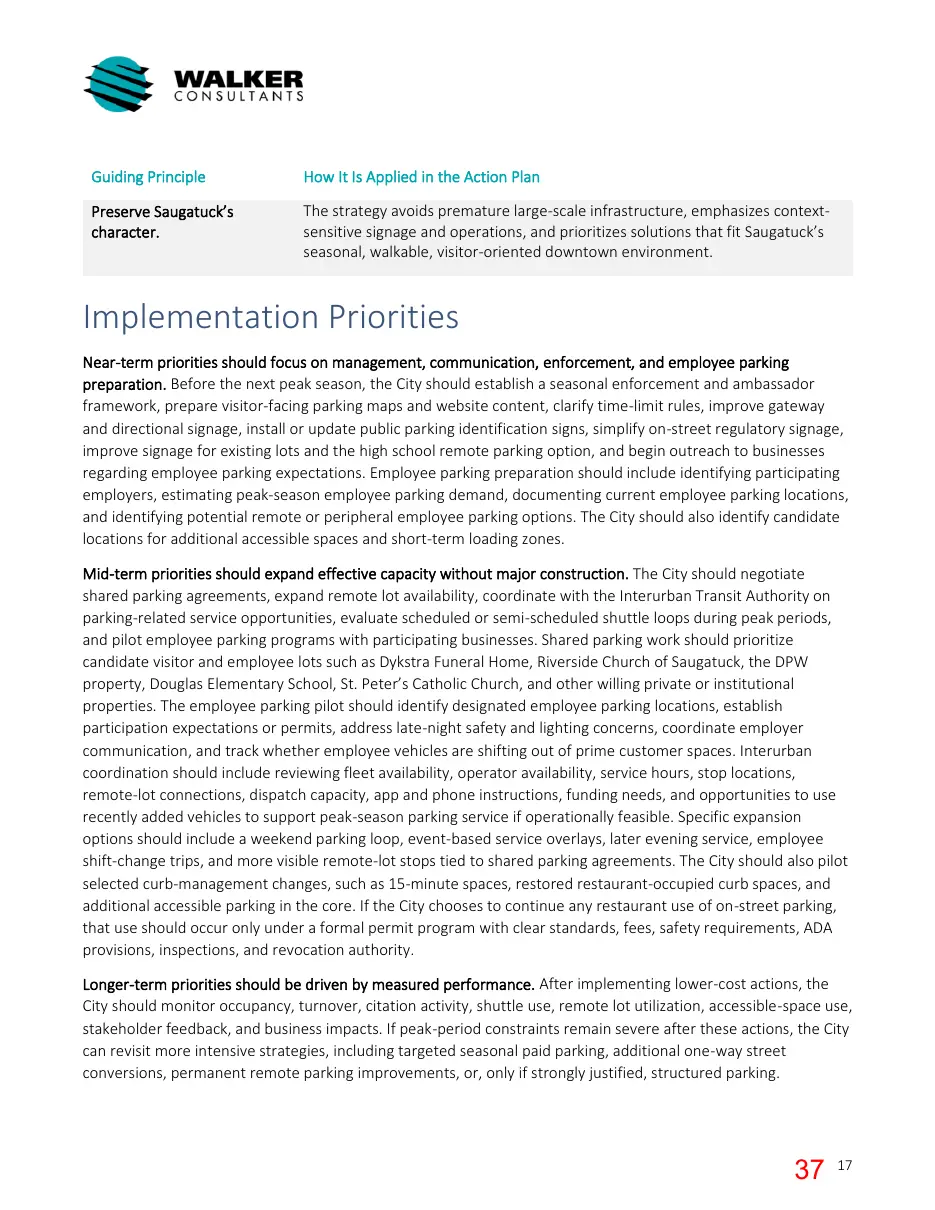
Text of page 37
Guiding Principle
How It Is Applied in the Action Plan
Preserve Saugatuck’s character.
The strategy avoids premature large-scale infrastructure, emphasizes contextsensitive signage and operations, and prioritizes solutions that fit Saugatuck’s seasonal, walkable, visitor-oriented downtown environment.
Implementation Priorities Near-term priorities should focus on management, communication, enforcement, and employee parking preparation. Before the next peak season, the City should establish a seasonal enforcement and ambassador framework, prepare visitor-facing parking maps and website content, clarify time-limit rules, improve gateway and directional signage, install or update public parking identification signs, simplify on-street regulatory signage, improve signage for existing lots and the high school remote parking option, and begin outreach to businesses regarding employee parking expectations. Employee parking preparation should include identifying participating employers, estimating peak-season employee parking demand, documenting current employee parking locations, and identifying potential remote or peripheral employee parking options. The City should also identify candidate locations for additional accessible spaces and short-term loading zones. Mid-term priorities should expand effective capacity without major construction. The City should negotiate shared parking agreements, expand remote lot availability, coordinate with the Interurban Transit Authority on parking-related service opportunities, evaluate scheduled or semi-scheduled shuttle loops during peak periods, and pilot employee parking programs with participating businesses. Shared parking work should prioritize candidate visitor and employee lots such as Dykstra Funeral Home, Riverside Church of Saugatuck, the DPW property, Douglas Elementary School, St. Peter’s Catholic Church, and other willing private or institutional properties. The employee parking pilot should identify designated employee parking locations, establish participation expectations or permits, address late-night safety and lighting concerns, coordinate employer communication, and track whether employee vehicles are shifting out of prime customer spaces. Interurban coordination should include reviewing fleet availability, operator availability, service hours, stop locations, remote-lot connections, dispatch capacity, app and phone instructions, funding needs, and opportunities to use recently added vehicles to support peak-season parking service if operationally feasible. Specific expansion options should include a weekend parking loop, event-based service overlays, later evening service, employee shift-change trips, and more visible remote-lot stops tied to shared parking agreements. The City should also pilot selected curb-management changes, such as 15-minute spaces, restored restaurant-occupied curb spaces, and additional accessible parking in the core. If the City chooses to continue any restaurant use of on-street parking, that use should occur only under a formal permit program with clear standards, fees, safety requirements, ADA provisions, inspections, and revocation authority. Longer-term priorities should be driven by measured performance. After implementing lower-cost actions, the City should monitor occupancy, turnover, citation activity, shuttle use, remote lot utilization, accessible-space use, stakeholder feedback, and business impacts. If peak-period constraints remain severe after these actions, the City can revisit more intensive strategies, including targeted seasonal paid parking, additional one-way street conversions, permanent remote parking improvements, or, only if strongly justified, structured parking.
37 17
Page 38
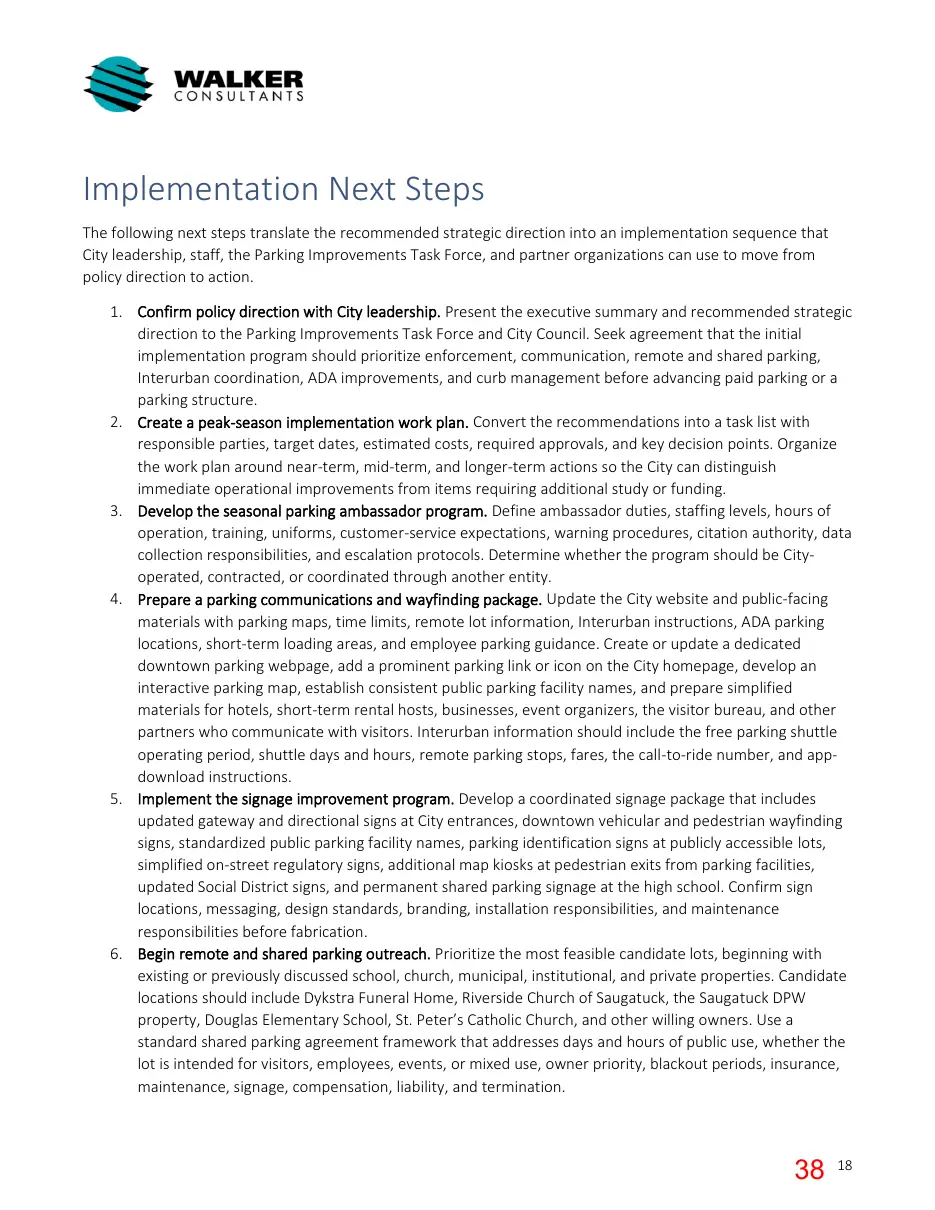
Text of page 38
Implementation Next Steps The following next steps translate the recommended strategic direction into an implementation sequence that City leadership, staff, the Parking Improvements Task Force, and partner organizations can use to move from policy direction to action. 1. Confirm policy direction with City leadership. Present the executive summary and recommended strategic direction to the Parking Improvements Task Force and City Council. Seek agreement that the initial implementation program should prioritize enforcement, communication, remote and shared parking, Interurban coordination, ADA improvements, and curb management before advancing paid parking or a parking structure. 2. Create a peak-season implementation work plan. Convert the recommendations into a task list with responsible parties, target dates, estimated costs, required approvals, and key decision points. Organize the work plan around near-term, mid-term, and longer-term actions so the City can distinguish immediate operational improvements from items requiring additional study or funding. 3. Develop the seasonal parking ambassador program. Define ambassador duties, staffing levels, hours of operation, training, uniforms, customer-service expectations, warning procedures, citation authority, data collection responsibilities, and escalation protocols. Determine whether the program should be Cityoperated, contracted, or coordinated through another entity. 4. Prepare a parking communications and wayfinding package. Update the City website and public-facing materials with parking maps, time limits, remote lot information, Interurban instructions, ADA parking locations, short-term loading areas, and employee parking guidance. Create or update a dedicated downtown parking webpage, add a prominent parking link or icon on the City homepage, develop an interactive parking map, establish consistent public parking facility names, and prepare simplified materials for hotels, short-term rental hosts, businesses, event organizers, the visitor bureau, and other partners who communicate with visitors. Interurban information should include the free parking shuttle operating period, shuttle days and hours, remote parking stops, fares, the call-to-ride number, and appdownload instructions. 5. Implement the signage improvement program. Develop a coordinated signage package that includes updated gateway and directional signs at City entrances, downtown vehicular and pedestrian wayfinding signs, standardized public parking facility names, parking identification signs at publicly accessible lots, simplified on-street regulatory signs, additional map kiosks at pedestrian exits from parking facilities, updated Social District signs, and permanent shared parking signage at the high school. Confirm sign locations, messaging, design standards, branding, installation responsibilities, and maintenance responsibilities before fabrication. 6. Begin remote and shared parking outreach. Prioritize the most feasible candidate lots, beginning with existing or previously discussed school, church, municipal, institutional, and private properties. Candidate locations should include Dykstra Funeral Home, Riverside Church of Saugatuck, the Saugatuck DPW property, Douglas Elementary School, St. Peter’s Catholic Church, and other willing owners. Use a standard shared parking agreement framework that addresses days and hours of public use, whether the lot is intended for visitors, employees, events, or mixed use, owner priority, blackout periods, insurance, maintenance, signage, compensation, liability, and termination.
38 18
Page 39
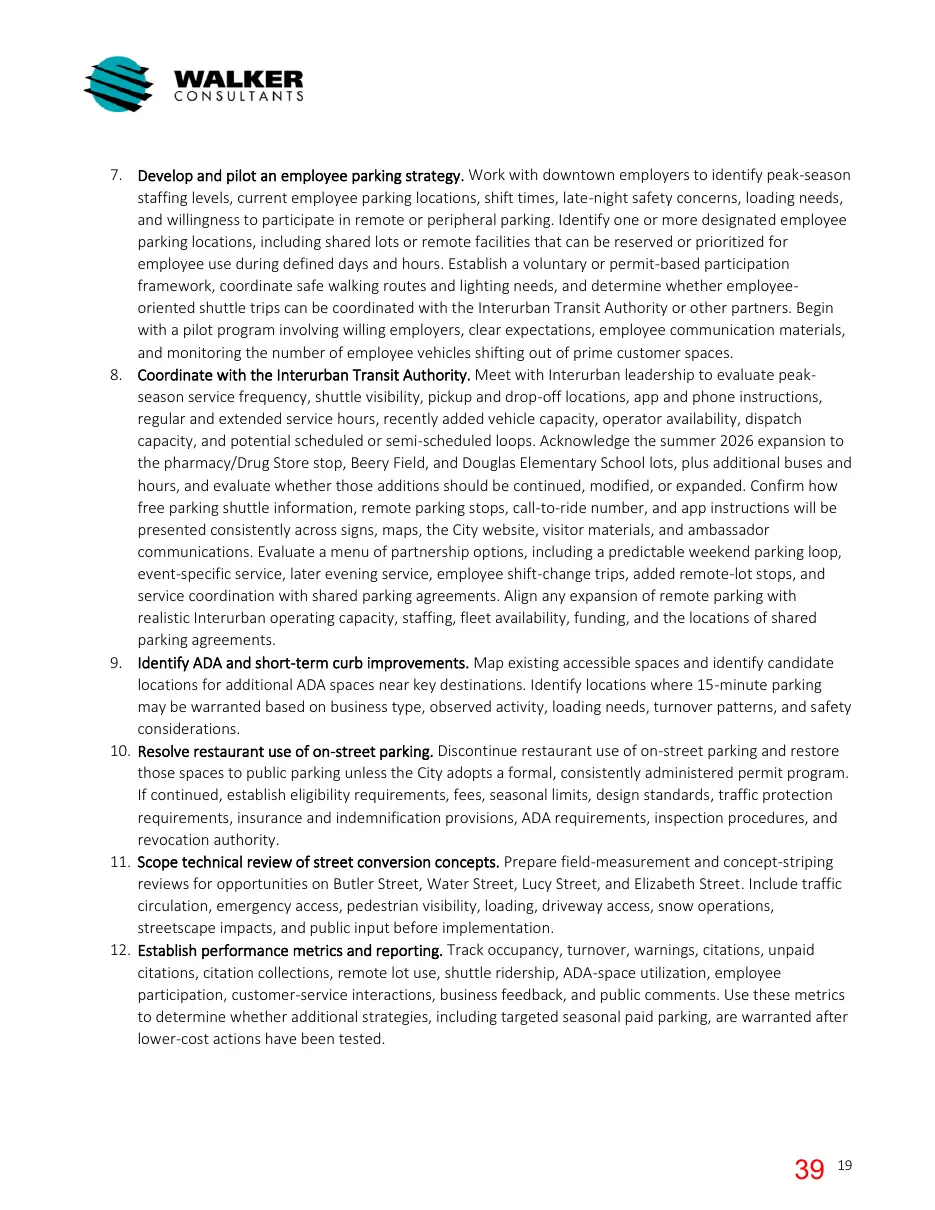
Text of page 39
7. Develop and pilot an employee parking strategy. Work with downtown employers to identify peak-season staffing levels, current employee parking locations, shift times, late-night safety concerns, loading needs, and willingness to participate in remote or peripheral parking. Identify one or more designated employee parking locations, including shared lots or remote facilities that can be reserved or prioritized for employee use during defined days and hours. Establish a voluntary or permit-based participation framework, coordinate safe walking routes and lighting needs, and determine whether employeeoriented shuttle trips can be coordinated with the Interurban Transit Authority or other partners. Begin with a pilot program involving willing employers, clear expectations, employee communication materials, and monitoring the number of employee vehicles shifting out of prime customer spaces. 8. Coordinate with the Interurban Transit Authority. Meet with Interurban leadership to evaluate peakseason service frequency, shuttle visibility, pickup and drop-off locations, app and phone instructions, regular and extended service hours, recently added vehicle capacity, operator availability, dispatch capacity, and potential scheduled or semi-scheduled loops. Acknowledge the summer 2026 expansion to the pharmacy/Drug Store stop, Beery Field, and Douglas Elementary School lots, plus additional buses and hours, and evaluate whether those additions should be continued, modified, or expanded. Confirm how free parking shuttle information, remote parking stops, call-to-ride number, and app instructions will be presented consistently across signs, maps, the City website, visitor materials, and ambassador communications. Evaluate a menu of partnership options, including a predictable weekend parking loop, event-specific service, later evening service, employee shift-change trips, added remote-lot stops, and service coordination with shared parking agreements. Align any expansion of remote parking with realistic Interurban operating capacity, staffing, fleet availability, funding, and the locations of shared parking agreements. 9. Identify ADA and short-term curb improvements. Map existing accessible spaces and identify candidate locations for additional ADA spaces near key destinations. Identify locations where 15-minute parking may be warranted based on business type, observed activity, loading needs, turnover patterns, and safety considerations. 10. Resolve restaurant use of on-street parking. Discontinue restaurant use of on-street parking and restore those spaces to public parking unless the City adopts a formal, consistently administered permit program. If continued, establish eligibility requirements, fees, seasonal limits, design standards, traffic protection requirements, insurance and indemnification provisions, ADA requirements, inspection procedures, and revocation authority. 11. Scope technical review of street conversion concepts. Prepare field-measurement and concept-striping reviews for opportunities on Butler Street, Water Street, Lucy Street, and Elizabeth Street. Include traffic circulation, emergency access, pedestrian visibility, loading, driveway access, snow operations, streetscape impacts, and public input before implementation. 12. Establish performance metrics and reporting. Track occupancy, turnover, warnings, citations, unpaid citations, citation collections, remote lot use, shuttle ridership, ADA-space utilization, employee participation, customer-service interactions, business feedback, and public comments. Use these metrics to determine whether additional strategies, including targeted seasonal paid parking, are warranted after lower-cost actions have been tested.
39 19
Page 40
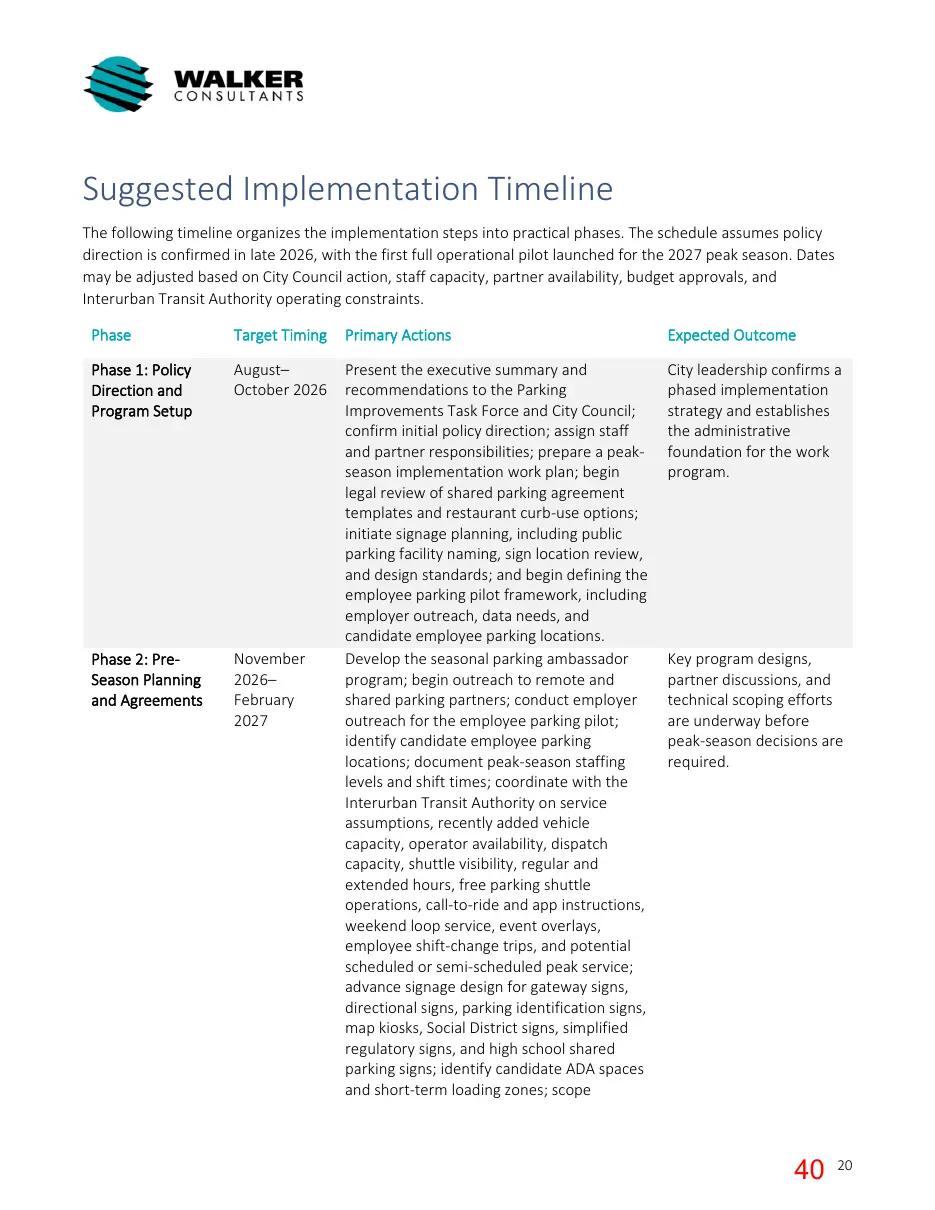
Text of page 40
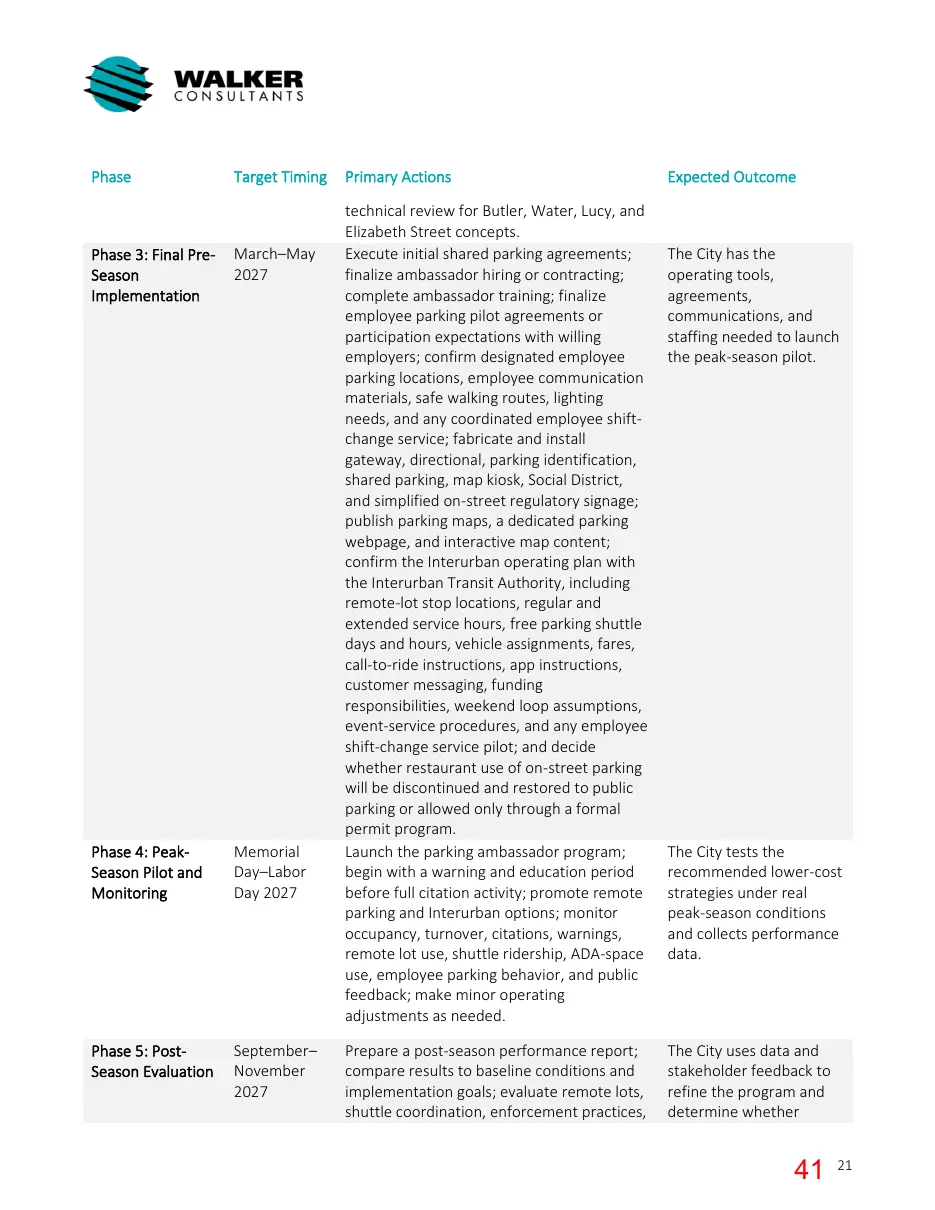
Suggested Implementation Timeline The following timeline organizes the implementation steps into practical phases. The schedule assumes policy direction is confirmed in late 2026, with the first full operational pilot launched for the 2027 peak season. Dates may be adjusted based on City Council action, staff capacity, partner availability, budget approvals, and Interurban Transit Authority operating constraints. Phase
Target Timing
Primary Actions
Expected Outcome
Phase 1: Policy Direction and Program Setup
August– October 2026
City leadership confirms a phased implementation strategy and establishes the administrative foundation for the work program.
Phase 2: PreSeason Planning and Agreements
November 2026– February 2027
Present the executive summary and recommendations to the Parking Improvements Task Force and City Council; confirm initial policy direction; assign staff and partner responsibilities; prepare a peakseason implementation work plan; begin legal review of shared parking agreement templates and restaurant curb-use options; initiate signage planning, including public parking facility naming, sign location review, and design standards; and begin defining the employee parking pilot framework, including employer outreach, data needs, and candidate employee parking locations. Develop the seasonal parking ambassador program; begin outreach to remote and shared parking partners; conduct employer outreach for the employee parking pilot; identify candidate employee parking locations; document peak-season staffing levels and shift times; coordinate with the Interurban Transit Authority on service assumptions, recently added vehicle capacity, operator availability, dispatch capacity, shuttle visibility, regular and extended hours, free parking shuttle operations, call-to-ride and app instructions, weekend loop service, event overlays, employee shift-change trips, and potential scheduled or semi-scheduled peak service; advance signage design for gateway signs, directional signs, parking identification signs, map kiosks, Social District signs, simplified regulatory signs, and high school shared parking signs; identify candidate ADA spaces and short-term loading zones; scope
Key program designs, partner discussions, and technical scoping efforts are underway before peak-season decisions are required.
40 20
Page 41
Text of page 41
Phase
Target Timing
Phase 3: Final PreSeason Implementation
March–May 2027
Phase 4: PeakSeason Pilot and Monitoring
Memorial Day–Labor Day 2027
Phase 5: PostSeason Evaluation
September– November 2027
Primary Actions technical review for Butler, Water, Lucy, and Elizabeth Street concepts. Execute initial shared parking agreements; finalize ambassador hiring or contracting; complete ambassador training; finalize employee parking pilot agreements or participation expectations with willing employers; confirm designated employee parking locations, employee communication materials, safe walking routes, lighting needs, and any coordinated employee shiftchange service; fabricate and install gateway, directional, parking identification, shared parking, map kiosk, Social District, and simplified on-street regulatory signage; publish parking maps, a dedicated parking webpage, and interactive map content; confirm the Interurban operating plan with the Interurban Transit Authority, including remote-lot stop locations, regular and extended service hours, free parking shuttle days and hours, vehicle assignments, fares, call-to-ride instructions, app instructions, customer messaging, funding responsibilities, weekend loop assumptions, event-service procedures, and any employee shift-change service pilot; and decide whether restaurant use of on-street parking will be discontinued and restored to public parking or allowed only through a formal permit program. Launch the parking ambassador program; begin with a warning and education period before full citation activity; promote remote parking and Interurban options; monitor occupancy, turnover, citations, warnings, remote lot use, shuttle ridership, ADA-space use, employee parking behavior, and public feedback; make minor operating adjustments as needed. Prepare a post-season performance report; compare results to baseline conditions and implementation goals; evaluate remote lots, shuttle coordination, enforcement practices,
Expected Outcome
The City has the operating tools, agreements, communications, and staffing needed to launch the peak-season pilot.
The City tests the recommended lower-cost strategies under real peak-season conditions and collects performance data.
The City uses data and stakeholder feedback to refine the program and determine whether
41 21
Page 42
Text of page 42
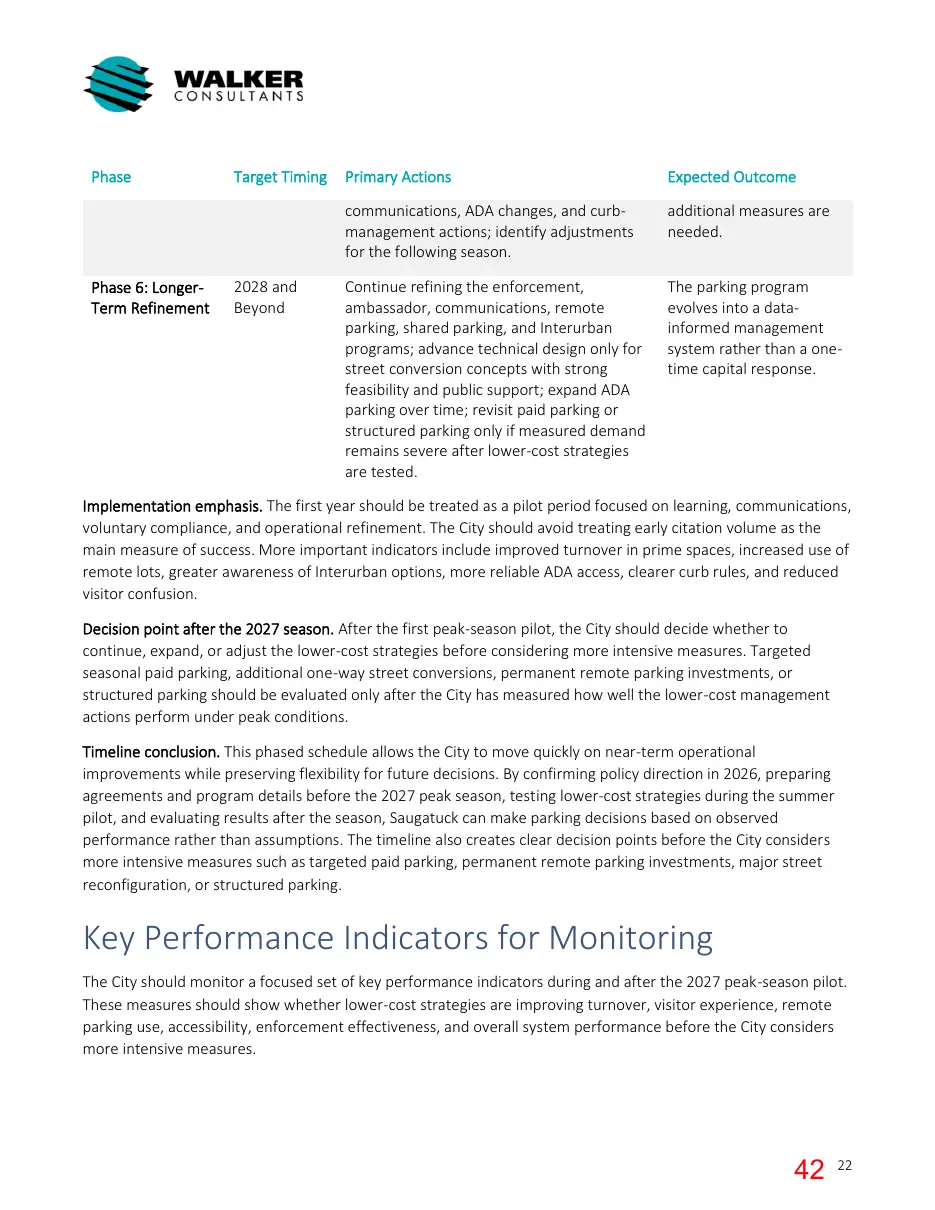
Phase
Phase 6: LongerTerm Refinement
Target Timing
2028 and Beyond
Primary Actions
Expected Outcome
communications, ADA changes, and curbmanagement actions; identify adjustments for the following season.
additional measures are needed.
Continue refining the enforcement, ambassador, communications, remote parking, shared parking, and Interurban programs; advance technical design only for street conversion concepts with strong feasibility and public support; expand ADA parking over time; revisit paid parking or structured parking only if measured demand remains severe after lower-cost strategies are tested.
The parking program evolves into a datainformed management system rather than a onetime capital response.
Implementation emphasis. The first year should be treated as a pilot period focused on learning, communications, voluntary compliance, and operational refinement. The City should avoid treating early citation volume as the main measure of success. More important indicators include improved turnover in prime spaces, increased use of remote lots, greater awareness of Interurban options, more reliable ADA access, clearer curb rules, and reduced visitor confusion. Decision point after the 2027 season. After the first peak-season pilot, the City should decide whether to continue, expand, or adjust the lower-cost strategies before considering more intensive measures. Targeted seasonal paid parking, additional one-way street conversions, permanent remote parking investments, or structured parking should be evaluated only after the City has measured how well the lower-cost management actions perform under peak conditions. Timeline conclusion. This phased schedule allows the City to move quickly on near-term operational improvements while preserving flexibility for future decisions. By confirming policy direction in 2026, preparing agreements and program details before the 2027 peak season, testing lower-cost strategies during the summer pilot, and evaluating results after the season, Saugatuck can make parking decisions based on observed performance rather than assumptions. The timeline also creates clear decision points before the City considers more intensive measures such as targeted paid parking, permanent remote parking investments, major street reconfiguration, or structured parking.
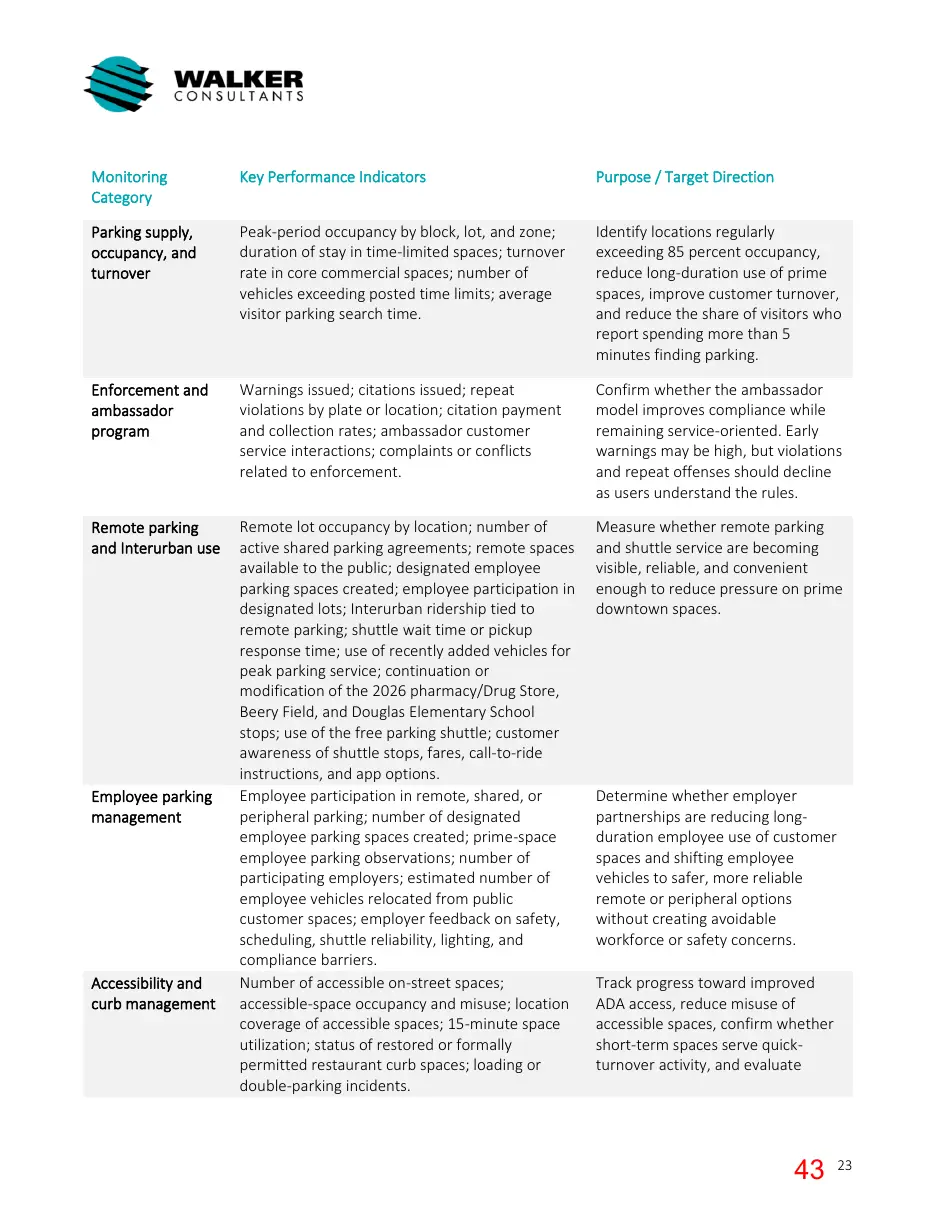
Key Performance Indicators for Monitoring The City should monitor a focused set of key performance indicators during and after the 2027 peak-season pilot. These measures should show whether lower-cost strategies are improving turnover, visitor experience, remote parking use, accessibility, enforcement effectiveness, and overall system performance before the City considers more intensive measures.
42 22
Page 43
Text of page 43
Monitoring Category
Key Performance Indicators
Purpose / Target Direction
Parking supply, occupancy, and turnover
Peak-period occupancy by block, lot, and zone; duration of stay in time-limited spaces; turnover rate in core commercial spaces; number of vehicles exceeding posted time limits; average visitor parking search time.
Identify locations regularly exceeding 85 percent occupancy, reduce long-duration use of prime spaces, improve customer turnover, and reduce the share of visitors who report spending more than 5 minutes finding parking.
Enforcement and ambassador program
Warnings issued; citations issued; repeat violations by plate or location; citation payment and collection rates; ambassador customer service interactions; complaints or conflicts related to enforcement.
Confirm whether the ambassador model improves compliance while remaining service-oriented. Early warnings may be high, but violations and repeat offenses should decline as users understand the rules.
Remote parking and Interurban use
Remote lot occupancy by location; number of active shared parking agreements; remote spaces available to the public; designated employee parking spaces created; employee participation in designated lots; Interurban ridership tied to remote parking; shuttle wait time or pickup response time; use of recently added vehicles for peak parking service; continuation or modification of the 2026 pharmacy/Drug Store, Beery Field, and Douglas Elementary School stops; use of the free parking shuttle; customer awareness of shuttle stops, fares, call-to-ride instructions, and app options. Employee participation in remote, shared, or peripheral parking; number of designated employee parking spaces created; prime-space employee parking observations; number of participating employers; estimated number of employee vehicles relocated from public customer spaces; employer feedback on safety, scheduling, shuttle reliability, lighting, and compliance barriers. Number of accessible on-street spaces; accessible-space occupancy and misuse; location coverage of accessible spaces; 15-minute space utilization; status of restored or formally permitted restaurant curb spaces; loading or double-parking incidents.
Measure whether remote parking and shuttle service are becoming visible, reliable, and convenient enough to reduce pressure on prime downtown spaces.
Employee parking management
Accessibility and curb management
Determine whether employer partnerships are reducing longduration employee use of customer spaces and shifting employee vehicles to safer, more reliable remote or peripheral options without creating avoidable workforce or safety concerns. Track progress toward improved ADA access, reduce misuse of accessible spaces, confirm whether short-term spaces serve quickturnover activity, and evaluate
43 23
Page 44
Text of page 44
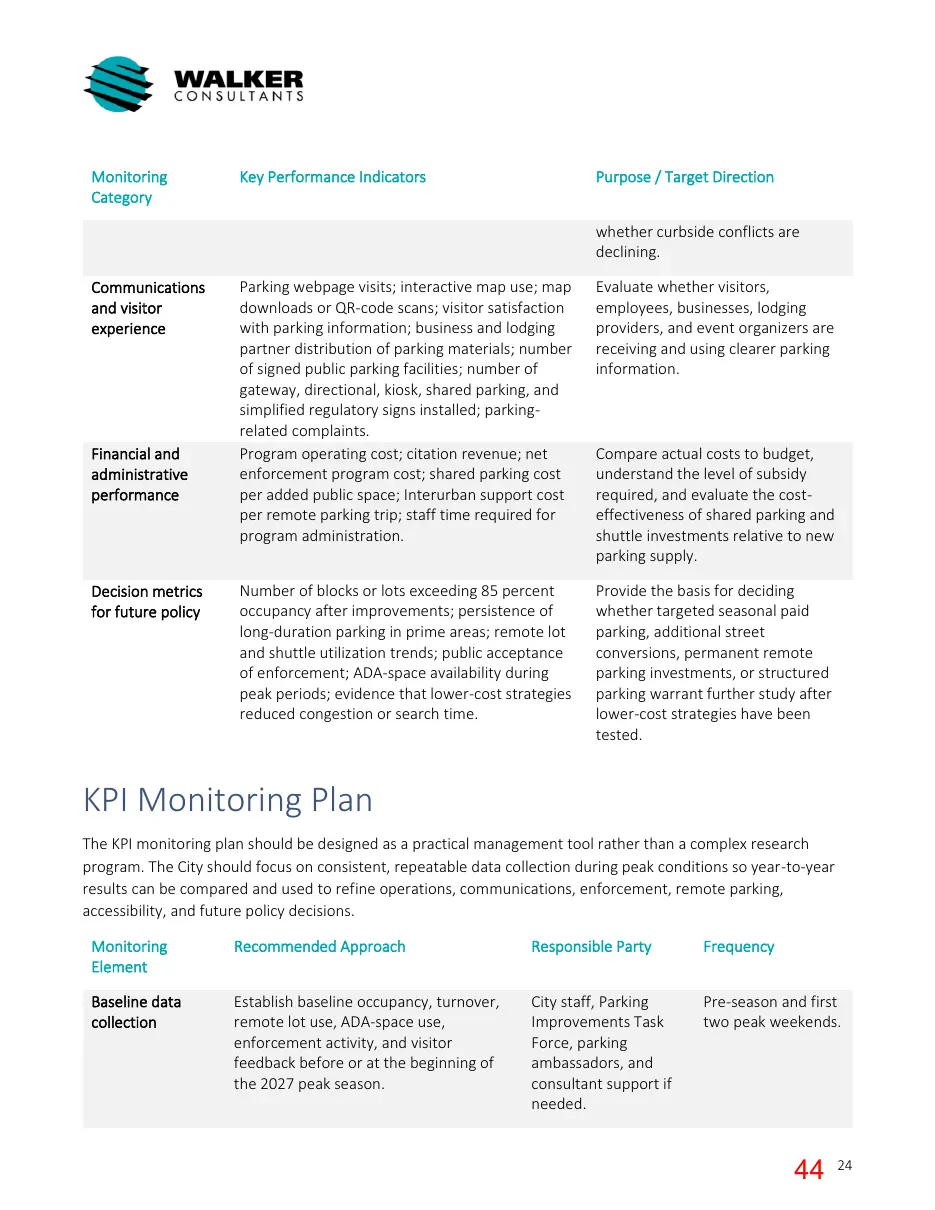
Monitoring Category
Key Performance Indicators
Purpose / Target Direction whether curbside conflicts are declining.
Communications and visitor experience
Financial and administrative performance
Decision metrics for future policy
Parking webpage visits; interactive map use; map downloads or QR-code scans; visitor satisfaction with parking information; business and lodging partner distribution of parking materials; number of signed public parking facilities; number of gateway, directional, kiosk, shared parking, and simplified regulatory signs installed; parkingrelated complaints. Program operating cost; citation revenue; net enforcement program cost; shared parking cost per added public space; Interurban support cost per remote parking trip; staff time required for program administration.
Evaluate whether visitors, employees, businesses, lodging providers, and event organizers are receiving and using clearer parking information.
Number of blocks or lots exceeding 85 percent occupancy after improvements; persistence of long-duration parking in prime areas; remote lot and shuttle utilization trends; public acceptance of enforcement; ADA-space availability during peak periods; evidence that lower-cost strategies reduced congestion or search time.
Provide the basis for deciding whether targeted seasonal paid parking, additional street conversions, permanent remote parking investments, or structured parking warrant further study after lower-cost strategies have been tested.
Compare actual costs to budget, understand the level of subsidy required, and evaluate the costeffectiveness of shared parking and shuttle investments relative to new parking supply.
KPI Monitoring Plan The KPI monitoring plan should be designed as a practical management tool rather than a complex research program. The City should focus on consistent, repeatable data collection during peak conditions so year-to-year results can be compared and used to refine operations, communications, enforcement, remote parking, accessibility, and future policy decisions. Monitoring Element
Recommended Approach
Responsible Party
Frequency
Baseline data collection
Establish baseline occupancy, turnover, remote lot use, ADA-space use, enforcement activity, and visitor feedback before or at the beginning of the 2027 peak season.
City staff, Parking Improvements Task Force, parking ambassadors, and consultant support if needed.
Pre-season and first two peak weekends.
44 24
Page 45
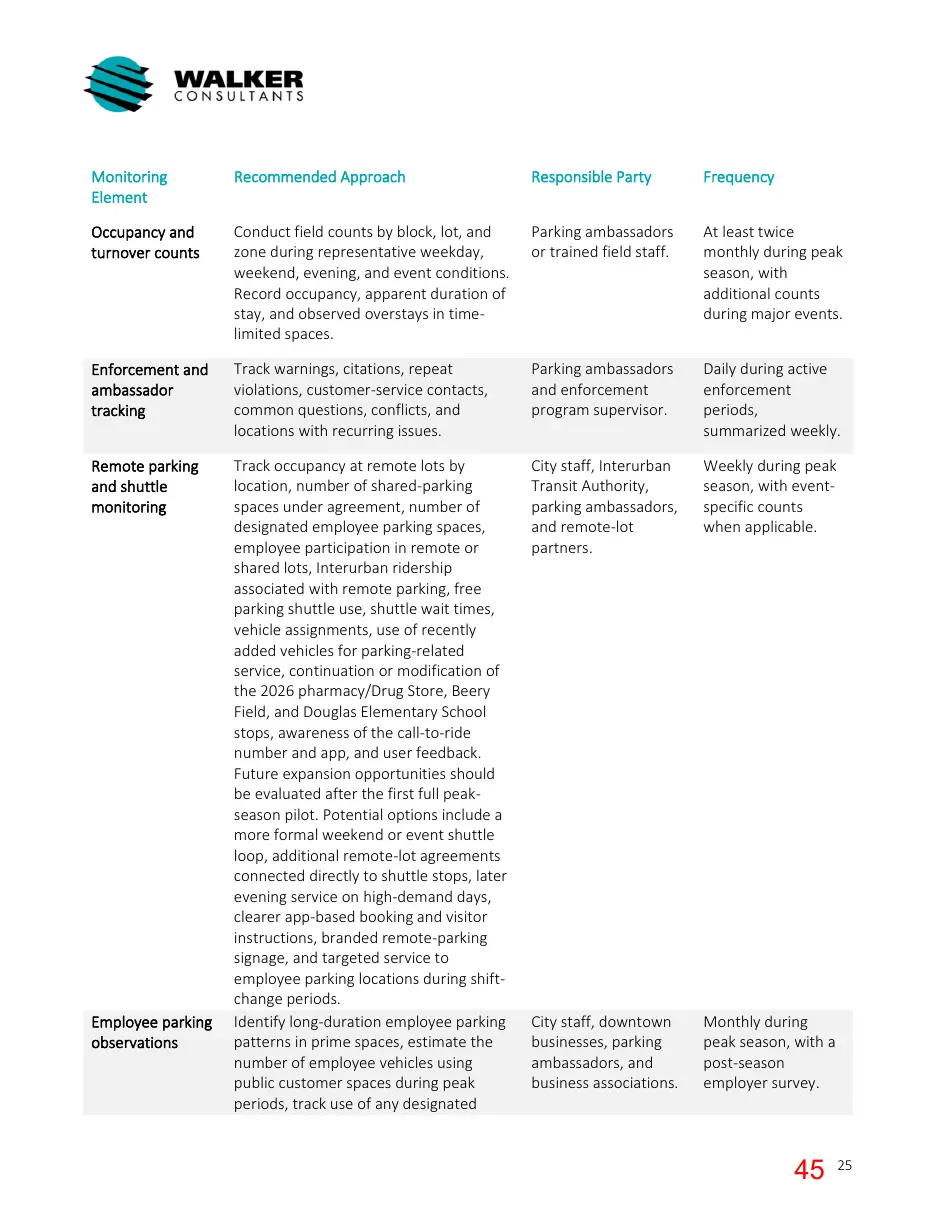
Text of page 45
Monitoring Element
Recommended Approach
Responsible Party
Frequency
Occupancy and turnover counts
Conduct field counts by block, lot, and zone during representative weekday, weekend, evening, and event conditions. Record occupancy, apparent duration of stay, and observed overstays in timelimited spaces.
Parking ambassadors or trained field staff.
At least twice monthly during peak season, with additional counts during major events.
Enforcement and ambassador tracking
Track warnings, citations, repeat violations, customer-service contacts, common questions, conflicts, and locations with recurring issues.
Parking ambassadors and enforcement program supervisor.
Daily during active enforcement periods, summarized weekly.
Remote parking and shuttle monitoring
Track occupancy at remote lots by location, number of shared-parking spaces under agreement, number of designated employee parking spaces, employee participation in remote or shared lots, Interurban ridership associated with remote parking, free parking shuttle use, shuttle wait times, vehicle assignments, use of recently added vehicles for parking-related service, continuation or modification of the 2026 pharmacy/Drug Store, Beery Field, and Douglas Elementary School stops, awareness of the call-to-ride number and app, and user feedback. Future expansion opportunities should be evaluated after the first full peakseason pilot. Potential options include a more formal weekend or event shuttle loop, additional remote-lot agreements connected directly to shuttle stops, later evening service on high-demand days, clearer app-based booking and visitor instructions, branded remote-parking signage, and targeted service to employee parking locations during shiftchange periods. Identify long-duration employee parking patterns in prime spaces, estimate the number of employee vehicles using public customer spaces during peak periods, track use of any designated
City staff, Interurban Transit Authority, parking ambassadors, and remote-lot partners.
Weekly during peak season, with eventspecific counts when applicable.
City staff, downtown businesses, parking ambassadors, and business associations.
Monthly during peak season, with a post-season employer survey.
Employee parking observations
45 25
Page 46
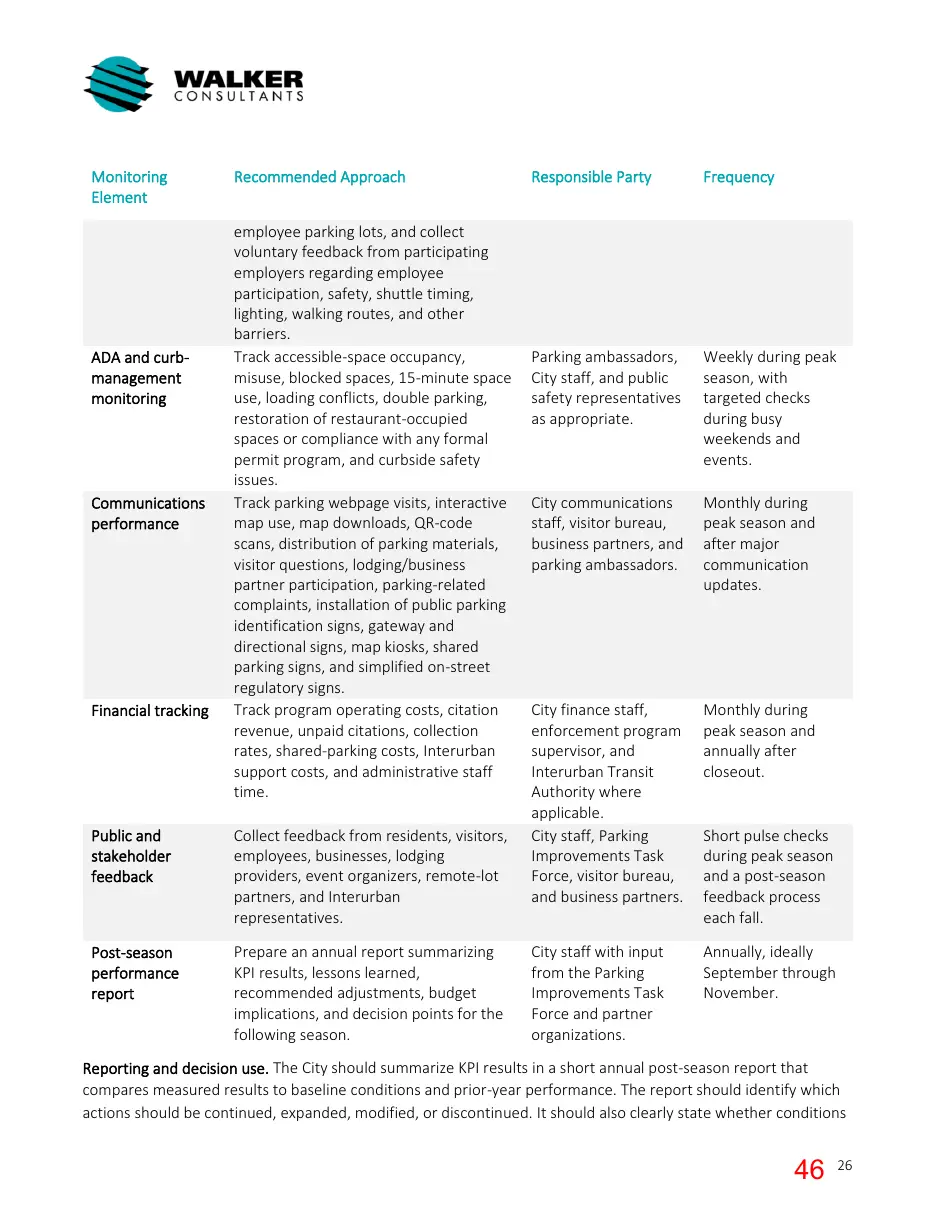
Text of page 46
Monitoring Element
ADA and curbmanagement monitoring
Communications performance
Financial tracking
Recommended Approach employee parking lots, and collect voluntary feedback from participating employers regarding employee participation, safety, shuttle timing, lighting, walking routes, and other barriers. Track accessible-space occupancy, misuse, blocked spaces, 15-minute space use, loading conflicts, double parking, restoration of restaurant-occupied spaces or compliance with any formal permit program, and curbside safety issues. Track parking webpage visits, interactive map use, map downloads, QR-code scans, distribution of parking materials, visitor questions, lodging/business partner participation, parking-related complaints, installation of public parking identification signs, gateway and directional signs, map kiosks, shared parking signs, and simplified on-street regulatory signs. Track program operating costs, citation revenue, unpaid citations, collection rates, shared-parking costs, Interurban support costs, and administrative staff time.
Public and stakeholder feedback
Collect feedback from residents, visitors, employees, businesses, lodging providers, event organizers, remote-lot partners, and Interurban representatives.
Post-season performance report
Prepare an annual report summarizing KPI results, lessons learned, recommended adjustments, budget implications, and decision points for the following season.
Responsible Party
Frequency
Parking ambassadors, City staff, and public safety representatives as appropriate.
Weekly during peak season, with targeted checks during busy weekends and events.
City communications staff, visitor bureau, business partners, and parking ambassadors.
Monthly during peak season and after major communication updates.
City finance staff, enforcement program supervisor, and Interurban Transit Authority where applicable. City staff, Parking Improvements Task Force, visitor bureau, and business partners.
Monthly during peak season and annually after closeout.
City staff with input from the Parking Improvements Task Force and partner organizations.
Annually, ideally September through November.
Short pulse checks during peak season and a post-season feedback process each fall.
Reporting and decision use. The City should summarize KPI results in a short annual post-season report that compares measured results to baseline conditions and prior-year performance. The report should identify which actions should be continued, expanded, modified, or discontinued. It should also clearly state whether conditions
46 26
Page 47
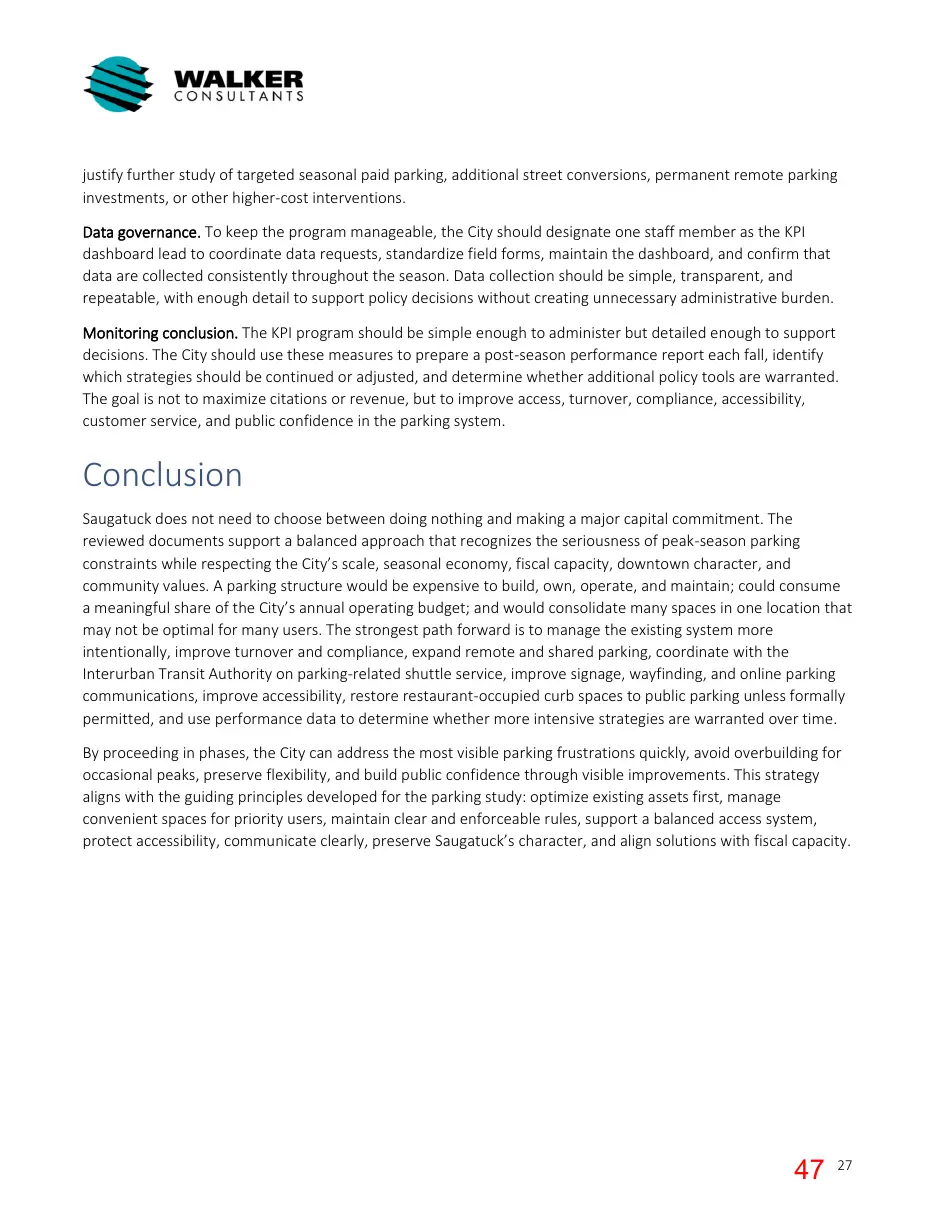
Text of page 47
justify further study of targeted seasonal paid parking, additional street conversions, permanent remote parking investments, or other higher-cost interventions. Data governance. To keep the program manageable, the City should designate one staff member as the KPI dashboard lead to coordinate data requests, standardize field forms, maintain the dashboard, and confirm that data are collected consistently throughout the season. Data collection should be simple, transparent, and repeatable, with enough detail to support policy decisions without creating unnecessary administrative burden. Monitoring conclusion. The KPI program should be simple enough to administer but detailed enough to support decisions. The City should use these measures to prepare a post-season performance report each fall, identify which strategies should be continued or adjusted, and determine whether additional policy tools are warranted. The goal is not to maximize citations or revenue, but to improve access, turnover, compliance, accessibility, customer service, and public confidence in the parking system.
Conclusion Saugatuck does not need to choose between doing nothing and making a major capital commitment. The reviewed documents support a balanced approach that recognizes the seriousness of peak-season parking constraints while respecting the City’s scale, seasonal economy, fiscal capacity, downtown character, and community values. A parking structure would be expensive to build, own, operate, and maintain; could consume a meaningful share of the City’s annual operating budget; and would consolidate many spaces in one location that may not be optimal for many users. The strongest path forward is to manage the existing system more intentionally, improve turnover and compliance, expand remote and shared parking, coordinate with the Interurban Transit Authority on parking-related shuttle service, improve signage, wayfinding, and online parking communications, improve accessibility, restore restaurant-occupied curb spaces to public parking unless formally permitted, and use performance data to determine whether more intensive strategies are warranted over time. By proceeding in phases, the City can address the most visible parking frustrations quickly, avoid overbuilding for occasional peaks, preserve flexibility, and build public confidence through visible improvements. This strategy aligns with the guiding principles developed for the parking study: optimize existing assets first, manage convenient spaces for priority users, maintain clear and enforceable rules, support a balanced access system, protect accessibility, communicate clearly, preserve Saugatuck’s character, and align solutions with fiscal capacity.
47 27