
Parking Task Force Agenda item 6D
City Policy Regarding Restaurant Use of On-Street Parking
Parking Improvements Task Force, Wednesday, July 29, 2026
Download these 3 pages, 557 KB Whole packet, 47 pages, 4.4 MB
Page 18
Text of page 18
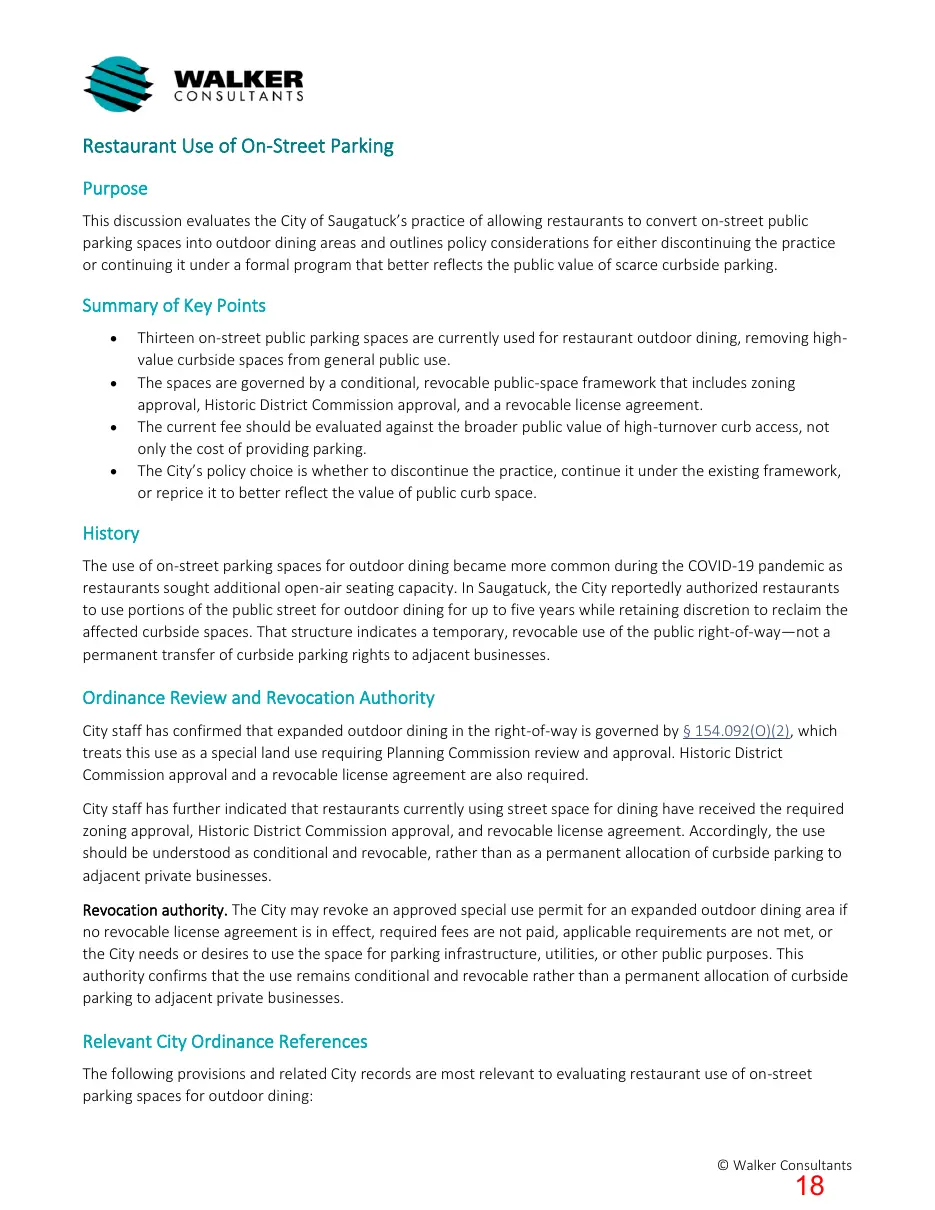
Restaurant Use of On-Street Parking Purpose This discussion evaluates the City of Saugatuck’s practice of allowing restaurants to convert on-street public parking spaces into outdoor dining areas and outlines policy considerations for either discontinuing the practice or continuing it under a formal program that better reflects the public value of scarce curbside parking.
Summary of Key Points • • • •
Thirteen on-street public parking spaces are currently used for restaurant outdoor dining, removing highvalue curbside spaces from general public use. The spaces are governed by a conditional, revocable public-space framework that includes zoning approval, Historic District Commission approval, and a revocable license agreement. The current fee should be evaluated against the broader public value of high-turnover curb access, not only the cost of providing parking. The City’s policy choice is whether to discontinue the practice, continue it under the existing framework, or reprice it to better reflect the value of public curb space.
History The use of on-street parking spaces for outdoor dining became more common during the COVID-19 pandemic as restaurants sought additional open-air seating capacity. In Saugatuck, the City reportedly authorized restaurants to use portions of the public street for outdoor dining for up to five years while retaining discretion to reclaim the affected curbside spaces. That structure indicates a temporary, revocable use of the public right-of-way—not a permanent transfer of curbside parking rights to adjacent businesses.
Ordinance Review and Revocation Authority City staff has confirmed that expanded outdoor dining in the right-of-way is governed by § 154.092(O)(2), which treats this use as a special land use requiring Planning Commission review and approval. Historic District Commission approval and a revocable license agreement are also required. City staff has further indicated that restaurants currently using street space for dining have received the required zoning approval, Historic District Commission approval, and revocable license agreement. Accordingly, the use should be understood as conditional and revocable, rather than as a permanent allocation of curbside parking to adjacent private businesses. Revocation authority. The City may revoke an approved special use permit for an expanded outdoor dining area if no revocable license agreement is in effect, required fees are not paid, applicable requirements are not met, or the City needs or desires to use the space for parking infrastructure, utilities, or other public purposes. This authority confirms that the use remains conditional and revocable rather than a permanent allocation of curbside parking to adjacent private businesses.
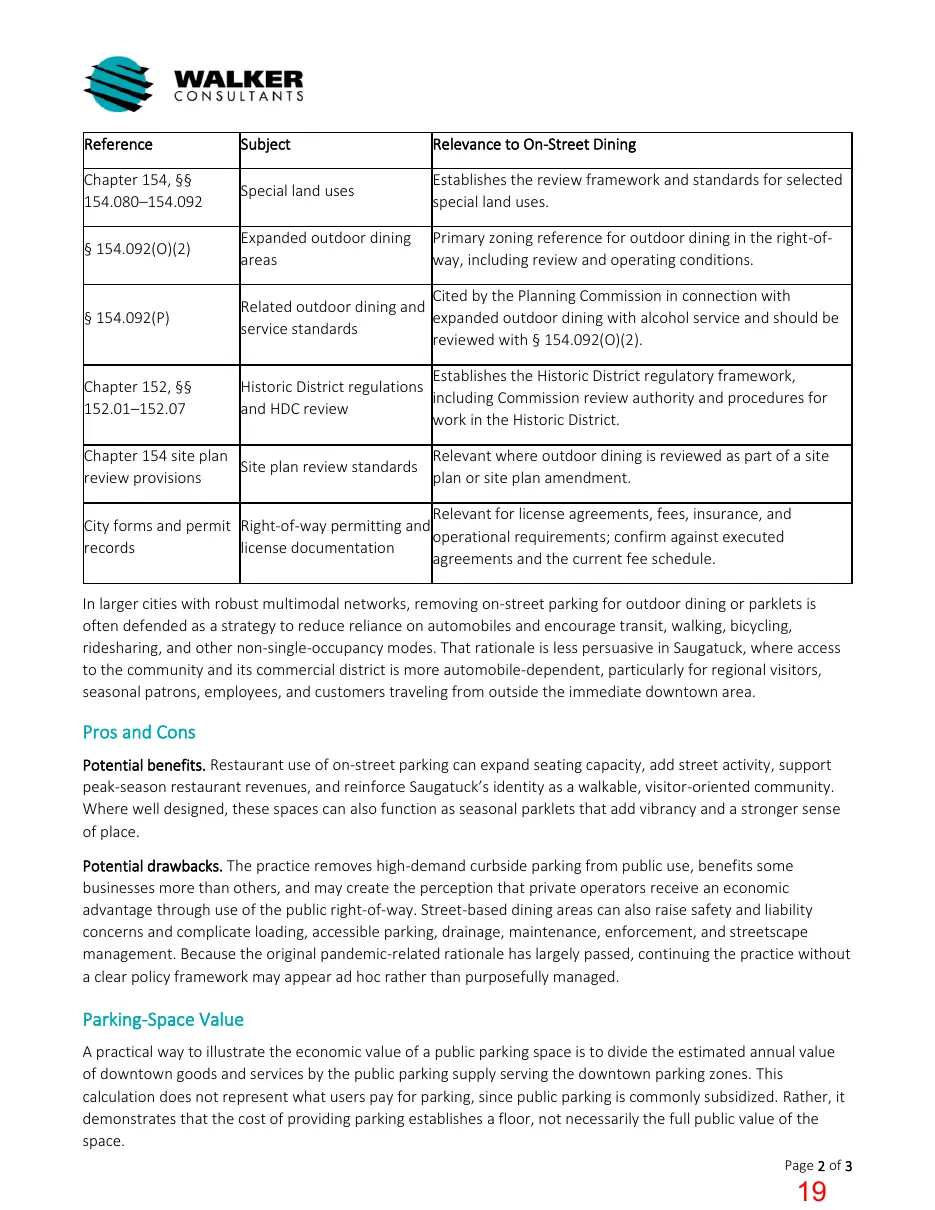
Relevant City Ordinance References The following provisions and related City records are most relevant to evaluating restaurant use of on-street parking spaces for outdoor dining:
© Walker Consultants
Page 19
Text of page 19
Reference
Subject
Relevance to On-Street Dining
Chapter 154, §§ 154.080–154.092
Special land uses
Establishes the review framework and standards for selected special land uses.
§ 154.092(O)(2)
Expanded outdoor dining areas
Primary zoning reference for outdoor dining in the right-ofway, including review and operating conditions.
§ 154.092(P)
Cited by the Planning Commission in connection with Related outdoor dining and expanded outdoor dining with alcohol service and should be service standards reviewed with § 154.092(O)(2).
Chapter 152, §§ 152.01–152.07
Establishes the Historic District regulatory framework, Historic District regulations including Commission review authority and procedures for and HDC review work in the Historic District.
Chapter 154 site plan Relevant where outdoor dining is reviewed as part of a site Site plan review standards review provisions plan or site plan amendment. Relevant for license agreements, fees, insurance, and City forms and permit Right-of-way permitting and operational requirements; confirm against executed records license documentation agreements and the current fee schedule. In larger cities with robust multimodal networks, removing on-street parking for outdoor dining or parklets is often defended as a strategy to reduce reliance on automobiles and encourage transit, walking, bicycling, ridesharing, and other non-single-occupancy modes. That rationale is less persuasive in Saugatuck, where access to the community and its commercial district is more automobile-dependent, particularly for regional visitors, seasonal patrons, employees, and customers traveling from outside the immediate downtown area.
Pros and Cons Potential benefits. Restaurant use of on-street parking can expand seating capacity, add street activity, support peak-season restaurant revenues, and reinforce Saugatuck’s identity as a walkable, visitor-oriented community. Where well designed, these spaces can also function as seasonal parklets that add vibrancy and a stronger sense of place. Potential drawbacks. The practice removes high-demand curbside parking from public use, benefits some businesses more than others, and may create the perception that private operators receive an economic advantage through use of the public right-of-way. Street-based dining areas can also raise safety and liability concerns and complicate loading, accessible parking, drainage, maintenance, enforcement, and streetscape management. Because the original pandemic-related rationale has largely passed, continuing the practice without a clear policy framework may appear ad hoc rather than purposefully managed.
Parking-Space Value A practical way to illustrate the economic value of a public parking space is to divide the estimated annual value of downtown goods and services by the public parking supply serving the downtown parking zones. This calculation does not represent what users pay for parking, since public parking is commonly subsidized. Rather, it demonstrates that the cost of providing parking establishes a floor, not necessarily the full public value of the space. Page 2 of 3
Page 20
Text of page 20
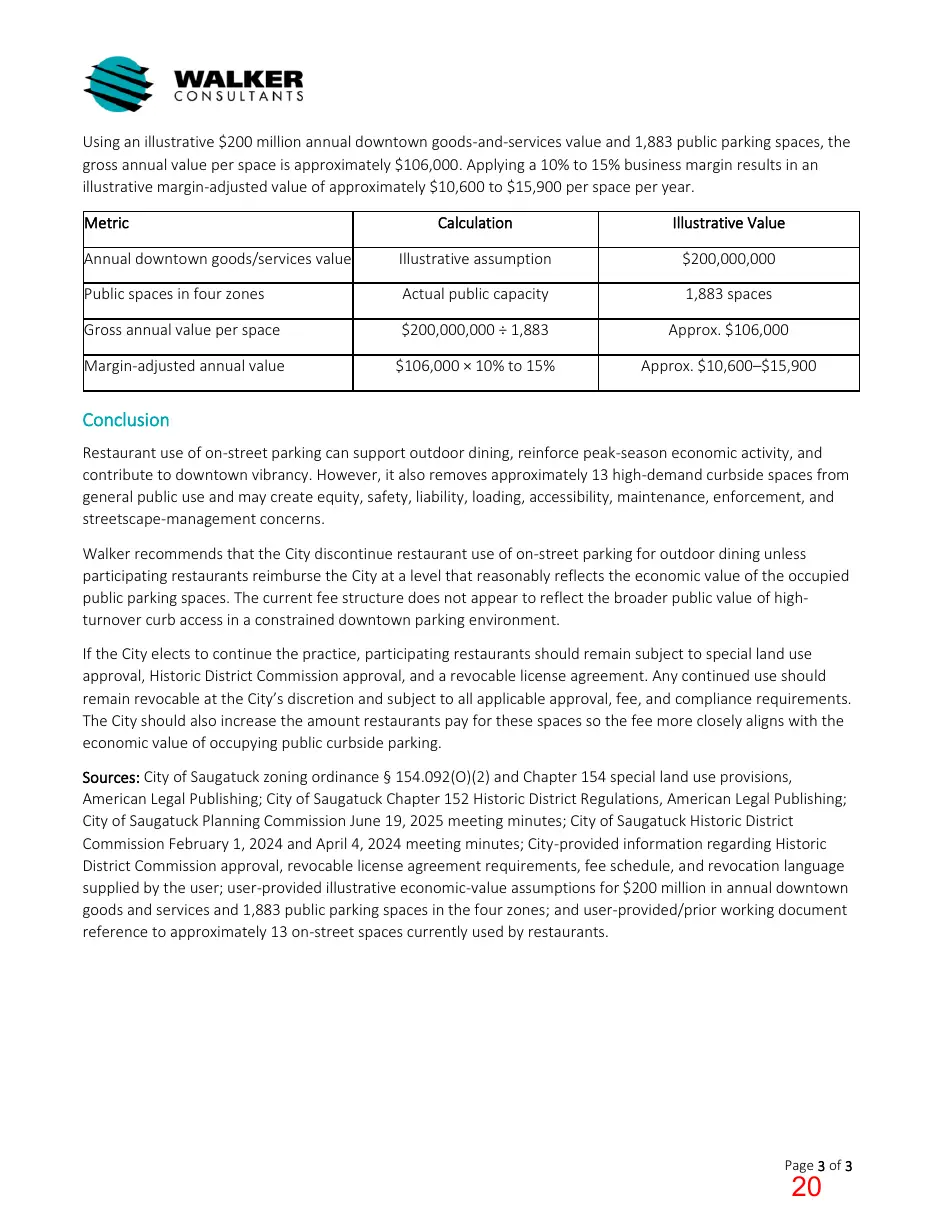
Using an illustrative $200 million annual downtown goods-and-services value and 1,883 public parking spaces, the gross annual value per space is approximately $106,000. Applying a 10% to 15% business margin results in an illustrative margin-adjusted value of approximately $10,600 to $15,900 per space per year. Metric
Calculation
Illustrative Value
Annual downtown goods/services value
Illustrative assumption
$200,000,000
Public spaces in four zones
Actual public capacity
1,883 spaces
Gross annual value per space
$200,000,000 ÷ 1,883
Approx. $106,000
Margin-adjusted annual value
$106,000 × 10% to 15%
Approx. $10,600–$15,900
Conclusion Restaurant use of on-street parking can support outdoor dining, reinforce peak-season economic activity, and contribute to downtown vibrancy. However, it also removes approximately 13 high-demand curbside spaces from general public use and may create equity, safety, liability, loading, accessibility, maintenance, enforcement, and streetscape-management concerns. Walker recommends that the City discontinue restaurant use of on-street parking for outdoor dining unless participating restaurants reimburse the City at a level that reasonably reflects the economic value of the occupied public parking spaces. The current fee structure does not appear to reflect the broader public value of highturnover curb access in a constrained downtown parking environment. If the City elects to continue the practice, participating restaurants should remain subject to special land use approval, Historic District Commission approval, and a revocable license agreement. Any continued use should remain revocable at the City’s discretion and subject to all applicable approval, fee, and compliance requirements. The City should also increase the amount restaurants pay for these spaces so the fee more closely aligns with the economic value of occupying public curbside parking. Sources: City of Saugatuck zoning ordinance § 154.092(O)(2) and Chapter 154 special land use provisions, American Legal Publishing; City of Saugatuck Chapter 152 Historic District Regulations, American Legal Publishing; City of Saugatuck Planning Commission June 19, 2025 meeting minutes; City of Saugatuck Historic District Commission February 1, 2024 and April 4, 2024 meeting minutes; City-provided information regarding Historic District Commission approval, revocable license agreement requirements, fee schedule, and revocation language supplied by the user; user-provided illustrative economic-value assumptions for $200 million in annual downtown goods and services and 1,883 public parking spaces in the four zones; and user-provided/prior working document reference to approximately 13 on-street spaces currently used by restaurants.
Page 3 of 3