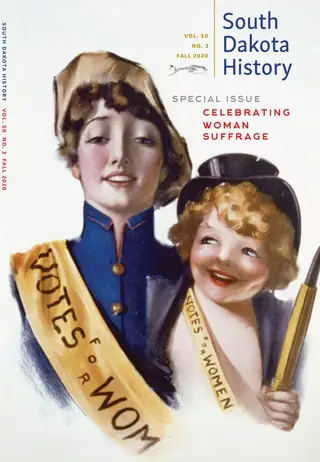
In This Issue
-
"Not a Tinker's Damn": The Politics of Suffrage in the South Dakota Election of 1918
Gerard W. Boychuk’s article, “‘Not a Tinker’s Damn’: The Politics of Suffrage in the South Dakota Election of 1918,” explores the arguments used to garner votes for the passage of Amendment E, the woman suffrage amendment to the state constitution. To get the backing of male voters, suffrage leaders connected women’s voting rights to alien disenfranchisement. By promoting themselves as good citizens when compared to immigrant men, they gained enough support to win equal voting rights in 1918.
Read the PDF of "Not a Tinker's Damn": The Politics of Suffrage in the South Dakota Election of 1918 Free
-
A Century Celebration: Woman Suffrage in South Dakota, 1868-1918
In an article titled “A Century Celebration: Woman Suffrage in South Dakota, 1868–1918,” Ruth Page Jones details the numerous debates over woman suffrage legislation that began during territorial days and continued for 50 years. She tracks the various strategies suffragists used during six major campaigns that eventually led to South Dakota granting women the vote in 1918. Two years later, woman suffrage became the law of the land when Tennessee became the final state needed to approve the Nineteenth Amendment.
Read the PDF of A Century Celebration: Woman Suffrage in South Dakota, 1868-1918 Free
-
DAKOTA IMAGES | Rose Bower
Rose Bower first gained fame with her siblings in the Bower Family Brass Band, but later gained individual recognition as an activist for woman’s suffrage. She would combine these two parts of her life to bring additional attention to the movement throughout the United States. Born on 16 May 1873 in Vermillion, Bower and her twin sister, Nettie, were the fifth and sixth of eight children of John Calvin and Keziah Huntington Bower. By Rose’s eleventh birthday, the Bower children started the family band, led by her eldest brother Sidney, and played their first show in their hometown in May 1884. The following year, the family made their way to the Black Hills, where the band became a regional fixture. Even after Sidney’s death in 1889, Rose, who had began playing the cornet after starting on the trombone, and her remaining siblings kept the band going until 1895 when she moved for teaching jobs in Florida and then Georgia. Their story eventually became a movie with the Walt Disney Corporation in the late 1960s. After four years teaching in the South, Bower returned to her family’s ranch along French Creek. She joined her eldest sister Alice Gossage, who worked as the editor of the Rapid City Daily Journal , in Rapid City in 1903 where she became the public library’s first librarian. Shortly after, Gossage asked Bower to attend a district convention of the Women’s Christian Temperance Union (WCTU) in Sturgis to deliver Gossage’s treasurer’s report. During the meeting, Bower was unexpectedly selected as the president of the WCTU’s Black Hills district, initiating her foray into becoming a national advocate. From 1904 to 1917, Bower traveled around South Dakota and the United States performing and giving speeches. At each event, she played her cornet, often playing her own piano accompaniment as well, to gain audiences’ attention before delivering her dialogues. Bower returned to the family ranch in 1917, running the business until 1929 when she moved back to Rapid City. She contributed to the cultural development of the southern Black Hills and remained active in Rapid City until her death on 26 July 1965 at the age of ninety-two. She was buried in Mountain View Cemetery in Rapid City.
-
Dakota Resources: Woman Suffrage on the Northern Great Plains: An Annotated Bibliography
In a “Dakota Resources” feature, “Woman Suffrage on the Northern Great Plains: An Annotated Bibliography,” Kelly Kirk compiles numerous archival and secondary sources that contain information on the movement in Montana, Wyoming, North Dakota and South Dakota. The comprehensive listing points readers to sources for further research.
-
The Stuff of Suffrage: Selected Images and Ephemera from the Woman Suffrage Movement
In “The Stuff of Suffrage: Selected Ephemera from the Woman Suffrage Movement,” Cody Dodge Ewert highlights the use of mass marketing materials from both pro- and anti-suffragists in the early twentieth century. The two groups employed cartoons, magazine covers, posters, postcards and other objects in an attempt to sway observers to their respective causes.
Read the PDF of The Stuff of Suffrage: Selected Images and Ephemera from the Woman Suffrage Movement Free