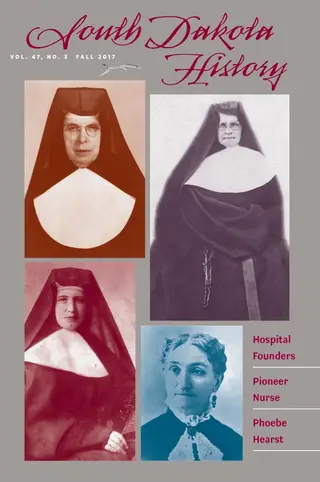
In This Issue
-
DAKOTA IMAGES | Helen S. Duhamel
Helen S. Duhamel began her career with the family saddle-making business and went on to launch broadcasting stations in western South Dakota, Nebraska, and Wyoming, becoming a pioneer in cable television in the region. Helen Seidell was born on 26 November 1904 in Windsor, Missouri, to William F. and Mae Reilly Seidell. The family moved to a ranch on the White River north of Chadron, Nebraska, in 1907. Helen attended Catholic schools in Nebraska and in Sturgis, South Dakota, before graduating from Rapid City High School in 1922. She married Francis A. (“Bud”) Duhamel in Rapid City in 1924, and the couple had two sons and two daughters. In 1933, Helen became bookkeeper for Duhamel Company, the decades-old family hardware business that had grown into a major manufacturer of saddles. She is credited with saving the business during the Great Depression by reorganizing, writing off customer credit, and renting out building space for extra income. In 1943, Duhamel bought an interest in the Black Hills Broadcasting Company, owner of KOBH radio, which had studios in the Hotel Alex Johnson near the Duhamel Trading Post in Rapid City. The station became KOTA radio in 1945, named for the last syllables of “Dakota.” Duhamel bought the remaining company stock in 1954 and asked the Federal Communications Commission for rights to broadcast television—partly because she wanted to provide entertainment for farm and ranch families. KOTA became the second television station in South Dakota when it went on the air in 1955. Over the next twelve years, Duhamel Broadcasting Enterprises expanded “KOTA Territory” through an extensive system of microwave transmitters, adding television stations in western Nebraska, Lead-Deadwood in the Black Hills, and Sheridan, Wyoming. In 1966, Duhamel became a partner in South Dakota Cable TV, Inc. Under her leadership, Duhamel stations earned national awards, including the Golden Mike Award from McCall’s magazine and the Alfred P. Sloan Radio-Television Award for Distinguished Public Service. When elected to head the South Dakota Broadcasters Association in 1961, Duhamel became the first woman in the nation to hold such a post. She was inducted into the South Dakota Broadcasting Hall of Fame in 1976 and the Nebraska Broadcasting Hall of Fame in 1991. Helen Duhamel died on 8 November 1991 at the age of eighty-six.
-
In Memoriam | Harold H. Schuler
-
Philanthropy as Cultural Outreach: Phoebe Hearst and Music in Lead, South Dakota
The life and legacy of Phoebe Hearst is explored in “Philanthropy as Cultural Outreach: Phoebe Hearst and Music in Lead, South Dakota” by Leta E. Miller. Hearst, the mother of newspaper mogul William Randolph Hearst, inherited the family fortune after the death of her husband George in 1891. This wealth included stock in the Homestake Mine in Lead, S.D., where she became a major community benefactor. Hearst enriched the lives of area citizens through the development of cultural and musical activities, including world-class concerts at the Hearst Free Library and Homestake Opera House and Recreation Center. Miller is a Professor of Music Emerita at the University of California and author of numerous works on twentieth-century American music. Articles in South Dakota History , the quarterly journal of the South Dakota Historical Society Press, are free to researchers and readers online once they are over ten years old, prior to that the issue can be purchased for $10.00, plus shipping and handling. Contact (605) 773-6009 for additional information.
Read the PDF of Philanthropy as Cultural Outreach: Phoebe Hearst and Music in Lead, South Dakota Free
-
Pioneer Nurse Jean Todd: A Woman Professional on the Dakota Frontier
“Pioneer Nurse Jean Todd: A Woman Professional on Dakota Frontier” by Ruth Page Jones is an account of a Scottish immigrant and single mother who became one of the first trained nursing professionals in South Dakota. From her arrival in the Mitchell/Plankinton area in 1887, Todd overcame challenges such as poor transportation and opposition from local doctors to serve the community until retiring in 1918. Jones is a researcher currently focusing on South Dakota women’s history. Articles in South Dakota History , the quarterly journal of the South Dakota Historical Society Press, are free to researchers and readers online once they are over ten years old, prior to that the issue can be purchased for $10.00, plus shipping and handling. Contact (605) 773-6009 for additional information.
Read the PDF of Pioneer Nurse Jean Todd: A Woman Professional on the Dakota Frontier Free
-
Three Catholics and a Congregationalist: Four Women and the Founding of a Medical Industry in South Dakota
“Three Catholics and a Congregationalist: Four Women and the Founding of a Medical Industry in South Dakota” examines the creation of the multi-million-dollar Avera McKennan medical system. The roots of the industry began when several Presentation Sisters traveled from Ireland in 1880 to assist Bishop Martin Marty in establishing mission schools in Dakota Territory. The order eventually expanded its role to operate a hospital, funded by Sioux Falls benefactor Helen Gale McKennan in 1906, as well as other facilities across the northern plains. Author Margaret Preston is a history professor at Augustana University. Articles in South Dakota History , the quarterly journal of the South Dakota Historical Society Press, are free to researchers and readers online once they are over ten years old, prior to that the issue can be purchased for $10.00, plus shipping and handling. Contact (605) 773-6009 for additional information.