
Parks & Public Works Agenda item 6C
Mount Baldhead Revegetation
Parks and Public Works Committee, Tuesday, February 24, 2026
Download these 28 pages, 33.5 MB Whole packet, 41 pages, 147.7 MB
Page 6
Text of page 6
Parks & Public Works Committee Agenda Item Report FROM:
Michelle GibsonAdministrative/Project Coordinator
MEETING DATE:
February 24, 2026
SUBJECT:
Mt. Baldhead Revegetation
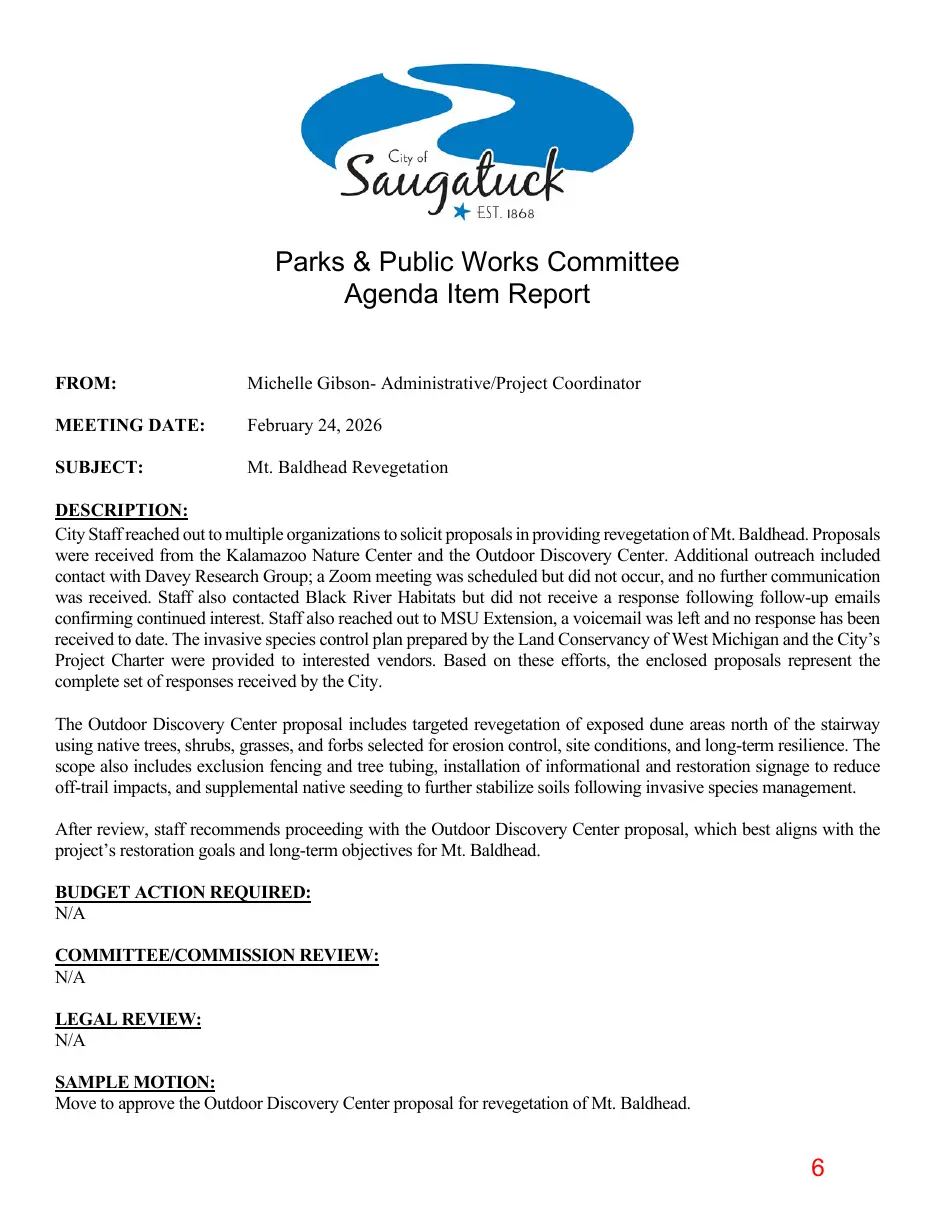
DESCRIPTION: City Staff reached out to multiple organizations to solicit proposals in providing revegetation of Mt. Baldhead. Proposals were received from the Kalamazoo Nature Center and the Outdoor Discovery Center. Additional outreach included contact with Davey Research Group; a Zoom meeting was scheduled but did not occur, and no further communication was received. Staff also contacted Black River Habitats but did not receive a response following follow-up emails confirming continued interest. Staff also reached out to MSU Extension, a voicemail was left and no response has been received to date. The invasive species control plan prepared by the Land Conservancy of West Michigan and the City’s Project Charter were provided to interested vendors. Based on these efforts, the enclosed proposals represent the complete set of responses received by the City. The Outdoor Discovery Center proposal includes targeted revegetation of exposed dune areas north of the stairway using native trees, shrubs, grasses, and forbs selected for erosion control, site conditions, and long-term resilience. The scope also includes exclusion fencing and tree tubing, installation of informational and restoration signage to reduce off-trail impacts, and supplemental native seeding to further stabilize soils following invasive species management. After review, staff recommends proceeding with the Outdoor Discovery Center proposal, which best aligns with the project’s restoration goals and long-term objectives for Mt. Baldhead. BUDGET ACTION REQUIRED: N/A COMMITTEE/COMMISSION REVIEW: N/A LEGAL REVIEW: N/A SAMPLE MOTION: Move to approve the Outdoor Discovery Center proposal for revegetation of Mt. Baldhead.
Page 7
Text of page 7
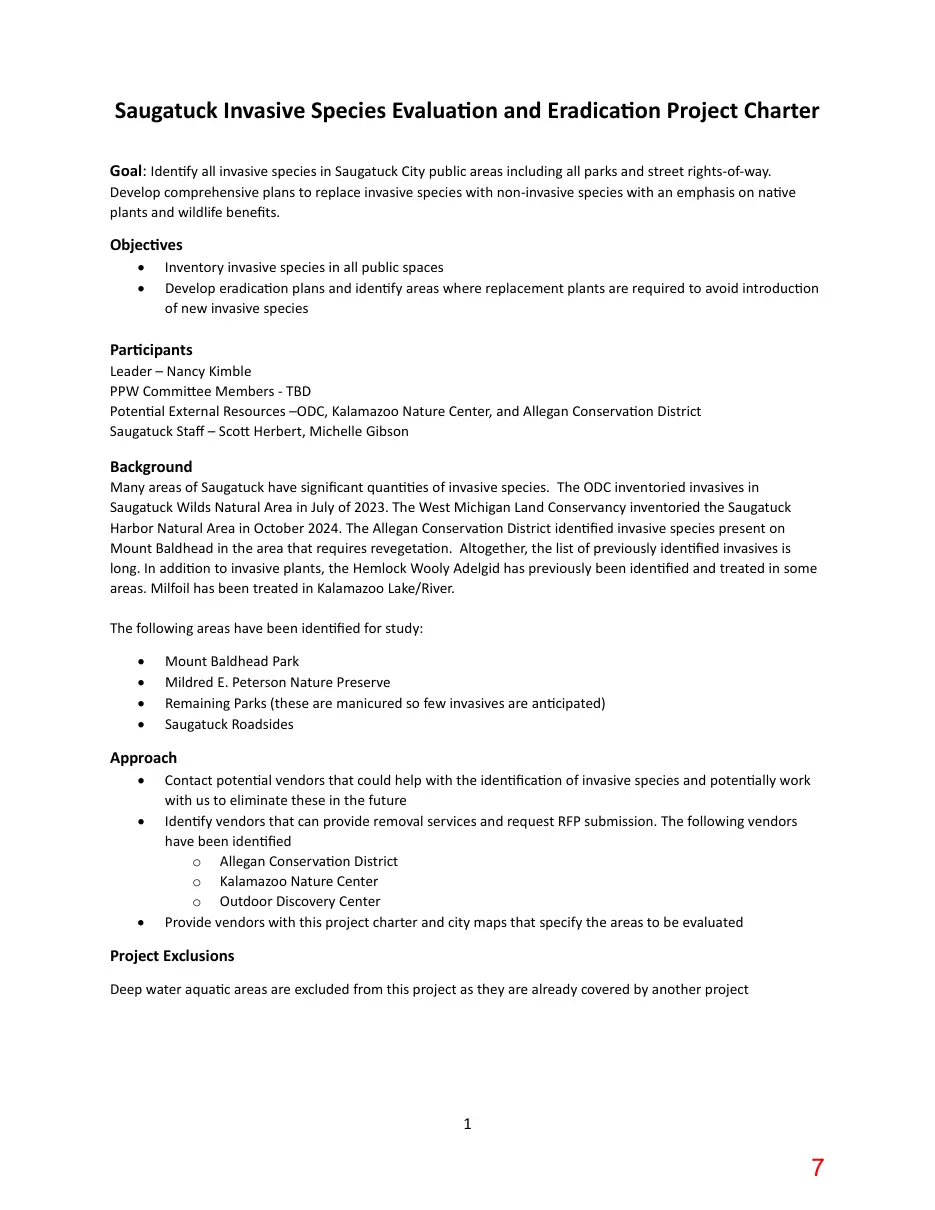
Saugatuck Invasive Species Evaluation and Eradication Project Charter Goal: Identify all invasive species in Saugatuck City public areas including all parks and street rights-of-way.
Develop comprehensive plans to replace invasive species with non-invasive species with an emphasis on native plants and wildlife benefits.
Objectives • •
Inventory invasive species in all public spaces Develop eradication plans and identify areas where replacement plants are required to avoid introduction of new invasive species
Participants
Leader – Nancy Kimble PPW Committee Members - TBD Potential External Resources –ODC, Kalamazoo Nature Center, and Allegan Conservation District Saugatuck Staff – Scott Herbert, Michelle Gibson
Background
Many areas of Saugatuck have significant quantities of invasive species. The ODC inventoried invasives in Saugatuck Wilds Natural Area in July of 2023. The West Michigan Land Conservancy inventoried the Saugatuck Harbor Natural Area in October 2024. The Allegan Conservation District identified invasive species present on Mount Baldhead in the area that requires revegetation. Altogether, the list of previously identified invasives is long. In addition to invasive plants, the Hemlock Wooly Adelgid has previously been identified and treated in some areas. Milfoil has been treated in Kalamazoo Lake/River. The following areas have been identified for study: • • • •
Mount Baldhead Park Mildred E. Peterson Nature Preserve Remaining Parks (these are manicured so few invasives are anticipated) Saugatuck Roadsides
Approach • •
Contact potential vendors that could help with the identification of invasive species and potentially work with us to eliminate these in the future Identify vendors that can provide removal services and request RFP submission. The following vendors have been identified o Allegan Conservation District o Kalamazoo Nature Center o Outdoor Discovery Center Provide vendors with this project charter and city maps that specify the areas to be evaluated
Project Exclusions Deep water aquatic areas are excluded from this project as they are already covered by another project
Page 8
Text of page 8
Saugatuck Invasive Species Evaluation and Eradication Project Charter Project Risks and Mitigation:
Risks: Costs for species removal and replacement plants could be significant. Budgeted funds may not be available in 2026. External resources may not be available in our timeframe.
Target End Date: 12/31/2026 Charter Preparation Date: 5/12/2025 Charter Prepared by: Nancy Kimble
Page 9
This page is a scanned image with no text layer. The PDF of these pages has it at full resolution.
Page 10
Text of page 10
Mt. Baldhead Tree Removal, Replacement, and Erosion Control Plan Saugatuck, Allegan County, Michigan
October 7, 2013
Tree Removal, Replacement, and Erosion Control Plan TABLE OF CONTENTS
1.0
INTRODUCTION .................................................................................................. 1
2.0
MT. BALDHEAD IMPACTS .................................................................................. 2
3.0
TREE REMOVAL AND REPLACEMENT ............................................................. 4
4.0
EROSION CONTROL .......................................................................................... 5
5.0
CONCLUSIONS ................................................................................................. 10
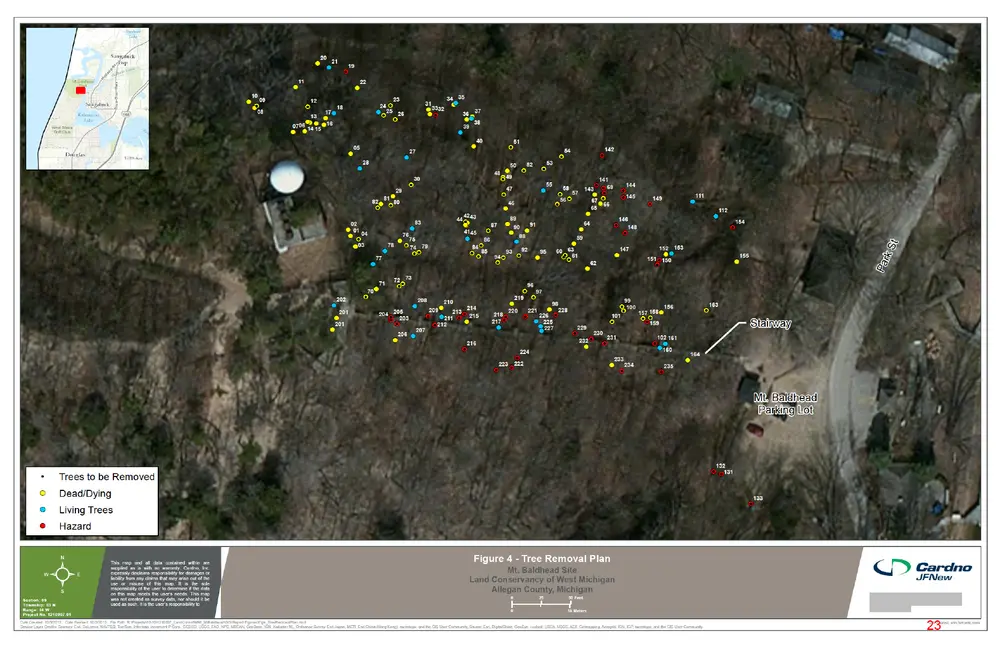
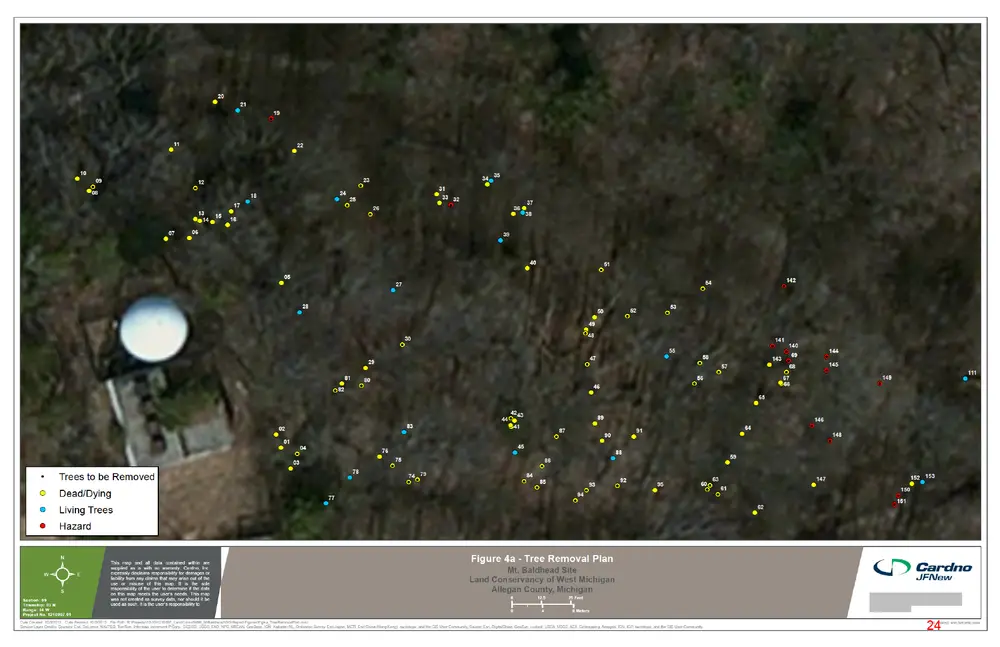
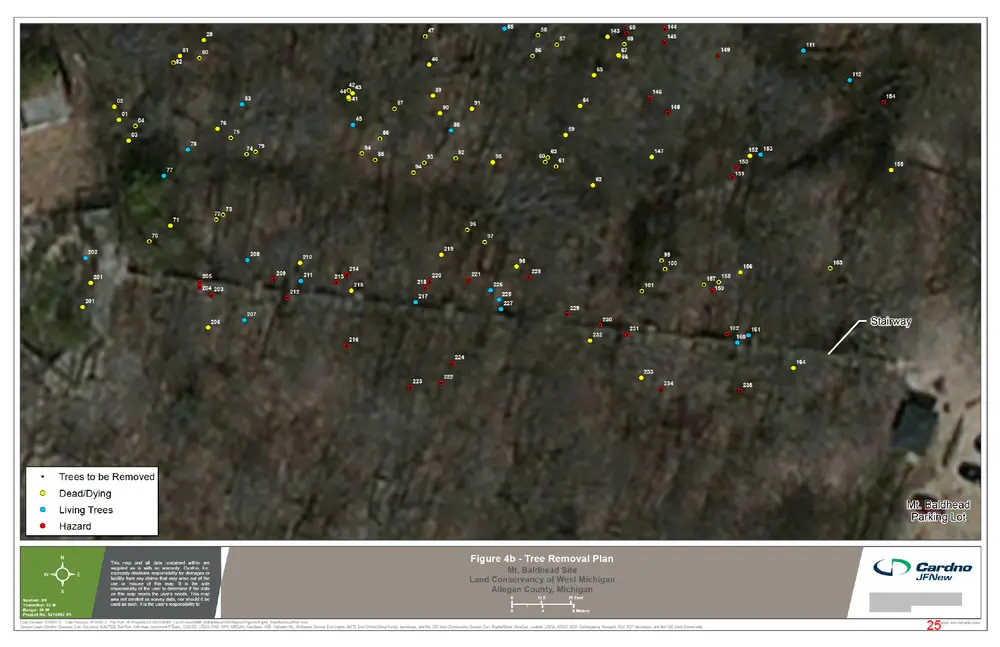
FIGURES: Figure 1: Figure 2: Figure 3: Figure 4: TABLES: Table 1: Table 2: Table 3: Table 4: Table 5:
Site Location Map Tree Locations Hazard Tree Locations Proposed Tree Removal Plan
Dead, or >50% Crown Loss Trees Tree Removal Proposed Tree Replacement Proposed Shrubs for Erosion Control Proposed Seed Mix for Disturbed Areas
Cardno JFNew Project #121007
Page i
Page 11
Text of page 11
Mt. Baldhead Tree Removal, Replacement, and Erosion Control Plan Saugatuck, Allegan County, Michigan
October 7, 2013
Cardno JFNew Project #121007
Page ii
Page 12
Text of page 12
Mt. Baldhead Tree Removal, Replacement, and Erosion Control Plan Saugatuck, Allegan County, Michigan
October 7, 2013
INTRODUCTION At the request of The Land Conservancy of West Michigan, Cardno JFNew and West Michigan Tree Services have been contracted to write a remediation plan for Mount Baldhead Park in Saugatuck, Michigan. The purpose of the remediation plan is to design a successful strategy to recreate the native habitat that was lost due to tree losses that occurred as a result of Oriental bittersweet control treatments.. To control a growing infestation of Oriental bittersweet on Mount Baldhead, the City of Saugatuck gave permission to the Land Conservancy of West Michigan to administer applications of herbicides for Oriental bittersweet control. These herbicide applications occurred in 2010 and 2011. Oriental bittersweet (Celastrus orbiculatus) is an exotic, invasive vine that can destroy native habitats. The vine overruns trees, woody-plants, and ground covers. Oriental Bittersweet can become so pervasive the vines block sunlight to the foliage of desirable trees and native plants. This remediation plan is intended to address the removal and replacement of impacted trees, as well as any soil erosion that may have occurred as a result of said impacts. 2.0
MT. BALDHEAD IMPACTS
Tree Impacts Tree impacts were limited to the northeast side of Mount Baldhead and the perimeter of the parking area at the base of the hill. The area inspected extends from the top of the hill to the base of the hill, and from the path on the northeast side of the hill southward to approximately thirty feet south of the stairway. The majority of the herbicide damage was limited to deciduous trees (there are very few conifer trees on Mount Baldhead). The size of the trees did not appear to have any influence on the extent of herbicide injury. Tree species, however, did have an influence. Sugar maples, red oaks and American basswoods were acutely affected. The mulberry trees and locusts incurred less damage. There is a grove of trees, approximately fifty feet in diameter, located three quarters of the way up the slope that suffered no damage. Of the 191 trees inspected, 148 trees are dead or suffered more than fifty percent crown loss and have little to no chance of survival (Table 1). Forty three trees were not affected or suffered less than fifty percent crown loss.
Cardno JFNew Project #121007
Page 1
Page 13
Text of page 13
Mt. Baldhead Tree Removal, Replacement, and Erosion Control Plan Saugatuck, Allegan County, Michigan
October 7, 2013
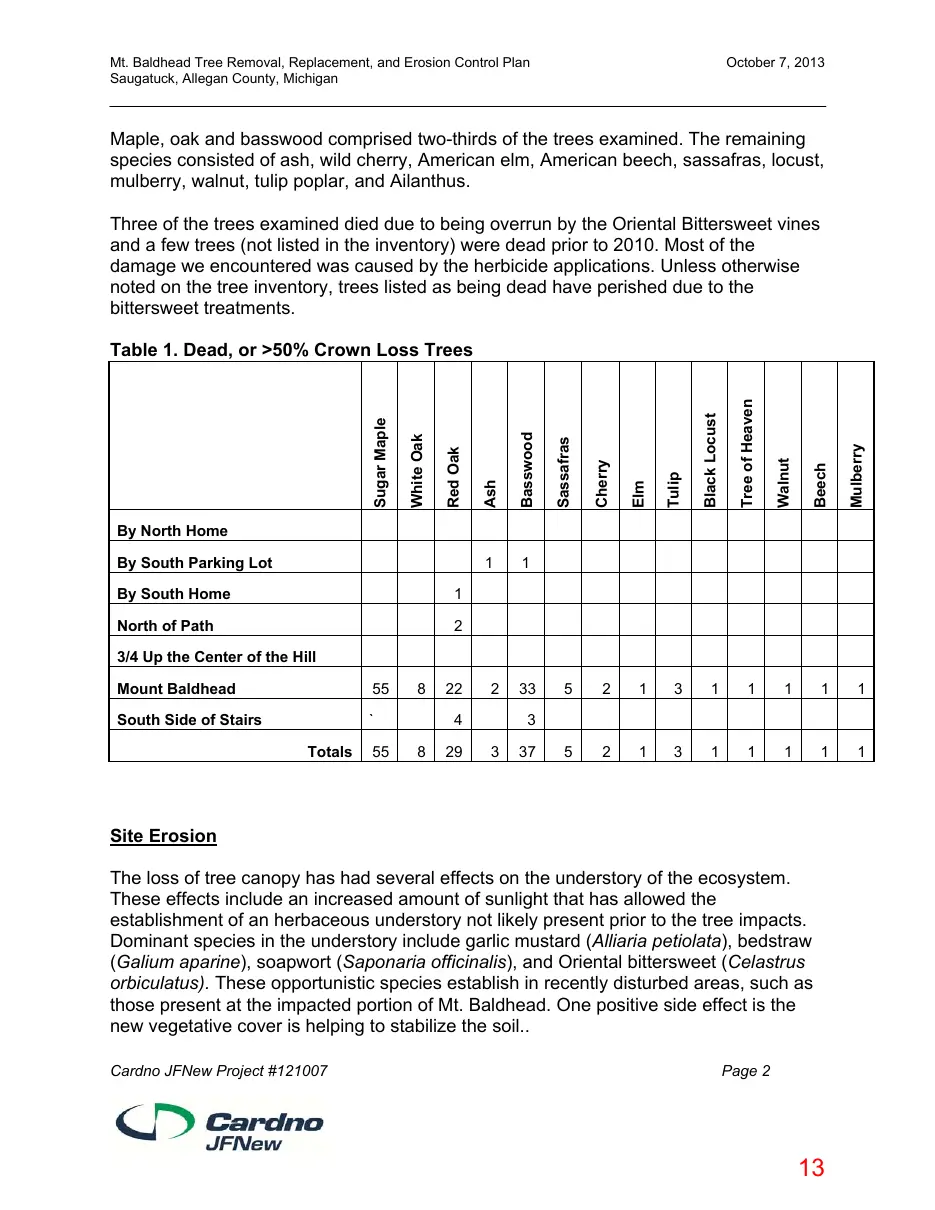
Maple, oak and basswood comprised two-thirds of the trees examined. The remaining species consisted of ash, wild cherry, American elm, American beech, sassafras, locust, mulberry, walnut, tulip poplar, and Ailanthus. Three of the trees examined died due to being overrun by the Oriental Bittersweet vines and a few trees (not listed in the inventory) were dead prior to 2010. Most of the damage we encountered was caused by the herbicide applications. Unless otherwise noted on the tree inventory, trees listed as being dead have perished due to the bittersweet treatments.
Black Locust
Tree of Heaven
Walnut
Beech
Mulberry
Tulip
Elm
Cherry
Basswood
Sassafras
Ash
Red Oak
White Oak
Sugar Maple
Table 1. Dead, or >50% Crown Loss Trees
By North Home By South Parking Lot By South Home
North of Path
3/4 Up the Center of the Hill Mount Baldhead
South Side of Stairs
` Totals
22 4
3 3
Site Erosion The loss of tree canopy has had several effects on the understory of the ecosystem. These effects include an increased amount of sunlight that has allowed the establishment of an herbaceous understory not likely present prior to the tree impacts. Dominant species in the understory include garlic mustard (Alliaria petiolata), bedstraw (Galium aparine), soapwort (Saponaria officinalis), and Oriental bittersweet (Celastrus orbiculatus). These opportunistic species establish in recently disturbed areas, such as those present at the impacted portion of Mt. Baldhead. One positive side effect is the new vegetative cover is helping to stabilize the soil.. Cardno JFNew Project #121007
Page 2
Page 14
Text of page 14
Mt. Baldhead Tree Removal, Replacement, and Erosion Control Plan Saugatuck, Allegan County, Michigan
October 7, 2013
When comparing the trees south of the staircase to the trees north of the staircase, there is a noticeable absence of vegetative diversity on the north side. The more native ecosystem south of the stairs has layers of herbaceous shrubs and tree cover, while the north side vegetation is limited to primarily the afore mentioned herbaceous cover. The north side will become more stable if these vegetative layers can be re-established. The soil on the north side has few signs of active erosion. The vegetation and detritus that are present are minimizing erosion. However, small amounts of soil movement/erosion s are evident. The erosion is primarily superficial and limited to comparatively small (10-20 square foot) areas. No new erosional rills or gullies were observed. What erosional activity has occurred is primarily where there is a lack of detritus or herbaceous vegetation, or where public use has created disturbances. There is a walking path on the north side of Mt. Baldhead. Although not related to invasive species treatments, this path creates potential instability because vegetation is unable to become established. With the loss of tree canopy cover, this path has a greater potential to erode if public use continues to inhibit the ability for vegetation to become established. As a critical dune, Mt. Baldhead has been historically subject to movement. This is particularly evident where a wood retaining wall was installed at the toe of the slope to impede soil movement. Soil movement/erosion has historically been minimized by the presence of vegetation and detritus throughout the dune, as is evident in predisturbance photos and an evaluation of the non-impacted south side of Mt. Baldhead. Long-term stability of the impacted north side of the dune will depend on the presence of vegetation and detritus in some form. Recommendations for increasing stability are provided below. 3.0
TREE REMOVAL AND REPLACEMENT
Tree removal and tree replacement are required to address the 148 trees that suffered mortality. In order to maximize the unique social, cultural, and environmental benefits provided by Mt. Baldhead, tree removal and tree replacement measures must account for public safety, soil stability, and the ecology of the dune ecosystem. Tree Removal There are currently 148 trees (Figure 2) on Mt. Baldhead that have been identified as dead or dying as a result of invasive species treatments. For public safety and soil stability reasons, each of these 148 trees must be addressed in a manner that will protect the public safety and enhance resident ecological community. Of the 148 dead or dying trees, 42 trees (Figure 3) have been identified as hazard trees. A hazard tree is defined as any dead and/or damaged tree caused by the application(s) Cardno JFNew Project #121007
Page 3
Page 15
Text of page 15
Mt. Baldhead Tree Removal, Replacement, and Erosion Control Plan Saugatuck, Allegan County, Michigan
October 7, 2013
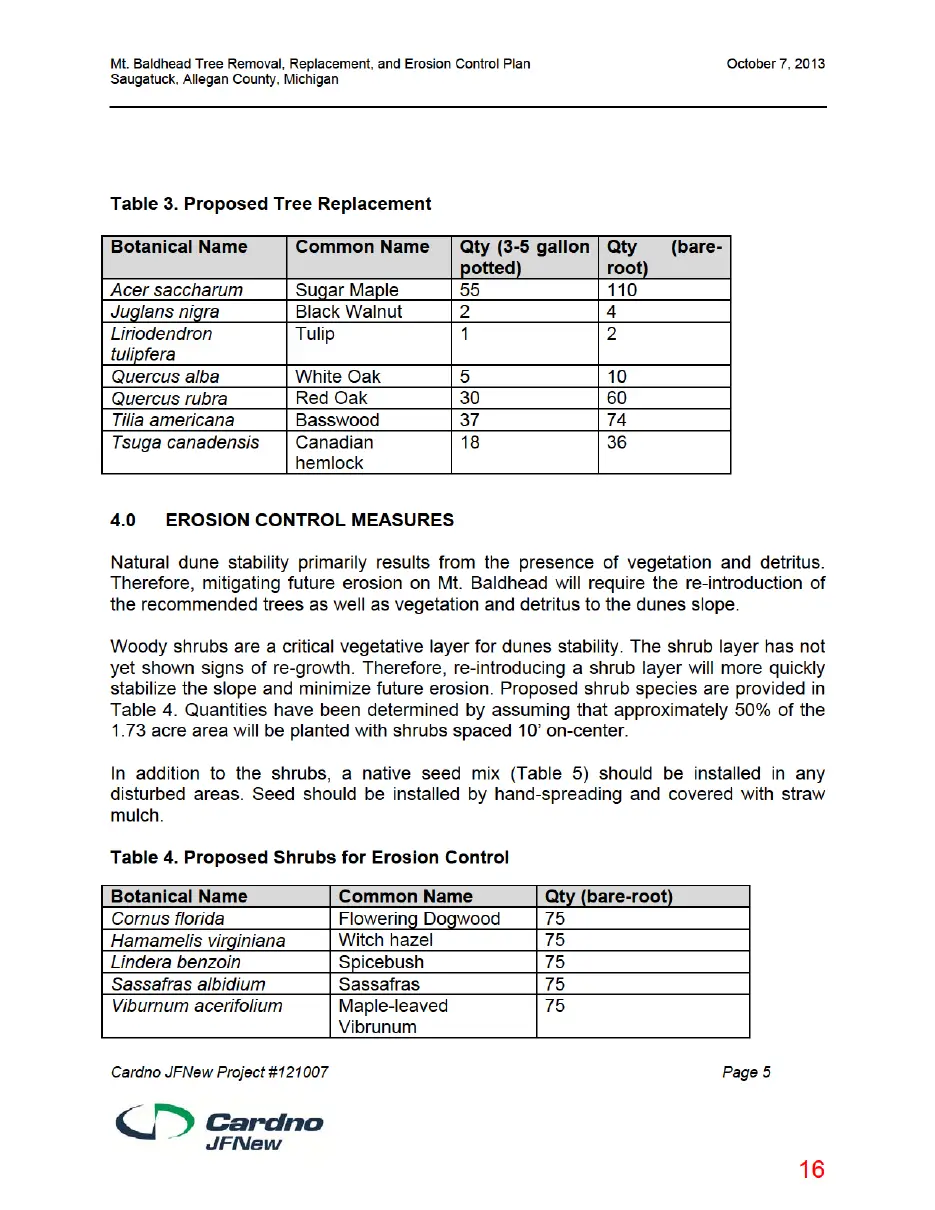
of non-selective herbicides, where limbs and/or the whole tree has the potential to fall and reach park visitors using the stairway, foot paths, private homes, and/or the parking lot or pavilion area. For public safety reasons, all hazard trees should be removed and the wood and brush scattered throughout the site, as described below. In addition to the 42 hazard trees, an additional 45 trees should be removed to reduce potential soil erosion that could be caused by wind throw and to encourage the reestablishment of the native ecological community. Scattering tree trunks and crowns throughout the site will re-introduce detritus to the system, provide microbial habitat and also serve to stabilize the soil. The remaining dead trees should be left standing in place for wildlife habitat. Tree Removal Methodology Removal of dead or dying trees shall be treated in one of two ways. They will either be left standing in place or they will be cut and scattered in appropriate locations for the reasons described above. Trees will be cut by the safest and most practical means necessary. Stumps will be cut flush to grade. Wood and brush will be spread throughout bare or open areas so as not to form “heaps” or piles. Tree crowns will be cut small enough to lay on the hill so that no portion extends more than four feet vertically from the ground surface. All cut material will be placed on the hillside in a manner that mimics natural detritus and minimizes erosion—cut material will not be placed in a manner that exacerbates erosion in any way. Tree Replacement To replace the 148 impacted trees, a combination of potted and bare-root trees should be installed. The 148 impacted trees should be replaced at a 1:1 ratio with potted stock, while additional bare-root stock will be installed at a 2:1 ratio. This would bring the total proposed tree replacement to a 3:1 ratio. The unique ecology of Mt. Baldhead suggests that an emphasis be placed on selecting native tree species from local tree sources. This will best insure a re-establishment of the pre-application native conditions. However, not all of the impacted species are commercially available from local (Michigan-grown) genotypes. The recommended tree replacements have been narrowed based on commercially available local genotype species available from Michigan sources. Oriental bittersweet continues to inhabit portions of Mt. Baldhead. As this plant will inhibit the establishment of native trees, it will need to be addressed.
Cardno JFNew Project #121007
Page 4
Page 16
This page is a scanned image with no text layer. The PDF of these pages has it at full resolution.
Page 17
This page is a scanned image with no text layer. The PDF of these pages has it at full resolution.
Page 18
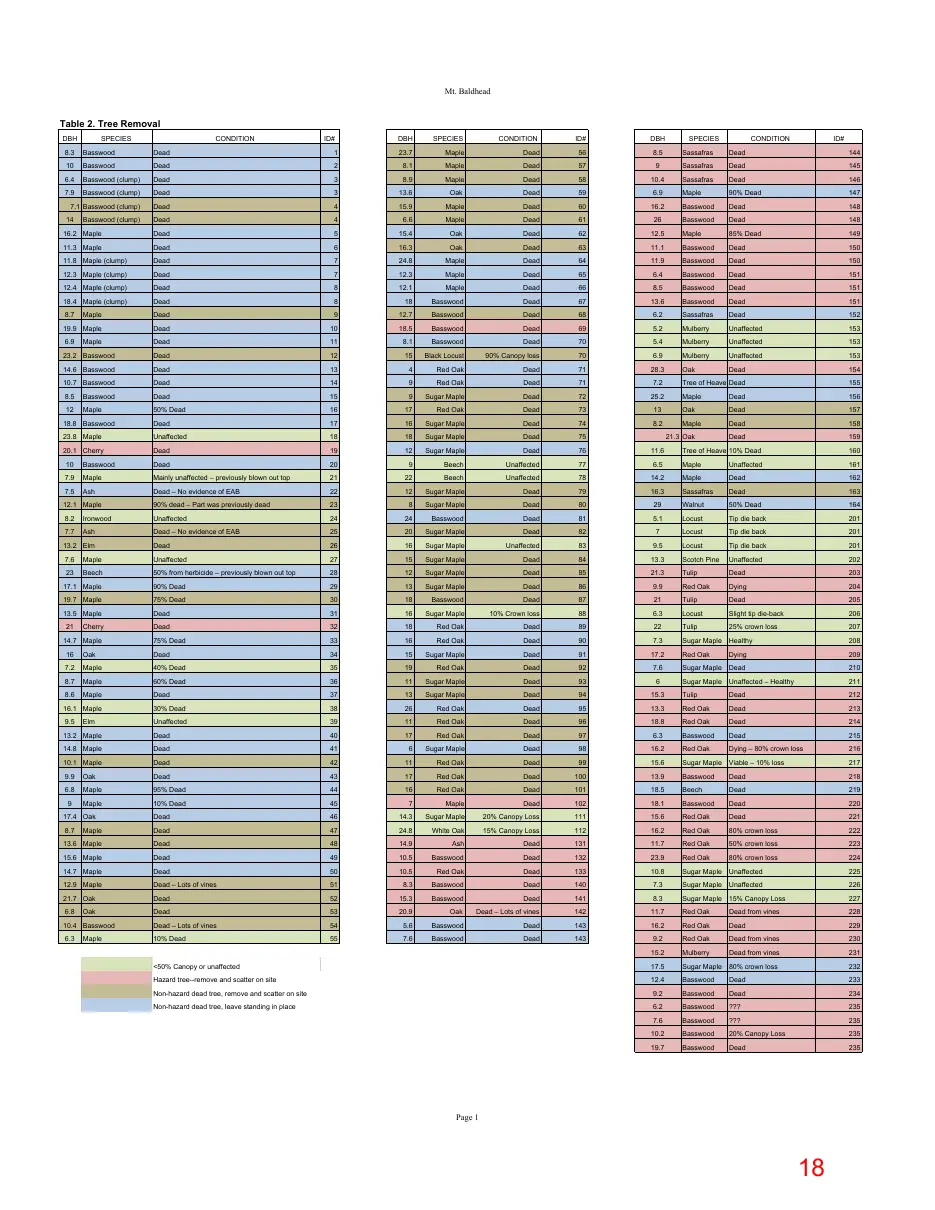
Text of page 18
Mt. Baldhead
Table 2. Tree Removal DBH
ID#
DBH
SPECIES
CONDITION
ID#
DBH
8.3
Basswood
SPECIES Dead
23.7
Maple
Dead
8.5
Sassafras
Dead
Basswood
Dead
8.1
Maple
Dead
Sassafras
Dead
6.4
Basswood (clump)
Dead
8.9
Maple
Dead
10.4
Sassafras
Dead
7.9
Basswood (clump)
Dead
13.6
Oak
Dead
6.9
Maple
90% Dead
7.1 Basswood (clump)
Dead
15.9
Maple
Dead
16.2
Basswood
Dead
Basswood (clump)
CONDITION
SPECIES
CONDITION
ID#
Dead
6.6
Maple
Dead
Basswood
Dead
16.2 Maple
Dead
15.4
Oak
Dead
12.5
Maple
85% Dead
11.3 Maple
Dead
16.3
Oak
Dead
11.1
Basswood
Dead
11.8 Maple (clump)
Dead
24.8
Maple
Dead
11.9
Basswood
Dead
12.3 Maple (clump)
Dead
12.3
Maple
Dead
6.4
Basswood
Dead
12.4 Maple (clump)
Dead
12.1
Maple
Dead
8.5
Basswood
Dead
18.4 Maple (clump)
Dead
Basswood
Dead
13.6
Basswood
Dead
Maple
Dead
12.7
Basswood
Dead
6.2
Sassafras
Dead
19.9 Maple
8.7
Dead
18.5
Basswood
Dead
5.2
Mulberry
Unaffected
Maple
Dead
8.1
Basswood
Dead
5.4
Mulberry
Unaffected
23.2 Basswood
6.9
Dead
Black Locust
90% Canopy loss
6.9
Mulberry
Unaffected
14.6 Basswood
Dead
Red Oak
Dead
28.3
Oak
Dead
10.7 Basswood
Dead
Red Oak
Dead
7.2
Tree of HeavenDead
8.5
Basswood
Dead
Sugar Maple
Dead
25.2
Maple
Dead
Maple
50% Dead
Red Oak
Dead
Oak
Dead
18.8 Basswood
Dead
Sugar Maple
Dead
8.2
Maple
Dead
23.8 Maple
Unaffected
Sugar Maple
Dead
Dead
20.1 Cherry
Dead
Sugar Maple
Dead
11.6
Tree of Heaven10% Dead
Basswood
Dead
Beech
Unaffected
6.5
Maple
Unaffected
7.9
Maple
Mainly unaffected – previously blown out top
Beech
Unaffected
14.2
Maple
Dead
7.5
Ash
Dead – No evidence of EAB
Sugar Maple
Dead
16.3
Sassafras
Dead
12.1 Maple
90% dead – Part was previously dead
Sugar Maple
Dead
Walnut
50% Dead
8.2
Ironwood
Unaffected
Basswood
Dead
5.1
Locust
Tip die back
7.7
Ash
Dead – No evidence of EAB
Sugar Maple
Dead
Locust
Tip die back
13.2 Elm
Dead
Sugar Maple
Unaffected
9.5
Locust
Tip die back
7.6
Maple
Unaffected
Sugar Maple
Dead
13.3
Scotch Pine
Unaffected
Beech
50% from herbicide – previously blown out top
Sugar Maple
Dead
21.3
Tulip
Dead
17.1 Maple
90% Dead
Sugar Maple
Dead
9.9
Red Oak
Dying
19.7 Maple
75% Dead
Basswood
Dead
Tulip
Dead
13.5 Maple
Dead
Sugar Maple
10% Crown loss
6.3
Locust
Slight tip die-back
Cherry
21.3 Oak
Dead
Red Oak
Dead
Tulip
25% crown loss
14.7 Maple
75% Dead
Red Oak
Dead
7.3
Sugar Maple
Healthy
Oak
Dead
Sugar Maple
Dead
17.2
Red Oak
Dying
7.2
Maple
40% Dead
Red Oak
Dead
7.6
Sugar Maple
Dead
8.7
Maple
60% Dead
Sugar Maple
Dead
Sugar Maple
Unaffected – Healthy
8.6
Maple
Dead
Sugar Maple
Dead
15.3
Tulip
Dead
16.1 Maple
30% Dead
Red Oak
Dead
13.3
Red Oak
Dead
9.5
Unaffected
Red Oak
Dead
18.8
Red Oak
Dead
Dead
Red Oak
Dead
6.3
Basswood
Dead
Elm
13.2 Maple 14.8 Maple
Dead
Sugar Maple
Dead
16.2
Red Oak
Dying – 80% crown loss
10.1 Maple
Dead
Red Oak
Dead
15.6
Sugar Maple
Viable – 10% loss
9.9
Oak
Dead
Red Oak
Dead
13.9
Basswood
Dead
6.8
Maple
95% Dead
Red Oak
Dead
18.5
Beech
Dead
Maple
10% Dead
Maple
Dead
18.1
Basswood
Dead
Dead
14.3
Sugar Maple
20% Canopy Loss
15.6
Red Oak
Dead
17.4 Oak Maple
Dead
24.8
White Oak
15% Canopy Loss
16.2
Red Oak
80% crown loss
13.6 Maple
8.7
Dead
14.9
Ash
Dead
11.7
Red Oak
50% crown loss
15.6 Maple
Dead
10.5
Basswood
Dead
23.9
Red Oak
80% crown loss
14.7 Maple
Dead
10.5
Red Oak
Dead
10.8
Sugar Maple
Unaffected
12.9 Maple
Dead – Lots of vines
8.3
Basswood
Dead
7.3
Sugar Maple
Unaffected
21.7 Oak
Dead
15.3
Basswood
Dead
8.3
Sugar Maple
15% Canopy Loss
Dead
20.9
Oak
Dead – Lots of vines
11.7
Red Oak
Dead from vines
10.4 Basswood
6.8
Oak
Dead – Lots of vines
5.6
Basswood
Dead
16.2
Red Oak
Dead
6.3
10% Dead
7.6
Basswood
Dead
Maple
9.2
Red Oak
Dead from vines
15.2
Mulberry
Dead from vines
<50% Canopy or unaffected
17.5
Sugar Maple
80% crown loss
Hazard tree--remove and scatter on site
12.4
Basswood
Dead
Non-hazard dead tree, remove and scatter on site
9.2
Basswood
Dead
Non-hazard dead tree, leave standing in place
6.2
Basswood
7.6
Basswood
10.2
Basswood
20% Canopy Loss
19.7
Basswood
Dead
Page 1
Page 19

This page is a scanned image with no text layer. The PDF of these pages has it at full resolution.
Page 20
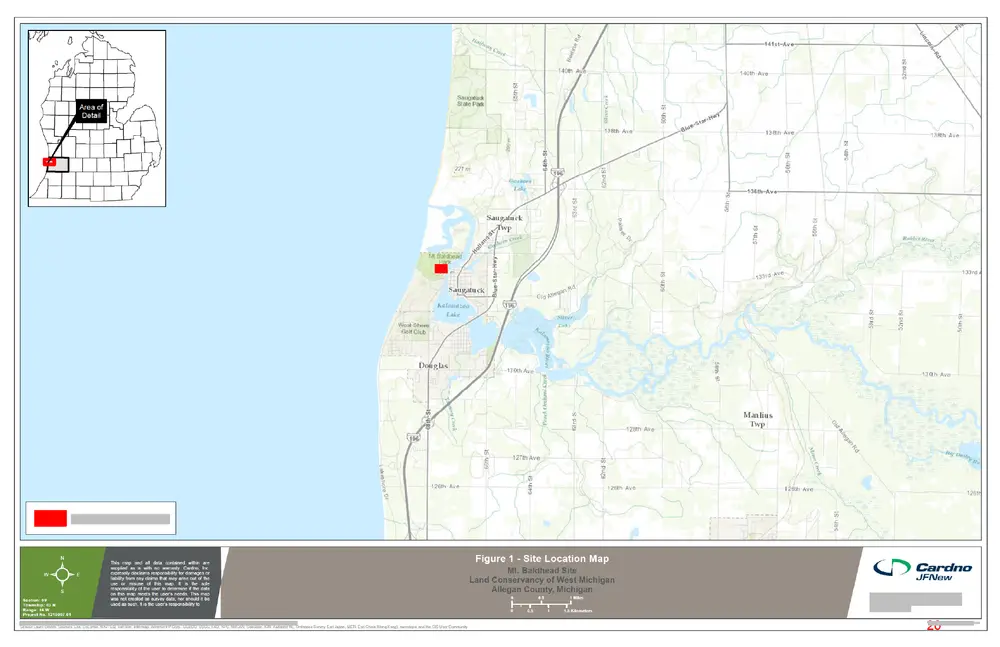
This page is a scanned image with no text layer. The PDF of these pages has it at full resolution.
Page 21
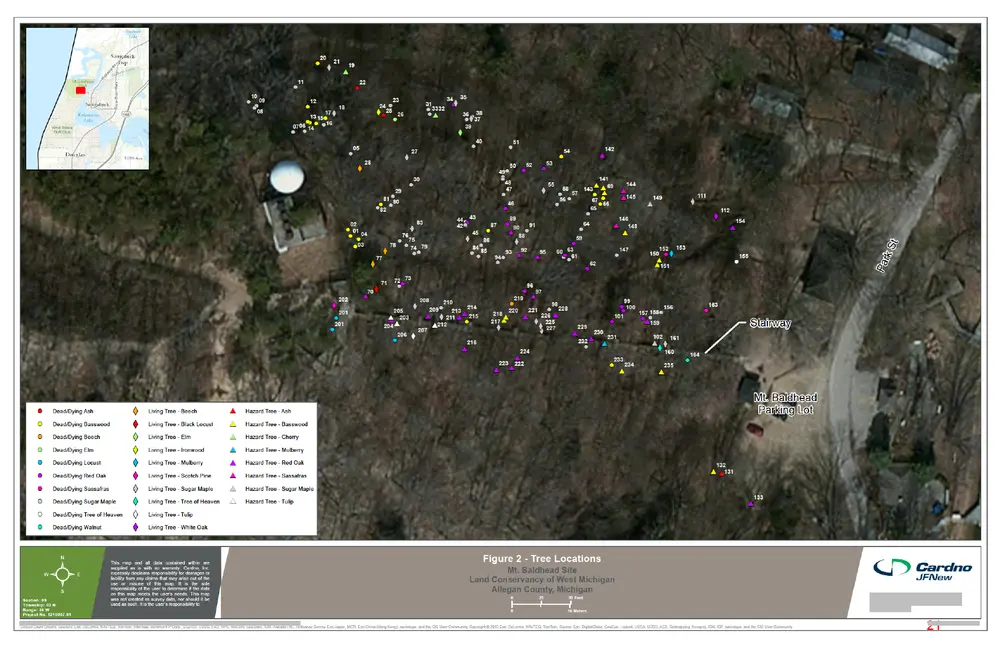
This page is a scanned image with no text layer. The PDF of these pages has it at full resolution.
Page 22
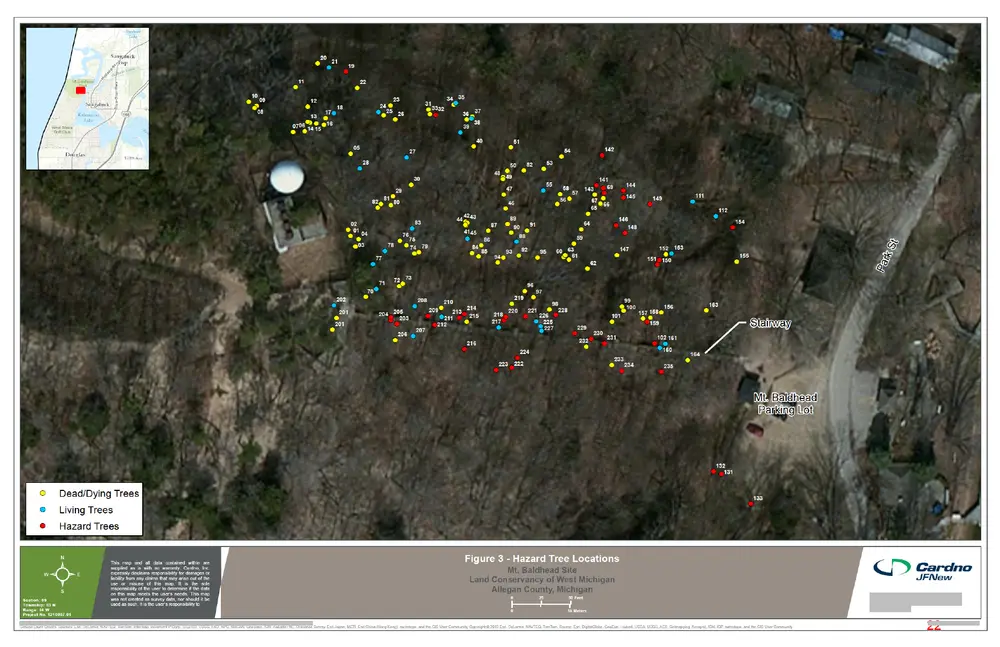
This page is a scanned image with no text layer. The PDF of these pages has it at full resolution.
Page 23
This page is a scanned image with no text layer. The PDF of these pages has it at full resolution.
Page 24
This page is a scanned image with no text layer. The PDF of these pages has it at full resolution.
Page 25
This page is a scanned image with no text layer. The PDF of these pages has it at full resolution.
Page 26
Text of page 26
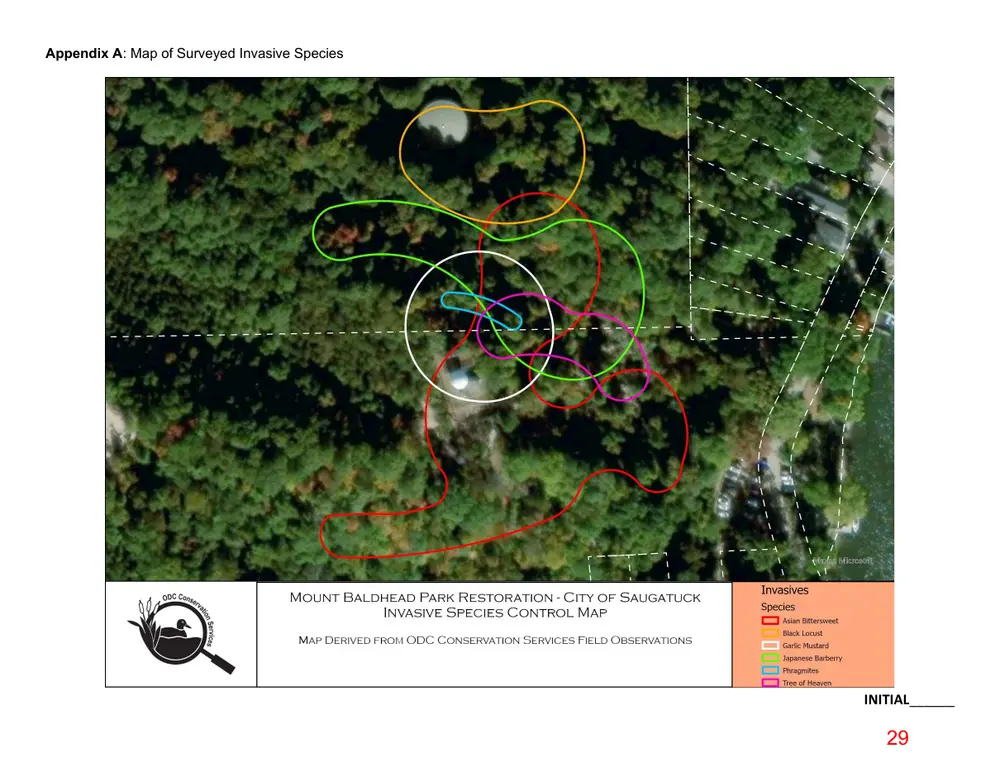
PROPOSAL FOR CONSERVATION SERVICES This proposal was created for: City of Saugatuck – Mount Baldhead Park Mt Baldhead Park Trail, Saugatuck, MI 49453 General Background and Scope of Work: The purpose of this proposal is to restore ecological health at Mount Baldhead through targeted invasive species management and the replanting of native dune vegetation. Previous control efforts done by a separate contractor inadvertently caused mortality to significant canopy cover and reduced dune stabilization, creating openings now dominated by invasive plants. Following a recent survey of the site, our team recommends the following management and replanting plan for 2026: 1. Invasive Species Management (see Appendix A for map) ▪ Several highly invasive species are present that threaten the integrity of the dune habitat, including: garlic mustard, multiflora rose, Asian bittersweet, Japanese barberry, tree-of-heaven, phragmites, and black locust. ▪ Our management approach will prioritize safe and targeted control methods that avoid unnecessary herbicide use and prevent damage to surrounding vegetation. Hand pulling will be implemented where practical, while cut-stump and hack and squirt treatments will be used to ensure precise and minimal herbicide applications. When foliar applications are necessary, they will be applied selectively and with safeguards to prevent off-target impacts. ▪ Includes procurement of all necessary permitting to apply herbicides through EGLE and MDARD. ▪ Note: Many of the invasive species listed above typically require sustained and repeated management to successfully control. Effective treatment generally requires repeated management efforts over a period of multiple years to achieve meaningful reduction or eradication. Our team will continue to monitor the population annually and will provide updated pricing and management recommendations each year. The allows for adaptive management strategies based on observed changes in site conditions and treatment efficacy year-to-year. 2. Dune Revegetation ▪ Large areas of exposed soil across the dune north of the stairway currently face high risks of erosion and rapid recolonization by adjacent invasive species. To stabilize these areas, prevent further invasive spread, and enhance both habitat quality and aesthetics, we propose installing a diverse mix of native trees, shrubs, grasses, and forbs in the vacant space. ▪ Species selection will highlight erosion control, drought tolerance, and deer resistance, recognizing the heavy browsing pressure present at this site. Plantings will be matched to each micro-site’s soil and sunlight conditions to maximize survival rates and ecological value. ▪ Trees: Sugar Maple (Acer saccharum), Tulip Poplar (Liliodendron tulipifera), Basswood (Tilia americana), White Pine (Pinus strobus), Oak (Quercus spp.), Bladdernut (Staphylea trifolia), Serviceberry (Amelanchier spp.), etc. ▪ Shrubs: Witch Hazel (Hamamelis virginiana), Sand Cherry (Prunus pumila), Ninebark (Physocarpus opulifolius), Spicebush (Lindera benzoin), Arrowwood Viburnum (Viburnum dentatum), Northern Bush Honeysuckle (Diervilla Ionicera), Sweet Fern (Comptonia peregrina), etc. ▪ Forbs/graminoids: Canada Wild Rye (Elymus canadensis), Bottlebrush Grass (Elymus hystrix), Little Bluestem (Schizachyrium scoparium), Beach Grass (Ammophila breviligulata), Sand Reed (Calamovilfa longifolia), Penn Sedge (Carex pensylvanica), Columbine (Aquilegia canadensis), Hairy Puccoon (Lithospermum caroliniense), Dotted Mint (Monarda punctata), Flowering Spurge (Euphorbia corollata), etc.
INITIAL______
Page 27
Text of page 27
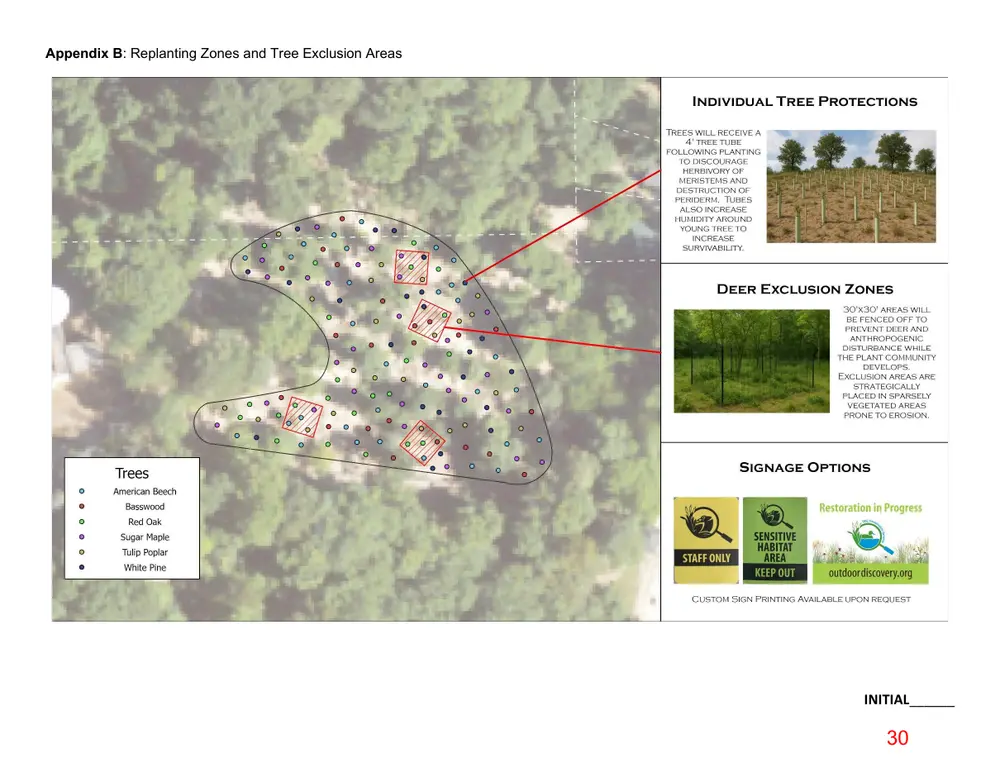
Approximately 500 native plants will be installed throughout the unit, including, bare-root, 1-3 gallon, and 4” plugs. • Protective exclusion measures such as tree tubes and four 900 ft2 sections of 6'tall exclusion fencing will be implemented where applicable to prevent herbivory and physical damage to developing plantings (See Appendix B for layout). • Informational signage will be installed in high-traffic and erosion-prone areas to encourage public awareness, limit off-trail usage, and protect restoration efforts (See Appendix B for examples). • “Sensitive Habitat Area – Keep Out” signs (4"x6") will be placed at key intervals and potential access points throughout the unit as needed. • A total of four (4) “Restoration in Progress” signs (2'x3') will be placed in key locations to minimize off-trail use and reduce disturbance from hikers. • In addition to the live plantings, a custom native seed mix highlighting duneadapted forbs and graminoids will be seeded following invasive species management efforts to enhance diversity and further stabilize exposed soils.
Project Timeline: • Invasive species management ongoing during the 2026 growing season • Live plantings and native seeding will be phased as invasive species treatments allow, from spring through early fall of 2026 • Signage and exclusion fencing will be installed immediately following planting. Project Budget: • Invasive Species Management in 2026 - $10,000 (billed in June 2026) ☐ • Dune Revegetation (500 plants) - $11,860 (billed in June 2026) ☐ *PLEASE CHECK THE APPROPRIATE BOXES ABOVE TO INDICATE ACCEPTED SERVICES Note: This proposal accounts for pricing of all labor, materials, and equipment necessary in order to perform the outlined invasive species management plan. If additional work is required beyond the scope of this proposal, we will provide written notification and pricing will be determined on a time and materials basis. Exclusions: This proposal does not account for: • Installation of exclusion fencing beyond what is outlined in this proposal. • Production and installation of signage beyond what is outlined in this proposal. • Installation or management of irrigation features. • Removal of standing dead plant material following invasive species control measures. • Replacement of damaged lawn, landscape plants, trees or shrubs as a result of nearby invasive species control measures. • Replanting of native vegetation following invasive species control measures (unless otherwise stated on the proposal). ** We are happy to assist with any of the above items upon request through a separate proposal. For custom signage inquiries or quotes, please contact:
INITIAL______
Page 28
Text of page 28
Qualifications: ODC Conservation Services staff are highly qualified conservation professionals. • ODC Network, and its subsidiaries, is a fully insured 501c3 and carries an extensive liability policy to conduct habitat improvement services in Michigan • State licensed herbicide applicators with certifications in Forest Pest, Right-of-Way, and Aquatic pesticide application • Combined 25+ years experience in invasive species management • Successfully restored over 250 acres of native prairie • Successfully installed over 25 native gardens and landscape beds • Manage 2,000+ acres of high quality natural area • Experienced Michigan flora and fauna identification • Advanced wetland delineation certification • Experienced GIS professionals We appreciate the opportunity to submit this proposal. We look forward to discussing the opportunity further with you. Please do not hesitate to ask questions or clarifications. If you choose to accept this proposal, please sign and return a copy.
Tanner Bricker, Conservation Services Director
If you wish to accept this proposal, please initial each page, as well as sign and date below:
_____________________________________________________ Signature of Authorized Property Owner/Manager
_____________________________ Date
INITIAL______
Page 29
Text of page 29
Appendix A: Map of Surveyed Invasive Species
INITIAL______
Page 30
Text of page 30
Appendix B: Replanting Zones and Tree Exclusion Areas
INITIAL______
Page 31
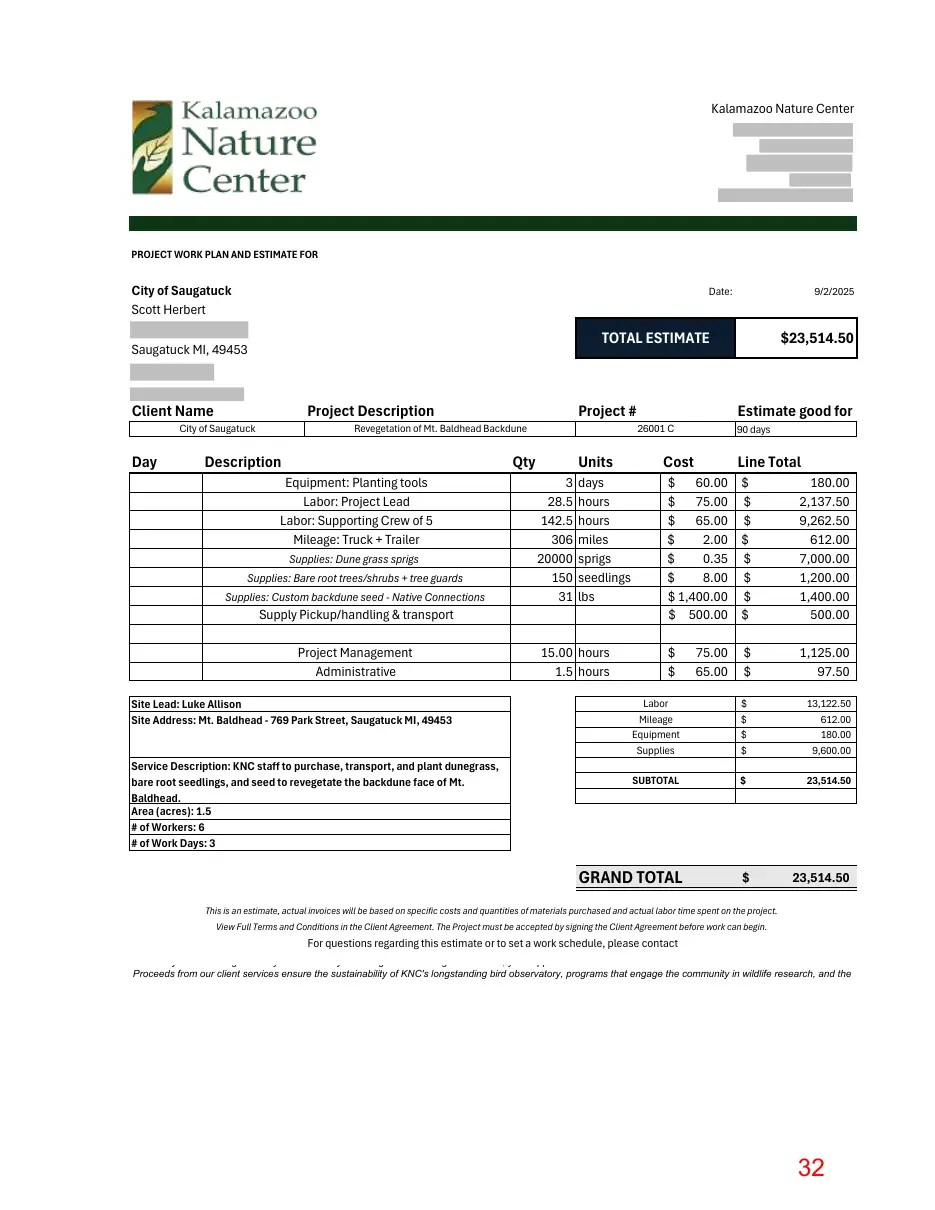
Text of page 31
Kalamazoo Nature Center
PROJECT WORK PLAN AND ESTIMATE FOR
City of Saugatuck Scott Herbert
Date:
TOTAL ESTIMATE
Saugatuck MI, 49453
Client Name
Project #
Project Description
City of Saugatuck
Day
9/2/2025
Revegetation of Mt. Baldhead Backdune
Description
Qty
Equipment: Planting tools Labor: Project Lead Labor: Supporting Crew of 5 Mileage: Truck + Trailer Supplies: Dune grass sprigs Supplies: Bare root trees/shrubs + tree guards Supplies: Custom backdune seed - Native Connections
Site Lead: Luke Allison Site Address: Mt. Baldhead - 769 Park Street, Saugatuck MI, 49453
Service Description: KNC staff to purchase, transport, and plant dunegrass, bare root seedlings, and seed to revegetate the backdune face of Mt. Baldhead. Area (acres): 1.5 # of Workers: 6 # of Work Days: 3
90 days
Cost
Line Total
3 days 28.5 hours 142.5 hours 306 miles 20000 sprigs 150 seedlings 31 lbs
$ 60.00 $ $ 75.00 $ $ 65.00 $ $ 2.00 $ $ 0.35 $ $ 8.00 $ $ 1,400.00 $ $ 500.00 $
180.00 2,137.50 9,262.50 612.00 7,000.00 1,200.00 1,400.00 500.00
15.00 hours 1.5 hours
1,125.00 97.50
Labor Mileage Equipment Supplies
13,122.50 612.00 180.00 9,600.00
SUBTOTAL
23,514.50
GRAND TOTAL
23,514.50
Supply Pickup/handling & transport Project Management Administrative
Estimate good for 26001 C
Units
$23,514.50
75.00 65.00
This is an estimate, actual invoices will be based on specific costs and quantities of materials purchased and actual labor time spent on the project. View Full Terms and Conditions in the Client Agreement. The Project must be accepted by signing the Client Agreement before work can begin.
For questions regarding this estimate or to set a work schedule, please contact y g y y g g ,y pp Proceeds from our client services ensure the sustainability of KNC's longstanding bird observatory, programs that engage the community in wildlife research, and the
Page 32
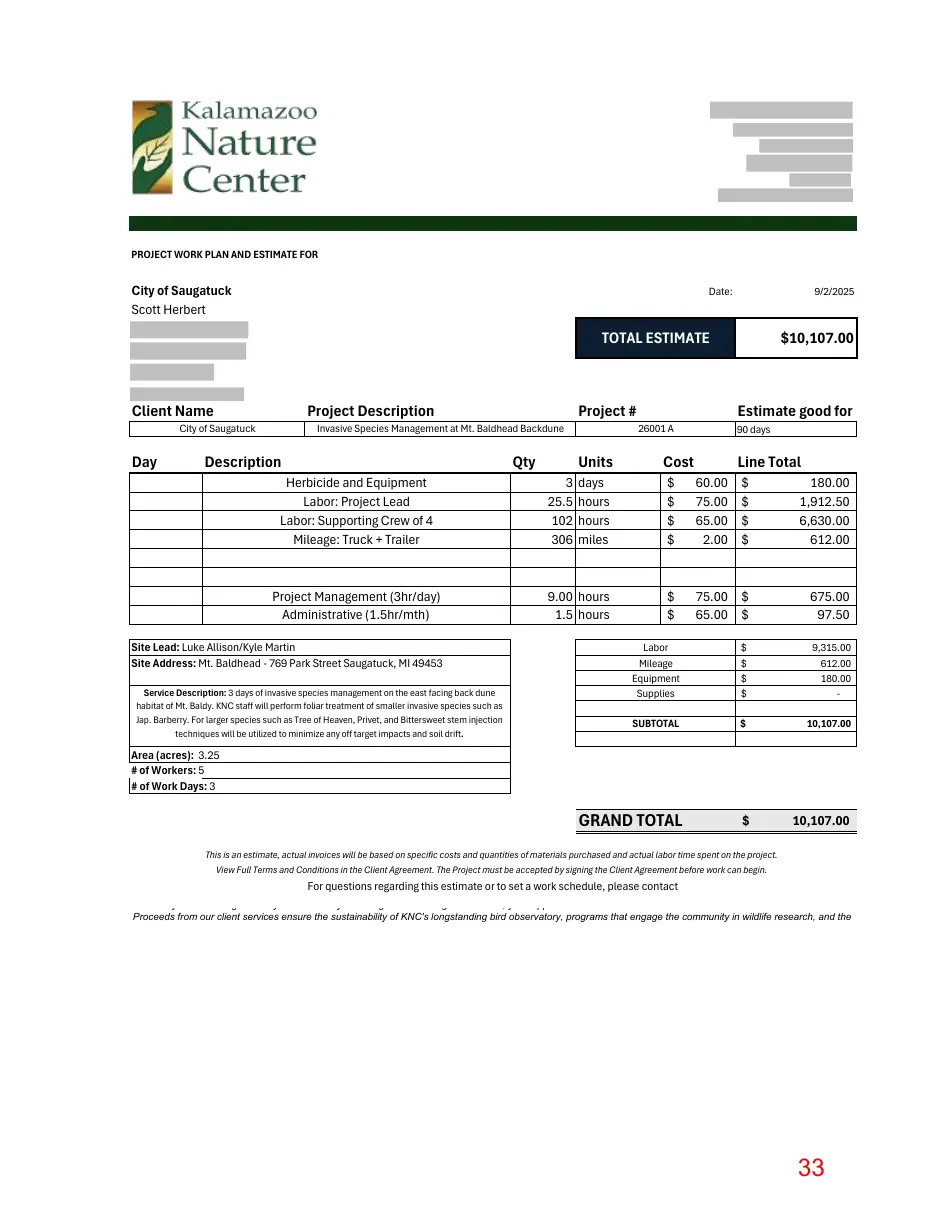
Text of page 32
PROJECT WORK PLAN AND ESTIMATE FOR
City of Saugatuck Scott Herbert
Date:
9/2/2025
TOTAL ESTIMATE
Client Name Day
Project #
Project Description
City of Saugatuck
Invasive Species Management at Mt. Baldhead Backdune
Description
Qty
Estimate good for 26001 A
Units
$10,107.00
90 days
Cost
Line Total
Herbicide and Equipment Labor: Project Lead Labor: Supporting Crew of 4 Mileage: Truck + Trailer
3 days 25.5 hours 102 hours 306 miles
60.00 75.00 65.00 2.00
180.00 1,912.50 6,630.00 612.00
Project Management (3hr/day) Administrative (1.5hr/mth)
9.00 hours 1.5 hours
75.00 $ 65.00 $
675.00 97.50
Labor Mileage Equipment Supplies
9,315.00 612.00 180.00 -
SUBTOTAL
10,107.00
GRAND TOTAL
10,107.00
Site Lead: Luke Allison/Kyle Martin Site Address: Mt. Baldhead - 769 Park Street Saugatuck, MI 49453 Service Description: 3 days of invasive species management on the east facing back dune habitat of Mt. Baldy. KNC staff will perform foliar treatment of smaller invasive species such as Jap. Barberry. For larger species such as Tree of Heaven, Privet, and Bittersweet stem injection techniques will be utilized to minimize any off target impacts and soil drift.
Area (acres): 3.25 # of Workers: 5 # of Work Days: 3
This is an estimate, actual invoices will be based on specific costs and quantities of materials purchased and actual labor time spent on the project. View Full Terms and Conditions in the Client Agreement. The Project must be accepted by signing the Client Agreement before work can begin.
For questions regarding this estimate or to set a work schedule, please contact y g y y g g ,y pp Proceeds from our client services ensure the sustainability of KNC's longstanding bird observatory, programs that engage the community in wildlife research, and the
Page 33
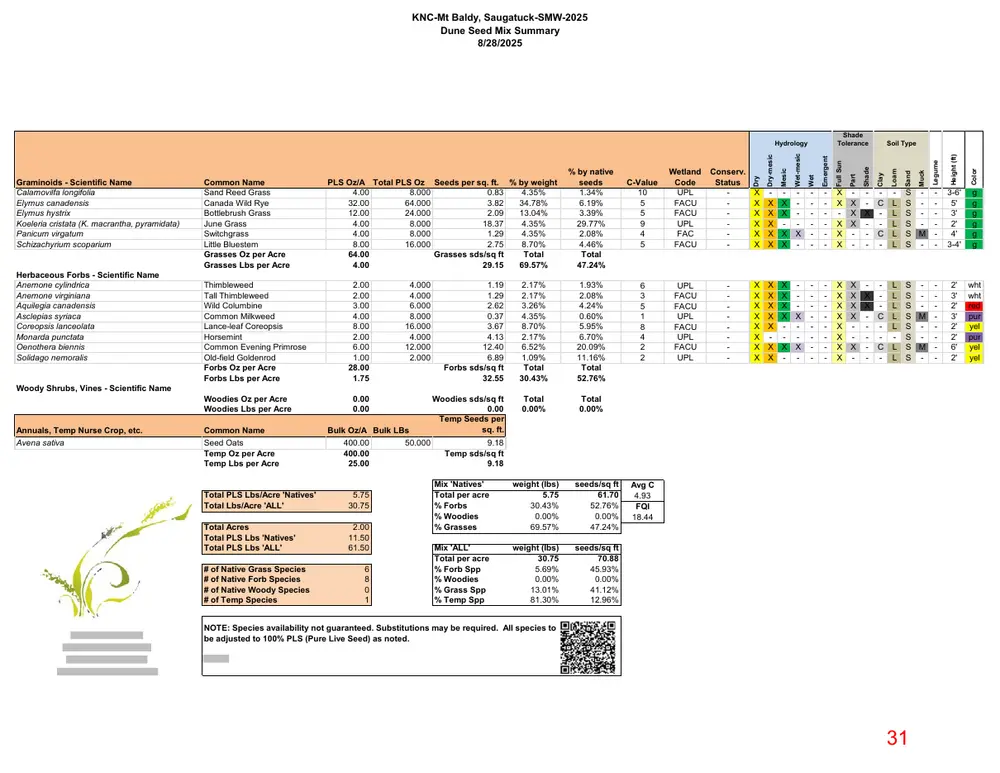
Text of page 33
KNC-Mt Baldy, Saugatuck-SMW-2025 Dune Seed Mix Summary 8/28/2025
Shade Tolerance
weight (lbs) 5.75 30.43% 0.00% 69.57%
seeds/sq ft 61.70 52.76% 0.00% 47.24%
Mix 'ALL' Total per acre % Forb Spp % Woodies % Grass Spp % Temp Spp
weight (lbs) 30.75 5.69% 0.00% 13.01% 81.30%
seeds/sq ft 70.88 45.93% 0.00% 41.12% 12.96%
X X X X X
- X X - X X X -
X - - X X - C - X X X X - X - - C X - - -
L L L L L
S S S S S M S -
3-6' 5' 3' 2' 4' 3-4'
g g g g g g
X X X X X X X X
X X X X X X X
X X X X X - - X X - -
X X X X X X X X
L L L L L L L
S S S S M S S S M S -
2' 3' 2' 3' 2' 2' 6' 2'
wht wht red pur yel pur yel yel
Shade
X X X X X X
Part
Color
Mix 'Natives' Total per acre % Forbs % Woodies % Grasses
Height (ft)
Total 0.00%
Legume
Total 0.00%
UPL FACU FACU UPL FACU UPL FACU UPL
Muck
Woodies sds/sq ft 0.00 Temp Seeds per sq. ft.
6 3 5 1 8 4 2 2
Sand
1.93% 2.08% 4.24% 0.60% 5.95% 6.70% 20.09% 11.16% Total 52.76%
Loam
2.17% 2.17% 3.26% 4.35% 8.70% 2.17% 6.52% 1.09% Total 30.43%
Clay
0.00 0.00
1.19 1.29 2.62 0.37 3.67 4.13 12.40 6.89 Forbs sds/sq ft 32.55
Conserv. Status -
Full Sun
Woodies Oz per Acre Woodies Lbs per Acre
4.000 4.000 6.000 8.000 16.000 4.000 12.000 2.000
Wetland Code UPL FACU FACU UPL FAC FACU
Emergent
2.00 2.00 3.00 4.00 8.00 2.00 6.00 1.00 28.00 1.75
C-Value 10 5 5 9 4 5
Wet
Thimbleweed Tall Thimbleweed Wild Columbine Common Milkweed Lance-leaf Coreopsis Horsemint Common Evening Primrose Old-field Goldenrod Forbs Oz per Acre Forbs Lbs per Acre
% by native seeds 1.34% 6.19% 3.39% 29.77% 2.08% 4.46% Total 47.24%
Wet-mesic
PLS Oz/A Total PLS Oz Seeds per sq. ft. % by weight 4.00 8.000 0.83 4.35% 32.00 64.000 3.82 34.78% 12.00 24.000 2.09 13.04% 4.00 8.000 18.37 4.35% 4.00 8.000 1.29 4.35% 8.00 16.000 2.75 8.70% 64.00 Grasses sds/sq ft Total 4.00 29.15 69.57%
Mesic
Herbaceous Forbs - Scientific Name Anemone cylindrica Anemone virginiana Aquilegia canadensis Asclepias syriaca Coreopsis lanceolata Monarda punctata Oenothera biennis Solidago nemoralis
Common Name Sand Reed Grass Canada Wild Rye Bottlebrush Grass June Grass Switchgrass Little Bluestem Grasses Oz per Acre Grasses Lbs per Acre
Dry-mesic
Graminoids - Scientific Name Calamovilfa longifolia Elymus canadensis Elymus hystrix Koeleria cristata (K. macrantha, pyramidata) Panicum virgatum Schizachyrium scoparium
Soil Type
Dry
Hydrology
X - X X X X X - C - - - - X - C - - -
Woody Shrubs, Vines - Scientific Name
Annuals, Temp Nurse Crop, etc.
Common Name
Avena sativa
Seed Oats Temp Oz per Acre Temp Lbs per Acre
400.00 400.00 25.00
Total PLS Lbs/Acre 'Natives' Total Lbs/Acre 'ALL'
5.75 30.75
Total Acres Total PLS Lbs 'Natives' Total PLS Lbs 'ALL'
2.00 11.50 61.50
# of Native Grass Species # of Native Forb Species # of Native Woody Species # of Temp Species
Bulk Oz/A Bulk LBs
6 8 0 1
50.000
9.18 Temp sds/sq ft 9.18 Avg C 4.93 FQI 18.44
NOTE: Species availability not guaranteed. Substitutions may be required. All species to be adjusted to 100% PLS (Pure Live Seed) as noted.