
Parking Task Force Agenda item 6D
Interurban, Shuttle Operations, Remote Parking, and Shared Parking Agreements, Attachment provided by Walker for review and comment
Parking Improvements Task Force, Wednesday, May 13, 2026
Download these 11 pages, 942 KB Whole packet, 27 pages, 1.9 MB
Page 16
Text of page 16
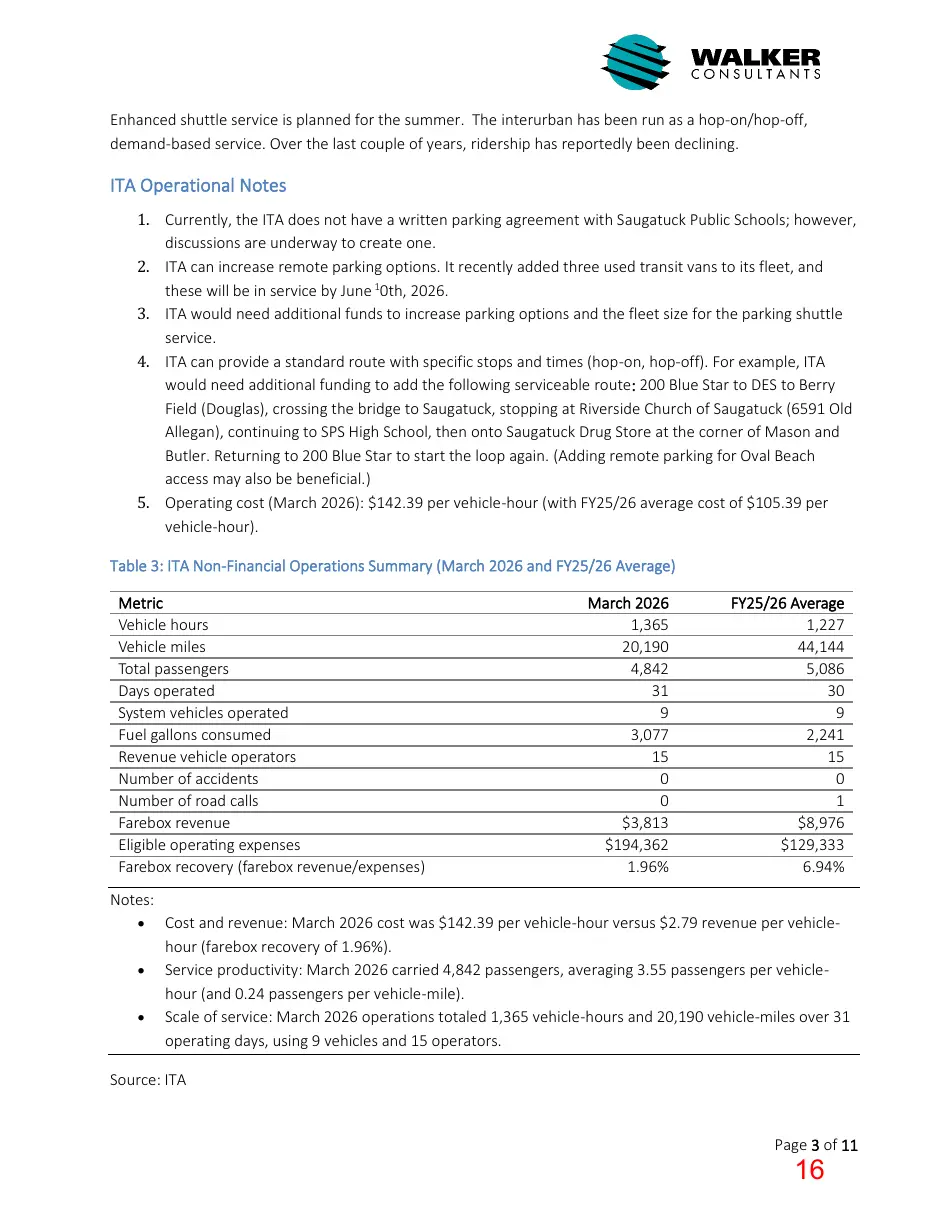
Enhanced shuttle service is planned for the summer. The interurban has been run as a hop-on/hop-off, demand-based service. Over the last couple of years, ridership has reportedly been declining.
ITA Operational Notes 1. Currently, the ITA does not have a written parking agreement with Saugatuck Public Schools; however, discussions are underway to create one. 2. ITA can increase remote parking options. It recently added three used transit vans to its fleet, and these will be in service by June 10th, 2026. 3. ITA would need additional funds to increase parking options and the fleet size for the parking shuttle service. 4. ITA can provide a standard route with specific stops and times (hop-on, hop-off). For example, ITA would need additional funding to add the following serviceable route: 200 Blue Star to DES to Berry Field (Douglas), crossing the bridge to Saugatuck, stopping at Riverside Church of Saugatuck (6591 Old Allegan), continuing to SPS High School, then onto Saugatuck Drug Store at the corner of Mason and Butler. Returning to 200 Blue Star to start the loop again. (Adding remote parking for Oval Beach access may also be beneficial.) 5. Operating cost (March 2026): $142.39 per vehicle-hour (with FY25/26 average cost of $105.39 per vehicle-hour). Table 3: ITA Non-Financial Operations Summary (March 2026 and FY25/26 Average) Metric Vehicle hours Vehicle miles Total passengers Days operated System vehicles operated Fuel gallons consumed Revenue vehicle operators Number of accidents Number of road calls Farebox revenue Eligible operating expenses Farebox recovery (farebox revenue/expenses)
March 2026 1,365 20,190 4,842 31 9 3,077 15 0 0 $3,813 $194,362 1.96%
FY25/26 Average 1,227 44,144 5,086 30 9 2,241 15 0 1 $8,976 $129,333 6.94%
Notes: • • •
Cost and revenue: March 2026 cost was $142.39 per vehicle-hour versus $2.79 revenue per vehiclehour (farebox recovery of 1.96%). Service productivity: March 2026 carried 4,842 passengers, averaging 3.55 passengers per vehiclehour (and 0.24 passengers per vehicle-mile). Scale of service: March 2026 operations totaled 1,365 vehicle-hours and 20,190 vehicle-miles over 31 operating days, using 9 vehicles and 15 operators.
Source: ITA
Page 3 of 11
Page 17
Text of page 17
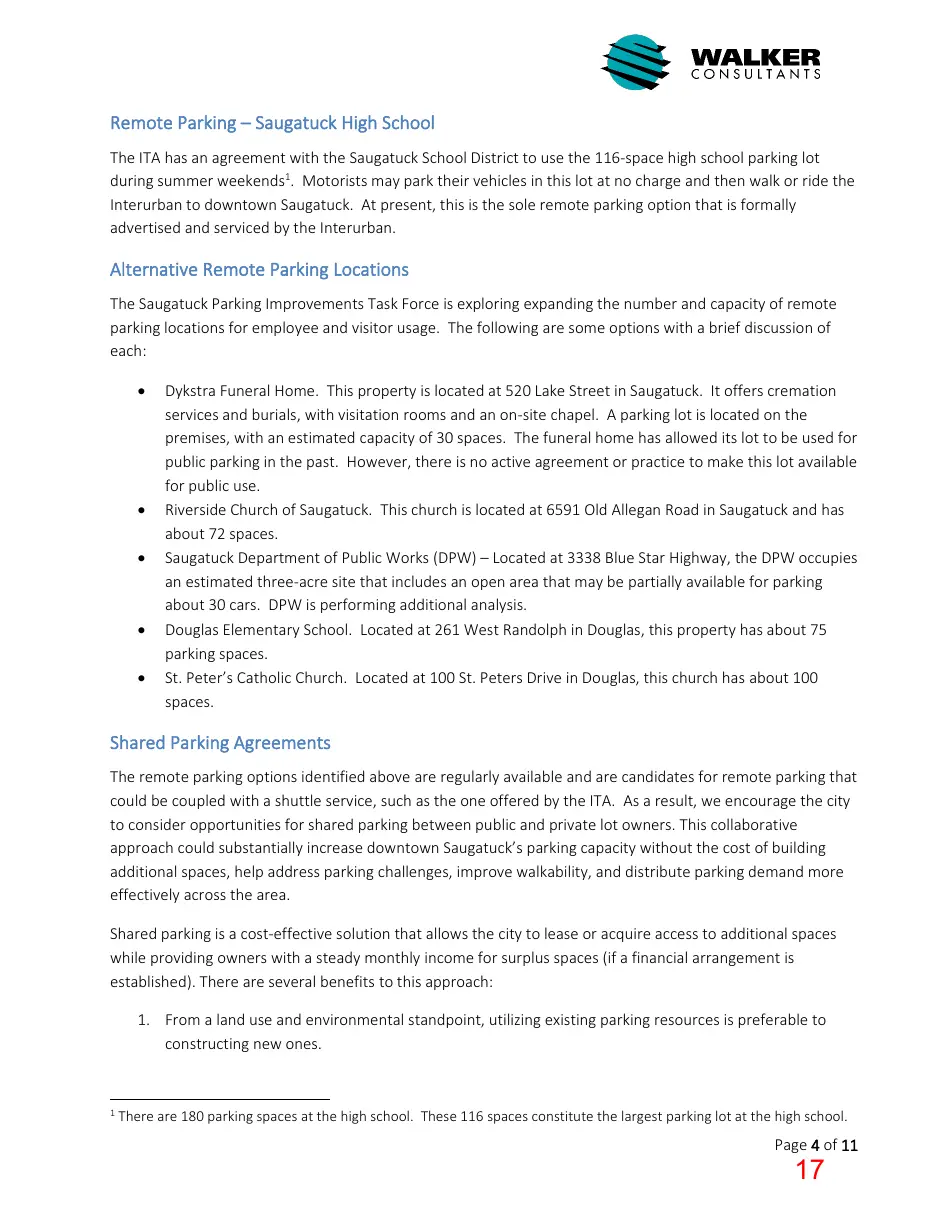
Remote Parking – Saugatuck High School The ITA has an agreement with the Saugatuck School District to use the 116-space high school parking lot during summer weekends1. Motorists may park their vehicles in this lot at no charge and then walk or ride the Interurban to downtown Saugatuck. At present, this is the sole remote parking option that is formally advertised and serviced by the Interurban.
Alternative Remote Parking Locations The Saugatuck Parking Improvements Task Force is exploring expanding the number and capacity of remote parking locations for employee and visitor usage. The following are some options with a brief discussion of each: •
Dykstra Funeral Home. This property is located at 520 Lake Street in Saugatuck. It offers cremation services and burials, with visitation rooms and an on-site chapel. A parking lot is located on the premises, with an estimated capacity of 30 spaces. The funeral home has allowed its lot to be used for public parking in the past. However, there is no active agreement or practice to make this lot available for public use. Riverside Church of Saugatuck. This church is located at 6591 Old Allegan Road in Saugatuck and has about 72 spaces. Saugatuck Department of Public Works (DPW) – Located at 3338 Blue Star Highway, the DPW occupies an estimated three-acre site that includes an open area that may be partially available for parking about 30 cars. DPW is performing additional analysis. Douglas Elementary School. Located at 261 West Randolph in Douglas, this property has about 75 parking spaces. St. Peter’s Catholic Church. Located at 100 St. Peters Drive in Douglas, this church has about 100 spaces.
Shared Parking Agreements The remote parking options identified above are regularly available and are candidates for remote parking that could be coupled with a shuttle service, such as the one offered by the ITA. As a result, we encourage the city to consider opportunities for shared parking between public and private lot owners. This collaborative approach could substantially increase downtown Saugatuck’s parking capacity without the cost of building additional spaces, help address parking challenges, improve walkability, and distribute parking demand more effectively across the area. Shared parking is a cost-effective solution that allows the city to lease or acquire access to additional spaces while providing owners with a steady monthly income for surplus spaces (if a financial arrangement is established). There are several benefits to this approach: 1. From a land use and environmental standpoint, utilizing existing parking resources is preferable to constructing new ones.
There are 180 parking spaces at the high school. These 116 spaces constitute the largest parking lot at the high school.
Page 4 of 11
Page 18
Text of page 18
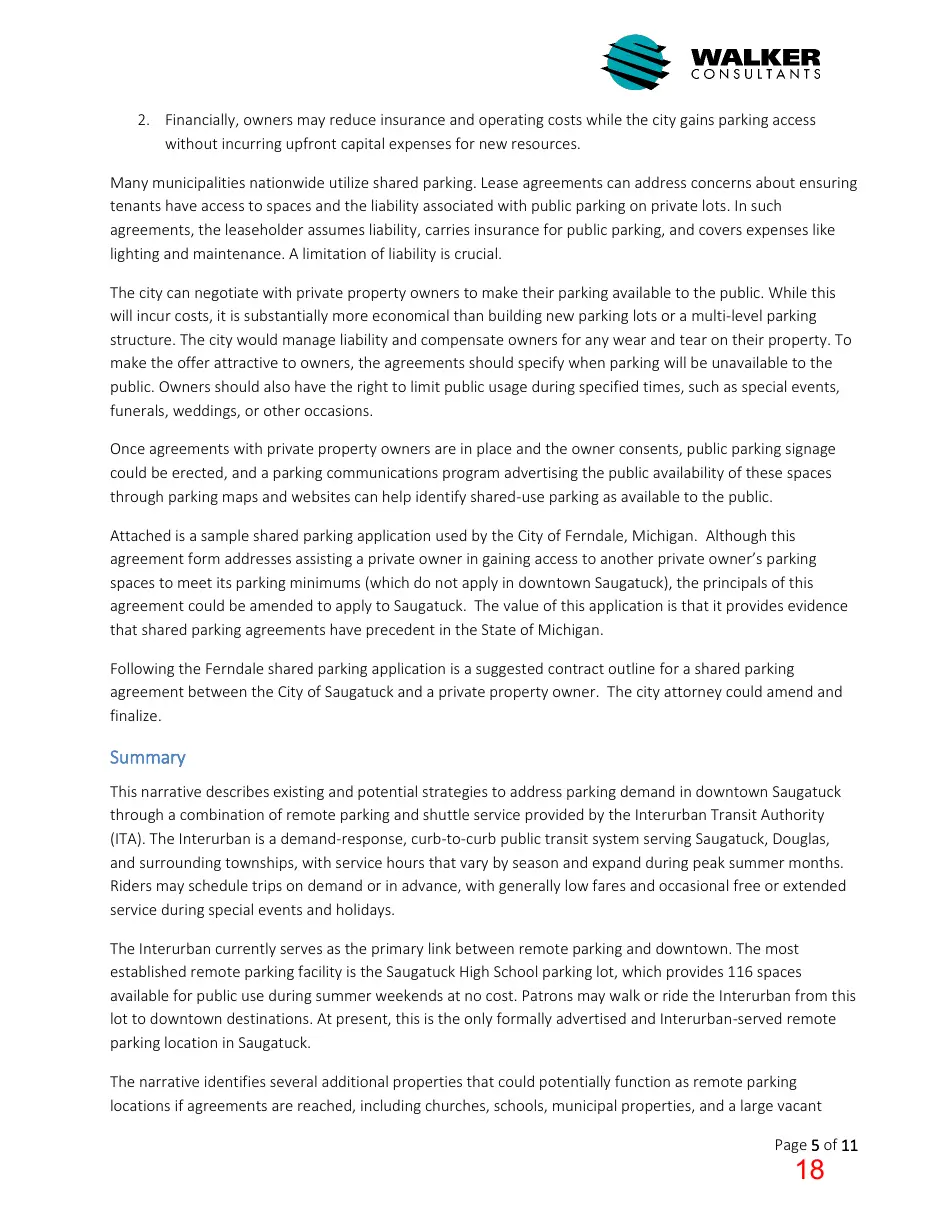
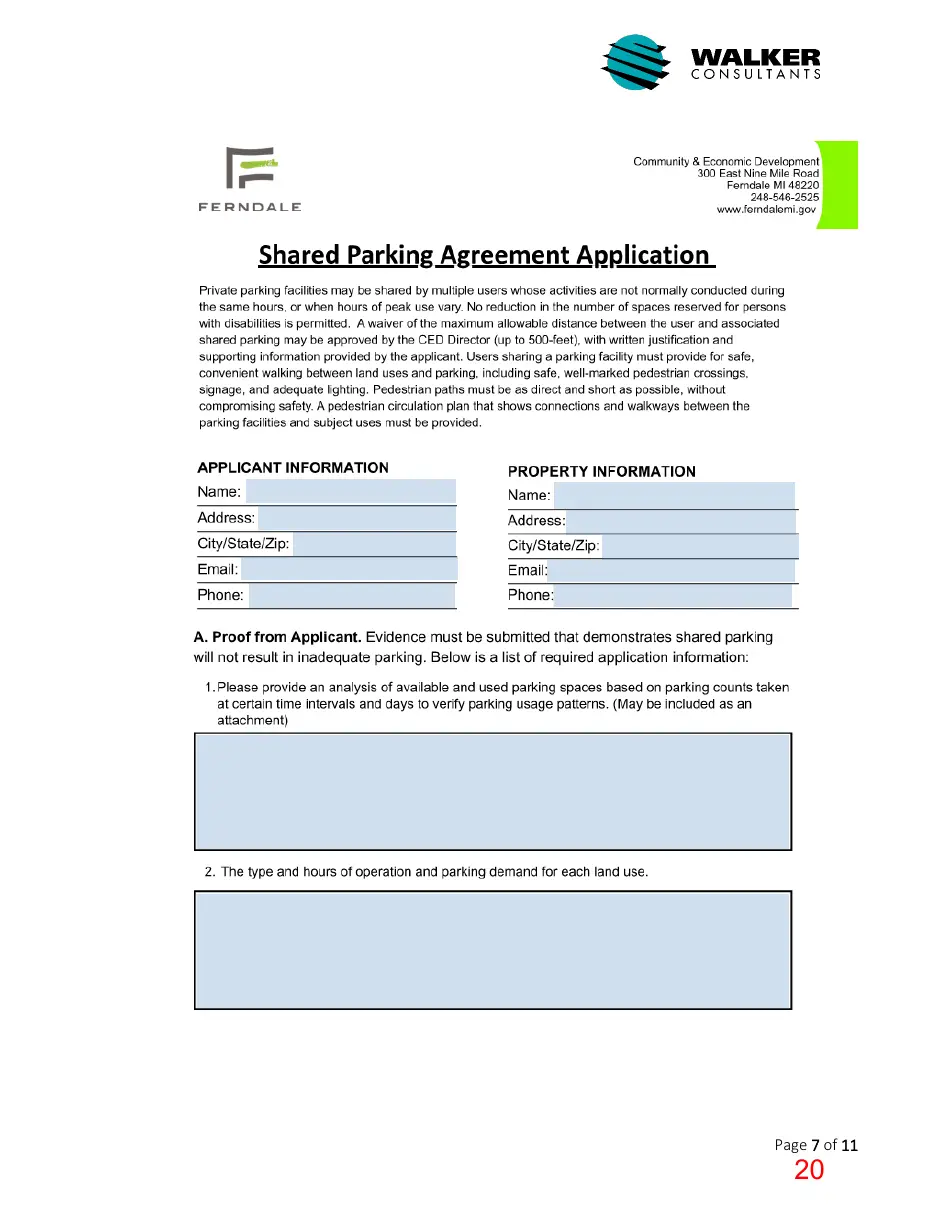
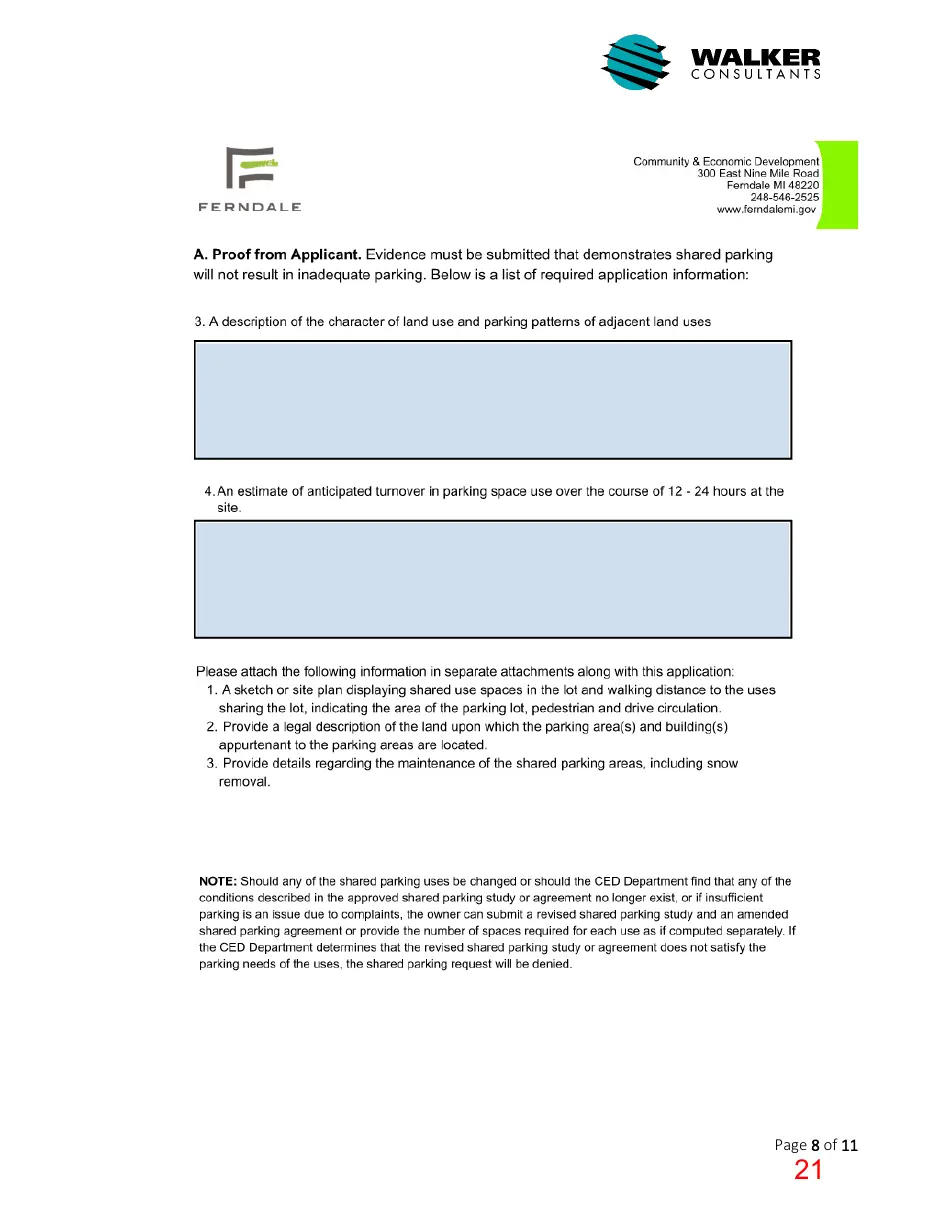
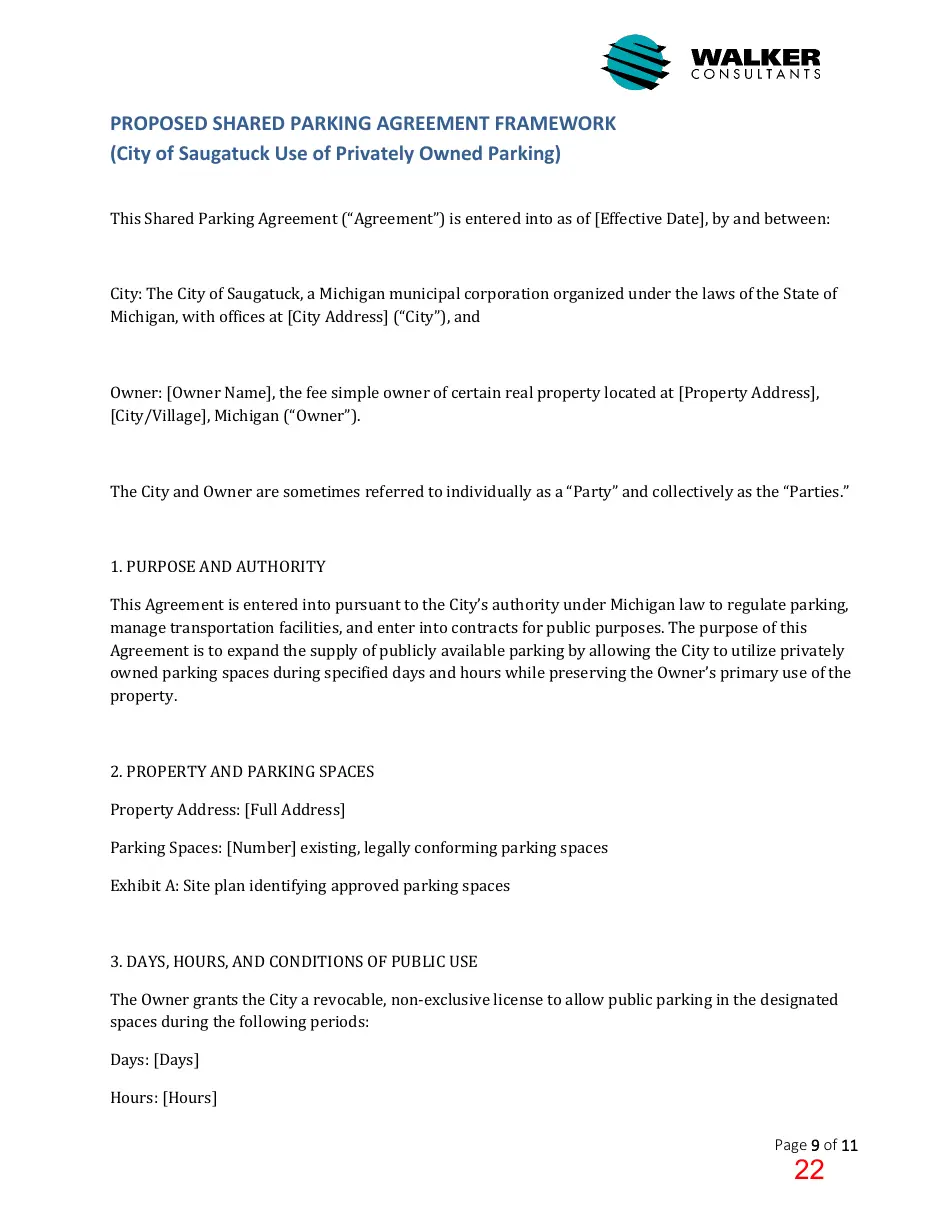
2. Financially, owners may reduce insurance and operating costs while the city gains parking access without incurring upfront capital expenses for new resources. Many municipalities nationwide utilize shared parking. Lease agreements can address concerns about ensuring tenants have access to spaces and the liability associated with public parking on private lots. In such agreements, the leaseholder assumes liability, carries insurance for public parking, and covers expenses like lighting and maintenance. A limitation of liability is crucial. The city can negotiate with private property owners to make their parking available to the public. While this will incur costs, it is substantially more economical than building new parking lots or a multi-level parking structure. The city would manage liability and compensate owners for any wear and tear on their property. To make the offer attractive to owners, the agreements should specify when parking will be unavailable to the public. Owners should also have the right to limit public usage during specified times, such as special events, funerals, weddings, or other occasions. Once agreements with private property owners are in place and the owner consents, public parking signage could be erected, and a parking communications program advertising the public availability of these spaces through parking maps and websites can help identify shared-use parking as available to the public. Attached is a sample shared parking application used by the City of Ferndale, Michigan. Although this agreement form addresses assisting a private owner in gaining access to another private owner’s parking spaces to meet its parking minimums (which do not apply in downtown Saugatuck), the principals of this agreement could be amended to apply to Saugatuck. The value of this application is that it provides evidence that shared parking agreements have precedent in the State of Michigan. Following the Ferndale shared parking application is a suggested contract outline for a shared parking agreement between the City of Saugatuck and a private property owner. The city attorney could amend and finalize.
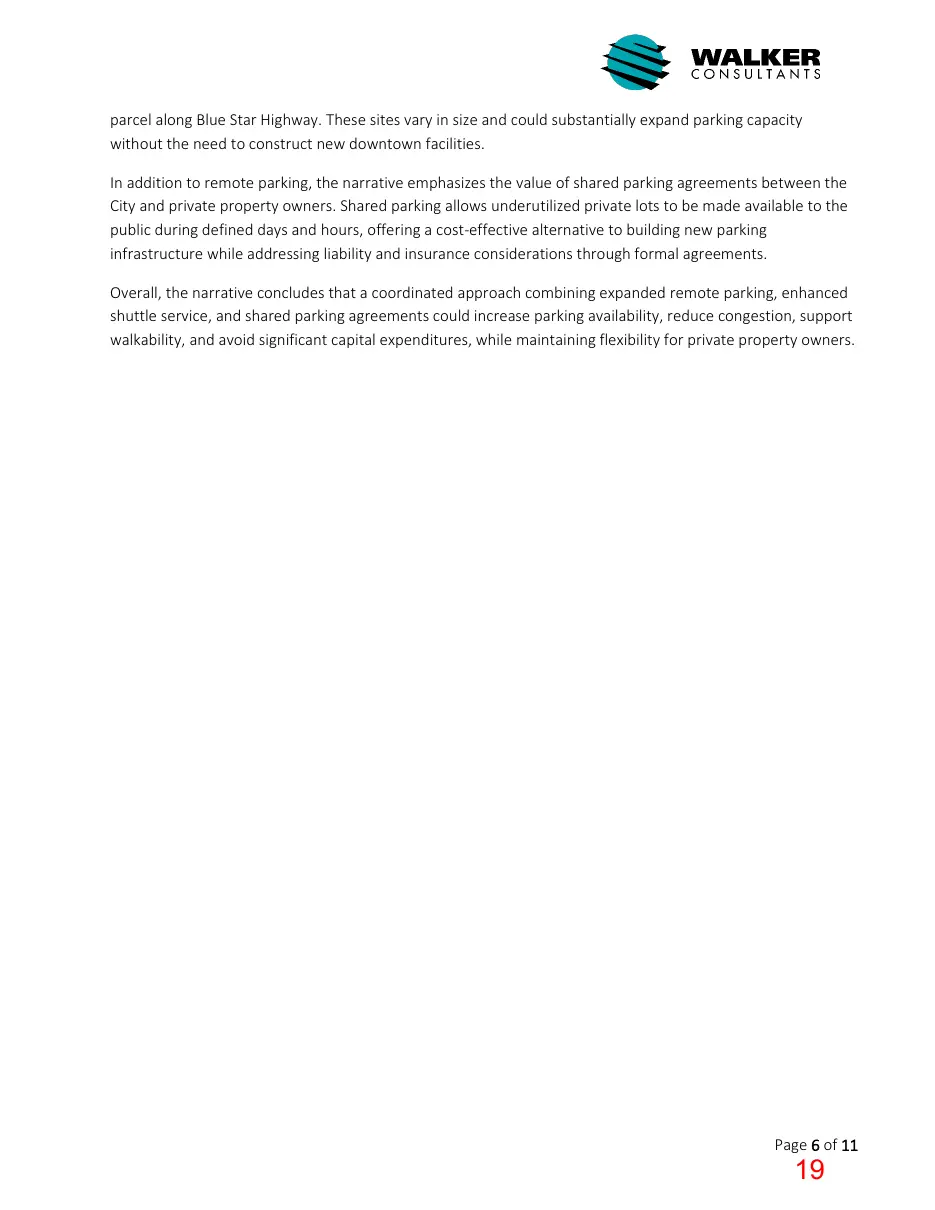
Summary This narrative describes existing and potential strategies to address parking demand in downtown Saugatuck through a combination of remote parking and shuttle service provided by the Interurban Transit Authority (ITA). The Interurban is a demand-response, curb-to-curb public transit system serving Saugatuck, Douglas, and surrounding townships, with service hours that vary by season and expand during peak summer months. Riders may schedule trips on demand or in advance, with generally low fares and occasional free or extended service during special events and holidays. The Interurban currently serves as the primary link between remote parking and downtown. The most established remote parking facility is the Saugatuck High School parking lot, which provides 116 spaces available for public use during summer weekends at no cost. Patrons may walk or ride the Interurban from this lot to downtown destinations. At present, this is the only formally advertised and Interurban-served remote parking location in Saugatuck. The narrative identifies several additional properties that could potentially function as remote parking locations if agreements are reached, including churches, schools, municipal properties, and a large vacant Page 5 of 11
Page 19
Text of page 19
parcel along Blue Star Highway. These sites vary in size and could substantially expand parking capacity without the need to construct new downtown facilities. In addition to remote parking, the narrative emphasizes the value of shared parking agreements between the City and private property owners. Shared parking allows underutilized private lots to be made available to the public during defined days and hours, offering a cost-effective alternative to building new parking infrastructure while addressing liability and insurance considerations through formal agreements. Overall, the narrative concludes that a coordinated approach combining expanded remote parking, enhanced shuttle service, and shared parking agreements could increase parking availability, reduce congestion, support walkability, and avoid significant capital expenditures, while maintaining flexibility for private property owners.
Page 6 of 11
Page 20
This page is a scanned image with no text layer. The PDF of these pages has it at full resolution.
Page 21
This page is a scanned image with no text layer. The PDF of these pages has it at full resolution.
Page 22
Text of page 22
PROPOSED SHARED PARKING AGREEMENT FRAMEWORK (City of Saugatuck Use of Privately Owned Parking) This Shared Parking Agreement (“Agreement”) is entered into as of [Effective Date], by and between:
City: The City of Saugatuck, a Michigan municipal corporation organized under the laws of the State of Michigan, with offices at [City Address] (“City”), and
Owner: [Owner Name], the fee simple owner of certain real property located at [Property Address], [City/Village], Michigan (“Owner”).
The City and Owner are sometimes referred to individually as a “Party” and collectively as the “Parties.”
1. PURPOSE AND AUTHORITY This Agreement is entered into pursuant to the City’s authority under Michigan law to regulate parking, manage transportation facilities, and enter into contracts for public purposes. The purpose of this Agreement is to expand the supply of publicly available parking by allowing the City to utilize privately owned parking spaces during specified days and hours while preserving the Owner’s primary use of the property.
2. PROPERTY AND PARKING SPACES Property Address: [Full Address] Parking Spaces: [Number] existing, legally conforming parking spaces Exhibit A: Site plan identifying approved parking spaces
3. DAYS, HOURS, AND CONDITIONS OF PUBLIC USE The Owner grants the City a revocable, non-exclusive license to allow public parking in the designated spaces during the following periods: Days: [Days] Hours: [Hours] Page 9 of 11
Page 23
Text of page 23
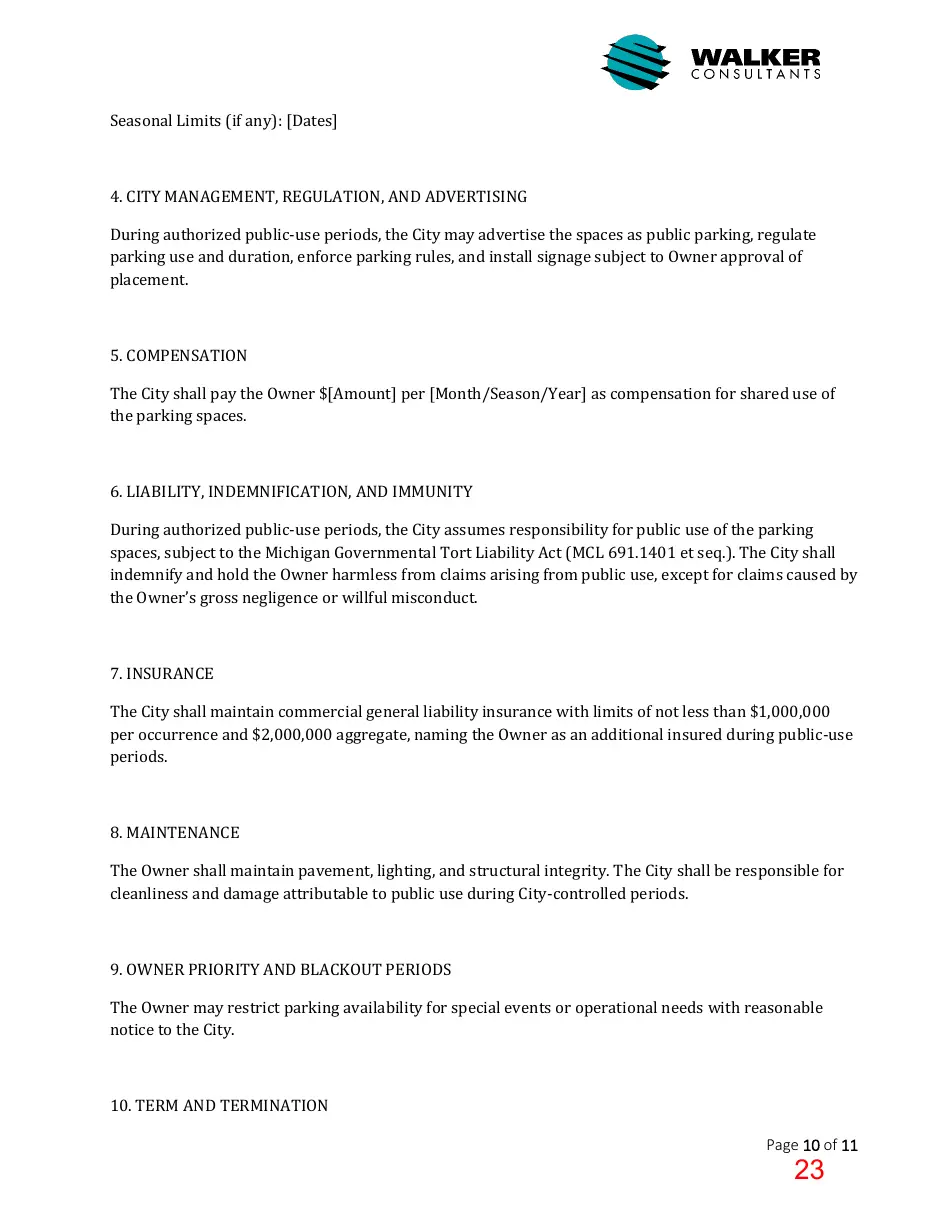
Seasonal Limits (if any): [Dates]
4. CITY MANAGEMENT, REGULATION, AND ADVERTISING During authorized public-use periods, the City may advertise the spaces as public parking, regulate parking use and duration, enforce parking rules, and install signage subject to Owner approval of placement.
5. COMPENSATION The City shall pay the Owner $[Amount] per [Month/Season/Year] as compensation for shared use of the parking spaces.
6. LIABILITY, INDEMNIFICATION, AND IMMUNITY During authorized public-use periods, the City assumes responsibility for public use of the parking spaces, subject to the Michigan Governmental Tort Liability Act (MCL 691.1401 et seq.). The City shall indemnify and hold the Owner harmless from claims arising from public use, except for claims caused by the Owner’s gross negligence or willful misconduct.
7. INSURANCE The City shall maintain commercial general liability insurance with limits of not less than $1,000,000 per occurrence and $2,000,000 aggregate, naming the Owner as an additional insured during public-use periods.
8. MAINTENANCE The Owner shall maintain pavement, lighting, and structural integrity. The City shall be responsible for cleanliness and damage attributable to public use during City-controlled periods.
9. OWNER PRIORITY AND BLACKOUT PERIODS The Owner may restrict parking availability for special events or operational needs with reasonable notice to the City.
10. TERM AND TERMINATION Page 10 of 11
Page 24
Text of page 24
Initial Term: [Term] Termination: Either Party may terminate with [30–60] days written notice. Immediate termination is permitted for safety or insurance lapses.
11. NO PROPERTY INTEREST CREATED This Agreement grants a license only and does not create a lease, easement, or dedication of property.
12. GOVERNING LAW AND VENUE This Agreement shall be governed by the laws of the State of Michigan, with venue in the Circuit Court of Allegan County.
13. ENTIRE AGREEMENT This Agreement constitutes the entire agreement between the Parties and may be amended only in writing signed by both Parties.
SIGNATURES
CITY OF SAUGATUCK By: ____________________________ Name/Title: ___________________ Date: _________________________
[PROPERTY OWNER NAME] By: ____________________________ Name/Title: ___________________ Date: _________________________
Page 11 of 11
Page 25
Text of page 25
Parking Yield Analysis: Converting Butler Street to One-Way Traffic from Lucy Street to Culver Street Purpose This analysis evaluates the on-street parking impacts of converting Butler Street from two-way traffic with parallel parking on both sides to one-way traffic, with 60-degree angled parking on one side and parallel parking on the other. The analysis covers the seven blocks of Butler Street between Lucy Street and Culver Street.
Key Design Assumptions The curb-to-curb width along Butler Street is approximately 40 feet. Butler is presently used as a two-way street with parallel parking on both sides where permitted. As an alternative to increasing parking capacity in the Saugatuck Central Business District, this analysis considers a proposed condition featuring one-way traffic with angled parking at 60 degrees on one side and parallel parking on the other. Average usable curb length per block is approximately 300 feet. A parallel parking stall is approximately 22 feet long. All parking estimates reflect whole stalls only; fractional spaces are not counted. Intersection clearances, crosswalks, and curb ramps are assumed to be consistent between existing and proposed conditions.
Existing Parking Yield – Two-Way Traffic with Parallel Parking on Both Sides Rounding down, parallel parking yields approximately 4 parking spaces per 100 feet on each side. With parallel parking on both sides, the effective yield is 8 spaces per 100 feet. Over a 300-foot block, this results in approximately 24 on-street parking spaces.
Proposed Parking Yield – One-Way Traffic with Angled Parking on One Side 60-degree angled parking on one side yields approximately 7 spaces per 100 feet. Parallel parking on the opposite side yields approximately 4 spaces per 100 feet. The combined yield is approximately 11 spaces per 100 feet, or approximately 33 on-street parking spaces per 300-foot block.
Block-by-Block Parking Impact Existing conditions provide approximately 24 spaces per block. The proposed condition provides approximately 33 spaces per block, representing a net increase of approximately 9.
Total Parking Impact Across the seven blocks between Lucy Street and Culver Street, existing conditions provide approximately 168 onstreet parking spaces. The proposed one-way configuration would provide approximately 231 on-street parking spaces, representing a net increase of approximately 63 spaces1.
Math includes some conservative rounding to account for fire hydrants, driveways, no parking zones, loading zones, etc. Each 100 feet of curb space is enough to allow for 9, 60-degree angled spaces. However, with curb cuts and no parking areas, we are intentionally aiming low to manage expectations for this idea. A more detailed and accurate study is recommended if the city is interested in implementing this idea. What is presented here is at the conceptual level, not the design level.
© Walker Consultants
Page 26
Text of page 26
Conclusion Converting Butler Street to one-way traffic with 60-degree angled parking on one side and parallel parking on the opposite side would meaningfully expand on-street parking within the existing curb-to-curb width. The proposed configuration increases parking supply while maintaining safe and efficient vehicular circulation appropriate for a downtown environment.
Butler Street One-Way Conversion and Parking Analysis: Opportunity, Pros, Cons, Precedent, and Policy Rationale The following summarizes the advantages, disadvantages, precedent, and policy rationale for converting Butler Street in downtown Saugatuck from two-way to one-way traffic to create room for additional on-street parking. The analysis is intended to support decision-making by City staff, elected officials, and advisory bodies in evaluating potential circulation and parking changes along one of Saugatuck’s primary commercial corridors.
Advantages of Converting Butler Street to One-Way Traffic 1. Significant Increase in On-Street Parking One-way traffic operations allow angled parking on both sides of Butler Street. However, in this case, Butler Street is only 40 feet wide, which is not wide enough to accommodate a through lane and angled parking on both sides. Therefore, this analysis considers parallel parking on one side of the street and 60-degree parking on the opposite side. 2. Improved Access to Downtown Businesses Angled parking improves the visibility of available spaces and makes it easier for visitors to identify parking opportunities while driving through downtown. This supports business access, increases parking turnover, and benefits retail, restaurant, and gallery uses that depend on short-term parking convenience in a resort-oriented downtown. 3. Traffic Calming and Pedestrian Comfort When properly designed, one-way streets with angled parking visually narrow the roadway and introduce frequent roadside activity, helping reduce vehicle speeds. These conditions improve pedestrian comfort and safety in a walkable downtown environment that experiences high seasonal foot traffic. 4. Operational and Maintenance Efficiency One-way traffic reduces vehicle conflict points, simplifies turning movements, and can improve snow removal and street maintenance operations. Clear circulation patterns also enhance driver predictability during peak tourist periods.
Potential Disadvantages and Risks 1. Reduced Route Flexibility One-way streets require drivers to follow a defined circulation pattern, which may initially feel less convenient to users accustomed to two-way travel. Some travel paths may require additional turns or slightly longer routes, particularly during early implementation. 2. Risk of Higher Speeds if Poorly Designed
Page 2 of 3